



Quick Summary:
- The facial recognition market will reach $9.95 billion in 2026 and grow at a 15.97% CAGR through 2031.
- AI features like liveness detection and CNN-based matching now define the best face recognition apps.
- FaceApp, Reface, and CLEAR lead consumer downloads among face recognition apps in 2026.
- Blippar has exited the consumer face recognition app category and now sells enterprise WebAR tools.
- Face2Gene and FaceFirst remain top choices for medical and security-focused face recognition apps.
- CMARIX builds custom face recognition apps and AI-driven biometric platforms for businesses worldwide.
In 2026, the worldwide face recognition market is projected to increase from $9.95 billion to $20.88 billion by 2031, growing at a CAGR of 15.97%, based on Mordor Intelligence’s study. Currently, face recognition applications can be used to unlock phones, authenticate passengers at airports, detect any genetic disorder, and protect banking credentials. Here is a list of the top 13 face recognition applications that work on Android and iOS in 2026.
The digital world saw a major shift when companies started upgrading device security with artificial intelligence and face recognition. Mobile app development services companies in India followed suit almost immediately. A few decades ago, a face recognition app sounded like science fiction. Rapid digitization changed that within a decade. A face recognition app now strengthens phone security, helps diagnose genetic disorders, and reduces cybercrime and fraud. Following this trend, more businesses want to hire a mobile app developer in India to add face recognition features before competitors do.
What Is Biometrics?
Biometrics is the technical measurement and statistical analysis of a person’s unique physical and behavioral traits. Businesses use biometrics for identification, access control, and monitoring of individuals under review. Biometric authentication confirms identity through these physical and behavioral markers. The word “biometric” comes from Greek, where “bio” means life and “metric” means measure.
Types of Biometrics
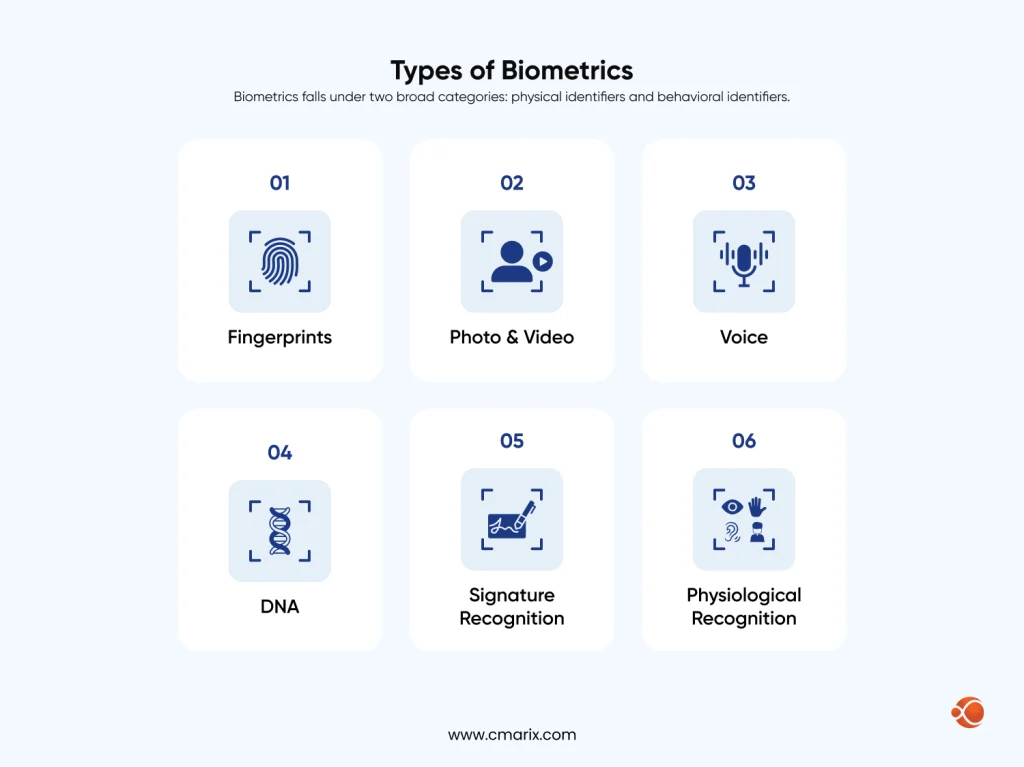
Biometrics falls under two broad categories: physical identifiers and behavioral identifiers.
1. Fingerprints
One of the first and foremost features of biometrics was fingerprints, which were first deployed on smartphones. Devices such as a mouse, the smartphone screen, and door panels have the technical capability to become fingerprint scanners.
2. Photo and Video
Every smartphone comes with high- to low-resolution cameras, and if the device has a good camera quality, then it can be used for authentication. In this aspect, facial recognition and retina scan are two main approaches. For instance, Google Face Recognition is one way the phone is unlocked.
3. Voice
One of the most prominent and popular authentication systems is voice commands used in voice assistants, not just in phones but also in digital assistants.
4. DNA
This is a unique biometric that traces familial ties. This identification biometric gives accurate details during any situation, like missing persons, to identify victims during disasters and even during potential cases of human trafficking. So this is a very useful biometric as well.
5. Signature Recognition
This is a recognition software and hardware that companies generally use in the retail sector and banks. This is an appropriate option used in situations when users are expected to sign their names.
6. Physiological Recognition
Apart from the human face, other parts of the body use image-based recognition, such as the iris, palm vein, hand geometry, and ear shape.
Businesses weighing an in-house biometrics team against outside help can read more on why hiring dedicated developers speeds up complex builds.
How AI Is Transforming Face Recognition Apps in 2026
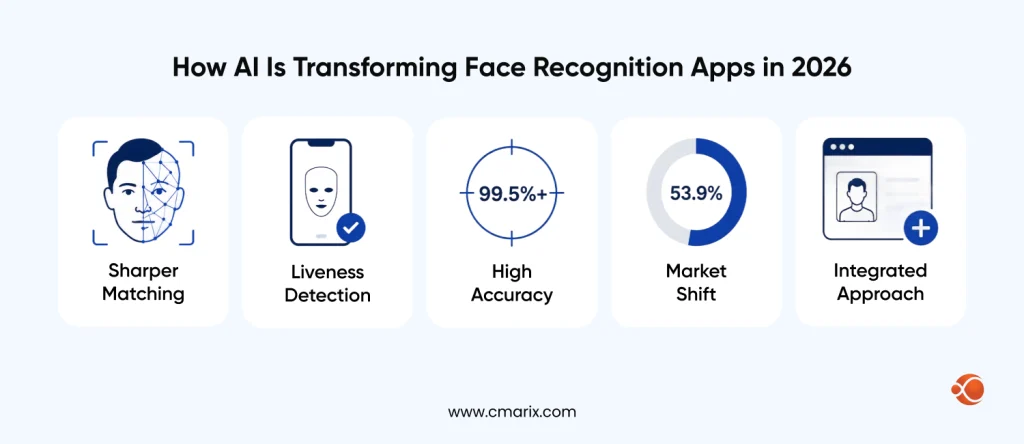
Sharper Matching in Real-World Conditions
Using convolutional neural networks, face-matching software becomes possible not only in poor lighting but also in partially occluded faces. NEC has embedded this technology into its enterprise platforms for security and border control.
Liveness Detection Beats Spoofing
Passive liveness detection is designed to defeat attacks like photos, masks, and even deepfakes without any additional effort on the part of the user. Luxand introduced this feature in its new release, FaceSDK 8.0.
Accuracy Is Improving, But Still Uneven
Independent testing is relevant in this case too. One example of this is the Face Recognition Vendor Test carried out by NIST, which demonstrated that the most advanced facial detection algorithms have an accuracy rate of over 99.5 percent in controlled settings, despite differences in illumination and skin color.
The Market Is Betting on Software
The software segment is expected to constitute 53.9% of the total face recognition market at the end of 2026, states a Coherent Market Insights report, owing to greater focus on accuracy and spoof detection techniques beyond hardware.
Businesses exploring AI software development or computer vision for enterprise use cases increasingly ask teams to fold facial recognition into an existing app rather than ship a one-off tool.
Our AI engineers assess your architecture before you upgrade.
13 Best Face Recognition Apps for Android and iOS in 2026
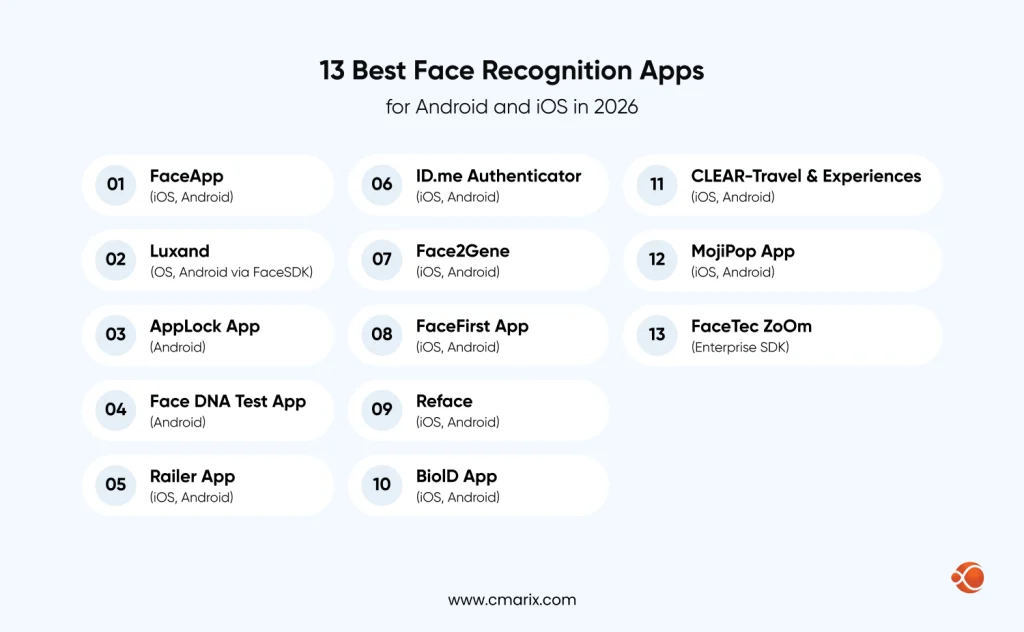
1. FaceApp (iOS, Android)
This is a biometric face recognition app that detects faces, which was launched in 2017 for iOS phones. With the increasing popularity, it wasn’t long before FaceApp was launched for Android too. It quickly became a trendy face recognition app on Android, and celebrities joined the trend.
2. Luxand (iOS, Android via FaceSDK)
Luxand is a hi-tech company that started its operations in 2005 with a few services and apps. It comprises FaceSDK, which is ideal for biometric face recognition, surveillance, and other purposes, and is used by big brands and organizations around the world. Some of its high-profile customers include LG, Universal Pictures, Samsung, Flipsnack, Unilever, P&G, Ford, and Badoo. The latest FaceSDK 8.0 release added passive and active liveness detection to catch spoofed photos.
3. AppLock App (Android)
This is one of the best face recognition apps on Android. This app ensures that no one other than the user can access their personal information, social media accounts, and financial accounts. In addition to mobile face recognition, it also offers voice recognition as a mobile security feature.
4. Face DNA Test App (Android)
One of the best apps for face recognition online, the Face DNA test is a facial recognition app that analyses the focal points of a face after successful scanning. The facial recognition app then compares the image with that of another person to detect a match.
5. Railer App (iOS, Android)
Gone are the days when students could do a “proxy” attendance on behalf of their friends; the Railer app is a face recognition attendance app. It is one of the best face recognition apps used to track employees’ or students’ attendance, depending on the organization. A noteworthy feature of the app is that it requires minimal manual work by integrating BioId connect technology.
6. ID.me Authenticator (iOS, Android)
ID.me occupies the old position of Blippar, as Blippar no longer has a consumer face/object recognition app. ID.me uses face/selfie verification with a liveness check to validate identity and perform tax filing, receive government benefits, veterans’ discounts, and retailer verification.
7. Face2Gene (iOS, Android)
A revolution in the healthcare app genre, this facial recognition app is designed specifically for healthcare professionals. They use it to evaluate genetic disorders and their variants in the lab and the clinic.
8. FaceFirst App (iOS, Android)
Of all the other face recognition apps, this one allows users to determine who they are from a distance. Hence, it becomes an appropriate face identification app for the military, retailers, transportation centers, and law enforcement. Upon uploading a picture to the app, it identifies the person by searching a vast database of known individuals and helps prevent identity theft. CMARIX has built comparable enterprise-grade security tooling with AnyVision’s face recognition platform, used for crime prevention across Europe.
9. Reface (iOS, Android)
The Reface app replaces a person’s face on viral videos, GIFs, and AI-generated videos by employing generative adversarial networks. It is the modern replacement of the face-swapping phenomenon created via FaceApp years ago.
10. BioID App
BioID is an authentication system with a multi-factor user feature. The app functions via biometrics to verify individual identities; this also makes it possible for users to log in to other supported websites and apps with facial identification.
11. CLEAR – Travel & Experiences (iOS, Android)
Face and eye authentication allow CLEAR users to bypass TSA lines, gain faster access to stadiums, and authenticate rideshare and rental car identities. The new 2026 version of CLEAR included a feature called “Know When to Leave.”
12. MojiPop App (iOS, Android)
A UK-based company called Eureka Studios has launched a customized Avatar app with MojiPop, now listed as “MojiPop: Art Meets AI.” This is a free facial descriptor recognition software that comprises a wide variety of fun animated stickers.
13. FaceTec ZoOm (Enterprise SDK)
The 3D facial matching and live detection technology developed by FaceTec verifies identity for financial institutions and governments around the world. Developers generally integrate the technology into a client’s own application rather than offering it as a separate product.
We build custom biometric solutions for your business.
Facial Recognition Websites That Work Without an App
If you don’t want to install another app on your phone, several web-based facial recognition tools let you search for similar faces directly from your browser. They include:
- Reversely.ai: An AI face search tool that scans multiple sources to help you find visually similar faces and related image matches online. It leverages AI to enhance results accuracy and also offers filters to help users narrow down their searches.
- SmallSEOTools Face Search: A free face search tool that lets you upload a face photo or enter an image URL to find visually similar results. Its simple interface and cross-platform compatibility make it suitable for users across the globe.
- DupliChecker Face Search: An easy-to-use web tool that performs facial recognition search to locate matching face pictures and their sources. It processes searches quickly and requires no registration, making it useful for fast facial recognition.
Why Choose CMARIX to Build Your Face Recognition App
Building a face recognition app takes more than a pretrained model. It needs secure data handling, cross-platform performance, and compliance with biometric privacy laws.

CMARIX has already shipped this kind of work: AnyVision, an AI-driven enterprise face recognition software used for real-time security and crime prevention across Israel, Belgium, and Germany, was built by CMARIX. That project backs up the mobile app development expertise the team brings to native and cross-platform builds.
- Dedicated AI and computer vision engineers who build detection, liveness, and matching pipelines from scratch.
- Native and cross-platform delivery through Swift, Kotlin, Flutter, and React Native, plus dedicated Android and iOS teams.
- EU AI Act compliance for biometrics, GDPR-ready architecture, encrypted biometric templates, and privacy-by-design implementation for enterprise applications.
- A proven track record, with 1500+ apps delivered under native and cross-platform development.

Wrapping Up
Biometrics is now commonplace for phones, laptops, and business environments. Facial recognition applications continue to spread into many different segments like travel, payments, health care, and work environment security. Every airport, shop, hospital, and stadium uses a facial recognition application to verify identities quickly and prevent any fraud.
Beyond consumer applications, enterprises are increasingly investing in custom biometric platforms for identity verification, secure access control, attendance management, and AI surveillance software development. As organizations adopt AI-powered security solutions, balancing innovation with privacy, compliance, and responsible use of biometric data has become just as important as achieving high recognition accuracy.
FAQs about Face Recognition Apps for iOS and Android
Is there a free face recognition app available for Android and iOS?
Yes. There are quite a few face recognition applications available for free on both Android and iOS; however, additional features may require a subscription. Free entertainment applications include FaceApp and Reface, while free identity verification/authentication applications can be used since the service is being paid for by the organizations. As far as enterprise-level face recognition applications are concerned, custom solutions are usually designed for particular business needs and not available to the general public.
What is the difference between face detection and facial recognition?
Face detection determines whether there is a face in the image or video and detects the location of that face. Face recognition technology takes this one step further by examining the distinctive facial characteristics and comparing them to the biometric template database. In other words, detection asks the question “Is there a face?” whereas recognition asks “Whose face is it?”
How does AI-powered face recognition work on mobile devices?
The AI-driven face recognition software uses the device’s camera to scan the user’s face, locate the crucial facial landmarks, and transform them into a biometric template, which is a set of mathematical data. The generated template is compared to those already present in the database for successful authentication. Other advanced technologies are used to improve performance and prevent photo/video attacks on the authentication process.
Can I use a face recognition app to find someone from a photo?
For the most part, no. Consumer face recognition applications are created for use in verifying one’s identity, photo editing, and organizing one’s photo collection, but not for identifying individuals from a single photo. In many jurisdictions, it is illegal to search for one’s identity through one’s photo because of privacy concerns.
Are face recognition apps secure for biometric authentication?
Of course, reliable face recognition apps can offer excellent security features if used properly. The security of such apps is based on encrypted biometric templates, secured hardware, liveness detection, and multi-factor authentication. Nonetheless, security also depends on how the app was developed, so you should look for apps that comply with established security standards.
Which is better: Face ID for Android or iOS?
Facial recognition on an iPhone, namely Face ID, is often viewed as more secure since it uses specialized hardware, including the TrueDepth camera system, which constructs a detailed 3D face map. Facial authentication systems on an Android phone come in various forms, with varying degrees of security dependent on the manufacturer of the device.
What are the best face recognition apps to use in 2026?
It all depends on what you intend to use the face recognition application for. When using an AI photo editor, you can choose from many apps; FaceApp is one of the most commonly used face recognition apps for AI photo editing. Another commonly used face recognition application is Reface for face swapping and entertainment. For security purposes, identity verification services like CLEAR and ID.me are options to consider.