


Quick Summary: Prompt engineering means writing clear instructions that get accurate, useful output from AI models like Claude and ChatGPT. This AI prompt engineering guide covers generative AI basics, the types of prompts worth knowing, and how reasoning models are changing the rules for developers developing real products.
Prompt engineering refers to the creation of instructions used by AI models in writing. The usage of natural language in the process distinguishes it from coding. Everyone engages in it today, ranging from content writers to artists, and even software engineers. It helps one to automate the mundane tasks, hence improving productivity and saving time.
What is AI prompt engineering? An explanation of the many kinds and how they are used.
An outline of methods and resources for creating the most effective prompts. What kinds of cues are there, and how might generative AI solutions and massive language models be used to communicate effectively? Regardless of your field or level of experience, you will achieve the necessary results.
AI Prompt Engineering: Simple Definition
The art of directing AI models to produce desired results is called AI prompt engineering. In this sense, a “prompt” is like speaking with a smart but rather literal-minded assistant. AI voice bot development can help with giving instructions. Instead of simply telling them to “write a story,” you give them explicit instructions on the genre, characters, and plot twist. AI prompt engineering is just that.
AI prompt engineering is crucial for problem-solving, data analysis, and creative writing. It is among the most effective instruments. It entails creating clear cues or instructions to direct AI models, such as large language models (LLMs). To get more precise, pertinent, and imaginative AI answers, you must carefully craft your demands and wording. At its core, this all comes down to how you talk to large language models (LLMs), the systems trained on huge amounts of text that power tools like ChatGPT and Claude.
How to Become an AI Prompt Engineer: Skills You Actually Need
Are you interested in becoming the best of AI prompt engineers? In actuality, it’s not a career path that can be pursued alone.
Let’s apply an example—
When you stop to think about it, learning to read and write is not enough to become a writer. “Writers” can be academics, journalists, or professional storytellers who just write a lot to convey their expertise or tell stories. Writing is a tool for accomplishing particular objectives.
Prompt engineering operates similarly. It is not a vocation in and of itself, but rather a skill.
Teachers, lawyers, marketers, and software developers all frequently employ AI. Nonetheless, rapid engineering typically enhances other abilities in a professional setting.
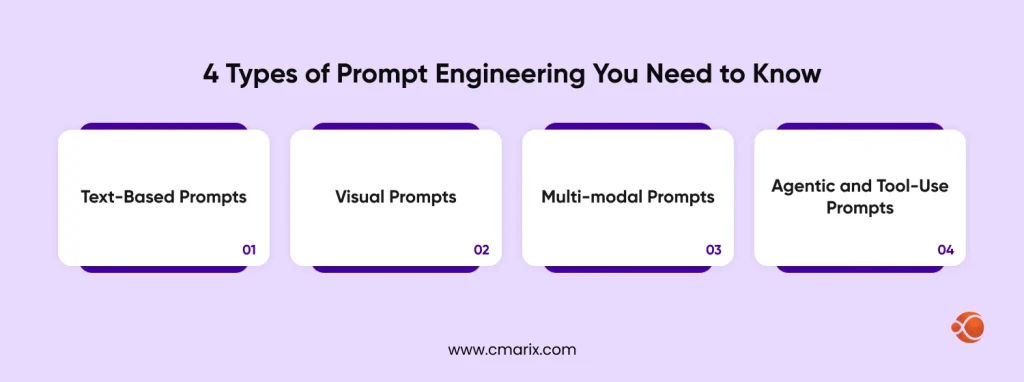
4 Types of Prompt Engineering You Need to Know
The key aspects of prompt engineering in AI rely on the sort of AI prompt you choose. It has a significant impact on the output’s quality and applicability. Create a website with ChatGPT to help customers and people with quick solutions with apt prompts. Let’s break down the main types:
Text-Based Prompts
These are written instructions or descriptions that are given to an AI model. AI replies are directly influenced by the language you choose. Thus, provide targeted prompts that result in more targeted answers. “Write a blog about GenAI benefits,” for example, is more specific than “Write a blog.”
The output’s tone and style can also be influenced by the language utilized. While a casual request will likely elicit a more informal response, a formal prompt is likely to elicit a formal response.
Visual Prompts
An AI model is fed these pictures or other visual inputs. These prompts create visuals using pre-existing photographs or verbal descriptions. Images can be analyzed by AI models such as DALL-E to detect sceneries, objects, or feelings. The style of one image can also be transferred to another using visual cues.
Multi-modal Prompts
These prompts combine various data inputs, such as visual cues, with text. They combine text and image cues to produce more creative and accurate images. Additionally, the multi-modal models are capable of handling tasks that call for comprehension of both texts and visual information, such as image captioning or visual question answering.
Agentic and Tool-Use Prompts
These prompts guide a model to act, not just write. Instead of asking for a paragraph, you ask the model to run a script, call an API, or pull data from a connected system and act on what it finds. This is the type behind most AI agents and automation tools running today, and it depends on giving the model a clear picture of what tools it has and when to reach for them. Teams doing serious Enterprise app development work with this type of prompting constantly, since agent-based features are becoming standard in business software rather than a nice-to-have.
Our AI team can map out the right approach for your product.
Prompt Engineering for Developers in 2026: Context and Reasoning Models
The ground has shifted under advanced prompt engineering, and here’s what’s changed:
- Reasoning models do more on their own. Claude’s extended thinking and OpenAI’s o-series now work through a lot of the step-by-step logic internally. That means prompts need less scaffolding than they used to.
- Chain-of-Thought (CoT) still earns its place, but selectively. Asking a model to reason step by step has been shown to lift performance by up to 20% on math and logic-heavy tasks. With reasoning models already doing that work under the hood, piling on extra CoT instructions is often wasted effort.
- Zero-shot vs few-shot still matters. Two techniques worth knowing here are zero-shot and few-shot prompting. Zero-shot means giving the model a task with no examples and letting it work from what it already knows. Few-shot means showing three to five examples of a good answer, which tends to sharpen results on more specialized tasks. Under the hood, this all connects back to natural language processing (NLP), the field that lets a model make sense of your instructions in the first place.
- Prompt engineering is now one piece of a bigger practice: context engineering. Instead of optimizing a single instruction, teams think about everything a large language model (LLM) sees in a session, prior messages, retrieved documents, tool definitions, and memory.
- System vs user prompts is where this shows up in practice. The system prompt carries the standing rules and role for the model. The user prompt carries the specific task at hand. Mix those up, and even a well-written prompt underperforms.
- Model performance optimization now leans on more than clever wording. It takes a real grasp of natural language processing (NLP) fundamentals, the right AI programming languages for the job, and a clear read on how a given model separates context from instructions.
- A basic ChatGPT prompt engineering tutorial only gets you so far. Building anything that holds state across multiple steps takes an actual prompt engineering framework behind it, not just a one-off clever prompt.
How Does Prompt Engineering Work?
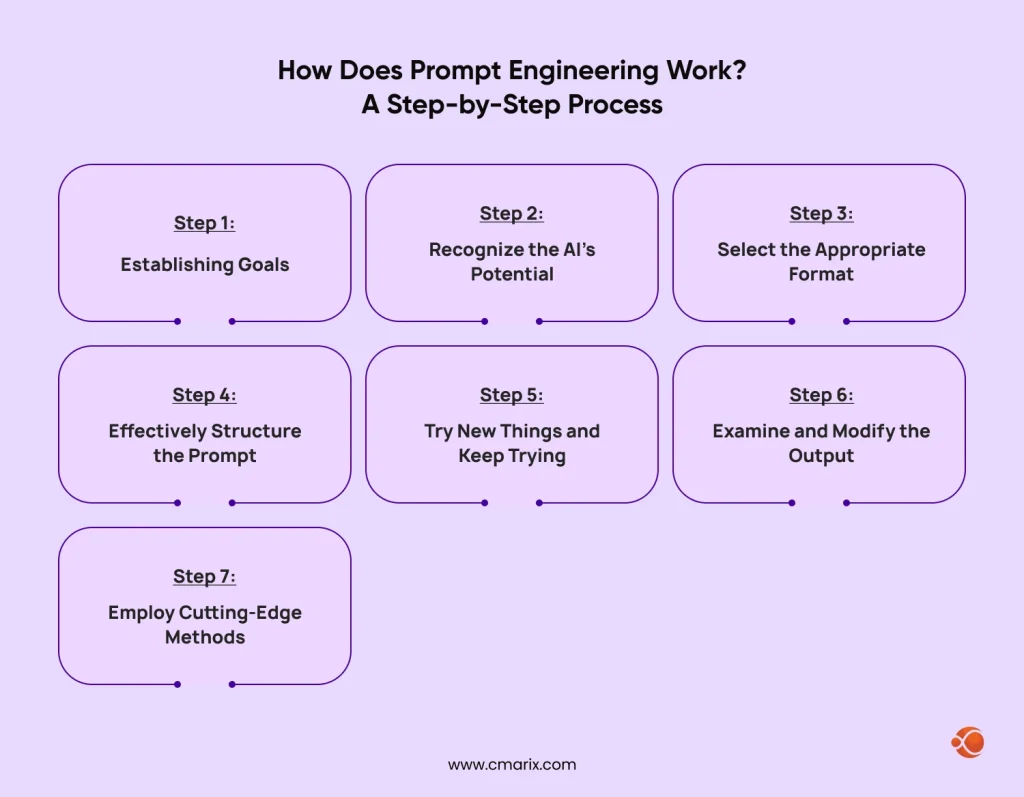
The process of creating efficient prompts to communicate with AI models is known as prompt engineering. By creating precise, context-aware, and unambiguous instructions, the aim is to attain the best possible outcomes.Let’s see how it functions:
Step 1: Establishing Goals
Knowing why you are interacting with the AI is the first step. What are you hoping the AI will produce or help with? Examples include “Write code,” “Answer a question,” “Translate text,” and “Create a blog.” The AI’s reaction is kept explicit by having a well-defined aim.
Step 2: Recognize the AI’s Potential
The next step is to become acquainted with the model. For instance, although some models are superior in language fluency, others are better at reasoning. Additionally, you must consider word counts, stylistic specifications, or domain-specific knowledge.
Step 3: Select the Appropriate Format
The next step is to determine if you need a comprehensive investigation or a specific, focused response. As an example of an open AI prompt engineering, let’s consider the question “What are some creative ideas for a fiction novel?” On the other hand, an example for a particular prompt is “List five planets suitable for colonization in a fiction novel.”
Step 4: Effectively Structure the Prompt
To help the AI tool, it’s also critical to include background information or vital details. “You are a content creator,” for instance. Provide tips on how to publish on social media to get the most interaction from users.
Step 5: Try New Things and Keep Trying
Trying out different prompts is a wonderful way to compare the outcomes. To improve output, you can reword ambiguous prompts with greater depth and detail and modify their language, tone, or structure.
Step 6: Examine and Modify the Output
The next step is to examine the response. You can check here to see if the AI tool has correctly carried out your instructions. It ought to be coherent and pertinent.
Step 7: Employ Cutting-Edge Methods
Among these is the chain of thought approach. Request that the AI “think step-by-step” for complex reasoning. For instance- “How would you explain the effect of weather change in agriculture- give a step-by-step process.”
We build and fine-tune AI systems that handle this at scale.
What are the Benefits of Prompt Engineering?
There are several advantages of effective rapid engineering, which improves the functionality and usability of AI models:
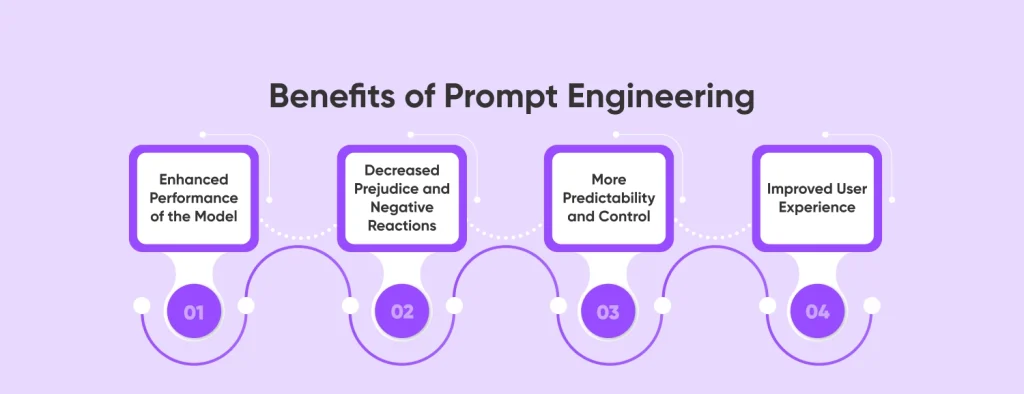
Enhanced performance of the model
Because they give precise instructions and context, well-written prompts help AI models produce more accurate, pertinent, and educational results.
Decreased prejudice and negative reactions
Prompt engineering reduces bias and the possibility of producing harmful or improper information by carefully managing input and directing the AI’s attention.
More predictability and control
By using prompt engineering, you can control the AI’s behavior and provide consistent, predictable responses that support your intended results.
Improved user experience
Users may interact with AI models more successfully when prompts are clear and succinct, which results in more intuitive and fulfilling interactions.
Best Prompt Engineering Tools and Resources for Developers in 2026
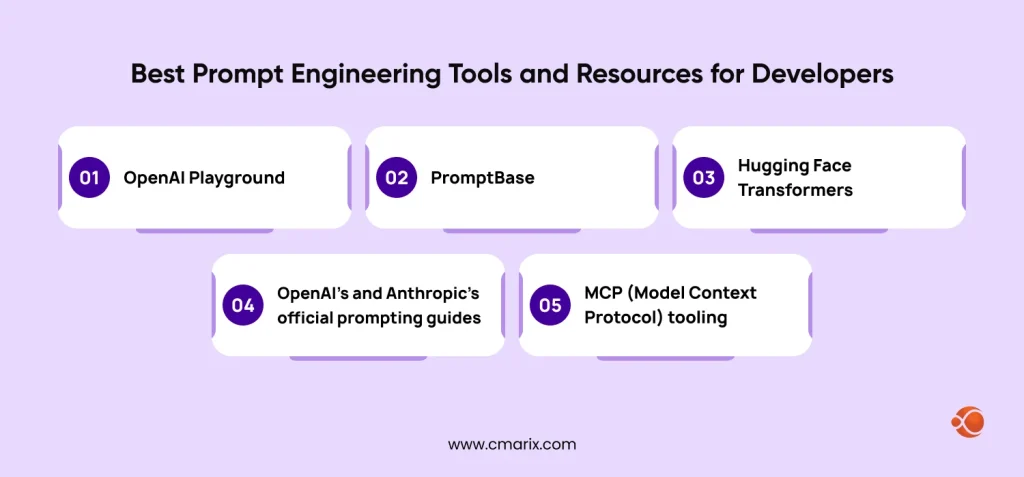
You can effectively integrate AI into an app and get better at prompt engineering with a handful of tools and techniques. Here’s what’s worth using:
OpenAI Playground
An interactive space to test models and prompts side by side. It’s still one of the fastest ways to see how a small wording change shifts the output.
Features:
- Adjustable settings to tune prompts
- Access to multiple OpenAI models
- Prompt sharing and saving
- Real-time feedback on output
PromptBase
A marketplace for buying and selling AI prompts. Good for a starting point or a quick reference when you’re short on time.
Features:
- A wide range of prompts across tasks like summarizing, translating, and content creation
- The option to sell your own prompts
- A community built around sharing what works
Hugging Face Transformers
A library for working directly with models like GPT and BERT, useful when you want to fine-tune or customize prompts outside a hosted API.
Features:
- A large collection of pretrained models
- Room to customize and experiment beyond what a playground allows
OpenAI’s and Anthropic’s official prompting guides
For structure and formatting advice straight from the source, OpenAI’s prompt engineering guide and Anthropic’s prompting best practices both cover the details: clear instructions, examples, and how to structure a prompt with XML and Markdown so a model isn’t left guessing.
Features:
- Clear explanations of core prompting principles
- Practical advice for improving model output, model by model
MCP (Model Context Protocol) tooling
Worth knowing once you move past single-turn prompts. MCP has become the common way to connect a model to outside tools and data, which matters if you’re building anything agentic.
Features:
- A standard way to give models access to tools and live data
- Useful groundwork for anyone building AI agents rather than one-off chat responses

Why Choose CMARIX for Generative AI and Prompt Engineering Projects
Writing a good prompt gets you a good answer once. Building AI into an actual product that keeps performing as models change is a different job entirely. That’s where most teams get stuck; they can prototype something in a playground, but turning it into a reliable feature takes real engineering behind it.
CMARIX works with teams at both ends of that gap. If you’re exploring what’s possible, our generative AI development services cover everything from early prototypes to production-ready systems.
Conclusion
Appropriate quick engineering is important and beneficial for making the most of AI systems. Organizations may improve decision-making, increase relevance, and customize consumer experiences with clear and intelligent prompts.
Maximizing these advantages requires collaboration with timely engineering specialists. Hire dedicated AI developers at CMARIX who can assist companies in streamlining procedures, improving client relations, and deriving insightful information from data. Organizations can revolutionize AI deployments and spur substantial growth by utilizing quick engineering.
FAQs: Prompt Engineering for Developers
What is prompt engineering, and why is it important?
Prompt engineering is the process of drafting instructions that provide relevant and coherent results when input into AI models. The reason for the importance of this concept is that the same AI model can give irrelevant or relevant results depending on how the prompts are drafted.
Does CMARIX provide custom prompt engineering solutions?
A strong prompt gives the model a clear goal, enough context to work with, and a defined format for the output. It also separates the standing rules (system prompt) from the specific task (user prompt), so the model isn’t guessing which instructions take priority.
Can I make money with prompt engineering?
Yes, you can make money with prompt engineering by creating content, AI training and development, consulting services, selling prompts on marketplaces, and AI-driven products.
How do I generate effective AI prompts?
Begin with the outcome you want, then add context, examples and format instructions. Revising and testing matter more than getting it right the first time. Small changes in structure or wording often produce noticeably different results.
What is the difference between “Zero-Shot” and “Few-Shot” prompting?
Zero-shot includes providing the model a task without any examples and using its prior training. In few-shot learning, the model is given a small number of examples, mostly between three and five, in order for it to know how the correct output is supposed to look like.
How can I improve an AI’s reasoning for complex tasks?
Chain-of-Thought prompting, asking the model to reason step by step, still helps on math and logic-heavy problems. With newer reasoning models, some of that step-by-step work now happens internally, so the prompt needs less explicit hand-holding than it used to.
What are the most common mistakes to avoid in prompting?
Being vague about the goal, skipping context the model needs and not particularly a format are the big ones. Overloading a single prompt with too many instructions at once is another; it tends to confuse the model rather than help it.
Do I need to be a programmer to be a prompt engineer?
No. Prompt engineering is a skill that layers onto other roles; marketers, writers, and support teams use it daily without writing code. That said, developers working on more advanced systems, including Artificial Intelligence programmers building agent-based tools, get more value out of also understanding a bit of the underlying model behavior.