


Quick Summary: Python leads AI development with 57.9% global adoption, but it is far from the whole story. This blog breaks down 9 AI programming languages, what each one is actually built for, where each falls short, and how to match the correct language to your project type and team.
Pick up any conversation about software today, and AI comes up within minutes. But behind every recommendation engine, fraud detection system, or code assistant sits a particular programming language doing the heavy lifting. The artificial intelligence programming language you choose isn’t just a technical preference. It shapes how well your model performs at scale or how fast you can prototype, and whether your team can actually maintain what they build.
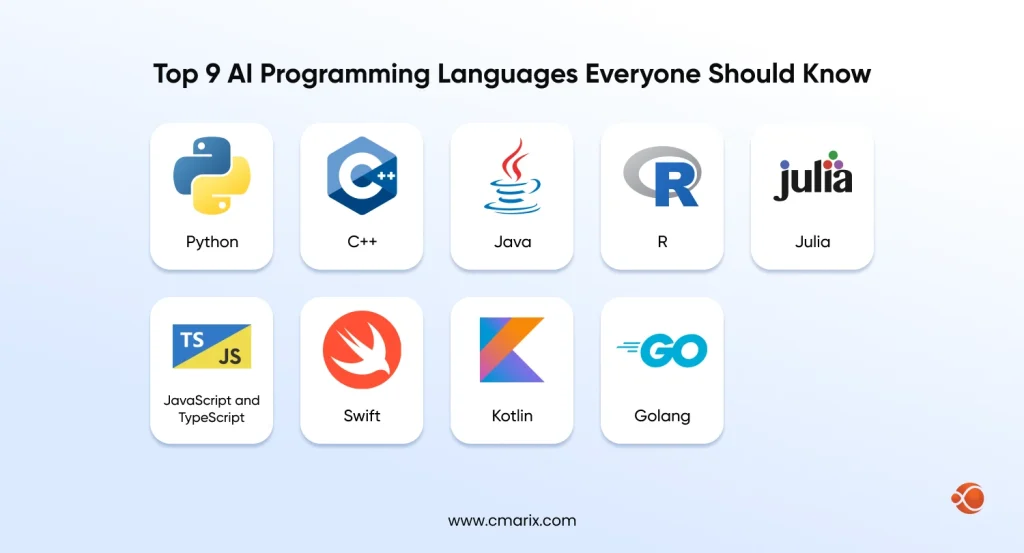
All languages are not created equal when it comes to artificial intelligence (AI) applications. The programming language Python has taken over in the realm of data science, while C++ reigns supreme in areas where speed and efficiency are paramount in neural net frameworks. Statistical models are constructed using the language R. By combining Python-like simplicity with near C++ execution speed, Julia eliminates the need to prototype in one language and optimize in another.
This blog covers 9 AI programming languages worth knowing in 2026, what each one is genuinely good at, where it falls short, and how to decide which fits your project.
AI Programming Languages at a Glance
| Language | Primary AI Use Case | Key Frameworks & Libraries | Learning Curve | Best For |
| Python | Machine Learning, NLP, Generative AI, Computer Vision | TensorFlow, PyTorch, LangChain | Low | Most AI and ML projects |
| C++ | Real-time inference, embedded AI, low-latency processing | TensorRT, OpenCV, ONNX Runtime | High | Performance-critical systems |
| Java | Enterprise AI, large-scale data processing | Deeplearning4j, Weka, H2O | Medium | Production-grade enterprise applications |
| R | Statistical modeling, research, and data analysis | caret, tidymodels, mlr3 | Low–Medium | Data science teams and academic research |
| Julia | Scientific computing, numerical AI, optimization | Flux.jl, MLJ.jl | Medium | High-speed numerical workloads |
| Go | AI deployment, model serving, infrastructure | Gorgonia, ONNX Runtime Go | Medium | Scalable AI APIs and microservices |
| JavaScript / TypeScript | LLM integrations, browser AI, edge AI | TensorFlow.js, LangChain.js, ONNX.js | Low–Medium | Web-based and edge AI applications |
| Swift | On-device AI for Apple ecosystems | Core ML, Create ML | Medium | iOS and macOS AI applications |
| Kotlin | Android AI applications, mobile inference | TensorFlow Lite, ONNX Runtime | Medium | On-device Android AI experiences |
Our engineers match the right language and framework to your exact use case.
Top 9 AI Programming Languages Everyone Should Know in 2026
1. Python (Why Python Dominates AI Development)
Python is not just famous. It has become the default programming language for artificial intelligence across every major category: NLP, machine learning, computer vision, generative AI, and AI agent frameworks. As per the 2025 Stack Overflow Developer Survey, Python has reached 57.9% global adoption among developers, a number that reflects how completely it has taken over data-heavy and AI-heavy workflows.
And this is no coincidence; the language structure is designed such that even researchers who lack programming experience have access to a powerful tool through which they can perform rigorous experiments. The list of advantages goes on; its library support is unparalleled; it provides support for deep learning frameworks like PyTorch and TensorFlow, fine-tuned LLMs through HuggingFace transformers, agents via Langchain, RAG systems, and more.
Key Python Libraries and Frameworks for AI
Teams building everything from recommendation engines to machine learning for chatbots rely on this same Python stack.
- PyTorch and TensorFlow for ML model training & deep learning
- Hugging Face Transformers for pre-trained LLMs
- LangChain and LlamaIndex for LLM application & retrieval architecture
- scikit-learn for conventional ML modeling and feature engineering
- FastAPI & Flask to serve inference endpoints
The only downside of Python is its execution speed. Being an interpreted language that’s inherently single-threaded, Python ends up using lower-level C/C++ libraries behind the scenes to do any complex task. While that’s important information to have, it usually doesn’t hinder product launches. But for a better product launch, hire Python developers.
2. C++ (Where C++ Fits in AI: Real-Time and Embedded Systems)
While C++ is not where AI development usually begins, it is certainly where it ends up when performance becomes the bottleneck. Frameworks that every Python developer works with on a daily basis, PyTorch, TensorFlow, and OpenCV, were all written in C++.
Autonomous driving cars, robotics, industrial inspection equipment, and video analytics systems – just to name a few examples – cannot tolerate Python’s overhead. C++ allows the engineer to directly allocate memory, manage threads, and communicate with hardware components. TensorRT, NVIDIA’s framework for optimized inference of neural networks on GPU, was developed using C++.
- Memory Management: Manual memory management eliminates GC pauses during inference
- Hardware Integration: Using native instruction sets provides optimal performance
- Multi-threading: C++ enables multi-threading without conflicts with the Python GIL
C++ is definitely not what you want to start your project on when trying to explore your data. It takes more time to code in C++, and there isn’t much that supports machine learning experiments with it. However, for deploying machine learning models to production, it might be your final stop.
3. Java (Java’s Role in Enterprise-Scale AI)

Java’s footprint in enterprise AI is larger than most practitioners acknowledge. Almost 90% of Fortune 500 companies use Java as a server-side language, which means that a significant share of enterprise AI deployments live inside Java-based infrastructure, whether teams want them to or not.
Rewriting all applications in Python does not seem viable for companies operating on huge Java-based stacks. The use of libraries such as Weka, Deeplearning4j, and H2O.ai enables developers to build ML solutions that easily interface with the rest of their application, which consists of Java services. Additionally, type safety in Java helps in avoiding costly mistakes in deployment.
Java is not competitive with Python for research or experimentation. It is slower to prototype, and the ML ecosystem is narrower. But for embedding AI into an existing enterprise system that already runs on the JVM, Java is a practical and reliable choice.
4. R (When to Use R, and When Not To)
R is the language of statisticians. There is no better language for exploratory data analysis. Tidyverse helps with easy data manipulation, while ggplot2 provides us with ready-to-publish plots. Machine Learning can be accomplished using packages such as mlr3 and caret.
The truth of the matter is that R was not meant for use in production AI. Running an R-based model through a busy API, incorporating it into a data pipeline, or deploying it onto a distributed infrastructure needs extensive hacks and tricks. Businesses that start experimenting with R typically transition their models to Python for deployment.
Your workflow needs R if your development team performs any kind of advanced statistical modeling, large-scale A/B testing, or clinical trials that require explainability and reporting over speed.
5. Julia (Julia’s Speed Advantage and Cross-Language Compatibility)
Julia was built to solve what its creators called the two-language problem: researchers write exploratory code in a high-level language like R or Python, then rewrite performance-critical sections in Fortran or C for production. Julia aimed to deliver high-level syntax with low-level speed. Developed at MIT,Julia offers 10x to 100x faster performance than Python for numerical analysis, according to benchmarks from its own researchers.
The real advantage Julia provides to AI developers is the ability of the language to work with different languages. In other words, you will be able to use the PyTorch or TensorFlow library from Julia without any problems, meaning that you could use the former to process numeric data faster.
Julia’s ecosystem is still smaller than Python’s, and hiring Julia developers is even harder. But for scientific computing, physics-based simulations, and AI workloads, including large-scale numerical optimization, it is genuinely worth evaluating.
6. Go (Golang) (Go for AI Deployment and Serving Infrastructure)
The advantage of Go in AI applications isn’t building models at all. It’s doing everything post-model training. Building the API layer for inference, running concurrent requests, building microservices that coordinate the entire pipeline of an AI application, and authentication and rate limiting on the model endpoint – all this is what Go does well.
Being able to create very compact and statically linked binaries, the capability of Go for implementing concurrency through goroutines, and quick startup make Go highly suitable for developing infrastructure related to the deployment of AI apps. There are some Go APIs available to frameworks like ONNX Runtime, as well as the Gorgonia library, enabling developers to build neural networks using purely Go.
If your team is designing AI-driven products and you need the backend that will be able to handle several thousand concurrent requests, then Go should definitely be taken into account, despite Python being used to train models and experiment with them.
7. JavaScript and TypeScript (LLM Tooling and Browser-Side AI with JavaScript)
JavaScript’s presence in AI has grown significantly in the past two years, driven largely by the explosion of LLM application development. LangChain.js brings the full agent and RAG tooling that Python’s LangChain made popular into a TypeScript-native environment. The Vercel AI SDK makes it straightforward to build streaming LLM interfaces. TensorFlow.js and ONNX.js allow models to run directly in the browser or at the edge without a server round trip.
If you’re a web developer integrating AI functionality into existing JavaScript code, this means that you don’t have to create a separate Python back end simply to implement an AI system. It means that you can use OpenAI, open-source models’ APIs, or Anthropic, deal with embeddings, develop RAG pipelines, or orchestrate agents using only JavaScript(JS).
With TypeScript giving typing safety for these architectures, the adoption of AI technology within existing JS ecosystems is finally legitimate.
8. Swift (On-Device AI with Swift and Core ML)
Swift’s AI story is specifically about Apple’s hardware ecosystem. Core ML, Apple’s on-device inference framework, integrates directly with Swift and allows models to run on the Neural Engine in iPhones, iPads, and Apple Silicon Macs without sending data to a server. Create ML lets developers train custom image classifiers, text classifiers, and object detection models directly on macOS.
The practical value here is latency and privacy. On-device AI with Core ML means no API call, no user data leaving the device, and no network round-trip. For applications in finance, healthcare, or any regulated context where data residency matters, this architecture is worth serious attention.
Swift is not a general-purpose AI language. Outside the Apple ecosystem, the tooling is sparse, and the community for AI work is small. But if you are shipping AI features in iOS or macOS apps, Swift with Core ML is the right tool.
9. Kotlin (Kotlin for AI in Android Apps and On-Device Inference)
Kotlin takes a similar position to Swift, but on the Android side. TensorFlow Lite, Google’s mobile inference library, has strong Kotlin bindings that allow trained models to run on-device in Android apps. ONNX Runtime also supports Android via Kotlin and Java APIs, making it possible to deploy cross-platform models to Android without a server dependency.
Google’s Machine Learning Kit, which gives ready-made AI capabilities like face detection, text recognition, and language identification, integrates cleanly with Kotlin. For Android developers adding AI-powered features to existing apps, Kotlin is the natural choice, and many businesses choose to hire Kotlin developers to build and deploy these capabilities efficiently.
Like Swift, Kotlin is not a language for training models or building general ML pipelines. It is the delivery mechanism for getting trained models onto Android devices and into the hands of users with low latency and no connectivity dependency.
How to Choose the Correct AI Programming Language
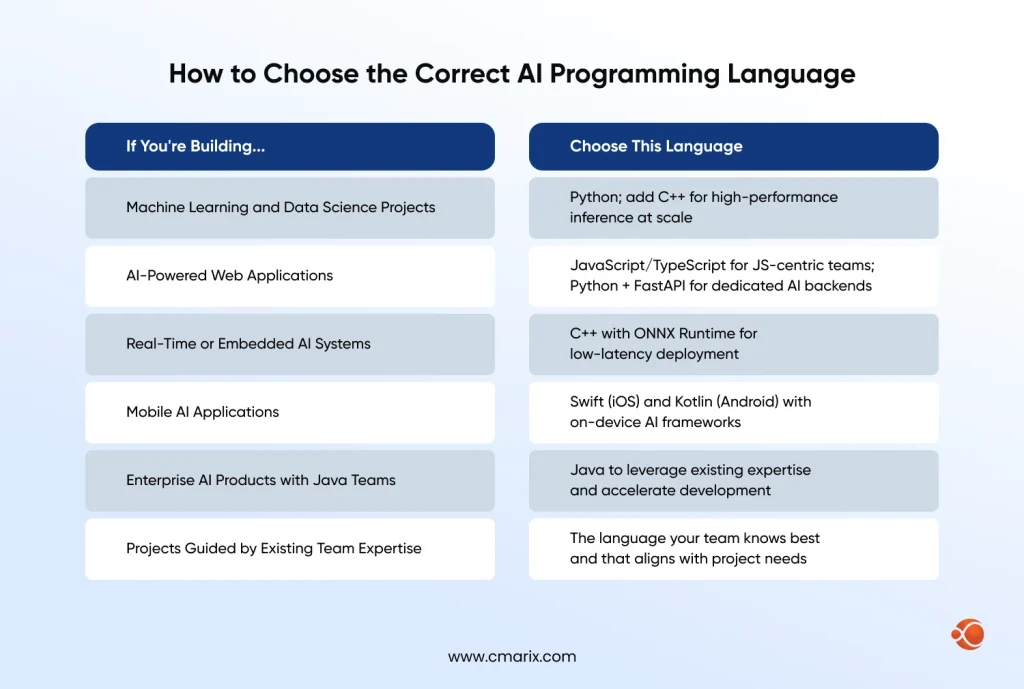
The right AI programming language is the one that fits your project type, your team’s existing skills, and your deployment environment. Here is how to think through it.
For ML and Data Science Projects
Begin with Python. The ecosystem, the community, and the tooling for every stage of a data science workflow are there. If you hit performance walls at scale, add C++ at the inference layer.
For AI-Powered Web Applications
If your development team lives in JavaScript, the Vercel AI SDK uses LangChain.js or TensorFlow.js. If you need a dedicated AI backend, Python with FastAPI is the standard approach. Teams working on high-performance custom software solutions often combine a Python inference layer with a Go or Node.js serving layer for throughput at scale.
For Real-Time or Embedded AI Systems
C++ usually does the trick here, especially for self-driving cars and robots, where the response time needs to be in milliseconds. ONNX Runtime in C++ provides a clear path from training your models in Python to deploying them using C++.
For Mobile AI Applications
Languages: Swift for the Apple platform and Kotlin for the Android platform. Both languages gain an advantage due to the use of inference frameworks on the device that do not rely on servers and provide privacy.
Team Skill Set and Ecosystem Considerations
Do not ignore what your team already knows. A team of experienced Java engineers building an enterprise AI product will move faster staying in Java than learning Python from scratch. The evolution of AI development technologies means every major language now has a credible path into AI work. Choose based on the intersection of project requirements and existing team expertise.
Why Choose CMARIX for Your AI Development Project
Knowing which AI programming language to use is step one. Finding a team that can actually build production-grade AI systems with it is the harder part. CMARIX has been doing exactly that for over 17+ years with 240+ developers, working across Python, Java, JavaScript, and Go to deliver high-performance custom software solutions for clients across fintech, healthcare, logistics, and enterprise software.
Here is what that looks like in practice:
- AI development across the stack: From data pipelines to models, to deployment, CMARIX covers the entire process of developing AI, end-to-end.
- Language-agnostic implementation: No matter whether your technology stack includes Java, your developers are skilled in Python, or you require a native JavaScript AI layer, CMARIX will work for you.
- Production-first thinking: Prototypes are easy. Scalable, maintainable AI systems that actually run in production are harder. CMARIX engineers build for the latter from day one.
- End-to-end ML expertise: From feature engineering and model selection to MLOps and monitoring, the team supports the full end-to-end Machine Learning development lifecycle.
- Domain-specific AI solutions: General AI tools are everywhere. CMARIX builds AI systems trained on your data, designed for your workflows, and integrated into your existing product stack.
We build AI systems that plug into your product, not generic tools that don’t fit.
Wrapping Up
AI programming languages are much more diverse than they might seem on the surface. What makes Python so dominant is the fact that it is genuinely good in all stages of AI development. However, the rest of the programming languages are far from being redundant here. C++ provides the performance layer in any environment, while Java ensures enterprise AI development through reliable integration with current technologies. R offers rigorous statistical analysis, and Julia is making fast progress in improving speed for numerical tasks.
Go guarantees AI reliability at scale, and JavaScript/TypeScript make it possible for LLMs to perform application development. Swift and Kotlin bring AI to mobile applications in a serverless manner. In any case, no language can be called superior. The crucial factor here is the compatibility of each language with your team, infrastructure, and problem type.
FAQ onAI Programming Languages
Which programming language is the best to start with for AI?
For most people, Python is always the best place to start. It is one of the most mature ecosystems when it comes to ML and AI; its learning curve is moderate, and due to its large community, solutions to most problems are always available. After mastering Python and getting comfortable with the workings of tools such as scikit-learn and PyTorch, learning additional programming languages is an intentional process.
Is Python the only programming language used for AI?
No. Python reigns supreme here, but not exclusively. C++ drives the speed-sensitive components in almost all big AI libraries. Java facilitates enterprise-scale AI deployments. R reigns supreme in the fields of statistical modeling and academic research. JavaScript and TypeScript are emerging contenders for the implementation of large language models and edge AI applications. It’s not easy to point out the winner in the AI world because it greatly depends on circumstances.
How does C++ compare to Python for machine learning?
Python is faster for development, better in terms of its large ecosystem, and suitable for experimenting. C++ is faster at executing programs, has more fine-tuned control over the program’s memory, and can be used when latency is an important factor. It should be noted that in practice, people use Python for training and C++ for deploying their solutions.
Are JavaScript or R used in AI development?
They find applications in various situations. R programming language is primarily used for conducting academic research and modeling in cases where there is no need for software solutions based on Python. The use of JavaScript and TypeScript is now deemed acceptable when building web applications using LLMs and frameworks like TensorFlow.js and LangChain.js. While neither technology can be considered an alternative to Python in machine learning applications, each one plays its role in the AI world.
Will AI coding assistants replace the need to learn these languages?
No. Code generation assistants such as GitHub Copilot and Claude can generate code, offer suggestions, and aid in debugging. However, they do not replace the necessity to know what the generated code is supposed to do, assess its correctness, and make architectural decisions based on this information. Programmers who are aware of AI languages will use these assistants much more effectively compared to those who see these assistants as a shortcut around programming knowledge.
Do I need to learn Lisp or Prolog for modern AI?
Not really. The languages Lisp and Prolog were crucial to the early evolution of symbolic AI and logic programming. Modern advancements in AI, such as machine learning and deep learning, among others, use Python and C++ languages and their corresponding frameworks as the basis of their architecture. Knowing Lisp and Prolog is important if you study the history of AI or if your work involves symbolic AI reasoning.