

Quick Summary: An AI use case prioritization framework helps you pick the few AI projects worth funding from a long wish list. It scores every idea on business impact, technical feasibility, data readiness, risk, and cost, so decisions rest on evidence instead of enthusiasm. This guide covers the seven steps involved in the process, examples of scoring and cost sheets, and the models organizations use to select high-return-on-investment AI projects.
Every business has more ideas for AI than budget. Finance needs forecasting, support wants to deploy a chatbot, engineering wants code assistants, and some leaders read about agents on the weekend. There is no way of funding everything. Funding the most vocal idea is how all the money disappears.
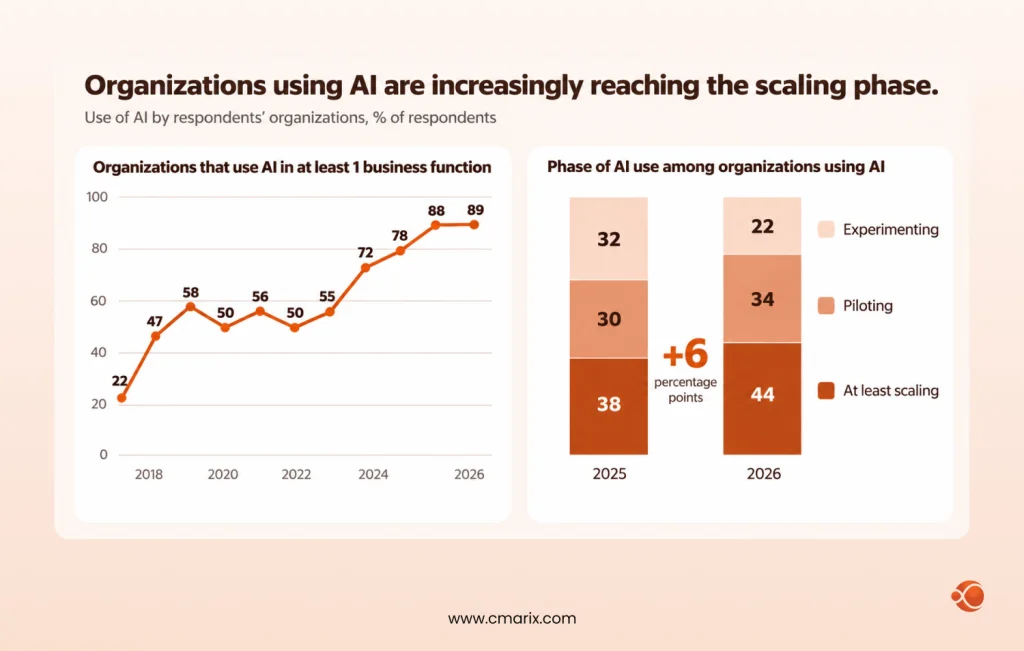
Adoption is no longer the hard part. McKinsey’s 2026 State of AI survey of 1,719 people across 97 countries found that 44% of organizations now report scaling AI across the enterprise, up from 38% a year ago, yet only 37% attribute any EBIT impact to it, essentially unchanged from 2025. Usage keeps growing while profit impact stays flat. Costs are also starting to bite: about one in five respondents say AI operating costs, including token costs, have forced their organization to limit AI use.
This means choosing the right projects matters more than picking more. This is precisely why most programs developed around artificial intelligence in digital transformation fail after the first pilot project.
What Is an AI Use Case Prioritization Framework?
An AI use case prioritization framework is a systematic approach for ranking AI project ideas based on a set of parameters. This framework doesn’t involve discussion and debate over which idea sounds better; instead, it evaluates and scores each idea against several criteria.
It looks similar to product frameworks like ICE (Impact, Confidence, Ease) or RICE (Reach, Impact, Confidence, Effort), but AI needs extra axes. A use case can score high on value and still fail because the training data is a mess, or because a wrong answer creates a compliance incident. There are some additional considerations in evaluating strategic alignment for AI.
A working framework answers four questions:
- Which use cases are worth pursuing at all?
- Which use cases come first?
- Which use cases require that data or infrastructure be ready before getting underway?
- What success means for each project?
AI Use Case Prioritization Framework at a Glance: The Filter, Score, Sequence Model
The framework has three moves: filter out ideas that cannot work, score the ones that can, and sequence the winners into a roadmap. Every use case goes through the same three moves, in this order.
| Move | What you do | What comes out | Covered in |
| Filter | Collect ideas, tie each to a KPI, and apply hard checks on data, permission, and reversibility | A clean shortlist and a parking lot | Steps 1 to 3 |
| Score | Rate survivors on impact, feasibility, data readiness, risk, strategic fit, and adoption, then estimate cost and ROI | A ranked list with cost and ROI estimates | Steps 4 and 5 |
| Sequence | Plot value against feasibility, group projects into waves, pilot, and re-rank each quarter | A phased roadmap with owners and review dates | Steps 6 and 7 |
The order is very important here. By filtering before scoring, one avoids scoring ideas that would not have been viable anyway; by scoring before sequencing, one keeps the roadmap grounded in facts.
Why AI Projects Fail Without a Prioritization Framework
AI projects fail at a higher rate than ordinary software work. RAND’s research reports that, by some estimates, more than 80% of AI projects fail, roughly twice the rate of IT projects that do not involve AI.
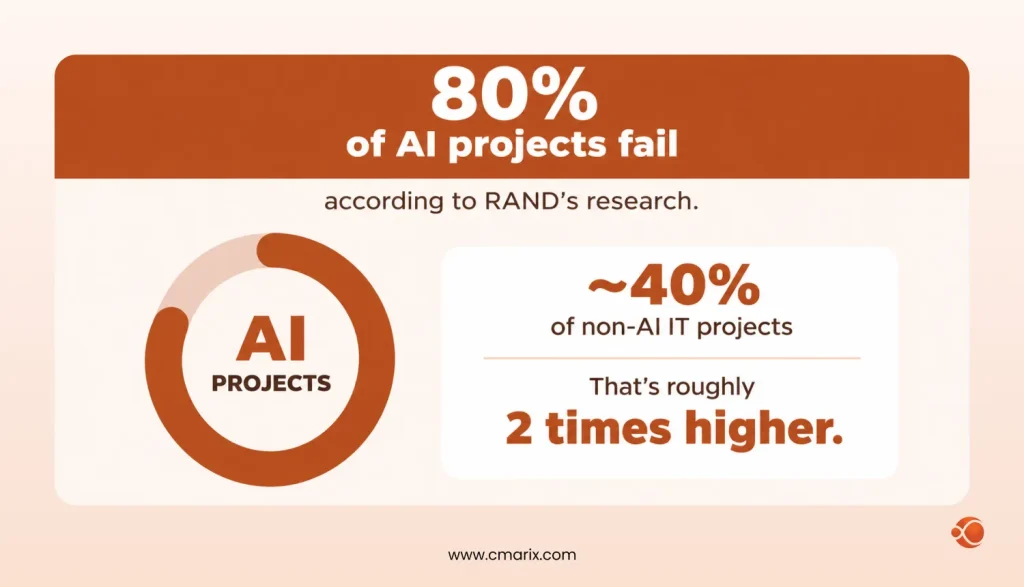
RAND interviewed experienced data scientists and engineers and pinned the failures on five root causes:
- Misunderstood problem- stakeholders miscommunicate what the AI is supposed to solve.
- Missing data- the organization lacks the data needed to train an effective model.
- Technology over outcomes- teams chase the latest tool instead of a real user problem.
- Weak infrastructure- there is no solid way to manage data and deploy finished models.
- Problems too hard for AI- the technology is pointed at something it cannot reliably solve.
Notice what is missing from that list: model quality. Every one of these causes can be caught before anyone writes code, if you score ideas properly. For enterprises running a wider digital transformation, the most common symptom is budget spread thinly across too many pilots with no clear owner.
AI Use Case Scoring Criteria: 7 Factors to Evaluate Every Project
Begin with a fixed set of questions. The table below covers the seven criteria most teams need, and it provides shared language across business, data, and engineering.
| Criterion | Question to ask | What a strong score looks like |
| Business impact | Which KPI moves, and by how much? | A named metric with a baseline and a target |
| Technical feasibility | Can we build and run this with current skills and systems? | Proven approach, few integration points |
| Data readiness | Is the data available, clean, and legal to use? | Accessible, labeled or labelable, owned |
| Cost and time to value | What does it cost to build and run, and when does it pay back? | Clear cost model, early measurable results |
| Risk and compliance | What happens when the model is wrong? | Low harm, human review possible |
| Strategic fit | Does it support a stated company goal? | Direct link to a top priority |
| Adoption and usage frequency | Will people actually use it often? | High volume, clear owner, easy workflow fit |
Treat these as your AI benchmarking criteria: the same questions for every idea, scored by the same people. Consistency matters more than perfection here.
We help you score, rank, and plan AI projects around business value.
How to Prioritize AI Use Cases in 7 Steps (With Scoring Matrix)
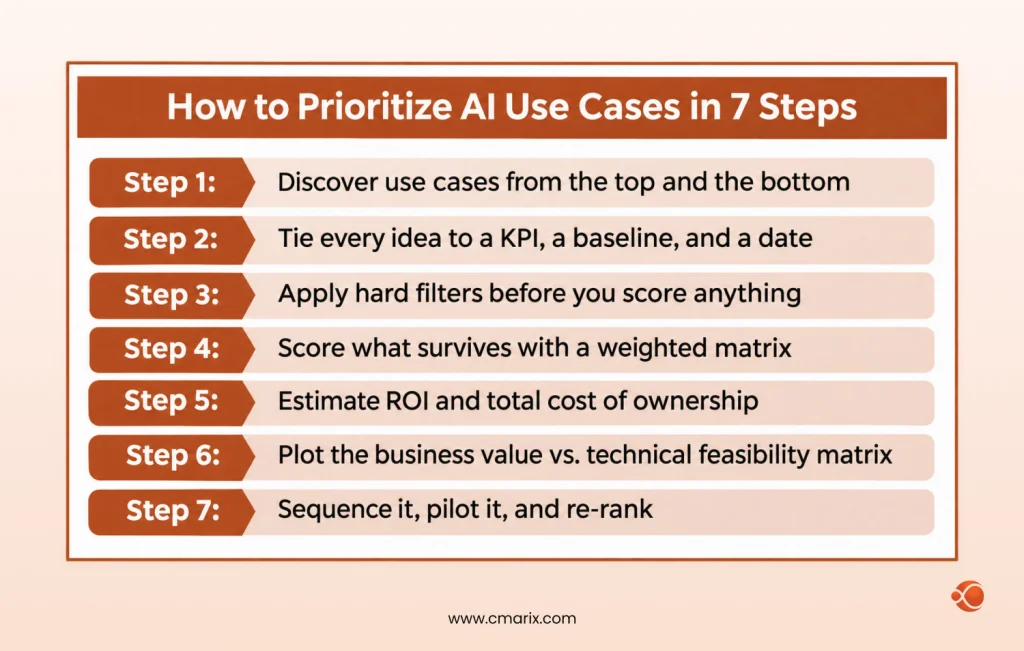
Let’s break the AI use case prioritization framework into seven steps you can run in order. Most teams finish steps one to four in a single working session and spend the following weeks on cost modeling and sequencing.
Step 1: Discover use cases from the top and the bottom
Every good idea starts somewhere. The leaders know the strategic intent, while the teams on the ground know the pain points. You will need both perspectives. OpenAI’s playbook for identifying and scaling AI use cases recommends looking at repetitive low-value activities, skills gaps, and ambiguous work. It also states that after analyzing more than 600 customer use cases, most fall into one of six categories: content creation, research, automation, coding, data analysis, and ideation & strategy.
Whether you run an AI target identification activity across departments or an internal service prioritization workshop for a single team, the deliverables must be the same: a long list of ideas, each with a designated owner and a clear problem statement.
Step 2: Tie every idea to a KPI, a baseline, and a date
List the KPI that will be affected by each initiative, its current baseline, and the date when change will occur. For example, reducing average ticket handling time relative to this quarter’s baseline is a good idea. When KPIs are forecasted, such as churn or demand, you may use predictive analytics solutions to determine a reasonable uplift.
Step 3: Apply hard filters before you score anything
Some ideas should never reach the scoring stage. Do a quick check with data readiness verification models, which have five yes/no conditions:
- Data exists- the data needed for the task is actually collected today.
- Data is accessible- teams can reach it without a six-month integration project.
- Data quality holds up- it is complete and consistent enough to learn from.
- Use is permitted- privacy, consent, and licensing allow this use.
- Failure is recoverable- a wrong output can be caught or reversed by a person.
Ideas that fail one of these go to a parking lot with a note on what must change. That is not a rejection. It is a sequencing decision.
Step 4: Score what survives with a weighted matrix
Rate the surviving ideas as per the criteria from 1 to 5, and give them weights. The initial weights should be distributed as follows:
- Impact 25%
- Feasibility 20%
- Data readiness 20%
- Risk 15%
- Strategic fit 10%
- Adoption 10%
Adjust the weights to match your priorities, then lock them before scoring begins so nobody bends the numbers toward a favorite idea. Risk is scored so that 5 means lowest risk.
Weighted score formula: Weighted score = (Impact × 0.25) + (Feasibility × 0.20) + (Data readiness × 0.20) + (Risk × 0.15) + (Strategic fit × 0.10) + (Adoption × 0.10)
For example, invoice processing automation scores (4 × 0.25) + (5 × 0.20) + (4 × 0.20) + (4 × 0.15) + (4 × 0.10) + (4 × 0.10) = 4.20.
The sample below is illustrative, but it shows how the AI feasibility assessment template works in practice.
| Use case | Impact | Feasibility | Data readiness | Risk | Strategic fit | Adoption | Weighted score |
| Invoice processing automation | 4 | 5 | 4 | 4 | 4 | 4 | 4.20 |
| Support ticket triage | 4 | 4 | 4 | 4 | 3 | 5 | 4.00 |
| Demand forecasting | 5 | 3 | 3 | 4 | 5 | 3 | 3.85 |
| Internal policy chatbot | 2 | 5 | 3 | 4 | 2 | 2 | 3.10 |
| Autonomous credit decisioning | 5 | 2 | 2 | 1 | 4 | 3 | 2.90 |
For the feasibility column, use a machine learning deployment complexity score built from three questions:
- Integration points- how many systems must connect for the model to be useful.
- Infrastructure needs- how much compute, tooling, and pipeline work is required.
- Monitoring and retraining- how much ongoing effort keeps the model accurate.
Rate each from 1 (heavy) to 5 (light) and average them. This kind of enterprise machine learning feasibility scoring is where outside input pays off, so many teams bring in a Machine Learning development partner to sanity-check the scores before sign-off.
Step 5: Estimate ROI and total cost of ownership
The rankings are indicated by the scores, while money indicates affordability. For each selected idea, determine the benefit per year, as well as the total cost per year, before computing the ROI. For tips on presenting the financial aspects of your numbers, check out the AI ROI guide.
Annual benefit formula: Annual benefit = Value of hours saved + Revenue gained + Losses avoided
For example, a hypothetical project that delivers $180,000 in annual benefit against $120,000 in total annual cost returns (180,000 – 120,000) ÷ 120,000 × 100 = 50%.
The cost side is where teams most often undercount. Build costs are only part of the picture.
| Cost component | What it covers | What pushes it up |
| Data preparation | Cleaning, labeling, pipelines | Messy sources, many systems |
| Model development or licensing | Building, fine-tuning, or paying per use | Custom models, high usage volume |
| Integration | Connecting to apps, workflows, and APIs | Legacy systems, many touchpoints |
| Inference and cloud usage | Running the model day to day | Heavy traffic, long inputs per request |
| Maintenance and monitoring | Retraining, drift checks, support | Fast-changing data, strict accuracy needs |
| Change management and training | Onboarding users, updating processes | Large teams, low trust in AI output |
One practical tip: Estimate cost per task, not just the cost of construction. Usage cost is based on volume and the length of input sent, meaning a solution may be inexpensive initially but expensive when scaled.
Step 6: Plot the business value vs technical feasibility matrix
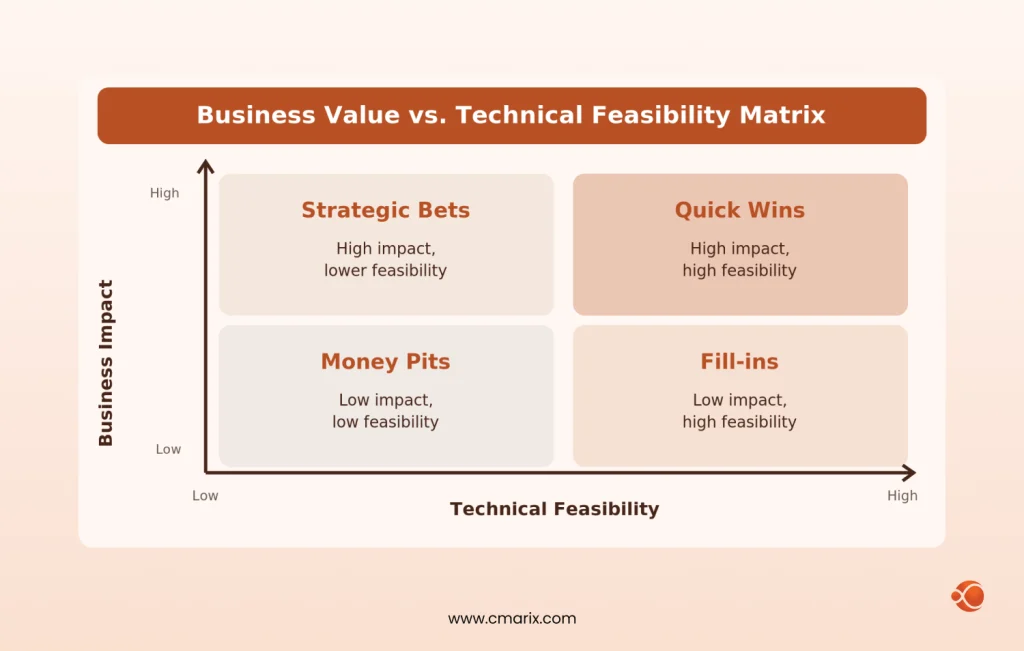
A picture makes the portfolio easy to discuss and understand. Plot each use case on one axis and feasibility on the other axis, and sort them into four groups:
- Quick Wins: High impact, high feasibility. Prioritize these first.
- Strategic Bets: High impact, low feasibility. Plan these after addressing technical or data dependencies.
- Fill-ins: Low impact, high feasibility. Consider these when resources are available.
- Money Pits: Low impact, low feasibility. Generally avoid investing in these.
Step 7: Sequence it, pilot it, and re-rank
Choose one to three use cases for the first wave, mixing a quick win with one strategic bet if capacity allows. Effective AI roadmap planning recognizes its iterative nature: each pilot gets its own measure of success and a review date, while the entire list is re-scored in light of better data and ideas. Corporate AI roadmap management is largely just doing this iteratively every quarter.
AI Prioritization Models Compared: Weighted Scoring, RICE, ICE, and More
The seven-step process above uses weighted scoring and an impact-versus-effort matrix, but several other models exist. Here is how they stack up.
| Model | Best for | Strengths | Limits |
| Weighted scoring | Final ranking of finalists | Transparent, customizable | Takes time to agree on weights |
| Impact vs effort matrix | First pass on a long list | Fast, visual | Ignores data readiness and risk |
| ICE (impact, confidence, ease) | Quick scoring in small teams | Simple, 1 to 10 scale | Confidence is subjective |
| RICE (reach, impact, confidence, effort) | Customer-facing features | Accounts for audience size | Weak fit for internal AI tools |
| Value vs complexity | Portfolio planning | Easy for executives to read | Needs a good complexity definition |
| Desirability, feasibility, viability | Early stage exploration | Balances user and business view | Less precise on cost |
Most teams pair an impact-versus-effort matrix for the first cut with weighted scoring for the finalists. If you have to select an AI engine, follow the same approach: screen based on suitability for the task, put all finalists through the same evaluation, and benchmark the results.
High-ROI AI Use Cases by Business Function
Similar trends occur across different industries. Below is a list of use cases likely to perform well because they have volume, deliver results, and carry low risk.
| Function | Use case | Main ROI driver | Complexity |
| Customer support | Ticket triage, agent assist | Lower handling time, faster resolution | Low to medium |
| Sales and marketing | Lead scoring, content drafting | Conversion lift, time saved | Low to medium |
| Finance | Invoice processing, anomaly detection | Fewer manual hours, fewer errors | Medium |
| HR and IT | Internal helpdesk, onboarding | Ticket deflection, faster onboarding | Low |
| Operations and supply chain | Demand forecasting, predictive maintenance | Less downtime, lower stock costs | Medium to high |
| Software delivery | Code assistance, test generation | Developer hours saved | Low to medium |
Finance deserves extra care. Wrong outputs carry real cost, so risk should carry more weight in your scoring. This principle also applies to machine learning in fintech, where explainability and audit trails are mandatory.
Prioritization strategies for the support team also offer clear benefits. For example, the prioritization framework can be used to determine which support articles the AI should consider first, often those with the most tickets.
In a McKinsey survey, participants identified benefits at the use-case level, specifically in software engineering, manufacturing, and IT. Our research paper about the application of AI in software development focuses on how these technologies are used throughout the development lifecycle.
Enterprise AI Scaling: Moving From Pilot to Production
Ranked lists are meaningless until delivery ownership is established. This is when enterprise AI scaling typically fails. McKinsey found that around 6% of people are classified as AI high performers, meaning they contribute 5% or more of EBIT from AI. Everyone else is somewhere between experimentation and value creation.
Once the shortlist is approved, the next question is who will develop AI systems that survive contact with production. Planning for that early saves painful handoffs later.
A few sequencing rules help:
- Start small- The OpenAI guide points out that complex use cases can hamper your progress, so begin with an attainable solution.
- Balance the portfolio- pair one quick win with one strategic bet.
- Share the groundwork- data pipelines and monitoring built for one project should serve the next.
- Cap work in progress- match the number of live projects to team capacity.
- Set a stop rule- decide in advance what result ends a pilot.
AI Governance and Strategic Alignment Checklist Before Budget Approval
Before the budget is released, every shortlisted use case should pass through a cross-functional steering committee. A good committee includes a business owner, a data or machine learning lead, and representatives from security, legal, finance, and operations.
The committee does three jobs. It agrees on the benchmarking criteria and weights; a bank might weigh risk heavily, while a fast-moving startup weighs speed. It checks that each proposal links to a stated company objective. And it runs a short approval checklist:
- ☐ Does the use case map to a named strategic goal and KPI?
- ☐ Do privacy, bias, and regulatory checks pass?
- ☐ Is a human in the loop where errors are costly?
- ☐ Does the business case cover the full cost, not just the build?
- ☐ Is there a single accountable owner?
Release funding in stages tied to pilot milestones, not as one lump sum.
Common AI Use Case Prioritization Mistakes to Avoid
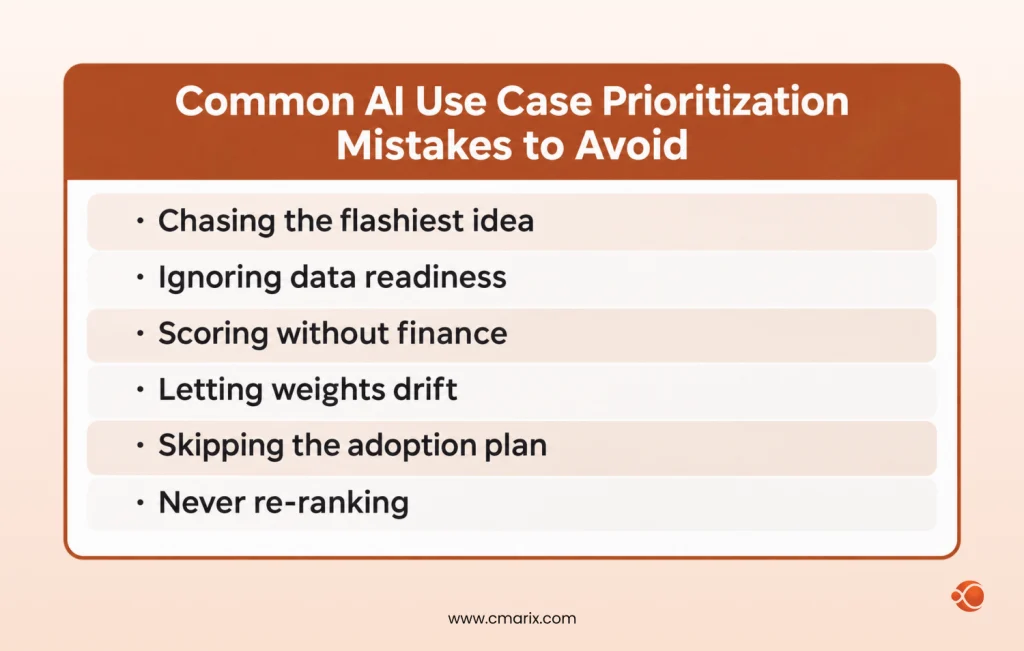
- Chasing the flashiest idea- the most impressive demo is rarely the best first project.
- Ignoring data readiness- a high-value score means little if the data is not there.
- Scoring without finance- benefits that finance cannot defend will not survive budget review.
- Letting weights drift- changing weights after seeing results turns scoring into rubber-stamping.
- Skipping the adoption plan- a tool nobody uses has zero ROI, however accurate it is.
- Never re-ranking- data, costs, and tools change, and last quarter’s list ages quickly.
Build, Buy, or Partner: Choosing the Right AI Delivery Path
Once a use case clears the matrix, you still need to decide how to deliver it. Like for simple internal workflows, AI app builders can get a prototype running quickly without a full engineering team. For anything core to your product or data, the choice is less obvious.
| Path | Best when | Strengths | Watch out for |
| Buy an off-the-shelf tool | The use case is common and well served | Fast, low upfront cost | Limited customization, vendor lock-in |
| Low-code or no-code builder | You need a quick prototype or internal tool | Speed, low skill barrier | Scaling and security limits |
| Build custom | The use case is unique or core to your edge | Full control, deep integration | Higher cost, needs strong talent |
| Partner with a specialist | You lack in-house skills or capacity | Experience, faster delivery | Needs clear scope and governance |
Where the use case happens to exist within a customer-facing application, AI in app development includes the architecture and design choices to plan for. The simple rule is: buy what is common, build what differentiates you, and partner when speed or skills are the gap.
Work with engineers who ship AI systems from pilot to production.
Why Choose CMARIX for AI Strategy and Development
CMARIX has been building software since 2009 and works across more than 40 industries. The company holds ISO 9001:2015 and ISO 27001 certifications, which matter when AI projects touch sensitive data.
Our teams support the full path from idea to production:
- Prioritization workshops- scoring and ranking use cases with your stakeholders through our AI consulting company‘s expertise.
- Feasibility and data checks- validating scores before the budget is committed.
- Build and scale- delivering models and integrations through our AI software development services.
Conclusion
A good AI use case prioritization framework does one thing well: it replaces opinion with a shared, repeatable score. First, eliminate use cases that don’t pass the data and risk filters, prioritize the remaining by impact and feasibility, assign each its real cost, and build a portfolio. Next, pilot them, measure their results, and rank again every quarter. Those who do will fund fewer projects but complete more.
FAQs on the AI Use Case Prioritization Framework
What is an AI use case prioritization framework, and why do enterprises need one?
A prioritization framework is a systematic process for scoring and ranking potential AI projects against considerations like business impact, feasibility, data availability, and risk level. An enterprise needs it because it often has many ideas but a limited budget, so without scoring, decision-making can default to the most vocal sponsor’s proposal.
What core variables should you include in an AI feasibility assessment matrix?
It includes data availability and quality, infrastructure needs, integration effort, team skills, monitoring and retraining burden, and regulatory exposure. Score each on a 1-to-5 scale with the same written definitions for every use case. Keep the matrix short enough to complete in one workshop.
How do you balance business value versus technical complexity when scoring AI projects?
Plot every use case on a value versus feasibility matrix. Those with high value but low feasibility come up first; those with high value and high feasibility are considered stage bets upon fulfillment of prerequisites; and the rest fall out of scope.
How does data readiness scoring prevent early AI pilot failures?
They spot gaps in, access to, quality of, or legal restrictions on data before spending any money. Missing data is one of five major reasons an AI project fails, according to RAND. A bad score doesn’t kill an idea; it pushes the project back until the data part is completed.
What framework does OpenAI recommend for identifying and scaling AI use cases?
According to OpenAI, there are three key steps to implement its guidelines on AI use cases: spot the opportunity, educate your team about different types of use cases, and collect and prioritize ideas using an impact vs. effort approach.
How can customer support teams use an AI prioritization framework to clear backlogs?
Score backlog drivers based on ticket volume, resolution time, and the likelihood of getting the wrong answer. Triage and assistant always come out on top, and the same ranking applies to deciding which support articles the AI surfaces first.
What is the best process to systematically score machine learning deployment complexity?
Assign points for each of the following criteria: integration, infrastructure, monitoring and retraining, and compliance. Give scores on a scale of 1 (difficult) to 5 (easy). Average the points and put the result in the feasibility box in your matrix. Rethink the score after a pilot because reality can differ from expectations.
How should cross-functional steering committees configure custom AI benchmarking criteria?
Get people from data, business, security, legal, and finance on the committee and come up with five to seven criteria. Assign weightings according to strategy, describe each criterion on a 1-to-5 scale in writing, and freeze the weightings before evaluating the ideas. Evaluate them quarterly.
What are the key steps to implement a high-ROI enterprise AI project selection routine?
Repeat a cycle that includes idea generation, hard filtering, weighting by matrix, ROI and cost estimates, sequencing by waves, piloting, and re-ranking. Have only one owner of this process per company, and do it once a quarter.
How do corporate governance boards use strategic alignment frameworks to approve AI budgets?
They ensure that all proposed projects align with company objectives and KPIs, comply with risk and compliance guidelines, and have an owner assigned to each initiative. Budget allocations are released in phases according to pilot milestones.