

Quick Summary: A cloud governance framework is all about the roles, policies, controls, and review processes that ensure that spending, security, and compliance in the cloud are under control as your estate expands. In this guide, you will find out everything you need to know regarding pillars, frameworks for comparison, eight steps for implementation, tools, and cost estimates for developing your own framework versus using a partner’s service.
The problem with cloud adoption is never the technology itself; it’s the lack of agreement on ownership rights. Projects rapidly create accounts, purchase software, and transfer data, and then once the financial and security departments have to start asking questions, the estate has already grown large and complex. The cloud governance framework provides the policy, process, and control needed to get ahead of that problem.
Overly tight governance slows delivery, and teams find ways around it. Governance that is too loose leaves you with surprise bills and audit findings. This guide shows you how to strike a balance.
What Is a Cloud Governance Framework?
A cloud governance framework, many times called a cloud computing governance framework, is a documented set of policies, roles, controls, and review routines that decide how your organization buys, builds, secures, and runs cloud resources. If you have been asking what cloud governance is, the short answer is this: it is how a company stays in control of cost, risk, and compliance while teams keep shipping.
It helps to separate it from two terms it often gets mixed up with.
- Cloud management- The day-to-day work of running workloads, such as provisioning, patching, and monitoring.
- Cloud security- The technical controls that protect systems and data, such as encryption, network rules, and threat detection.
- Cloud governance- The decision layer above both. It sets the policies that management and security carry out, and it defines who is accountable when something breaks the rules.
In most enterprises, a cloud center of excellence or a cross-functional governance board owns the framework, with sponsorship from IT, security, and finance.
Why Enterprises Need Cloud Governance in 2027
Flexera’s 2026 State of the Cloud Report, based on a survey of 753 cloud decision-makers and users, found that organizations estimated wasting 29% of their IaaS and PaaS cloud spend. The report also found that 71% of organizations had a Cloud Center of Excellence (CCoE) or equivalent. What this really means is that cost control gets harder as cloud use gets more dynamic, not easier.
Cost is only one part of the case for enterprise cloud governance:
- Cost sprawl- Untagged resources, idle environments, and on-demand pricing that nobody reviews.
- Shadow IT- Teams buying cloud services outside procurement and security review.
- Compliance exposure- Data stored outside the required region or with access logs not as required by the auditor.
- Security drift- Inadequacies that arise from misconfiguration as more accounts are created.
Governance provides the guidance, while cloud cost optimization is its implementation on a weekly basis. Planning for commitment, rightsizing, and budget alerts becomes more effective after resolving ownership and tagging issues.
Our cloud experts can audit your estate and map the gaps quickly.
7 Core Pillars of a Cloud Governance Framework
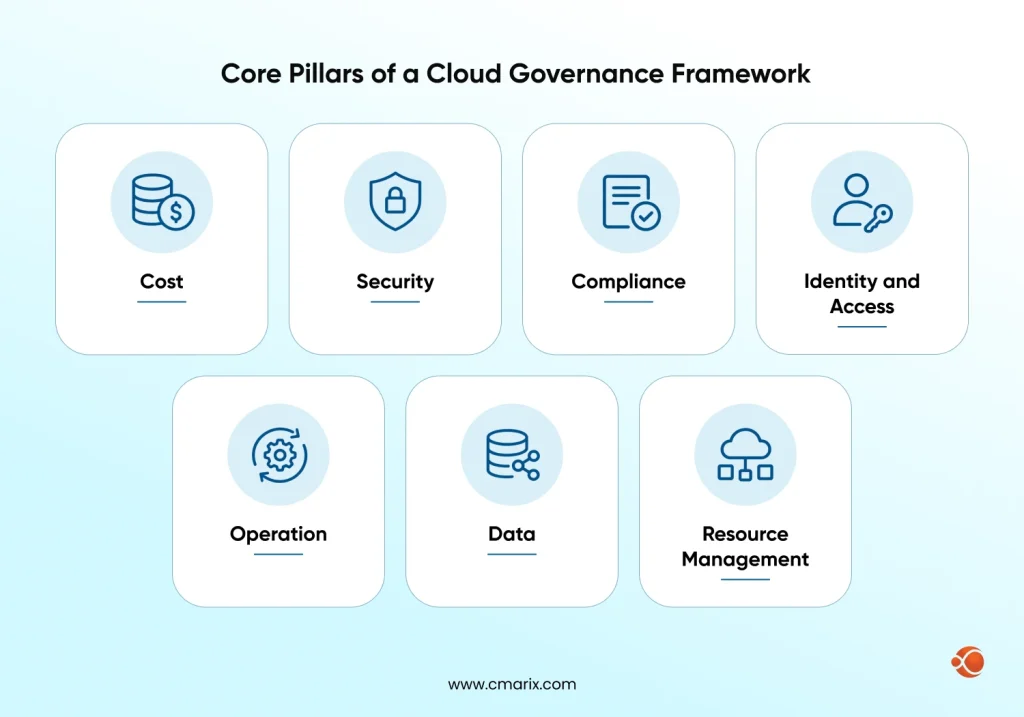
No matter which model you choose, these pillars appear in every working framework. Data governance is one part of the broader cloud governance framework, covering data classification, ownership, access, retention, and quality.
| Pillar | What it covers | Typical owner |
| Cost | Budgets, tagging, showback or chargeback, commitment planning | FinOps lead and finance |
| Security | Encryption, network controls, logging, threat response | Security team |
| Compliance | Regulation mapping, audit evidence, policy exceptions | Risk and compliance |
| Identity and access | Roles, least privilege, single sign on, access reviews | Security and IT |
| Operations | Provisioning standards, monitoring, incident response, backup | Platform or DevOps team |
| Data | Classification, residency, retention, lineage, quality | Data office |
| Resource management | Account structure, naming, lifecycle, decommissioning | Cloud center of excellence |
Enterprise data governance tools can automate classification and lineage once your policies are defined, so write the rules first and buy the tooling second.
Gaps normally start to appear in the data pillar as classification and lineage require clean pipelines. Normally, people opt for data engineering solutions in order to build the required lineage and quality checks before applying any policies on top.
Popular Cloud Governance Frameworks Compared
No single standard covers everything. Most enterprises borrow from two or three of these cloud governance frameworks.
| Framework | Focus | Best for |
| AWS Cloud Adoption Framework | Six perspectives, including governance, security, and operations | Organizations standardizing on AWS |
| Microsoft Cloud Adoption Framework | Strategy, plan, ready, adopt, govern, manage lifecycle | Azure heavy and Microsoft 365 estates |
| Google Cloud Adoption Framework | Readiness assessment across themes such as learn, lead, scale, and secure | Teams building maturity on Google Cloud |
| NIST Cybersecurity Framework | Govern, identify, protect, detect, respond, and recover functions | Regulated industries and government suppliers |
| COBIT | IT governance objectives tied to business goals | Enterprises with strong audit and board oversight |
| ISO 27001 | Certifiable information security management system, with ISO 27017 guidance for cloud services | Organizations needing external certification |
| FinOps Framework | Cloud financial management practices and maturity | Cost accountability across engineering and finance |
Choose whichever fits your platform, and then you can either add NIST or ISO to it for control mapping and FinOps for cost. Also, regarding application-layer controls, quite a few organizations use OWASP security standards as their starting point.
How to Implement a Cloud Governance Framework in 8 Steps
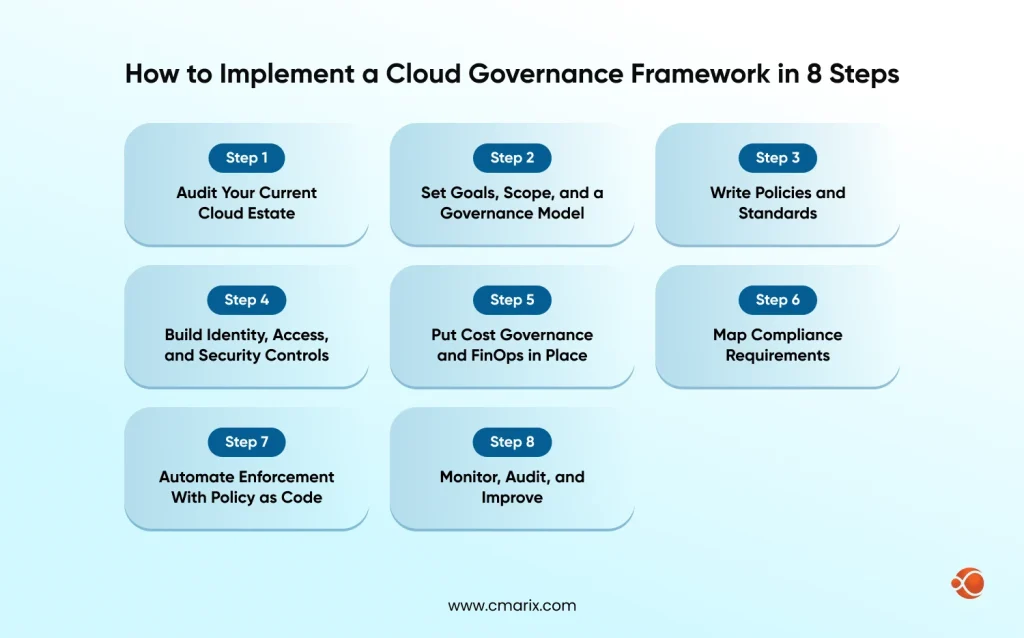
Let’s break it down. These eight steps work in order, but you can run steps 3 to 6 in parallel once the governance model is agreed.
Step 1: Audit Your Current Cloud Estate
Start by identifying the facts. Document all accounts, projects, subscriptions, ownership details, cost information, and associated data for all these elements. Evaluate tag coverage, compliance issues, and identity configuration. If there is still migration of workloads going on, then synchronize your governance efforts to the Azure migration you plan.
Here is what to capture in the audit:
- Account and subscription map- Every account, subscription, and project, with a named owner and business unit.
- Spend by owner- The last three months of cost grouped by team, plus the share of spend with no owner tag.
- Identity and access- Who holds admin rights, where multifactor authentication is missing, and which service accounts exist.
- Data inventory- Workloads with regulated and sensitive data and the regions they are located.
- Configuration risks- Public storage, open network ports, unencrypted volumes, and disabled logging.
Rank the findings by risk and cost, so your first policies go after the biggest problems, not the easiest ones.
Step 2: Set Goals, Scope, and a Governance Model
Determine what the governance structure should accomplish, such as reducing wastage, expediting approval or audit processes, etc. After that, design your cloud governance structure- a cloud center of excellence or governance body with RACI defined for policy, budget, security, and operations. Microsoft’s advice for designing a cloud governance team advises you to assign ownership for each area rather than delegating all responsibilities of cloud governance to a single overstretched group.
A simple RACI table clarifies ownership. R is responsible, A is accountable, C is consulted, and I is informed. Treat this one as a starting example and adjust it to your org chart.
| Activity | Cloud center of excellence | Security | Finance and FinOps | Engineering teams | Executive sponsor |
| Write and update policies | A, R | C | C | C | I |
| Enforce security guardrails | C | A, R | I | R | I |
| Set budgets and review spend | C | I | A, R | R | I |
| Approve policy exceptions | R | C | C | I | A |
| Report compliance status | R | C | I | I | A |
Keep the board small enough to decide quickly, and meet on a fixed schedule. A governance group that only meets after something breaks is not governing anything.
Step 3: Write Policies and Standards
Keep the policies short and enforceable. If a policy cannot be checked, it will not survive.
- Tagging and naming- All resources must have tags in the following categories: Owner- Cost Center- Environment
- Provisioning- Approved services, regions, and instance types for each environment.
- Data handling- Classification levels with rules for storage, encryption, and retention.
- Budget thresholds- Spend limits that trigger alerts and, above a set level, approval.
Every policy should be written in a certain way so that engineers can understand the policy and make it automated: what is the rule, why it should be applied, who owns this rule, how it is monitored, and how to get an exception for it. The policy about tagging could look as follows: all resources must have tags for owner, environment, and cost center; untagged resources are reported after 24 hours and blocked after 7 days in non-production environments.
There should be two types of policies.
- Mandatory policies should be applied throughout the organization and require an exception.
- Recommended policies establish default behavior and allow overriding it for a documented reason.
Step 4: Build Identity, Access, and Security Controls
This forms the core of a cloud security governance program. Implement single sign-on and multi-factor authentication, follow the principle of least privilege, separate duties for production, and encryption and logging by default. Set guardrails at the organizational level to make sure that they cannot be turned off by any one group alone.
Cover these six areas:
- Identity- Use one identity provider across all clouds, require multifactor authentication for every human account, and replace long-lived access keys with short-lived credentials.
- Access- Provide group-based roles rather than individual ones, conduct quarterly reviews of privileges, and employ just-in-time elevations in production.
- Network- Default to private connectivity, limit public endpoints to approved services, and segment production from development.
- Data protection- Encrypt the data at rest and in transit, manage keys centrally, and block public storage by policy.
- Logging and detection- Send audit logs to a central, tamper-resistant location and alert on high-risk events such as root logins or policy changes.
- Shared responsibility- Document which controls the provider handles and which stay with you, so nothing falls into the gap.
Step 5: Put Cost Governance and FinOps in Place
Budgets must be assigned to teams, with spend reported back to their owners, and an alerting system put in place for anomalies. Commitment discounts need to be reviewed on a quarterly basis, and unit costs must be tracked, such as cost per customer or transaction.
A workable cost governance setup includes:
- Budgets and alerts- Setting up budgets monthly for each team/product and setting alerts at defined levels like 50%, 80%, and 100%.
- Showback or chargeback- Show each team its own spend first. Move to chargeback only when tagging is reliable enough to trust.
- Rightsizing and cleanup- Reviewing idle instances, large databases, unattached volumes, and outdated snapshots regularly.
- Commitment planning- Reserved capacity or savings plans for steady workloads, on-demand pricing for spiky ones.
- Anomaly detection- Alerts on sudden daily cost jumps, so a runaway job gets caught in hours instead of at month-end.
- AI and GPU spend- Separate budgets and tags for AI workloads, since usage-based pricing makes them harder to forecast.
Step 6: Map Compliance Requirements
Identify the applicable regulatory frameworks, including HIPAA, GDPR, SOC 2, or PCI DSS, and map the regulations to the relevant controls in your organization. Compliance and cloud governance complement each other most effectively where evidence gathering is automated. An automated cloud compliance model that collects logs, configurations, and access reviews on an ongoing basis prevents audit processes from becoming chaotic.
Here is how common regulations translate into cloud controls:
| Regulation | Focus | Typical cloud controls |
| GDPR | Personal data of people in the EU | Data residency policies, encryption, deletion policies, access control policies. |
| HIPAA | Protected health information | Access controls, audit trails, encryption, business associate agreements with providers |
| SOC 2 | Security, availability, and confidentiality of services | Change management records, access reviews, monitoring evidence |
| PCI DSS | Payment card data | Network segmentation, key management, vulnerability scanning, restricted access |
Assign each control to one owner, decide what evidence proves it, and define how it gets tested. Automated evidence collection supports continuous control monitoring and reduces the effort required during periodic audits.
Step 7: Automate Enforcement With Policy as Code
It is almost impossible to scale up through manual review. Code your policies, execute them in your infrastructure pipeline, and ensure compliance before deploying to production. Our guide to DevOps in practice with real-world automation includes the patterns that make this stick.
Start with a short list of policies that are easy to automate and high in value:
- Block public storage- Reject any deployment that creates publicly readable storage.
- Require tags- Fail the pipeline when owner or cost center tags are missing.
- Restrict regions and services- Allow only approved regions and service types for each environment.
- Enforce encryption- Reject unencrypted databases and volumes.
- Cap instance sizes- Stop oversized resources in non-production environments.
Run checks at three points:
- In the deployment pipeline
- In the pull request
- Continuously against live resources to catch drift
Start in audit mode, where violations are reported but not blocked, then switch to enforcement once teams have had time to clear the backlog. Skipping that warm-up period is the fastest way to turn engineers against the framework.
Step 8: Monitor, Audit, and Improve
Governance is not done via projects but on a continuous basis. Measure your KPIs on a monthly basis, perform control audits quarterly, and set an expiration period for each waiver under exception management. Start with this cloud governance checklist:
- Structure of cloud accounts and subscriptions
- Policy-enforced tagging requirements
- Single sign-on, MFA, and least privilege policies in place
- Encryption and logging enabled by default
- Budgets, alerts, and showbacks in place for all teams
- Mapped compliance controls with automated evidence
- Policy as code executed in deployment pipelines
- Review cadence and exception process set up
Create two views of the same data. Engineers require a dashboard highlighting the violations by teams and how to remediate them. The executives require a short monthly summary highlighting risk, spend, and compliance trends. With both views derived from one source, the numbers will never disagree with each other.
Cloud Governance Tools and How to Choose One
Native tools get you started. Third-party platforms fill the gaps once you run more than one cloud.
| Category | Examples | Best for |
| Native, AWS | AWS Organizations, AWS Control Tower, AWS Config | Multi-account governance on AWS |
| Native, Azure | Azure Policy, Microsoft Defender for Cloud | Policy and posture on Azure |
| Native, Google Cloud | Organization Policy Service, Security Command Center | Guardrails across projects and folders |
| Policy as code | Open Policy Agent, HashiCorp Sentinel | Pipeline enforcement across clouds |
| Cost and FinOps platforms | Flexera One, CloudHealth | Cross-cloud cost visibility and allocation |
| Security posture | Wiz, Prisma Cloud | Misconfiguration and risk detection |
When you compare cloud governance tools, weigh these criteria:
- Multicloud coverage- Can it see all your providers in one view?
- Automation depth- Can it fix or block issues, or only report them?
- Reporting- Can it produce audit-ready evidence and executive dashboards?
- Pipeline fit- Will it fit your delivery process? Policy validations can take place as a pipeline step in Azure DevOps pipelines rather than as a standalone external process.
- Total cost- Licensing models vary, so compare cost at your expected scale, not the entry price.
Governing Multicloud and Hybrid Environments
Multi-cloud complicates the problem of governance because each handles structure and naming differently. Write the same policy statement once as an intent, and then implement that same policy on the native controls of the platforms. It will keep the same tagging methodology, single identity provider, and centralized logging.
For AWS governance best practices across multiple accounts, start here:
- Use AWS Organizations- Group accounts into organizational units by environment or business unit.
- Apply service control policies- Define the maximum permissions available to accounts in an AWS organization. SCPs do not grant permissions, but they help prevent accounts from using services or actions outside the organization’s permitted scope.
- Build from a Control Tower landing zone- you get standard account setup, logging, and baseline guardrails.
- Centralize logs and findings- send them to dedicated audit and log archive accounts.
On Azure, management groups and subscriptions play the same role. On Google Cloud, the organization, folders, and projects hierarchy does the job.
The Azure pattern works in the same way. Apply Azure policies and roles to management groups such that they cascade down to all subscriptions under them. With Google Cloud, apply organization policies to folders and think of projects as units of billing and ownership. Here, the key point is always a singular policy intention enforced natively on each platform and reported in one place.
AI and Cloud Data Governance: Managing AI and Data Workloads
AI changes the picture. Flexera’s 2026 report found that 58% of organizations use generative AI as a public cloud service, up from 50% a year earlier, and these workloads make both spend and data exposure harder to predict. Set rules for which models teams can call, what data can leave your boundary, and how prompts and outputs get logged.
Your data architecture matters too. If you are weighing a central or federated approach, our breakdown of the difference between Data Fabric and Data Mesh explains how each one affects ownership and policy enforcement.
For oversight at the model level, our guide to AI model governance tools covers monitoring, risk scoring, and audit trails.
Cloud Governance Implementation Cost and Timeline for Enterprises
Cost disclaimer: the amounts below represent illustrative ranges based on typical scope of work. Cost will vary based on cloud footprint, number of service providers, compliance burden, and tooling.
| Organization profile | Typical timeline | Indicative budget (USD) |
| Mid size, one primary cloud, roughly 50 to 200 workloads | 8 to 12 weeks | $40,000 to $120,000 |
| Large, two clouds, regulated data | 4 to 6 months | $120,000 to $350,000 |
| Global enterprise, multicloud and hybrid | 6 to 12 months | $350,000 and above |
Five things move these numbers most:
- Account and workload count- More environments mean more policy work and testing.
- Compliance scope- Each added regulation brings new controls and evidence needs.
- Tooling licenses- Platform fees are recurring and scale with usage.
- Automation level- Policy as code costs more upfront and saves effort every month after.
- Change management- Training and adoption work is easy to under budget.
In House Team vs Cloud Governance Partner: Which Is Right for You?
| Factor | In-house team | Governance partner |
| Speed to start | Slower, depends on hiring | Faster, with ready playbooks |
| Upfront cost | Lower cash outlay, higher internal time | Higher cash outlay |
| Expertise | Deep in your business, may lack multicloud depth | Broad across industries and clouds |
| Long-term ownership | Strong | Needs a clear handover plan |
| Main risk | Dependence on a few specialists | Vendor reliance if handover is weak |
Many enterprises land in the middle. A partner builds the framework and automation, and an internal team runs it. If you are short on AWS skills, bringing in dedicated AWS developers for the landing zone and policy automation is a quick way to close the gap.
Common Cloud Governance Challenges and How to Fix Them
| Challenge | Why it happens | Fix |
| Low adoption | Policies feel like blockers | Involve engineers early, publish clear standards, automate approvals |
| Policy sprawl | Rules get added and never cleaned up | Review policies quarterly and retire what no longer applies |
| Slower delivery | Manual reviews at every step | Use guardrails and policy as code instead of ticket queues |
| Unclear ownership | No named owner per account | Require owner tags and review them monthly |
| Tool overlap | Teams buy their own tooling | Standardize on a short approved list |
Cloud Governance Maturity Model and KPIs
A cloud governance strategy needs a way to show progress. This four-stage model gives you a simple scale.
| Stage | What it looks like |
| Ad hoc | Teams govern themselves, no common policies, frequent cost surprises |
| Defined | Policies and owners documented, checks mostly manual |
| Managed | Controls automated, regular reviews, shared dashboards |
| Optimized | Continuous improvement, governance tied to business outcomes |
Track these KPIs to see whether the framework is working:
- Tag coverage- Share of resources with the required tags.
- Policy compliance rate- Share of resources passing automated checks.
- Wasted spend- Idle or oversized resources as a share of total spend.
- Mean time to remediate- How quickly violations get fixed.
- Audit findings- Count and severity per audit cycle.
Get a clear scope, timeline, and budget range for your cloud estate.
Why Choose CMARIX for Enterprise Cloud Governance Services
CMARIX has delivered custom software and cloud solutions across 40+ industries, and our processes are ISO 9001:2015 and ISO/IEC 27001 certified. Our teams pair enterprise DevOps services with cloud architecture, automation expertise, and security to build governance frameworks that engineers actually follow.
- Governance assessment- An audit of accounts, spend, identity, and compliance gaps, with a prioritized fix list.
- Framework and model design- Policies, RACI, and governance board design that aligns with the real work of your teams.
- Policy as code and automation- Guardrails built into CI/CD pipelines and enforced across AWS, Azure, and Google Cloud.
- Cost and compliance setup- FinOps approach, budgets, and audit-proofing of controls based on the compliance requirements you face.
- Handover and enablement- Documentation and training so your internal team can run the framework on its own.
For data and AI-heavy estates, our strategic AI consulting practice helps you set model and data controls that match your risk appetite.
We start with an audit, agree the scope with your stakeholders, and hand over a framework your own team can run.
Conclusion
A cloud governance framework works when it is automated, specific and owned by someone. Begin with an audit, agree on a governance model, enforce policy through code, and measure the results. Teams that do this stop treating cloud bills and audits as surprises.
Don’t try to tackle all the challenges at once. Just pick a single business unit or cloud account, use the eight steps, and validate the approach by measuring improvements in tag coverage, policy compliance, remediation time, and audit findings. Then deploy across the rest of the estate using KPIs described above.
Usage of clouds and AI will continue to grow, and the cost of doing nothing about governance will increase accordingly. The proposed framework is much more cost-efficient than cleanup efforts after that.
FAQs About Cloud Governance Framework
What is an enterprise cloud governance framework?
It is a documented set of roles, policies, controls, and review cycles that governs how a large organization uses cloud services. It encompasses all areas, including cost, compliance, security, data, and operations, across all teams and providers.
What is the structural importance of governance in cloud computing?
The role of governance provides structure in the growth of clouds in terms of standards, ownership, and automation. Without governance, expenditures, accounting, and risks run ahead of everyone’s management capabilities. However, with governance, individuals move quickly within limits, and at the same time, leadership has the necessary visibility.
What are the core pillars of an effective cloud data governance framework?
The core pillars are data classification, data ownership and stewardship, access control, data residency and retention, data lineage, and data quality management. Encryption and logging are fundamental to each of them. They help identify where the data is, who can use it, and how reliable it is.
How does a cloud compliance framework mitigate regulatory risks?
The framework associates every regulatory requirement, like GDPR, HIPAA, and PCI DSS, with certain technical controls and responsible parties. The process of gathering automated evidence shows that these controls are functioning.
What should be included in an enterprise cloud governance checklist?
At minimum, include a documented account structure, enforced tagging, least privilege access, default encryption and logging, budgets and alerts, mapped compliance controls, policy as code, and a review cadence with an exception process. Step 8 above has a ready to use version.
How can IT teams deploy AWS governance best practices across multi-account structures?
AWS Organizations should be used to organize accounts within organizational units. Service Control Policies should be applied as permission boundaries, and Control Tower should be used to create the landing zone. The logging and findings data should be sent to centralized accounts. All should be managed as infrastructure as code.
What features differentiate a modular cloud governance platform from basic native tools?
A modular solution can provide you with cloud visibility, provider-independent policy management, automation for remediation purposes, integration with CI/CD and ticketing solutions, and also audit-ready reports. A native solution is efficient when you work with one provider, while modular solutions will allow you to extend functionality by adding modules of any kind.
How do you integrate a cloud security governance framework with existing DevOps pipelines?
Add policy enforcement steps in the pipeline process that analyze infrastructure as code and prevent any non-compliance from getting through. Policies should be stored in version control and reported back to the dashboards your teams use.
What are the best design steps for building a custom cloud governance model from scratch?
Audit the existing cloud environment, identify objectives and scope, assign responsibilities using RACI, create enforceable policies, and automate them. Begin with just one business unit, demonstrate the effectiveness of the cloud governance model, and then expand on that. Audit it every quarter to keep up with evolving cloud usage patterns.
How do organizations choose between specialized cloud governance tools?
Decide based on the capability of the tool to support multicloud, automation, reporting, and pipeline support. Test the effectiveness of the tool through a proof of concept and measure the reduction in manual effort. Consider the cost incurred relative to expected volume.