


Agentic AI vs Generative AI Quick Comparison:
- Generative AI creates content from a prompt. Agentic AI works toward a goal and takes action.
- Most agentic systems run a generative model inside them, so the two work as a pair.
- Choose generative AI to write drafts, responses, and summaries. Choose agentic AI for multi-step tasks that use your tools.
- Autonomy introduces risks. According to McKinsey, productivity has dropped in almost 30% of businesses using agentic coding tools.
- Begin with one workflow, include human oversight in the process, and evaluate the outcome before scaling up.
Generative AI writes, summarizes, and answers. Agentic AI plans, decides, and acts. That gap determines which one fits your next project. IDC’s forecast puts agentic AI at over 26% of worldwide IT spending by 2029, or $1.3 trillion.
Almost all teams use generative AI today. Chatbots help write emails, summarize documents, and suggest code. The current hype is about vendors marketing autonomous agents that schedule meetings, resolve issues, and update databases independently. These terms get confused often. As a result, people implement the wrong technology, waste allocated funds, and fail in pilot implementations. This guide clarifies the differences between AI agents and chatbots. You’ll learn the purpose, use cases, and interaction between these two technologies. At CMARIX, we have worked with both technologies, so our guide reflects real-world experience.
What is Agentic AI vs Generative AI?
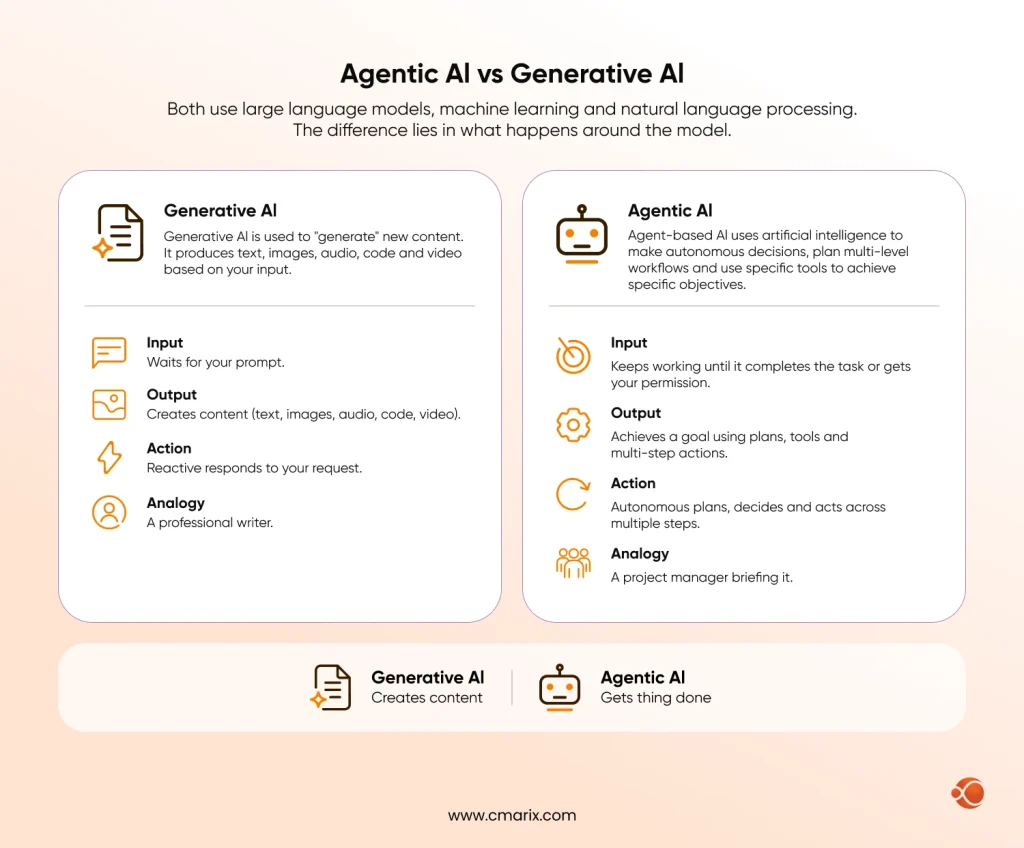
Generative AI is used to “generate” new content. It produces text, images, audio, code, and video based on the input provided. Agent-based AI uses artificial intelligence to make autonomous decisions, plan multi-level workflows, and use specific tools to achieve specific objectives, unlike Gen AI, which reactively creates content based on prompts.
Both use large language models, machine learning, and natural language processing techniques. However, the main distinguishing factor lies in what happens around the model. Generative AI waits for your prompt. On the other hand, agentic AI keeps working until it completes the task or gets your permission. One can compare generative AI to a professional writer. And agentic AI to the project manager briefing it.
Is Agentic AI the Same as Generative AI?
No. An Agentic AI typically uses Generative AI, but it also includes planning, memory, and tool use. When an AI writes a refund email for you, it’s generative. However, when it verifies your order, authorizes the refund, updates the bookkeeping, and sends you the email, it’s agentic.
We identify the right use cases, workflows, and AI architecture for your project.
What Does “Agentic” Mean in the Context of AI?
The word comes from agency, the power to act on your own to reach a goal. In AI, agentic describes systems that decide what to do next instead of waiting for each instruction. The idea is not new. Russell and Norvig’s classic textbook defines an agent as anything that senses and acts on its environment. What changed is simple. Language models now give agents a flexible way to reason. Modern tools give them something to act on.
Agentic AI vs AI Agents
We know AI lingo can get confusing, and many similar-sounding words seem interchangeable. But they are not.
An AI agent is one component. It senses information, makes a decision, and takes an action toward a goal. Agentic AI is the wider approach. Think of AI agents as soldiers and Agentic AI as the army
It may use one agent or many, plus a layer that coordinates them. The count matters less than the ability to pursue goals with the right level of autonomy and oversight.
What Is an Agentic Workflow or Agentic Programming?
An agentic workflow is where AI goes through a loop of planning, acting, checking, and revising instead of responding to prompts. Agentic programming refers to programming AI software this way. In 2024, Andrew Ng, a founding member of Google Brain, made an audacious claim. He said agentic workflows would drive more advances in 2024 than the next wave of agentic AI models.
Agentic AI Design Patterns
Ng also outlined four patterns that show up in most agentic systems.
- Reflection. The model reviews its output and fixes mistakes before responding.
- Tool use. The model calls search, databases, code, or APIs to get facts and take action.
- Planning. The model breaks a large goal into ordered steps and adjusts the plan as results arrive.
- Multi-agent collaboration. Specialized agents share the work, such as one that researches and one that reviews.
Agentic vs Generative AI: Side-by-Side Comparison
The table below shows where the two differ most. Read it as a guide to job fit, not a scoreboard.
| Feature | Generative AI | Agentic AI |
| Primary purpose | Creates content from a prompt | Achieves a goal through multi-step action |
| Role of the user | Writes prompts, reviews output, prompts again | Sets an objective and approves key steps |
| Output | Text, images, audio, video, code | Completed tasks, decisions, updated records (may include content) |
| Autonomy | Reactive. Waits for input | Proactive. Runs several steps on its own |
| System access | Limited unless tools are added | Built around APIs, databases, and tools |
| Memory | Context within a session | Task memory and history across steps |
| Main risk | Wrong or invented answers (hallucination) | Wrong actions, misused permissions, runaway cost |
| Best for | Drafting, summarizing, explaining, coding help | Workflows that span several systems |
However, neither one alone succeeds. Each solves different problems, which we discuss further in the next two sections.
Generative AI: Key Features and Use Cases
Generative artificial intelligence learns patterns from vast amounts of data and applies them to create something new. Most current applications use deep learning techniques. Generative AI works best when the goal is to produce something meaningful.
Key Features of Generative AI
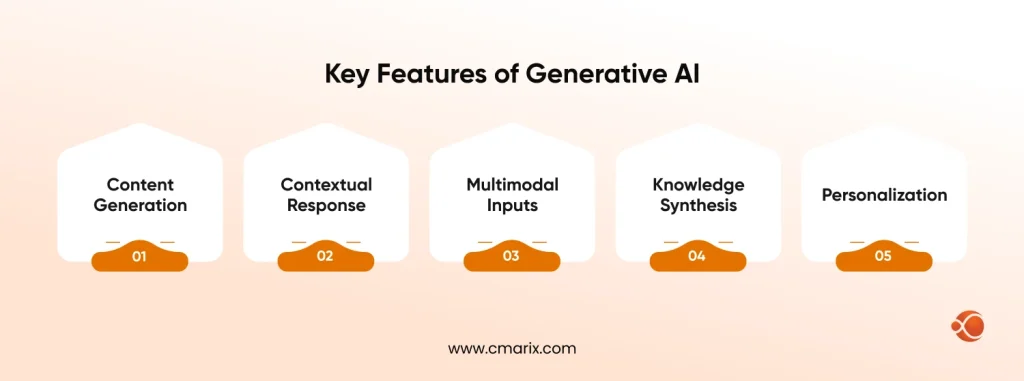
- Content generation. It generates text, images, audio, video, and code. It can also edit content or create summaries.
- Contextual response. It adapts to instructions and feedback inside a conversation. The model itself does not learn from that chat.
- Multimodal inputs. Many applications use text, images, and sound in a single request.
- Knowledge synthesis. It compresses long content and identifies patterns. It may also give false information, so it requires human verification for any important information.
- Personalization. It tailors tone, format, and recommendations to the user and the data it can see.
Generative AI Use Cases
Every use case below follows the same rule. A person asks, the model produces, and a person decides.
- Content creation and marketing. The teams create blog posts, product descriptions, ad copy variations, and email messages. Then they translate and customize them for particular channels. The benefit is faster first drafts.
- Customer support. Assistants answer common questions, synthesize customer conversations, and suggest responses to live customer support representatives. They also write help articles based on old tickets. Answers stay consistent across all channels.
- Software development. Programmers utilize the tool to write boilerplate, explain complicated code, generate tests, and create documentation. The process gets much faster because of the tool. However, reviewers decide on final versions.
- Knowledge management. With retrieval-augmented generation, the model pulls approved documents before it answers. Employees ask questions in plain language and get grounded answers instead of digging through folders.
- Financial services. Analysts synthesize earnings reports, draft client messages, and analyze complex regulatory text. The model explains complex numbers in an understandable way. People check anything that should go to clients.
- Human resources. HR specialists use it to create job descriptions, synthesize resumes, and answer policy-related inquiries. They can use it to develop onboarding guides and reviews.
- Legal and compliance. Lawyers can use it to compare contract clauses, summarize new regulations, and draft policies. It speeds up initial screening. It doesn’t replace lawyers’ decision-making.
- Product design. Product development teams can use it to create requirements, summarize customer feedback, build initial prototypes, and create synthetic data.
Agentic AI: Key Features and Use Cases
Agentic AI keeps the language model and adds the parts that turn answers into action. That shift explains the current wave of enterprise agentic AI trends, from multi-agent orchestration to tighter governance.
Key Features of Agentic AI
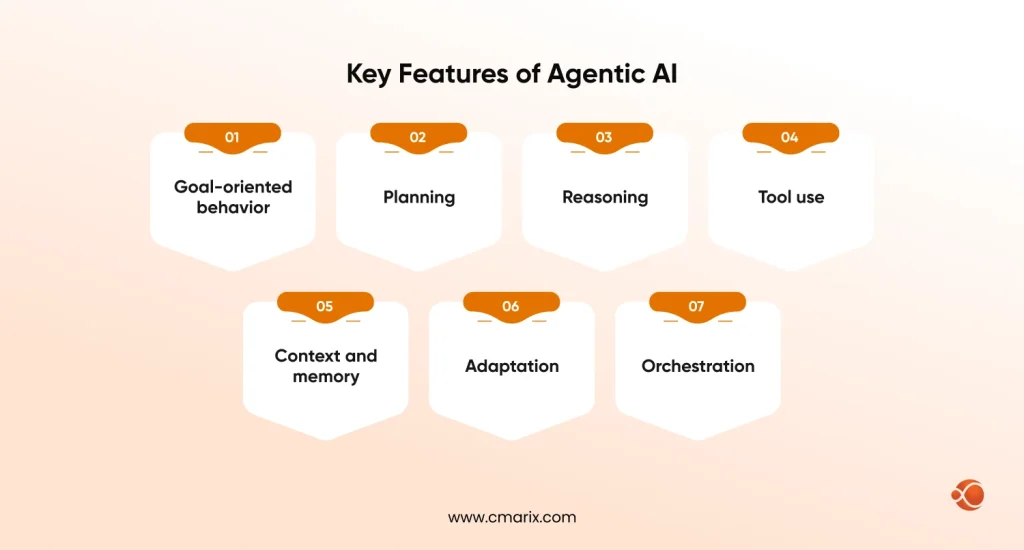
- Goal-oriented behavior. You state the outcome. The system works out many of the steps.
- Planning. It splits a complex goal into smaller tasks and changes course when a step fails.
- Reasoning. It weighs information and picks the next action based on the goal. The depth depends on system design and the oversight you set.
- Tool use. It connects to APIs, databases, and software to fetch data and perform actions. Open standards such as the Model Context Protocol (MCP) make those links easier.
- Context and memory. It records progress, retains previous outcomes, and provides context throughout an operation.
- Adaptation. Feedback loops let it restart, change plans, or query a human when it can’t continue reliably.
- Orchestration. It lets complex systems integrate multiple agents and tools toward a single goal.
Agentic AI Use Cases
Here the pattern flips. You give a goal, the system acts, and a person approves the risky steps.
- Customer service. An agent verifies the customer, checks the order in your system, updates an address, or processes a return. It escalates edge cases to a person. It resolves the request instead of pointing to an article. Our guide to AI customer service in the agentic era shows how this works in practice.
- Software Development. The agent analyzes requirements, develops code, performs tests, finds bugs, and refines the solution before sending it to a software developer for review. It deals with full jobs, not individual pieces.
- IT operations. Agents watch systems, investigate alerts, diagnose problems, and run approved fixes. They keep administrators informed throughout.
- Cybersecurity. The agents correlate events from various tools, prioritize potential threats, and recommend remediation steps. Security analysts retain control of high-stakes situations.
- Financial services. Agents support fraud response, compliance monitoring, and credit risk checks. They keep watching new data and act within policy.
- Healthcare operations. Agents help schedule appointments, document patient information, and communicate with patients. Doctors make clinical decisions and work with private data. CMARIX develops technology for this field through its healthcare software development services. One example is the PBR Insights analytics tool.
- Procurement and Supply Chain. The agents monitor inventory levels, detect disruptions, compare supplier data, and trigger purchasing processes within policy frameworks.
- Human resources. Agents screen candidates, schedule interviews, answer employee questions, and route requests across HR systems.
- Sales and marketing. Agents qualify leads, personalize outreach, watch engagement, and suggest next steps. They can also coordinate campaigns across channels. For a look at customer communication work, see portalCX.
- Workflow automation. Agents run multi-step processes such as document handling, onboarding, and procurement. They use business rules and connect to enterprise apps. Our overview of how enterprise AI agents redefine business processes goes deeper.
Get agentic workflows that connect AI models with your data, tools, and business systems.
How Is Agentic AI Different From Traditional AI, Chatbots, and Predictive AI?
Agentic AI sits at the end of a long line of AI types, so it helps to place each one.
- Traditional AI follows fixed rules or a narrow model built for one task. A spam filter is a good example. It does one job and never changes its goal.
- Predictive AI forecasts from historical data, such as churn risk or demand. It returns a score or a prediction and stops there. An agent can call a predictive model as a tool.
- Generative AI creates new content and responds to prompts.
- Agentic AI pursues goals across steps and systems. It often uses the other three inside its loop.
How Is Agentic AI Different From a Traditional Chatbot?
A traditional chatbot follows scripts and decision trees. It answers what you ask and hands off anything else. An agentic system understands the request, checks your systems, and completes the task. For a deeper look, read How is an AI agent different from a chatbot?
What Is the Difference Between Agentic AI and AGI?
Artificial general intelligence is an imagined system that can match humans’ capabilities in almost everything. Agentic artificial intelligence exists today and operates within certain constraints. An agentic system may look impressive but still falls outside what you provide it.
How Do Generative AI and Agentic AI Work Together?
In reality, you usually don’t choose one over the other, it isn’t supposed to be generative AI vs agentic AI. Agentic systems rely on the generative model to handle language and content generation. The generative model interprets the query, generates the text, and describes the outcome. The agentic layer determines what happens and when.
Think about organizing an event for a customer. In this case, the generative approach would create the agenda, invitations, and presentation materials. In turn, the agentic approach schedules the guests, rents the venue, contacts vendors, etc.
This also applies to software and support. The model generates the code, and the agent plans, tests, and refines it. The model produces the response, and the agent retrieves the customer file and closes the ticket.
Bill Gates offers a useful warning for anyone deploying agents. In 2026, he published an essay titled “A Turbulent AI Era and Critical Choices to Make.” In the best-case scenario, he considers the upcoming transition as “one of the most turbulent eras in human history.” He adds that people sometimes choose to reserve certain functions for themselves, even when a computer can perform them. This concept fits well with agentic design. Models provide the vocabulary. Agents provide the execution. People provide judgment for high-stakes decisions, such as monetary transactions, data deletion, or a critical customer message. Human confirmation doesn’t impede the process; it is what makes a company trust an agent with tasks.
What Do the Numbers Say About Agentic AI Adoption?
Andrew Ng once called AI “the new electricity.” The spending data suggests the grid is being wired fast.
Money is moving first. IDC expects agentic AI to exceed 26% of worldwide IT spending and reach $1.3 trillion in 2029. Software vendors feel the shift next. Gartner estimates that up to $234 billion of enterprise application spending will be exposed to agentic AI by 2030. That equals roughly 20% of enterprise SaaS spending. Agents bypass screens built for people, which weakens seat-based pricing.
Adoption appears possible in big corporations. According to a McKinsey survey, 40% of participants from large companies said they have scaled agents in one or more functions. Big companies are those with revenue exceeding $1 billion.
Lagging behind, the outcomes are. According to McKinsey’s Technology Trends Outlook 2026 report, productivity decreased in almost 30% of organizations after team members introduced agentic AI. It attributes this to poor organization, a lack of a roadmap, and the need for upskilling. Stanford’s 2026 AI Index makes the same point.
Spending is racing ahead of discipline. That is the real lesson for anyone choosing between the two.
Agentic AI vs Gen AI: Which One Does Your Business Need?
Management theorist Peter Drucker noted that “the greatest danger to our future lies in action with yesterday’s logic.” Choosing the right AI technology based on a name is just that, yesterday’s logic.
Start with the job instead. When you review AI tools for business, ask which of the two you are really buying. Any AI-driven digital transformation plan should map each workflow to one of these types.
Five questions make the choice easier.
- Does the task end with content or an answer? Generative AI is usually enough.
- Does it span several systems and several steps? Look at agentic AI.
- Can someone undo a wrong action? If not, keep a human approval step.
- Is your data clean, and can your systems connect through APIs? Agents need both.
- Who owns the outcome when the agent errs? Decide before launch.
As autonomy increases, governance becomes increasingly important. The NIST AI Risk Management Framework provides a straightforward framework for governing, mapping, measuring, and managing risks. Evaluation is also important. Our guidance on evaluating AI agents describes how to evaluate decision-making, not just decision outcomes.
Make vs. Buy? Our analysis of custom AI bots vs. ready-made solutions covers the pros and cons. Budget is another factor. The estimation of AI application development prices offered by CMARIX suggests that simple projects start at $30,000, while complex ones cost over $500,000. Agentic models tend to be expensive to operate, as every action may require a machine learning model or tool. It’s easy to play it safe. Start small, add approvals, track outcomes, and expand the scope. Review overall AI application development costs to better prepare and plan.
Why CMARIX Is a Strong Partner for Combining Agentic and Generative AI
Most businesses do not need a pure agent or a pure chatbot. They need both, wired into their own data and systems. That is where CMARIX focuses.
- One team for both layers. CMARIX AI Application Development Services engineers handle the generative side, including model integration and retrieval pipelines. They also handle the agentic side, including planning, tool connections, and orchestration. Our generative AI development solutions and custom AI agent development services fit together, rather than sitting in separate silos.
- Products, not demos. Our AI application development services wrap models and agents in secure, scalable applications. That includes the interface, integrations, and monitoring.
- A staged path. Teams usually start with a proof of concept, move to an MVP, and then scale. CMARIX reports 50+ AI proofs of concept and 100+ AI deployments. This route lets you test one workflow before you commit a full budget.
- From the get-go, governance. We plan approvals, logging, and evaluations from the start because agents interact with the system.
- Industry experience. CMARIX has created software solutions for healthcare, fintech, and customer interaction. That experience gives us insight into where an agent is needed and where only a generative agent will suffice.
- Flexible engagement. You can hire a dedicated AI team or hand over a scoped project. Either way, you keep control of priorities.
Choosing a partner is a decision in itself. Our checklist, How do you choose an AI agent development company?, shows what to ask any vendor, including us. If you want to test one workflow, speak with the CMARIX AI team about a scoped pilot.
FAQs About Gen AI vs Agentic AI
What is the difference between Generative AI and Agentic AI?
Generative AI generates content in the form of text, images, or code from a prompt. Agentic AI achieves a goal through planning, tool usage, and acting within the system. One produces outputs; the other produces outcomes.
Is Agentic AI the same as Generative AI?
No, Agentic AI usually involves running a generative model but with planning, memory, tool usage, and autonomy. Generative AI, by contrast, answers prompts and creates outputs without taking further action. Agentic AI requires connections to tools to take action.
What does “agentic” mean in the context of AI?
“Agentic” means the AI has the agency to decide the next move and take action toward achieving a goal without specific step-by-step instructions. This level of autonomy will depend on your design and oversight.
How is Agentic AI different from traditional AI chatbots?
Chatbots follow a script and hand over more complicated requests to a person. However, Agentic AI understands the request, reviews your systems, and performs a task. It can also escalate to a person if it can’t continue reliably.
How does Agentic AI differ from earlier forms of AI?
Earlier AI focused on pattern recognition, prediction, or rule-based systems. Agentic AI integrates natural language processing along with planning and tool usage. It can break down a task into steps and adapt to changes in outcomes.
What is the difference between Agentic AI and AGI (Artificial General Intelligence)?
AGI refers to an imaginary system that is competent at most things like a human being. Agentic AI, on the other hand, is real and operates within set boundaries. It can do things based on your goals, but only using the means you give it.
What is the difference between Agentic AI and Predictive AI?
Predictive AI forecasts outcomes from historical data and returns a score. Agentic AI takes action toward a goal. An agent can use a predictive model as a tool, such as a churn score that triggers a retention offer.
What are some real-world examples of Agentic AI vs Generative AI?
Generative AI includes tasks like writing an email, summarizing a contract, writing code, and generating product images. Agentic agents are those that complete tasks, like checking out an identity and issuing a refund by an agent for support purposes. Another example is a coding agent that writes and tests code.
What are AI agents in Generative AI?
They are software systems that operate based on a generative model and include sensing, deciding,, and acting. The model provides language and reasoning capabilities. The agent provides tools, memory, and loops that continue working toward the goal.
What is Agentic Programming or an Agentic Workflow?
An agentic workflow is a process in which an agentic loop plans, acts, observes results, and adapts. Developing software programs that work this way is called agentic programming.