




Quick Summary: Angular statistics in 2026 reveal a framework built for long-term enterprise stability rather than short-term trends. This blog compiles key Angular statistics on adoption, market share, salaries, usage trends, and roadmap updates to help businesses and developers evaluate its real-world impact and future viability.
The front-end ecosystem moves fast. Trends change every year. Frameworks rise and fall.
Angular has a different approach. It emphasizes stability, organization, and scalability. It is designed for large-scale teams and business-critical applications. In 2026, Angular will remain a prominent enterprise framework. It is used for building platforms in finance, healthcare, government, and SaaS. With steady adoption, it has amassed a noteworthy market share and offers competitive compensation for Angular developers globally.
Answers you will get in this detailed Angular statistics library 2026
- What is Angular, and how does it differ from AngularJS?
- How popular is Angular in 2026?
- Is Angular a growing, stable, or shrinking framework
- How does it compare to React, Vue.js, and Svelte?
- What is the actual market share and corporate adoption of Angular?
- Which countries and sectors use Angular the most?
- What is the job market and salary situation like
- What does NPM download data and website metrics say about actual usage?
- What is on the 2026 Angular roadmap?
- Is Angular a sound long-term enterprise solution?
What is Angular?
Angular is an open source, TypeScript-driven framework that uses SPA architecture and is developed and maintained by Google. Unlike UI frameworks like React, which only provide UI elements and little else, Angular provides its own routing, HTTP client, forms, dependency injection, state management, and testing utilities out-of-the-box. Angular 21, the latest major release (late 2025), builds on Angular 20’s stabilized Signals API and zoneless change detection, adding Signal Forms as a stable feature and deeper AI-first tooling.
An important distinction: AngularJS (v1.x) and Angular (v2+) are entirely different frameworks. Google ended support for AngularJS in January 2022. All modern references to ‘Angular’ mean the v2+ platform, actively developed and maintained by Google.
Key Angular Statistics 2026 Overview at a Glance
| Metric | Angular Statistics | Source |
| Developer adoption | 18.2% of all developers | Stack Overflow Survey 2025 |
| Companies using Angular | 51,737 globally | 6sense, 2026 |
| Live websites | 60,054+ active sites | BuiltWith, 2025 |
| Front-end framework category market share | 48.24% | 6sense, 2026 |
| Peak NPM weekly downloads | 4,799,194 | NPM Trends |
| Recent NPM weekly downloads | 4,650,010 (Feb 8, 2026) | NPM Trends |
| US share of Angular-using companies | 45.84% (16,904 firms) | 6sense, 2026 |
| Average Angular developer salary (US) | $131,594 / year | Glassdoor, Dec 2025 |
| Signals API status | Stable (Angular v20, May 2025) | Angular Roadmap |
| Zoneless mode status | Stable (Angular v20.2) | Angular Roadmap |
What Makes Angular a Popular Choice in 2026?
Angular popularity trends stems from practical enterprise needs, not trends. Here’s what keeps large organizations loyal to it:
- Google’s support: organizational commitment, LTS support, and an engineering team ensure stability that cannot be achieved by community-driven projects.
- Enforced architecture: Angular’s opinionated architecture ensures a common pattern for all teams and projects, which is a huge win when dozens of developers are contributing to the same codebase over many years.
- Signals & Zoneless mode: Angular 20 stabilized the Angular Signals API and moved to zoneless change detection as stable, providing 30-50 KB bundle size reductions, 40-50% improvements in LCP, and improved debugging.
- Built-in security: automatic XSS sanitization, CSRF protection, and TypeScript’s compile-time type safety make Angular the default choice for finance, healthcare, and government applications.
- Superior tooling: the Angular CLI, Angular Material, DevTools, and a new MCP server (August 2025) connecting Angular docs to AI coding assistants make Angular one of the most productive development platforms available.
“React optimizes for individual developer speed; Angular optimizes for organizational safety.” Hire dedicated Angular developers from a trusted frontend development company to have the best chance at building scalable, and engaging applications.
Angular Usage Statistics: How Many People Use Angular in 2026 and Beyond?
According to the StackOverflow Developer Survey 2025 data, 18.2% of all developers report to actively use Angular, the second most used framework after React (44.7%). Angular adoption has held a steady grip and grown slightly year-over-year:
| Framework | 2023 | 2024 | 2025 |
| React | 40.58% | 39.50% | 44.70% |
| Angular | 17.46% | 17.10% | 18.20% |
| Vue.js | 16.38% | 15.40% | 17.60% |
| Svelte | 6.62% | 6.50% | 7.20% |
The Angular data statistics reveals a remarkably consistent story: Angular’s adoption has held steady at roughly 17-18% for three consecutive years, even as the overall developer survey landscape has shifted. Far from declining, Angular’s share has actually modestly grown from 17.1% in 2024 to 18.2% in 2025. When Statista surveyed developers in 2024, their data similarly placed Angular at 18.2% of all developers worldwide.
Admired vs. Used: The Enterprise-Consumer Gap in Angular’s Usage
It’s interesting to see a huge discrepancy between the numbers from actual Angular enterprise usage data and how much developers generally respect Angular. In the 2025 Stack Overflow Survey, 18.2% of developers reported using Angular, yet only 44.7% of those users indicated they admired or respected Angular, putting Angular behind Svelte (62.4%), React (52.1%), and Vue.js (50.9%).
The issue is less about Angular development services being irrelevant and more about it being built to work within a certain framework. You see, as mentioned earlier, Angular is primarily used in enterprise businesses where the cost of changing (switching costs) is extremely high, and so developers would rather use Angular because their company tells them to do so, while they may use a smaller framework for their own projects.
NPM Download Trends
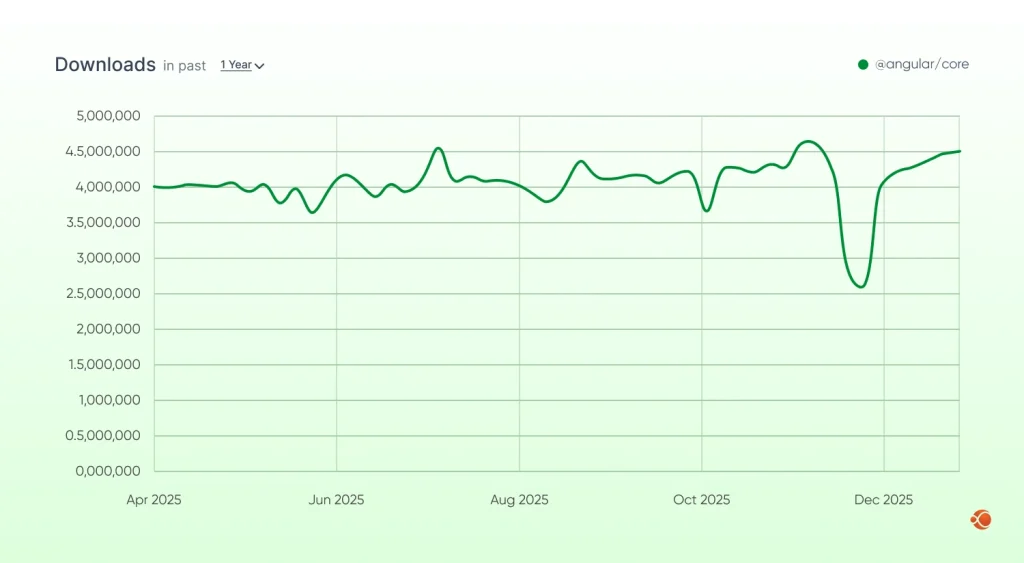
NPM download data provides one of the most concrete and unbiased measures of a framework’s actual usage. Angular’s download trajectory through 2025 and into 2026 shows consistent demand, with peak usage recorded at 4,7,99,194 on November 30, 2025, and the latest recorded usage reaching 4,650,010 on Feb 8, 2026.
Website Adoption Data
Website-level adoption statistics from W3Techs and BuiltWith provide a different but equally valuable perspective. According to W3Techs, Angular is used by 0.3% of all websites globally whose JavaScript framework is known, a number that understates Angular’s importance, because Angular powers a disproportionately high percentage of high-traffic, high-complexity enterprise web applications.
BuiltWith data shows that over 60,054 live websites are actively using Angular. This includes major enterprise portals, financial platforms, government services, and healthcare applications, sites that collectively serve billions of user sessions monthly.
Understanding Angular’s True Reach
Angular is used by fewer websites than Bootstrap or jQuery, but those websites receive significantly more traffic. This is the enterprise pattern: fewer, larger, more impactful deployments.
GitHub & Community Interest
The Angular GitHub repository has seen well over 90,000 stars due to continued developer interest and community involvement. The repository is constantly updated with active issue- and pull-request-tracking, as well as RFCs (Requests For Comments) to help build the framework’s roadmap. The Angular open development process also involves soliciting public comments on RFCs (there are more than 1,000 comments on the Signals API RFC), which provides evidence that the Angular community is a healthy, engaged open-source community, even though Angular is typically associated with enterprise projects.
Contact our team to build fast, scalable, and enterprise-grade applications.
Contact UsAngular Market Share: How Big is Angular’s Market Share?
Angular’s market share is best understood through two distinct lenses:
- Share of the front-end framework ecosystem
- Share of the enterprise application development market.
The former is more commonly cited and places Angular second; the latter is where Angular’s dominance is most pronounced.
Front-End Framework Market Share
More than 51,737 companies worldwide have adopted Angular as their front-end framework tool as of 2026. In the front-end framework category tracked by 6sense, Angular commands a 48.24% market share among its direct category competitors, ranking it at the top of its competitive set.
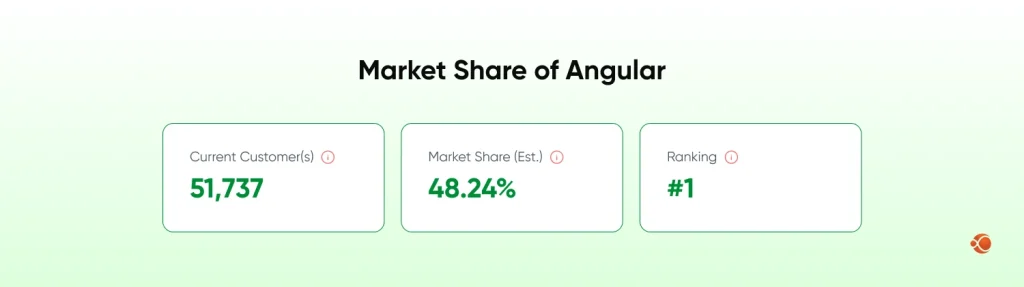
The apparent discrepancy between 48.24% category market share and 0.3% global website share reflects the difference in market definition. When we measure Angular’s share among companies that have adopted specialized front-end frameworks, excluding the vast majority of simpler websites that use no framework. Among enterprises that have deliberately decided to build structured, component-based applications, Angular holds a commanding position.
Company Size Distribution
One of the most revealing aspects of Angular’s market data is the distribution of its users by company size.
| Company Size | Companies Using Angular |
| 100 – 249 employees | 12,827 companies |
| 20 – 49 employees | 12,816 companies |
| 1,000 – 4,999 employees (Enterprise) | 5,347 companies |
| Small (<50 employees) | 51% of all Angular customers |
| Large (>1,000 employees) | 15% of all Angular customers |
| Medium (50-999 employees) | 34% of all Angular customers |
According to the same 2025 Stack Overflow Survey, Angular scored just under React and Vue in regard to ‘admired’ (React: 52.1% | Vue: 50.9% | Angular: 44.7%), and based on the data collected, it can be inferred that the main reason developers choose to use Angular is because of their company’s requirements. Meaning that the primary reason Angular is used is because of a corporate need rather than an individual developer’s sentiments regarding the framework.
Angular Regional Adoption Trends
Angular adoption is strongest in mature enterprise software markets where large teams build and maintain complex applications. The United States leads by a significant margin, followed by India and Brazil, with a strong presence across key European economies.
Regional breakdown:
| Rank | Country | Usage Count | Percentage Share |
| 1 | United States | 30,457 | 62.67% |
| 2 | Germany | 5,644 | 11.62% |
| 3 | India | 3,783 | 7.79% |
| 4 | United Kingdom | 3,004 | 6.18% |
| 5 | Mongolia | 1,387 | 2.85% |
United States
- 30,457 usage count (62.67% share in this dataset)
- 45.84% of global Angular-using companies (16,904 firms)
- Average salary: $130,700/year (Dec 2025); top earners reach $201,779
- Strong enterprise adoption across SaaS, finance, healthcare, and large tech firms
Germany
- 5,644 usage count (11.62%)
- One of Europe’s strongest enterprise software markets
- Heavy usage in automotive, manufacturing, and industrial tech sectors
- Stable demand driven by large B2B platforms and regulated industries
India
- 3,783 usage count (7.79%)
- Major hub for global IT services and outsourcing
- Widely used by firms like Tata Consultancy Services and Infosys
- Strong enterprise and offshore development demand
United Kingdom
- 3,004 usage count (6.18%)
- Strong adoption in fintech and enterprise SaaS
- Used across banking, insurance, and government digital services
- Consistent demand in mid-to-large enterprise projects
Mongolia
- 1,387 usage count (2.85%)
- The developer market is smaller but more concentrated
- Adoption is likely driven by digital modernization and outsourcing projects
- Emerging tech ecosystem relative to market size

What’s the Job Market Like for Angular Development in 2026?
The Angular job market reflects its enterprise positioning: high compensation, concentrated in stable industries, with genuine demand from organizations that need specialized skills.
| Source | Average Salary (US) | Range |
| Glassdoor | $134,195/year average | $107,708–$168,913, top earners $206,701 |
| ZipRecruiter | $121,649/year average | range $109,500–$134,000, top earners $146,000 |
| Top earners (Glassdoor) | $201,779 / year | Principal engineers, FAANG |
Industry-Wide Angular Adoption and Use Cases
Financial Services
Angular is widely adopted in the finance sector for building secure, data-intensive platforms, such as trading dashboards and online banking portals. The structured architecture and inherent security features of Angular make it an excellent choice for building systems that require compliance and reliability, as well as maintainability.
- Secure architecture ideal for regulatory applications
- Strong support for real-time data dashboards
- Built-in testing tools for risk-sensitive systems
- Scalable code structure for large finance teams
Healthcare
Healthcare applications use Angular to handle the complexities of patient data and medical workflows. Angular is well-suited for applications that require precision, adherence, and stability because of its modularity and comprehensive testing infrastructure.
- Angular framework for structured medical workflows
- Support for HIPAA-compliant application development
- Strong testing ecosystem for reliability
- Real-time interaction capabilities for patient portals
E-Commerce & Retail
Angular helps retailers manage large-scale commerce platforms that require dynamic pricing, inventory control, and seamless integrations. Its architecture supports complex business logic while keeping the codebase maintainable as the platform grows.
- Efficient handling of large product catalogs
- Real-time inventory and pricing updates
- Easy integration with payment and supplier systems
- Flexible architecture for scaling operations
Education Technology (EdTech)
Learning management systems and digital education platforms use Angular to support structured content delivery and collaboration. Its organized framework makes it easier to manage multiple user roles and interactive learning experiences.
- Structured role-based access management
- Assessment and evaluation engine support
- Real-time collaboration features
- Scalable architecture for growing institutions
Government & Public Sector
Public sector platforms require secure, accessible, and standardized systems. Angular’s opinionated structure helps maintain consistency across teams, while its accessibility alignment supports inclusive digital services.
- Secure framework for citizen service portals
- Consistent code standards across departments
- Accessibility support aligned with WCAG
- Suitable for long-term public infrastructure projects
SaaS & Enterprise Software
Angular is commonly used to build complex enterprise systems such as ERP, CRM, and HRMS platforms. Its modular and lazy-loaded architecture supports large teams working in parallel while ensuring scalability over time.
- Modular architecture for enterprise-grade systems
- Lazy loading for Angular performance optimization
- Supports parallel development workflows
- Long-term scalability for evolving business needs
Top Use Cases for Angular in Enterprise Environments
Angular’s comprehensive architecture makes it the natural fit for a specific set of high-value enterprise scenarios:
| Use Case | Why Angular Works Well |
| Enterprise SPAs (Portals, ERP, CRM) | Routing, lazy loading, and role-based access help manage complex navigation and large user systems. |
| Financial Dashboards & Trading Platforms | Handles live market data smoothly with RxJS. TypeScript reduces calculation and data-handling errors. |
| Healthcare Patient Systems | Modular structure manages multi-source data and supports HIPAA-compliant deployments. |
| Progressive Web Apps (PWAs) | Built-in service worker support enables offline access, push notifications, and app-like experiences. |
| Micro-Frontend Architecture | Angular in Micro Frontend architecture uses a module system and Module Federation makes it easier to split large apps into smaller front-end modules. |
| Server-Side Rendering (Angular Universal) | Improves page speed and SEO. Hydration enhancements help strengthen Core Web Vitals performance. |
| Hybrid Mobile Apps (Angular + Ionic) | Angular for mobile app development uses one codebase that supports iOS, Android, and web apps, reducing cost and speeding up development. |
Angular vs React vs Vue: Which Framework Should You Actually Build On?
Angular market share numbers and developer adoption rate figures only answer half the question. The other half is which framework actually fits the team and project sitting in front of you right now.
| Factor | Angular | React | Vue |
| Best team size | Large, multi-team orgs | Small to mid-size teams | Small teams, solo devs |
| Learning curve | Steeper, opinionated | Moderate, flexible | Gentle, approachable |
| Long-term maintenance | Lower, enforced structure | Depends on team discipline | Lower on small codebases |
| Hiring pool | Smaller, enterprise-skewed | Largest pool available | Growing, smaller than React |
| Best fit | Regulated, long-lived enterprise systems | Fast-moving product teams | Lightweight apps, progressive adoption |
Angular’s case comes down to structure. It’s a TypeScript-based web framework that ships routing, forms, HTTP, and dependency injection out of the box, so ten different teams building custom web applications with Angular end up writing code that looks similar instead of ten different versions of the same problem. That consistency is what shows up later as lower maintenance costs, which is the trade a lot of enterprise buyers are making when they pick Angular over something more flexible.
If you’re evaluating the Angular ecosystem itself, not just the core framework, it’s worth a look at the best Angular frameworks built on top of it. Tools like Angular Material and NgRx extend what Angular already gives you, which is part of why enterprise-grade web development teams keep choosing it even when React wins on raw popularity.
Angular’s Future: What’s Coming in 2026 and Beyond?
Zoneless by Default
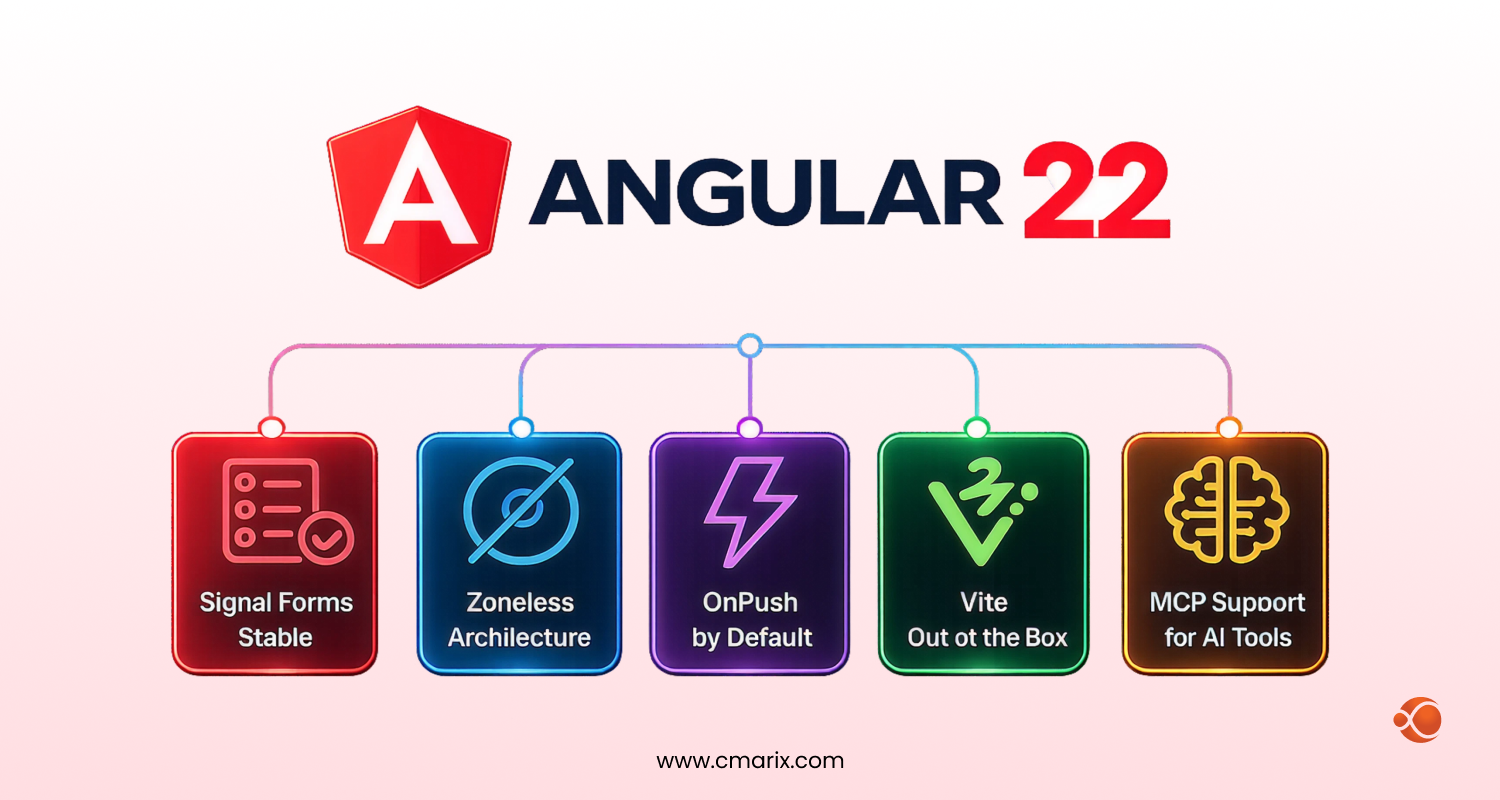
The latest Angular version (v22) will have no dependency on Zone.js, thus cutting the size of your bundle (from 30 KB to 50 KB) and providing better stack traces when debugging. Signals will also enable more accurate detection of changes in large applications.
An AI-Ready Ecosystem
The Angular team has built an MCP server that connects AI coding assistants to Angular documentation and guidelines. Minko Gechev, the lead for the Angular project, has also worked on LLM-first ideas to integrate AI development more deeply.
Nitro & SSR Evolution
The Angular team is working to integrate Nitro into the Angular CLI to enable faster builds and a more streamlined production toolchain. It’s currently opt-in/experimental. This will provide enhanced runtime compatibility, improved deployment options, and support for file-based routing patterns currently used in many modern meta-frameworks.
Signals-Based Forms
Signal Forms shipped stable with Angular 21, giving teams a signals-based way to manage form state instead of the older reactive forms API. Angular built-in interoperability with existing reactive forms, so large form-heavy applications can migrate a section at a time.
Conclusion
The data paints a clear picture: Angular in 2026 is not a framework in decline, but a framework that has found its lane and is executing exceptionally well within it. With 18.2% developer adoption (Stack Overflow 2025), over 51,000 companies globally, peak NPM downloads of 825,221 in a single week, and a stable of enterprise giants in finance, healthcare, government, and technology relying on it daily, Angular’s relevance is unquestionable.
Abbreviations Used in This Angular Statistics Guide
| Abbreviation | Full Form |
| JS | JavaScript |
| TS | TypeScript |
| AngularJS | Angular JavaScript (v1.x) |
| SPA | Single Page Application |
| ERP | Enterprise Resource Planning |
| CRM | Customer Relationship Management |
| HRMS | Human Resource Management System |
| SaaS | Software as a Service |
| PWA | Progressive Web App |
| SSR | Server-Side Rendering |
| CLI | Command Line Interface |
| XSS | Cross-Site Scripting |
| CSRF | Cross-Site Request Forgery |
| LTS | Long-Term Support |
| NPM | Node Package Manager |
| RFC | Request for Comments |
| RxJS | Reactive Extensions for JavaScript |
| HIPAA | Health Insurance Portability and Accountability Act |
| SOX | Sarbanes-Oxley Act |
| SEO | Search Engine Optimization |
| LCP | Largest Contentful Paint |
| MCP | Model Context Protocol |
| LLM | Large Language Model |
| FAANG | Facebook, Apple, Amazon, Netflix, Google |
| B2B | Business-to-Business |
| IT | Information Technology |
| IoT | Internet of Things |
| WCAG | Web Content Accessibility Guidelines |
| W3C | World Wide Web Consortium |
| HTTP | Hypertext Transfer Protocol |
| AI | Artificial Intelligence |
FAQs on Angular Statistics 2026-2030
Is Angular still relevant for web development in 2026?
Indeed. Angular was at second place in the 2025 Stack Overflow Survey with 18.2% developer adoption rate, while downloads of the @angular/core library on npm have increased to the level of 5 to 6 million per week this year, as opposed to 4.8 million in late 2025. However, the framework is not the one making headlines.
What is the difference between AngularJS and the modern Angular framework?
AngularJS (version 1.x) and Angular (version 2 and above) are two separate frameworks that happen to share a name. Google ended AngularJS support in January 2022, and every current reference to “Angular” points to the actively developed rebuild, now on version 21. The two aren’t code-compatible, so moving between them means a rewrite, not an upgrade.
How does Angular’s market share compare to React in 2026?
React leads on raw developer usage, with 44.7% in the 2025 Stack Overflow Survey against Angular’s 18.2%. Narrow the lens to companies that have deliberately adopted a structured front-end framework, though, and Angular holds 48.24% of that category according to 6sense data, ahead of React within that specific slice. Where Angular ranks depends entirely on which measure of frontend framework popularity you’re looking at.
Can Angular be used for SaaS platforms?
Yes. Angular is widely used for SaaS platforms including ERP, CRM, and HRMS systems, supporting modular architecture, role-based access, and scalable multi-tenant application development.
Which is the latest stable version of Angular?
Version 21 of Angular, which was released at the end of 2025, is the latest version of Angular. This version builds on the mature reactive signals architecture and dependency-less change detection in Angular 20, with the addition of Signal Forms as a stable module.
What percentage of developers use Angular worldwide?
Approximately 18.2% of developers worldwide report actively using Angular, according to recent developer surveys, placing it among the top three front-end frameworks globally.
Is there a high demand for Angular developers in the current job market?
Yes, especially in finance, health care, and government industries where stability is more important than efficiency. Glassdoor reports the average annual salary for an Angular developer to be $134,195, while the maximum salary stands at $206,701. In contrast, ZipRecruiter estimates an even higher salary range of $121,649 on average. The employment demand trend for Angular developers in 2026 is likely to stay the same.
How has Angular’s performance evolved with Signals and Zoneless mode?
Performance has dramatically increased after Angular 20 was able to stabilize these components since now 30 to 50 KB are saved from bundle size and Largest Contentful Paint is improved by 40 to 50%. Eliminating Zone.js also helps to achieve clean stack traces that save some time while debugging on big projects. Angular 21 combines all these achievements but doesn’t break anything from version 20.
What percentage of top websites use the Angular framework?
The number provided by W3Techs shows 0.3% of all websites on which the framework is deployed in terms of website usage, but this is misleading due to the fact that Angular mainly powers complex websites. On the other hand, BuiltWith has tracked more than 60,054 live websites currently powered by Angular.
What are the key features in the Angular 2026 roadmap?
The Angular roadmap 2026 centers on deeper Nitro integration into the Angular CLI for faster, more streamlined production builds, continued work on AI-assisted tooling through Angular’s MCP server, and ongoing refinement of Signal Forms interoperability with older reactive forms. None of this is speculative. All three are already in active development per Angular’s own published roadmap.