



Quick Summary: Developer experience (DevEx) makes deployment easier in 2026 by reducing cognitive load and automating repetitive tasks. Companies that invest in developer experience ensure engineers focus on developing applications rather than solving infrastructure problems.
It’s not that teams move slowly because developers move slowly. They move slowly because of all the context that surrounds those developers.
Slow CI pipelines. Manual deployment approvals. Fragmented toolchains. Unclear ownership. These are friction costs; they accumulate silently across every sprint and compound over time.
Developer experience, or DevEx, is the conscious effort to make things easier. It includes aspects such as tools and processes, documentation, and even the developer’s mental burden throughout the day.
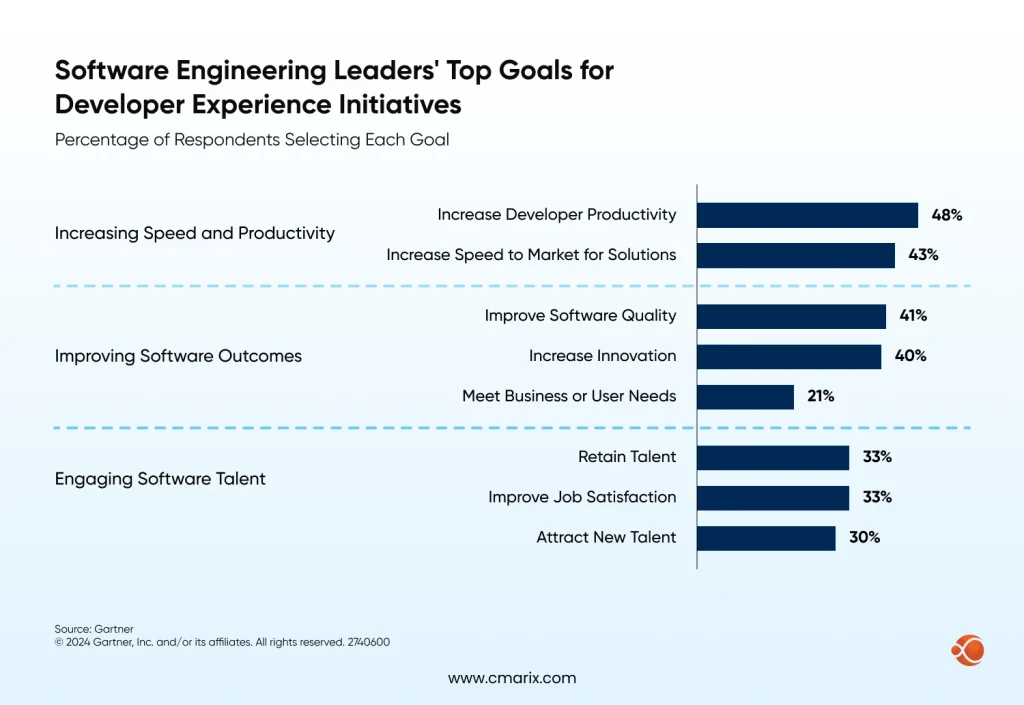
According to Gartner, the top goals for DevEx initiatives are increasing developer productivity by 48%, improving speed to market by 43%, improving software quality by 41%, and increasing innovation by 40%. Retaining talent and improving job satisfaction also rank highly at 33% each, showing that DevEx is as much about keeping teams effective as it is about making them faster.
This blog will cover
- Definition and importance of DevEx in 2026, as well as reasons why it impacts delivery times.
- Sluggish CI processes, approval delays, and disparate tools are slowing down delivery.
- Why Internal Developer Portals (IDPs) are becoming essential for self-service engineering.
- How Flow Metrics help teams measure velocity, efficiency, load, and cycle time.
- The role of Golden Paths in standardizing and accelerating software delivery.
- How AI tools are being used to reduce engineering toil and improve feedback loops.
- What DevEx changes help decrease the delivery cycle in actual engineering teams?
- How to measure DevEx ROI using delivery speed, quality, and developer satisfaction.
- Why top engineering teams treat DevEx as a system design strategy, not just a tooling upgrade
- How CMARIX helps organizations build faster, more scalable engineering workflows.
What Is Developer Experience (DevEx), and Why Does It Affect Delivery Time?
“Developer Experience” (DevEx) refers to how efficiently and comfortably a developer can move from an idea or task to working, tested, deployed code.
The concept borrows from user experience research. Just as UX asks, “How easily can a user accomplish their goal?” DevEx asks, “How easily can a developer accomplish their technical goal, without unnecessary friction?”
The friction shows up in predictable patterns:
- A developer waits 25 minutes for a CI build to finish. During this period, he switches contexts. Now that he has received the build status, switching contexts again takes him 15 minutes.
- A new engineer spends three days configuring their local environment before writing a line of production code.
- An infrastructure change requires an ops ticket, which adds 48 hours to a feature that was otherwise complete.
None of these is an engineering failure. They are system design failures, and the good news is they are easily fixable.
Two concepts are central to understanding DevEx in 2026:
| Term | Definition | Typical Tools / Examples | Why It Matters |
| Internal Developer Portal (IDP) | A centralized, self-service platform that lets developers provision infrastructure, access service documentation, track deployment status, and manage secrets without depending on another team. | Backstage, Cortex, Port | Reduces bottlenecks, improves developer autonomy, and speeds up delivery by making common tasks self-service. |
| Flow Metrics | A framework for measuring how work moves through an engineering system across four dimensions: flow velocity, flow efficiency, flow load, and flow time. | Mik Kersten’s Flow Framework, Flow Framework community practices | Gives teams a business-outcome view of delivery performance that DORA metrics alone do not fully capture. |
Both of these: IDPs and flow metrics, are practical instruments. Teams implement them, measure against them, and use the data to make investment decisions. They are not strategic abstractions.
The Technical Reality of Slow Delivery
Before exploring what DevEx improves, it is worth being precise about where delivery time actually goes.
Research from the DORA 2024 State of DevOps Report and analysis from Jellyfish. Co-identify the most common delivery bottlenecks:
1. AI adoption can improve productivity, but it is not automatically a delivery-speed win
AI can increase productivity and flow, leading to greater job satisfaction for individuals. AI could lead to unstable, inconsistent software delivery if the development team does not stay on track with their engineering methods. For this reason, AI thrives best in a disciplined environment rather than in chaos.
2. Platform engineering and internal developer platforms matter
In DORA, both platform engineering and internal developer platforms have been considered critical levers for performance. Such platforms can enhance performance by making development easier. On the other hand, if such platforms are not properly designed, they may cause instability and slow performance.
3. Stable priorities are a major factor in delivery speed
Unstable priorities within an organization can be seen as counterproductive, as they contribute to employee burnout. When teams continuously change course, even if engineering methods are well-implemented, they become ineffective. This is where priorities come in to provide focus to teams.
4. Cloud infrastructure helps when used well
DORA also points to flexible cloud infrastructure as a positive factor in performance. The advantage comes from using cloud capabilities to support delivery, experimentation, and scale. Simply moving to the cloud is not enough unless the operating model changes, too.
5. Slow delivery is a system problem
This is a systemic issue involving priorities, inefficient feedback systems, and boundarylessness. DevEx shortens delivery time by overcoming these inefficiencies without putting more strain on programmers. The software development methodologies that compress delivery cycles all address at least two of these four bottlenecks directly.
Is Your Team’s Delivery Gap a Tooling Problem or a System Problem?
Tell us your team size and the one thing slowing down your sprints the most. We’ll give you a straight answer.
Beyond DORA: Why Flow Metrics Give a Clearer Picture
DORA metrics: Deployment Frequency, Lead Time for Changes, Mean Time to Restore (MTTR), and Change Failure Rate remain valuable. They are the most widely adopted engineering benchmarks and provide a reasonable proxy for delivery health.
But they have a scope problem.
DORA metrics are pipeline-centric. They measure what happens inside the engineering system. They do not measure what happens before a ticket reaches the pipeline (discovery, design, backlog refinement) or what a deployment actually delivers in business terms.
Flow Metrics address this gap.
| Flow Metric | Definition | What It Reveals |
| Flow Velocity | Work items completed per two-week period | Actual throughput, normalized to item type |
| Flow Efficiency | Active time ÷ total elapsed time × 100 | The percentage of time work is actually progressing |
| Flow Load | Work items in progress per developer | Whether WIP limits are being respected |
| Flow Time | Time from “in progress” to “deployed” | The full cycle visible to the business |
Even with great DORA metrics, frequent deployments, and short MTTR, a team may struggle with poor flow efficiency if its planning and reviews are overly complex. Flow efficiency under 15 to 20 percent is typical for teams with extensive Jira process management, long PR reviews, or too many meetings.
The Cognitive Load Management is the variable that becomes evident through Flow Metrics. When a developer works on four streams at once, he delivers lower-quality output than when he works on just one stream. This is supported well enough by existing research in cognitive science. DevEx initiatives can help minimize flow load by setting proper limits, clarifying tasks, and automating status updates.
The practical implication: teams that adopt flow metrics alongside DORA get a more complete picture of where delivery time is going and can make more targeted improvements.
The Golden Path: Standardization as a Speed Lever
The “Golden Path” concept originated at Spotify and is now used by many engineering companies, both on Backstage and other internal developer platforms. Essentially, the Golden Path is a well-curated approach for building and deploying applications.
It is worth being precise about what this means technically.
A Golden Path typically packages together:
- A dev container definition (devcontainer.json) that specifies the runtime, language version, pre-installed tools, and VS Code extensions
- Pre-configured CI/CD pipelines (GitHub Actions workflows, GitLab CI templates, Tekton pipelines) with built-in security scanning, test execution, and artifact publishing features.
- A pre-built IDP skeleton that automatically adds the service to Backstage, sets up monitoring, and builds the first deployment configuration file.
- A dependency baseline, a set of approved libraries that have passed security review, license checks, and internal compatibility testing
The value is not that these decisions are better than what each developer would choose. The value is that these decisions are already made. A developer starting a new microservice spends 20 minutes on scaffold setup rather than 2 days researching the toolchain.
Without an IDP, the Golden Path remains in the realm of documentation, which is correct for 6 months before it becomes stale. The IDP enables the Golden Path to come to life and be discovered.
Feedback Loop Optimization is built into a well-designed Golden Path. Specifically:
- Pre-commit hooks run linting and type checking on the local machine before a push.
- Pull request creation triggers a quick check suite (linting, type checking, and fast unit tests) that completes within 3 minutes.
- Integration test suites operate in parallel and report asynchronously until a merge is made.
- Preview environments deploy automatically for every open PR using ephemeral infrastructure.
Serverless architecture for agile deployments integrates cleanly at the preview environment layer. Ephemeral preview environments, spun up per PR and torn down on merge, use serverless compute and managed databases to minimize cost while giving reviewers a live, testable version of every proposed change.
AI-Augmented Developer Experience (DevEx) Use Cases: What It Actually Does (and Doesn’t Do)
The anticipated shortfall of 1.2 million developers by 2026 constitutes a structural limitation. The supply of university graduates from computer science programs has not kept pace with industry demand, and retraining efforts are slow. Companies cannot simply recruit themselves into improved engineering capability.
AI tooling does not solve the shortage. But it does change what a given headcount can accomplish.
The Stack Overflow 2025 AI Developer Survey provides useful data here. Developers using AI coding assistants reported meaningful time savings on specific task categories: boilerplate generation, test scaffolding, and documentation drafting. Sentiment was more positive among developers who had integrated AI into their existing toolchain than among those using standalone AI tools disconnected from their IDE.
Importantly, the study found that the AI model performed worst on challenging refactoring projects in large codebases, critical security code paths, and highly specialized tasks. This is a key caveat. The AI coding software speeds up certain processes; it does not replace the engineer’s gut instinct.
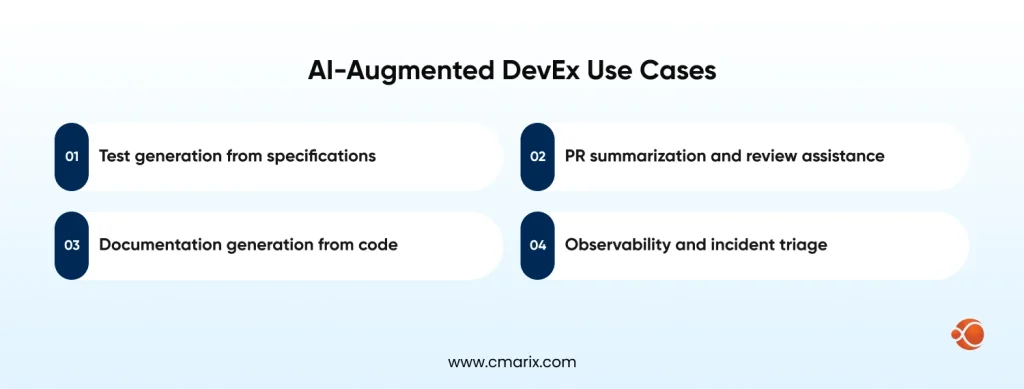
The practical DevEx applications of AI in 2026:
1. Test generation from specifications
Modern AI coding assistants can generate unit test suites from function signatures and docstrings. This supports the shift-left testing approach recommended by NIST’s Minimum Standards for Developer Verification (NIST.IR.8397). The NIST document specifically calls for automated verification to be integrated early in the development lifecycle. AI-generated tests, reviewed and adjusted by developers, make this practical at a higher velocity than manual test authoring alone.
2. PR summarization and review assistance
The use of AI technology integrated into GitHub and GitLab will extract summaries of PRs based on their differences, point out common mistakes, and identify untested code. Nevertheless, it does not replace their evaluation of architectural and security issues, particularly when dealing with complex and extensive PRs.
3. Documentation generation from code
In-line documentation that becomes out of sync with the actual code base is worse than having no documentation at all. AI-powered systems that automatically generate and modify documentation based on surrounding code eliminate any documentation friction discussed above.
4. Observability and incident triage
AI for DevOps automation now extends into incident response. AI-powered observability tools correlate signals across logs, metrics, and traces to suggest probable root causes during incidents. This reduces mean time to identify (MTTI), a precursor to MTTR improvement, particularly for on-call engineers who may not be familiar with every service in a large system.
The hope for those who have adopted AI tooling effectively: faster time-to-first-draft for code and tests, less time spent on documentation, and quicker incident triage. Productivity multipliers like “8 developers working to do the job of 12” are merely marketing buzzwords. The truth is that productivity improvements will vary immensely depending on the type of task being performed and the level of integration between AI tooling and workflow.
Building a Developer Experience (DevEx) Program: A Practical Sequence
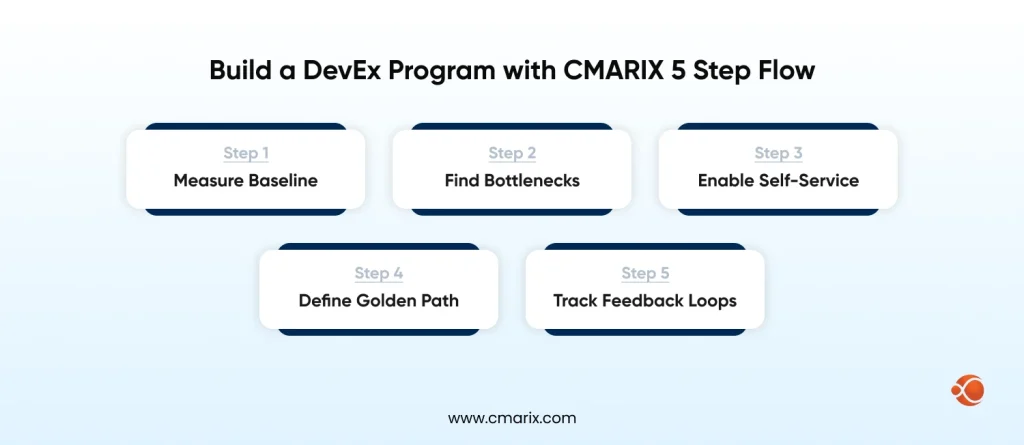
Improvement of DevEx is not a singular endeavor. It is a continuous engineering process. Teams that treat it as a one-shot affair usually end up with transient improvements before reverting to where they started.
The following sequence reflects how mature organizations typically approach this:
Step 1: Establish a measurement baseline
Before making any change, you must first measure the status quo. The DX Core 4 model from GetDX provides an organized method of measuring based on four parameters—speed, efficiency, quality, and impact—which can be measured both quantitatively (build time, deployment rate) and qualitatively (developer satisfaction survey).
Without a baseline, improvements are invisible. With one, you can attribute specific changes to specific interventions.
Step 2: Identify the highest-friction bottleneck
But not all frictions are equal. There is more friction for a CI pipeline that requires 1 hour but processes transactions only twice a week than for a pipeline that requires only 1 minute but executes 30 times a day.
High-frequency examples of frictions: Slow PR reviews, local environment set-up for new services, and approvals to deploy into low-impact environments.
Step 3: Implement self-service infrastructure
Consider using the Internal Developer Portal. Backstage is an open-source solution that is widely adopted, well-supported (CNCF project), and scalable. The commercial solutions include Cortex, Port, and Configure8, which provide quick implementation and lower operational costs.
Map your highest-frequency ops tickets. Build self-service workflows for each. Measure ticket volume reduction quarterly.
Step 4: Define and publish a Golden Path
It all starts with the small steps. One language, one deployment environment, and one type of service. Clearly document it. It becomes part of your IDP, and the rest learn about it. Who followed it, and who didn’t?
Differences are great and educational, too. Learn why you’re different. The difference is the direction the Golden Path travels next.
Step 5: Instrument feedback loops
State your aims clearly: PR Check Suite in less than 3 minutes, Test Suite in less than 15 minutes, and the Preview Environment ready before starting the PR review. Monitor these as engineering health metrics along with DORA and Flow Metrics. If your organization works with dedicated development teams through an external partner, these instrumented feedback loops also give you clear visibility into delivery performance across distributed teams without relying on anecdotal reporting.
DevEx ROI: How to Think About the Numbers
DevEx improvements are measurable, but the numbers circulating in vendor content deserve scrutiny.
Claims like “50% reduction in ops ticket volume after IDP implementation” are plausible in the right conditions, but the starting state matters enormously. A team drowning in tickets can see dramatic reductions. A team with a mature ops function may see modest gains.
The more realistic approach would be to identify your exact problem areas, implement changes to address them, and observe the difference.
Metrics worth tracking:
| What to Measure | Why It Matters | How to Measure |
| Lead time for changes | Reflects end-to-end delivery speed | DORA / pipeline analytics |
| Flow Efficiency | Shows active vs. wait time ratio | Jellyfish, LinearB, or Jira analytics |
| Time to first PR (new hire) | Reflects onboarding friction | HR/engineering logs |
| P75 CI pipeline duration | Tracks build experience at the long tail | CI provider metrics |
| Developer satisfaction (eNPS) | Leading indicator of attrition risk | Quarterly pulse survey |
DevEx improvements do compound in practice. Shorter cycles and faster feedback lead to less rework, less time spent on each feature, and higher throughput. Yet compounding happens over quarters, not sprint lengths. The teams that measure and iterate see this phenomenon. Those who do one tooling change and then expect miracles will be disappointed.
Software development outsourcing engagements benefit from DevEx instrumentation because it creates objective, shared visibility into delivery health, replacing the subjective status updates that often create friction between clients and external teams.
Why Engineering Teams Work With CMARIX on DevEx
Building a DevEx program requires both engineering capability and operational maturity, two things that take time to develop in-house. CMARIX works with product and engineering leaders who need to compress that timeline without assembling an entirely new internal function from scratch. The focus is practical: identify where delivery time is going, implement the right tooling and process changes, and measure the outcome.
- DevEx Audits and Baseline Measurement: We measure the existing pipeline performance, onboarding process, tool chain sprawl, and Flow Efficiency before making any recommendations for changes. We analyze the problem first, then find solutions.
- IDP setup and Golden Path definition: CMARIX teams have hands-on experience implementing Backstage and configuring it for real codebases, not demo environments. We help teams define, document, and maintain a Golden Path that engineers actually adopt.
- CI/CD pipeline optimization: Either by enabling parallel tests, build caching layers (Nx, Turborepo), or preview environments, we optimize your inefficient pipeline processes that can create barriers for your sprint process.
- AI tooling integration: We assist engineering teams in integrating AI-driven coding assistants, pull request reviews, and observability AI tools into existing workflows, while maintaining a realistic assessment of their benefits and drawbacks.
- Dedicated development teams with embedded DevEx practices: CMARIX’s dedicated development teams come equipped with instrumented pipelines, IDP integration, and AI-powered workflows pre-configured. Our clients save time on onboarding, usually taking up the first month in an outsourced team setup.
Not Sure Which DevEx Investment Will Move the Needle Fastest?
Tell us your team size and the one delivery metric you wish looked different.
Final Words
Developer productivity is emerging as a practical way to accelerate deliveries, minimize errors, and maximize the capabilities of developer teams given a fixed headcount.
What sets apart companies that achieve results from those that fail is the latter’s willingness to identify bottlenecks, make specific improvements, and really measure their performance.
The foundation is measurement. The mechanism is self-service. The accelerant, increasingly, is AI tooling applied to the right task categories.
If your engineering organization is working through this kind of DevEx investment, whether building internal tooling, evaluating IDPs, or restructuring delivery workflows, CMARIX’s Managed DevOps Services team works with engineering leads on exactly these problems. The starting point is always the same: understanding where delivery time is actually going before deciding how to shorten it.
FAQs about Developer Experience (DevEx)
How does DevEx specifically cut delivery time in 2026?
It is due to the attention paid to everything around coding. The key elements of DevEx include faster feedback loops, self-service infrastructure, and less cognitive load. Each one can offer a different advantage depending on the specific bottleneck in your team’s workflow.
What is the role of AI in 2026 DevEx?
DevEx in 2026 for AI tooling makes the most sense for four specific applications: writing boilerplate code and tests, aiding in the review process for pull requests, ensuring that documentation is up to date with code changes, and linking observability data for incident correlation. The benefits will be use case-specific. AI code generation works best on well-specified bounded tasks, not on architecture or security-related tasks.
Why are companies moving from DORA metrics to Flow Metrics?
The DORA metrics are used for measuring the health of the deployment pipeline. Flow metrics focus on the movement of work through the whole process, from planning through review and wait times. Organizations that implement flow metrics usually strive to connect engineering performance to business results rather than simply measuring pipeline efficiency.
What is a “Golden Path” in a modern DevEx strategy?
A Golden Path is a curated, supported set of tools, templates, and workflows for building and deploying software within an organization. It typically includes a dev container definition, CI/CD pipeline templates, an IDP scaffold, and an approved dependency baseline. It is not mandatory; teams can deviate, but it is maintained, documented, and actively supported. The goal is to make the right choices and the easy choices.
How can we measure the ROI of improving developer experience?
Four measures for tracking delivery efficiency include delivery speed (time taken to implement changes and release software, frequency of releases), quality (rate of defects passing through, mean time to recover), developer satisfaction (eNPS score, voluntary attrition rate), and efficiency (productivity per developer week prior to and after implementation of changes). Baseline measurements should be set before any changes occur. Credit changes were made rather than DevEx itself.