

Quick summary: AI in football turns hours of game film into searchable, time-coded data within minutes. Computer vision tracks players, deep learning tags plays, and dashboards surface defensive trends before kickoff. This guide covers the core technology and a five-step workflow. It also covers real use cases, the NFL and AWS case study, and what to check before you build or buy.
Remember how sports anime or fiction always had someone sitting behind a laptop, analyzing every move of the opponent and their favorite team to pull together key highlights and feedback?
Well, it’s no longer make-believe. AI in sports has reached the point where this is not only possible, but the norm. From grassroots teams to elite league players in every sport, coaches are now seeking a smarter, faster, and more reliable way to gain a tactical edge over their competitors.
This is especially true for AI in football. The level of game film analysis AI has unlocked is helping coaches make real-time decisions, break down complex plays, and personalize training at scale.
Today, we are going to decode how smart football coaches are turning to AI for game film analysis and why it can make a significant difference in how sports strategies are worked on in 2026 and beyond.
What Is AI Football Film Analysis?
AI football film analysis uses computer vision and machine learning to automatically read game footage. It identifies players, tags plays, and tracks movement. The output is time-coded video analysis that coaches can search, filter, and compare in minutes.
Traditional film study asks staff to chart every snap by hand. Automated game film breakdown moves that work to software. Coaches then spend their time on decisions instead of tagging.
Video is only one data source. Sensors add another. The NFL’s Next Gen Stats system records player location, speed, distance, and acceleration 10 times per second. Combining both sources gives coaches a fuller picture of every play.
Research shows where the technology stands today. The SoccerNet-Tracking benchmark offers 200 annotated 30-second sequences plus a full 45-minute half for testing player trackers. Its authors found that fast motion and heavy occlusion still cause tracking errors.
That matters for American football too, where pileups hide players from the camera. Strong systems pair automated tagging with a quick human check on low-confidence plays.
The Popularity of AI in Sports in 2026
According to Allied Market Research, the global market for AI in sports is expected to reach $19.2 billion USD by 2030. What was once a time-consuming, resource-intensive task is now being streamlined by AI technologies that unlock new opportunities and insights smart coaches can use to upgrade their tactics and gameplay strategies.
The firm has since extended its outlook to $29.7 billion by 2032, a 30.1% CAGR from 2023. In its earlier 2020 data, football held the largest share by sport type, at more than one-fourth of the market.
Factors that affect the Rise in Use of AI in Sports
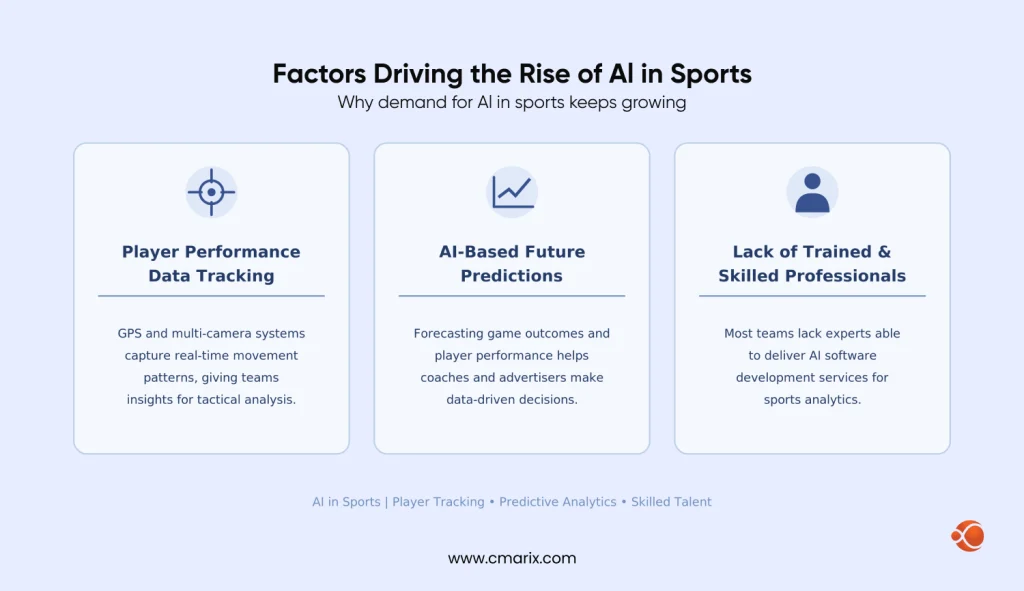
The report stated that this rise in demand for AI in sports comes from a few major factors:
Player Performance Data Monitoring and Tracking
The sports industry has seen transformational change with the advent of AI, IoT, and big data, enabling real-time monitoring of players’ movement patterns. These technologies include GPS and multi-camera systems that provide valuable insights into player performance for tactical analysis.
Rise in Demand for AI-based Future Predictions
Advancements in AI for forecasting game outcomes and player performance are another reason for the popularity of AI in football analysis and other sports analysis. This helps stakeholders like advertisers and coaches gain a competitive advantage by enabling data-driven decisions.
Lack of Trained & Skilled Professionals
Despite these benefits, AI football analysis predictions and sports video analytics software haven’t reached their full potential because most sports teams lack access to skilled professionals experienced in providing AI software development services for the sports industry.
The Evolution of Game Film Analysis in Football
Game film analysis has always been an integral part of football coaching. It gives football coaches strategic insights about player performance, team dynamics, and tactics. However, as the game evolves, so does the need for efficient, accurate analysis methods.
The Shortcomings of Traditional Game Film Analysis in Football
Traditional methods of football video analysis require laser focus and manual analysis of hours-long video footage, manually tagging plays, reviewing formation shifts and understanding player movements. This method brings valuable insights but takes hours to interpret and months to develop a strategy to overcome the challenges.
Since the game has become overly competitive today, football demands real-time adjustments and deeper strategic foresight. Manual video analysis can’t keep up with the amount of footage and changing gameplay strategies. This is where AI football analysis comes to play.
Core AI Technologies Powering Modern Football Film Analysis
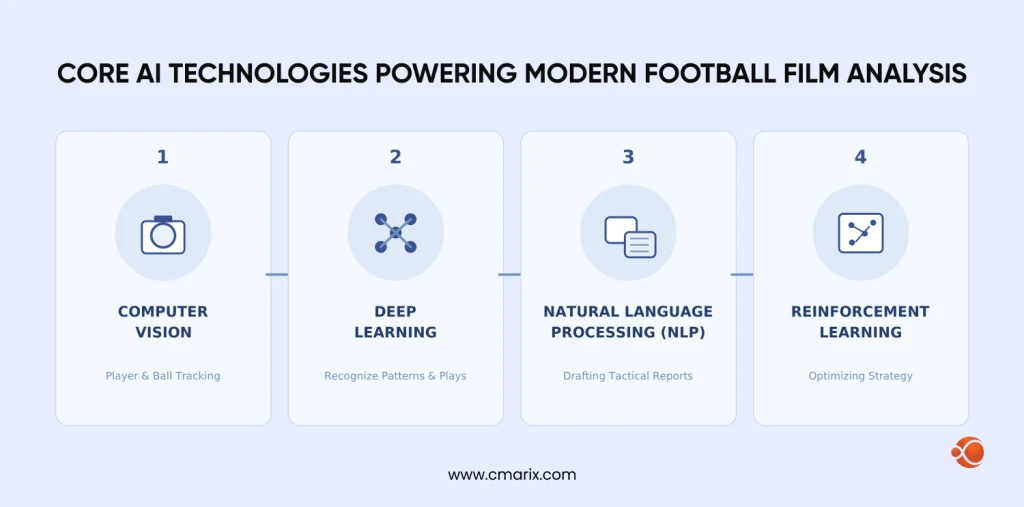
The power of AI in sports coaching comes from its ability to process vast amounts of visual data, extract meaningful information and provide actionable insights that football coaches can use to improve their game plans. Here are the various technologies that make AI football analysis possible:
Computer Vision for Player and Ball Tracking
Computer Vision provides coaches with a bird’s-eye view of every player and ball movement throughout the match. It converts the raw footage into spatial data. It enables heatmaps, provides metrics about distance covered, zone control reports and other relevant insights that lead to smarter substitution and real-time strategy shifts.
Teams building their own pipeline can study a YOLO and DeepSORT tracking walkthrough as a starting point. It targets traffic, but the detection and tracking logic carries over to football.
Deep Learning to Recognize Patterns and Plays
Don’t want to spend hundreds of hours analyzing thousands of footage to identify play patterns and plays? Deep learning models are trained on those thousands of hours of film to identify specific formations, passing tactics and different play types. These tools allow AI football prediction engines to flag trends that might be missed by the human eye. The same models power automated play tagging and defensive trend analysis.
NLP for Tactical Notes and Automated Commentary
Natural Language Processing is a useful part of AI in sports coaching. It converts video insights into readable summaries with proper suggestions and breakdowns of successful and failed tactics. Generative AI development solutions can also draft these coaching video breakdowns in a staff’s preferred format.
Reinforcement Learning for Tactical Simulations
AI football analysis predictions provide proactive insights. With help of reinforcement learning, football coaches can simulate different play outcomes and optimize decision-making based on previous game scenarios.

How Football Coaches Can Use Sports Video Analytics Software?
We understand the importance of AI for Game Analysis, but how can football coaches actually use sports video analytics software? Here is a basic rundown:
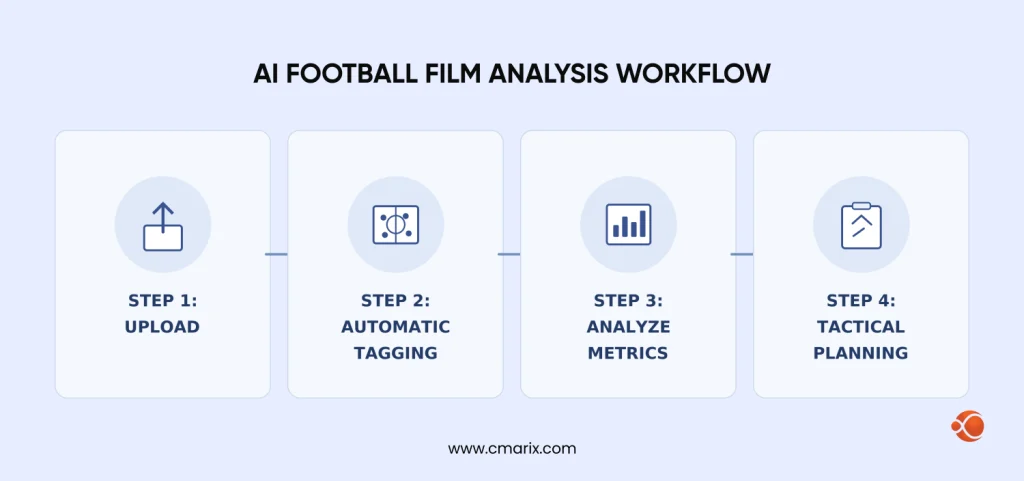
Step 1: Upload and Preprocess Game Footage
First, coaches upload raw game footage into an AI-based sports analytics tool. The system identifies players, marks field zones, and creates timestamps in minutes. In this preparatory phase, the software saves hours of work and enables the analytic approach.
With player recognition and event segmentation in place, the system creates a structured dataset ready for analysis, making the footage far more accessible and actionable. Teams that prefer cloud tools can integrate the Google Video Intelligence API for shot and object detection.
Step 2: Automatic Tagging and Metadata Generation
After processing the footage through the AI engine, the most significant events such as tackles, passes, fouls, and set pieces are tagged automatically. The engine also links these moments to player data, including actions and outcomes such as turnovers or successful passes.
This metadata allows coaches to filter and search plays with incredible precision, saving time and revealing patterns that would be nearly impossible to identify manually.
Step 3: Analyze Key Metrics
The AI platform provides dynamic dashboards with KPIs based on modern football metrics. Coaches can review stats like pass completion rates under defensive pressure, expected goals (XG) buildup zones, pressing efficiency, and transition speed.
This information enables coaches to assess performance, spot patterns, and identify weaknesses across the stages of play. When performance is measured in real time, teams can gain a data-driven tactical advantage.
Step 4: Tactical Planning and Opponent Study
Coaches can use AI-enabled software to analyze previous competitors’ behavior and match-result data, evaluate past formations and player tendencies, and prepare predictions and alternative strategies for future matches.
This tool turns video analysis into a proactive approach as coaches adjust and form tactics to counter an opponent’s strengths.
Step 5: Share Visualized Reports with Team
After analysis, AI tools generate interactive reports with visuals like heatmaps, video snippets, and tactical annotations. These reports are easy to understand and can be customized for individual players or the whole team.
Football coaches use advanced reports during team meetings to turn complex strategies into easy-to-understand information, fostering involvement and understanding. This visual approach improves information sharing, accountability, and alignment on strategies before games.
Businesses or football coaches looking to develop a custom AI-based solution for their team can contact a reliable sports software development company to build a tailored analytics platform.
Real-World Applications of AI Football Analysis for Smart Coaching
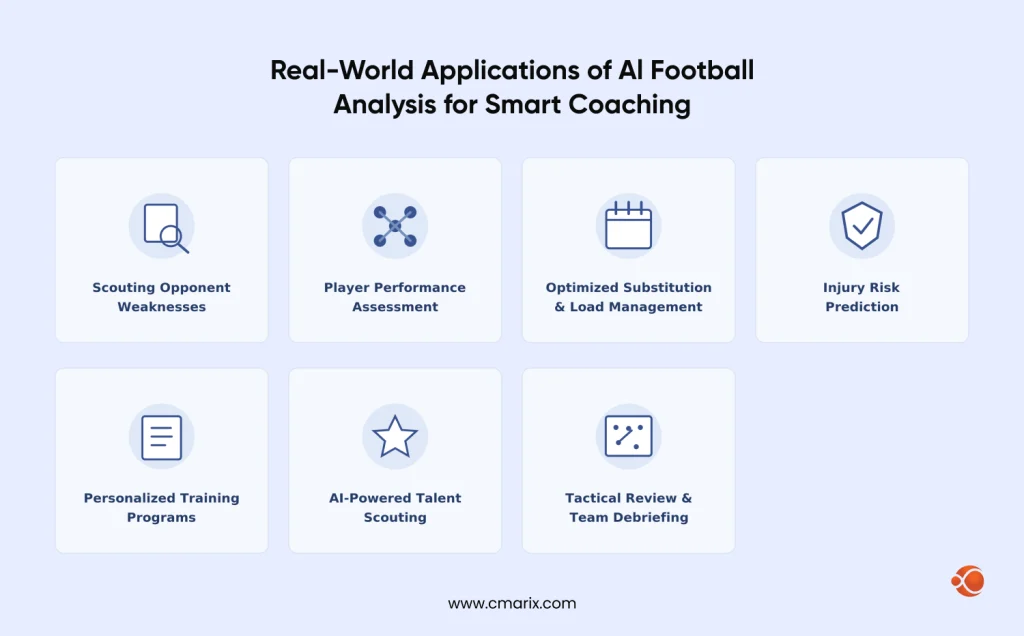
AI use in football analysis is not futuristic; it is an indispensable tool for smart football coaching today. It enables performance improvement, win-focused strategy, and more. Real-life examples show how teams use AI in sports coaching across preparation, gameplay, and development.
Scouting Opponent Weaknesses
Hire AI developers to build smart AI football prediction models that can analyze previous match clips. With these models, coaches can uncover hidden trends in opponent formations and identify weak points and defensive loopholes. This lets teams prepare targeted strategies with reliable sports video analytics software, giving them a tactical edge before stepping onto the pitch.
Player Performance Assessment
With AI-powered player performance analysis, the coaching staff gets a clear view of each player’s movement, decision-making efficiency, and performance under pressure. This type of analysis is important for selecting players and making substitutions.
Optimized Substitution and Load Management
By monitoring fatigue parameters through football coaching technology, artificial intelligence can show when a player’s performance begins to drop. This allows better substitutions and reduces injury risk.
Injury Risk Prediction
Computer vision in AI football analysis can help flag subtle biomechanical changes that may precede injuries. By detecting movement abnormalities and loading patterns, teams can manage risk early enough to keep top players available for vital matches. Peer-reviewed work supports the direction: a systematic review of machine learning in sport injury prediction found these methods could improve prediction and prevention.
Personalized Training Programs
Smart training focuses on you. Coaches now use AI data to catch the small things you might miss, like a slow reaction time or a late run. Fixing those gaps is the quickest way to improve your technique and make faster choices on the field.
AI-Powered Talent Scouting
AI is changing the game for football recruitment. Professional clubs now use player comparison tools—similar to fantasy trade analyzers—to evaluate targets. By tracking positioning data and off-ball awareness, teams ensure every new signing is a smart, calculated move.
If you’re looking to create a fantasy sports website that mimics real-world performance or integrates AI-based stats for users, these scouting tools provide a strong foundation for smarter and more engaging user experiences.
Tactical Review and Team Debriefing
Teams can now replay key moments using AI-generated overlays, heatmaps, and annotations. This visual approach clearly highlights tactical gaps, making it much easier for the squad to understand and fix mistakes together.
How College and High School Teams Use AI in Football
High school and college teams can simply use the video they already record. Because video-based AI needs no wearable sensors or tags, it fits smaller budgets perfectly. Football researchers like the creators of SoccerNet-Tracking point out that video processing extracts rich tracking data from regular footage, meaning any team in any stadium can use it.
Common uses at this level include:
- Automated play tagging saves hours of manual review after every game.
- Defensive trend analysis uncovers tactical patterns across a full season.
- Short player clips make individual film review fast and focused.
- Tactical match prep uses data to map out the next opponent’s habits.
Small staff gain the most. One analyst can now finish breakdowns that once needed several people. Cloud video tools help too, as our guide to Google Video AI use cases shows.
AI in Football Real-World Case Study: NFL and AWS AI
Many big names in the football industry and tech giants are already collaborating to provide smart football analytics services that are transforming the industry. Here is how NFL and AWS AI made AI in football a reality:
NFL and AWS AI
The NFL has always provided deep insights about its league matches, stats over the years, player performance, and other metrics. However, their traditional prediction methods were still limited. They soon realized the need to implement AI football analysis to collect better data and make more sense of it. Their goal was to build customer loyalty for the NFL and give fans better tools to understand the game.
Modern-day NFL uses Next Gen Stats (NGS) with tracking technology via RFID devices. The device is attached to every player’s shoulder pads and is used across different stadiums. It collects on-field player data in real time, including speed and movement direction. They partnered with AWS to implement this capability through Amazon’s machine learning and analytics capabilities. The NFL states that Next Gen Stats runs entirely on AWS infrastructure.
Amazon provided a complete set of sports video analytics software using different AWS technologies that revolutionized how the NFL uses AI.
| Core Purpose | Tool & Product | Description | Intended Benefit & Outcome |
| Machine Learning Model Deployment | Amazon SageMaker | Builds, trains, and deploys predictive models like Completion Probability. | Provides accurate, timely insights for smarter decision-making by coaches. |
| Real-Time Data Visualization | Amazon QuickSight (now Amazon Quick Sight, part of Amazon Quick) | Creates fast, filterable dashboards for clubs, broadcasters, and NFL writers. | Enables quick data access and storytelling across coaching and media teams. |
| Player Tracking & Data Collection | RFID Tracking System | Captures in-play metrics like player speed, separation, and positioning. | Improves gameplay understanding and feeds models for AI football analysis. |
| Performance Metrics & Fan Engagement | NFL Next Gen Stats (NGS) | Delivers AI-driven insights (e.g., pass difficulty) to enhance broadcasts. | Improves broadcasts by making them interactive and informative for fans and analysts. |
| Pattern Recognition & Safety Planning | Machine Learning via AWS | Identifies trends in play to guide coaching and safety improvements. | Helps coaches minimize injury risks and optimize strategies for player safety. |
What to Know Before You Build or Buy Football Video Analysis Software
What to Check in a Platform
Demo clips always look clean. Test any tool on your own footage before you commit. Check these points:
- Tagging accuracy on your camera angles, whether sideline, end zone, or broadcast
- Export of time-coded data to your existing tools
- Time from upload to finished report
- Ownership and privacy of your footage and trained models
- Support for wearables and other football player tracking data
Off-the-shelf platforms suit small staffs with standard needs. Custom football analytics solutions suit clubs with unique data or workflows.
Limits to Expect
AI is a great tool, but it still makes mistakes. In crowded plays, the tracking software often gets blocked and loses the ball or the player. If you are filming from a bad angle, the AI won’t tag your plays accurately. Teams also need to be careful relying on AI to predict injuries, because a computer can’t fully understand how a human body feels.
A 2025 British Journal of Sports Medicine review of 38 studies found that while football is the most heavily researched sport, the models remain limited. Even though some tools report high accuracy, they rely on overly broad prediction windows and vague injury definitions. Experts add that, to be truly effective, machine learning models must adapt to how a player’s real-time injury risk shifts throughout a season.
Treat predictions as decision support, not verdicts. Keep a coach in the loop for every call that matters.
What Drives the Cost
No single price fits every build. At CMARIX, we scope football video analysis projects around these factors:
- Tagging complexity: The total number of play types, formations, and events the AI model must recognize.
- Footage quality: The types of camera setups used and the resolution of the video feeds.
- Accuracy & workflow: The precision targets required and the level of human review built into the process.
- Processing speed: The choice between delayed post-game analysis or instant, real-time live data.
- System integrations: Connections to wearable sensors, GPS trackers, and existing team platforms.
- Deployment infrastructure: The choice between cloud-based hosting or localized, on-premise servers.
Treat the build as part of a wider plan for AI in digital transformation, with data pipelines and governance set early. If footage comes from edge cameras, our AI video telematics guide covers edge inference, latency, and privacy trade-offs that apply here too.
Why Hire AI Developers from CMARIX for Custom Football Analytics Solutions?
CMARIX stands at the intersection of advanced sports technology and custom software innovation. With proven expertise in developing AI-powered solutions for performance analytics, video intelligence, and predictive modeling, we empower football coaches, clubs, and sports businesses with data-driven game strategy platforms tailored to competitive needs.
Here’s what sets our AI developers apart for football analytics solutions:
Purpose-Built Sports AI Expertise
Our dedicated AI developers specialize in sports video analytics, computer vision development, and deep learning tailored for football. We’ve worked on scalable solutions that process game footage, generate real-time metrics, and enable predictive modeling specific to formations, play styles, and team strategies.
End-to-End Custom Development
From building player tracking systems to integrating real-time tactical dashboards, CMARIX delivers full-cycle AI product development. We design, develop, train, and deploy models that meet each football team’s unique needs, from grassroots to elite league level.
Real-Time Insights with Visual Intelligence
Our team builds smart platforms that track match data, player stats, and fatigue through simple dashboards and video clips. Coaches get easy-to-use tools to review heatmaps, adjust formations, and make smart substitutions right in the middle of a game. But this tech doesn’t stop on the sidelines. It also works well for sports betting apps, using live data and predictive models to give fans deeper insights, safer risk analysis, and accurate, real-time odds updates as the game unfolds.
Seamless Integration with Wearables and IoT
We link Artificial Intelligence (AI) with RFID devices, GPS sensors, and wearable sports technologies to provide users with a complete overview of athlete performance. By integrating telemetry data into in-depth video analysis, our systems facilitate an anticipatory injury prevention system and an accurate assessment of biomechanics of athletes, making sure that the data collected leads to precise, actionable outcomes.
Scalable, Secure, and Modular Platforms
CMARIX provides enterprise-level AI infrastructure tailored to the intensive data requirements of professional sports organizations. By integrating the latest advancements in computer vision technology with a powerful yet secure deployment, teams can convert unedited match recordings into a competitive advantage.
Proven Sports Software Development Partner
CMARIX offers high-quality AI solutions built with cutting-edge technologies used in markets worldwide. CMARIX developers understand how football games work and deliver reliable, high-tech solutions that are fully adjustable to customers’ needs, with a wide range of features and capabilities.
Build next-gen AI-driven film analysis application with the help of CMARIX dedicated AI experts.
Final Words
From high school programs to the NFL, the playbook is no longer built on instinct and experience alone; it’s increasingly shaped by data, precision, and AI-powered insights.
Nowadays, football coaches have started embedding AI technology into their workflows, laying the groundwork for better decision-making, more effective processes, and a deeper understanding of the game. In a game where everything matters, AI is becoming less of a benefit and more of a necessity. CMARIX turns this shift from idea into reality.
FAQs on AI for Football Game Film Analysis
How does AI in football improve game film analysis?
Artificial Intelligence (AI) is streamlining the slowest aspect of preparing for a football match. It recognizes players, annotates plays, and monitors action autonomously, eliminating the need for manual charting. Coaches can now search timestamped footage, compare formations, and detect defensive patterns in minutes instead of spending days.
What is the best AI football film analysis software for coaches?
The best option depends on your footage, budget, and team size. Try tagging a few of your own match recordings to see how accurate the results are. Also, check whether the tool supports the exports you need and gives you control over your data. Want to see how AI analyzes video? Check out our guide to Google’s Video AI API to understand how cloud-based video analysis works.
Can AI football coaching software automatically tag key plays?
Yes. Modern systems can automatically identify passes, tackles, fouls, and set pieces in match footage. They also connect each event to the player involved, their position on the field, and the outcome. However, coaches and analysts should review low-confidence tags, especially when several players are involved in the same play.
How do college and high school teams use AI in football analysis?
Most teams can get started with the match footage they already have. Video-based tools don’t require players to wear tracking devices. Coaches can use them to tag plays automatically, track defensive patterns across a season, create individual player highlight clips, and prepare tactical plans for upcoming matches.
How does AI-powered video analysis improve football coaching?
It helps coaches turn match footage into useful feedback much faster. Within hours, they can share annotated clips, heatmaps, and performance metrics with players. Seeing their mistakes in actual game situations helps players understand what went wrong and gives coaches a clearer direction for the next training session.
How do professional teams use AI in football for player performance?
Pro clubs combine tracking data with their own player and wellness data. NFL clubs receive Next Gen Stats, which logs speed, distance, and acceleration 10 times per second. The Seattle Seahawks, for example, have used AWS to merge that feed with club data.
Which AI football scouting platforms identify emerging talent?
Look for platforms that compare players based on positioning, match performance, and off-ball movement. The right tool should help you assess prospects against your team’s playing style. If standard tools don’t offer the filters you need, a custom model can help fill those gaps.
Can AI football analytics identify player strengths and weaknesses?
Yes. Tracking and tagging data help coaches understand how a player moves, makes decisions, and performs under pressure. They can compare performance across multiple matches to spot strengths and areas for improvement. Predictive football analytics can offer additional insights, but coaches should use them as guidance rather than rely on them alone.
Which platforms offer real-time AI football match analysis?
Sensor-based systems such as NFL Next Gen Stats stream data 10 times per second. Video-based real-time analysis needs fast edge or GPU processing, and many teams still review post-game. Wondering how AI video telematics works at the edge? The same ideas apply.
How much does it cost to develop AI football analysis software?
Cost depends on scope. The main drivers are the number of play types, footage quality, accuracy targets, real-time needs, integrations, and hosting. A focused post-game tagging tool costs far less than a full real-time platform. Share your goals with CMARIX for a scoped estimate.