

Quick Summary: Python still runs some of the biggest apps on the internet. This guide covers ten real Python app examples, from Instagram and Netflix to Robinhood and Hugging Face. You will see what Python does in each product. You will also learn when to pick it and when to add another language.
Let us guess – you want to pick a programming language for your project but are not sure which is the best? We know choosing one technology can be hard, but we suggest trying Python. The language is flexible, and we think you will find programming with it fun!
Quick Snapshot: Top Python Apps Summarized
Top Python App Examples: Instagram, Netflix, Spotify, Dropbox, Uber, Lyft, Meta, YouTube, Robinhood, and Hugging Face.
Why Python Is Used:
- 58 % of developers use it (Stack Overflow 2025), and it ranks No. 1 on the TIOBE Index (September 2026).
- It fits best for web backends, AI and machine learning, data pipelines, fintech, and automation.
One common trade-off to look out for:
When a single service needs extra speed, teams often rewrite just that piece in Go; Reddit did exactly this.
Python is also easier to learn than many other programming languages, so you can learn it fast and finish your project sooner. If you start using Python, you will like it and want to use it for all your projects. To make it easier to see how Python programming language is used, we put together the best Python app examples in this article. Let’s dive in and get ideas from the great Python app examples that are leading the current tech industry!
Python: What Is It and Why Is It So Well-Known?
Do you wonder what Python is and how come it’s so easy to pick up? Python is a general-purpose programming language. It is interpreted so that you can run code right away. It also supports object-oriented programming. Its syntax is clean and plain, so coding in Python stays quick, even when many people work together.
Python is modular so that developers can mix it with other technologies easily. It is also open-source. A large community supports it, which keeps development costs lower.
The numbers tell the same story. In Stack Overflow’s 2025 Developer Survey, 58% of developers said they use Python. That is a 7-point jump in one year. Python also holds the top spot on the TIOBE Index for September 2026, with a 17.76% rating.
Several reasons explain why there are so many Python app examples in the industry today:
- Simple syntax. It helps developers build simple and complex apps quickly. This is why startups and large firms hire Python developers for many kinds of projects.
- Strong AI and data tools. Libraries such as NumPy, pandas, and PyTorch handle data work and model training. That is why you find so many Python app examples in AI and machine learning development.
- Easy to read, write, and learn. Engineers can review Python code quickly so that larger teams can work on the same project without friction.
- A large, active community. Developers share tools, fixes, and advice, so help is easy to find.
- Huge library choice. PyPI now lists over 800,000 projects, so most needs already have a package. Many businesses also invest in Python-powered mobile app development services for this reason.
- A glue language. Developers can connect other languages, frameworks, and infrastructure to Python with little effort.
- Modern API frameworks. FastAPI usage rose by 5 points in the same Stack Overflow survey. More teams now build fast, async APIs in Python.
- Faster, more parallel Python. Python 3.14 made free-threaded Python officially supported so that code can use several CPU cores at once. It is still optional, and standard builds keep the Global Interpreter Lock. Official macOS and Windows builds also include an experimental JIT compiler. Test both before production use.
- Inherent web security. The frameworks include built-in security measures against common threats such as CSRF and XSS.
- Scalable in stages. Teams can upgrade servers, implement caching, and use task-queuing systems like Celery as demand increases. Only the component that needs more speed is migrated to another programming language.
We can assess your use case, tech requirements, and scale to recommend the right approach.
Top Python App Examples That Developers and Businesses Must Check Out
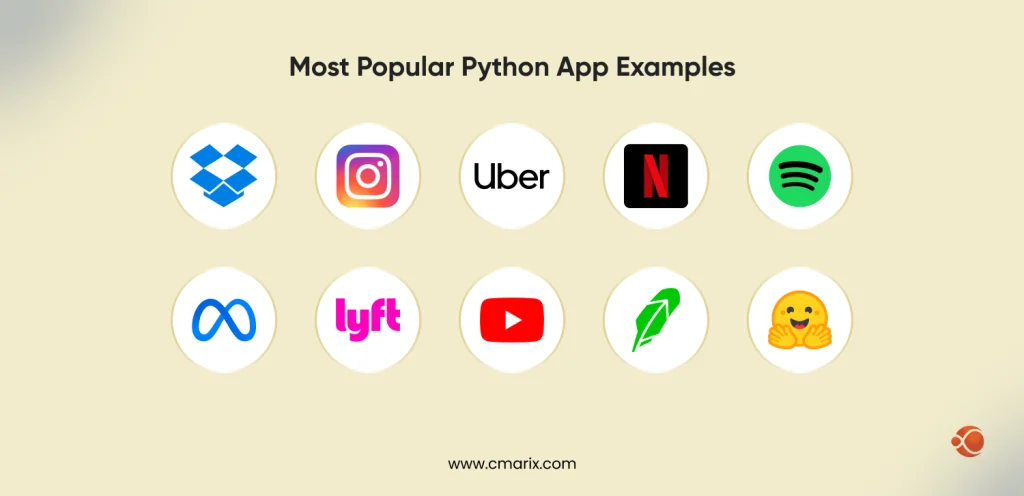
Now that you know what Python is used for, here are some of the best Python app examples for businesses. Well-known apps built in Python include Instagram, Netflix, Spotify, Dropbox, Uber, Lyft, Meta, YouTube, Robinhood, and Hugging Face.
Not every company runs pure Python. Most mix it with Go, Java, or C++. For each app below, we point out where Python does the work.
Python App Examples at a Glance
| Python App Examples | Role of Python | What is it Used For |
| Dropbox | Backend services, desktop client, mypy type checking | Cloud storage |
| Django-based server monolith | Social media | |
| Uber | Machine learning and data platforms | Ride-hailing |
| Netflix | Content lifecycle tools, ML, CDN operations | Streaming |
| Spotify | Data pipelines and ML | Music streaming |
| Meta | Infrastructure tools, PyTorch, free-threading work | Social media |
| Lyft | Flyte ML pipelines and data tools | Ride-hailing |
| YouTube | Front-end web servers (2017 report) | Video |
| Robinhood | Django services alongside Go | Fintech |
| Hugging Face | Transformers library and Hub client | AI platform |
1. Dropbox
Dropbox has a web app and mobile apps for iOS and Android. The service also runs on Mac, Windows, and Linux. According to Dropbox, Python powers its backend services and its desktop client. That gives its developers one language across both sides of the product.
Interesting Fact: Dropbox has been instrumental in shaping Python itself. Its engineers, including Python creator Guido van Rossum, advanced mypy. Mypy is a static type checker that lets developers quickly verify a huge codebase. Its 2026 release notes still thank Dropbox for supporting the project.
The company now publishes an open-source Dash MCP server written in Python. It lets AI tools search a company’s content.
2. Instagram

Instagram’s tech stack has changed over the years, but the app still depends on Python. Its server is a Python monolith with several million lines of code. It runs on Django, a high-level Python web framework that speeds development. Hundreds of commits reach that codebase every day.
To keep it safe, Instagram engineers use type annotations and static checkers. These verify the contracts for the platform’s Python HTTP APIs. The scale is huge: Meta reported 3 billion monthly active users (MAU) for Instagram in September 2025.
3. Uber

When Uber started, its team chose Node.js for the marketplace and Python for almost everything else. Ride prices depend on traffic, supply and demand, trip length, and weather. It required heavy arithmetic on big data, and Python was the right fit for projects like that.
As it scaled, Uber started using Python in some performance-critical services originally built in Go and Java. Uber kept Python where data and models were the primary focus. Uber’s Michelangelo platform uses PyTorch and TensorFlow to build deep learning models.
Uber also uses Ray, a Python-first framework, to scale that training. Data-heavy needs like these show up across transportation and logistics software too.
4. Netflix

Netflix revolutionized the entertainment industry with its recommendations and analytics engine, which recommends movies and shows based on the viewer’s history. As mentioned in the Netflix technology blog, they implemented Python across their entire content lifecycle management system, from selecting shows to ingesting and streaming them through their network.
Python powers Netflix’s machine learning models, security tools, and network automation. Netflix also built Metaflow, an open-source Python framework that moves ML projects from prototype to production. Python tooling also helps run Open Connect, its content delivery network. With so many features built in Python, Netflix is one of the best Python web app examples around.
5. Spotify

Spotify keeps your music and podcasts going on every commute. Behind the scenes, Python drives most of the platform’s data work. They built Luigi, a Python tool for batch data pipelines, and open-sourced it back in 2012. Those pipelines feed features such as Discover and personalized recommendations.
Today Spotify runs around 20,000 batch data pipelines every day. Its newer platform, described in Spotify’s engineering post on orchestration, runs on Flyte, which offers a Python SDK. So you might like to thank Python for the playlists you love.
6. Facebook (Meta)

Facebook, now Meta, introduced social networking. Its technology stack includes various languages. One popular language is Python. Meta programmers use Python to manage infrastructure, from when machines enter a data center to when they are decommissioned.
Meta also created PyTorch, the Python deep learning framework that now sits under the Linux Foundation. A Meta engineer wrote PEP 703, the proposal to make Python’s Global Interpreter Lock optional. Python 3.14 officially supported that free-threaded build. Together with Instagram, Meta runs Python at a scale few companies match.
7. Lyft

Lyft launched in 2012, three years after Uber. It grew fast by putting ride-hailing, scooters, bike sharing, and more in one app. Python played, and continues to play, a big role in its data and machine learning work.
The company launched Flyte, an open-source engine that powers its ML pipelines for arrival estimates, pricing, incentives, and maps. The Flyte workflows are written using its Python SDK. Lyft has also open-sourced Python tools like Amundsen for data discovery and Cartography for security risks.
8. YouTube

YouTube is the biggest video site on the web, and Python has long run inside it. Google counts Python as one of its official languages. A 2017 Talk Python podcast with a YouTube engineer described the site’s front-end servers as mostly Python. They served millions of requests per second.
Some parts have likely changed since then. The lesson still holds: Python can carry video-scale traffic when you design for it. Streaming and publishing firms can follow the same path.
9. Robinhood

Robinhood’s investing app serves millions of customers. Its own 2026 job posts list Python with Django and Go among the tools behind its core financial products. They also list PostgreSQL, Kafka, and Redis.
This mix is common in fintech. Python handles product logic, data, and risk checks, while Go covers the fastest paths. Want to see how finance teams use it? Read CMARIX’s guide to Python for fintech, or see how Python powers low-latency trading systems. CMARIX has also built a real-time trading web platform for active futures traders.
10. Hugging Face

Hugging Face is where developers share open AI models, datasets, and demo apps. Its Transformers library installs with a single pip command. Its Hub client is also an official Python package. Python is the main language of AI, so this is no surprise. Many open models, including Meta’s Llama and Google’s Gemma, are shared there.
If you plan AI features of your own, CMARIX’s AI software development team can help you scope and build them.
When Should I Use Python for My Web and Mobile Applications?
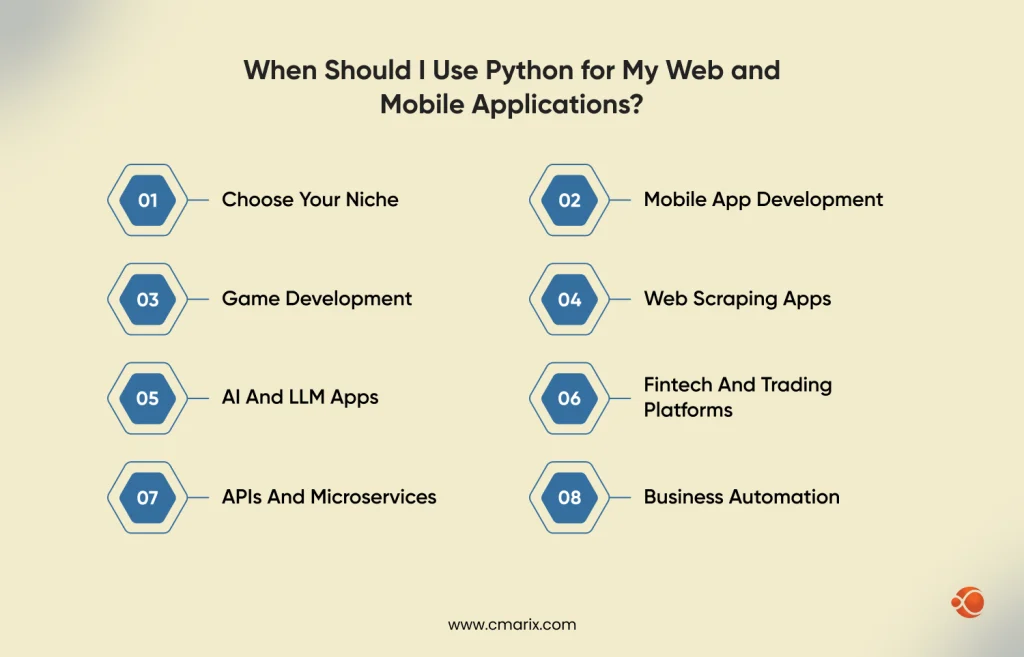
Now that you have seen the top Python app examples, here are more use cases for the language:-
1. Data Science
In today’s competitive landscape, data is becoming every company’s biggest currency. To realize its worth, these corporations need skilled Python developers who can use Python’s computational and analytical capabilities. With popular Python libraries like pandas, NumPy, and Matplotlib, companies can turn big data into clear charts and forecasts. Our guide to machine learning with Python focuses on how teams can turn data into predictions. Hospitals and clinics often use data science to back their processes, and CMARIX is known for applying it in our data-driven healthcare software solutions.
2. Mobile App Development
Python rarely generates mobile app screens. Its core strengths lie in back-end development of APIs, databases, and the AI capabilities the application needs. Python has also made its way to phones. Python 3.14 now offers binary releases for Android. For any business application, the ideal structure is to write the back end in Python while the front end is in Flutter/React Native.
3. Game Development
For all gamers out there and entry-level aspiring game developers, libraries such as Pygame is a great place to start. You can build prototypes and 2D games, and learn the fundamentals of game development, with proper documentation and tutorials available. Many gaming studios also use Python for game tools and animation pipelines. If you are planning to build high-end 3D games, you’ll need a more powerful framework like Unity.
4. Web Scraping Apps
Have you ever wondered how some websites manage to perform price matching in real time? Or have you ever asked yourself how researchers create enormous data sets? The solution lies in web scraping. It is a way to pull large amounts of data from websites. Python is easy to program, and great libraries make it possible. Beautiful Soup, Scrapy, and Playwright gather the data while pandas processes it.
5. AI and LLM Apps
If you are planning on Python software development or tools for specific use cases such as chatbots, document searches, and AI agents mostly depend on Python. All major AI providers offer Python SDKs, and tools such as LangChain help integrate language models with your data. CMARIX has helped develop an AI-based personalization platform at Idomoo. If you plan to build something like that, start by developing your AI agents.
We can help you choose the stack, define the architecture, and build an MVP ready for real users.
6. Fintech and Trading Platforms
Banks and traders use Python for risk models, fraud detection, and market analysis. Python also makes it easy to integrate with brokers’ and payment gateways’ APIs. This is evident from Robinhood’s tech stack. Because these businesses must ensure top-notch security and availability, they should choose a partner that specializes in finance and banking software.
7. APIs and Microservices
FastAPI, Flask, and Django REST make it easy to build lightweight microservices. Each microservice performs one function and can be scaled independently. Follow our tutorial on building scalable microservices with Python. Combine them with an advanced frontend solution, as described in our React-with-Python guide.
8. Business Automation
Python script automation can pull reports, sync systems, and route approvals without manual effort. It also fits claims, invoicing, and onboarding. CMARIX built a custom claims management platform for Aspen Claims Service in the US insurance market. Insurers can apply the same ideas, and our insurance software development team builds them.
What These Python Application Examples Teach Businesses
Study the apps above, and a pattern emerges. Most of them started in Python and grew fast. Some later moved a few speed-critical parts to other languages.
Reddit is the clearest case. It grew on Python, but its team is now moving its core models to Go. Reddit’s comments migration aims to cut latency in one of its busiest systems. That move includes comments, accounts, posts, and subreddits. Uber’s engineers reached the same view years ago. They wrote that Go suits most new performance-critical services.
None of this means Python is a weak choice. It means Python and speed-critical languages work best as a team. Use the table below as a quick guide.
| Real-World Python Use Cases | Recommended Approach | Why |
| MVP or first launch | Python | Fast to build and easy to change |
| AI and ML features | Python | Most AI libraries ship for Python first |
| Data pipelines and reports | Python | Luigi and Flyte prove it works at scale |
| Standard web apps and APIs | Python | Django, Flask, and FastAPI cover most needs |
| CPU-heavy parallel jobs | Test first | Free-threaded Python 3.14 helps, but check your libraries |
| Ultra-low-latency services | Python plus Go, Rust, or C++ | Keep Python for logic and rewrite only the hot path |
The smart path is simple. Build in Python, measure real traffic, and rewrite only what the numbers flag. If you are starting fresh, MVP development gets a working product in front of users quickly. If a big Python app has slowed down, app modernization services can split it into faster parts without a rewrite.
Why Choose CMARIX for Python App Development?
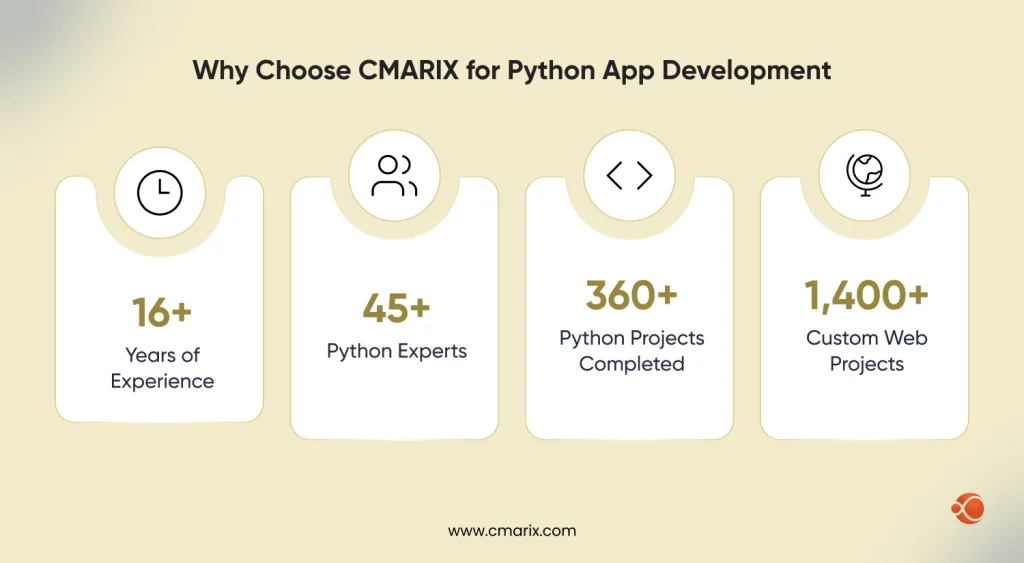
CMARIX has built Python solutions for startups and Fortune 500 companies for more than 16 years. The team turns ideas like the Python app examples above into working products.
- Full Python stack. The team works with Django, Flask, and FastAPI, plus TensorFlow and PyTorch for AI and ML work. Our Python development services cover APIs, full-stack apps, migration, and machine learning.
- Proven range. Recent work spans insurance claims for Aspen Claims Service and AI-driven video for Idomoo. Clients also come from fintech, healthcare, and logistics.
- Cloud and DevOps built in. Apps launch on AWS, Azure, or Google Cloud with Docker, Kubernetes, and CI/CD. Releases stay smooth and repeatable.
- Flexible teamwork. Choose a dedicated development team, a full project squad, or a mix that fits your budget.
- Trusted by clients. CMARIX holds a 4.7/5 rating on Clutch from 50+ reviews. Teams work from India, the USA, Canada, South Africa, Germany, and the UK.
Final Words
As you can see, Python is a simple programming language with advanced capabilities. Once you start working with Python, you’ll appreciate the language’s versatility.
We hope the article above offered some great Python application examples and helped you understand why it’s so popular. If you have a development idea in mind and think Python is a good fit, go for it without hesitation!
FAQs about Popular Python Apps
What are some famous apps built with Python?
So, what apps use Python? Instagram, Netflix, Spotify, Dropbox, YouTube, Uber, and Lyft all use it in production. Robinhood and Hugging Face are newer names on that list. The guide above breaks down what Python does in each one.
What real-world applications use Python?
Python powers web backends, machine learning models, data pipelines, fintech solutions, and enterprise automation. For example, Netflix uses Python for its recommendation engine, and Lyft uses it for Flyte pipelines.
Can you build mobile apps in Python?
Yes, with limits. Python works best as the backend that powers a mobile app. Python 3.14 also added official Android builds. Tools such as Kivy and BeeWare let you build apps entirely in Python. For most business apps, hire mobile app developers for the front end and keep Python on the server.
What are the best Python applications for beginners to study?
Start with open-source applications written in Python that you can both read and use. Examples include the Zulip collaboration program, built on the Django framework, and Home Assistant, a home automation software suite.
Why does Python power so many successful applications?
The language is easy to read, has an extensive library ecosystem, and excels in AI and data science. Teams can develop faster and recruit more easily. This combination makes Python possible for large-scale use at Instagram, Netflix, and Spotify.
Which Python frameworks are best for web applications?
Django is suitable for developing comprehensive web applications. Flask is a good choice for small-scale services and custom solutions. FastAPI is ideal for building high-performance asynchronous APIs. Our team specializes in web application development.
Do you have any open-source Python app examples?
Yes. Spotify’s Luigi, Lyft’s Flyte, Amundsen, Cartography, Dropbox’s mypy, and Meta’s PyTorch are all open-source Python projects. Most sit on GitHub so that you can read the code.
Does Python support AI applications?
Yes. Python is the main language for AI and machine learning. Libraries such as PyTorch, TensorFlow, and Transformers power most models. How do I start an AI project? A proof of concept is the safest first step.
What is the difference between a Python script and a Python application?
A Python script is usually one file that does one task, like renaming files. A Python application has several modules, an interface or API, tests, and a deployment setup. Scripts often grow into applications.
How can I start finding Python app examples for my project?
Define your use case first. Then study apps in that space and read the engineering blogs of the companies above. Test a small prototype before you commit. If you want expert input, book a free consultation with CMARIX to review your idea.