


Quick Summary: Building a real estate website like Zillow comes down to four calls: listing data, features, tech stack, and budget. This guide covers each one in seven steps. The hardest part is the data, not the design. Expect costs from $20,000 to $200,000+, depending on search complexity, data integrations, and automation requirements.
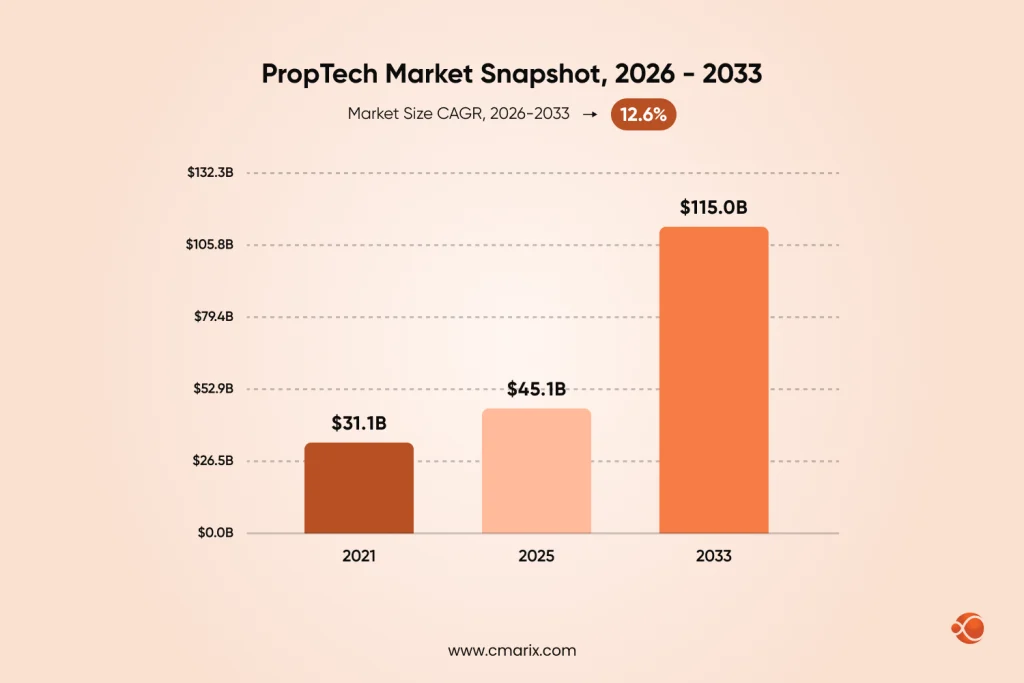
Houses are found through the internet, and the market supporting the practice only grows bigger. In 2025, the global proptech market value stood at USD 45.1 billion but is forecasted to grow to USD 115.0 billion in 2033 at a CAGR of 12.6% from 2026 to 2033. It goes without saying that a real estate website like Zillow stands at the heart of that money.
The fact is that the interface is the easiest part of it. It will work or fail depending on listing data that you probably don’t have, quick searching through thousands of listings, and trust factors that can lure real estate agents and property owners into the website. Building a real estate website is impossible without addressing these issues first.
What Is a Real Estate Website like Zillow?
Let’s break down what you are actually building. A real estate website like Zillow is a two-sided marketplace. One side publishes property listings, the other side searches them, and the platform can generate revenue through agent advertising, lead generation, subscriptions, rental services, mortgage products, and other tools for real estate professionals. A Zillow real estate platform also adds tools around that core, such as map search, saved searches and alerts, agent profiles, and valuation estimates.
Not every site in this category does the same job. Here are the main types:
| Type | Core Job | Typical Revenue |
| Property listing websites | Gather listings from many sources for public search | Advertising and lead sales to agents |
| Agent or broker sites | Showcase one agent’s or brokerage’s own listings | Commissions, driven by captured leads |
| Real estate marketplaces | Let buyers, sellers, and agents transact on one platform | Fees, commissions, and subscriptions |
| Investment platforms | Surface properties with yield and cash flow tools | Subscriptions and transaction fees |
Most Zillow-type websites start as a property listing portal and add marketplace features later. A real estate portal website is the broadest version of the idea, since it serves buyers, renters, agents, and owners at once. Rental platforms work somewhat differently. Short-term stays work closer to an app like Airbnb, where booking and payments sit at the center instead of lead capture, so decide early which model you are following.
How Zillow Earns Its Revenue
| Revenue category | FY2025 revenue |
| Residential | $1.704 billion |
| Mortgages | $199 million |
| Rentals | $630 million |
| Other | $50 million |
| Total | $2.583 billion |
The Zillow FY2025 annual report splits the revenue into four segments. The residential segment includes agent services like Premier Agent, in which agents pay to be listed as buyer connections, and home builder advertising. The rental segment includes rental listing advertising and a rental application service that charges renters a standard fee. The mortgage segment includes originations of Zillow Home Loans and advertising for lenders sold on a per-lead cost basis.
Four groups use sites like this: buyers, renters, agents, and homeowners selling on their own. Your feature list and revenue model depend on which of them you serve first.
Custom Build vs Real Estate Website Builder vs Zillow Clone WordPress
Be aware of the choices before deciding on custom development. An estate property website builder will get your basic site up and running quickly. Zillow-style estate property listings on WordPress, often with a listing theme and plugins, suit smaller catalogs. An estate property market website builder or estate property market web app white-label software falls somewhere in between.
| Option | Setup Speed | Control | Handles Scale and MLS Feeds | Best For |
| Real estate website builder | Fastest | Low | Limited | A single agent or small brokerage site |
| Zillow clone WordPress | Fast | Medium | Weak beyond small catalogs | Testing an idea or a local niche directory |
| Marketplace builder or white-label script | Fast | Medium | Depends on vendor code | Early marketplaces with standard needs |
| Custom build | Slowest | Full | Built for it | Platforms with MLS feeds, custom search, or their own lead routing |
Templates come at a lower price on the first day and become expensive when they reach their limits – speed of search, data feed integration, lead distribution, etc.
If you plan to work with MLS or IDX data, a custom website is a better choice because prebuilt plugins cannot solve licensing issues or handle big data. For a small collection of listings, a theme can be the right solution.
How to Build a Real Estate Website like Zillow in 7 Steps
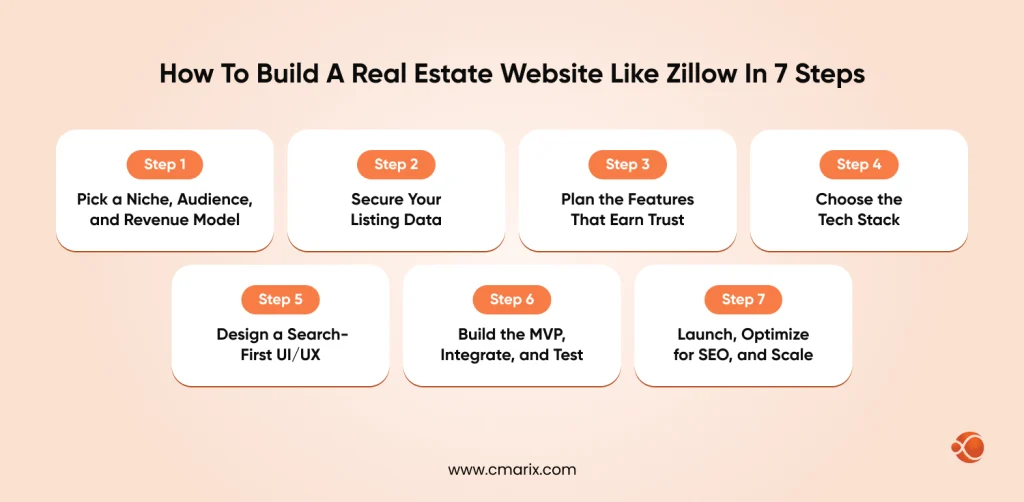
These seven steps cover building a real estate website from the first decision to launch.
Step 1. Pick a Niche, Audience, and Revenue Model
Zillow is an entire country-based listing site. Competing directly with an established national portal can require substantial investment in listings, marketing, and brand recognition. Starting with a specific city, property category, or audience can help a new platform build inventory and attract users before expanding. Select one of the following: area (city or region), type (residential rental, luxury homes, construction, commercial property, etc.), or audience (investors or realtors). Then select how you intend to generate income.
Real estate is one component of the larger field of proptech, and our proptech software development guide explains how listing sites are linked to CRMs, property management systems, and analytics.
Step 2. Secure Your Listing Data
This is the step most guides skip, and it decides whether your site has inventory. Zillow does not offer open access to its own listing data, so a site like yours needs sources of its own. The main ones:
- MLS and IDX feeds– Multiple Listing Services hold the most complete listing data. Participating brokers can display it through IDX, but you get access only after agreeing to the MLS’s data use and licensing rules.
- RESO Web API– This is the standard way MLSs deliver data now. It is RESTful and paired with the RESO Data Dictionary, so field names stay consistent across boards. Developers must arrange access through the relevant MLS or its technology provider and comply with its eligibility, licensing, and data-use requirements.
- Direct uploads– You will upload the listings using your dashboard. The growth will be slow, but you get to keep the data and the relationship.
- Third-party data providers– Commercial APIs supply property records, rental data, and valuations. Our rundown of the best real estate APIs compares what each one covers and how access works.
Prepare a license compliance audit for each source prior to writing any code. As soon as the data comes in, your website will work as all the other real estate search engines out there: ingest, clean, index, and return quick results.
Step 3. Plan the Features That Earn Trust
Start with the core set, then add advanced features once real users show you what they want.
| Feature | What It Does | Why It Matters |
| Property search and filters | Narrows results by price, location, beds, baths, and type | Search is the main reason users arrive |
| Map search with boundaries | Shows listings on a map and lets users draw custom areas | Buyers shop by neighborhood, not only by city |
| Listing detail pages | Shows photos, floor plans, price history, and agent contact | Pages that answer questions convert and rank |
| Saved searches and alerts | Notifies users of new matches | Brings visitors back without ad spend |
| User accounts and favorites | Saves homes, compares them, and tracks activity | Builds a returning audience |
| Agent profiles and lead forms | Connects users with the listing agent | Sits at the core of most revenue models |
| Admin panel | Moderates listings, users, and data feeds | Keeps data accurate and the platform clean |
For maps, most teams combine Mapbox or Google Maps for display, Google Places for nearby amenities, and GeoNames for place data. Mapbox also supports drawing a polygon on the map to narrow results.
The agents comprise a large portion of your supply-side and employ the use of technology that helps them save time. In the Realtors Technology Report by NAR 2026, 81% of agents adopt new technology primarily to save time, compared to 66% who did so last year. This should be considered a brief for design: easy listings, lead inboxes, and scheduling must be part of the agent dashboard.
Once the core works, consider these advanced features:
- Valuation estimates– Automated home value estimates keep users on your site, but they need quality sales data and a clear statement of accuracy.
- Mortgage and affordability calculators- simple to build and good for engagement.
- 3D tours and video- buyers can screen homes remotely, though storage and delivery costs rise.
- AI search and recommendations- natural language search and personalized suggestions only work when listing data is clean and structured. Our guide to AI in real estate covers where it pays off.
- Agent CRM and lead routing- sends each inquiry to the right agent and tracks follow-up.
Tell us your market, and we will scope features and effort.
Step 4. Choose the Tech Stack
Search and images have a much greater impact on the architecture. The listing page is light, but searching through an extensive catalog, including map boundaries, filters, sort orders, and every listing having lots of photos, is heavy.
| Layer | Common Choices | Why It Fits |
| Frontend | React and Next.js or Vue and Nuxt | Uses server-side rendering for list page crawlability and quick loading |
| Backend | Node.js, Python, or Laravel | Handles feed ingestion, APIs, and business logic |
| Database | PostgreSQL with PostGIS | Provides geospatial querying capabilities for map and radius searching |
| Search | Elasticsearch or OpenSearch | Enables fast filtering and ranking across large catalogs |
| Maps | Mapbox or Google Maps Platform | Supports custom styling, polygon drawing, and place data |
| Media and hosting | Cloud object storage with a CDN on AWS | Serves photos quickly and scales with traffic |
Step 5. Design a Search-First UI/UX
Design around the one thing every visitor does first, which is searching.
- Place the search box at the top of the homepage.
- Include a list-and-map view toggle that works together, so filters work in both.
- Display the price, number of bedrooms and bathrooms, as well as high-quality images in every card.
- Make the filters generous, and never display an empty page without suggestions.
- Design the website with a mobile-first approach, while ensuring lightweight images.
Also include some trust features like the agent’s picture and credentials, date of listing, and ways to get in touch.
Step 6. Build the MVP, Integrate, and Test
Send out the minimum version that indicates user interest: search, listing pages, lead forms, accounts, and an admin area. Add feeds and extra features in later versions. Consider using real entries for testing purposes rather than using test entries, since the data would be sensitive. Perform load tests on searches and map searches, make sure the data is accurate and there won’t be any incorrect prices or addresses for users, and test security in relation to logging and personal information.
Step 7. Launch, Optimize for SEO, and Scale
Since organic search is one of the important channels to list websites, SEO should be planned in advance. Create location-specific pages for cities and neighborhoods that offer unique content rather than generic content. Include schema.org RealEstateListing markup on listing pages; update the XML sitemap when inventory changes; remove old listings; and monitor Core Web Vitals. Once the website goes live, ensure that there is a support and maintenance strategy in place.
Our team can build, launch, and support your platform end to end.
How Real Estate Websites Make Money
Pick one primary model and add others once you have traffic.
| Model | How It Works | Works Best When |
| Lead generation | Sell or route buyer inquiries to agents | You have strong search traffic |
| Featured listings and advertising | Agents, builders, or lenders pay for visibility | Inventory and traffic are both strong |
| Agent subscriptions | Agents pay monthly for profiles, tools, or CRM | Your tools save agents real time |
| Rental application fees | Renters pay a flat fee to apply to multiple properties | You serve rentals |
| Mortgage and partner referrals | Lenders or service providers pay for qualified leads | You reach buyers early in their search |
Zillow’s mix of agent, rental, and mortgage revenue shows how far this can stretch, but you do not need every model at launch.
Real Estate Website Development Cost
Real estate website development typically costs $20,000 to $200,000+. The gap comes from three things: where your listing data comes from, how advanced the search is, and how much automation you add.
| Tier | Cost | What Is Included | Typical Timeline |
| MVP | $20,000 to $50,000 | Listings, search filters, user accounts, lead forms, admin panel, manually managed or limited data | 8 to 16 weeks |
| Mid-Market | $50,000 to $100,000 | MVP plus map search, saved searches and alerts, agent dashboards, lead routing, one licensed data provider | 4 to 7 months |
| Full Platform | $100,000 to $200,000+ | Mid-Market plus MLS and IDX feeds, valuation estimates, AI search, 3D tours, scale-ready architecture | 8 to 12 months |
These ranges cover a website. Native mobile apps follow different math, and our guide to real estate app development cost covers that side separately.
What Moves the Price
This is just a set of indicative costs; do not blindly sum them up, as some may intersect with the core development costs.
MLS and IDX integration– $15,000 to $35,000 for licensing, data mapping, and sync logic.
- Advanced search and geolocation– $15,000 to $35,000 for licensing, data mapping, and synchronization algorithm.
- AI property matching– $25,000 to $60,000, and it only works on clean, structured data.
- 3D tours and AR– $20,000 to $50,000, driven by the content pipeline and rendering.
- CRM and portal sync– $15,000 to $40,000 to keep agent and buyer portals in step.
Where the Budget Goes
| Stage | Share of Budget |
| Discovery and requirements | 7% |
| UI/UX design | 15% |
| Development (frontend and backend) | 48% |
| API and third-party integrations | 12% |
| QA and testing | 13% |
| Deployment and launch | 5% |
| Total | 100% |
After launch, expect maintenance of 15% to 20% of the initial build cost each year for hosting, security patches, and data feed updates.
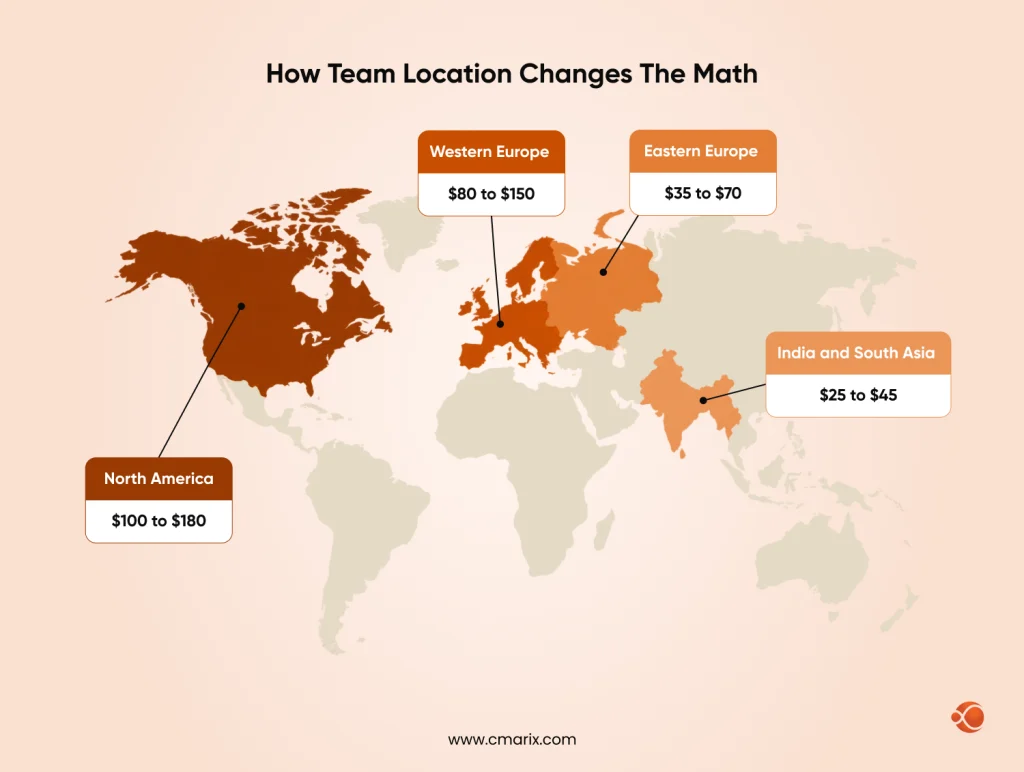
How Team Location Changes the Math
| Region | Hourly Rate |
| North America | $100 to $180 |
| Western Europe | $80 to $150 |
| Eastern Europe | $35 to $70 |
| India and South Asia | $25 to $45 |
An MVP built by a South Asia team at 800 to 1,100 hours and $25 to $45 per hour comes to $20,000 to $49,500, which sits inside the MVP tier. A Full Platform built by a blended team at 1,700 to 2,000 hours and $60 to $100 per hour comes to $102,000 to $200,000, which sits inside the Full Platform tier. A lower rate saves money only if the team moves fast and already knows real estate data.
Challenges and Scalability
- Data licensing and accuracy– Every MLS will have its own standards related to data refresh, display, and attribution. Incorrect pricing information erodes confidence faster than any design issue.
- Real estate website scalability– Search requests, image serving, and feed synchronization increase proportionately. Account for caching, an indexing system for searches, a CDN, and queue-based ingestion of feeds to ensure one burst in traffic doesn’t slow down all pages.
- Fair housing and privacy– The ads or filters should be in compliance with Fair Housing Laws, and the personal information comes under privacy laws, such as CCPA. Consider legal consultation from the very beginning.
- Agent trust and cold start– A site with few listings attracts few buyers, and the reverse is also true. Seed one niche deeply before you widen the scope.
Why Choose CMARIX for Real Estate Website Development
We develop platforms that are heavy on listings and whose search speed, feed capabilities, and other tools need to integrate perfectly with each other. We offer our team for the complete development, including architecture, MLS/IDX integration, design, testing, and support. If you want a partner for real estate website development services, we scope by feature and data source, so you see what each piece costs before you commit.
Conclusion
Building a real estate website like Zillow requires more than a polished interface. Reliable listing data, effective search, user trust, and the right revenue model determine how well the platform serves buyers, renters, and real estate professionals.
Start with a focused MVP, secure the necessary data access, and prioritize the features your target audience needs most. A custom platform may cost $20,000 to $200,000 or more, depending on its scope and complexity. Budget separately for data licensing, third-party services, hosting, and ongoing maintenance, then refine your investment as the platform grows.
FAQs About Real Estate Websites like Zillow
What features define a modern real estate website like Zillow?
Current real estate websites have features such as fast search engines with map search, listing pages, saved searches, alerts, user profiles, and lead generation tools for agents. Advanced sites have added value estimations, mortgage calculators, virtual 3D tours, and even intelligent search engines. Behind the scenes, there is an administrative dashboard, along with feed lists for correct listings.
How do you integrate an IDX/MLS data feed into a Zillow real estate platform?
MLS connectivity usually passes through an MLS participant broker or an authorized vendor; hence, you should begin by asking for a feed while adhering to the MLS license terms. The majority of the MLS platforms have now begun to offer their feeds using the RESO Web API, where credentials are issued through the MLS itself or its software vendor.
What are the best options for choosing a specialized real estate website builder?
Choose a builder depending on your requirements. Hosted builders are best for an individual agent or small real estate agency, while marketplace builders and white-label scripts work better for the initial platform that doesn’t require any special features. It is important to make sure that there is an option for IDX, lead routing, SEO, and exporting of the data.
How does custom real estate web development compare to out-of-the-box templates?
The templates load quickly and are cheap to develop, but they restrict search performance, which is expensive at the start; you get the flexibility to design the system yourself. It depends on what you plan to achieve that will not be achieved through templates.
What alternative websites like Zillow exist for international properties?
Local portals outside the US: Zoopla and Rightmove in the UK; realestate.com.au and domain in Australia; Idealista in Italy, Spain, and Portugal; ImmoScout24 in Germany; and PropertyGuru in Southeast Asia. They all use local data regulations and feeds, which is the reason why a single global clone is unlikely to work.
What are the architectural requirements for achieving high real estate website scalability?
Decouple the search process from your core database using an indexing solution like Elasticsearch or OpenSearch, use a CDN to deliver photos, and consume feeds using queues rather than real-time requests. Incorporate caching and horizontal scalability into the search query process. Conduct tests with realistic amounts of data.
How can homeowners use a custom platform to create a website to sell my house?
In some cases, a custom page with photos, a virtual tour, price, and lead forms is sufficient for a property listing. With a platform, users get an extra opportunity to use scheduling features, track offers, and analytics so that property owners can see which leads have visited them. Owners who sell by themselves need marketing or syndication to be found by buyers.
Is it more cost-effective to use a Zillow clone WordPress framework or build from scratch?
The WordPress solution based on a Zillow clone will be cheaper at the beginning but good enough to test your project locally in a specific niche. However, if you decide to develop the site from scratch, you need more money, and the MVP level will cost from $20,000 up to $50,000 but will support MLS feeds and scaling without refactoring.
What are the prerequisites before launching real estate web application development services?
Make sure you know what your niche, audience, revenue model, and data sources will be before development begins. Have licensing secured for each data feed, features prioritized in your list, budget allocated for development and ongoing support, and KPIs defined for the MVP. Teams that don’t do this end up paying for change later on.
What is the total cost estimate when hiring a professional real estate website development company?
For an MVP, plan on $20,000 – $50,000; for an average build, $50,000 – $100,000; and for a complete platform, $100,000 – $200,000+. Location of the development team, MLS connection, AI capabilities, and timing drive the figure most.