



Quick Answer: Building an app like Airbnb involves choosing the appropriate marketplace business model and niche, defining features for guests, hosts, and administrators, focusing on creating a trustworthy user experience, and selecting the best technology. This article covers all the details on how to create such a marketplace like Airbnb.
The global vacation rental market was worth $101.7 billion in 2025 and is expected to reach $121.9 billion by 2033, growing at roughly 3.7% annually.
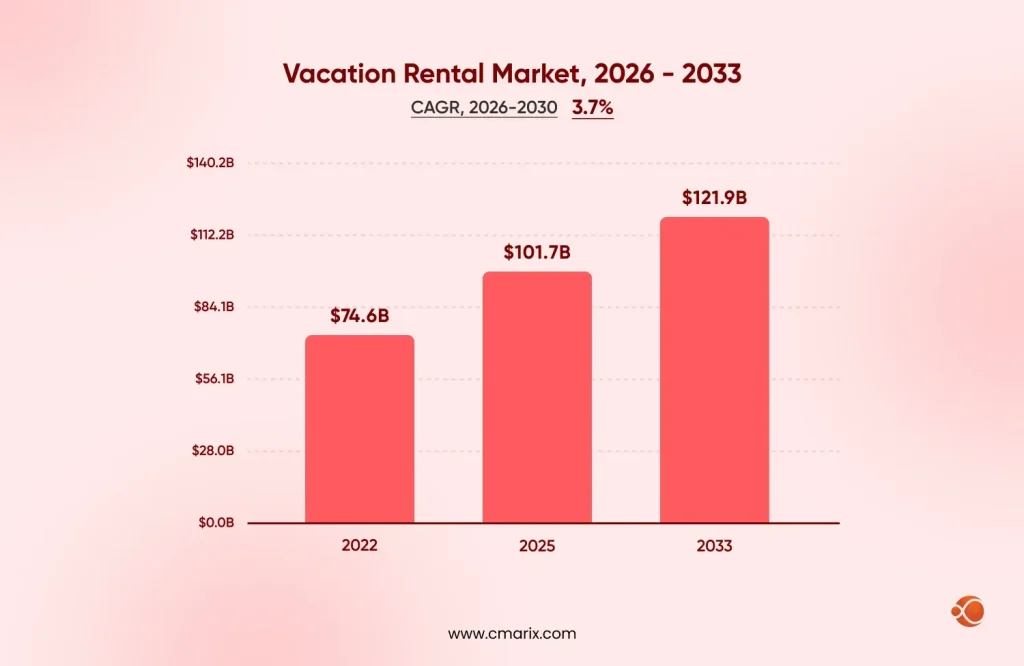
That’s not a hockey stick figure. That’s an adult category, and adults reward founders who have chosen a real hole rather than trying to out-Airbnb. This company has taken care of the “everything, everywhere” model of this business. What remains are all those it’s not good at: super-local stays, pro hosts, corporate housing, female travel, and pet-friendly accommodations. The hole you’re seeing in your local market is likely the hole worth filling.
Quick Highlights
- Development cost: An Airbnb-like application will cost approximately 35,000-55,000 for an MVP, 65,000-120,000 for a mid-range app, and 130,000-220,000+ for an enterprise app.
- Essential products: An Airbnb clone would typically require separate apps for guests, hosts, and administrators.
- Required features: Search and map functionality, property listings, bookings management, integration with a payment gateway, messaging, reviews, verification of identities, and dispute resolution.
- Tech stack recommendation: React or Vue, React Native or Flutter, Node.js or Laravel, PostgreSQL, Elasticsearch or Algolia, Stripe Connect, and Google Maps API.
- Development time: About 3-4 months for MVP, 5-7 months for a mid-range app, and 9-12 months for enterprise.
What matters most is that developing an Airbnb-like application is not only about creating similar features. Trust, payment handling, verification, fraud prevention, and dispute management are what may make or break a marketplace.
Why Do Users Prefer Airbnb?
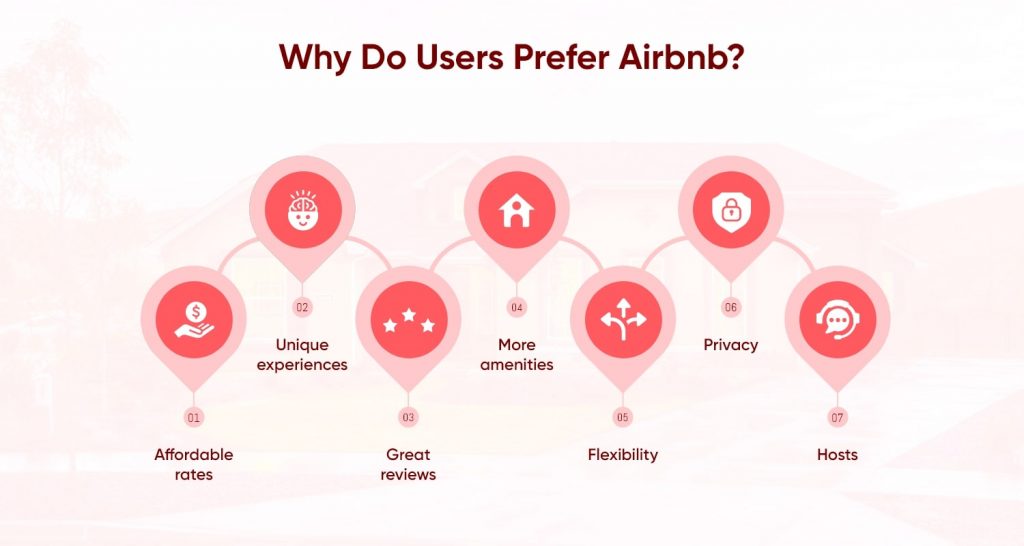
Compared with other platforms, Airbnb has several advantages. Compared with other travel sites, Airbnb is preferred by most travelers for its lower prices and widespread appeal.
Users consider it a prudent choice, as they can spend the money they would have spent on lodging on more interesting and culturally significant experiences in their destination city.
Compared to hotel rooms, Airbnb prices are the lowest available. The vast majority of Airbnb listings are private homes, such as condos, houses, and castles, rather than hotels.
People traveling in large groups will find these accommodations to be excellent. Families would rather stay in a rented house than a hotel because of the homey atmosphere it provides. The cost of lodging may be reduced by sharing a room.
Airbnb also offers hotel rooms, hostels, and even beds for rent, in addition to the aforementioned options. In addition, those who are traveling alone or who do not want to rent out their whole home will appreciate the opportunity to rent out only a single room or an additional area. A conversational element between guests and hosts is also available on Airbnb.
Users may make specific inquiries about the leased property, such as extra costs, amenities, opening hours, and more. The host may learn more about their visitors thanks to this function, which also benefits the user when they decide to build an app like Airbnb.
Why a Feature Checklist Isn’t a Strategy
Every “how to build an app like X” blog post online includes the following six functionalities: search, book, pay, review, chat, and list a property. It may be called a blueprint, but actually it is nothing more than minimum requirements that will allow you to enter the market.
Airbnb has taken almost 20 years trying to address the question of trust at scale: how to detect fraud, how to verify people’s identities, how to cover the host through insurance, how to deal with the problem when someone comes into your house and trashes it. Without the layer, you will not have a smaller Airbnb. What you will have is a company no one wants to use.
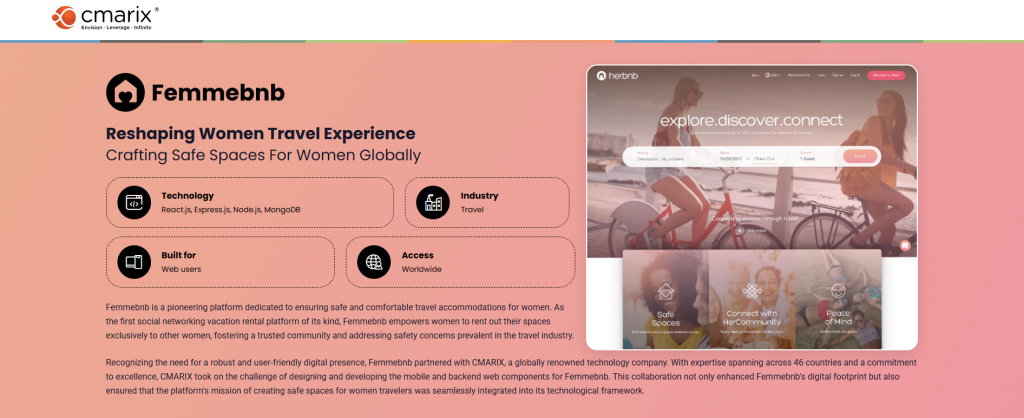
The problem presented itself to CMARIX while they were developing a vacation rental platform called Femmebnb, created exclusively for female travelers. What the developers did not want was an exact copy of all of the features available on Airbnb. They needed a profile verification system, a chat feature to help guests get acquainted with the host, and a review system stringent enough to prevent a bad host from creating another profile and starting over.
Build a scalable rental marketplace with expert developers.
How Airbnb’s Business Model Actually Works
Airbnb does not own any properties. They act as intermediaries between hosts with rooms or properties available for rent and guests looking for accommodation, and charge fees for the transaction. The property owners post their property information, including pictures, prices, and availability. The guests can browse through this information, compare it, and make bookings. Airbnb receives the money and holds it until check-in, then gives it to the host at the start of the booking. Airbnb explains in detail the process by which it calculates its charges to hosts, and I found it useful when designing my own fee structure.
It is precisely this escrow-like mechanism that new entrepreneurs often ignore. What we are talking about is not simply the implementation of an easy-to-use payment option by charging a credit card, but rather an interaction among three parties – the visitor, the host, and the service provider. And this is how Airbnb navigates this complex mid-stage of the process, thanks to its Resolution Center, a dedicated platform for handling refunds, property damage, and disputed payments.
If Airbnb-style rentals aren’t quite your niche but travel still is, it’s worth skimming CMARIX’s roundup of travel app ideas for startups before committing to a full marketplace build. Sometimes a narrower booking or itinerary tool gets you to product-market fit faster than a two-sided marketplace ever will.
Core Features: What Guests, Hosts, and Admins Actually Need
The rental marketplace comprises three products under one brand – the user app, the host app, and the administration app – which ensures honesty on the part of the first two. Here’s everything each product requires, and how not having each will hurt you down the road.
Guest App
| Feature | Description |
| Search with map and filters | Location, price, dates, and amenity filters turn thousands of listings into the five a guest will actually consider |
| Property detail pages | Photos, house rules, cancellation policy, host response time: the page that decides whether someone books |
| In-app chat | Lets guests ask a host about check-in logistics before committing, which cuts cancellations |
| Secure payment gateway integration | Card and wallet payments, split-cost options for group trips |
| User review and rating system | Two-way. Guests rate stays, hosts rate guests, and that’s what keeps both sides honest |
| Booking management | View, modify, or cancel a reservation without contacting support |
Host App
| Feature | Description |
| Listing creation | Photos, pricing rules, availability calendar, house rules |
| Booking requests inbox | Approve, decline, or auto-accept reservations |
| Earnings dashboard | Payout history, upcoming payments, tax documents, all in one view |
| Calendar sync | Blocks dates across multiple listings or external calendars. iCal import matters more than most founders expect |
| Guest messaging | The same chat thread as the guest app, just seen from the other side |
Admin Panel
| Feature | Description |
| Listing approval queue | Manual or automated review before a property goes live. This is your fraud checkpoint |
| Identity verification | KYC checks on hosts, sometimes guests too, depending on your risk tolerance |
| Dispute resolution tools | Refund overrides, communication logs, evidence upload for damage claims |
| Analytics dashboard | Bookings, revenue, take rate, churn: the numbers that tell you whether the marketplace is actually working |
| Content moderation | Flags fake listings or review manipulation before they damage trust in the platform |
The good admin panel would unite all three into one system, meaning that the host wouldn’t need to keep five separate calendars for five listings, and support wouldn’t need to hunt for disputes in emails.
The UI Patterns That Actually Move the Needle
Feature parity gets a marketplace into the market. How those features get presented on screen is what gets someone to actually book. A few patterns are worth building deliberately rather than leaving to whoever’s doing the frontend that week.
Search and map together, not as separate tabs.
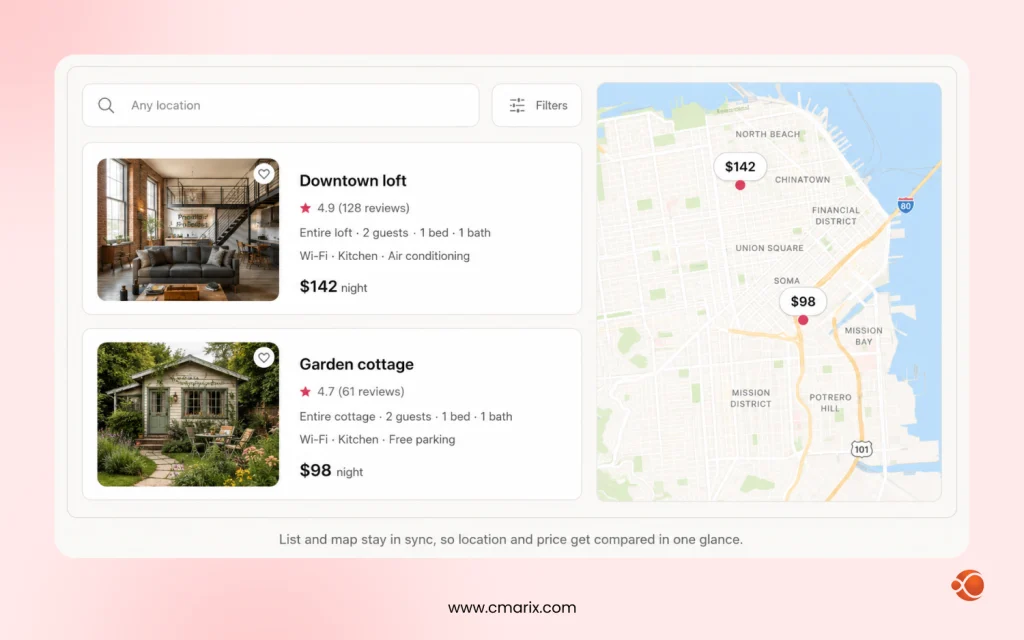
Combining the two together allows for both the listing and the location to be updated simultaneously, so that users will no longer need to memorize the details of the listing first, then switch over to the map and then back again, while allowing them to compare the price, distance, and neighborhood all at once.
Trust signals above the price, not below it.
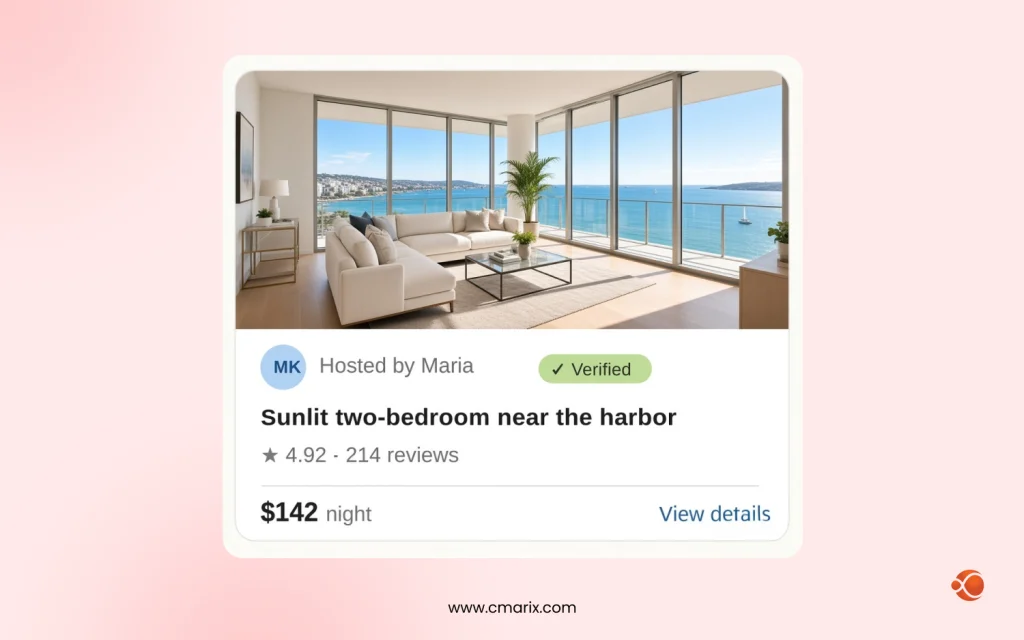
The host’s verification badge and review count must be shown before the guest views the price. If price is what people see first, then they will only compare prices and doubt its correctness at any sign of discrepancy. If the guest gets trust cues first, then the price becomes the verification of the message.
One checkout screen, fully itemized.
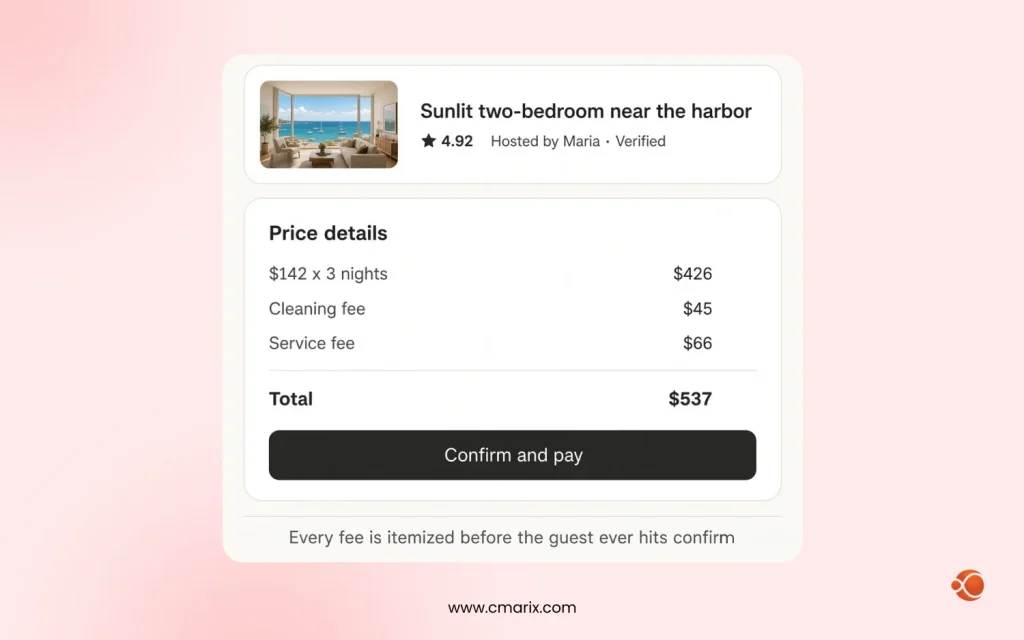
The nightly rate, cleaning cost, service cost, and total are all clearly shown to the guest prior to booking, with no costs being hidden until the confirmation email. This is the same “trust” mechanism as the escrow payment process mentioned earlier, but on the front end of the user interface: Hidden fees at checkout can kill nearly completed bookings.
All of this is not just for show. All of these patterns map to a line item already in the pricing tiers below, and the work on the design of the guest app is where all of this will be implemented, which is why the line is priced at 25,000–45,000.
What Tech Stack Powers an Airbnb-Style Rental App?
Features alone take you halfway there. It is the stack behind the app that will determine whether the app can sustain itself when actual bookings start flowing in, and that is where shortcuts taken by an inexperienced development team usually come to light.
The right choice depends more on your team’s existing skills than any inherent technical superiority, but here’s what tends to work well for a two-sided home rental app development marketplace at this scale:
| Layer | Popular Technologies | Notes |
| Frontend (web) | React.js or Vue.js | React gives you a larger hiring pool. Vue’s built-in data table components handle the host-side booking calendars and admin grids with far less custom code than building them from scratch |
| Mobile | React Native or Flutter | Cross-platform gets you to both app stores without maintaining two native codebases |
| Backend | Node.js or Laravel | Laravel’s routing system makes it fast to stand up clean guest, host, and admin route separation. Node.js suits teams that want one language across the whole stack |
| Database | PostgreSQL + serverless option | Amazon Aurora Serverless or PlanetScale for read-heavy search traffic. Availability queries spike unpredictably around holidays, and serverless scaling means you’re not paying for idle capacity the rest of the year |
| Search | Elasticsearch or Algolia | Property search needs geo-filtering and fuzzy matching that a plain SQL query struggles with once listings hit real scale |
| Payments | Stripe Connect | Built for marketplace payouts. Splits payments between platform and host automatically |
| Geolocation and Map integration | Google Maps API | Property location, distance filters, neighborhood search |
CMARIX designed the Femmebnb platform with React, Node.js, Express, and MongoDB. Stripe is used to process payments, while JSON Web Tokens (JWT) are used for authentication. This is the tech stack developed specifically for a two-sided real-time platform, and not an add-on to an existing platform. For more details on how platform and device choices affect cost, refer to our app development cost guide.
7 Easy Steps to Creating Your Own Airbnb-Style Travel App
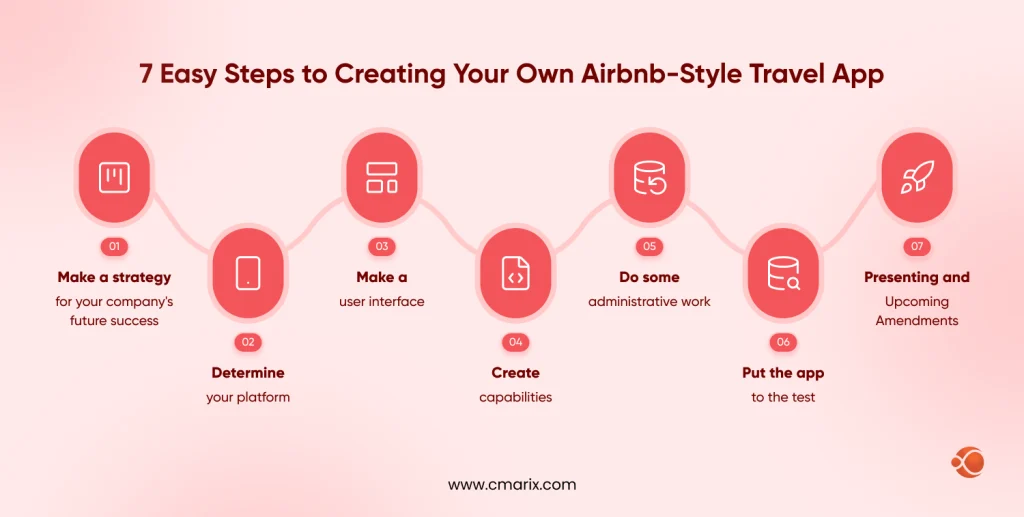
Need some advice on creating your own Airbnb-style app? Airbnb-style travel software development is a scalable, high-profit business. The essential steps for Airbnb app development are outlined here.
Make a strategy for your company’s future success
A well-thought-out business strategy is essential to turning your million-dollar app concept into a reality. There are already hundreds of travel applications available in the app store, so it’s important to get the ball rolling with a high-level business plan that outlines the company’s long-term vision, short-term objectives, and how the app’s features will set it apart from the competition.
A well-thought-out business strategy is the key to making progress toward your objectives and realizing your vision for Airbnb’s future. To address the question of “how to develop an app like Airbnb,” the first step is to draft a business strategy.
Determine your platform
It is common for companies to believe that supporting multiple platforms (such as iOS and Android) or developing cross-platform software would help them attract a larger customer base. To reach a wide audience, however, requires a time-consuming and resource-intensive process of developing native applications for each platform.
Cross-platform application development will hamper the development process and development quality. The best approach would be to first launch the application for the platform that most of your target audience will have access to. After analyzing its performance, you can go ahead with the other platforms. It is very important to analyze the advantages and disadvantages of each platform prior to choosing one.
Make a user interface
Apps that are easy to use and understand are highly desired. A wireframe or low-fidelity prototype is recommended before diving headfirst into UI/UX design, as it serves as a skeleton for the app and demonstrates how users interact with its features and subsequent actions.
Businesses may learn about the app’s flow and any design tweaks they need to make on their own using a do-it-yourself (DIY) approach. The next step is to dive into the code and bring your vision for the app to life. It’s also possible to take into account the one-of-a-kind UX design approach and handy tips for delivering a truly memorable and impressive experience.
Create capabilities
It takes time to gain traction and establish a competitive advantage in the market with Airbnb-style services, so starting late is not an option. Building your app’s essential features and the unique selling proposition (USP) that will set it apart from the competition is best accomplished by starting with a minimum viable product.
The Airbnb app was developed with three distinct user experiences in mind: the visitor, host, and admin experiences.
Do some administrative work
Backend development is crucial, since it is the engine that keeps your app running smoothly. It’s responsible for the nuts and bolts of the program, such as storing and retrieving data, responding to API queries, and setting business rules. Mobile app development companies may either use a backend-as-a-service provider or build their own backend from scratch.
Put the app to the test
Without proper testing before release, no program can be guaranteed to do well. Apps are tested in a variety of ways to guarantee they meet and exceed user expectations, including functional testing, user interface/user experience testing, usability testing, experience testing, and performance testing. The purpose of quality assurance and testing is to eliminate any problems with the app’s functionality or performance.
Presenting and Upcoming Amendments
After the developers have finished their work and uploaded the app to the app store, it becomes available to the public. Updating the app with new features and performing regular maintenance are two ways to keep users engaged and ensure the app remains successful.
How Much Does It Cost to Build an App Like Airbnb?
Costs are broken into three tiers based on scope. Here’s what each one actually buys you.
| Tier | Price Range | What You Get |
| MVP | 35,000–55,000 | Single platform (iOS or Android), core booking flow, basic search, in-app chat, Stripe payments |
| Mid-Market | 65,000–120,000 | Dual platform (iOS + Android), admin panel, KYC verification, advanced search and filters, reviews, calendar sync |
| Enterprise | 130,000–220,000+ | Everything above, plus AI-driven recommendations, multi-currency and multi-language support, fraud detection, dedicated dispute-resolution tooling, high-availability infrastructure |
Break the mid-market tier into its components, and the range adds up cleanly: guest app development runs $25,000 to $45,000; the host app runs $20,000 to $35,000; backend and admin panel runs $15,000 to $30,000; QA and project management runs $5,000 to $10,000. Add the floors, and you land on $65,000. Add the ceilings, and you land on $120,000, which is exactly the tier range above.
The average development time for a mid-range build is roughly 2,200 hours. With an hourly rate at CMARIX that ranges from $32 to $52, this would cost you between $70,400 and $114,400, which easily qualifies as mid-market.
The jump to enterprise pricing is mostly the AI layer. A recommendation engine that matches guests to listings they’ll actually book, or helps hosts price competitively against local demand, is a real machine learning problem: a model that scores listings against a guest’s search history, seasonality, and comparable local pricing in real time. This is a completely different type of engineering effort from UI features, and the cost reflects this, falling more in the territory of CMARIX’s AI consulting services than just another app feature.
Two costs founders underestimate.
The ongoing maintenance cost for one year is 15-25% of the total cost involved in the development phase. If the mid-level system costs $92,500, the annual cost will be about $14,000- $23,000.
Trust and safety infrastructure. ID verification products like Stripe Identity and Persona are billed per transaction, as are the tools needed for dispute resolution. These are where the enterprise pricing premium normally comes from.
If your mobile app is more inclined towards an on-demand delivery app than a booking marketplace, the cost structure changes entirely. The following guide provided by CMARIX describes how much it takes to develop an application like UberEats.
Get a clear estimate based on your features and goals.
Why Going For Cheap App Like AirBnb Options Won’t Yield Results
A $5,000 Airbnb clone app development script sold on a template marketplace looks tempting next to a $65,000 custom build. For a weekend hackathon project, fine. A real business tends to fail in one of three ways.
The logic of payments is generic as well. It can make a payment by card but cannot keep the money in escrow, split the payment between the platform and the host, or provide partial reimbursement for the cancellation of a multiple-night booking. In any case, most founders will have to redesign the payment layer in the first six months of the project’s existence. The template scripts use the same source code in hundreds of copies for buyers; thus, the same security flaws are distributed to all the users of these templates, and markets that store payment information are a popular target.
A custom build costs more upfront. It also doesn’t force a second, more expensive rebuild the moment your first host-guest dispute happens.
Why Build A Travel And Hospitality App With CMARIX
Most of what’s above applies to any team capable of building a two-sided marketplace. What actually differs between agencies is whether they’ve done it before or are learning on your budget.
- A shipped marketplace, not a portfolio slide. Femmebnb was not a template with an updated logo. It required the same verification and review framework discussed throughout this guide – one constructed for a particular set of users with specific trust needs. That’s the build that is discussed here.
- One team across the whole stack. The frontend, backend, and AI work referenced in the tech stack and cost sections above- React and Vue, Node and Laravel, the AI consulting behind a recommendation engine- sit inside CMARIX rather than getting split across subcontractors who’ve never worked together before your project.
- Estimates that match how this piece breaks down cost. The tier and component pricing above isn’t a generic industry average; it’s how CMARIX actually scopes a build: guest app, host app, backend, QA, priced separately and added up. A quote for your specific feature list works the same way.
Conclusion
The development of an Airbnb-type app is less about adding features that have already become standard and more about creating a reliable marketplace. The basic booking functionality can cost about $35,000, whereas an application with all the features listed above may cost up to $220,000.
For most startup companies, MVP is a more logical option to begin with. Focus on a specific segment or an underserved audience, develop the guest and host apps to suit the target market, and pay close attention to payments, verification, reviews, and dispute handling from the very beginning. Later on, it will be possible to introduce more sophisticated features such as AI-driven recommendations, multi-currency support, and other enterprise capabilities.
FAQs About Building an App Like Airbnb
How much does it cost to build an app like Airbnb?
The cost of building a rental marketplace app is generally around $65,000 to $120,000 for a mid-range development with dual-platform applications, KYC verification, and an administration panel. For a budget-version MVP, costs range from $35,000 to $100,000. An enterprise solution with AI and multi-currency support costs 130,000-220,000, or more.
What is the best tech stack for a home rental application?
React or Vue for the front end, Node.js or Laravel for the back end, PostgreSQL with a serverless database for heavy search queries, Stripe Connect for payments split between two accounts, Elasticsearch for searching properties. The tech stack used by CMARIX to develop Femmebnb includes React, Node.js, Express, and MongoDB.
How long does it take to develop a marketplace app like Airbnb?
For an MVP development, you will need 3-4 months. For the middle market, where both guest and host apps and an administration panel are necessary, you will need 5-7 months. For enterprise-level solutions with additional features, such as AI and multi-regional support, you will need 9-12 months.
What are the essential features of a vacation rental app?
Search & filtering options, secure payment gateway integration, messaging, user review and rating system booking management, and, importantly, verification and dispute resolution services on the administration side. The absence of the trust and safety component is the most frequent cause of clone failures.
Can I build an Airbnb clone for both Android and iOS?
Yes, because it is possible to release an application that runs on two platforms using a common codebase with React Native or Flutter; this is the norm for mid-level and enterprise-level applications.
How do I monetize a rental marketplace app?
The predominant business model involves a host or guest fee per transaction, which varies from 3% to 15%, and depends on the specific market. Additional models include promoting listings to premium positions or charging subscription-based fees for professional hosts.
What is the difference between a rental app and a hotel booking app?
The rental platform is where direct connections exist between hosts and guests and therefore requires some host-facing components (property listing management, payment dashboard, calendar synchronization) that are not required in a hotel booking application. The hotel apps deal only with aggregating available stock and do not involve onboarding new stock from independent property owners. CMARIX’s travel and hospitality development work covers both models, since the two often need to communicate through channel manager integrations.
How can I find reliable developers to build a booking platform?
Look for a team that’s shipped a two-sided marketplace before, not just a general app development shop. The payment escrow logic and trust-and-safety tooling are exactly where inexperienced teams underestimate the scope. CMARIX’s dedicated React developers and Node.js team have handled builds like this before.