


Quick Summary: Nowadays, the role of artificial intelligence in healthcare is not limited to pilots but has become an integral part of everyday activities. Health systems use AI to record visits, analyze scans, process prior authorizations, and identify patients who need further attention before anything bad happens to them. The following guide will walk you through how AI is revolutionizing modern healthcare IT systems, its applications, benefits, and its challenges and more.
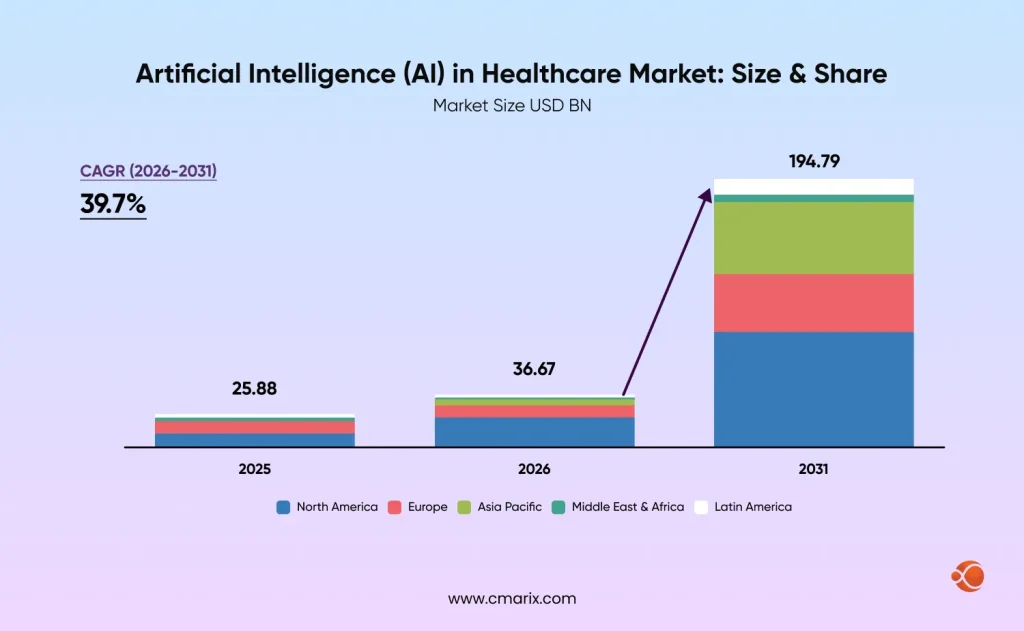
Most hospital IT systems were not built for this moment. They were built to store records, keep the lights on, and route billing codes. Now those same systems are expected to support real-time clinical decisions, catch fraud, cut documentation time, and do all of it while staying compliant with regulations that keep changing. That gap between what legacy healthcare IT was designed for and what AI-native tools now expect is where most of the friction sits today, and it’s part of why the global AI in healthcare market is predicted to rise from roughly $25.88 billion in 2025 to $194.79 billion by 2031.
The complexity is not just technical. A hospital adopting AI has to manage clinical safety, data governance, staff training, and vendor risk at the same time, often with the same small team that used to just keep the EHR running. This guide on the role of artificial intelligence in healthcare is written for hospital CIOs deciding where to spend limited budgets, compliance officers trying to keep pace with a regulatory picture that shifts every quarter, and clinical leaders trying to keep AI tools safe and useful at the bedside.
Disclaimer: This blog is purely informational in nature and indicative of emerging trends within the use of technology and artificial intelligence in healthcare. This blog is neither intended to be nor should be considered to be any form of medical advice.
What Is AI in Healthcare IT Systems
The role of AI in healthcare is best understood at the systems level, not just the individual tool level. AI in healthcare IT systems refers to the application of natural language processing, machine learning (ML), and all related technologies within the software utilized by the hospital or clinic, rather than simply the clinical applications themselves. It includes everything from an algorithm that flags suspicious activities like mammograms to the system that drafts a doctor’s note while they’re still in the room with the patient.
How AI works in healthcare, in practice, comes down to a few shared building blocks:
- Massive volumes of clinical data (lab results, imaging, notes, claims)
- Models trained to recognize patterns in that data
- Workflows that put the AI’s output in front of the right person at the right time
The distinction that matters most right now is between AI as a bolt-on feature and AI-driven digital healthcare solutions built into the core of clinical and administrative workflows. The former adds a chatbot on top of an old system. The latter rebuilds how information moves through the hospital in the first place, which is where most of the value actually shows up.
Key AI and Machine Learning Terms in Healthcare
A few terms come up constantly in any conversation about role of AI in healthcare IT, and they get used loosely enough that it’s worth being precise.
| Term | What It Means | What It Looks Like in Practice |
| Agentic AI | AI that completes multi-step tasks on its own instead of just producing a suggestion for a human to act on. | A billing agent checks a payer’s rules, pulls the right clinical documentation, and files a prior authorization request without staff involvement, flagging only the cases that don’t fit the pattern. |
| Ambient AI | AI that captures a clinical conversation in real time and turns it into a structured note, without anyone typing or dictating. | A physician talks with a patient as usual; by the time the visit ends, a formatted note with diagnosis codes is already available in the EHR for review. |
| EHR-Native AI | AI functionality built into the electronic health record (EHR) platform itself, rather than a separate tool connected through an API. | A readmission risk score appears automatically inside the patient chart instead of requiring clinicians to log in to a separate dashboard. |
| Clinical Decision Support System (CDSS) | Software that analyzes patient data against clinical rules or trained models and provides recommendations at the point of care. | An alert appears when a prescribed drug dose falls outside the safe range for a patient’s age, weight, and existing conditions. |
The common thread across all four; the more specific and workflow-embedded the AI is, the more it actually gets used. Generic AI tools that sit outside a clinician’s normal screen tend to get ignored, no matter how accurate they are.
AI in Healthcare IT: Key Statistics
A handful of numbers capture where this market actually stands right now.
- $187.7 billion by 2030 — Projected size of the global AI in healthcare market, growing at a 38.5% CAGR from 2024 (Grand View Research)
- 75% — U.S. health systems with at least one AI solution deployed, up from 59% a year earlier (Deloitte)
- 26% to 40% — Reduction in clinical documentation time from ambient AI using voice recognition (peer-reviewed study, PMC)
- 1,000+ — AI/ML-enabled medical devices authorized by the FDA, most in radiology (FDA.gov)
Benefits of Artificial Intelligence in Healthcare
Before getting into how each application works, it’s worth being direct about why the role of AI in healthcare keeps expanding across every corner of the hospital.
- Faster, more consistent diagnoses — AI-assisted imaging tools catch patterns a human reviewer might miss on a busy shift, and they don’t get fatigued
- Less time on documentation — Ambient AI gives clinicians back hours that used to go into after-hours charting
- Fewer administrative bottlenecks — Agentic AI handles prior authorization and scheduling without human interference
- Earlier intervention — Predictive analytics flags high-risk patients before a routine visit turns into an emergency
- Potential long-term cost savings — Fewer errors, fewer readmissions, and less staff time spent on repetitive tasks add up across a health system
- Faster path to new treatments — AI-driven drug discovery reduces the timeline between a promising compound and an approved therapy
None of this replaces clinical judgment. It removes the friction around it, which is exactly why adoption keeps climbing.
How AI Is Transforming Healthcare IT Systems
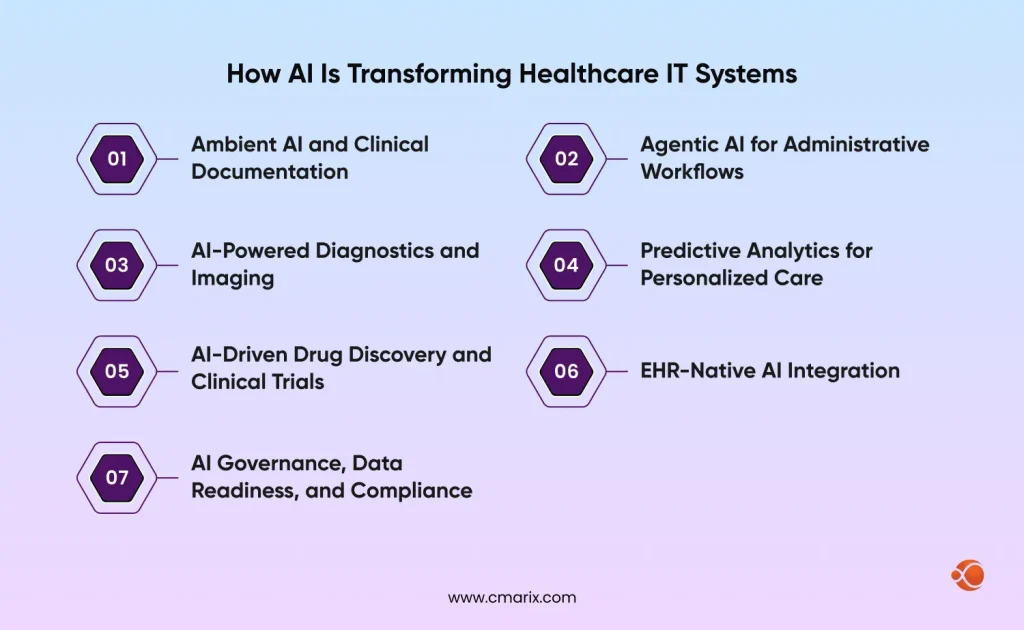
The table below gives a quick view of where AI is showing up across healthcare IT before the details on each one.
| Application | What It Does |
| Ambient AI and Clinical Documentation | Listens to patient visits and automatically generates structured clinical notes. |
| Agentic AI for Administrative Workflows | Handles prior authorization, appointment scheduling, and eligibility verification with minimal human intervention. |
| AI-Powered Diagnostics and Imaging | Detects abnormalities in medical images and prioritizes urgent cases for review. |
| Predictive Analytics for Personalized Care | Identifies patients at risk and helps personalize treatment plans based on predicted outcomes. |
| AI-Driven Drug Discovery and Clinical Trials | Predicts promising drug compounds and monitors clinical trials for safety signals in real time. |
| EHR-Native AI Integration | Embeds AI capabilities directly into electronic health record (EHR) platforms rather than relying on external tools. |
| AI Governance, Data Readiness, and Compliance | Oversees AI models, improves data quality, and supports regulatory compliance and accountability. |
1. Ambient AI and Clinical Documentation
Ambient AI is cutting the time doctors spend typing notes by letting the system listen and write the note for them. Rather than a physician splitting their attention between the patient and the keyboard, an ambient AI tool captures the conversation and generates structured documentation that syncs directly into the EHR.
This is one of the fastest-growing use cases in healthcare IT right now because the return is immediate and easy to measure: less after-hours charting, more time actually looking at the patient. Some of these tools lean on the same NLP in Healthcare techniques that power clinical search and coding automation elsewhere in the hospital.
2. Agentic AI for Administrative Workflows
Agentic AI is starting to handle the administrative tasks that used to require a person to sit down and do them manually. Prior authorization is the clearest example. Instead of a staff member gathering documents and submitting a request by hand, an AI agent can pull the relevant clinical data, draft the justification, and submit it, flagging anything unusual for human review.
The same pattern applies to scheduling, insurance eligibility checks, and provider directory maintenance. This is patient care automation in the sense that matters most: it frees clinical staff from paperwork so they can spend more time treating patients.
3. AI-Powered Diagnostics and Imaging
AI is now becoming a standard part of how many radiology departments read scans, not an experimental add-on. Machine learning models trained on large imaging datasets can flag a suspicious lesion, measure the size of a tumor, or triage a stroke case for faster review, often before a radiologist has even opened the file.
A number of the companies pushing this forward are newer players; our piece on AI healthcare startups covers how fast that space is moving. This isn’t limited to radiology either. Dermatology, ophthalmology, and cardiology all have FDA-cleared AI tools in active clinical use today.
4. Predictive Analytics for Personalized Care
Predictive analytics in medicine is what lets a care team intervene before a patient’s condition gets worse instead of reacting after it does. By analyzing patterns across a patient’s history, labs, vitals, and even social determinants of health, AI models can flag who’s at high risk of readmission, sepsis, or a missed follow-up. Building the interfaces that surface these predictions to clinicians in a usable way is its own discipline, one closely tied to medical web application development.
CMARIX built exactly this kind of platform for PBR Life Sciences: PBR Insight uses machine learning to process EHR data, lab results, and patient feedback into predictive models that flag at-risk populations, while staying compliant with GDPR and HIPAA. This is also the foundation of personalized treatment planning: instead of a one-size-fits-all protocol, care plans get adjusted based on how a specific patient is actually responding.
5. AI-Driven Drug Discovery and Clinical Trials
AI is cutting years off the drug discovery timeline by predicting which compounds are worth testing before a single lab experiment happens. Pharmaceutical companies and research institutions now use machine learning to model how molecules will behave, identify promising candidates faster than traditional trial-and-error methods allow, and screen for likely side effects.
The same technology is transforming clinical trials, providing researchers the ability to identify potential challenges with recruitment, safety concerns, and data inconsistencies in a timely manner without having to wait until the next scheduled review. Many of the systems supporting this transformation are built using the same telemedicine frameworks.
6. EHR-Native AI Integration
The biggest shift in 2026 is AI moving from bolt-on tools to features built directly into the major EHR platforms themselves. Instead of hospitals stitching together a patchwork of third-party AI vendors, EHR vendors are shipping native AI capabilities that plug straight into existing clinical workflows, work that usually runs through dedicated healthcare web development.
This matters because it cuts integration complexity dramatically and reduces the technical debt that comes with maintaining a dozen separate AI integrations. For hospitals building or extending their own platforms rather than relying entirely on off-the-shelf EHR vendors, this is where Machine Learning development services come in.
7. AI Governance, Data Readiness, and Compliance
None of the above work without governance, and that’s become its own discipline inside healthcare IT. AI governance covers who approves a model before it touches a patient, how its performance gets monitored over time, and what happens when it gets something wrong.
Healthcare data privacy sits right alongside it: AI models are only as good as the data feeding them, and most healthcare organizations still don’t have that data fully ready for large-scale AI use. Electronic Health Records (EHR) integration is usually where this gets tested first, since that’s where the most sensitive patient data lives and where AI tools need the cleanest access to it.
Challenges in Adopting AI in Healthcare IT
Expanding the role of AI in healthcare doesn’t move at the pace the technology allows. It moves at the pace an organization can manage risk, and that’s a real constraint, not a lack of ambition.
| Challenge | Why It Matters |
| Regulatory Uncertainty | FDA rules for AI/ML devices continue to evolve, while frameworks such as the EU AI Act add complexity for organizations operating across multiple regions. |
| Data Readiness Gaps | Many healthcare organizations lack clean, well-structured clinical and operational data, making data quality a bigger obstacle than the AI technology itself. |
| Clinical Trust and Safety | AI systems can make significant errors, making human oversight and validation critical before deployment in clinical settings. |
| Legacy System Integration | Older healthcare infrastructure often isn’t designed for AI, making integration slower, more complex, and more expensive than expected. |
| Workforce Readiness | Healthcare staff need proper training to use AI tools effectively; without it, adoption slows, and pilot projects often fail. |
Organizations increasingly look at modern types of healthcare software built with AI integration in mind from the start, rather than retrofitting AI onto systems that were never designed for it.
We design predictive, patient-facing tools built around real clinical workflows.
Future Trends in AI in Healthcare IT
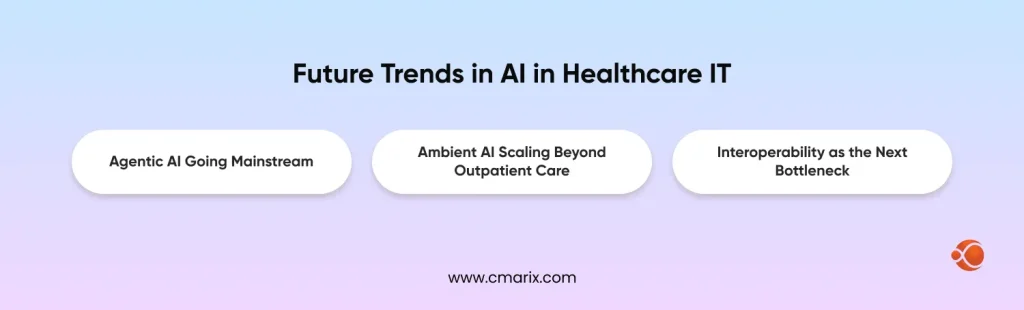
- Agentic AI going mainstream — Expected to move from early pilots into standard use across administrative and clinical workflows over the next two to three years, handling more of the multi-step tasks that used to require a person, start to finish
- Ambient AI scaling beyond outpatient care — Following a similar path as agentic AI, expanding from ambulatory settings into inpatient and emergency care at scale
- Interoperability as the next bottleneck — As more AI tools enter the picture, the ability to move clean data between systems, not the AI itself, will decide which organizations actually get the return they’re expecting
Why Choose CMARIX for AI-Driven Digital Healthcare Solutions
Building AI into healthcare IT isn’t a plug-and-play project. It requires a development team that understands clinical workflows, data privacy requirements, and the practical limits of what AI should and shouldn’t automate. CMARIX works with healthcare organizations on the software layer that makes AI adoption actually usable, from machine learning development services to custom healthcare platforms built around real compliance and interoperability needs. If you’re evaluating where AI fits into your organization’s IT roadmap, that’s exactly the kind of conversation we have every day.
Ready to see what AI-driven healthcare software could look like for your organization?
Final Words
The role of artificial intelligence in healthcare has shifted from a future promise to a present-day operating reality. The health systems seeing real results aren’t the ones chasing every new AI tool that launches. They’re the ones treating AI adoption as an IT and governance problem first, with the clinical upside following from getting that foundation right. That’s the work ahead for most healthcare organizations in 2026, and it’s not going to slow down.
FAQs: Role of Artificial Intelligence in Healthcare
What is the current role of AI in the healthcare industry?
Today, AI is used in administrative and clinical processes, including predictive analytics, diagnostic imaging, ambient documentation, and prior authorization. The technology has transcended from being piloted to having 75% of the United States healthcare organizations implementing at least one AI application.
How is AI transforming patient diagnosis and treatment?
AI models trained on imaging, lab and patient history data can flag abnormalities faster and more consistently than manual review alone, specifically in radiology, cardiology and dermatology. Predictive analytics also lets care teams personalize treatment plans based on how an individual patient is actually responding, rather than a generic protocol.
Will AI eventually replace human doctors and nurses?
No, artificial intelligence is built to support clinical decision-making, not replace clinical judgment. Current FDA-cleared AI diagnostic tool still requires a human clinician to interpret and act on their output, and studies have shown AI models can make serious errors when used without proper oversight.
What are the major challenges facing AI adoption in healthcare?
The biggest challenges are regulatory uncertainty, data readiness, integration with legacy IT systems and developing enough clinical trust to use AI tools safely. Workforce training is also a common reason AI pilots stall before reaching full deployment.
How does AI accelerate medical research and drug development?
AI can be used to simulate the behavior of molecules and predict their possible side effects even before conducting physical lab tests, thereby saving years in the discovery phase of drug development. During the clinical trial stage, AI technology is also used by scientists to identify any potential problems with recruitment and safety in real time.
Can patients use AI for personal health advice?
AI-powered symptom checkers and virtual assistants can help patients understand general health information and decide whether a situation needs medical attention, but they are not a substitute for a licensed clinician’s diagnosis. Anything beyond general guidance should go through a healthcare provider.