



Quick Summary: NLP in healthcare is helping hospitals and providers turn messy clinical notes into usable data. From clinical documentation to drug discovery, this guide breaks down the biggest use cases, the challenges still holding providers back, and what a healthcare software development partner can do about them.
Health professionals waste several hours a week typing notes, gathering patient histories, and entering records that never talk to one another. And most of those details end up in free text, like discharge summaries, dictated notes, referrals, and scanned documents that existing software cannot recognize. That is the real challenge for the contemporary healthcare system, and it has nothing to do with a lack of staff. It’s all about data.
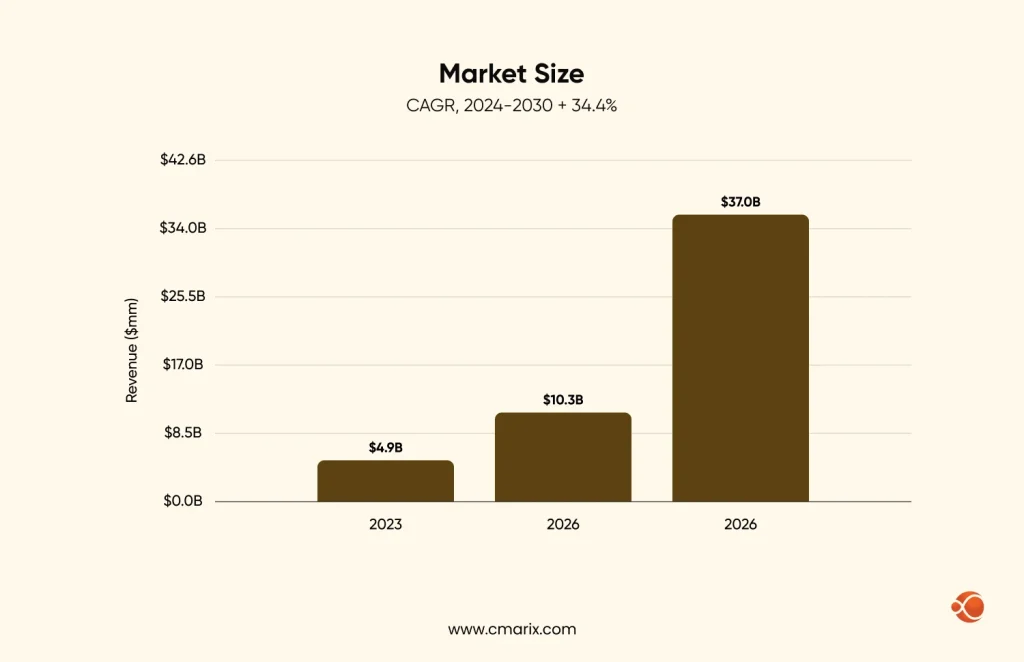
NLP in healthcare exists to close that gap, and providers are investing in it fast: the global NLP in healthcare and life sciences market is projected to hit $37.0 billion by 2030. But turning unstructured patient data into clinical decision support, faster billing, and earlier diagnoses isn’t a simple plug-and-play switch. HIPAA compliance, model accuracy, integration with legacy EHR platforms, and the sheer variety of medical language all add layers a provider has to work through before NLP delivers real value.
Key Takeaways
- NLP in healthcare converts unstructured clinical text (notes, reports, transcripts) into usable, searchable data
- Roughly 80% of healthcare data is unstructured, which is why NLP has become central to clinical workflows
- The worldwide NLP in healthcare and life sciences market is projected to hit $37.0 billion by 2030
- Core use cases span clinical documentation, medical coding, drug discovery, and predictive analytics
- Data privacy and integration complexity remain the biggest adoption barriers, and both are solvable with the right development partner
What Is NLP in Healthcare?
NLP in healthcare refers to the branch of AI that reads, interprets, and extracts meaning from human language inside clinical settings. This includes doctors’ notes, patient interactions, lab reports, and medical literature. Instead of leaving that information locked in free text, NLP software pulls out structured insights: diagnoses, medications, symptoms, and relationships between them.
This matters because most clinical data isn’t clean. Roughly 80% of healthcare data remains unstructured after it’s created, sitting in formats that standard databases can’t process (NCBI/PMC). NLP for clinical notes is what makes that 80% usable for research, billing, diagnosis, and care coordination. It’s also why many healthcare providers now work with a specialized healthcare software development company to build NLP into their existing systems rather than bolt it on as an afterthought.
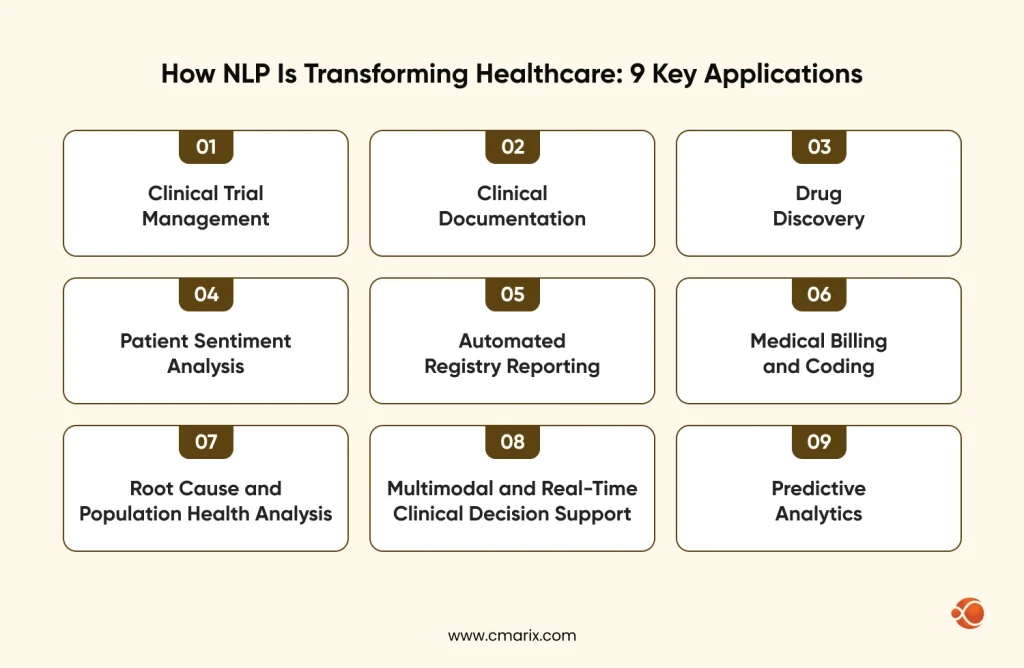
How NLP Is Transforming Healthcare: 9 Key Applications
1. Clinical Trial Management
NLP draws structured information from research papers, protocol documents, and patient records simultaneously. This process helps in quickening the process of recruiting patients for trials, ensures proper patient stratification, and assists in tracking adverse events and adherence to protocol rules in real-time. The overall effect is reduced trial timelines without compromising on safety aspects.
2. Clinical Documentation
This is where NLP for clinical records plays its part. Ambient transcription applications transcribe the dialogue between doctors and patients into a structured form in an automatic way, thereby cutting down on the paperwork that eats away at the available time for working with patients.
3. Drug Discovery
Applications of NLP in the healthcare sector run wide within pharmaceutical research. Through examining data from clinical trials and previous patient experiences and through mining biomedical publications, NLP tools identify molecular mechanisms and drug targets that would otherwise require a much longer time for humans to discover. Many life sciences companies are now pairing this with broader AI in pharmaceutical industry strategies to cut time-to-market on new products.
4. Patient Sentiment Analysis
NLP analyzes patient feedback across surveys, online reviews, and call center transcripts to surface how patients actually feel about their care. That insight helps providers catch dissatisfaction early, respond to concerns before they escalate, and build more trust into the overall care experience.
5. Automated Registry Reporting
Submitting clinical data to the health registry system was a tedious task, which involved manual extraction of the information. NLP will automate this process by extracting information from both structured and unstructured data sources to make sure that submissions to regulatory authorities are always on time and accurate.
6. Medical Billing and Coding
As clinical notes go, NLP also directly affects medical coding and billing. It converts doctors’ notes and descriptions of procedures into a coded format to minimize errors and expedite billing. Together with the use of AI in healthcare administration tools, this is one of the quickest methods to recoup NLP costs.
7. Root Cause and Population Health Analysis
NLP can connect patterns across huge patient populations that traditional databases miss entirely, including how race, social conditions, and location influence health outcomes. That kind of population health insight gives care teams a much clearer picture of why specific health issues cluster where they do.
8. Multimodal and Real-Time Clinical Decision Support
The newer generation of NLP tools doesn’t just read text. It combines clinical notes with imaging and lab data for a fuller picture of patient risk. This multimodal approach is becoming one of the defining NLP solutions for healthcare heading into 2026, particularly for flagging patients at risk of deterioration before it happens.
9. Predictive Analytics
When paired with predictive analytics, NLP can assist health care practitioners in identifying patients who might become ill in the near future based on their medical records. ClinicalBERT is a case study in this field of research; the inclusion of unstructured clinical documents along with structured data increases the accuracy of predictions such as hospital readmission.
Build a custom NLP solution designed around your existing clinical workflows.
NLP Use Cases in Healthcare: Summary Table
| Application | Core Benefit |
| Clinical Trial Management | Faster recruitment and better compliance monitoring |
| Clinical Documentation | Less paperwork with faster, more accurate records |
| Drug Discovery | Faster identification of drug targets and candidates |
| Patient Sentiment Analysis | Early detection of patient dissatisfaction |
| Automated Registry Reporting | Accurate, on-time regulatory submissions |
| Medical Billing and Coding | Fewer errors and faster reimbursement |
| Root Cause and Population Health Analysis | Clearer view of health disparities and their underlying causes |
| Multimodal Clinical Decision Support | Earlier risk detection using combined data sources |
| Predictive Analytics | More accurate readmission and risk predictions |
How NLP Is Improving Patient Care Across the Care Journey
Putting Patients in Control of Their Own Data
NLP-powered apps give patients real-time, understandable access to their own medical records, which supports better-informed decisions about their care. Some providers are extending this further with AI telemedicine chatbot development, giving patients a conversational way to ask questions and get guidance between visits.
Making Sense of Large, Messy Data Sets
NLP processes huge volumes of unstructured medical data in the background, so care teams aren’t stuck manually sorting through records before they can act on them.
Sharper Diagnosis and Treatment Planning
Identifying risk factors early on through recognizing patterns, NLP enables better diagnoses and a tailor-made treatment plan for each patient instead of a one-size-fits-all approach.
Automating the Repetitive Administrative Work
Paired with machine learning and RPA, NLP takes over data entry and report generation, tasks that used to eat up hours every week, freeing clinicians to spend that time with patients instead.
Stronger, Earlier Patient Monitoring
NLP-driven monitoring tools help care teams flag potential problems in high-risk patients earlier, supporting more proactive rather than reactive care.
A More Personalized Patient Experience
By analyzing how patients communicate, NLP helps providers tailor interventions and messaging to match each patient’s needs and preferences.
We build predictive NLP tools tailored to your patient population and workflows.
Future of NLP in Healthcare: Trends to Watch Through 2030
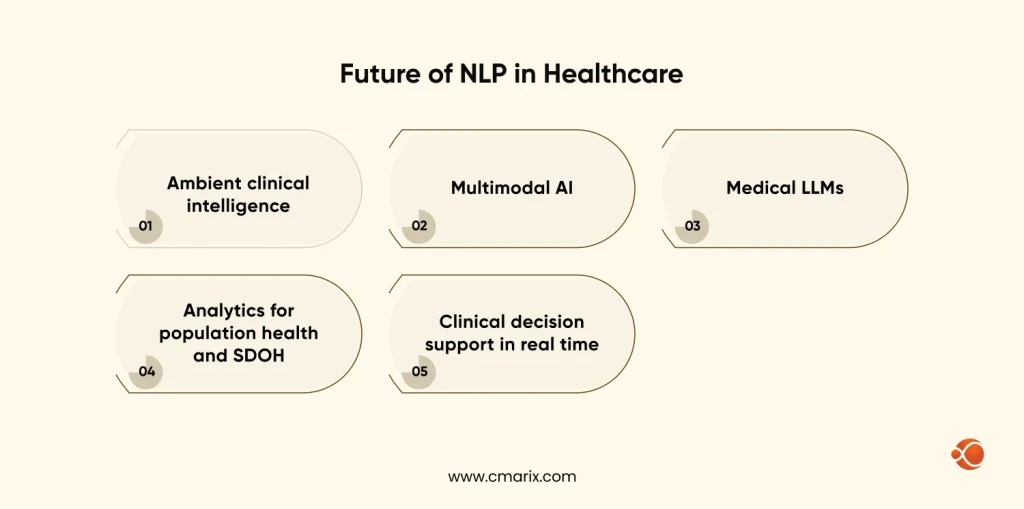
Some changes that are already being seen as the future of NLP in healthcare include:
- Ambient clinical intelligence: Live documentation during a patient visit, completely automated, without any post-processing needed.
- Multimodal AI: Using clinical text alongside imaging, laboratory results, and devices in order to get a comprehensive look at the patient’s risk
- Medical LLMs: Large language models specifically trained in clinical language rather than being general-purpose
- Analytics for population health and SDOH: Using NLP to map out social determinants of health within larger groups of patients
- Clinical decision support in real time: Switching from analyzing things retrospectively to giving advice in real time.
Challenges of NLP in Healthcare Implementation
Data Privacy and HIPAA Compliance
Healthcare data is among the most sensitive information a business can hold. Any NLP system touching patient records has to meet HIPAA requirements at each step, from model training to data storage, which limits how freely providers can experiment with off-the-shelf tools.
Integration With Legacy Systems
Most hospitals run on EHR systems that weren’t built with NLP in mind. Getting a new NLP layer to talk to decades-old infrastructure is often the hardest part of any healthcare software development company’s job.
Accuracy in Clinical Context
Medical language is dense with shorthand, abbreviations, and context-dependent clinical nuance, and in healthcare, that margin for error is much smaller than in most other industries.
Variability in Unstructured Data
Clinical notes vary wildly by provider, specialty, and even individual writing style. Building an NLP for a clinical notes system that handles that variability consistently takes more than a generic, pre-trained model.
How a Healthcare Software Development Company Solves These Challenges
An experienced development partner addresses each of these problems directly rather than working around them:
- For data privacy, they build HIPAA-compliant infrastructure from the ground up, with access controls, encryption, and audit trails built into the system rather than added later.
- For legacy integration, they design NLP layers that connect to existing EHR and EMR platforms through proper APIs, so providers don’t have to rip out systems that already work.
- For clinical accuracy, they fine-tune models like ClinicalBERT or other biomedical NLP frameworks on the provider’s own data, rather than relying on generic language models.
- For unstructured data variability, they build extraction pipelines trained on the specific documentation styles a hospital or clinic actually uses, instead of a one-size-fits-all model.
Why Choose CMARIX for NLP in Healthcare Development
CMARIX works with healthcare providers to build NLP solutions that fit into how their teams already operate, not the other way around. That means HIPAA-compliant architecture from one, models trained on real clinical documentation rather than generic datasets, and integration with existing EHR and EMR systems.
Whether the goal is automating clinical documentation, improving medical coding and billing accuracy, or building predictive analytics into patient monitoring, the team scopes each project around the provider’s actual data and workflows.
This isn’t theoretical. CMARIX partnered with PBR Insights, a UK-based life sciences analytics company, to develop a healthcare data platform that pulls together EHRs, lab results, and patient feedback into one system. The platform uses AWS Comprehend Medical to apply NLP to unstructured medical text, feeding predictive models that flag at-risk patients while keeping the whole system GDPR and HIPAA compliant. It’s a real example of what NLP-driven healthcare infrastructure looks like once it’s actually built and deployed, not just proposed.

Conclusion
NLP in healthcare has moved well past the experimental stage. It’s now driving faster documentation, earlier risk detection, more accurate coding, and better-informed patients. The providers seeing the most value from it are building it with partners who understand both the technology and the compliance requirements around it.
If your organization is ready to move from manual documentation to structured, AI-supported workflows, working with an experienced healthcare software development company is the fastest way to get there without disrupting the systems you already depend on.
FAQs on NLP in Healthcare
What is NLP in healthcare?
NLP in healthcare is a branch of AI that reads and interprets human language in clinical settings, including doctors’ notes, medical literature, and patient records. It converts unstructured text into structured data that software and care teams can actually use.
How is NLP used in healthcare?
NLP is used across clinical documentation, medical coding and billing, drug discovery, patient sentiment analysis, clinical trial management, and predictive analytics. It works behind the scenes to extract meaning from text that would otherwise sit unused in a patient’s file.
What are the most common use cases for NLP in healthcare?
The most common use cases are ambient clinical documentation, automated medical coding, clinical decision support, and predictive analytics for patient risk. These tend to deliver the fastest, most measurable return for providers.
How does NLP improve quality patient care?
NLP frees up clinician time by automating documentation and administrative work, supports earlier and more accurate diagnoses through pattern recognition, and gives patients better access to their own health information. All three add up to more attentive, better-informed care.
Is NLP technology secure and HIPAA-compliant?
NLP itself is just a technology category, so security and compliance depend entirely on how a specific system is built. A properly designed NLP solution includes encryption, strict access controls, and audit trails to meet HIPAA requirements, but that has to be engineered in from the start rather than assumed.
What are the biggest challenges in implementing NLP in healthcare?
The biggest challenges are HIPAA compliance, integrating with legacy EHR systems, maintaining accuracy across highly varied clinical language, and handling the sheer inconsistency of how different providers document care. Each is solvable, but requires deliberate engineering rather than an off-the-shelf tool.
What does the future of NLP in healthcare look like?
The coming years will bring about ambient clinical intelligence, which is medical-specific large language models that perform better than general models with respect to clinical accuracy and multimodal AI with a combination of text, imaging, and laboratory data. Real-time clinical decision-making will definitely become the norm.