


Quick Summary: This blog explores how to build AI-Powered Web App with MERN Stack, explaining why the combination of MongoDB, Express.js, React.js, and Node.js is ideal for integrating modern AI capabilities. It covers key tools, real-world use cases, integration steps, and performance tips to help developers create scalable, intelligent, and data-driven web applications.
MERN Stack is the preferred technology stack, and the reason is simple: it works! And combining the MERN stack with AI capabilities is redefining the possibilities of innovation-driven smart app development. Modern web apps can be enhanced with user behaviour analysis, natural language processing, image recognition, and other advanced AI features that deliver personalized experiences to many customers.
By combining AI with the MERN stack, developers can create sophisticated systems used by small-scale, mid-scale, and enterprise-grade organizations. In this blog we will cover why to create a MERN app using AI, explore the best AI tools for MERN developers and much more.
You don’t need high-level programming knowledge to integrate AI into web applications. All you need to do is hire MERN stack developers who have knowledge of the right tools for integrating powerful machine learning capabilities in your web applications. This blog will cover all the important components, integration strategies, and best practices for integrating AI features into MERN web apps.
The Role of MERN Stack and the Popularity of Artificial Intelligence
MERN stack provides a strong base for developing dynamic web applications. Combining MERN stack and AI creates a robust ecosystem for developing smart, data-driven applications. You can use MERN stack and AI for developing chatbots, recommendation systems, predictive analytics and more.
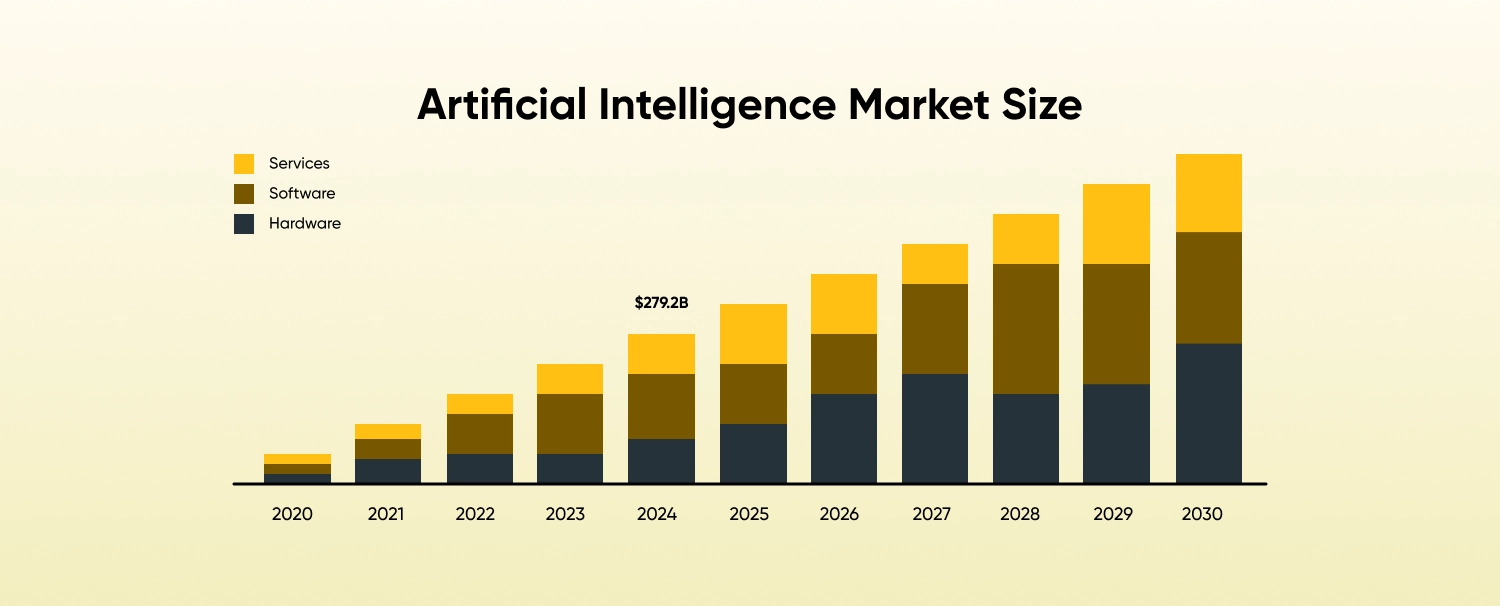
A study by Grand View Research stated that the AI market size was worth $279.22 billion in 2024. And the size of the AI market is only going to grow at a staggering rate of 35.9% from 2025 to 20230.
What is MERN Stack and Why is it Ideal for AI Integration?
MongoDB
MongoDB is the foundation of the MERN stack. It provides a flexible document-based NoSQL database. It supports JSON data storage, which is used to handle unstructured data, primarily in AI applications.
Express.js
Express.js is a great middleware framework used for backend operations of MERN applications. It simplifies the development of robust APIs and server-side components needed for AI integration.
React.js
React.js is one of the most popular JavaScript frameworks responsible for frontend development in MERN stack-based web applications. React uses its virtual DOM to make responsive interfaces capable of displaying AI-generated content.
Node.js
Node.js is the final piece of the MERN stack. It has an event-driven model that makes it efficient at handling concurrent requests, thus providing real-time data streaming ability, which is a common need in AI applications.
Why Use MERN Stack with AI?
Combining the MERN stack and AI creates a robust ecosystem for developing smart, data-driven applications. The flow between MERN Stack and AI is ideal for developing chatbots, recommendation systems, predictive analytics, and more. Here is how each component of MERN stack is useful for AI integration:
Flexibility for Full-stack AI integration
The MERN stack is based entirely on JavaScript. A unified technology stack enables smooth data flow across application layers. MongoDB JSON structure is ideal for using JavaScript objects in Node.js and React.js, which creates a natural flow when integrating AI features in MERN stack apps.
Unified Language Across the MERN AI Integration Stack
Since the application is entirely based on JavaScript, developers who are proficient in MERN stack development can easily work across all layers without needing to switch contexts. JavaScript has an active collection of AI libraries that further strengthen its capabilities and enable AI integration. TensorFlow has a dedicated TensorFlow.js library that brings machine learning capabilities to Node.js-based environments.
Modular and Scalable Architecture
Build an AI-powered web app with MERN Stack with React. React.js uses a component-based architecture, and Express.js acts as a middleware. Hence, when you hire MERN stack developers, they can easily modularize AI features for efficient scaling and maintenance. Whether you want to integrate real-time recommendations or dynamic content personalization, MERN apps can adapt and grow without structural rewrites.
Efficient API Communication for AI Services
Node.js and Express.js are both well-suited for building RESTful APIs or connecting with third-party AI integrations. With an efficient group of developers, MERN stack can simplify request handling, data transformation needs and authentication for efficient AI communication.

Current Trends in AI in Web Development
AI-Powered Development Tools
- AI assistants like GitHub Copilot and Tabnine are helping developers write, debug, and refactor code faster.
- These tools automate repetitive coding tasks, freeing developers to focus on system logic and AI integration.
- For MERN developers, it means quicker API development and cleaner integration with popular AI libraries.
Hyper-Personalized User Experiences
- AI is used to analyze user data to deliver customized layouts, product recommendations, and content flows.
- With MongoDB and React, developers can design real-time personalization that adapts to user behavior.
- Personalization boosts engagement and retention, making AI a core part of the UX strategy.
Voice and Conversational Interfaces
- Chatbots and voice assistants are becoming standard in modern web apps.
- Tools like Dialogflow and OpenAI API make it easier to integrate NLP into MERN applications.
- These features help businesses offer human-like customer interactions 24/7.
Low-Code and AI-First Platforms
- Businesses are adopting AI-driven builders to reduce manual coding and enable rapid prototyping.
- While convenient, custom MERN + AI solutions still offer more flexibility for scaling and security.
- Smart teams use low-code for early MVPs and full-stack MERN for production-grade AI apps.
AI-Driven Code Quality, Testing, and Security
- Machine learning tools now assist in automated testing, vulnerability detection, and code reviews.
- They help maintain performance and security standards across large-scale MERN applications.
- Continuous AI-assisted testing ensures stable deployments even with frequent updates.
Real-Time and Edge AI Processing
- AI workloads are shifting closer to users with edge computing for faster predictions.
- TensorFlow.js and React components can be used to fine-tune models and run them directly in the browser.
- Real-time and Edge AI processing can reduce latency and dependency on servers.
Real-World AI in MERN Stack Applications Use Cases
E-commerce: Intelligent Product Recommendations
E-commerce platforms use AI-powered recommendation engines to analyze users’ browsing history, purchase behavior, and preferences. By processing large sets of user interaction data stored in MongoDB and processed through Node.js APIs, MERN-based apps can serve real-time product suggestions that increase conversions and average order value.
Healthcare: Symptom Checkers and Diagnostics
Healthcare applications are integrating AI models, often rule-based or decision tree algorithms, to power interactive symptom checkers. These tools collect user input via React-based forms and deliver assessments through Express APIs, guiding patients toward appropriate care paths while reducing strain on healthcare providers.
Finance: Fraud Detection and Smart Advisory
The fintech industry uses AI for various use cases, like real-time fraud detection. It monitors transaction patterns, flags abnormal activities, and reduces false positives. MERN stack applications also deliver AI-driven investment recommendations by connecting to ML models via Node.js, improving the user experience with data-driven insights.
Education: Adaptive Learning Platforms
EdTech platforms use AI and ML to improve their study materials and the way they are taught, helping users of all experience levels better understand and retain the material. MERN-based applications in the education section can track each student’s progress using MongoDB, and developers can integrate AI algorithms to update content based on course difficulty and individual limitations.
Media: Content Personalization and Engagement
Media and entertainment companies leverage AI to build AI-powered web apps with the MERN stack. They develop content recommendation engines that increase viewer retention. Using real-time user interaction data, MERN stack applications surface personalized articles, videos, or playlists using React interfaces, boosting both engagement and platform loyalty.
Banking: Predictive Analytics and Customer Insights
Banks are also using AI-powered analytics with the MERN stack for powering their applications. This is enabling them to build applications and processes capable of understanding customer behaviour and predicting financial trends. Such AI models connected via Node.js APIs have many use cases, including credit risk assessment, getting financial product recommendations, customer support automation, and more.
Transportation & Logistics: Route Optimization and Predictive Maintenance
AI-powered MERN stack applications are used by logistics and transport agencies to automate and ease their operations through real-time data analysis. AI algorithms are optimized to improve delivery routes, forecast delays, and predict maintenance costs.
Insurance: Risk Assessment and Claims Automation
Insurance companies also benefit from combining AI with MERN stack capabilities to automate claims processing and properly evaluate policy risks. AI models analyze claim documents, detect anomalies, and provide instant approvals for low-risk cases. This minimizes manual effort while ensuring accuracy and transparency in policy management.
Travel & Hospitality: Personalized Itineraries and Chatbots
The travel and hospitality market and its key leaders are also integrating AI into their applications using the MERN stack. Whether it is AI-driven chatbots and recommendation engines, or building personalized itineraries from scratch, AI in the travel industry has many applications and use cases.
Sports: Performance Analytics and Fan Engagement
Sports organizations use AI to track player performance, predict outcomes, and personalize fan engagement. AI MERN-based dashboards provide coaches with all the necessary tools and insights to better analyze their players’ performances and the opposition. Many teams are using AI in football game analysis or similar services for different sports to make real-time data-backed decisions on the field.
Key Benefits of AI-Powered Web App With MERN Stack
Hyper-Personalized UX
AI learns each visitor’s behavior in real time and reshapes layouts, content, pricing, and even color schemes so every user feels the site was built just for them, lifting engagement by 30-50% without extra traffic.
Zero-Wait Support, 24/7
Conversational chatbots and voice agents answer 80 % of questions instantly, escalate the rest with full context, and never ask “Have you tried turning it off and on again?”, cutting support costs by half while keeping CSAT scores high.
Predictive Everything
From forecasting next quarter’s sales to pre-loading the page a shopper is likely to click, AI turns historical data into confident forward-looking actions that reduce stock-outs, server lag, and missed conversions before they happen.
Self-Optimizing Code & UX
Built-in A/B engines run thousands of micro-experiments per hour, automatically promoting the variants that increase conversion or reduce latency, so the app literally gets faster and more profitable while you sleep.
Fort-Knox Security on Autopilot
Models baseline normal user behavior and flags anomalies like fake accounts, card testing, and bot farms in milliseconds, blocking threats that rule-based engines miss and slashing fraud losses by 40-90%.
Voice & Vision Interfaces
Users can search by talking, uploading a photo, or pointing a camera; AI interprets intent and returns exact products, docs, or answers, opening your app to audiences that cannot or will not type.
Infinite Scale, Tiny Team
Auto-scaling cloud pipelines, AI-generated tests, and self-healing infrastructure mean a four-person startup can serve millions without hiring armies of DevOps or QA engineers.
Accessibility for Everyone
Real-time captioning, screen-reader narration, dynamic color-contrast tuning, and language translation baked into the frontend make the app usable by people with disabilities or low literacy, expanding the market reach by 15-20%.
Best AI Tools for MERN Developers in 2026

We saw how efficient the MERN stack is for accommodating AI features and capabilities. To truly get the benefits of hiring MERN stack developers, make sure your dedicated developers know how to use these AI tools for smoother AI integration with the MERN stack:
TensorFlow.js
TensorFlow.js is an advanced JavaScript-based machine learning library. It allows developers to use ML capabilities directly in the client’s browser, server-side with Node.js, and mobile with React Native. This tool is ideal for the MERN stack for front-end development with AI capabilities.
OpenAI API
The OpenAI API gives web apps access to advanced language models like GPT, with capabilities such as chatbots, text summarization, content generation, and sentiment analysis.
Hugging Face
Hugging Face is another popular AI tool for MERN developers seeking an extensive library of pre-trained models for tasks such as question answering, translation, and sentiment analysis. It has a dedicated ‘Transformers’ library that can be integrated with Node.js. This allows developers to add high-level NLP features in MERN stack-powered applications.
IBM Watson
Next on the list of AI web development tools is IBM Watson. This is an enterprise-grade AI platform with many AI-assistive tools and APIs. This includes support for language translation, speech-to-text, and visual recognition.
It scales easily to match the dynamic needs of enterprise-grade MERN stack applications that need AI-driven data analytics, customer support, and cognitive search functionality.
Dialogflow
We can’t complete the list of the best AI tools for MERN developers without including a popular Google Cloud-based tool: Dialogflow. It is mainly used to build smart chatbots and voice assistants.
With support for multiple languages, omnichannel deployment, and easy integration with React-based UIs, it is the go-to AI tool for improving customer experience in MERN stack applications.
How to Build AI-Powered Web App with MERN Stack?
Here is a detailed breakdown of steps for creating a MERN Stack using AI, or integrating AI into your MERN applications:
Step 1: Set Up the MERN Stack Development Environment
Since the MERN Stack is entirely JavaScript-based, it supports modularity and scalability. Here is a quick rundown of the different purposes each technology solves:
- Node.js and npm form the core for server-side logic and package management.
- MongoDB offers a flexible NoSQL database that supports unstructured and dynamic AI data.
- Express.js is used for routing and middleware management for backend services.
- React.js is used to build modular UIs that can adapt to AI-powered features.
You can set up the environment locally, but if you want the project to scale or deploy across multiple environments, you should containerize it using Docker.
Step 2: Design the Database for AI-Driven Workflows
Next, we need to prepare the database for handling AI-driven processes and workflows. General-purpose databases have rigid relational schemas that make it difficult to support such integrations, but MongoDB supports various AI data types.
- Store user interaction logs to provide relevant data for behavior tracking or model training.
- Save model input/output data for improving future analysis or auditability.
- Version AI predictions to support A/B testing or continuous model improvements.
Step 3: Develop the Backend with Express.js
We need to prepare the backend infrastructure. Express.js is a great middleware technology that connects frontend and backend artificial intelligence development services. It handles data transfer, security, and third-party integrations.
- Create connection points for your app to interact with AI tools and models.
- Add helper layers that clean and check data before it goes to the AI brain.
- Build control centers to manage information flows between users and AI systems.
- Set up security gates and secret keys to ensure only authorized users can access your AI features.
Step 4: Develop Intelligent User Interfaces with React.js
The frontend is where the show is presented; it is where AI comes alive for users. Hence, it is important that the frontend framework supports AI features and is properly configured for a smooth customer experience. Here is how you can set up React for AI integration:
- Provide personalized recommendations with AI.
- Design smart chatbots to improve the customer experience.
- Add interactive visualizations to make AI predictions more presentable.
- Improve form validation with features such as auto-error detection and auto-completion.
Step 5: Enable Real-Time AI Interactions Using Node.js
Build web apps with MERN and AI to deliver real-time capabilities such as predictive typing, live recommendations, and collaborative tools for remote work.
- Use Node.js for its non-blocking asynchronous operations, which enable AI inference or API responses.
- Integrate WebSockets for live updates like collaborative AI tools.
- Connect with external AI engines for better communication using cloud or container hosting.
Step 6: Connect External Machine Learning APIs
No AI software development services are complete without machine learning capabilities. Make sure your dedicated development team knows how to set up APIs with established, trusted providers so you can use production-ready AI tools with deep ML expertise.
- Use the OpenAI API for generative AI needs such as text generation, summarization, and sentiment analysis.
- Add Google Cloud Vision or Amazon Rekognition for image classification and object detection needs.
- Connect speech recognition and synthesis API for conversational interfaces.
Step 7: Build an AI-Ready Backend Pipeline
A successful AI integration relies on the preparation and processing of data. Before serving predictions to the frontend, the backend must handle various pre-inference and post-inference steps.
- Add preprocessing layers to properly clean, normalize, and format user inputs before they’re fed into the model.
- Implement queuing and batching to handle data in groups, enabling more efficient batch inference, especially useful for large models or heavy-traffic situations.
- Store predictions efficiently, linking each result to its relevant context. This includes linking the user session, timestamp, or request metadata.
- Optimize data transfer by using compressed or partial responses. Doing so helps minimize latency and maintain a smooth, responsive frontend experience.
Step 8: Implement Voice Assistant Capabilities
Add voice assistant capabilities to your AI-driven web applications. Doing so will help specially-abled individuals get better access to your services and products.
The Web Speech API is used to convert spoken language into text.
- Pass the input through an NLP engine to interpret user intent.
- Use text-to-speech synthesis to generate audible responses from your AI-powered app.
Step 9: Integrate Image Recognition Features
Visual intelligence adds significant depth to applications. It is especially very useful in sectors such as healthcare, eCommerce, and others.
- Allow users to upload images for analysis with an easy-to-use drag-and-drop interface and preview functionality.
- Process these images using AI API integration to detect objects, read text, or analyze emotions.
- Return results with confidence scores and annotations, clearly displayed in the UI.
Security Considerations for AI Features
Securing your AI-powered application requires special attention. Here are some best practices for securing AI implementation that you should follow:
- Implement rate limiting to protect expensive AI operations from abuse.
- Apply proper authentication and authorization to ensure only authorized users access sensitive AI features.
- Encrypt user data and AI model parameters to maintain privacy.
Performance Optimization Tips for AI-Driven MERN Stack App Development
AI-powered features can add great functionality to your web applications; however, if it is not implemented properly, they can also increase the load on both client and server. Hence, it is important to keep in mind not to sacrifice response time and make sure resource usage doesn’t spike. For this you need to optimize AI component integration with MERN stack applications.
Cache AI Responses for Avoiding Repetition
Many AI operations, such as text summarization or product recommendation, provide the same output when given the same input. To make this process efficient, you should use proper caching mechanisms to store and reuse these outputs, and not reprocess them entirely with every request. This will significantly reduce the load of AI services.
Optimize Model Loading and Execution
Heavy machine learning models can cause delays if not managed properly. Load models only when needed and consider techniques such as lazy loading or model compression. Keeping models lightweight or choosing smaller versions can also help reduce execution time.
Divide the Workload between the Client Side and the Server Side
Don’t try to do everything on the server; make use of tools like Tensorflow.js for diving and shifting certain tasks to the user’s browser (client-side). This reduces server load, improves performance, and provides real-time feedback with improved accuracy.
Use Asynchronous Processing for Non-Critical Tasks
Not all AI features need to run or be executed immediately. For instance, you can implement asynchronous processing for background insights or behavioral analysis. Hire AI developers who can queue these tasks so they don’t interfere with core user actions, ensuring a smoother overall experience.
Monitor and Profile AI Feature Usage
Track how AI components perform in real-world conditions. Use monitoring tools to identify latency issues, memory spikes, or bottlenecks.
Why Hire AI Developers from CMARIX for MERN App AI Integration?
As a reliable AI software development company, CMARIX has a dedicated team of skilled web and mobile app developers who can build tailored, intelligent digital products. Hire AI developers to gain deep technical knowledge, industry experience, and a product-centric approach for developing AI-enabled solutions.
Domain-Centric AI Expertise
Our AI developers provide cross-industry expertise across retail, logistics, fintech, and 46+ other industries. This ensures that all AI integrations are technically accurate and support context-aware, specific business operations.
Full-Cycle AI Development
We cover all steps of the AI lifecycle, including data preprocessing and model training, validation, integration, and optimization. Our sprint-based development phases are aligned to your business goals, compliance needs, and real-time performance requirements.
Scalable and Production-Ready Solutions
We provide AI MVP and PoC development services to test your product before committing to a full-fledged application. We only provide enterprise-grade systems for cloud-based deployments, edge AI, and real-time analytics.
Seamless Tech Integration
We ensure that the AI components integrate seamlessly with your existing software stacks. Our developers provide full-stack solutions and services across front-end, backend, and DevOps to integrate machine learning models into different apps, dashboards, CRMs, and more. without disrupting workflows.
Final Words
AI-powered MERN stack applications are shaping the future of smart, responsive digital solutions. Combining full-stack flexibility with advanced AI capabilities provides rapid, scalable development across industries.
From predictive insights to personalized experiences, the combination of MERN and AI delivers real business value. Embracing this approach positions businesses to lead in a competitive, innovation-driven landscape.
FAQs on How to Build an AI-Powered Web App with MERN Stack
What is the MERN stack, and how is it used with AI for web development?
MERN stack is a full-stack solution that can be used with AI by connecting frontend interfaces with AI-powered backend services. There are many ways AI can be integrated into the MERN stack to build smart web apps, ecommerce websites, data analytics tools, and more.
How to integrate AI with the MERN stack?
AI integration connects the Node.js backend to Python-based AI models with robust APIs. React handles user input, Express handles API routes, and MongoDB stores data for training or predictions.
Is it possible to integrate machine learning models into a MERN stack application?
With the help of skilled AI MERN stack developers, we can integrate ML models by hosting them as APIs with FastAPI or Flask. The MERN app sends data to these endpoints, displays predictions, and makes smart features easily accessible.
What libraries or tools are needed to add AI features to a MERN app?
Tools include TensorFlow.js for browser-based AI, Flask/FastAPI for backend models, and Axios for API calls. Docker is used for app deployment, while MongoDB stores datasets, AI results, and user interactions.
Is the MERN stack ideal for developing scalable AI-enabled applications?
MERN’s modular architecture supports scalable AI apps. React provides a dynamic UI, Node.js provides the ideal environment for fast server performance, and MongoDB manages data flow, ideal for cloud deployments, real-time predictions, and continuously evolving intelligent features.