


Quick Summary: Building a fitness app like MyFitnessPal takes more than copying its calorie counter and food database. This guide walks through the planning, monetization, features, and tech stack decisions that go into an app like it, plus what it actually costs to build one in 2026. You’ll also see why partnering with an experienced healthcare and fitness app development company can save you both time and budget on the way to launch.
With the growing speed of fitness and health consciousness in people today, to build a fitness app is a great concept. As per a study in the market, MyFitnessPal is generating revenue of around 12 million US Dollars today.
Fitness applications have become the lighthouse for millions on their quest for well-being in a society where wellness and health are the top priorities when making lifestyle decisions. One of the most well-known success stories from this digital fitness revolution is MyFitnessPal. Over the years, MyFitnessPal has transformed from just an idea to a brand today in the health tech industry.
In this blog today, we will learn about how to create apps similar to MyFitnessPal. The process steps start from idea to development and launch and maintenance. You can partner with an on-demand application development company to understand the stages and the process involved in building an app like MyFitnessPal.
What are the Types of Fitness Apps
Selecting the kind of fitness app is a prerequisite to developing one. Users of fitness applications can take advantage of a wide range of capabilities, such as socializing, encouraging others to continue, recording results, and even education on the topic. It’s similar to having your own personal, pocket-sized coach.
Based on their performance attributes, fitness applications are divided into four categories.
Let’s examine each one of them.
Applications to track physical activity
These apps may track almost everything you do during the day, including a user’s daily physical activity. Activity monitoring applications keep track of a user’s daily steps, sleep hours, stairs climbed, speed and distance traveled, and total calories burnt.
Applications for personal training
These applications can transport you to the gym. The user is paired with a personal trainer. The person helping the user on their quest for fitness could be a human or an AI-based assistant.
Like a traditional trainer, the teacher in the fitness monitoring software advises users on what to eat, how much exercise to perform, and other activities that will help them lead healthy lives.
How to Build a Fitness App Like MyFitnessPal
The steps to create a fitness app carry out in-depth research, selecting and discussing the concept, revenue model, tech stack, and how to implement what features to improve the user experience.
The following are the simple 10 steps to make a nutrition app.
Market research
This is the first step to developing a fitness app. You need to carry out specific market research that entails examining the market, and customer preferences, and understanding of gap in the fitness industry. Getting information about rival tactics and user opinions of previous apps can help you make an app that differentiates itself from the competition. The features and functionality of your app are shaped by this research to cater to the needs of your target audience specifically.
Verifying the idea
Post the market research, it is important to assess the potential of the app and discuss it with your partners and stakeholders about the application. From the level of competition to the features you want to integrate into the app, you need to verify and finalize the app requirements. The long-term viability of the app will depend on how the app idea is useful to the potential users.
Determining the target audience
Determine the target audience for your fitness and nutrition app based on the research you performed. Assess the preferences, interests, and demographics of the users to bridge the gap. For example, your app should meet the needs of fitness fanatics who are searching for advanced tools for recording their workouts. Developing a user-friendly design and content that appeals to your audience also benefits from knowing them.
Choosing a monetization model
To earn revenue, there has to be a monetization model that balances revenue generating and providing users with successful apps like MyFitnessPal. Below you can read some of the best monetization models to choose what fits your business the best.
- I. Paid apps
Before they may access your software, users must make a single purchase. The kind of app, the smartphone platform it works with, and the content it provides can all affect how much it costs.
- II. In-app purchase
You can encourage users to make purchases within the app if you’re trying to earn money off of a free fitness app. Provide a selection of in-app purchases, such as access to healthier recipe options or premium features.
- III: Freemium
Using the freemium model entails giving away your app’s basic functionality in exchange for charging for the premium features. This sometimes entails a subscription model where customers pay for individualized coaching or sophisticated diet and exercise regimens.
- IV. Advertisements
Partner with other companies in the fitness industry to display advertisements inside your app. You can generate income when people view your fitness material by charging a commission based on cost per mile or cost per click.
- V. Advertised Content
Form alliances with gyms and fitness professionals to add sponsored content to your app. Your partners can provide insightful and superior content to your app, enhancing its functionality and creating a revenue stream.
Selecting the core elements
The elements of a fitness app determine its level of success. Choose the essential features that will make your app stand out and give consumers something of value. This could involve goal-setting, activity journaling, measuring calories, and keeping tabs on your progress.
Think about adding features like challenges, community forums, or wearable device integration that increase user involvement. Make sure your app lives up to the expectations and motivation of your target audience by giving features that correspond with their fitness goals and preferences top priority.
Design of UI/UX
User happiness is increased when there is smooth navigation and an eye-catching design. Make sure you get the best mobile app design services – an appealing UI/UX designed to make interaction simple. Make sure the design complements the functionality and that consumers can easily navigate through the various features. A well-thought-out UI/UX greatly enhances user retention and favorable evaluations.
Development platform
Your fitness app’s development platform should be selected with your target market and commercial objectives in mind. Choose if you want to create the app for Android, iOS, or both platforms. When making this choice, take into account variables including user demographics, market share, and your budget. Another alternative to app development is cross-platform development based on a single code to reach a large audience.
Tech stack
Complete the tech stack for your fitness app once the development platform has been selected. The development tools and frameworks or even the programming language is a part of the tech stack, that helps in better performance, and scalability, and improves user experience.
Hire fitness app developers
Hire mobile app developers who are skilled and experienced in building a fitness app. Make sure the team is in line with your goals and objectives whether you decide to work with a fitness app development firm or employ individual mobile app developers.
To determine their capabilities, consider their background, experience, and completed projects. Successful cooperation requires open communication and common objectives. Employing developers with a track record of success in mobile app development and an understanding of your goals can greatly help the overall success of your fitness app.
Testing and Deployment
You should test your fitness app thoroughly before releasing it to the public. The application is tested for bugs, problems, and overall performance in a live environment once it has been deployed. Based on the testing results, necessary adjustments are performed to guarantee a flawless user experience. The app is released on the selected platforms—iOS, Android, or both—after the testing phase. With this last phase, the app is ready to go live and have a good impact on the fitness app industry. It is now ready for people to download and use.
How Much Does It Cost to Build a Fitness App Like MyFitnessPal?
The price tag for a fitness app like MyFitnessPal moves a lot depending on what you actually build. A basic version with calorie tracking, a food database, and simple progress logs runs about $20,000 to $50,000. Add wearable integration, AI-based coaching, and social features, and the range moves to $50,000 to $150,000. If you want something built to compete directly with MyFitnessPal at scale, with live coaching, a content marketplace, and advanced personalization, expect $150,000 to $400,000 or more.
Here’s how that breaks down by tier:
| App Tier | Core Features | Estimated Cost |
| Basic | Calorie tracking, food database, progress logs | $20,000 – $50,000 |
| Full-Featured | AI coaching, wearable integration, social features | $50,000 – $150,000 |
| Enterprise | Live coaching, content marketplace, and AI personalization | $150,000 – $400,000+ |
A few things push the number up regardless of which tier you land in:
- Wearable integration – connecting to Apple HealthKit or Google Fit typically adds $3,000 to $5,000 to the budget.
- AI personalization – smart coaching, adaptive plans, and similar features can add another $10,000 to $20,000, depending on how deep you go.
- Platform choice – building for one platform usually runs $30,000 to $50,000, while iOS and Android together can reach $60,000 to $100,000 or more.
It also helps to see where that budget actually goes. Here’s the cost mapped to the same development stages covered earlier in this guide, using a full-featured app as the example:
| Development Stage | What It Covers | Estimated Cost |
| Market Research | Competitor analysis and market positioning | $1,500 – $5,000 |
| Idea & Audience Validation | Demand validation and target audience definition | $1,000 – $3,000 |
| Feature Planning | Feature selection and project scoping | $2,000 – $5,000 |
| UI/UX Design | Wireframes, prototypes, and visual design | $8,000 – $25,000 |
| Development & Integration | Frontend, backend, APIs, and wearable connectivity | $30,000 – $90,000 |
| Testing & Launch | Quality assurance, bug fixes, and deployment | $5,000 – $15,000 |
Final numbers always come down to your feature list, your development team’s rates, and how well the project is scoped before work starts. Working with a healthcare and fitness app development company from the planning stage, rather than after requirements are already vague, is usually what keeps a project inside budget.
Features required to develop MyFitnessPal like a Fitness App
I hope this overview of the many kinds of fitness apps has helped you choose which one to go into when you want to design fitness applications. However, have you ever considered the elements that a fitness and nutrition app ought to contain? Here are some essential functional features to think about.
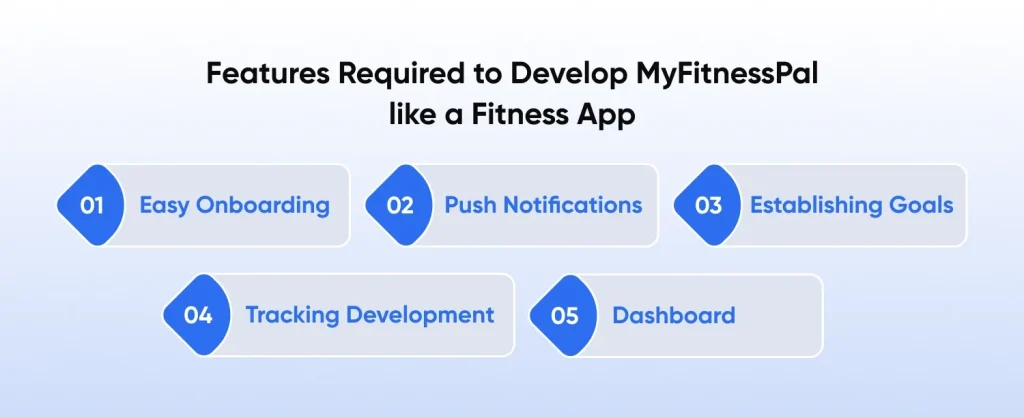
Easy Onboarding
Using this app, the process of registering and using the fitness features should be a cakewalk to the users. It should be as easy as integrating social media or inputting an email address or mobile number to sign up or log in. It should only take a single tap to log into the program on the same phone after you have signed up. Build healthcare software development that uses personal trainers, and onboarding for ease to the personal trainers.
Push Notifications
Customers’ regular commitments and objectives, as well as their continuing app actions, are communicated to you through push notifications. Additionally, it’s a fantastic way to suggest fresh offerings, promo codes, and intriguing deals that the platform wishes to advertise.
Establishing Goals
The intention of getting fit and healthy drives everyone to download fitness and nutrition applications. Many come hoping to maintain their general health, treat a medical condition, or reduce weight. The user experience is enhanced when a feature that lets users create goals according to their needs is enabled. They think the app understands them completely and offers them individualized health treatments based on their information.
Tracking Development
As mentioned before, one crucial aspect is goal-setting. Users can use it to determine what has to be done. In a similar vein, the progress tracking tool is vital.
The progress tracking tool summarizes the user’s progress toward the objective daily. The user is motivated by this since they can see and understand what more they need to accomplish to get the desired outcome.
To monitor progress, one could utilize manual feeding or wearable technology. App users who want to track their progress in terms of predicted calorie consumption must feed themselves.
Dashboard
Dashboards serve as the user’s windows, allowing them to see what has to be done, how to execute it precisely, and then monitor their progress. The app’s straightforward navigation and user-friendly user interface should be able to explain the admin panel, personal trainer dashboard, and user dashboard.
For the user to build up their profile and monitor their progress toward the goal while using the app, the dashboard needs to be easy to grasp.
Why Choose CMARIX to Build Your Fitness App
CMARIX has built healthcare and wellness apps for businesses that needed more than a generic fitness tracker. Our team handles mobile app development, backend architecture, and UI/UX design under one roof, so you’re not coordinating five different vendors just to get one app out the door.
Here’s what it looks like in practice:
- Healthcare domain experience- We’ve delivered healthcare web application development services for clients who needed careful data handling, not just a fancy-looking dashboard.
- Full-stack execution – one team covers planning, design, development, QA, and launch, so nothing gets lost between handoffs.
- Transparent cost planning – We scope your feature list before development starts, so the quote you get is the number you actually pay.
- Post-launch support – Fitness apps need updates as wearables and AI models change, and we stick around as a support and maintenance partner after launch.
If you already have an app idea like MyFitnessPal in mind, talk to our team, and we’ll walk you through a realistic timeline and budget for your version.
Conclusion
Millions of people worldwide aspire to be fit, and health and fitness applications help people take the initial step toward leading healthy lives. Developing a fitness app similar to MyFitnessPal is a lucrative economic venture.
You can partner with CMARIX- the fastest-growing healthcare and mental health app development company that takes challenges and transforms innovative ideas into the best tech solutions. To achieve your goal of developing the best fitness app, you can rely on us and our skilled developers team that offers extensive and robust healthcare web application development services. Working together with you at every turn, from strategy to design, development, and launch, is something we enjoy doing.
We help you uncover possibilities and obstacles and produce meaningful insights from the first day forward with a range of digital fitness solutions. Collaborate with us to develop fitness applications that empower people.
Frequently Asked Questions
How to make an app like MyFitnessPal?
Steps to make an app similar to MyFitnessPal
1. Define the idea for the app.
2. Perform a Market Analysis.
3. Select the Best Features. Create an Interesting App Design.
4. Utilizing the Most Recent Technology, Develop the App.
5. Install the fitness app, give it a test, and then launch it.
What is the cost to build alternatives to my fitness pal?
Developing a fitness app depends on your ideas and features. However, the expenses may increase with the additional features or depending on the complexities of the application. You can consult the developers at CMARIX to get the approximate cost of developing an application like MyFitnessPal.
How do fitness apps make money?
Fitness applications frequently collaborate and sponsor with companies that promote health and fitness. These collaborations may involve the app’s inclusion of challenges, branded content, or special discounts. Sponsorships offer users many benefits in addition to financial gain. Additionally, subscription-based, freemium, and in-app purchases generate revenue.
How long does it take to develop a fitness app like MyFitnessPal?
A basic MVP with main tracking features can launch in 8 to 12 weeks. A full-featured app with wearable sync, AI coaching, and a custom food database usually takes 4 to 6 months. Enterprise-level development with live classes and advanced personalization can run 8 months or longer.
What features add the most to fitness app development cost?
Computer vision for form correction, AI-based personalization, and wearable integrations are the biggest cost drivers. A large, accurate food database with barcode scanning also adds meaningful development time compared to a basic manual food log.
Is it better to launch on one platform or both iOS and Android at once?
Most businesses start with one platform, usually the one their target users prefer, to validate the idea before spending more. Launching on both iOS and Android together costs more upfront, but reaches a wider audience faster if the budget supports it.