

Quick Summary: AI in healthcare statistics reveal rapid growth in market size, clinical adoption, and operational use. In 2026, 81% of US physicians use AI professionally, and the FDA has cleared more than 1,500 AI-enabled medical devices. In this guide, we discuss AI’s growing role in diagnostics, drug discovery, and healthcare operations, alongside the need for reliable validation, data privacy, and regulatory compliance.
AI in healthcare statistics now points in one direction. Artificial intelligence has moved from pilot projects into daily clinical and operational work. The AMA’s 2026 physician survey reports that 81% of US physicians use AI in practice. The FDA has cleared more than 1,500 AI-enabled medical devices. Forecasts show the market growing more than tenfold between 2026 and 2034.
This cheat sheet includes key figures on artificial intelligence in healthcare that could help you in 2027. It covers market size, adoption, diagnosis, generative AI, drug discovery, payers, and risks.
Key AI in Healthcare Statistics at a Glance
- USD 50.70 billion: projected global AI in healthcare market in 2026, rising to USD 613.81 billion by 2034
- 81%: share of US physicians using AI professionally, up from 38% in 2023.
- 1,524: AI-enabled devices cleared by the FDA through March 2026, with radiology at 76%.
- 29%: rise in cancer detection in the MASAI breast screening trial, with 44% less reading workload.
- 80% to 90%: Phase I success rate of AI-discovered molecules, against a historic norm near 50%.
- 85%: healthcare organizations planning larger AI budgets in 2026.
How Big Is the AI in the Healthcare Market?
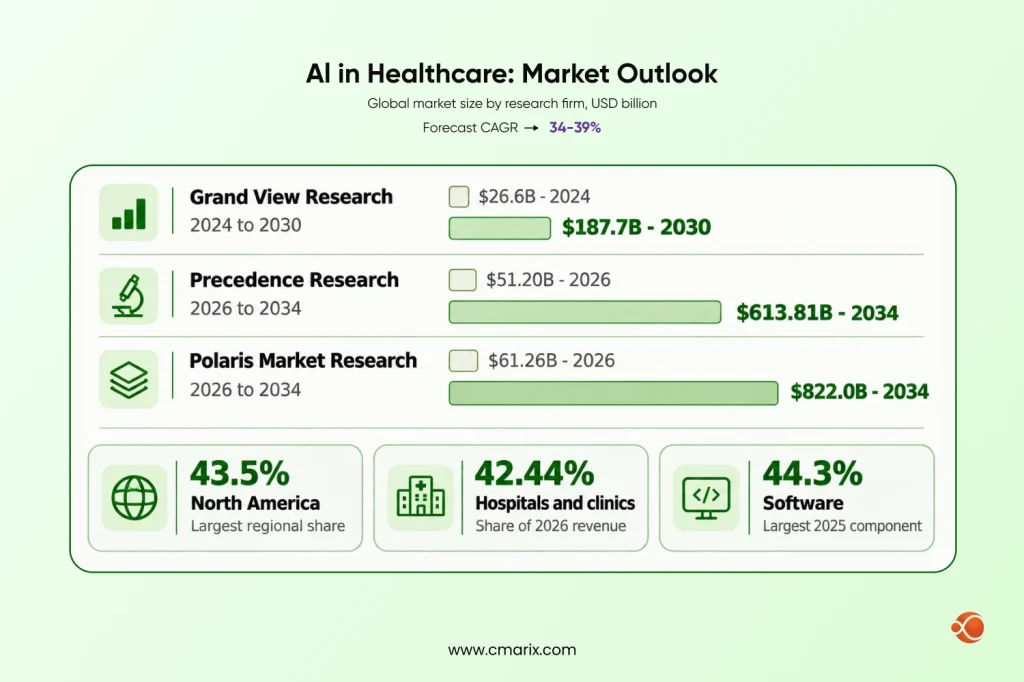
Forecasts differ by firm, but all show steep growth. Grand View Research valued the global AI in healthcare market at USD 26.6 billion in 2024. It projects it to reach USD 187.7 billion by 2030. Precedence Research puts the 2026 market at USD 51.20 billion and projects USD 613.81 billion by 2034, a 36.83% CAGR. Polaris Market Research is more aggressive, forecasting USD 61.26 billion in 2026 and USD 822.0 billion by 2034.
But why? Companies define AI spending differently. For some companies, it’s only software. Others include services, hardware, and embedded components. But growth rate is a key indicator. Major forecasts range from 34% to 39% CAGR, including Technavio at 34% and Market.us at 38.5%.
Three additional graphs indicate how the money is distributed. North America accounts for the largest share at 43.5%, according to Market.us. Hospitals and clinics accounted for 42.44% of revenue in 2026, according to Azumo’s 2026 report. Software had the highest share in 2025 (44.3%), according to Polaris.
Analysts point to three drivers: growing healthcare data volumes, demand for efficient diagnostics, and improved machine learning models.
What this means for you: A market growing above 30% a year attracts crowded vendor lists. Teams that need deep EHR integration or proprietary workflows often look beyond generic tools.
How Widely Do Providers Use AI?
Adoption data shows AI is now routine. The AMA surveyed 1,692 physicians in early 2026. 81% use AI professionally, more than double the 38% reported in 2023. The average physician now reports 2.3 use cases, up from 1.1.
Experience builds confidence. The percentage of doctors who think AI will help them treat their patients rose to 76%, compared with 65% in 2023. Nearly 70% of doctors view AI as a way to automate work processes that cause burnout. Research summaries are the fastest-growing use case, rising from 13% in 2024 to 39% in 2026.
The same trend holds for executives. According to a March 2026 survey of 120 health system executives, 75% were currently using or planning to use an AI platform. This is reflected in budget increases too. 85% of organizations intend to increase their AI budget in 2026, and 46% plan to increase it by more than 10%.
Doctors also want a say. 85% of doctors want to be involved in AI decision-making.
What this means for you: Tools chosen without clinician input risk low usage. Involve physicians early in design and testing.
AI in Diagnostics: What the Evidence Shows
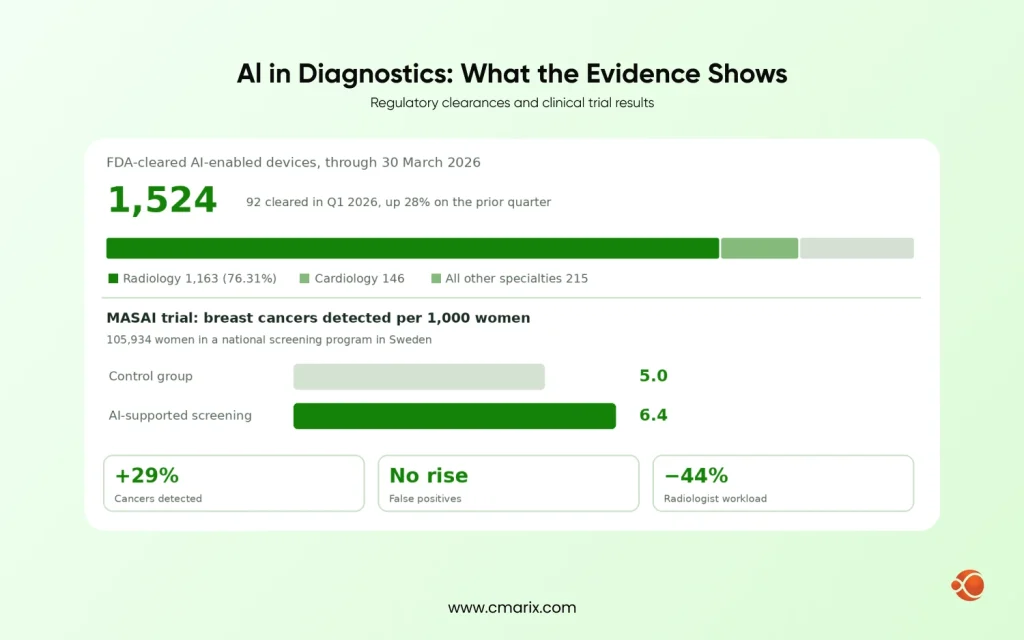
Diagnostics is the most mature area. The FDA has cleared 1,524 AI-enabled devices through March 30, 2026. Radiology accounts for 1,163 of these, or 76.31%. Cardiology comes second with 146. Counting imaging AI filed under other specialties, imaging nears 80%.
The rate is accelerating. The FDA approved 92 devices in Q1 2026, a 28% increase from the previous quarter. GE HealthCare stands out as the top vendor, with 130 approvals. There is one caveat to note. The FDA states that its list is not comprehensive.
Numbers prove effort. Results prove the effect. MASAI Trial involved 105,934 women in a national screening program in Sweden. AI screening found 6.4 cancers per 1,000 women, compared with 5.0 per 1,000 in the control group. This shows a 29% increase, with no increase in false positives. Radiologist workload decreased by 44%.
As you learn about AI medical diagnostic accuracy statistics for 2026, remember that the study depends on several factors, including task, data, and care context. Reliable results come from randomized, prospective studies.
What this means for you: Imaging offers the clearest path to proven value. Other specialties hold far fewer cleared tools. That leaves room for computer vision and NLP in pathology, cardiology, and clinical notes.
Generative AI and Administration: Where Time Is Saved
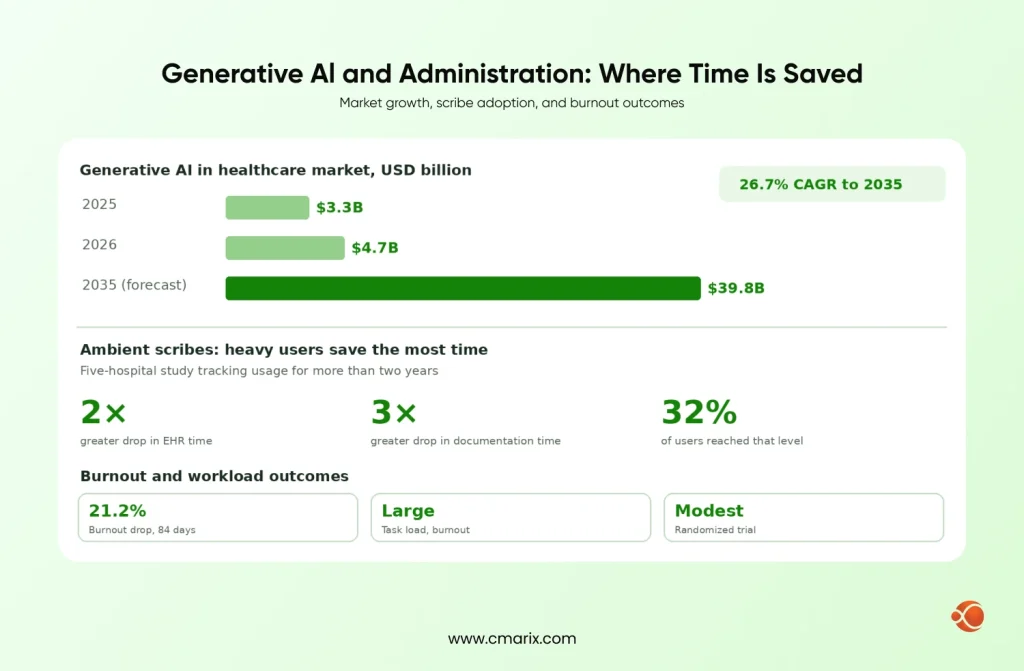
Generative AI is the fastest-moving layer. One analysis sizes the generative AI in healthcare market at USD 3.3 billion in 2025 and USD 4.7 billion in 2026. It projects the market at USD 39.8 billion by 2035, a 26.7% CAGR.
Documentation drives the use cases. Ambient scribes capture visits and create notes for review. A multi-site study across five hospitals tracked usage for more than two years. Clinicians who used scribes in more than half of visits saw EHR time drop by twice as much and documentation time by three times as much. Only 32% of users reached that level.
Burnout outcomes are more pronounced. At Mass General Brigham, ambient tools were tied to a 21.2% absolute drop in burnout prevalence after 84 days. A Stanford pilot of 48 physicians found large drops in task load and burnout. A randomized trial of 238 physicians, published in NEJM AI, saw modest gains. It also noted occasional inaccuracies that need physician review.
Wider administrative savings are forecast too. AI nursing assistants and admin automation could save USD 20 billion a year.
What this means for you: Value depends on depth of use, not licenses bought. Plan for training, EHR integration, and a clear note-review workflow.

AI in Drug Discovery: Faster Design, Open Questions
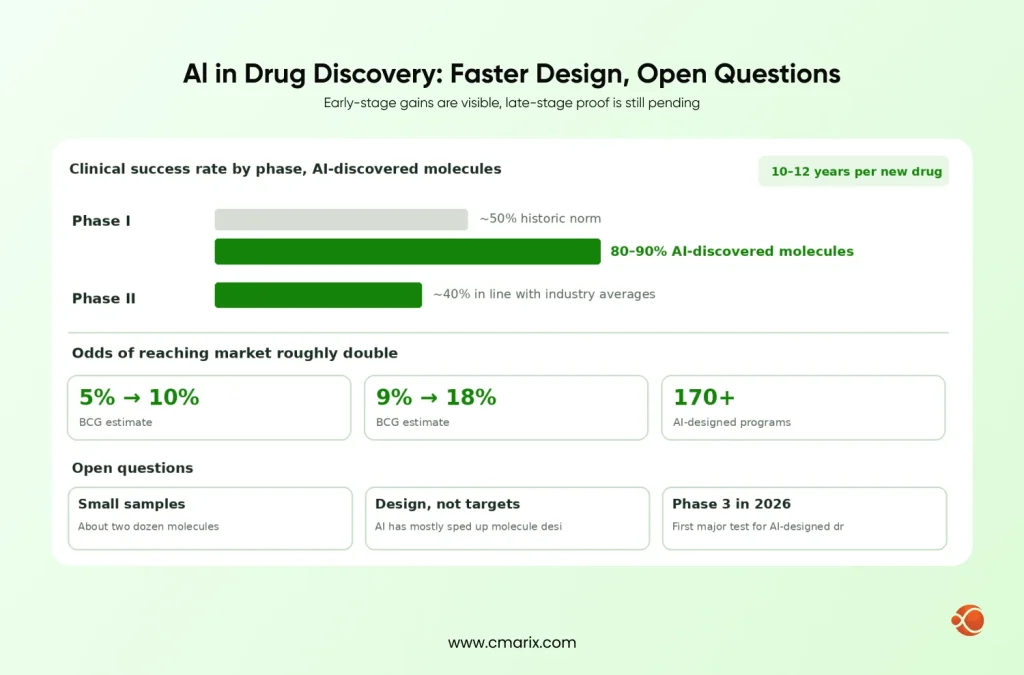
A new drug often takes 10 to 12 years to develop. AI will first address the earlier stages. A Boston Consulting Group analysis, cited in 2026 coverage, covered about two dozen AI-discovered molecules. Phase I success ran from 80% to 90%, up from a historic norm near 50%. Phase II success fell back to about 40%, in line with industry averages. BCG estimates AI roughly doubles a drug’s odds of reaching market, from 5% to 10% and from 9% to 18%.
Pipelines are growing. More than 170 AI-designed programs were in clinical development by early 2026.
Caution applies. The samples are small. AI has mainly sped up molecule design, not target selection. A cohort of AI-designed drugs will reach Phase 3 in 2026, the first major test.
What this means for you: Expect AI to cut early-stage cost and time first. Treat late-stage claims as unproven.
Payers, Operations and Logistics: The Back-Office Shift
Back-office AI draws less attention, yet it represents a sizable market. The healthcare payer AI market is projected to reach USD 46.67 billion by 2035, a 23.40% CAGR. Operations tools follow similar curves:
- Hospital command centers: USD 3.18 billion in 2026 to USD 14.85 billion by 2036 (16.6% CAGR).
- AI in clinical workflow: USD 3.7 billion to USD 59.5 billion by 2036 (32.0% CAGR).
- Ambient clinical intelligence: USD 2.5 billion to USD 17.6 billion by 2036 (21.8% CAGR).
These areas cover patient flow, capacity, and documentation. Their value rests on clean data connections between systems.
Risks, Compliance and the Limits of the Data
The numbers also show the limits. Eighty-six percent of physicians call data privacy critical to wider adoption. Eighty-eight percent say the same of safety and efficacy validation. Only 28% are personally worried about skill loss, but that rises to 35% among early-career doctors.
The rules are getting stricter. State laws effective from January 1, 2026, including Texas TRAIGA, require disclosure when artificial intelligence is used in clinical settings. Lawsuits have been filed in both California and Illinois over ambient scribing due to lack of proper consent. As of January 2026, FDA guidelines reduced pre-market review for certain digital health technologies.
A scalable AI in healthcare data system needs five basics:
- HIPAA-grade security and access control
- Consent and disclosure workflows
- Audit trails for every model output
- Bias and drift monitoring
- Clear human review before action
Confirm requirements with your legal and compliance teams before launch.
AI Trends in Healthcare to Watch in 2027
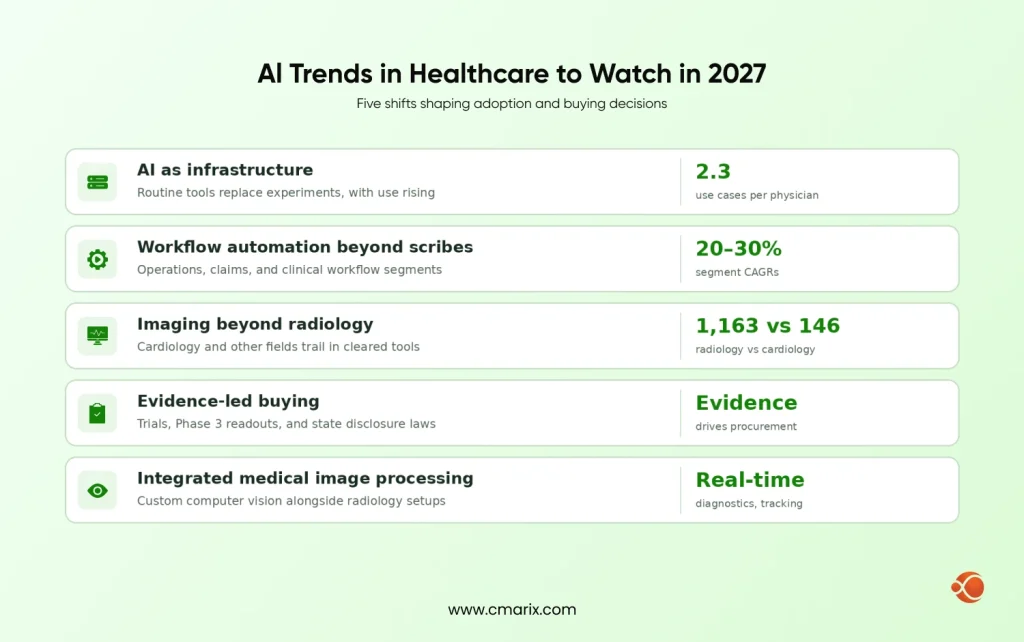
- AI as infrastructure: Use is moving from experiments to routine tools, with 2.3 use cases per physician and rising.
- Workflow automation beyond scribes: Operations, claims, and clinical workflow segments show 20% to 30% CAGRs.
- Imaging beyond radiology: Cardiology and other fields trail radiology by a wide margin in cleared tools.
- Evidence-led buying: Randomized trials, Phase 3 drug readouts, and state disclosure laws will shape procurement.
- Integration of medical image processing: Medical tech is shifting toward deep integration pipelines where custom computer vision algorithms automate real-time diagnostics and anatomical tracking alongside traditional radiology setups, as detailed in our computer vision development services.
Turn These AI in Healthcare Statistics Into a Roadmap
The data points to one lesson. Projects tied to a specific workflow and a measurable goal are easier to prove and scale. CMARIX helps healthcare teams do this through custom healthcare software development and machine learning development. Common starting points include clinical documentation, imaging support, patient triage, and claims automation.
Share your use case through the inquiry form. Our team will review your goals, data readiness, and compliance needs, then outline next steps. Request a free consultation today.
FAQs of AI in Healthcare Statistics
What do the latest AI in healthcare statistics tell us about digital transformation?
85% of healthcare organizations plan to increase AI budgets in 2026, and 75% of surveyed health system executives use or plan to use AI platforms, so transformation is now budgeted.
What is the current projected global AI in healthcare market size?
Estimates vary by publisher: about $50.7 billion in 2026, reaching $613.8 billion by 2034, though one conservative report says $29.5 billion.
What are the core drivers behind AI’s accelerating growth in healthcare?
Hospitals have too much data, not enough staff, and burned-out doctors. They are pouring money into AI ($22.4 billion in 2025) to save time on paperwork, predict patient risks, and personalize treatments.
How do recent surveys profile hospital and physician use of generative AI?
More than 4 out of 5 doctors (81%) use AI today, up from 38% in 2023. On average, doctors use AI for about two different tasks, mostly writing patient notes and summarizing medical research. Note that the main AMA survey tracks all types of AI, not just generative AI.
What specific benchmarks define the AI medical diagnosis accuracy statistics 2026 report?
There is no single official scorecard. Instead, researchers test how well AI catches actual sickness (sensitivity), avoids false alarms (specificity), and compares to human doctors. Because over-relying on AI can still lead to mistakes, safety watchdogs (ECRI) named AI diagnosis errors the #1 patient safety risk for 2026.
What macro AI trends in healthcare are expected to dominate the clinical horizon?
Tools that listen to appointments and write notes (“ambient scribes”), automate routine hospital tasks, chat with patients, and read medical scans are leading the way. Task-automation AI is expected to grow 32% a year through 2036, while note-taking AI will grow 21.8% a year.
How does the healthcare AI market map segment patient triage software from administrative backends?
Maps typically split by application: clinical (imaging, diagnostics, triage, robotic surgery) versus administrative (workflow, documentation, payer). Imaging holds a 22.3% share; payer AI is tracked as its own market.
What specific parameters dictate machine learning deployment limits for the AI healthcare payer market?
No fixed rules exist, but health insurance companies face messy data, siloed computer systems, strict government regulations, safety testing, privacy laws, and uncertainty over who takes the blame if the AI makes a mistake. Despite these hurdles, the health insurance AI market is expected to grow 23.4% annually and reach $46.67 billion by 2035.
What compliance infrastructure is required to implement scalable AI in healthcare data systems?
Hospitals need robust data security (HIPAA compliance in the US), strong encryption, strict login controls, and activity-tracking logs. Medical AI also requires FDA oversight, regular testing to prevent bias and safety errors, and clear data-management rules. In Europe, hospitals must also comply with GDPR and the EU AI Act.
Where can healthcare networks find enterprise-ready solutions for healthcare logistics models with verified AI adoption rates?
Evaluate enterprise vendors such as Epic, Microsoft (Nuance DAX), GE HealthCare, and Aidoc, plus cloud platforms like AWS and Google Cloud; verify claims through pilots, references, and regulatory clearances.