

Key Highlights
- Costs to develop real estate mobile apps range from $20,000 (MVP) to $ 300,000+ (enterprise). Mid-level apps cost around $50,000 to $120,000.
- MLS/IDX integration adds $15,000–$35,000 on top of your base tier
- AI-powered property matching adds $25,000–$60,000; AR/VR virtual tours add $20,000–$50,000
- The developer’s location is the highest influencing factor, and a US developer’s team costs up to 2-3 times more than an Indian one
- Continuous maintenance runs 15–20% of the initial build cost every year
- Cross-platform development typically cuts cost by 25–35% versus building separate native iOS and Android apps
The real estate business revolves around data, not merely listings. Home buyers want fast searches, real estate agents demand CRM integration, while property management expects automation, which used to be a function of an entire back-office staff.
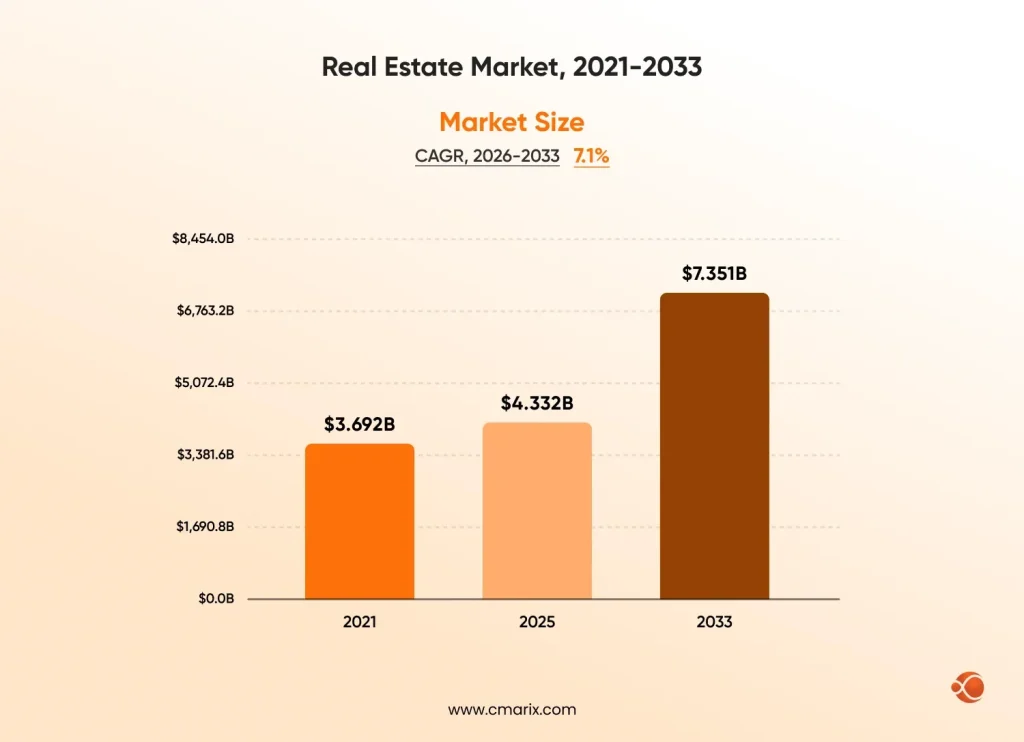
The global real estate market was valued at $4,332.4 billion in 2025 and is projected to reach $7,351.3 billion by 2033, a 7.1% CAGR, and PropTech spending is scaling right alongside it, expected to hit $165 billion by 2035. That growth is exactly why “how much does a real estate app development cost” has become a board-level question, not just a developer one.
Most cost guides provide you with a single number that means almost nothing, because a $20,000 listing app and a $250,000 AI-driven marketplace both get called “a real estate app.” What actually determines your number is a particular mix of features, integrations, and team structure, and once you see that mix laid out, budgeting stops being a guessing game.
What Is Real Estate App Development
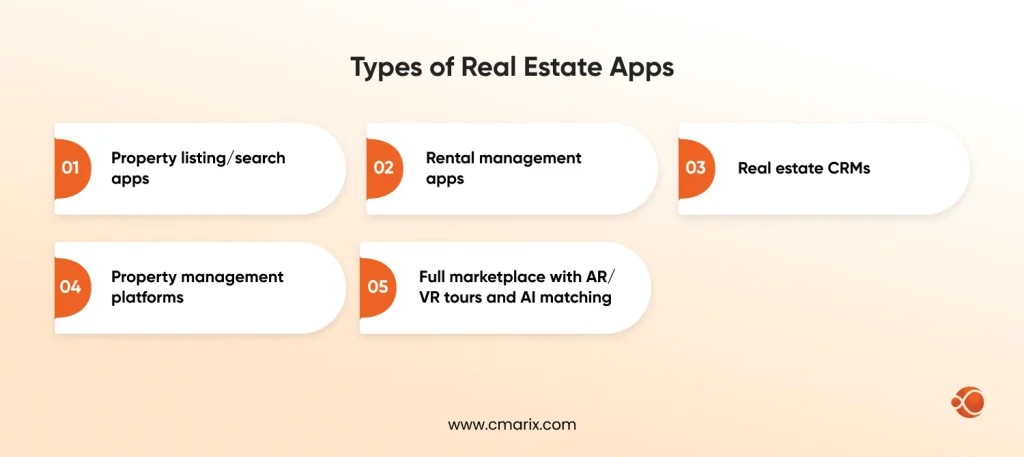
Real estate app development includes building a mobile or web platform for buying, selling, managing, and renting property. That can mean a property search and listings app for buyers, a rental management tool for landlords, a CRM built for agents, or a full marketplace that ties all three together with mapping, payments, and MLS data.
Scope changes more here than in most industries because “real estate” includes four different user groups:
- Buyers who want search and discovery,
- Agents who need lead and deal management,
- Landlords who need operational tools,
- Back-office staff who need compliance and reporting.
Rarely does a single app serve all four well without deliberate scoping; that is why the cost tiers below are separated by feature set rather than a vague “small, medium, large” label.
It’s also a different scope than the cost to develop a real estate website, which usually covers listing display and lead capture without the transaction logic, offline access, or push-notification layer a native app needs.
Talk to our team and get a clear, itemized estimate.
Real Estate App Development Cost by Tier: MVP to Enterprise
Every other number in this guide checks against this table.
| Tier | Cost Range | What’s Included |
| MVP | $20,000 – $50,000 | Property listings, search filters, basic user accounts, contact/lead forms |
| Mid-Market | $50,000 – $120,000 | MVP features plus CRM, push notifications, in-app messaging, basic map search, payment gateway |
| Enterprise | $120,000 – $300,000+ | Mid-market features plus MLS/IDX integration, AI property matching, AR/VR tours, multi-role portals (agent, buyer, admin) |
- An MVP ($20,000–$50,000) gives businesses a way to test demand before committing to a larger product build. That means that users are able to do basic actions: filter listings, look at property details, and send a request. The MVP assumes manually managed or limited property data rather than live MLS/IDX feeds. AI-powered matching is also excluded to keep the initial scope focused.
- Mid-market level ($50,000-$120,000) is the place for funded startups or traditional agencies with the need for a product launch. It provides an additional operational layer, namely a CRM system, push notifications, and a payment gateway.
- Enterprise ($120,000–$300,000+) is for platforms competing on data and experience. MLS/IDX integration can become a significant portion of the budget, particularly when multiple MLS feeds, complex data mapping, or additional compliance requirements are involved.
If you’re validating an idea before committing to the full build, MVP software development solutions are the standard entry point, since they get a working product in front of real users for a fraction of the enterprise cost.
Types of Real Estate Apps and Their Development Cost
Cost varies as much by what the app does as by how big it is.
Property listing/search apps
A property listing app typically focuses on browsing, filtering, saving, and contacting agents. It is often the simplest real estate app model because it does not require transaction management or complex multi-role workflows. Costs will be kept to a minimum, as the fundamental functionality of search experience design and a property listings database are all that will be required, without any transactional functions, user management, or data licensing – unless location-based searches are implemented, moving them towards a mid-market offering.
Rental management apps
This app works for the benefit of landlords and property managers, rather than buyers, and includes listings, lease management, and maintenance requests. For this reason, they are more expensive than a mere search app despite offering similar features. There has to be a difference between the two types of experiences – those of tenants and landlords – and the rental payment process has its own development.
Real estate CRMs
Real Estate CRMs are for agents, not buyers. Lead tracking, deal pipelines, and follow-up automation are some of the features used in Real Estate CRMs in order for brokerages to have their agents operate from one system and not spreadsheets and individual inboxes. Such systems will be costly when compared to a consumer application, since integration, calendar integration, email integration, and dialer functionality, and CRM not being integrated well to an agent’s tool usually ends up being abandoned after weeks.
Property management platforms
The combination of owner, tenant, and manager into one system, which involves accounting, documentation, and maintenance dispatch, is developed for companies that manage many units at a time, not just one unit. The multi-role architecture pushes these toward the top of the mid-market range: each role needs a distinct interface, and the accounting layer- rent ledgers, owner statements, expense tracking- is close to a small finance app bolted onto a property app.
Full marketplaces
Full marketplaces with AR/VR tours and AI matching sit at the top of the cost spectrum, built for platforms trying to become the primary destination for a market rather than a tool for one brokerage. They’re really three products in one: a consumer-facing search experience, an agent-facing CRM, and a data/AI layer running underneath both, all sharing the same property and user data cleanly. Building any one of those three well is a mid-market project on its own.
| App Type | Typical Cost Range |
| Property listing/search app | $20,000 – $60,000 |
| Rental management app | $40,000 – $90,000 |
| Real estate CRM (agent-facing) | $50,000 – $110,000 |
| Property management platform | $60,000 – $150,000 |
| Full marketplace with AR/VR tours and AI matching | $150,000 – $300,000+ |
If you’re still deciding what to build, our roundup of Real Estate app ideas breaks down which product type fits which business model before you commit budget to any of them.
Key Features That Impact Real Estate App Development Cost
Note: These are indicative engineering estimates, not fixed feature prices. Some features overlap with core development work, so they should not simply be added together without accounting for shared architecture and development effort.
- MLS/IDX integration – Pulling live listing data from Multiple Listing Services isn’t a plug-and-play API call; licensing, data mapping, and sync logic add $15,000 to $35,000. Choosing among the best real estate APIs early avoids a costly re-integration later.
- Advanced search and geolocation – Map-based search, radius filters, and school/commute overlays run $8,000 to $20,000, depending on how many data layers you’re pulling in.
- AI property matching and recommendations – Machine-learning-driven suggestions add $25,000 to $60,000, and only work well if your underlying data is clean and structured, which is why data readiness for AI matters as much as the model itself. Artificial Intelligence in Real Estate is worth reading before you scope this feature.
- AR/VR virtual tours – 3D walkthroughs and augmented reality staging add $20,000 to $50,000, largely driven by content pipeline and rendering infrastructure.
- Real estate CRM and portal sync – Keeping agent and buyer portals in sync, with shared appointment scheduling and document status, adds $15,000 to $40,000.
- Payment gateway and transaction management – Rent collection, deposits, or transaction fee processing adds $10,000 to $25,000.
- Blockchain-based transaction security – Some platforms are layering in Web3 technology in real estate for tamper-proof title records and smart-contract closings. It’s still a niche add-on, running $30,000 to $70,000.
Real Estate App Development Cost by Stage: A Step-by-Step Breakdown
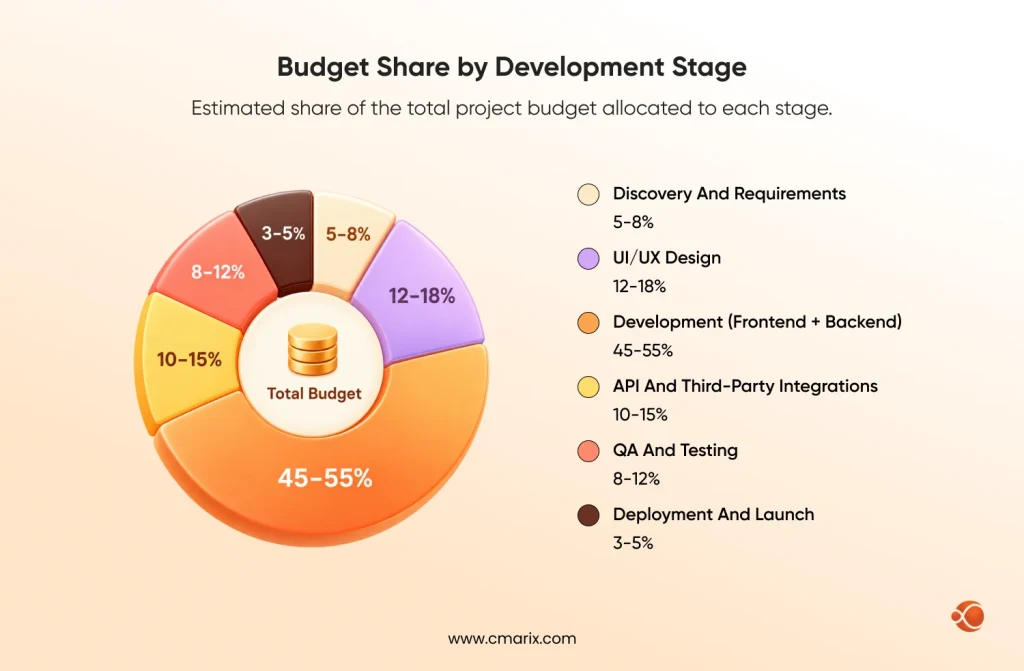
Regardless of tier, your budget moves through the same six phases.
1. Discovery and requirements (5–8%)
Scope gets locked here: user roles, feature list, data sources, platform decisions, and which MLS or payment provider you’ll integrate with. This stage also includes competitive research and a technical audit of any existing systems (a legacy website, an internal spreadsheet-based CRM) the new app needs to replace or connect to.
Rushing this is the single most common reason projects blow past their original budget later, because an MLS integration or a payment flow discovered mid-development costs far more to add retroactively than one scoped up front.
2. UI/UX design (12–18%)
Wireframes and visual design for all screens, including search results pages, property detail pages, and agent dashboards, should be developed and tested on both desktop and mobile platforms. In real estate applications, this process matters more than in standard interfaces (e.g., map and filtering tools); user testing is crucial, not a ready-made template from a generic app-builder library.
3. Development, frontend and backend (45–55%)
Development is typically the largest budget component, covering the client-facing application, backend services, APIs, database architecture, and administrative tooling. This is also where platform decisions from discovery, native versus cross-platform, get executed, and where scope creep does the most budget damage if it isn’t controlled.
4. API and third-party integrations (10–15%)
Feed integrations for MLS/IDX, payment systems, mapping SDKs, and CRM systems are integrated and tested in this phase. This is where the money you paid for feature add-ons from the previous section is actually spent, and timelines get derailed the most, because third-party APIs almost never work like their documentation says, particularly MLS feeds.
5. QA and testing (8–12%)
Listing search load and cross-device tests as well as security tests for payment and log-in processes. The testing of property data accuracy becomes very important because wrong prices and addresses lead to distrust and thus become a trust issue rather than a technical issue, and thus users leave real estate applications immediately.
6. Deployment and launch (3–5%)
App store submission, setting up the production environment, and launch-day monitoring, followed by a final review to make sure the app complies with payment and personal information handling requirements.
| Stage | Share of Budget |
| Discovery and requirements | 5–8% |
| UI/UX design | 12–18% |
| Development (frontend + backend) | 45–55% |
| API and third-party integrations | 10–15% |
| QA and testing | 8–12% |
| Deployment and launch | 3–5% |
Post-launch maintenance sits outside this breakdown and runs 15–20% of your initial build cost every year, covering server costs, security patches, MLS feed updates, and OS compatibility.
Cost To Develop a Real Estate App Breakdown By Developer Region
Where your team is based changes the math more than almost any other single factor.
| Region | Hourly Rate |
| North America | $100 – $180 |
| Western Europe | $80 – $150 |
| Eastern Europe | $35 – $70 |
| India / South Asia | $25 – $45 |
- MVP tier, India/South Asia team: 800–1,100 hours at $25–$45/hour comes to $20,000–$49,500, landing inside the $20,000–$50,000 MVP range.
- Mid-market tier, Eastern Europe team: 1,300–1,700 hours at $35–$70/hour comes to $52,000–$119,000, landing inside the $50,000–$120,000 mid-market range.
- Enterprise tier, blended multi-region team: 2,000–3,000 hours at $60–$100/hour comes to $120,000–$300,000, landing inside the enterprise range.
An hourly rate that is lower in cost will only reduce costs if there are no problems with velocity, and real estate projects are complicated enough to cause many more hours of labor for an inexperienced group than a specialized team. This applies to a hybrid group with experienced architecture at a high hourly rate area and implementation at a low hourly rate area.
When choosing between in-house staff and outsourcing, compare the real costs of outsource app development instead of assuming that outsourcing is always cheaper. It has been seen that a group of dedicated mobile app developers working at the correct regional rate usually beats one person from the in-house team when it comes to cost efficiency and faster delivery time for the product.
We’ll scope your features and give you exact numbers.
Real Estate App Development: A Strategic Investment, Not Just a Line Item
A real estate app tied to a market growing at 7.1% CAGR is not a cost center; it’s infrastructure for capturing that growth. The platforms winning market share right now matched feature spend to actual buyer and agent behavior, not to a competitor’s feature list.

An MLS integration that saves an agent two hours a day pays for itself in retention. An AI matching engine that shortens time-to-close pays for itself in transaction volume. A well-built CRM sync pays for itself in lead conversion, since leads left unanswered for even an hour convert at a fraction of the rate of ones followed up immediately. Before adding any feature from the list above, it’s worth asking which of those three outcomes it’s actually meant to move.
How to Reduce Real Estate App Development Cost
You don’t have to choose between a real product and a real budget.
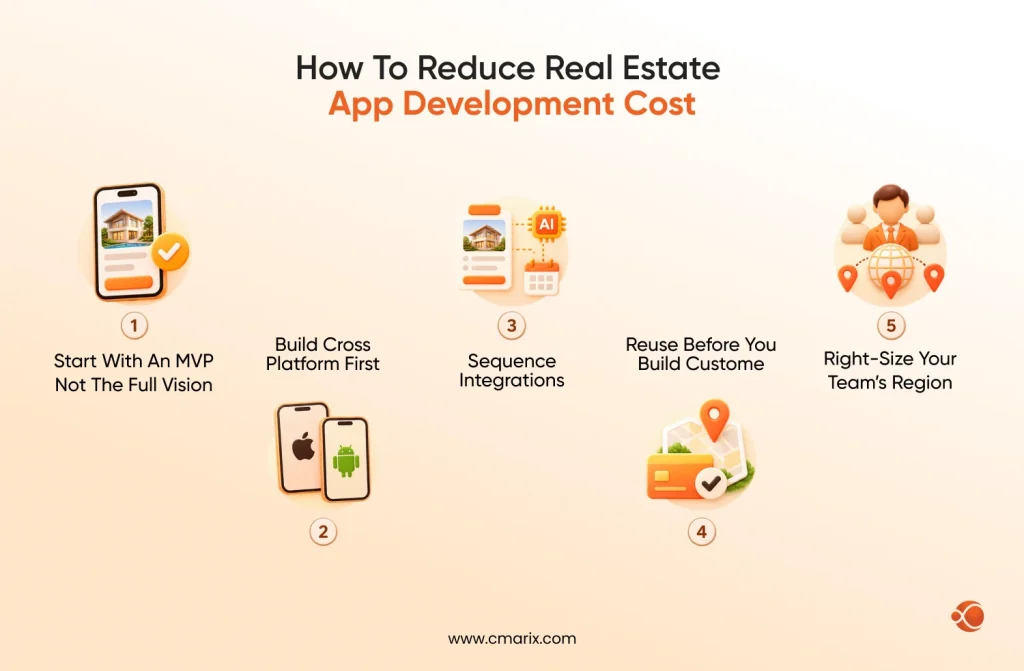
- Start with an MVP, not the full vision. Start by validating demand at the $20,000-$50,000 level before going for AI matching or AR tours.
- Build cross-platform first. React Native or Flutter development is 25-35% cheaper than native iOS and Android development, with no real difference in terms of the actual product users want.
- Sequence integrations. MLS/IDX and AI features don’t need to ship on day one. Adding them post-validation spreads cost across two budget cycles instead of one.
- Reuse before you build custom. Off-the-shelf payment gateways and mapping SDKs are almost always cheaper than custom-built equivalents for standard functionality.
- Right-size your team’s region. A blended team, senior architecture from a higher-rate region, implementation from a lower-rate one, often beats an all-in-house build on both cost and speed.
Why Choose CMARIX Real Estate App Development
Data accuracy and consistency of integrations are important in Real Estate platforms, and that is where most vendors compromise. We specialize in real estate software development and offer MLS/IDX integrations, AI matching, and multi-role portals.
Our regional development team includes senior architects who develop talent without charging premium rates for simple CRUD operations. If you require skilled web developers, we estimate projects based on feature costs and not just an abstract price range.
Conclusion
Real estate app development costs can range from around $20,000 for a focused MVP to $300,000 or more for a complex, enterprise-grade platform. The final cost depends on the type of application, number of user roles, integrations, data requirements, design complexity, and the level of automation or AI involved.
The global real estate market is projected to grow from $4.33 trillion in 2025 to $7.35 trillion by 2033, according to Grand View Research. This growth creates a larger addressable market for digital real estate products and platforms.
For businesses planning a real estate app, the most practical approach is to define the core user journey first, prioritize the features that directly support that journey, and build the product in stages. An MVP can help validate the concept before investing in more complex capabilities such as MLS integrations, AI-powered recommendations, advanced property management, or immersive property experiences.
The right development strategy should balance initial development costs with long-term scalability, maintenance, security, integrations, and user experience. A clear scope and realistic technical roadmap can help avoid unnecessary development costs while leaving room for the product to evolve as business requirements become clearer.
FAQ AboutReal Estate App Development Cost
How much does a real estate app cost?
The cost of building a real estate app ranges from $20,000 for an MVP to $300,000 and beyond for an enterprise-grade solution with AI matching and MLS integration. The majority of mid-range solutions with CRM and virtual tours are priced from $50,000 to $120,000.
What are the main factors that influence real estate app development costs?
Feature scope, platform selection (native or cross-platform), MLS/IDX, artificial intelligence and AR/VR elements, as well as developers’ geographic location, all contribute to the cost. Location of developers only can increase the price for the same set of features two to three times.
How much does it cost to integrate MLS or IDX data feeds?
MLS/IDX integration will cost you an additional $15K to $35K above your base package price due to licensing costs and data mapping services.
What are the hidden costs of running a real estate application?
Maintenance after launch costs between 15 and 20% of your total build cost per year, taking into account server expenses, bug fixing for security purposes, MLS data feeds, and OS compatibility problems. The same is true for app store costs and API licensing fees.
How long does it take to build a custom real estate app?
Minimum viable products take 8-16 weeks. Average products take 4-7 months, and enterprise systems with ML and MLS integration may require 8-12 months or even more.
Is cross-platform development cheaper than native development for real estate apps?
Yes, cross-platform tools such as Flutter and React Native cost 25-35% less money than native solutions for iOS and Android separately, but there is no feature loss for the majority of real estate applications.
How much does it cost to implement advanced features like AR/VR property tours or AI property matching?
AR/VR virtual tours add $20k to $50k, and AI-powered property matching adds $25k to $60k. Both are additive costs on top of your base tier, not standalone builds.
How can I optimize and reduce my real estate app development budget?
Start with an MVP instead of the full feature vision, build cross-platform instead of native, sequence complex integrations like MLS and AI for a later phase, and use off-the-shelf tools for standard functionality like payments and maps instead of custom-building them.