


Quick Summary: Agentic AI trends in 2026 show a clear shift from experimentation to product, with enterprises redeploying goal-directed agents across their core business processes. From the orchestration of multi-agent systems (MAS) and autonomous decision-making to data integration, governance, cybersecurity, and automation in particular domains, agents are increasingly influencing how companies conduct their business processes. Nevertheless, scaling up these processes entails proper levels of interoperability, security measures, and governance practices.
Unlike conventional automation, Agentic AI can interpret goals, plan sequential actions, use tools, perform tasks within a system, and adjust to results. As companies embrace multi-agent systems and reconfigure work processes to improve business outcomes, AI agents are becoming increasingly important for enterprise operations.
However, scaling Agentic AI also requires strong governance, interoperability, security controls, and human oversight. At CMARIX, our AI agent development and AI consulting teams are seeing this shift play out across client engagements in procurement, ERP, and cybersecurity; the pattern below is drawn as much from that work as from market data.
What Is Agentic AI?
“Agentic AI” refers to intelligent entities capable of working independently toward their own aims. The intelligent entities can comprehend their goals, plan their actions, employ tools and API, perform actions in other systems, and learn from their results.
Unlike rule-based automation, which follows predefined logic, or generative AI, which primarily produces content, Agentic AI focuses on achieving outcomes through action.
An Agentic AI system typically combines:
- Large Language Models (LLMs)
- Planning and reasoning capabilities
- Integrations of tools and APIs
- Memory and context awareness
- Workflow orchestration
- Feedback mechanisms
This allows AI agents to operate within real business environments rather than simply generating responses.
Agentic AI vs Generative AI
| Aspect | Generative AI | Agentic AI |
| Primary function | Generates content and responses | Achieves goals through actions |
| Human involvement | Requires prompting and refinement | Requires governance and oversight |
| System integration | Often connects through APIs | Operates across workflows and enterprise systems |
| Decision-making | Responds to requests | Plans and executes multi-step actions |
| Business impact | Improves productivity | Enables end-to-end AI workflow automation services |
Why 2026 Is an Inflection Point for Agentic AI
Several technological and business developments are converging in 2026.
Reasoning improvements, a larger window of context, standardization of integration protocols, maturity of orchestration tools, and the growing proof of return on investment from AI applications.
Organizations now have stronger foundations for deploying AI agents across operational environments while maintaining governance and control.
As a result, Agentic AI is moving beyond proof-of-concept projects and becoming part of the broader enterprise operating model. Let’s now look at the top AI trends in agentic development.
Build a practical roadmap around use cases, integrations, governance, and ROI.
Top Agentic AI Trends to Watch in 2026
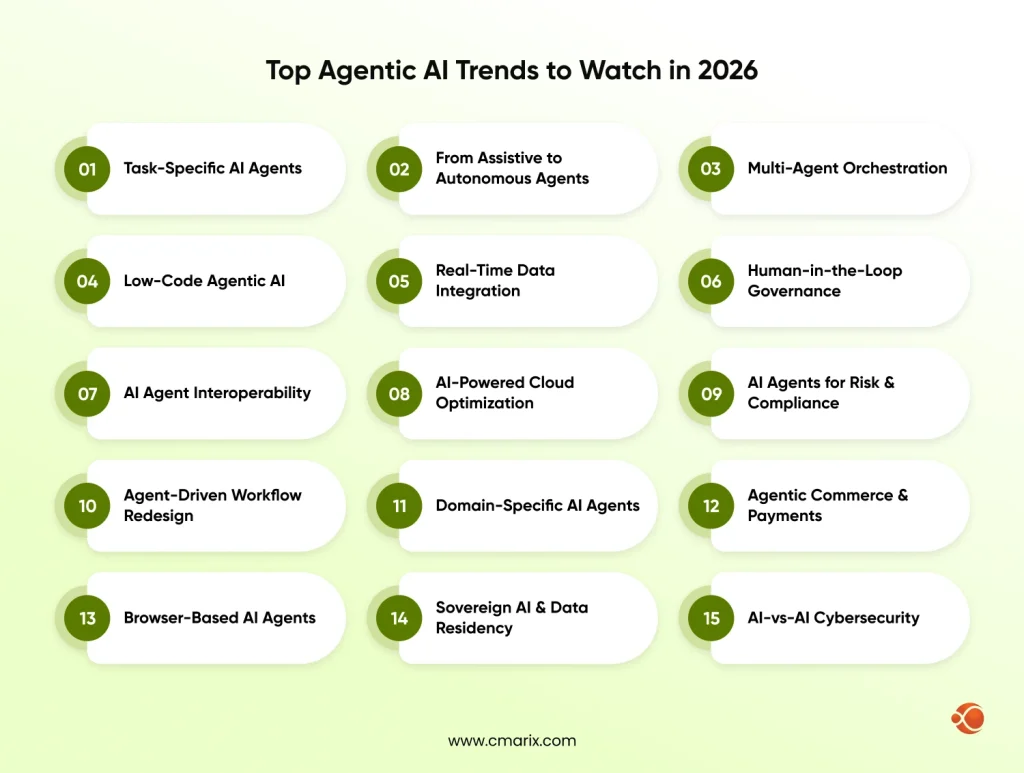
1. Task-Specific Agents Are Becoming Native to Enterprise Software
Enterprise AI agent infrastructure is now being built directly into current systems and not as separate applications. This is happening across all manner of systems, such as cloud computing, ERP, CRM, Procurement, Financial, and Cybersecurity. What is more, attention is being given to making software able to detect problems and act upon them.
2. Agents Are Moving From Assistive Tools to Autonomous AI Agents
The functions of intelligent systems are no longer confined to merely giving advice or acting on directions. With set limits in place, intelligent systems can be used to consider various possibilities, determine suitable action, and make standard decisions. Hence, humans can concentrate on strategy, exceptions, management, and judgment-based decisions.
Autonomous operation, however, would need goals and controls in place to avoid goal drift and misalignment. Humans, therefore, will be able to focus on strategy, exceptions, management, and judgments.
3. Multi-Agent Orchestration Is Becoming an Enterprise Control Layer
It is becoming more common for organizations to rely on multiple specialist agents rather than a single universal agent to meet all organizational needs. Multi-agent orchestration platforms help organizations coordinate various agents across areas such as data processing, security, finance, customer service, and infrastructure management. Frameworks such as LangGraph, CrewAI, and Microsoft Agent Framework provide support for task assignment, agent communication, and policy and context sharing within an organization. Agentic orchestration frameworks facilitate task allocation, agent interaction, and the sharing of policies and context within an organization.
4. Low-Code and No-Code Platforms Are Expanding Access to Agentic AI
With the emergence of low-code/no-code platforms, it is becoming easier for a broader pool of business professionals to automate their workflows. In other words, it becomes possible for subject-matter experts to configure and design their workflows even without extensive knowledge of development.
5. Real-Time Data Integration Is Enabling Continuous Execution
One of the latest AI agent developments in 2026 is evident in how data is handled in enterprises. The importance of live business data in addressing environmental changes is growing day by day. Organizations do not have to wait for their reports, as they can track all aspects, including infrastructure, demand, cash flow, logistics, and customer issues.
6. Human-in-the-Loop Governance Is Becoming a Standard Operating Model
The increased level of automation does not negate the requirement for human intervention. Companies have been working to set up a system in which routine tasks are automated while important and risky decisions are delegated to humans. Human-in-the-loop (HITL) approaches establish checkpoints where employees review, approve, or override AI-generated decisions and actions. Governance frameworks assist in developing rules and controls regarding permissions, trails, decision-making, and approval processes.
7. Interoperability Is Becoming Critical for Scalable Agent Ecosystems
With greater adoption of specialized systems, it is becoming increasingly critical to find ways to link them. Interoperability through shared language and common contextual understanding may be possible by using standard communication protocols. The benefits of such approaches include easier integration, reduced reliance on specific vendors, and more flexible architectural design.
8. Agentic AI Is Transforming Cloud Cost Optimization
AI app development cost management in the cloud is now evolving from dashboards to a continuous approach. Through automation, it is possible to track usage, identify inefficiencies such as unused resources, make recommendations for infrastructure changes, and adhere to cost policies.
9. AI Agents Are Expanding Into Governance, Risk, and Compliance
Governance and compliance initiatives are now being integrated directly into the workflow. These systems will be able to track policies, identify risks, verify compliance obligations, and prepare regulatory information for audits. Such an integration within day-to-day operations may enable businesses to cope with the scale of automation. Make sure you understand the latest agentic AI frameworks to identify which ones can benefit your business.
10. Workflow Redesign Around Agents Will Drive the Largest Gains
The biggest value from Agentic AI is unlikely to come from simply adding AI to existing workflows.
Organizations are increasingly redesigning processes around agentic execution.
Traditional workflows often follow a step-by-step structure.
Agentic workflows are becoming more intent-driven.
Humans define the desired outcome, while AI agents determine the sequence of actions required to achieve it.
For instance, rather than listing all the steps necessary to resolve the customer’s problem, the organization can state the goal and let the agent analyze the problem, gather information, and implement the authorized actions.
This shift could significantly change enterprise operating models.
11. Vertical and Domain-Specific AI Agents Are Accelerating Adoption
Industry-focused solutions are becoming increasingly important as organizations look for systems that understand their specific operating environments. Domain-specific agents can account for industry terminology, regulations, workflows, constraints, and common scenarios. Sectors such as financial services, healthcare, manufacturing, logistics, and cybersecurity are particularly suited to this approach.
12. Agentic Commerce and AI-Enabled Payments Are Emerging
Automated systems are beginning to play a greater role in commercial activities such as product research, price comparison, purchasing, subscription management, and supplier negotiations. As these systems become involved in transactions, organizations will need stronger controls around identity, permissions, authentication, and payment authorization. Clear rules will be essential for determining what automated systems can purchase or negotiate.
13. Live Web and Browser-Based Agents Are Expanding Automation Capabilities
Browser-based automation is creating opportunities to streamline processes that traditionally require employees to work across multiple websites and applications. Systems can potentially navigate websites, complete forms, gather information, and execute multi-step processes. This has applications in procurement, research, operations, data collection, and customer service, but also creates new access and security considerations.
14. Sovereign AI and Data Residency Are Becoming Strategic Priorities
There is increased organizational focus on the location of data, infrastructure, and computing activities. This becomes highly relevant for companies operating in regulated industries or across different regions. Issues such as data sovereignty, compliance, infrastructure control, and geopolitical considerations are becoming increasingly important in technology planning.
15. Cybersecurity Is Becoming an AI-Versus-AI Environment
Cybersecurity is increasingly becoming an AI-driven battlefield.
Attackers are using AI for more sophisticated activities, including:
- Automated phishing
- Social engineering
- Deepfake attacks
- Adaptive malware
- Automated reconnaissance
At the same time, cybersecurity teams are adopting AI agents to automate threat detection and response.
An Agentic Security Operations Center may use AI agents to:
- Identify suspicious activity.
- Collect relevant security data.
- Analyze potential threats.
- Correlate information across systems.
- Initiate containment actions.
- Escalate complex incidents to security teams.
This allows human analysts to focus on strategic validation and complex investigations.
Agentic AI Use Cases As Per Industry
| Industry | Use Cases of Agentic AI |
| Procurement | Identifying requirements; Researching suppliers; Comparing vendors; Generating purchase orders; Monitoring approvals; Identifying compliance issues; Managing invoices |
| Sales | Lead generation; Customer research; Personalized outreach; Opportunity management; Proposal development; CRM updates; Sales forecasting |
| Finance and ERP | Financial reconciliation; Invoice processing; Anomaly detection; Real-time monitoring; Scenario planning; Forecasting |
| Cloud and IT Operations | Incident detection; Root cause analysis; Infrastructure monitoring; Automated remediation; Cloud cost optimization; Performance monitoring |
| Manufacturing | Predictive maintenance; Production planning; Inventory management; Quality monitoring; Equipment optimization |
| Cybersecurity | Threat detection; Alert triage; Incident investigation; Security data correlation; Automated response workflows |
Procurement
Agentic AI is increasingly supporting procurement across the end-to-end purchasing process. It can coordinate activities such as requirement identification, supplier research, vendor comparison, and purchase order generation. This enables procurement teams to streamline workflows, improve compliance, and reduce manual effort.
Sales
AI-powered agents are assisting sales teams throughout the entire process, including lead generation and customer research, opportunity management, and forecasting. Repetitive tasks such as personalized outreach, proposal generation, and CRM updates can be automated by using AI agents. As a result, salespeople can focus on relationship-building and other important initiatives.
Finance and ERP
These kinds of systems are now being applied within financial functions, where they will help automate processes and provide visibility into financials. These could include functions such as reconciliation, invoicing, anomaly detection, forecasting, and scenario modeling.
Cloud and IT Operations
Systems like these are now being applied to financial functions to assist in automating certain processes and gain visibility into the finances. Such financial functions could include activities such as reconciliations, invoicing, anomaly detection, and forecasting.
Manufacturing
Manufacturing firms have also considered AI agents to help them enhance their operational efficiency, equipment maintenance, and manufacturing processes. The AI agents analyze operational data and help predict equipment issues or manufacturing process challenges before they become serious.
Cybersecurity
Agentic AI is helping security teams analyze security data and manage potential threats through the coordination process. The agents can help detect threats, filter and investigate responses to them, enabling security analysts to concentrate on other, potentially more complex security threats.
How Enterprises Should Prepare for Agentic AI
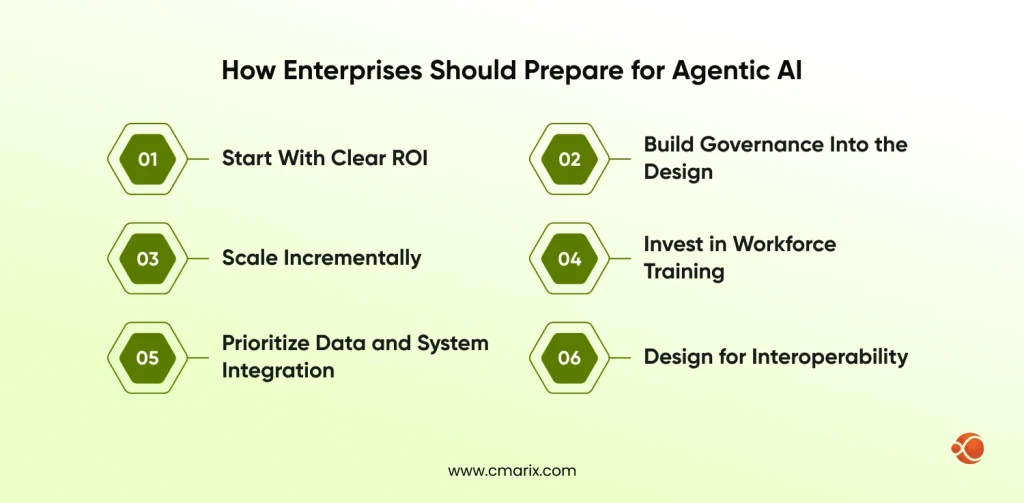
Organizations planning to adopt Agentic AI should focus on building strong foundations.
1. Start With Clear ROI
Pick processes that can generate measurable outcomes and business value. Organizations should use a CFO AI ROI Framework to evaluate expected cost savings, productivity gains, revenue impact, implementation costs, and payback period before scaling an AI initiative.
2. Build Governance Into the Design
Plan the processes of permissions, approvals, decision-making, and auditing before implementing your agents.
3. Scale Incrementally
Start small and then grow your AI agents from selected use cases to full-scale multi-agent systems.
4. Invest in Workforce Training
It is essential that employees receive training in supervising and coordinating AI agents, governance, and process management.
5. Prioritize Data and System Integration
AI agents must have access to accurate and contextualized data.
6. Design for Interoperability
Organizations should avoid isolating AI systems from communication with other enterprise systems.
Develop secure, scalable AI agents designed for real enterprise workflows.
Challenges and Considerations
Despite its potential, the adoption of Agentic AI presents several challenges.
Strategic Uncertainty
There can be uncertainty about which areas AI agents can contribute the most value in business terms due to ambiguous objectives, leading to fragmented experimentation with no tangible results.
Legacy System Integration
Modern organizations function in advanced IT landscapes. The integration of AI agents into legacy systems can entail modifications to APIs, data models, and procedures.
Workforce Transformation
The employees will become increasingly responsible for managing various roles, such as overseeing the application of AI agents, handling exceptions, validating decisions, and formulating strategy.
Trust and Unpredictable Behavior
The workforce will have to adjust to their roles related to AI oversight, exception handling, decision validation, and strategic planning.
Security Risks
Compromised AI agents could potentially perform harmful actions at scale. Organizations need strong security measures, including permission controls, agent sandboxing, continuous monitoring, authentication, and access management.
Regulatory Compliance
Regulatory Compliance Regulations on AI are growing in number, including voluntary frameworks such as NIST’s AI Risk Management Framework, which will make responsible development of AI systems more essential. Companies have to comply with regulations at the design and deployment phases, not just afterward.
Why Choose CMARIX As Trusted AI Agent Development Company
As a leading AI agent development company, CMARIX offers an AI strategy, agent development, system integration, and optimization framework to create production-ready AI agents in line with tangible business goals. It follows a well-defined process, starting with use case identification and ROI assessment, and moving on to architecture, development, testing, piloting, and scaling up.
With a special team of AI experts, 35+ AI agents shipped, 200+ enterprise clients, support for 8 AI agent frameworks, and an average time-to-pilot of 9 weeks, CMARIX brings practical experience to organizations moving from AI experimentation to production deployment.
In addition, there is an emphasis on governance and reliability throughout the development process. Access control based on permissions, human-in-the-loop, agent observability, automated assessment, and security measures in CMARIX will make sure that the systems stay consistent with the company’s policy.
CMARIX also offers integration capabilities for CRM, ERP, ITSM, cloud services, and REST or GraphQL APIs, enabling AI agents to run within the current business infrastructure without setting up an entirely different system.
For organizations assessing an AI initiative, CMARIX adopts an outcomes-based framework where the process begins with AI strategy → use case prioritization → pilot → KPIs → scaling to production. This framework ensures that investment is made for business benefits while laying the groundwork for Agentic AI deployment.
Final Words
Agentic AI has come out of experimental settings and become a significant component of business operations.
Organizations are embedding AI agents into cloud infrastructure, procurement, finance, sales, cybersecurity, and other business functions.
The most significant transformation, however, will not come from simply adding AI agents to existing workflows. It will come from redesigning processes around intelligent, goal-driven execution.
Organizations that successfully adopt Agentic AI will need to balance autonomy with accountability. Strong governance, human oversight, real-time data, interoperability, and workforce readiness will remain essential. Get your agentic AI evaluation done by the capable and skilled developers at CMARIX.
Enterprise automation systems are now evolving towards systems that go beyond merely reacting to commands. Intelligent agents are taking an increasingly proactive role in the way companies process information, make decisions, and run business processes.
The defining question for 2026 is no longer whether enterprises will adopt Agentic AI. It is how effectively they will integrate it into their technology, workflows, and operating models, and that’s where a partner matters. If you’re weighing where to start, talk to CMARIX’s AI consulting team about a pilot.
FAQs On Top Agentic AI Trends
What are the latest trends in agentic AI?
Agentic AI is moving toward multi-agent orchestration, autonomous workflows, tool use, MCP integration, and stronger governance. Focus is shifting from AI-generated content toward goal-driven systems that execute tasks and make decisions.
How is agentic AI used today?
Agentic AI is being used for customer support, software development, research, cybersecurity, data analysis, and business process automation. Agents are increasingly connecting with enterprise tools to execute multi-step workflows with limited human intervention.
What is the most popular agentic AI framework and toolset?
LangGraph, Microsoft Agent Framework, CrewAI, and AutoGen are examples of frameworks used to develop agentic systems. The choice of framework would depend on issues such as multi-agent coordination, tool invocation, memory, and enterprise-wide integration.
What are the key trends in agentic AI for 2026?
Important trends for the year 2026 include multi-agent systems, tool integration via MCP, agentic cybersecurity, multimodal agents, and autonomous enterprise workflows. Governance, observability, security, and human supervision are becoming critical parts of production systems.
What is the next stage of evolution for agentic AI?
The next stage of evolution will be AI systems capable of collaboration, planning, reasoning, tool use, and coordination with other agents. These kinds of AI are gradually moving from specialized assistants into digital workers.
How is the transition from Generative AI to Agentic AI changing automation?
In this regard, Generative AI is used to create content and responses, whereas agentic AI is used to execute actions across various stages and systems.
What is the Model Context Protocol (MCP) and why is it trending?
MCP is a free protocol that enables AI applications to connect to other tools, data, and service providers through a common interface. The increasing use of MCP is contributing to more interoperable agent integrations.
How are multi-agent systems (MAS) evolving in recent developments?
Multi-agent systems have moved away from collaborative agents to specialized agents that are orchestrated and contextualized. The agents are becoming more task-centric,, dividing tasks and validating outputs.
How do modern cognitive architectures handle “goal drift”?
The contemporary agent architecture employs goal setting, constraints, milestones, state, and validation checks to detect any inconsistencies. Human approval and policy constraints are other means used by agents to make crucial decisions.
What is the trend regarding “Human-in-the-Loop” (HITL) in autonomous workflows?
The HITL process is shifting away from constant observation to intervention where necessary, at the time of making important decisions. It thus facilitates greater independence while ensuring human control of important business decisions.