




Quick Summary: AI Orchestration is the coordination of multiple AI agents with automated systems that work together seamlessly through shared context, memory, and sequential task execution. This guide explains what AI orchestration is and why it has become a non-negotiable layer in modern AI architecture. It helps a CTO evaluate their AI stack and product managers exploring different agentic systems.
With the increasing use of AI solutions within companies, orchestration is now vital to ensuring that workflows do not fragment, that data is not siloed, and that automation does not fail.
Half of all active AI agents today operate in complete isolation. They cannot communicate, share context, or hand off tasks to one another.
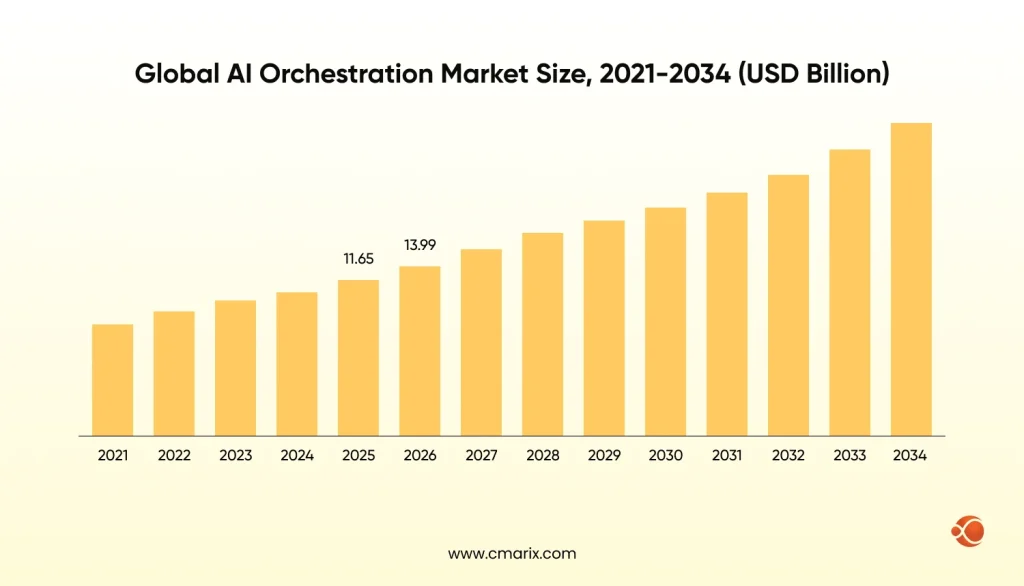
Meanwhile, the AI orchestration market- currently valued at $13.99 billion in 2026, is projected to hit $60.34 billion by 2034. The gap between what enterprises invest in AI and what they actually get from it is not a model problem. It is a coordination problem.
Now, if you have deployed AI agents, automation tools, and even large language models throughout your stack, then you have already seen this first-hand. AI tools that perform excellently in demonstrations simply break down under real-world conditions. Processes get stuck because there are no contingencies in case of failure during an individual process. The end product? Budget waste, disillusioned teams, and failed AI projects.
What This Guide Covers
- What is AI orchestration, and what is its role in contemporary AI?
- Why is AI orchestration necessary in enterprises that implement AI?
- What are the distinctions between AI orchestration and automation and single AI agents?
- Why do contemporary AI models fail when there is no orchestration and coordination?
- What are the approaches to solving contextual issues and handling memory in AI orchestration?
- What are the key elements of a comprehensive AI orchestration solution?
- How does error management and fallback work in AI orchestration?
- What are the real-world examples of applications for AI orchestration in different areas?
- What tools and frameworks are used in AI orchestration today?
- How can companies start using AI orchestration in their technology stacks?
- What issues can be solved by introducing AI orchestration in enterprise AI systems?
- Where is the future of AI orchestration headed, and why is it growing at a rapid pace?
What is AI Orchestration?
Quick Answer: AI orchestration is the technology that coordinates multiple AI agents or models into a cohesive whole. This technology handles task orchestration, communication of memories between models, fault tolerance, and decision-making for the operation of all the individual AI systems.
AI orchestration is not the same as basic automation or traditional LLM workflow management systems that only handle linear prompt execution.
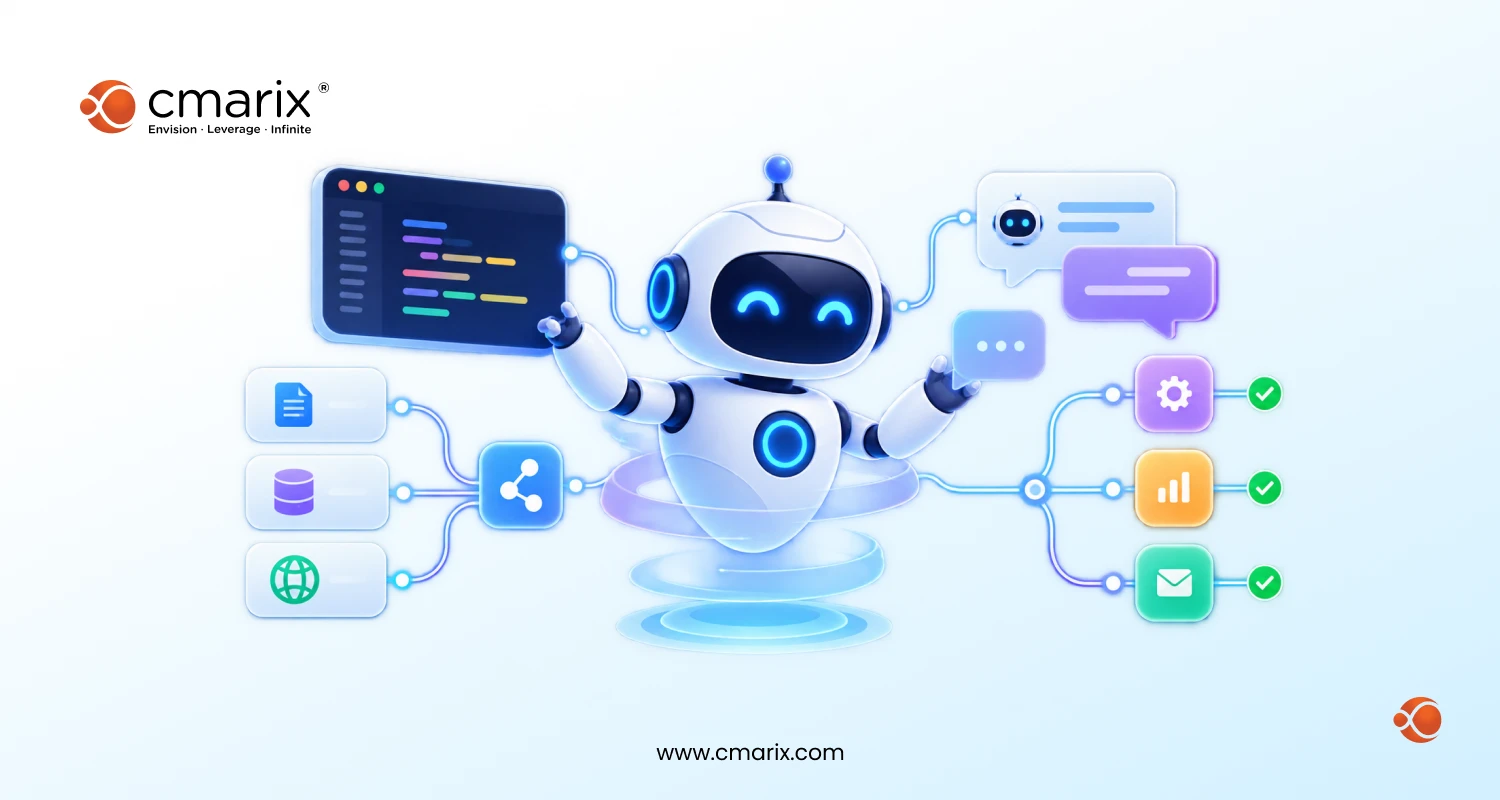
A traditional RPA bot follows a fixed script. A standalone AI agent responds to prompts. AI orchestration does something more sophisticated: it decides which agent handles which task, in what order, with which tools, and it dynamically adjusts when conditions change.
Consider it the conductor of an orchestra. An individual instrument (agent, model, or tool) can perform independently. To understand the full landscape of AI capabilities before orchestration enters the picture, it helps to explore the different categories and types of AI that power these systems.
Why AI Orchestration Matters Right Now
The need for orchestration is not simply academic. According to Gartner, 40% of efforts involving agentic AI will be shut down before 2027 if businesses do not employ proper orchestration and risk management practices. This is not because AI technology is complicated; this is because AI technology is not properly connected to anything.
Here is what unorchestrated AI environments look like in practice:
- Agents that generate output that is unusable by any other system
- LLMs that forget context in the middle of conversations due to a lack of memory layers
- Automation pipelines that stop at the first error and need to be restarted manually
- Organizations that have created five different AI tools without a common data pipeline flow
The orchestration challenge only gets worse as you scale up. It is feasible to coordinate a single agent. Five agents running independently pose an availability risk. Fifty presents a governance challenge.
This is precisely where building smarter enterprise AI solutions starts, not more AI models but rather with their architectural interconnect. The transition from AI experimentation to full-blown enterprise AI cannot do without an orchestration layer built into the system’s design.
In the CMARIX experience, we find that many organizations tend to underestimate the orchestration complexities during planning phases while overestimating what a single, well-designed model can do to mitigate bad workflow design. The problem does not lie with the model, but with coordination itself.
How AI Orchestration Works (Core Mechanics)
This orchestration approach ensures that all processes are automated and interconnected, rather than disconnected. Each workflow step will be interconnected, tracked, and recovered throughout the entire process.
Here is the essential process flow:
Step 1: Input Reception
An event happens: the user makes a request, something is scheduled to occur, an API triggers a webhook, or there’s a change in the dataset. This event is recognized by the orchestrator.
Step 2: Task Decomposition
To fulfill a task, it should be decomposed into several subtasks. To complete the task “create a monthly financial report,” the following sequence of actions will be necessary: obtain data → validate it → analyze it → generate an overview → format results → send out the report.
Step 3: Agent Assignment
Agents assigned to specific subtasks must be selected. To extract data, one would use an agent with a SQL skillset; to generate an overview of the data, one should involve LLMs; and to send an email, one should use a communication agent.
Step 4: Context and Memory Passing
Outputs of the activities become the inputs for subsequent operations. The orchestrator keeps the context of interactions – both short-term and long-term.
Step 5: Error Handling and Fallback
If there’s an error in the process, the agent can’t respond within the set period of time or produces incorrect outputs, there is a fallback strategy applied.
Step 6: Output Delivery
The completed result is returned to the end user, stored in the appropriate system, or triggers the next downstream workflow.The technical expertise involved in orchestrating AI agents and large language models can be seen in steps 4 and 5. It is the memory management and error handling that cause naive implementations to fall flat on their face.
Transform AI and enterprise systems into results-driven workflows.
To go deeper on process automation at the foundation layer, AI workflow automation provides a comprehensive breakdown of how these pipelines are designed and maintained in production environments.
Key Components of an AI Orchestration System
A production-grade orchestration system is not a single piece of software. It is a set of layers working together.
1. Orchestration Layer / Controller
This is the brain. It holds the master workflow logic, interprets the plan, assigns tasks, and manages sequencing. Without this layer, you do not have orchestration; you have a collection of independent tools.
2. Agent Pool
This is what specialized AI workers look like: LLMs, classifiers, retrievers, executors, and callers. Each worker’s design is oriented toward its designated task types. Proper coordination ensures that such specialization becomes an advantage rather than a hindrance to the workers. Specialization becomes far more advantageous once AI task automation is implemented.
3. Memory & Context Management
Short-term memory keeps the status of the current session. Long-term memory keeps persistent information such as users’ preferences and previous choices. Context passing allows downstream agents to be aware of what previous agents have done.
4. Tool & API Integrations
Orchestrators interface with external applications, databases, CRMs, clouds, communication services, and APIs. That is what distinguishes an orchestrated AI from mere smartness. An agent with no external connectivity is a chatbot. An agent with embedded services is an operator.
5. Monitoring & Fallback Logic
Each robust orchestration engine will include observability features such as latency monitoring, error logging, output validation, and alerts. Fallbacks determine how the process should be handled in case of problems, such as retries, user interaction, or a sensible default action.
6. Security & Compliance Layer
Orchestrators deal with confidential data on the move. An adequate level of security ensures management of access control, data masking, auditing, and compliance with standards such as GDPR, HIPAA, SOC 2, or industry-level standards. Such a layer is usually ignored at an early stage, becoming the sole reason for late deployments.
AI Orchestration vs. Basic Automation vs. Standalone Agents
The distinctions here matter practically, not just conceptually.
| Dimension | Basic Automation (RPA) | Standalone AI Agent | AI Orchestration |
| Flexibility | Rule-based, rigid | Adaptive, single-scope | Adaptive, multi-scope |
| Multi-task handling | Sequential, fixed steps | Single task focus | Multi-agent, parallel |
| Context awareness | None | Session-level only | Short + long-term memory |
| Error handling | Fail or escalate | Retry or fail | Fallback, reroute, recover |
| Scale | Linear cost increase | Limited by single model | Horizontally scalable |
| Governance | Script-level | Prompt-level | System-level |
Automation works great for highly repetitive processes with little variation. On the other hand, standalone bots excel at conversation or research work. But orchestration comes into play when a single process alone is not enough – when there is intricacy, complexity, multiple steps, and dependability.
The development of automation to AI orchestration is a well-researched path. It will help you understand how both AI and RPA have changed business processes to date, where their synergy lies, and how orchestration fits into the picture.
The most important thing to remember here is that orchestration does not take the place of RPA or independent agents. Orchestration raises RPA to a whole new level.
Real-World AI Orchestration Use Cases
The 20–30% efficiency improvement organizations report in their first year of AI-driven process orchestration is not uniform across industries, but the pattern is consistent. Orchestration unlocks efficiency at the handoff points between systems, teams, and data sources.
1. Customer Service Automation
The orchestration layer receives requests for support and automatically distributes the queries, depending on their complexity and intention, to the right agent (FAQs bot, escalations manager, CRM updater). Then, after finishing, it closes the loop without any human involvement in 70-80% of the cases.
2. Supply Chain and Inventory Optimization
Orchestrators can receive information from various sources at once, such as IoT sensors, ERP systems, and forecasting models. Then, they can analyze this information, triggering reorder processes and issuing exceptions.
3. Software Development Pipelines
Using AI-driven orchestration of the CI/CD pipeline enables automatic review of the code, generation of test plans, security checks, and approval of the deployment process.
4. Healthcare Records and Compliance
The processes for creating clinical documents arrange transcription models, medical coders, compliance checkers, and EHRs, alleviating the burden of document preparation for the practitioner while ensuring compliance.
5. Financial Reporting and Fraud Detection
Information gathering from various sources, reconciliation, anomaly detection using artificial intelligence, and reporting those that need to be analyzed by people form part of the financial process.
Again, in this case, the competitive edge does not stem from the AI application itself, but from how well the integration process was done.
Popular AI Orchestration Tools and Frameworks
Choosing a popular agentic orchestration framework depends on your stack, your team’s expertise, and your scale requirements. Here is a practical overview:
| Framework / Tool | Simple Overview | Best For |
| LangChain / LangGraph | Used to build AI agents and connect multiple AI tasks together | Complex AI workflows and multi-agent systems |
| AutoGen | Allows multiple AI agents to communicate and work together | AI collaboration and approval-based workflows |
| CrewAI | Creates AI agents with different roles and responsibilities | Simple team-based AI automation |
| Prefect / Apache Airflow | Manages workflows, scheduling, and automation processes | Data pipelines and ML workflow management |
| Framework Selection | Every framework has different strengths | Choosing the right framework for the project needs |
How to Get Started with AI Orchestration
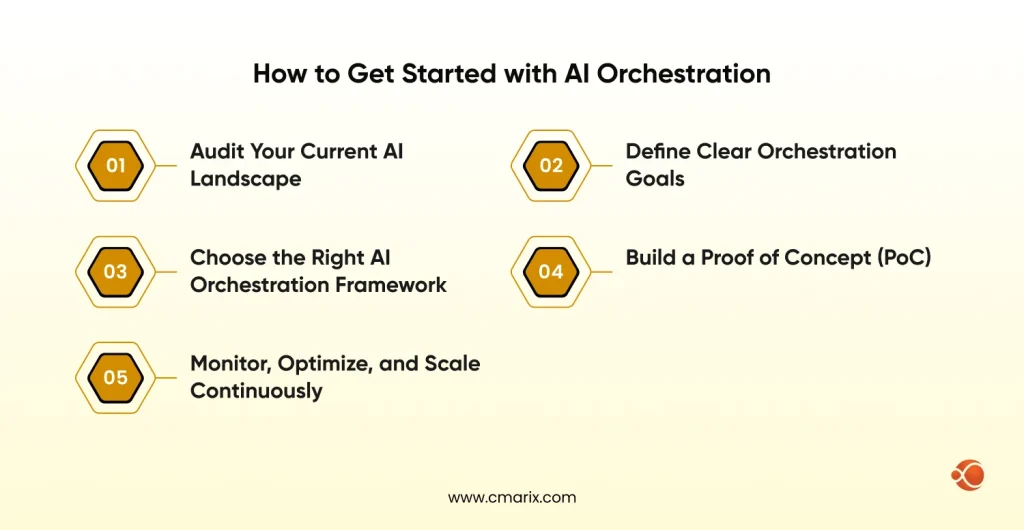
Step 1: Audit Your Current AI Landscape
List all your AI agents, automation scripts, and LLMs. Figure out what data and processes are involved at each step. Most companies learn that their current stack includes even more tools than they knew.
Step 2: Define Clear Orchestration Goals
Orchestration goals such as efficiency, reliability, scalability, cost savings, and orchestration should always have measurable goals, rather than simply relying on the fanciest tools.
Step 3: Select the Right Framework for Your Stack
Different frameworks can be selected. These include LangGraph, AutoGen, CrewAI, and an orchestration framework called Prefect. Choose the one that works for you.
Step 4: Build a Proof of Concept with a Contained Use Case
Begin by designing a simple, contained use case, not a complex one. It is important to validate the design through the proof of concept before deploying it into a live environment. Find more information on the top AI PoC development services.
Step 5: Monitor, Iterate, and Scale
Always deploy with observability right from the start. Observe performance metrics such as latency, failure rate, and output. It is important to note that the orchestration architecture will need iterations as it evolves once deployed.
Ready to Orchestrate Your AI Stack?
Orchestrating your AI isn’t some distant future goal. For teams that have deployed any kind of AI, it’s the crucial ingredient that will decide whether all the effort compounds into a payoff or fizzles out.
CMARIX assists corporate teams with designing and building an AI Orchestration architecture, from concept through to production rollout. Whether you need to connect existing bots, design a new bot architecture, or evaluate your current automation architecture, our team has the expertise and experience to assist.Consider our enterprise AI consulting and deployment services to talk about your orchestration strategy. For organizations requiring intricate process automation systems, our robotic process automation development services and dependable DevOps services provide a crucial infrastructure foundation for orchestration.
Final Words
AI orchestration is the architecture that turns a collection of AI investments into a competitive advantage. Without it, agents work in silos. Workflows stall at handoffs. Automation scales poorly. With it, enterprises unlock the compounding returns that AI was always supposed to deliver.
The market growth path, from the current figure of $13.99 billion to a forecasted value of $60.34 billion in 2034, is indicative of one fact: coordination is the new competence. The teams that will be successful in running AI-powered operations are not those with the most advanced models.
If your AI stack is ready for that next layer, the path starts with a clear architecture and the right implementation partner.
FAQs About AI Orchestration
What is the difference between AI orchestration and basic automation?
Whereas automation (such as RPA) follows rule-based scripting that always executes the same sequence of steps each time, AI orchestration is highly flexible. Orchestration guides the workflow between agents, facilitates context-dependent action transitions, accounts for potential failures, provides a backup in case of failure, and handles different inputs. Complexity is handled through orchestration, while repetition is handled through automation.
Why do I need orchestration if I already have AI agents?
Individual AI agents are specialized for their tasks. They take certain inputs and produce certain outputs; however, they cannot communicate with each other, provide context for each other, or manage workflows across multiple steps. If there is no orchestration involved, you simply have several very effective tools. It is orchestration that makes them into an interconnected system.
What role does “memory and context” play in orchestration?
Memory ensures that the process does not restart at each stage of an orchestrated process. Short-term memory contains session information, which consists of what has happened up to now in the current process. Long-term memory stores persistent data, including preferences, decisions, and patterns. Context passing ensures that each agent in the pipeline receives the structured result from its predecessor.
Can orchestration handle complex error handling and fallbacks?
Certainly – and one of the most critical functions of orchestration lies here. A good orchestration layer will include built-in fallbacks: retrying with backoff, routing to another destination, escalating the task to a human for review, or even falling back to a safe output. Without error handling in the orchestration layer itself, the failure of just one agent in the chain halts the entire process.
How does AI orchestration handle security and data privacy?
Orchestration technologies transfer data between agents, tools, and third-party APIs. This can expose organizations to compliance risks unless the solution is built properly. Strong orchestration solutions will provide role-based security controls, data masking during transmission, encrypted storage, audit logging, and compliance governance built into the system (e.g., GDPR, HIPAA, SOC 2). Secure by design, orchestration solutions must be implemented from the very start.
What are some popular tools used for AI orchestration?
In 2026, the leading frameworks include LangChain/LangGraph for orchestration within LLMs, Microsoft AutoGen for orchestration across multiple agents in conversation, and CrewAI for orchestration of agents based on roles. Prefect and Apache Airflow remain effective at orchestrating machine learning pipelines and data workflows. Your choice depends on your technology stack, expertise, and the complexity of your workflow; an organized proof of concept is typically the best way to confirm your selection.