


Quick Summary: The applications of generative AI in healthcare have moved past pilot projects and into daily clinical workflows, from ambient documentation to drug discovery to agentic systems that chain multiple clinical tasks together. This guide breaks down the generative AI use cases in healthcare that are actually delivering results today, the steps to implement generative AI software development in healthcare responsibly, and what to watch for as adoption scales through 2026 and beyond.
Healthcare has never had a shortage of data. What it’s had is a shortage of time to make sense of it. Clinicians spend hours on documentation instead of patients, researchers sift through mountains of literature by hand, and administrative teams process claims and prior authorizations that take days to clear.
Generative AI in medical applications changes that equation, but not without real complexity. Clinical settings carry higher stakes than most industries adopting AI: a hallucinated fact in a marketing email is annoying; a hallucinated fact in a treatment plan is dangerous. That’s why the applications gaining real traction right now are narrow, well-scoped, and built with a human checkpoint still in the loop.
Let’s look at where the applications of generative AI in healthcare are actually working in clinical settings today.
What Is Generative AI in Clinical Healthcare?
Generative AI in clinical settings refers to AI models that create new content, predictions, or structured data from existing medical information rather than just classifying or retrieving it. That includes drafting clinical notes from a patient conversation, generating candidate drug molecules, producing synthetic medical data for training, or summarizing a patient’s history into a readable clinical picture using Large Language Models (LLMs) in medicine.
This is different from the earlier wave of types of healthcare software that focused mainly on digitizing records and automating rules-based workflows, largely centered around Electronic Health Records (EHR) automation. Generative models work with unstructured inputs directly, whether that’s a physician’s spoken notes, a radiology image, or years of scattered EHR entries, and turn them into something usable without a human first converting the data into a structured format.
The shift matters because most clinical and administrative work in healthcare involves exactly this kind of unstructured, manual interpretation. Sorting through logs, notes, and records by hand is slow and error-prone. When a generative AI development company builds these systems correctly, they cut that manual work down significantly while keeping a clinician or specialist reviewing the output before it touches a patient record.
Top Applications of Generative AI in Clinical Healthcare
Generative AI has moved well beyond experimental pilots in several parts of the healthcare industry.
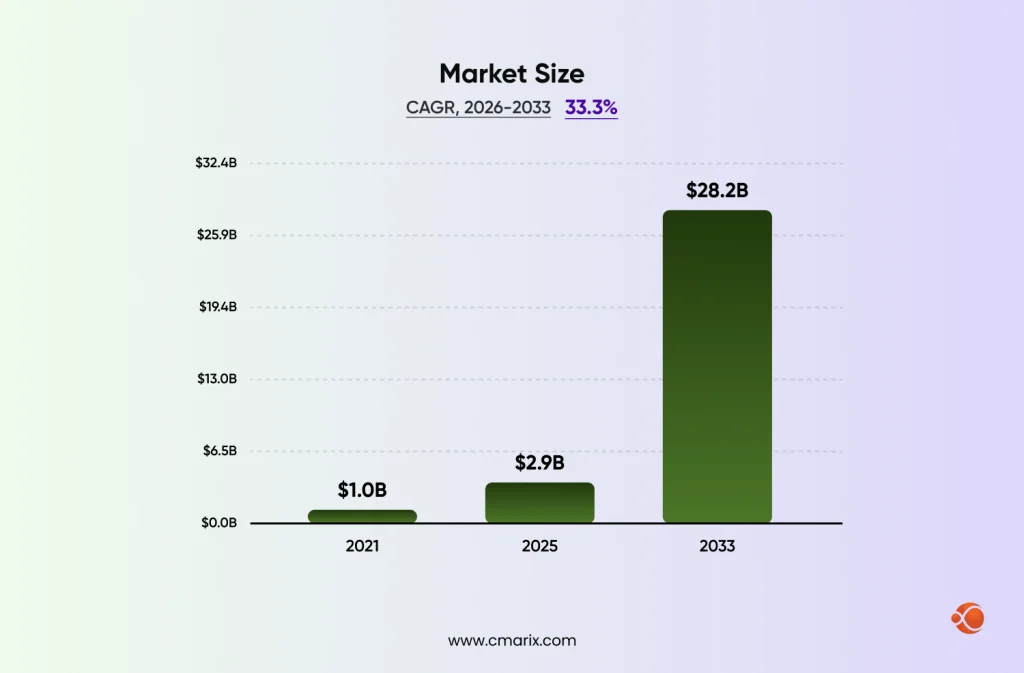
Grand View Research values the global generative AI in healthcare market at $2.9 billion in 2025, projecting growth to $3.8 billion in 2026 and $28.2 billion by 2033 at a 33.3% CAGR, with the clinical application segment already accounting for more than 62% of 2025 revenue. McKinsey Global Institute separately estimates that generative AI could unlock between $60 billion and $110 billion in annual economic value for the pharmaceutical and medical-product industries alone. Here’s where that growth is actually showing up.
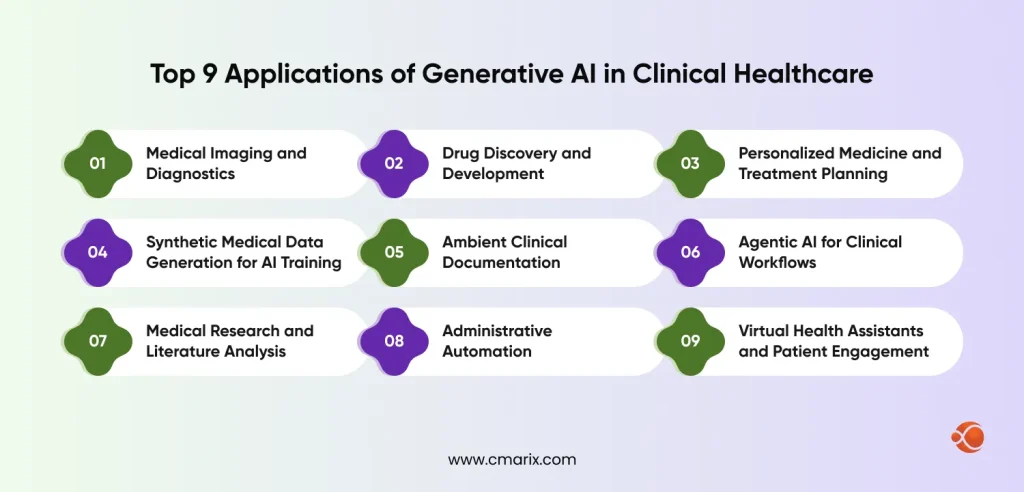
1. Medical Imaging and Diagnostics
Radiologists are using generative AI, closely tied to computer vision in healthcare, to speed up and improve accuracy in reading X-rays, MRIs, and CT scans. This medical imaging enhancement means models trained on large, varied patient datasets can flag early indicators of conditions like lung and skin cancers, Alzheimer’s, and diabetic retinopathy, often catching patterns a human eye might miss on a first pass.
- Image Synthesis: Generative models create realistic images of organs or tissues for training medical staff and explaining conditions to patients without relying on real patient scans.
- Automated Segmentation: AI automatically identifies and labels organs or abnormalities within a scan, cutting down the manual review time for radiology teams.
- Pathology Prediction: By analyzing patterns across large image sets, generative AI can flag likely pathological findings for a specialist to confirm.
Grand View Research notes that medical imaging analysis is expected to grow faster than any other function segment in the generative AI healthcare market through 2033, driven by rising demand for faster and more consistent diagnostic turnaround. The regulatory pathway is maturing alongside the technology too: the FDA has authorized more than 1,000 AI-enabled medical devices through its established premarket pathways, with the majority concentrated in radiology and imaging.
2. Drug Discovery and Development
This is where AI in pharmaceutical industry applications is generating the clearest ROI. Generative AI for drug discovery compresses timelines that traditionally take years. By analyzing molecular structures and biological data, including safety and efficacy signals, these models can propose new compounds with specific desired properties, often supported by protein folding and molecular modeling techniques that predict how a candidate compound will actually behave in the body.
- Compound Generation: Generative models search chemical space far faster than traditional methods, surfacing promising candidate molecules for further testing.
- Drug Interaction Prediction: AI models forecast how combinations of drugs might interact, supporting safer decisions around combination therapies.
NVIDIA Healthcare’s generative AI microservices, including tools built for genomics and imaging, are already being used by pharmaceutical and biotech teams to accelerate parts of the discovery pipeline that used to require months of manual lab work. Building this kind of pipeline usually calls for offshore Python developers who can work across molecular modeling libraries, AI/ML frameworks, and the data science tooling that drug discovery platforms are typically built on.
3. Personalized Medicine and Treatment Planning
Generative AI synthesizes large volumes of patient data, including genetic information, clinical notes, and EHR history, to support individualized treatment plans instead of one-size-fits-all protocols.
- Customized Treatment Regimens: Models analyze a patient’s clinical and genetic profile to suggest which treatments are most likely to work for that specific person, a core piece of personalized treatment planning.
- Predictive Analytics for Disease Progression: By combining multiple patient variables, predictive healthcare analytics can forecast how a condition is likely to progress and how a patient may respond to treatment.
- Real-Time Clinical Decision Support: Clinical Decision Support Systems (CDSS) powered by generative AI surface evidence-based treatment suggestions to physicians at the point of care, based on a patient’s specific history and genetic markers.
- Compliance-Aware Design: Handling genetic and treatment data at this level means privacy and regulatory compliance can’t be an afterthought. HIPAA-compliant AI solutions need to be built with HIPAA and GDPR requirements baked in from the start, not bolted on later.
4. Synthetic Medical Data Generation for AI Training
One of the biggest blockers to building better clinical AI models is data itself: real patient data is scarce for rare conditions and heavily restricted by privacy law. Generative models, particularly GANs and diffusion models, can produce realistic synthetic medical data that preserves the statistical patterns of real records without exposing actual patient information.
This lets research teams train and test other AI models on rare disease cases or underrepresented populations without waiting years to accumulate enough real-world examples, and without the privacy risk of using real patient records for that training.
5. Ambient Clinical Documentation
This is one of the fastest-moving applications in healthcare right now. Ambient AI tools use Natural Language Processing (NLP) for clinical notes to listen to a physician-patient conversation in real time and generate a structured note automatically, cutting out manual charting after the visit. This builds directly on the NLP in healthcare innovation foundation that made structured extraction from unstructured clinical text possible in the first place.
6. Agentic AI for Clinical Workflows
Where a chatbot answers one question, an agentic system chains several steps together with a human checkpoint at the end. A typical example: the system pulls a patient’s labs from the EHR, cross-references a drug interaction database, drafts a medication order, and flags it for physician sign-off before anything is finalized.
This is still an early-stage application. Multi-agent clinical orchestration is generally considered a few years out from broad production use, and vendor claims in this space should be read carefully. The direction is clear, though. Agentic systems extend what ambient documentation already does, taking AI from a note-taker to something that can prep an action for a clinician to approve.
7. Medical Research and Literature Analysis
Research teams use generative AI to process volumes of medical literature and patient data that would take a human researcher weeks to work through manually.
- Document Processing: AI extracts and summarizes relevant findings from large sets of medical documents automatically.
- Medical Record Summarization: Long, dense clinical records get condensed into readable summaries for researchers or referring physicians.
- Trend Identification: AI surfaces emerging patterns across recent studies, helping teams stay current without reading every new publication in full.
8. Administrative Automation
Health insurance processes, particularly prior authorization and claims, are notoriously slow. Verifying prior authorization the traditional way often takes about ten days. Insurance claims processing automation converts unstructured intake data into structured formats, letting benefits get verified in a fraction of that time by factoring in a patient’s specific coverage, provider contract rates, and other variables automatically. This kind of automation is spreading fast: an AMA survey found that 81% of U.S. physicians now use AI in some part of their practice, up from just 38% two years earlier, with documentation, coding, and administrative support among the most common use cases.
- Appointment Scheduling: AI automates booking and rescheduling while keeping slots convenient for patients.
- Billing and Claims Processing: Automated claims handling reduces errors and speeds up reimbursement cycles for providers.
- Data Entry and Extraction: AI pulls relevant information from multiple sources automatically, reducing manual entry and improving database accuracy.
9. Virtual Health Assistants and Patient Engagement
AI-powered virtual assistants, integrated with EHR systems, let patients book, reschedule, or cancel appointments without waiting on a human scheduler. Much of this now runs through AI telemedicine chatbot development, which handles routine questions and follow-ups so clinical staff can focus on higher-value work.
Beyond scheduling, virtual assistants send personalized medication reminders and adherence alerts through mobile apps or connected devices, which helps reduce treatment disruptions from missed doses. Building this kind of always-on patient engagement layer typically calls for skilled mobile developers who understand both native app performance and how to integrate securely with clinical backends. Where multiple languages are in play, generative AI can also translate medical information in real time, closing communication gaps that otherwise slow down care.
How to Implement Generative AI in Clinical Healthcare
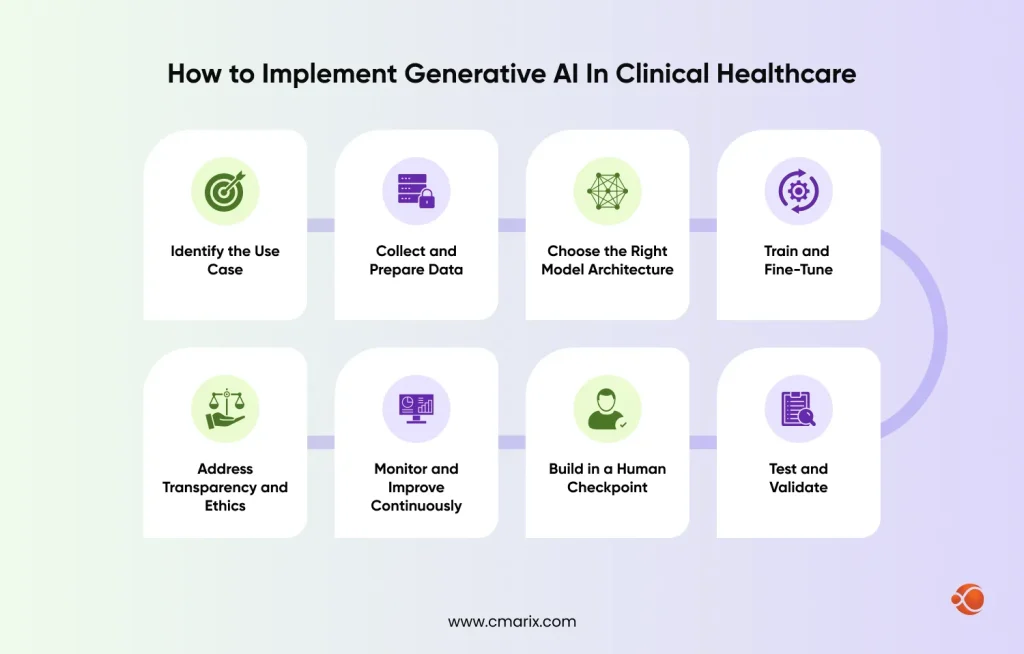
Rolling out generative AI in a clinical setting takes a more careful approach than most software deployments, given the regulatory and patient-safety stakes involved. Here’s a practical sequence:
- Identify the Use Case: Start narrow. Pick one workflow, such as ambient documentation, imaging support, or claims processing, rather than trying to deploy AI everywhere at once.
- Collect and Prepare Data: Gather representative, diverse datasets that comply with privacy regulations. Clean and preprocess the data before training, since model accuracy depends heavily on data quality going in.
- Choose the Right Model Architecture: Match the model type to the use case. GANs and diffusion models suit image generation and synthetic data, while transformer-based models fit documentation and language-heavy tasks.
- Train and Fine-Tune: Train the selected model on your prepared datasets, then fine-tune it against the specific clinical application to improve real-world accuracy.
- Test and Validate: Validate the model against datasets it hasn’t seen during training. Check performance, dependencies, and correctness against clinical requirements before any patient-facing use.
- Build in a Human Checkpoint: For anything touching a medical record or treatment decision, keep a qualified professional reviewing AI output before it’s finalized. This isn’t optional in clinical settings.
- Monitor and Improve Continuously: Track system performance after launch and update the model with fresh data regularly to maintain accuracy as clinical environments change.
- Address Transparency and Ethics: Be upfront with patients and staff about where and how AI is being used, and actively monitor for bias in model outputs.
Why Choose CMARIX for Generative AI in Healthcare
Building generative AI for clinical settings isn’t the same as building it for retail or marketing. The margin for error is smaller, the compliance requirements are stricter, and the systems have to earn trust from both clinicians and patients before they get real adoption.
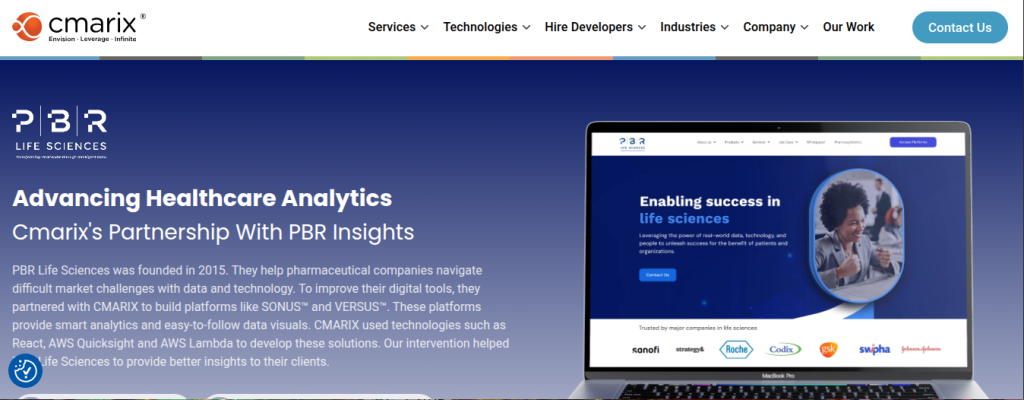
Our work with PBR Insights is a good example of what that looks like in practice. We built a healthcare analytics platform that uses AWS Comprehend Medical to extract structured insights from unstructured clinical text, predictive modeling to flag at-risk patients early, and a security architecture built around HIPAA and GDPR compliance from the ground up rather than added on afterward. The platform integrates data from EHRs, lab results, and patient feedback into a single unified view for UK healthcare providers navigating exactly the kind of data fragmentation most health systems deal with.
That’s the same approach we bring to generative AI projects: start with the compliance and data architecture right, then build the AI layer on top of a foundation that can actually be trusted with patient information.
Ready to build generative AI into your healthcare platform the right way?
Conclusion
Generative AI in clinical healthcare has moved well past the proof-of-concept stage. Ambient documentation is already standard practice at major health systems, imaging models are catching diagnoses earlier, and drug discovery pipelines are moving faster than they have in decades. Agentic workflows and synthetic data generation are the next wave, and they’re coming faster than most organizations expect.
None of this replaces clinical judgment. It removes the friction around it, cutting down the hours clinicians spend on documentation and administrative work so they can spend more of that time actually treating patients. Getting there requires a careful balance between real innovation and the ethical, regulatory, and safety obligations that come with handling patient data and treatment decisions.
Collaborate with CMARIX to develop generative AI solutions built specifically for your healthcare organization’s use case, with compliance and clinical safety built in from day one.
FAQs on Applications of Generative AI in Healthcare
What are the most common applications of generative AI in healthcare?
The most established applications of generative AI in healthcare are medical imaging analysis, drug discovery, personalized treatment planning, ambient clinical documentation, and administrative automation like claims and prior authorization. Ambient documentation and imaging support currently have the widest real-world deployment across health systems.
How is generative AI used in drug discovery?
Generative AI for drug discovery analyzes molecular structures and biological data to propose new compound candidates with specific desired properties, and predicts how drugs might interact with each other. This includes protein folding and molecular modeling work that used to take research teams months to complete manually. McKinsey estimates this could unlock $60 to $110 billion in annual value across the pharmaceutical industry.
Can generative AI improve Electronic Health Records (EHR)?
Yes. Generative AI supports Electronic Health Records (EHR) automation by summarizing long patient histories into readable clinical pictures, extracting structured data from unstructured notes, and reducing the manual entry that has traditionally made EHR systems slow to update and search.
What is the role of generative AI in medical imaging?
Generative AI supports medical imaging enhancement through automated segmentation, pathology prediction, and image synthesis for training purposes. Radiologists use these models to catch early indicators of conditions like lung cancer, Alzheimer’s, and diabetic retinopathy faster and more consistently than manual review alone.
How does generative AI assist in clinical settings?
In clinical settings, generative AI assists through real-time Clinical Decision Support Systems (CDSS), ambient documentation that drafts clinical notes during patient visits, and predictive healthcare analytics that flag disease progression risk. The common thread is that a clinician reviews the AI output before it becomes part of a patient’s official record.
What are the ethical considerations (bioethics) of using AI in healthcare?
The core bioethics concerns are algorithmic bias in training data, transparency about when and how AI is being used with patients, data privacy given how sensitive health information is, and maintaining meaningful human oversight over clinical decisions rather than letting AI operate unchecked. Organizations need clear governance frameworks before scaling any generative AI deployment.
How can healthcare organizations implement generative AI software?
Healthcare organizations should start with a single, well-scoped use case, gather compliant and representative training data, choose a model architecture suited to that use case, and validate thoroughly before any patient-facing rollout. A human checkpoint should stay in place for anything touching a medical record, with continuous monitoring after launch to catch drift or bias.
How does generative AI enable personalized medicine?
Generative AI enables personalized medicine by synthesizing a patient’s genetic data, clinical history, and treatment response patterns to recommend therapies suited to that specific individual rather than a generic protocol. This can shorten the trial-and-error process common in treatment planning and improve the odds of a first-line treatment actually working.