


Quick Summary: Real estate APIs power everything from listing search to AI-powered valuation models in 2026. This guide breaks down the best real estate APIs across property records, rentals, MLS listings, and geospatial data, including what each one is actually built for. In this, you’ll have a quick-reference table, a framework for choosing between providers, and answers to the questions developers ask most about integration and access.
Building a real estate product without reliable data is like building a house without a survey of the land under it. Property listings change daily, valuations shift with the market, and MLS access alone comes with a maze of regional rules that vary from state to state. Most teams don’t have the time or budget to scrape and maintain that data on their own.
The global PropTech market is projected to grow from $50 billion in 2026 to $115 billion by 2033, according to Grand View Research, and the API layer underneath most of that growth is doing more heavy lifting than most teams realize.
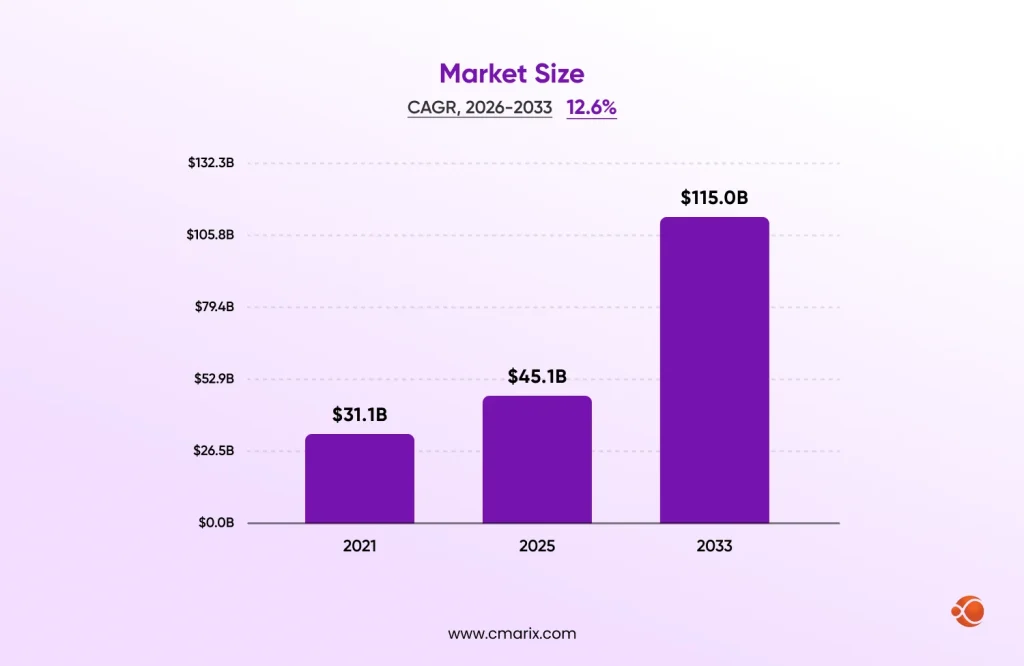
That’s where a real estate API comes in. The hard part isn’t finding one; it’s finding the correct one. A real estate data API built for enterprise lenders looks nothing like one built for a rental analytics startup, and choosing the wrong fit usually means rebuilding your data layer six months in.
This guide breaks down real estate APIs for developers by category, so you can match the tool to what you’re actually building. Whether that’s an MLS listing API, a valuation engine, or a commercial real estate API.
Whether you’re building a property search portal, an AI-driven investment tool, or a mortgage risk model. The right choice shapes your product’s speed, accuracy, and how much engineering time you spend maintaining a data layer instead of building features.
What Is a Real Estate API and How Does It Work
A real estate API is an interface that connects your application to the databases of real estate data providers. Rather than manually scraping listings or downloading databases, it sends all of that information straight to your CRM, underwriting model, or investment platform. With each user query about an address or any other comparison you need to make, it automatically gets the most up-to-date information rather than you having to manually update the database yourself.
The majority of APIs with property information are either public record data (information about the property itself and its history, which is primarily information on past transactions), MLS integration (current listings and local market activity), or analytics (valuation, forecast, and risk score that helps to convert data into actionable insights). It is unlikely that one vendor provides good coverage of all these categories, which is one of the reasons why the majority of proptech products require at least two or three vendors to get the information they need.
How to Choose the Best Real Estate API for Your Product
Not every API fits every product, and most of the buyer’s guides floating around skip straight to a list without covering how to actually evaluate one. Searching for the “best real estate API” tends to return page after page of vendor listicles, several of them published by vendors ranking their own product first. That’s not a great way to make an infrastructure decision your product will depend on for years, so it’s worth pressure-testing a provider on its own merits before signing anything. Before you commit, check these:
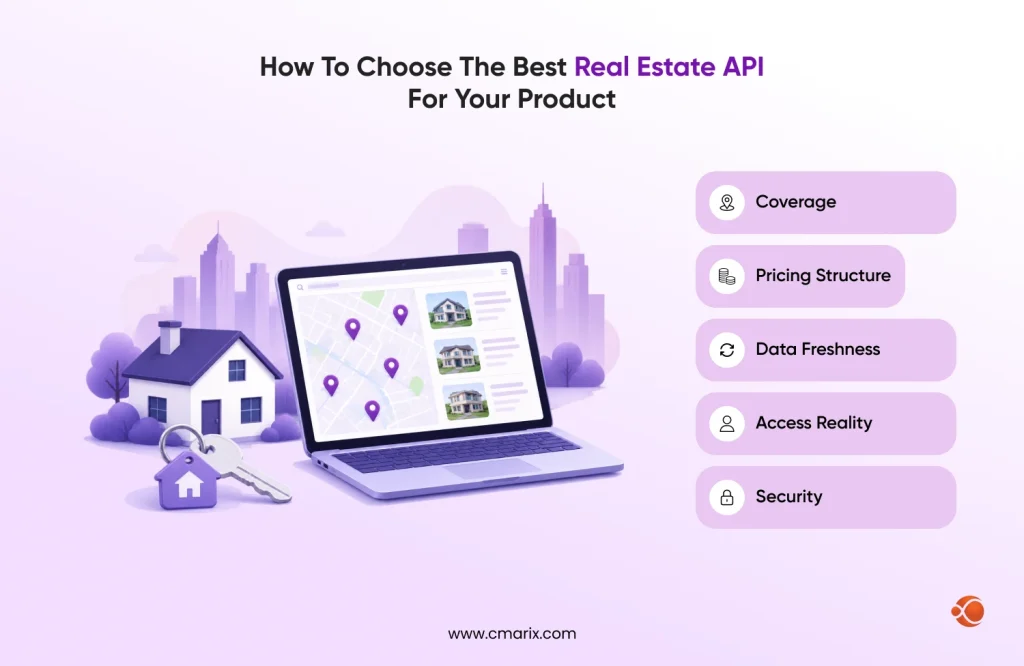
- Coverage – does it align with your market, or does it offer more coverage in a few major metropolitan areas but with very little information elsewhere?
- Pricing structure – flat subscription, per-call credits, or an enterprise contract, and does that scale the way your usage will
- Data freshness – how often the records are refreshed, but just as importantly, how are changes handled when a property record is corrected?
- Access reality – some providers restrict access to approved partners or licensed brokerages, so confirm you actually qualify before you design around one
- Security – you’re pulling sensitive property and ownership data, so review how the provider handles authentication, and make sure your own integration follows secure REST API practices
A team building a single-metro rental tool weighs these differently than a team building a national underwriting model. There’s no single best real estate API for everyone, only the one that fits your roadmap and your budget.
Our team can review your requirements and point you to the right API.
Best Real Estate APIs at a Glance: Quick Comparison Table
| API | Best For | Data Type |
| ATTOM Data | Enterprise lenders, insurers | Property, mortgage, risk |
| RentCast | Rent estimates at scale | Rental analytics |
| HouseCanary | Valuations and forecasting | AVM, risk analytics |
| Realtor API | Real-time US listings | Listings, market stats |
| MLS API | Broad regional listing access | Listings |
| SimplyRETS | Easy MLS integration | Listings |
| Redfin API | Listing trends, price changes | Listings, historical data |
| Walk Score API | Neighborhood and walkability | Location, amenities |
| Spark API | MLS data with CRM tools | Listings, CRM |
| Trulia API | Community and market insights | Listings, neighborhood |
| Mashvisor | Investment property analysis | Investment analytics |
| Zillow API | Zestimates (MLS-affiliated only) | Valuations, listings |
This table is meant as a starting filter, not a final decision. Pricing and access terms shift often enough, and providers get acquired or shut down often enough, that it’s worth confirming directly with each one before you build anything around it.
Top 12 Real Estate APIs for Developers in 2026
1. ATTOM Data

ATTOM is one of the most complete property data APIs on the market, including more than 155 million US properties with deed, tax, mortgage, foreclosure, and environmental risk data in one warehouse. It’s the pick for lenders, insurers, and large proptech platforms that need normalized data at national scale rather than a patchwork of regional sources.
In addition, ATTOM acquired the neighborhood and demographic data from Onboard Informatics back in 2018, meaning that teams seeking information regarding schools and neighborhoods will receive it together with the main property data without having to look for additional data sources. The bulk querying capability is another reason why this data source is included in enterprise consideration sets, as it enables ingestion of public records in batches, not single addresses.
2. RentCast

Of all the APIs, RentCast is currently the most developer-friendly. Input any US address and receive, in return, an estimated rent per month, min/max estimate, number of beds and baths, property type, and coordinates, all in one call. This API is designed for proptech teams who need to quickly obtain rental data without dealing with scraping technology or an enterprise-level sales process. An example of how this API could be used would be a property management application in which landlords submit a list of addresses and get rent recommendations for them.
3. HouseCanary

The Data Explorer API from HouseCanary offers fine-grained valuation and forecasting information, with over 75 data points available for individual properties, census tracts, ZIP codes, and states. The advanced analysis powered by artificial intelligence aids in spotting trends and warning signs at the block level and therefore serves as a valuable real estate valuation API for companies that wish to build their underwriting or investment models instead of property listings. Also, bulk requests are possible with this API to get valuations on many properties at once.
4. Realtor API

The Realtor API gives users real-time access to real estate statistics, geolocation services, listings, and market forecasting throughout the United States. This is an excellent tool for those developers looking for fresh, organized listing information that doesn’t involve compiling data from different feeds, and the market forecast feature allows the platform to present information other than the price to the buyer, such as trends in the last year in that particular neighborhood.
5. MLS API
The Multiple Listing Service (MLS) API continues to be the primary source of real estate data in the US. This API allows access to properties from many regions or states and is essential if you require standardized data from across the country rather than just the data from one individual broker. Given that access to MLS is regional and regulated, it is advisable to approach a vendor or an aggregator instead of having to go through the same process for one national API.
6. SimplyRETS

SimplyRETS provides a simple RESTful API to access MLS data from real estate organizations, and it happens to be the easiest gateway for developers trying to integrate MLS listing data with a minimal integration cost. The downside with this product is that it is limited in terms of regional availability compared to a full-blown aggregation service such as Spark API.
7. Redfin API

This is an unofficial API, but it is definitely a popular one, providing an easy method for accessing new listings, changes in statuses, reductions in prices, and trends in history. It works great when you have to monitor market dynamics, and not just the static listing information. Given the fact that it is not an official product, it makes sense to include some alternative source of information just in case.
8. Walk Score API

The Walk Score API gives walkability scores, amenities, transit information, and neighborhood details. This helps solve an issue faced by companies developing platforms where quality of life, as well as location, plays an important role alongside the real estate itself. When such companies develop their own map layers using the data provided, they integrate the Google Map API as well.
9. Spark API

The Spark API offers easy access to MLS data and listing management as well as CRM solutions. The platform is suitable for those who want listing information and management capabilities integrated into their existing operational solution, rather than having just the data feed as a separate service, especially for brokers who require listing information and CRM in one platform.
10. Trulia API

Trulia API gives detailed listings, market trends, and neighborhood insight data, and it’s particularly useful for apps focused on comparative market analysis and community-level detail rather than raw listing volume. Crime data and school ratings tend to be a draw for platforms building tools aimed at families relocating to a new area.
11. Mashvisor

Mashvisor is an application designed for investment purposes, not listing purposes, and includes features for calculating rental yields, cash flows, and investment grades on the neighborhood level. Worth considering real estate investing platforms instead of buyer or renter platforms, and those that require comparing long-term rental income to short-term rental income on the same property.
12. Zillow API

Zillow is definitely the household brand in this market, but the access game has evolved quite a bit since the days of the public API. Zillow shut down its publicly available API in 2021. The one that exists currently goes through Bridge Interactive and is limited to brokerages with access to MLS. Individual developers and most proptech startups won’t qualify for direct access, so if you’re not MLS-affiliated, budget time to look at Zillow API alternatives such as the providers listed above rather than assuming you can sign up and start pulling data the same day. It’s still worth including in a real estate API comparison because so many product decisions still get made around what “the Zillow way” looks like, even when the actual data comes from somewhere else.
Most of the APIs for real estate data mentioned above will provide you with a free or sandbox version to test out, but when you start using them beyond just a few API calls per month, you will have to pay for the actual use of the API in the production environment. Take that into consideration from the beginning when planning the budget, and find out if the cost depends on the number of API calls, on the number of property records, or on a monthly fee for a user license.

Additional Resources for Real Estate API Integration
- Real estate software solutions – CRM systems, property management software, and marketing automation tools are what turn raw API data into something a real estate business actually uses day to day. A valuation feed is only useful once it’s surfaced somewhere a broker or investor can act on it, whether that’s a dashboard, an automated alert, or a client-facing report. Pairing the right real estate software solutions with the right data source is what makes a product sustainable past launch, rather than a demo that looks good but never scales past a handful of users.
- API integration – Fetching data from a variety of real estate databases at once comes with its own challenges in the form of different formats, rate limitations, and authentication requirements, while still not disrupting your application. A proper API integration solution ensures that these connections remain consistent even as your sources continue to evolve, because the last thing you want is to have to rush into changing your production application because a provider alters its terms or drops its endpoints. It’s worth reading up on web API development fundamentals if your team is building this layer in-house for the first time, particularly around how to structure requests and handle errors gracefully when a third-party source goes down.
- Web3 technology – Blockchain-based property transactions are still a small slice of the market, but they’re worth watching if you’re building for the next few years rather than just the next release. Web3 technology in real estate covers how tokenized transactions and smart contracts could reshape parts of this space.
- API testing tools – Before any real estate API integration ships, it needs to be tested against real-world conditions, not just the happy path. Tools like SoapUI, JMeter, and Postman, covered in our guide to API testing tools, catch the failures that only show up under load or with malformed responses, which matters more with real estate data than most categories since a bad valuation or an outdated listing can directly cost a user money.
- Real estate app ideas – If you’re still scoping what to build on top of this data, our roundup of real estate app ideas covers where the market has room, from virtual tours to investment analysis tools. AI is also reshaping what’s possible here well beyond simple search, and it’s worth reading how AI in real estate is already changing valuation, lead scoring, and personalized recommendations.
Why Choose CMARIX for Real Estate API Integration
Picking the right real estate API is only half the job. Getting it integrated cleanly, kept up to date as providers change their terms, and secured properly against a data type this sensitive is where most in-house teams lose time, especially when a small internal team is also expected to ship product features on the same timeline.
CMARIX has experience working with companies in both the real estate and proptech industries, helping them with everything from choosing a provider that will be most suitable for their particular product to building and managing an API integration layer that ties everything together. This will cover the authentication process, rate limiting, and data normalization from a number of providers at once.
Conclusion
The landscape of real estate APIs has certainly changed since two years ago. Categories like climate risk and artificial intelligence valuations have evolved into standard offerings. Selecting a real estate API for developers is not about the name but rather about understanding the scope of the solution, its accessibility, price, and, more importantly, the applicability in relation to the actual application you are creating. The first step is to select the appropriate category depending on the use case – valuations, listings, rentals – then adding another one later only when a real need emerges.
FAQs About Real Estate APIs
What is a real estate API used for?
The real estate API is a tool which helps gather structured information about properties such as property listings, property valuations, property ownership, etc., and integrate it with an app. Instead of scraping or downloading data into spreadsheets, an API provides instant access, which is how most of the modern proptech search and CRM platforms work. Some examples of where real estate API is used are property search portals, automated valuations, etc.
How can developers use real estate data APIs?
Developers usually integrate a real estate data API into a CRM, listing platform, or investment tool to automate property search, valuation, or lead enrichment. Most providers give REST endpoints with JSON responses, so integration usually comes down to authentication, request formatting and handling rate limits. It’s worth building error handling and caching into that integration from the start, since real estate data providers do occasionally have downtime or rate-limit spikes during high-traffic periods.
What is an MLS listing API?
An MLS listing API connects an application to Multiple Listing Service data, giving access to active property listings across a specific region or set of regions. Because MLS access is regional and licensed rather than open to the public, most developers go through an approved vendor like SimplyRETS or Spark API rather than the MLS directly.
Are there free real estate APIs available?
Many API providers offer a free tier for experimenting and testing that allows a limited number of monthly requests. Paid access to most real estate APIs will be required once one goes beyond the experimental stage, which makes a free tier quite valuable to test but useless for production.
Can I build a SaaS product using MLS real estate API tools?
Yes, MLS real estate API tools are commonly used as the data backbone for real estate SaaS platforms, from listing search tools to CRM add-ons. The bigger consideration is usually licensing and regional coverage rather than the technical integration itself, since MLS terms vary by board, and some boards require display and attribution rules that need to be built into your product’s UI before you can go live.
What are the best real estate APIs for commercial real estate?
ATTOM Data and HouseCanary have data offerings that include information on commercial real estate in addition to valuation and risk analysis that goes beyond just residential listings. In case of pure commercial listing data, a specialist provider will be needed, as these listings don’t go through the same MLS as residential listings do.
How do I integrate MLS data into my real estate app?
Integrating MLS data starts with getting an API key from an approved vendor, since direct MLS access is restricted to licensed participants. From there, you’ll use the provider’s documentation to authenticate, request listing data, and handle the specific data format and refresh rules that MLS board sets.
What are some good Zillow API alternatives for 2026?
Considering that Zillow’s API has been deprecated and Bridge Interactive only supports MLS partner companies, most programmers prefer to use Realtor API, RentCast, ATTOM Data or SimplyRETS based on what they require, either listing, valuations or rental information. It all depends on what you need, whether you need a Zestimate valuation or simple listing.
How do real estate valuation APIs work?
Valuation API in real estate, commonly referred to as an AVM (automated valuation model), is an application programming interface that provides information on how much a property is worth. The information is based on the prices of similar properties, tax records, trends in the market, and even machine learning algorithms based on past pricing data. However, accuracy may differ from one company to another and from market to another.
Is it better to use a single provider or multiple real estate data APIs?
This varies by application. One source is easier to manage and less expensive for small-scale projects, while the combination of more than one source of real estate data will be more extensive and redundant, yet costly and complicated. It is common practice to begin with one source of data and then move to a second only if the absence of the necessary data becomes apparent, otherwise running two sources in parallel from day one complicates things from the outset.