

Quick Summary: The right web development team structure ensures tasks move smoothly from ideation to deployment, without gaps or overlap. The following guide will help you understand the typical roles within the web development team, the responsibilities of each one, and how team size varies depending on the type of MVP or enterprise. You will also learn how to choose different team-hiring approaches, how AI affects team structure, and common mistakes.
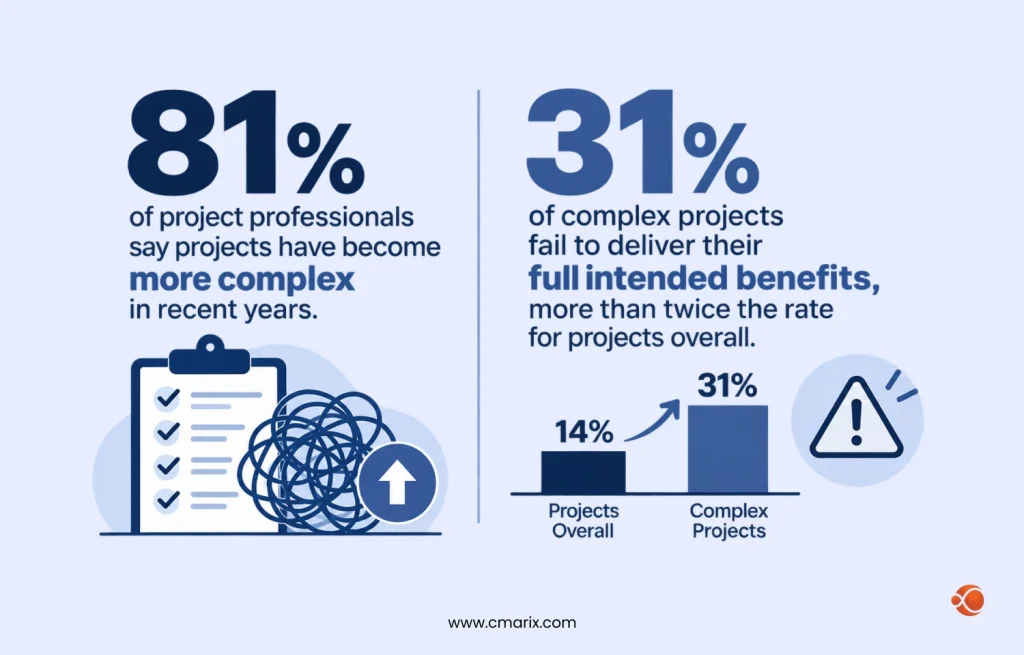
Most web projects do not fail because the code was bad. They fail because nobody owned the requirements, two people owned the same decision, or the QA engineer joined in week ten. PMI’s 2026 Pulse of the Profession found that 81 percent of project professionals say projects have become more complex in recent years, and 31 percent of complex projects fail to deliver their full intended benefits, more than twice the rate for projects overall. Team design is one of the few levers you control from day one.
There’s no single right way to organize a web development team. What works for a three-person MVP team is completely different from what a twenty-person product team needs. Whether you build in-house or bring in a custom web development company, the structure you pick shapes how fast you move, what it costs, and how many surprises show up along the way.
What Is a Web Development Team Structure?
A web development team structure is the way you organize roles, people, and responsibilities to plan, design, build, test, and ship a website or web application. It decides who owns requirements, who builds what, who makes technical calls, and how work moves from idea to release.
Every website development team has the same core job: turn a business goal into working software. What changes from team to team is the structure around that job. Three things define it:
- Roles: who sits on the team and what each person owns.
- Size and mix: how many people you need in each role, and when they join.
- Operating model: how the team works, whether agile or not, in-house or outsourced, local or remote.
A web application development team usually carries more backend engineering and infrastructure than a marketing site team, which leans harder on design and content. The roles below cover both, so you can pick what fits your project.
Standard Web Development Team Structure: Core Roles at a Glance
Here is the web development team structure in one view. You can use this as a checklist rather than a staffing requirement. In small teams, job positions overlap, but this is okay. It is only not acceptable when there is an unassigned responsibility.
| Role | What they own | When you need them |
| Business Analyst | Requirements, scope, specifications | Discovery, before design starts |
| Project Manager | Timeline, budget, risk, delivery | Kickoff to launch |
| Product Manager | Vision, priorities, roadmap, product metrics | Idea stage and ongoing |
| Solution Architect | Tech stack, system design, standards | Before development, then reviews |
| UI/UX Designer | User flows, wireframes, visual design | Discovery through handoff |
| Front-End Developer | Browser interface, speed, accessibility | Build phase |
| Back-End Developer | Server logic, databases, APIs | Build phase |
| Full-Stack Developer | Both layers, faster MVP delivery | Small teams and MVPs |
| DevOps Engineer | CI/CD, cloud setup, monitoring | Before the first deployment |
| QA Engineer | Test plans, automation, defect tracking | Every sprint |
| AI/LLM Engineer | AI features, model integrations, evaluation | When the product includes AI |
Web Development Team Roles and Responsibilities Explained
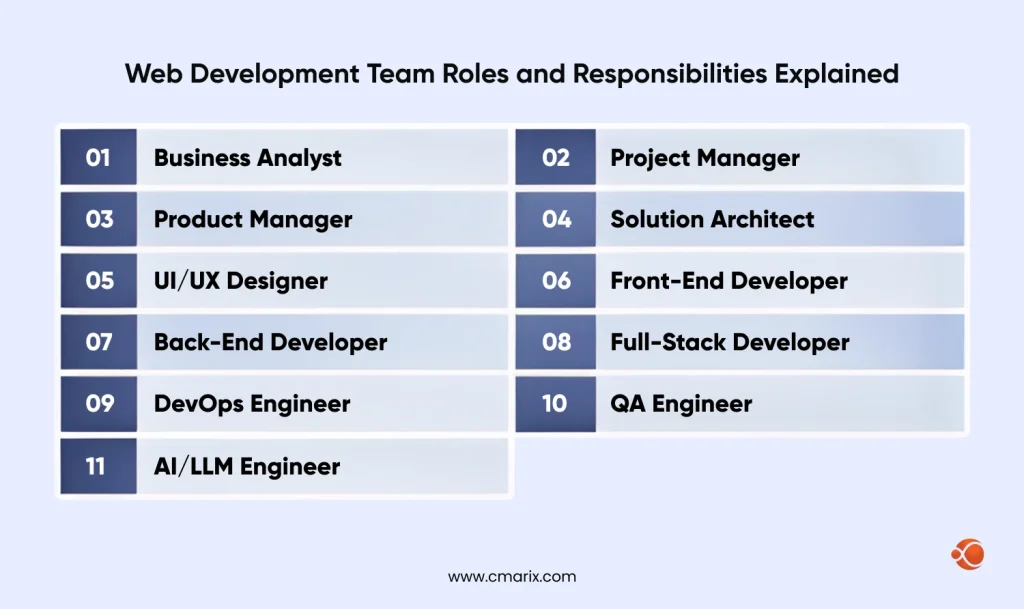
Web teams’ responsibilities intersect in several areas, which creates much of the confusion. Here is what each position is responsible for.
1. Business Analyst: Requirements and Scope
A business analyst turns business needs into something the team can actually develop. A business analyst conducts interviews, captures requirements, writes user stories, and defines done criteria for every feature. Otherwise, developers have to make assumptions, which means lots of rework.
- Requirements: captures business needs and translates them into technical requirements.
- Scope: identifies what is included and not included in a release to keep scope creep documented.
- Acceptance criteria: sets the conditions each feature must meet before QA signs off.
2. Project Manager: Delivery and Risk
Project Manager is responsible for Delivery. Project manager manages timelines, budget, risk, and communication between stakeholders and team members. Their job is to make sure the plan survives contact with reality.
- Planning: creates the roadmap, milestones, and resources plan.
- Risk: flags blockers early and keeps the timeline honest.
- Coordination: runs sprint ceremonies and status updates with the help of a project tracking tool.
3. Product Manager: Vision and Priorities
The project manager is responsible for delivery. They manage timelines, budget, risk, and communication between stakeholders and the team. Their job is to make sure the plan survives contact with reality.
- Priorities: runs the backlog and decides what matters most.
- User insight: interviews users and turns feedback into product decisions.
- Metrics: tracks conversion, retention, and the other results the business cares about.
4. Solution Architect: Tech Stack and System Design
The solution architect designs the technical blueprint the developers build against. This includes decisions about the stack, service communication, scaling, security, and performance from the start. Good architecture decisions are cheap early and expensive to reverse later.
- Stack selection: picks databases, framework, and hosting based on content, usage, and growth plans.
- System design: maps services, APIs, and data flow.
- Technical standards: coding, security, and review standards for the team.
5. UI/UX Designer: User Experience and Interface Design
The UI/UX designer shapes the product’s feel and usability. The designer conducts user research, creates personas, develops user flows, and creates wireframes and prototypes before the developer writes any code. UI/UX designers and frontend developers should work together, ideally with a shared design system for clear communication. Companies without a designer may hire one through professional UI/UX design services.
- Research: personas, user interviews, and usability testing.
- Design: prototypes, wireframes, and visual design.
- Systems: reusable components and accessibility standards.
6. Front-End Developer: Browser Interface and Performance
The front-end developer creates everything that users see and interact with in the browser. Modern technology stacks involve TypeScript, React, Next.js, Vue, or Angular technologies along with HTML and CSS under the hood. Beyond building better-looking web pages, they also manage page performance and Core Web Vitals.
7. Back-End Developer: Server Logic, Databases, and APIs
A back-end developer creates what happens in the background: business logic, databases, authentication, integration, and APIs. Common stacks include Node.js, Python, Java, .NET Core, PHP, and Go. The back-end engineering architecture that they create, which includes servers, queues, databases, and caching, will limit the scalability of the product.
8. Full-Stack Developer: Both Layers, Faster MVPs
Full-stack developers work across both layers. They anchor the early stage because one developer can take a feature from the database to the UI layer. That cuts handoff overhead and speeds up MVP delivery. Once the product grows, specialists take over the heavy lifting, and full-stack developers become the glue between front end and back end.
9. DevOps Engineer: CI/CD and Cloud Infrastructure
This role is missing from most older team structures, and it shouldn’t be. A DevOps engineer builds your CI/CD pipeline, manages cloud infrastructure, runs monitoring, and makes releases boringly reliable. If you deploy more than once a month, you need someone with this skill set. If a full-time hire isn’t realistic yet, a professional DevOps services provider can cover it.
10. QA Engineer: Testing and Quality Assurance
A QA engineer keeps quality safe throughout the entire process, not just at the end. They analyze requirements for missing pieces, create test plans, automate regression tests, and track defects until they’re resolved.
11. AI/LLM Engineer: AI Features and Integrations
If your product features chat, search, recommendations, or document analysis, you’ll need someone who knows how to integrate AI services, language models, etc., effectively. They deal with model selection, prompt and retrieval design, evaluation, costs, and guardrails. For a small team, a strong back-end engineer is enough to start.
Add vetted engineers, designers, and QA specialists to your team within days.
Product Manager vs Project Manager in Web Development: Key Differences
These two titles get swapped constantly, and mixing them up leaves a gap on the team. The product manager decides what to develop and why. The project manager makes sure it gets built on time and within budget.
| Product Manager | Project Manager | |
| Core question | What are we building, and why? | How and when do we deliver it? |
| Focus | Users, market, business goals | Schedule, budget, resources, risk |
| Owns | Roadmap, backlog priorities, product metrics | Plan, milestones, status reporting |
| Success measure | Adoption, conversion, retention | On time, on budget, scope under control |
| Works most closely with | Designers, stakeholders, business analyst | Developers, QA, DevOps |
On a small team, one person often wears both hats. That works for an MVP, but watch for drift. People in a dual role tend to default to delivery tasks because they feel urgent, and product direction slips. If you cannot afford both roles, split the time on paper so strategy gets its own calendar block. Product managers also rely on analytics and product management tracking systems to see how users behave after launch, which is a feedback loop a project manager does not usually own.
Front-End vs Back-End Developers on a Web Application Development Team
The simplest way to think about it: the front end handles what happens in the browser, and the back end handles what happens on the server. The two meet at the API, and that handoff is where most integration bugs are born. How the split looks also depends on the project type, and web development types cover those differences in detail.
| Area | Front-end developers | Back-end developers |
| User interface | Build pages, components, and interactions | Not involved |
| Business logic | Light validation and display logic | Core rules, calculations, workflows |
| Data | Fetch and display it | Store, secure, and serve it |
| Performance | Load speed, rendering, browser caching | Query speed, server response, scaling |
| Security | Input handling, safe rendering | Authentication, authorization, data protection |
To keep everyone busy, agree on the API contract before anyone starts developing. Use tools like OpenAPI or a common GraphQL schema so the front-end developer can develop with mocks while the back end is still under development.
If you need additional interface capacity quickly, you can hire front-end developers who already work in your chosen framework.
Ideal Team Composition for a Web Platform: Size by Stage
There is no fixed number. Ideal team composition for a web platform depends on scope, timeline, and how much risk you can carry. The ranges below are common working patterns, not rules.
| Stage | Team size | Typical composition | Best for |
| MVP or early startup | 3 to 5 | Founder as product owner, 1 UI/UX designer, 2 full-stack developers, part-time QA | Validating an idea in a few months |
| Growth stage | 6 to 10 | Product manager, delivery lead, designer, 2 front-end, 2 back-end, DevOps, QA | Scaling features and reliability |
| Enterprise or complex platform | 12 to 25+ | Business analyst, solution architect, several squads with front-end, back-end, and QA, dedicated DevOps and security, AI engineer | Multi-product, compliance-heavy builds |
Some basic rules apply across all levels. Make sure each team does not exceed five to nine members, as communication overhead increases rapidly after that. The Scrum Guide agrees, saying the team should be small enough to stay flexible, usually with fewer than ten members. Assume one QA engineer for every three to five software engineers to start with. Also add extra engineers if you face strict deadlines, since absence or sick leave is inevitable.
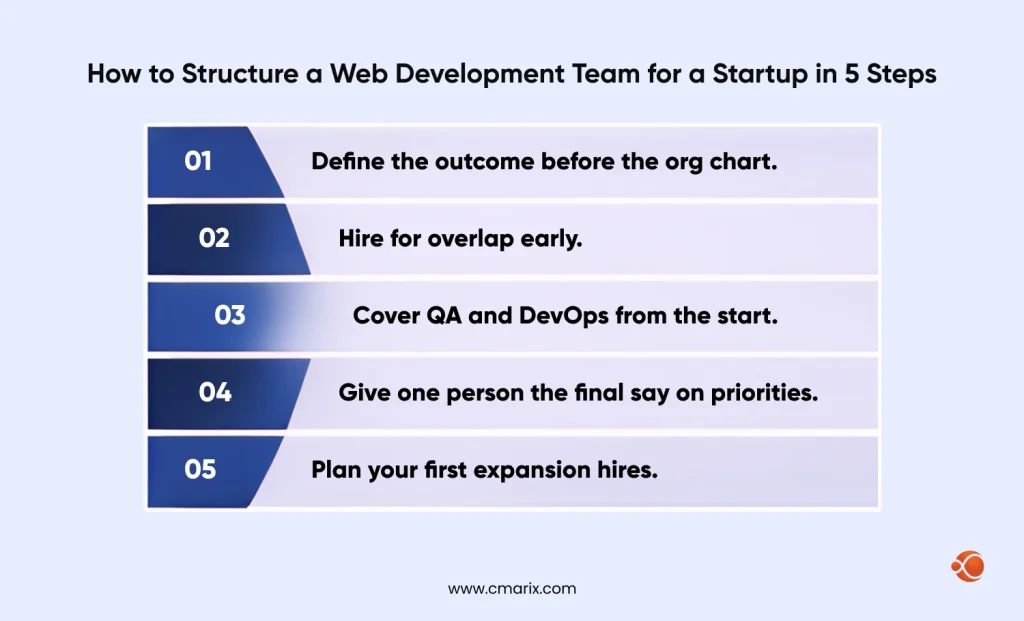
How to Structure a Web Development Team for a Startup in 5 Steps
Startups don’t have the budget for eleven roles, and they don’t need them on day one. Startup website development collaboration works best when a small team covers every responsibility, even if it doesn’t cover every title. These steps apply whether you are launching a marketplace, a portal, or a product where you plan to create a SaaS application.
Step 1: Define the outcome before the org chart. Identify what the first release must demonstrate and when. The roles that you need will emerge from this decision, not vice versa.
Step 2: Hire for overlap early. Two full-stack developers and one decent designer are better than five specialists at the MVP level. Overlap keeps you ready if a developer doesn’t show up today.
Step 3: Cover QA and DevOps from the start. You do not need full-time hires, but you do need someone to own testing and deployment. Skipping both is the most common reason a first launch slips.
Step 4: Give one person the final say on priorities. It’s usually the founder or product manager. Otherwise, nothing gets released.
Step 5: Plan your first expansion hires. Decide in advance whether the next hire is a back-end specialist, a front-end specialist, or a DevOps engineer, based on where the bottleneck will be. For guidance on adding people as you grow, see our tips to hire dedicated programmers.
In-House vs Agency vs Hybrid Web Development Team: Which Is Best?
Is it better to hire a web development agency or build an in-house team? Neither wins every time. An in-house team gives you control and long-term product knowledge. An agency or dedicated team offers speed and access to specialists. Many startups end up with a hybrid. If outsourcing is on the table, outsourcing web development services can cover gaps without a long hiring cycle.
| Factor | In-house | Agency or dedicated team | Hybrid |
| Time to start | Slowest, hiring takes months | Fastest, days to weeks | Moderate |
| Cost structure | Salaries, benefits, tools, recruiting | Fixed project or monthly rate | Core salaries plus flexible spend |
| Control | Highest | Shared, depends on the contract | High on strategy, shared on delivery |
| Specialist access | Limited to who you hire | Wide bench of skills | Add specialists when needed |
| Scaling up or down | Slow | Fast | Moderate |
| Best for | Long-term core products | Fast launches, skill gaps, fixed scope | Growing products with in-house product ownership |
Whichever way you go, ask how the development agency’s organizational structure works. Find out whether you get a dedicated squad or shared resources, who your day-to-day lead is, and how work gets reported. Those answers tell you more than the portfolio does. For a deeper look at vendor selection, read our guide for outsourcing software development.

How AI Is Changing Web Development Team Structure in 2026
AI coding assistants now handle a real share of boilerplate code, test generation, and documentation. In Stack Overflow’s 2026 Developer Survey, 73 percent of respondents who use AI coding assistants or agents use them daily. That changes the development team structure in three practical ways.
- Smaller teams, similar output: routine work moves faster, so a small team can cover more ground than before. The same survey found the share of respondents working in an organization of one rose from 4 percent to 10 percent.
- Review matters more: senior software developers are more involved in checking whether the generator’s code has vulnerabilities or logical errors and fits the architecture. As the Google Cloud 2025 DORA report states, artificial intelligence increases delivery throughput while increasing delivery instability.
- New skills join the team: AI features need engineers who understand model integration, evaluation, and cost control.
AI does not remove the need for an architect, a business analyst, or QA. If anything, faster code generation makes unclear requirements and weak testing more costly, because mistakes ship sooner. DORA’s research describes AI as an amplifier: it magnifies the strengths of a well-run team and the weaknesses of a struggling one.
Requirements matter here too, since 85 percent of Stack Overflow’s respondents named project goals and requirements as a source of trusted context for AI output. However, AI remains outside production for the most part, since only 20 percent reported using it in deployment, operations, and troubleshooting of live systems; hence, there is no need to worry about replacing your DevOps engineer anytime soon. Prioritize judgment over speed when hiring. If your roadmap includes an AI assistant, remember to add the additional engineering costs.
Agile Development Team Setups and the QA Testing Lifecycle
Most modern teams run agile, usually in one- to two-week sprints. An agile development team setup typically includes a product owner, a delivery lead or scrum master, developers, designers, and QA, all working from one shared backlog. The rituals are simple: sprint planning, daily standups, sprint review, and retrospective. Keep them short and useful, or people stop caring. PMI’s 2026 data points to the same thing: projects that used a structured framework to manage complexity succeeded 72 percent of the time, versus 61 percent for those that used none.
QA must happen within the sprint, not outside of it. The QA engineer working in an agile team looks at stories before the work starts on them, writes tests along with the code, implements regression testing automation, and validates fixes prior to the release.
The quality assurance testing lifecycle usually runs through these stages:
- Requirement review: QA verifies stories for gaps and testability.
- Test planning: QA identifies test scope, test tools, test environments, and high-risk areas.
- Test case design: Create manual and automated test cases.
- Test execution: The team executes functional, integration, performance, and security testing in every sprint.
- Defect logging: Defects are captured and retested after fixing.
- Regression and release sign-off: The team performs the full test cycle before any release.
If you lack in-house capacity, specialist software testing services can slot into this cycle without rebuilding your process.
How to Manage a Remote Web Development Team Successfully
Remote and distributed work is standard now. In Stack Overflow’s 2026 Developer Survey, only 18 percent of developers said they go into an office every day. Remote teams work well when you set rules instead of hoping for the best. Digital experience team composition looks the same on paper, but communication needs more structure.
- Set overlap hours: Choose 2 to 4 hours when everyone is available for decision-making; use the rest for asynchronous work.
- Write decisions down: keep one source of truth for specs, architecture choices, and sprint goals.
- Define handoffs: Decide on definitions of development-ready and done to avoid back-and-forth.
- Review fast: Define an SLA for pull requests, like one working day.
- Demo every sprint: Make sure that every sprint ends with a demo.
- Pick tools and stick to them: one for task management, one for chatting, one for documentation.
Trust is more important than surveillance. Focus on metrics such as delivered functionality and defects rather than time spent online.
5 Common Mistakes to Avoid When Building a Web Development Team Structure
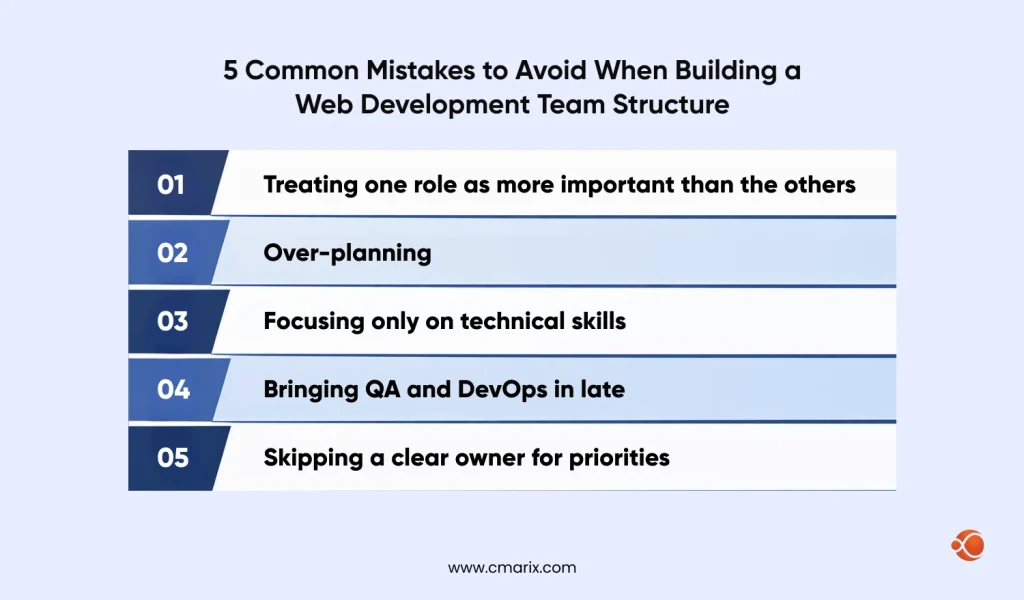
Treating one role as more important than the others
When leaders favor one role, the others stop speaking up. Designers stop pushing back on feasibility, and developers stop questioning requirements. Give every role a voice in planning, and give them the tools to do the job.
Over-planning
Planning matters, but a plan with no slack puts pressure on the team and pushes people to skip issues just to hit a date. Leave room in each sprint to respond to feedback and fix what you find.
Focusing only on technical skills
A team that understands the business catches problems a purely technical team misses. Make sure everyone knows who the product serves, what problem it solves, and how the business makes money.
Bringing QA and DevOps in late
Deployment and testing are not last activities. Organizations that bring them in the final month will spend the following three months debugging what should have been caught before.
Skipping a clear owner for priorities
If nobody owns the backlog, every stakeholder becomes a product manager. Name one person who decides what comes next, and make that known to everyone.
Tell us about your project, and we will map roles and budget.
Why Choose CMARIX as Your Web Development Team Partner
CMARIX has been building web products since 2009 for clients across 40+ industries, from early-stage startups to enterprise teams. Our engagement models let you add a single specialist, a dedicated squad, or a full delivery team, depending on where your product stands.
- Dedicated teams: analysts, designers, developers, QA engineers, and DevOps operating as a single team.
- Flexible scaling: scale up or down depending on your roadmap.
- Certified processes: ISO 9001:2015 and ISO 27001 certified delivery.
Need extra capacity right now? You can hire web developers who plug straight into your sprint rhythm.
Conclusion
A good web development team structure is not about having the most roles. It is about making sure every responsibility has an owner, every handoff is clear, and the team size matches your stage. Start by defining the roles that protect requirements, drive delivery, and ensure quality control. Then add specialists as product complexity increases, and choose a hiring strategy that best fits your cost and control needs.
FAQs About Web Development Team Structure
What is the standard web development team structure?
The standard structure for a web development team includes the following roles: business analyst, project manager, product manager, solution architect, user interface/user experience designer, front-end developer, back-end developer, quality assurance engineer, and, increasingly, DevOps engineer. In small teams, people share these roles, but in large platforms, they split into specialized squads.
What is the ideal team size for a web development project?
Three to five people would make an ideal team size for MVPs. Growth-stage startups need six to ten people, and more complex platforms need twelve or more, divided into squads. Each squad should consist of five to nine people.
How do you structure a web development team for a startup?
Start small with a product owner, a UI/UX designer, and two full-stack developers; also bring QA and DevOps in from the start. Give someone the power to make decisions regarding priorities, and keep adding specialists depending on the growth of the product.
What are the key roles in a web development team?
They are business analyst, project manager, product manager, solution architect, UI/UX designer, front-end developer, back-end developer, full-stack developer, DevOps engineer, and QA engineer. If there are any AI features in your product, include the AI/LLM engineer too. Each position has its own responsibility in the process.
What is the difference between product managers and project managers in web dev?
The product manager identifies the right product to build and why, while the project manager ensures it’s completed on time, within budget, and within acceptable risk levels.
How do front-end and back-end developers split work on a website?
The front-end developer builds the interface users see and use in the web browser. The back-end developer develops the server-side code, the database, and the API. They connect via the API, and therefore agreeing on the contract beforehand avoids dependencies between the two parties.
What does a QA engineer do in an agile web team?
The QA engineer reviews stories before development, writes and executes test cases during the sprint, automates regression tests, and verifies bug fixes before release. The QA engineer operates within the sprint, not outside it.
Is it better to hire a web development agency or build an in-house team?
In-house teams are easier to control and understand the product well, but they take many months to recruit. Dedicated teams/agencies offer faster access to specialists and can start immediately. Some firms use a combination of both.
How do you manage a remote web development team successfully?
Establish overlap periods, centralize decision-making, and ensure proper handover. Make sure that the pull request review process and sprint demos are swift. Measure results in terms of shipped features and bugs rather than time spent online.
What is the role of a business analyst in web development?
The business analyst translates business objectives into detailed requirements, user stories, and acceptance criteria. The business analyst bridges stakeholders and developers, reducing rework caused by ambiguous scope. In smaller organizations, the product owner handles this responsibility.