



Quick Summary: Social media app development cost in 2026 will range between $20,000 and $500,000+ depending on the complexity of the app: from a one-platform minimum viable product (MVP) up to an advanced AI-powered platform that includes video streaming and in-app shopping features. The exact price will vary depending on the degree of complexity, the selection of platforms to develop for (native or cross-platform), geography of developers, and the level of integration of AI algorithms into the feed and content moderation engine.
Marketers aren’t slowing down on social media. In a 2026 survey of marketers worldwide, 86% said they use Facebook for marketing, 82% use Instagram, and 72% use LinkedIn, proof that a well-built social platform still has room to carve out an audience and a revenue stream.
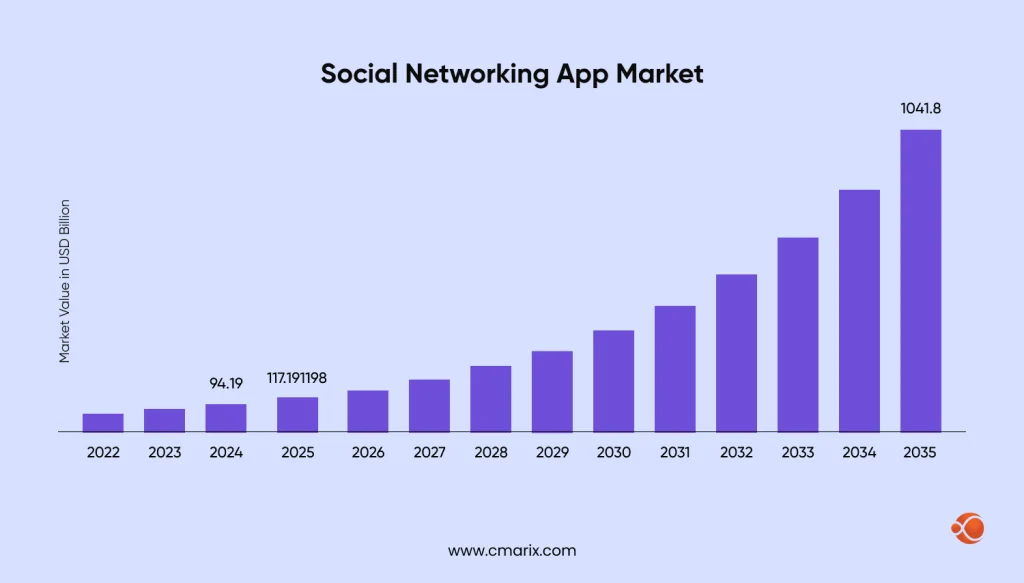
The global social media app market size is estimated at 117.19 USD billion in 2025, expected to grow to 1041.8 USD billion by 2035. The success of social network applications comes from the freedom they offer users. People express themselves on networks such as Facebook and Instagram by sharing views, photos, and milestones. Users communicate, ask questions, learn, and make new friends through social networking applications. Business owners are building their own niche social apps too, targeting audiences already interested in what they sell.
Types of Complexity in Modern Social Media Apps
1. Simplistic Social Media Apps (Minimum Viable Product – MVP)
- Core Features: Secure login (SSO), profile customization, regular push notifications, and simple native permissions for camera, microphone, and file access.
- Platform Availability: Single platform deployment (iOS or Android native).
- Modern Development Cost: Price is set in the $20,000–$60,000 range. Creating a working production application with new security features will cost more compared to past years.
2. Middling Social Media Apps
- Core Features: All basic features, short video sharing, photo filters, interactive standard stories, cloud-based text messaging, and optimized discovery algorithm.
- Platform Availability: Single native or multi-platform development (using tools such as Flutter and React Native).
- Modern Development Cost: Expect to invest between $60,000 and $150,000. The sharp increase in pricing stems from the infrastructure required for high-bandwidth video rendering, asset storage, and media transcoding pipelines.
3. Advanced Social Media Apps
- Core Features: Built-in with customized UI, advanced animation effects, cloud-based cross-device synchronization, E2EE communication based on the Signal Protocol, artificial intelligence recommendation feed, live stream broadcasting, and in-app shopping cart checkout.
- Platform Availability: Truly cross-platform native performance on Android, iOS, and the Web through microservice-based architecture.
- Modern Development Cost: Costs range from $150,000 to over $500,000. Building a scalable, highly secure product capable of handling concurrent data requires specialized full-stack engineers. Organizations can consult specialized engineering teams such as CMARIX to build advanced, enterprise-grade apps.
Plan the right features, budget, and technology for a scalable social platform.
Social Media App Development Cost by Feature (Hourly Breakdown)
Not all features are equally costly to develop, and a generic estimate won’t show where your funds are going. The following is an approximate breakdown of the costs for basic features, calculated using average hourly rates:
| Feature | Estimated Build Hours | Average Cost (USD) | Notes |
| User onboarding & profile (SSO, KYC-lite) | 80–150 hrs | $2,500–$7,500 | Faster with pre-built auth SDKs |
| Feed algorithm (chronological → AI-ranked) | 250–600 hrs | $10,000–$40,000 | Cost jumps sharply once ranking becomes personalized |
| Chat & real-time messaging | 200–450 hrs | $8,000–$25,000 | E2EE adds 20–30% to base messaging cost |
| Stories / Reels (short video) | 300–500 hrs | $12,000–$30,000 | Video transcoding and CDN costs recur monthly, not just at build |
| Push notifications & activity feed | 60–100 hrs | $2,000–$5,000 | Low complexity, high retention value |
| AI content moderation | 150–350 hrs | $6,000–$20,000 | Often licensed via API rather than built in-house |
| Payments / social commerce checkout | 200–400 hrs | $8,000–$22,000 | Scope depends on markets and payment providers supported |
| Admin & analytics dashboard | 150–300 hrs | $6,000–$15,000 | Frequently underquoted in freelancer estimates |
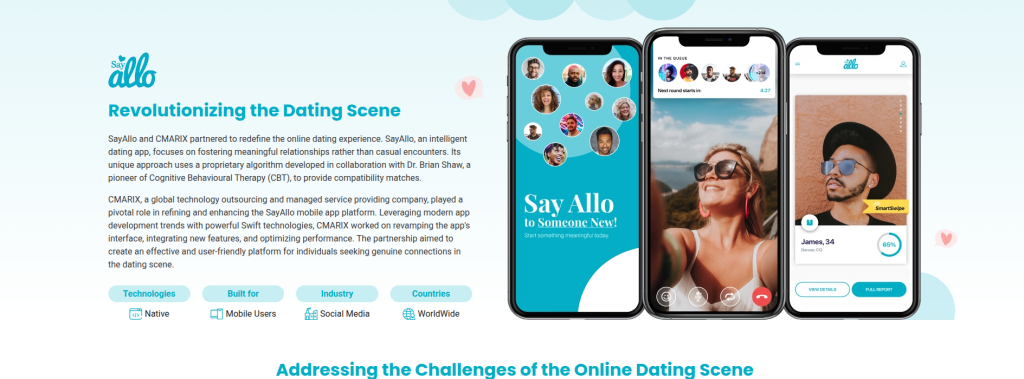
CMARIX has built messaging and social-networking layers into products beyond the dating and social category too; the API work behind chat, profile sync, and social login on a platform like the Sayallo dating and social discovery app uses many of the same building blocks a general-purpose social app needs.
If a project needs deep third-party platform connections (Google, Apple, Meta login, or cross-posting), CMARIX’s social networking API integration team handles that layer directly, and payment API integration covers checkout for social commerce features.
Regional Hourly Development Rates: Where You Build Changes What You Pay
Feature scope sets the floor, but where your development team sits sets the multiplier. Senior developer hourly rates vary sharply by region in 2026:
| Region | Senior Dev Hourly Rate | Typical Mid-Complexity Social Media App Cost (USD) |
| United States | $120–$250 | $150,000–$400,000+ |
| UK / Western Europe | $90–$180 | $120,000–$300,000 |
| Eastern Europe | $45–$90 | $60,000–$180,000 |
| India | $30–$65 | $40,000–$130,000 |
| Latin America | $50–$95 | $65,000–$190,000 |
The rates are made up of senior developer bands and can be 40%-60% lower for the offshore team at the same level of seniority, when you factor in management costs. That’s one of the reasons why CMARIX follows a hybrid global delivery approach – customers will have project management based in the US/UK along with their senior developers based in India.
How to Build a Social Media App: Development Process and Budget Breakdown 2026
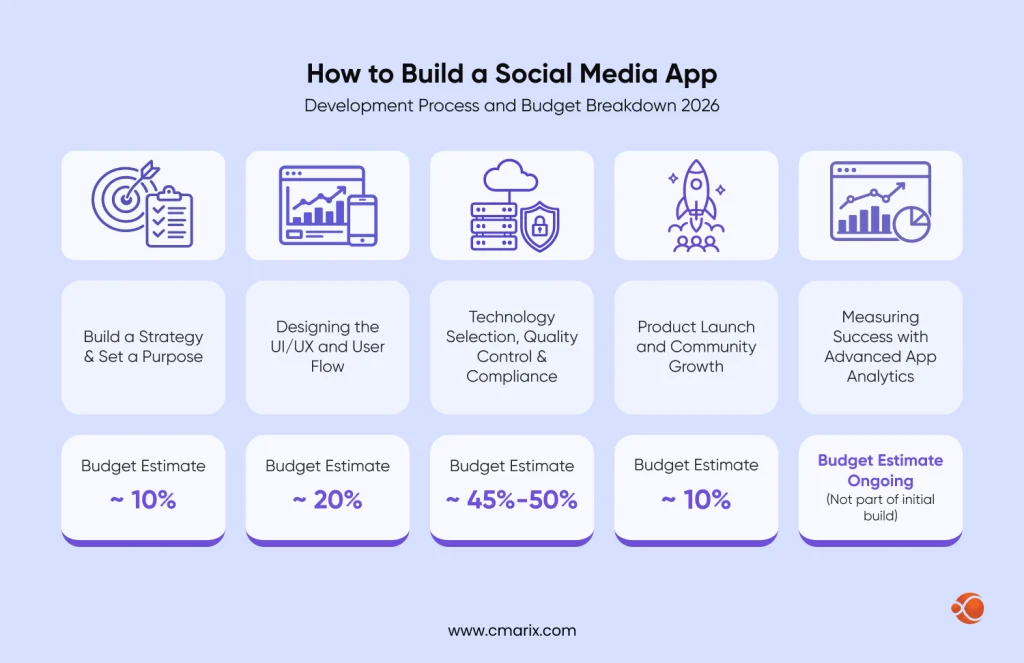
Step 1: Build a Strategy & Set a Purpose (roughly 10% of budget)
- Core Value Definition: Discover a unique, niche value proposition to compete against dominant platforms.
- Feature Selection: Plan the creation of an exciting personal content recommendation algorithm and discovery architecture.
- Monetization Strategy: Establish monetization channels for creators, whether through subscription tiers, direct tipping, or integrated creator commerce systems.
- Security and Privacy Architecture: Develop encryption schemes from the get-go to avoid future compliance problems.
Skipping or rushing this phase is the most common reason budgets balloon later; a discovery phase this small still has to catch requirement gaps, and catching them here costs a fraction of catching them mid-build.
Step 2: Designing the UI/UX and User Flow (roughly 20% of budget)
- Sketching: Draw user journey maps that show onboarding paths and help prevent user drop-off.
- Wireframing: Construct low-fidelity prototypes that illustrate navigation concepts, screen constraints, and media placement.
- Prototyping: Create functional prototypes to test out the workflows before moving on to the backend development phase.
- Bespoke UI Design: Implement modern UI trends, optimizing the visual layer for dark modes, edge-to-edge layouts, and accessible design patterns.
Step 3: Technology Selection, Quality Control & Compliance (roughly 45–50% of budget)
- Backend Infrastructure: Deploy scalable, cloud-native backend systems (e.g., AWS, Google Cloud) using graph databases to handle high-frequency user connections seamlessly.
- AI & Real-time Integration: Implement AI algorithms locally on devices that will perform analytics and indexing tasks and also enable fast CDN workflows.
- Automated Content Moderation: Embed computer vision and automated text screening APIs to filter inappropriate submissions immediately.
- Regulatory Compliance: Conduct strict testing of the code against existing regulatory frameworks, including the DSA and GDPR of the European Union.
- Quality Assurance: Combine human code reviews with stringent automated test scripts to ensure zero-latency performance.
This is the largest single line item by a wide margin; coding, backend, feature integration, and QA all live here, which is exactly why the Cost-by-Feature table earlier in this guide breaks it down further.
Step 4: Product Launch and Community Growth (roughly 10% of budget)
- Targeted Beta Programs: Deploy the validated Minimum Viable Product (MVP) in the hands of a selected target audience to gather behavioral insights.
- Growth Marketing: Launch localized influencer campaigns, viral referral structures, and direct download incentives to jumpstart community density.
- App Store Optimization (ASO): Build optimized app store landing pages to convert traffic from digital advertisements into active installs.
Deployment itself is cheap: app store submission, server provisioning, monitoring setup. Growth marketing spend sits outside this percentage and is a separate budget line entirely.
Step 5: Measuring Success with Advanced App Analytics ( ongoing, not part of the initial build)
Performance evaluation based on key metrics is an essential step in determining your social media app’s ratio of success and fit in the market. By analyzing trends in the data collected, you will be able to make educated choices about how to proceed in your future upgrades. In contrast to Steps 1–4, this step is not a one-time expense.
How to Set Up Your Social Media App Development Budget: Quick Overview
| Phase | Share of Build Budget |
| Strategy & Discovery | ~10% |
| UI/UX Design | ~20% |
| Development, Backend & QA | ~45–50% |
| Launch & Deployment | ~10% |
| Contingency buffer (recommended) | ~10–15% |
App Store & Play Store Publishing Costs, Plus Monetization Models
Publishing itself is cheap; everything around it is not. Apple’s Developer Program runs $99 a year, and Google Play charges a one-time $25 registration fee- small line items next to your total build cost, but they come with real compliance work attached (App Tracking Transparency prompts, data-safety forms, in-app purchase review) that does add developer hours if your app wasn’t built with these requirements in mind from day one.
Once the app is live, monetization strategy decides whether that build cost turns into revenue:
| Monetization Strategy | Description |
| In-app Advertising | Fastest to implement and generates revenue through ads, but requires strong daily active users (DAUs). |
| Subscriptions / Premium Tiers | Offers recurring revenue by providing premium features or exclusive content to paying users. |
| In-app Purchases | Sells virtual gifts, profile boosts, and premium features, commonly used in social and dating apps. |
| Creator Commerce & Tipping | Allows users to support creators through tips and paid content, a rapidly growing monetization model in 2026. |
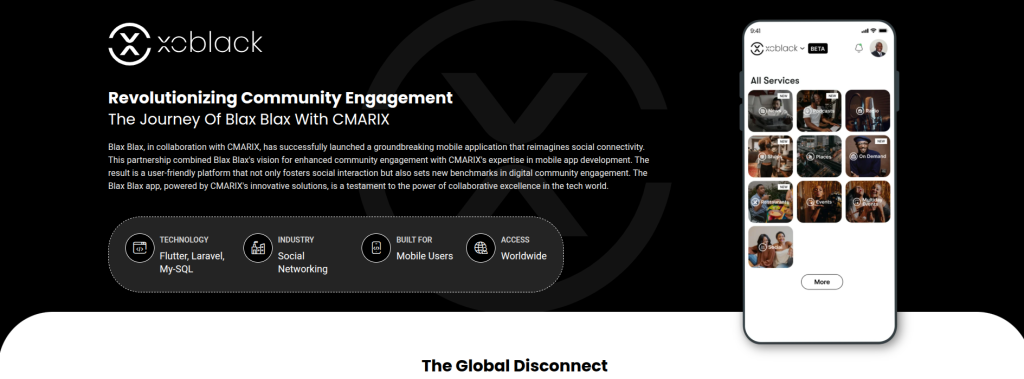
A community-first product like the Blax social connection app that CMARIX built shows how monetization and moderation decisions get baked into the architecture early, not bolted on after launch. Retrofitting a payment or subscription layer onto an app that wasn’t designed for it is one of the most common (and expensive) mistakes founders make post-launch.
Get a tailored cost estimate based on your app features and business goals.
Social Media App Development Cost Breakdown by App Type
| App Type | Estimated Social Media App Development Cost |
| Community Hubs & Discussion Forums | USD 40,000 to USD 150,000+ |
| Professional Networking & Relationship Apps | USD 50,000 to USD 160,000+ |
| Media Sharing & Creator Networks | USD 60,000 to USD 180,000+ |
| Social Commerce & Review Platforms | USD 60,000 to USD 200,000+ |
| Decentralized & Microblogging Platforms | USD 70,000 to USD 220,000+ |
Community Hubs & Discussion Forums
Estimated Cost: USD 60,000 to USD 180,000+
Short video applications will remain at the top of social media usage in 2026. They will be oriented on AI-based recommendation algorithms, creator payments, live streaming, editing features, and personalized feeds.
Key Features:
- Short video-sharing services are used by most people.
- Advanced AI filters shape content creation trends.
- Built-in monetization features attract the best creators.
Examples: TikTok, Instagram Reels, YouTube Shorts.
Professional and Relationship Networks:
Estimated Cost: USD 50,000 to USD 160,000+
AI-powered solutions for matching, recommending, communicating, and verifying are becoming increasingly important for professional and personal networks. The demand is rising, especially due to remote work and online networking.
Key Features:
- The trend towards remote work increases the demand for online networking.
- Algorithm-driven matching services match both professionals and romantic partners.
- Decentralized professional networks are increasingly popular.
Examples: LinkedIn, Bumble, Threads.
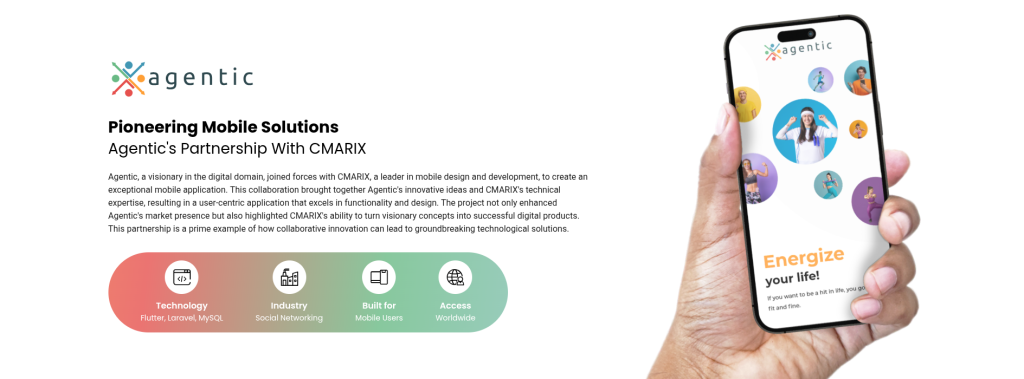
CMARIX’s own work in this space, including the Agentic Premier mobile networking platform, leans on the same matching algorithm and profile-discovery logic that professional and dating apps both need; the underlying engineering problem barely changes even when the audience does.
Decentralized & Microblogging Platforms:
Estimated Cost: USD 70,000 to USD 220,000+
Microblogging platforms are advancing by employing decentralized systems, real-time communication, federated networks, and user identity ownership.
- Users prefer real-time, text-based updates today.
- Web 3 integration enables superior control over personal data.
- Open protocols enable cross-platform social interactions.
Examples: X (Twitter), Mastodon, Bluesky.
Community Hubs & Discussion Forums:
Estimated Cost: USD 40,000 to USD 150,000+
Community websites emphasize discussion, real-time interaction, information exchange, and moderation. Modern websites have started incorporating elements of AI moderation, voice chat, and gamification.
Key Features
- Audio-first spaces support real-time interactions within communities.
- Niche QA platforms provide highly specialized technical advice.
- Gamified reward systems incentivize high-quality user answers.
Examples: Reddit, Discord, Stack Overflow.
Social Commerce & Review Platforms:
Estimated Cost: USD 60,000 to USD 200,000+
Social commerce integrates content generation, e-commerce, customer reviews, and influencer marketing. AI-enabled recommendations and live commerce are still engaging users and converting them into buyers.
Key Features:
- Live stream shopping combines entertainment and instant buying.
- Zero-party data generation helps build trust with buyers.
- AI-powered review synthesis ensures consumers are not overwhelmed by choices.
Examples: Yelp, Lemon8, Pinterest Shop.
Why a Cheap, Freelancer-Built Social App Rarely Scales
$10,000 of freelancing will give you a working demo that would break under 10,000 users posting, chatting, and uploading videos concurrently. The difference is in the architecture; feed ranking, chat delivery, and media transcoding should have been designed on scalable infrastructure from the very beginning, rather than implemented later when the load spike breaks your servers.
This is where most custom or budget projects run into trouble, and where having a professional AI software development partner pays off: proper architectural design of recommendation engines and moderation pipelines takes more time but saves the costs of a much more expensive migration to a new platform that every underdesigned application ends up needing. If your roadmap involves AI-powered recommendation or moderation systems, our AI consulting team can design that layer before any coding starts.
Beyond the Build: True Total Cost of Ownership
However, the build cost is only one component of the budget that you should be preparing for. Founders that budget based on the development cost alone always face an unpleasant surprise within six months. These are the costs that do not feature in the build cost yet impact your annual budget.
Ongoing Cloud & Infrastructure Costs
The hosting cost of a social app is not constant; it increases with the number of users, and features with high video consumption increase the cost even further. The hosting cost of a feed that has 10,000 active users per day may be somewhere between $500 and $1,500 per month using AWS or Google Cloud services. Increase this number of active users to 500,000 while including features like Stories and short videos, and the costs for CDN, transcoding, and storage might be above $15,000-$40,000 per month.
Third-Party Service & Licensing Costs
Most social apps lean on paid services rather than building everything in-house:
- Push notifications & analytics: Firebase, OneSignal, Mixpanel, or Amplitude, typically $0–$1,000/month depending on volume tier.
- Content moderation APIs: Licensed computer-vision and text-screening services often run $500–$5,000/month once you’re moderating real volume, versus building the models yourself.
- SMS/OTP & email verification: Twilio-style providers charge per message, which adds up fast at scale.
- Cloud storage & media CDN: Usually billed separately from compute, and it’s the line item that surprises founders most.
Team Roles Beyond Engineering Hours
The hourly-rate tables earlier in this guide price developer time. In practice, a social app project also needs a product manager, a QA/testing function, a DevOps engineer for deployment pipelines, and dedicated UI/UX design work. Budget roughly 25–40% on top of raw engineering hours to cover these roles — freelancer quotes that skip this line are one of the most common reasons budgets run over mid-project.
App Store and Play Store Commission
Both Apple and Google charge between 15% and 30% of any in-app purchases or subscription revenue (the percentage depends on which revenue tier you are at and whether you qualify for the program or not). This does not relate to development costs, but it definitely impacts the business model based on subscriptions or virtual products, so it needs to be accounted for from the very beginning.
Compliance and Legal Costs
Engineering can build systems that comply with GDPR and DSA, but you have to write your privacy policy, terms of service, and, in some countries, the age verification process as well as parent consent processes for social apps by 2026. A basic legal review will cost a few thousand dollars if you are developing a simple app, while it could be much more expensive if you are planning to launch in three different regions – EU, UK, and US.
Post-Launch Scaling Cost
However, the very architecture which has worked wonderfully well for 10,000 users does not scale up to 1 million users easily. The architecture would usually involve database sharding, message queuing changes, and the switch from a monolith to microservices. However, all these changes are not always considered while pricing out the initial build cost, as the problem can only be realized at the point of failure. Planning for the above event in advance is why CMARIX plans enterprise-level architecture right from MVP.

Why Choose CMARIX For Social Media App Development
Get an end-to-end social media application development service from a reputable React native app development company like CMARIX. Be it product strategy, UI/UX design, scalable backend architecture that is scalable, real-time features, AI-based recommendations, deployment and post-launch support, or any other aspect, CMARIX creates powerful and secure social networking applications for long-term growth.
Final Words
You should now be able to estimate what a social networking app will cost you, whether you’re aiming for something as focused as a niche community app or as ambitious as a LinkedIn or Instagram competitor. It’s worth using an MVP strategy to test the product concept first, and to get clear on what you’re actually trying to achieve through the app before scope creep sets in.
Hiring a mobile app developer from CMARIX helps you avoid wasting time and money on the wrong architecture from the start. You get a team of mobile developers and specialists who’ve already handled the scaling problems your app will eventually run into.
FAQs About Cost to Build a Social Media App
How much does it cost to build a social media app in 2026?
Social media apps are scalable in terms of features. Basic MVP app development starts at $35,000-$70,000. The mid-level social media application with the ability to share advanced media will cost around $70,000-$150,000. Very complex video network apps that are AI-driven (Instagram or TikTok-like) cost more than $300
What factors influence the cost of social media app development?
Factors such as the selection of platforms (iOS, Android, or both), the features available in an app, the development company’s geographic location, and the level of AI-powered customization and moderation integration affect cost. Specialized engineering features like AI-based recommendation engines, real-time streaming, and AR filters make the biggest impact on costs due to the required technical implementation and developer effort.
How much does it cost to build a social media MVP?
The price range for building an MVP with a single-platform social media application is between $20,000 and $60,000, depending on whether you go for a native approach or choose cross-platform development using frameworks such as Flutter or React Native.
What are the essential features of a social media app?
As a minimum: Login, Profile Creation, Content Feed, Push Notifications, and Basic Messaging. In addition to the MVP, almost all platforms offer Stories/Short Video, AI Discovery Feed, Content Moderation, and some form of monetization.
How do I build a social media app from scratch?
The process includes a strategic phase where you choose your niche and monetization model, a UI/UX design phase, backend development, and then implementing AI features and ensuring compliance. The five-step process described above in this guide details each step.
Is it cheaper to build a social media app for Android or iOS?
Generally, developing for Android is slightly cheaper because specialists are more available, but the App Store has a much more rigorous review process, which takes additional time regardless of the platform. Most entrepreneurs realize that creating a cross-platform application saves on development costs compared to making two native apps for two stores.
How can a social media app make money?
In-app advertisements, subscription services, virtual purchases in the form of gifts and bonuses, and creator commerce are among the most popular monetization techniques. However, in 2026, most of the best social networks combine two or more of the above methods.
How do I choose the right social media app development company?
Consider looking for a team with actual experience in creating social networking applications rather than mobile application listings. CMARIX has been building social networking platforms in the areas of dating, communities, and professional networking, and even considers the aspect of Artificial Intelligence and compliance before providing a quotation.