

Quick Summary: Navigating the difficult landscape of selecting a mobile app development company in Riyadh can be a huge challenge. Many businesses face the risk of budget overruns and unmet user expectations when making the wrong choice. This blog provides seven essential questions designed to help you identify a reliable partner for your app development needs, ensuring a successful product that excels in the competitive market.
In the race to digitize services and reach consumers directly, building a mobile application is now a foundational requirement for business success. The total revenue in the App market in Saudi Arabia is projected to reach USD 1.57 billion in 2022, with an anticipated annual growth rate of 7.04% through 2029, resulting in a projected market volume of USD 2.57 billion.
However, the decision of choosing a development partner is one of the most important, and often one of the most overlooked, steps in the entire process. Selecting the right mobile app development company in Riyadh means securing an architect for your core digital product, one who impacts its security, speed and market appeal. Rushing this selection based solely on low cost or fast timelines often leads to budget overruns, technical debt, and a finished product that fails to meet user demands.
This guide provides the seven crucial questions needed to cut through the sales pitch, assess technical maturity and guarantee a high-quality, long-term partnership essential for navigating Saudi Arabia’s booming digital landscape.
Why Riyadh Is Becoming a Strong Market for Mobile App Development
Riyadh is not just a capital; it is a technological and economic engine of Saudi Arabia, experiencing an unparalleled growth which is fueled by national initiatives. This makes it an ideal location to find high-calibre development talent.
Growth of Digital Services and Tech Investment in Saudi Arabia
The demand for mobile app development services in Saudi Arabia is exploding, driven by widespread adoption and technological advancements across digital services. Nowadays, more businesses have shifted online, the need for innovative mobile solutions has surged, creating a dynamic ecosystem for established companies and startups alike. Also, increased internet penetration and smartphone usage have further accelerated this growth, allowing consumers access to a myriad of services at their fingertips.
Government Initiatives Pushing Mobile-First Solutions
The kingdom’s economic transformation plan for the year 2030 focuses on digital services. From essential public sector applications like Absher to large-scale smart city projects like NEOM, the government actively pushes for mobile-first to citizen-centric solutions. This top down push for digitalization creates a fertile ground for businesses needing custom mobile app development in Riyadh.
What to Finalize Before Contacting Any App Development Company
Before sending a single inquiry to an app development agency in Riyadh, you must have internal clarity. A well-defined product vision makes sure that every proposal you receive is based on fact, not assumption, which results in more accurate estimates and timelines.
Define Your Core Idea and Purpose
Clearly articulate the single most important problem your application will solve. For instance “The app will reduce the average time a user spends ordering a customized coffee from 10 minutes to 30 seconds.”
Identify Your Primary and Secondary Users
Who absolutely must use the app, and who else might use it? Knowing their demographics, tech literacy, and needs is essential for effective UX design. If you plan to develop a food delivery app in Saudi Arabia, understanding local dining habits, delivery expectations and payment preferences becomes critical to the product’s success.
List Must-Have Features vs. Nice-to-Have Additions
Create a list of priority features, and the must-haves are the Minimum lovable product (MLP); everything else is for phase two. This prevents the scope creep and controls the cost of mobile app development in Riyadh.
Set a Practical Budget Window
Be honest about your financial limits. As a good agency can adjust the technology stack and the scope to fit a reasonable budget, a vague budget forces them to overquote and underpromise.
Outline Your Target Launch Date and Potential Phases
Specify when you need the core project in your hand and how long subsequent phases will take. This helps the agency schedule resources and propose a realistic timeline.
How Early Clarity Boosts Better Proposals From Agencies
When you provide clear, precise documented requirements, a professional development company can quickly generate a detailed proposal that includes a design concept, technical architecture breakdown and precise time/cost estimate. It transforms the conversation from a general inquiry into a partnership discussion about how best to achieve a shared, defined goal.
Top 7 Questions to Ask Any Mobile App Development Company in Riyadh
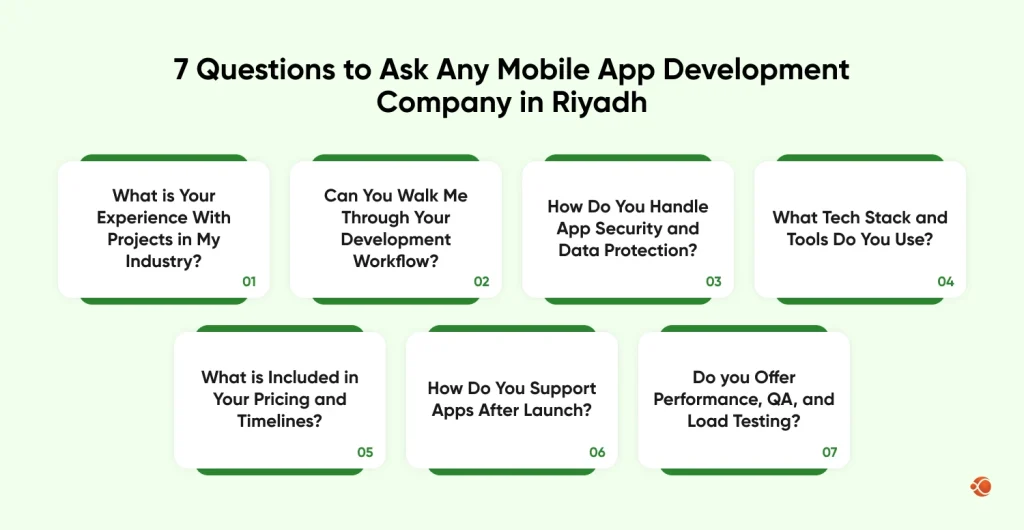
Question 1: What is Your Experience With Projects in My Industry?
This is the first non-negotiation question. You want a team that can hit the ground running, not one that has to learn your industry’s peculiarities on your dime.
Why Industry Familiarity Shortens the Learning Curve
Every sector like Fintech, Healthcare, E-commerce and Logistics, has unique compliance, security, user expectation and integration challenges. A team that has built a similar healthcare app knows about HIPAA, like data privacy concerns and secure API integration for Electronic Health Records (EHRs). A team familiar with E-commerce understands payment gateways, inventory synchronization and complex delivery logistics from the beginning.
How to Examine Their Past Projects
Don’t just ask for a list of logos. Focus on inspecting on three key areas:
- Revalence: Have they built an app for a direct competitor or parallel industry.
- Scale: Were they ever built an app for startups or did they handle the solutions for enterprise-level clients with millions of users.
- Longevity: Are the apps still active on Google Play/ Apple Store? An app that disappeared after six months suggests a lack of long-term support of a failed product.
How to Evaluate Whether They Understand User Behavior in Your Market
Ask pointed questions about their prior work’s user experience (UX) decisions:
- “In your previous e-commerce app, how did you streamline the checkout process to improve conversion for local customers?”
- “For your FinTech project, what did you learn about the local user’s comfort level with new payment methods?”
The Type of Evidence You Should Request: Demos, Case Studies, KPIs
- Case Studies: Ask on a detailed study on a relevant project, including the initial business challenges, the technical app development Riyadh solution they delivered and the outcomes.
- Demos: Request a live walk-through of the relevant app on a tablet or phone, not a pre-recorded video.
- Key Performance Indicators (KPIs): The best evidence is data. Ask for specific results: “That e-commerce app… what was the user retention rate after 30 days, and how did you measure it?” or “How many daily active users did the app have at its peak?” This reveals their focus on business results, not just code.
We build user-friendly iOS apps with transparent pricing, predictable delivery, and scalable architecture to accelerate your startup’s growth.
Contact UsQuestion 2: Can You Walk Me Through Your Development Workflow?
A smooth project relies on a predictable and structured process. A vague answer here suggests an unorganized approach, which is the definition of project risk.
What a Structured Workflow Usually Includes
A mature app development company in Saudi Arabia will have a process which typically includes these stages:
- Discovery and Planning: Deep-dive into requirements, market research, creating a detailed Product Requirement Document (PRD) and settling the project architecture.
- UX/UI Design: Wireframing, prototyping and visual design creation, often with user design testing cycle.
- Backend and Frontend Development: Parallel work on server-side logic, database and user-facing interface with frequent internal builds.
- Testing Cycle: Dedicated phases for usability, functional, performance and security testing.
- Deployment: Submitting the app to the Google Play Store and Apple App Store and managing release cycles.
Questions to Ask About Communication Frequency, Updates, and Approvals
This section is about managing the relationship, which is the most common cause of client dissatisfaction.
- “How often will we have scheduled status meetings, and who will be running them?”
- “What method do you use for reporting progress (e.g., weekly burndown charts, demo links, written summary)?”
- “At what stages are my team’s formal approval required, and how much lead time will we have to review the work?”
- “How do you manage changes to the original plan (Change Requests)?” (Look for a formal process, not a casual answer.)
Question 3: How Do You Handle App Security and Data Protection?
In an increasingly regulated world, security is not a feature; it is a fundamental pillar. A superficial answer is a red flag.
Why Security Should Be Discussed Early, Not Later
Security must be built in from the first line of code, not bolted on at the end. Retrofitting security measures is more time-consuming and expensive. This question checks if the team has a security mindset from the beginning of the planning stage.
Encryption, Secure APIs, Role-Based Access, and Other Practices
Listen for these specific technical practices:
- Data Encryption: Do they use HTTPS/ SSL for all communication and how is sensitive data encrypted both in transit and at rest.
- Secure APIs: Do they use standard practices for API authentication to prevent unauthorized access to the backend.
- Input validation: How do they make sure that user inputs cannot be used to inject malicious code.
- Role-Based Access Control (RBAC): How do they ensure that an ordinary user cannot access administration functions or another user’s data.
How They Manage Cloud Data, Third-Party Tools, and Storage
Most modern apps use cloud services (AWS, Google Cloud, Microsoft Azure) and third-party tools (analytics, push notifications). Ask:
- “Which cloud service do you suggest and how are the access credentials and keys managed securely?”
- “What is your policy for vetting and integrating third-party software development (SDKs) to make sure they don’t introduce security vulnerabilities?”
- “Where will the user data physically be stored, and how will it be backed up?”
Questions to Ask About Compliance with Local Regulations
Compliance is essential, especially for local businesses operating in the Kingdom.
- “Are you familiar with the local data protection frameworks and how will you ensure my app adheres to them?” (Though Saudi Arabia is still developing its privacy law landscape, the principle of local data sovereignty and security applies.)
- “What are the steps you take to protect intellectual property (IP), and will I own the complete source code from the moment it is written?” (The answer must be an unequivocal “yes, you own all the IP and code.”)
What a Trustworthy Security Approach Looks Like
A solid security approach involves multiple layers: regular security audits, a clear policy for handling reported vulnerabilities and a commitment to using the latest, non-deprecated security standards and software versions.
Question 4: What Tech Stack and Tools Do You Use?
The answer to this question defines the performance, cost and long-term future of your app. Don’t worry if the technical terms are new; focus on why they chose them.
Why the Choice of Technology Affects Speed, Scalability, and Future Updates
The “tech stack” refers to the programming language, frameworks, and database used to build the app.
- Scalability: A correct backend technology paired with a scalable database allows apps to handle growth from 1000 to 1000,000 users without crashing.
- Performance: The choice between native code and cross-platform frameworks affects the app’s smoothness and speed.
- Maintainability: Using popular, well-supported technologies makes it easier to hire mobile app developers for updates and fixes in the future.
How to Match the Tech Approach with Your Business Goals
- If your primary goal is a fast launch and consistent experience with moderate complexity: Cross-platform (Flutter, React Native) may be the best fit.
- If your app must use complex hardware features (e.g., augmented reality, high-end graphics) or is the single core product of your business: Native development is usually the better, albeit more expensive, choice.
- If you are building an MVP with limited funds and plan to rebuild later: Hybrid/Cross-Platform is a viable starting point.
Questions to Ask About Long-Term Maintainability
- “How often do you plan to update the code to the latest framework versions?”
- “Will the team leave behind detailed, well-commented code that another mobile developer interview questions candidate could understand easily?”
- “Do you follow standard design patterns (like MVVM or MVC) that ensure the code is modular and easy to extend?”
Question 5: What is Included in Your Pricing and Timelines?
Three common pricing models exists in development world, and you need know which one they propose:
- Fixed Price: The total cost is determined upfront based on fully defined scope. Which is best for small, well-defined projects(MVPs)
- Time and Materials(Hourly): You pay based on hours actually worked. The scope can change flexibly. This is best for complex, long-term projects with evolving requirements.
- Milestone-Based: Payments are tied to the completion and approval of specific stages. Used for both fixed-price and time & materials projects.
AI App Development Cost in Saudi Arabia
| App Complexity | Timeline | Cost (SAR) | Cost (USD) |
| Simple AI App | 2-4 months | 75,000 – 150,000 | $20,000 – $40,000 |
| Medium AI App | 4-7 months | 150,000 – 375,000 | $40,000 – $100,000 |
| Complex AI App | 7-12 months | 375,000 – 750,000+ | $100,000 – $200,000+ |
Additional Costs:
- Cloud hosting: 7,500 – 75,000 SAR/year
- Third-party AI APIs: 3,750 – 37,500 SAR/year
- Annual maintenance: 15-25% of development cost
For companies solely focusing on Apple’s ecosystem, the iOS app development cost in Riyadh varies, and it typically ranges between SAR 60,000 for basic apps to SAR 600,000+ for complex solutions.
How to Check for Hidden Costs — Revisions, UI Design, Integrations, Hosting
Hidden costs can quickly inflate the AI app development cost in Saudi Arabia, ask directly about:
- Design Revision: How many rounds of revision and reviews are included in the price.
- Third-party Integration: Is the time required to integrate APIs for payment, SMS or maps included, or is it an extra charge?
- Post-Launch Fees: Are hosting, server management and store submission fees included or is it an extra charge?
- Data and Documentation: Is the creation of user manuals, technical documentation and transfer of all assets included?
How to Verify Whether Their Timelines Are Practical
Compare the agency’s timelines with industry averages for similar complexity. If one agency promises to complete the project in 3 months and another quotes 6 months of time, then be a little skeptical. Ask them to justify the timeline by showing their resource allocation.
What a Transparent Pricing Breakdown Looks Like
A professional quote should not include just a single amount, it must be a document that shows:
- Phase Breakdown: Discovery, Design, Development, Testing, Deployment, and Support.
- Team Hours: Estimated Hours per phase and per team member.
- Total Cost and Payment Schedule: A clear plan tied to specific, measurable milestones.
Question 6: How Do You Support Apps After Launch?
The launch is merely the end of the beginning. You will need continuous care, making app maintenance and support in Riyadh a critical consideration.
What “Post-Launch Support” Actually Covers
An app needs continuous maintenance to stay competitive and viable. This support should cover four areas.
- Reactive Bug Fixes: Addressing all the immediate high-priority issues that were missed during testing.
- Operating System Updates: Every time Apple or Google releases a major OS update, codes might break. The support plan should cover adapting the app to maintain compatibility.
- Third-party Library Updates: All the software components your app relies on requires updates to fix bugs and security holes.
- Code Refactoring/Optimization: Routine planned work keeps underlying code clean, efficient and up-to-date with modern practices.
How to Check Their Response Time and Support Policy
- Service Level Agreement (SLA): Ask for their policy on critical issues. A good SLA will define the maximum response time and maximum fix time.
- Communication Channel: Where do they track and communicate support issues? Avoid agencies that rely only on Whatsapp and email for critical support.
- Cost Structure: Is a block of support hours included in the launch price and what is the hourly rate afterward for ad-hoc changes or fixes?
Why Long-Term Support Matters for User Retention
Users expect their application to function perfectly. A high crash rate, slow load times or issues with the latest devices will lead to negative reviews, high uninstallation rates and ultimately failure. A dedicated post-launch partner is important to make sure your application remains stable, secure and highly rated.
Question 7: Do you Offer Performance, QA, and Load Testing?
Complete testing is the firewall between a high-quality product and a buggy disaster. The team must look beyond simply checking for broken buttons.
Why Testing Must Cover More Than Basic Bug Checks
Quality Assurance (QA) is a specialized function that involves multiple testing types:
- Functional Testing: Does the app perform all features as designed?
- Usability Testing: is the app easy and intuitive for the target user to navigate?
- Performance Testing: Is the app fast? Does it load quickly and does it respond instantly to user actions?
- Security Testing: Is the app protected against the common vulnerabilities?
Importance of Load, Stress, and Device Testing
The most common causes of app failure upon launch relate to traffic volume and device fragmentation:
- Load Testing: Simulating a huge number of users interacting with an app simultaneously to make sure the backend server can handle the peak traffic without slowing down or crashing.
- Stress Testing: Pushing the app beyond its normal limits to see where it breaks and how gracefully it recovers.
- Device Testing: Making sure the app works flawlessly across a wide range of screen sizes, device, and OS versions.
How Testing Impacts User Reviews, Retention, and Speed
A buggy app instantly garners 1-star reviews, which severely hinders the ability to attract new users. Load testing directly prevents the embarrassing scenarios where the app crashes or freezes on launch day because too many people downloaded it. Complete QA is an investment in user satisfaction and long-term brand reputation.
What Tools and Methods Good Teams Typically Use
A professional team will mention:
- Dedicated QA Engineers: Not just developers testing their own codes.
- Automated Testing Frameworks: Tools that run pre-written tests automatically on every code change.
- Beta/Pilot Groups: The use of platforms like TestFlight (iOS) or internal testing tracks to get real user feedback before the public launch.
Top Warning Signs to Avoid When Choosing App Development Partners
While the seven questions help you identify the best partners, knowing the warning signs can help you eliminate risky options quickly.
- Incomplete proposals or Vague Timelines: If they cannot provide detailed, itemized breakdown of what they plan to do in the first month, then they lack clear process.
- No Clear Example of Past Work: Refusing to share a relevant case study, client reference or link of live apps is a major concern. Every studio has a public portfolio.
- Overpromising Unrealistic Delivery Dates: If your app is complex, and they promise a launch in two months they are cutting the corners in design, testing or security or all three.
- Poor Communication or Slow Replies: How they treat you in the pre-sales process is how they treat you during the project. It follows-ups are slow or unclear walk away.
- One-Person Team Claim Handles All Work: Developing a major application requires a dedicated team: a project Manager, UI/UX designer, QA engineer, Frontend developers and Backend developers in Riyadh. One person cannot handle these roles effectively.
- Unclear Pricing or Missing Documentation: If their quote is just a single number, or they avoid formal contract with intellectual property clauses, you are setting yourself up for financial and legal trouble.
Why Choose CMARIX for App Development in Riyadh
CMARIX stands out as a mobile app development company in Riyadh because of robust global experience with a focus on local market requirements. With over 15+ years in software engineering and 2000+ successful projects worldwide, we offer reliable, scalable solutions using modern stacks like Flutter and React Native. They prioritize secure, user-centric design and employ a transparent, Agile workflow, directly addressing the key concerns outlined in this guide.
Here are the distinct strategic reasons to choose CMARIX for your app development Riyadh project:
- Guaranteed Technical Longevity: Expertise in modern, open-source frameworks (Flutter/React Native) ensures your app remains adaptable and cost-effective to update for years to come.
- IP Protection and Transparency: They strictly adhere to a transparent agile contract that guarantees you own the complete Intellectual Property (IP) and source code from day one.
- Scalability Blueprint: They architect the backend for high-traffic environments, ensuring your application can seamlessly handle Saudi Arabia’s high mobile penetration rates and rapid user growth.
- Proactive Maintenance Model: Their long-term support model for app maintenance and support in Riyadh includes specific plans for handling mandatory OS updates (iOS/Android) and security patches, minimizing post-launch downtime.
For businesses seeking a proven partner dedicated to technical excellence, CMARIX offers the maturity and expertise needed for digital success in the Kingdom.
Concluding Lines
Choosing a mobile apps development company in Riyadh demands scrutiny. Use these seven questions to vet their process, security, and scrutiny. Prioritize quality and transparency over the lowest cost of mobile app development in Riyadh. Your due diligence ensures a strong, scalable digital product, transforming a costly project into a confident partnership and a successful venture in the Kingdom’s rapidly growing tech ecosystem.
FAQs for Mobile App Development Services in Saudi Arabia
How long does it take to build a mobile app in Saudi Arabia?
Simple apps take 2-4 months, medium-complexity apps require 4-7 months, and complex AI-powered applications need 7-12 months to complete. The timeline depends on your app’s features, integrations, and testing requirements.
Do app development companies in Riyadh provide post-launch support?
Yes, reputable companies offer post-launch support covering bug fixes, OS updates, security patches, and performance optimization. Most provide maintenance packages with defined Service Level Agreements specifying response times and support channels.
What project management methods do top companies in Riyadh use?
Leading Riyadh companies primarily use Agile methodologies with iterative development cycles and regular client feedback sessions. This ensures transparency through frequent updates, demos, and milestone-based approvals throughout development.
Should I choose a local Riyadh company or outsource internationally?
Local Riyadh companies understand market dynamics, regulations, and cultural nuances while giving easier communication and face-to-face meetings. However, prioritize expertise, communication capability, and relevant portfolio over location; international companies with proven industry experience can also deliver excellent results.
What industries do Riyadh app development companies specialize in?
Riyadh companies commonly specialize in FinTech, E-commerce, Healthcare, Logistics, Food Delivery, and Vision 2030-aligned smart city solutions. Always request case studies and demos specifically relevant to your industry to verify their expertise.
How much does it cost to hire app developers in Riyadh?
For hiring mobile app developers in Riyadh, the cost generally ranges from SAR 75,000 – 750,000+ (approx), but it depends on the complexity, project type, cloud infrastructure, API integration, and annual maintenance. For further information or a detailed quotation, you can contact our sales team.