


A Brief Overview: Software development teams may face issues such as slow releases, fragile deployments, and complex integrations. This guide will discuss the differences between microservices vs web services, when to use each, and how to combine the two in order to find a balance between scalability, speed, and system stability.
Imagine this: It’s 2 AM, and you’re staring at your production dashboard. Your entire application is down due to a bug in a small feature. Sound familiar?
Or maybe this sounds familiar: Your team is working towards launching a new payment provider. Simple enough, right? But the deployment requires coordinating across four teams, extensive regression testing, and a three-week rollout plan. All for what should be a straightforward integration.
These scenarios aren’t hypothetical; they very much happen to engineering teams on a daily basis. The core reason behind such nightmare situations most times is that such teams still run enterprise-grade applications on monolithic architectures.
The thing is, when it comes to microservices vs. web services, it’s not just another technical decision to tack onto your product backlog. It’s a big decision that has a lot to do with how quickly you can move, how much you’ll pay for infrastructure, and whether your team remains productive.The microservices architecture market reached $7.45 billion in 2025. It is expected to grow to $15.97 billion in 2029. On the other hand, API management, the backbone of web services, is still expanding at a rate of 16.45% every year.
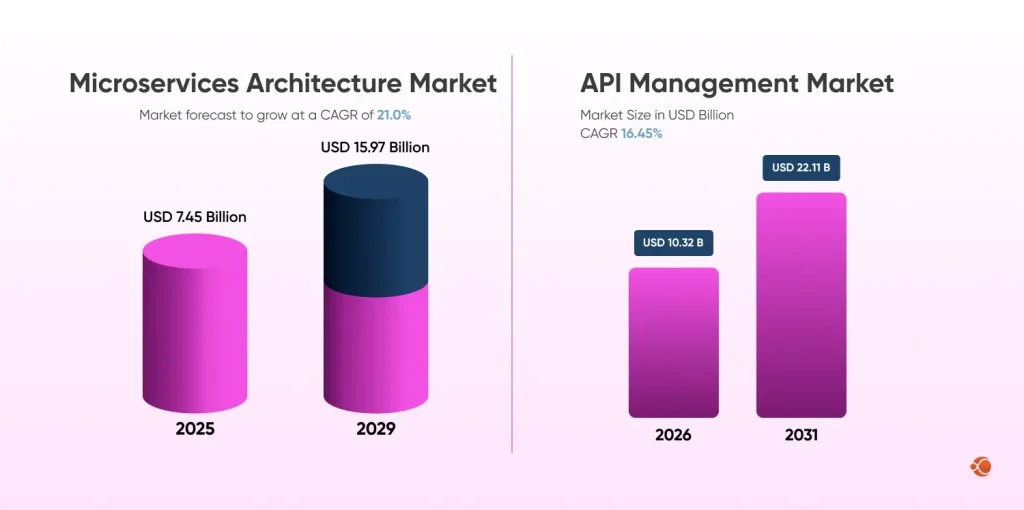
These are not just big numbers; they tell a story. Modern applications aren’t choosing one over the other. They’re strategically combining both.
This guide will help you understand when to use microservices, when web services make more sense, and how to implement a hybrid approach that actually works in production.
Who This Guide Is For
| Audience | What They Care About |
| CTO / Engineering Leader |
|
| Solution Architect / Technical Lead |
|
| Developer / DevOps Engineer |
|
| Product Manager |
|
| Startup / Small Business |
|
| Enterprise IT Decision-Maker |
|
What Are Microservices? Understanding Modern Application Architecture
A monolithic application is like a Swiss Army knife. A single knife serves multiple purposes. It’s convenient at first, but it becomes limiting eventually.
On the other hand, Microservices are like a professional kitchen. You have different tools for chopping, mixing, and cooking. Each tool is very good at one thing. There are many top microservices frameworks you can use.
The Microservices architecture is like dividing your app into small, independent services. Each service is responsible for a particular business function. It runs independently. It can be deployed independently.
How This Actually Works
Imagine you’re building an e-commerce platform. Instead of one massive application, you create separate services:
One service manages your product catalog. Another handles the shopping cart. A third processes payments. A fourth manages shipping. A fifth sends notifications.
Each service is independent. The payment service doesn’t care how the shopping cart works internally. It just needs to receive payment information and return success or failure.
Here’s what makes this powerful:
- Each service has a single job. Your payment service processes payments. Period. It doesn’t get distracted managing product images or calculating shipping costs.
- You can deploy them separately. Found a bug in the notification service? Deploy a fix. No need to touch payment processing, shopping cart, or anything else.
- They handle their own data. The product catalog is PostgreSQL. The recommendation engine is MongoDB. Session management is Redis. Use the best tool for the task.
- Different technologies for different needs. Payment processing is Java for enterprise-grade robustness. Real-time notifications are a Node.js approach to event-driven scalability. Machine learning is Python for its AI environment.
- Failures stay contained. If the recommendation service crashes, customers can still browse and buy products. They just won’t see personalized suggestions temporarily.
Collaborate with our expert development team to implement scalable, flexible, and performance-driven microservices or web services solutions.
Contact UsThe Real Benefits You Actually Feel
You must have experienced this: making a tiny change and having to redeploy your entire application. Then waiting nervously to see what breaks.
Microservices change that. Here’s how:
Scalability that makes sense.
Black Friday hits. Your checkout service is slammed. With microservices, you scale only the checkout. Your admin panel? Stays at normal capacity. Your report generator? Untouched. You pay only for what you need. Companies report 30-50% infrastructure cost reduction this way.
Deploy when you’re ready.
Not when everyone else is ready. Teams implementing microservices go from quarterly releases to multiple deployments per day. That’s a 40-60% improvement in deployment frequency. Think about what your team could accomplish with that velocity.
Uptime that matters.
Properly implemented microservices achieve 99.99% uptime. That’s less than 1 hour of downtime per year. Compare that to typical monolithic applications at 99.5%, over 43 hours annually.
Have you ever wondered why Netflix can deploy thousands of times per day without breaking? This is how.
What Are Web Services? The Integration Standard
Here’s a day-to-day operations problem you’ve probably faced: You need to integrate your application with a partner’s system. They use Java. You use Python. Their database is Oracle. Yours is PostgreSQL.
How do you make them talk to each other?
Enter web services.
Web services are standardized ways for different applications to communicate. They don’t care about programming languages, platforms, or databases. They just work.
Think of web services as the postal service of software. You put your message in a standardized envelope (HTTP request). Add a standardized address (API endpoint). Send it off. The other side reads it and responds.
How Web Services Actually Function
Imagine this scenario: You’re running an online store. You need to:
- Accept payments through Stripe
- Ship products via FedEx
- Manage inventory in your warehouse system
- Sync customer data with your CRM
Each of these systems is totally different. Developed by different vendors. On different tech stacks. With different infrastructures.
What Web Services Provide For Teams
- Standardized communication. All communication is HTTP/HTTPS. All platforms know how to handle it. All languages support it. All firewalls allow it.
- Format standards everyone understands. Most modern web services use REST APIs with JSON. Clean. Simple. Human-readable. Some legacy systems use SOAP with XML. More verbose, but standardized.
- Platform independence. Your Python application calls Stripe’s web service API. Stripe runs on who-knows-what internally. You don’t care. The API is the contract between you and the system.
- Clear documentation. Web services use OpenAPI (formerly Swagger) specifications. Interactive documentation. Code examples in multiple languages. Everything you need to integrate successfully.
The Real Benefits in Production
You must have felt difficulty trying to connect two systems that weren’t designed to work together. Wrestling with different data formats. Debugging cryptic errors. Writing custom integration code.
Connect anything to anything.
An enterprise manufacturer integrates SAP (on-premises, decades-old), Salesforce (cloud-based, modern), a custom warehouse management system (Java), and partner systems (various technologies). All through standardized web service APIs.
Lower complexity.
Web services are simpler than distributed microservices. Well-defined protocols. Established patterns. Your team doesn’t need to become distributed systems experts overnight.
Perfect for partnerships.
You’re building a payment gateway. Hundreds of merchants need to integrate with you. They use PHP, Ruby, .NET, Java, Python, everything. One well-designed REST API serves them all. They don’t need to know how your internal systems work.
It helps when you think of web services as your public face to the world. It keeps everything clean, standardized, and documented.

What are the Differences between Web Service and Microservice?
Here’s where many people get confused. They think microservices and web services are competing approaches when it comes to understanding the difference between services and microservices.
They’re not.
Think about it this way: Microservices describe how you build your application. Web services describe how different systems communicate.
They answer different questions.
Microservices Ask: How Do We Structure Our Application?
Microservices are about internal organization. Breaking your application into small, independent pieces. Deploying them separately. Scaling them independently. Managing them autonomously.
It’s like asking, “How should we organize our company?” By department? By product line? By customer segment?
Web Services Ask: How Do We Communicate?
Web services are about external integration. Providing standardized interfaces. Enabling different systems to talk. Making your functionality accessible to others.
It’s like asking: How do we communicate with customers? Email? Phone? Web portal? Mobile app?
The Real-World Relationship
Imagine you’re building a modern e-commerce platform. Internally, you use a microservices architecture. Separate services for inventory, orders, payments, shipping, and notifications.
But how do those services communicate with each other? Often, through REST APIs, a type of web service.
And how do external systems access your platform? Through web service APIs, you expose.
- Your mobile app? It calls your web service API.
- Your partner integrations? Web service APIs.
- Your third-party shipping providers? Web service APIs.
See the pattern? Microservices internally. Web services for communication and integration.
Quick Recap: Differences Between Microservices and Web Services
- The scope is different. Microservices define your entire application architecture. Web services define communication protocols.
- Granularity also changes. Microservices are small, focused, and built around business domains. Web services can be anything from a simple endpoint to a large, multi-step business function.
- Flexibility is another gap. Microservices can communicate in many ways, such as REST, gRPC, message queues, and event streams. Web services usually stick to HTTP or HTTPS with fixed, standardized formats.
- Complexity grows differently. Microservices add complexity to distributed systems, service discovery, tracing, and eventual consistency. Web services are less complex but less flexible.
- Web Services vs Microservices architecture: They handle concerns differently. Microservices are based on domain-driven services with separate deployment, while web services provide functionality via centralized, standardized APIs without defining the application structure.
When to Use Microservices Architecture
You must have experienced this: Your application works fine at a small scale. Then you grow. Suddenly, everything becomes harder.
That’s when microservices start making sense.
| Scenario | What’s Happening | Why Microservices Fit | Real-World Example |
| Large, Complex Applications | Many features like catalog, checkout, payments, and support live in one product | Each feature runs as its own service with independent releases | Amazon-style marketplace where catalog, checkout, and recommendations evolve separately without blocking each other |
| Variable Traffic Patterns | Different parts of the system peak at different times | Services scale only when needed instead of scaling everything | Netflix-like platform where streaming scales on weekends while billing and recommendations scale differently |
| Multiple Development Teams | Many developers work on different features at the same time | Teams own services, deploy independently, and avoid conflicts | Uber-scale engineering teams where separate teams own rides, payments, pricing, and notifications |
| Continuous Innovation | Features and experiments ship frequently | Individual services can be updated without affecting others | Spotify-style experimentation where recommendation and discovery services are updated frequently without touching payments or subscriptions |
When to Use Web Services Architecture
Here’s a day-to-day operations problem: You need to connect your new application with a legacy system from 2005. The old system can’t be rewritten since it’s too risky and too expensive.
This is where web services excel.
| Scenario | What’s Happening | Why Web Services Work | Example |
| Enterprise Integrations | Many systems like ERP, CRM, and legacy tools need to talk to each other | REST APIs act as a common connector across different technologies | SAP and Salesforce syncing data |
| Partner & B2B | Partners use different tech stacks and platforms | One well-documented API works for everyone | Stripe-style APIs used across languages |
| Regulated Environments | Strict compliance, audits, and traceability requirements | Standard contracts and documented flows simplify reviews | Banking APIs reviewed by auditors |
| Small Teams | Limited people, time, and budget | Simple web services ship faster with less overhead | Startup running on a single REST API |
Using Microservices and Web Services Together: A Hybrid Strategic Approach
Here’s what most successful companies do in 2026: They use both.
A simple way to remember this: Microservices are internally for flexibility. Web services externally for integration.
How Hybrid Architecture Actually Works
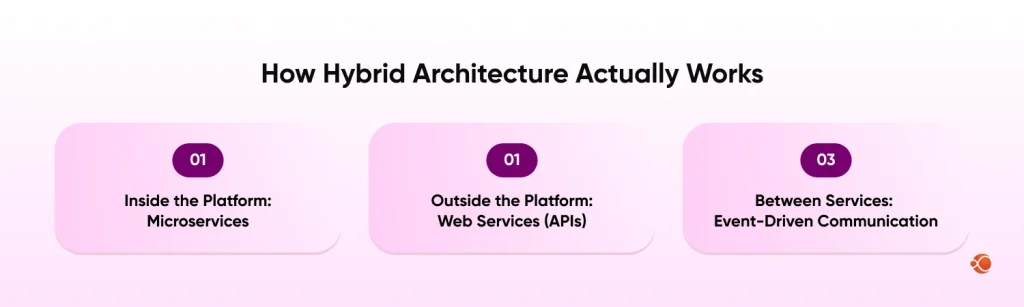
Think of a modern e-commerce platform as having three clear layers working together.
1. Inside the Platform: Microservices
Each core function is implemented as a separate service, maintained and operated independently:
- Product Catalog Service: The product catalog service will allow adding/managing product stock levels, prices, and images.
- Search Service: The search service supports searching, filtering, and sorting products within a product catalog.
- Shopping Cart Service: The shopping cart service manages user sessions and cart operations.
- Recommendation Engine: The recommendation engine provides AI-based, personalized recommendations and product recommendations tailored to each user.
- Order Processing Service: The order processing service manages the entire lifecycle of an order, from when the order is placed to when the order is fulfilled.
- Payment Service: Integration with Stripe, PayPal, and traditional payment gateways.
2. Outside the Platform: Web Services (APIs)
The platform provides robust and stable APIs for external parties and systems:
- Public Product API: Partners can view product information, pricing, and availability.
- Order Status API: Customers can check the status of their orders and shipping information.
- Webhook APIs: External systems can be notified in real-time.
- Shipping Provider APIs: Integration with FedEx, UPS, and DHL.
- Payment Gateway Integrations: Integration with Stripe, PayPal, and traditional payment gateways.
3. Between Services: Event-Driven Communication
Behind the scenes, services stay in sync using events:
- Order Placed triggers an inventory update.
- Payment Confirmed triggers shipping.
- Shipment Delivered triggers an update of the order status.
Why This Works
You get flexibility where you need it. Internally, teams work independently. They choose optimal technologies. They deploy on their own schedules.
You provide stability where it matters. Externally, partners get standardized APIs. Clear contracts. Backward compatibility. Professional documentation.
You maintain clear boundaries. Internal architecture evolves freely. External APIs remain stable.
Have you ever wondered how Amazon handles millions of sellers integrating with their platform while constantly innovating internally? This is how.
How to Make Your Decision: A Practical Decision Framework
You must have felt this difficulty: Too many options. Too many opinions. Too much confusion.
Let’s make this simple.
Choose Microservices When:
- Your application is genuinely complex. Multiple distinct business capabilities. Not just features, entire domains.
- You have multiple teams. At least 10-15 developers. Preferably organized by domain, and not by technology layer.
- Traffic patterns are highly variable. Some systems require extreme scaling. Others remain stable.
- Your DevOps skills are excellent. You have CI/CD pipelines. Container knowledge. Monitoring software. Experts in distributed systems.
- You can afford to spend more upfront. Higher upfront costs yield better long-term costs.
Choose Web Services When:
- Complexity is manageable. You’re not building the next Amazon. Your application has well-defined uses.
- Your team is small. 5-10 developers. Everyone knows the codebase. Coordination is still manageable.
- Integration is the priority. Integration with external systems is more important than internal flexibility.
- DevOps maturity is developing. You have the basics covered, but aren’t ready for the full complexity of Kubernetes.
- The budget favors simplicity. Lower initial investment. Faster time-to-value.
Choose Hybrid When:
- Requirements are mixed. You need both internal flexibility and external integration.
- You’re growing. Not huge yet, but getting there. You want to set up for future scale.
- Maturity is intermediate. You’ve got DevOps basics down. Ready to level up gradually.
- Strategy is long-term. You’re thinking in years, not months. Building for the future while delivering today.
- It helps when you’re honest about where you actually are. Not where you want to be. Where are you today?
What Are Your Next Steps?
Assess honestly. Where are you today? Where do you need to be? What’s the gap?
Start with a pilot. Prove the approach works for your team. Build confidence. Then scale.
And remember, architecture is a journey, not a destination. You’ll evolve. Your needs will change. That’s okay. That’s expected. The important thing is making the right choice for where you are right now.
How Partnering with CMARIX Can Help Build Resilient Software Products?
CMARIX delivers custom enterprise software development services designed for complex, large-scale business environments. We architect and implement secure, scalable systems that support long-term growth, seamless integrations, and evolving enterprise workflows.
Our focus areas include:
- We build microservices with Python, .NET, Java, Node.js, and other enterprise-ready technologies
- Designing microservices and web services architectures aligned with business domains
- Developing API-driven platforms for ERP, CRM, payment, and third-party integrations
- Implementing cloud-native deployments with containerization and CI/CD pipelines
- Modernizing legacy enterprise systems into modular, service-based architectures
Conclusion: Your Path Forward
What do we learn from this Microservices vs Web Services comparison? There’s no perfect architecture. Only the right architecture for your specific situation. Microservices aren’t always better. Web services aren’t outdated. Hybrid approaches aren’t the universal answer.
The best architecture is the one your team can build, deploy, and maintain successfully while meeting your business goals.
Start small. Pick a pilot project. Learn. Iterate. Expand.
You must have experienced this: Projects that looked perfect on paper but failed in production. Why? Because they didn’t match the team’s actual capabilities and constraints.
Don’t over-engineer. Don’t under-invest. Find the balance.Want to discuss your specific situation? Have questions about implementation? Need help planning your architecture migration? We’re here to help. Reach out for a personalized consultation.
FAQs On Difference Between Microservices And Webservices
What is the difference between Web Services and Microservices?
Web services are a communication approach that allows systems to exchange data over protocols like HTTP or SOAP. Microservices are an architectural style where applications are built as small, independent services that often communicate using web services.
How do Microservices and Web Services impact development and deployment processes?
Microservices enable independent development, testing, and deployment of each service, speeding up releases and reducing risk. Web services mainly standardize communication but do not inherently change how applications are developed or deployed.
How do Microservices and Web Services differ in terms of scalability?
Microservices scale at the service level, allowing specific components to scale based on demand. Web services typically scale at the application level, which can lead to unnecessary resource usage.
Can you build Microservices without Web Services?
Yes, microservices can communicate using messaging systems, event streams, or gRPC instead of traditional web services. However, REST or API-based web services remain the most common communication method.
When should I choose Microservices over Web Services?
Microservices are ideal for large, complex systems that require frequent updates, independent scaling, and team autonomy. Web services are better suited for simpler integrations or when exposing functionality without restructuring the entire application.