

Quick Summary: Laravel vs Symfony vs CodeIgniter are the top three PHP frameworks. And the comparison in the article is based on architecture, performance, scalability, and developer experience and many other important aspects. CodeIgniter works well for lightweight projects, Laravel suits quick development, and Symfony fits enterprise systems. Hence, choosing the right PHP framework depends on the project size, team size, and long-term maintenance needs.
The development of PHP applications is a time taking process, thus the choice of framework isn’t just a technical detail; it shapes how the project is built, maintained and scaled over time. Even in 2026, the debate between Symfony, Laravel and CodeIgniter remains active because each framework has different strengths, ideal use cases and trade-offs. Choosing the wrong one could mean slower development, future headaches with upgrades and messy code.
In this article, we’ll explore these three PHP frameworks in detail. From covering architecture, developer experience, performance, scalability, ecosystem, to practical project fit. By the end, you’ll have an idea which PHP framework works best for your development team, project size, and long-term goals.
Understanding the PHP Framework Landscape
The PHP framework has come a long way from being a simple scripting language to powering millions of websites worldwide, from small business sites to large ecommerce platforms. Raw PHP is flexible; it can become complicated and difficult to maintain as the project grows. This is where the framework enters the process. Frameworks give structure, coding standards and reusable components, which make applications more scalable and maintainable. Choosing the best PHP frameworks is important as it makes sure your projects stay secure, organized and efficient over time.
When comparing Symfony vs Laravel or CodeIgniter vs Laravel, it is important to consider how each framework aligns with your project requirements and development workflow, rather than just looking at the basic features. All three of these PHP frameworks remain popular because of their balance of modern coding practices with practical usability. By understanding their features, architecture and ideal use cases, you can select the right framework that aligns with your project goals.
PHP Framework Market Share Comparison
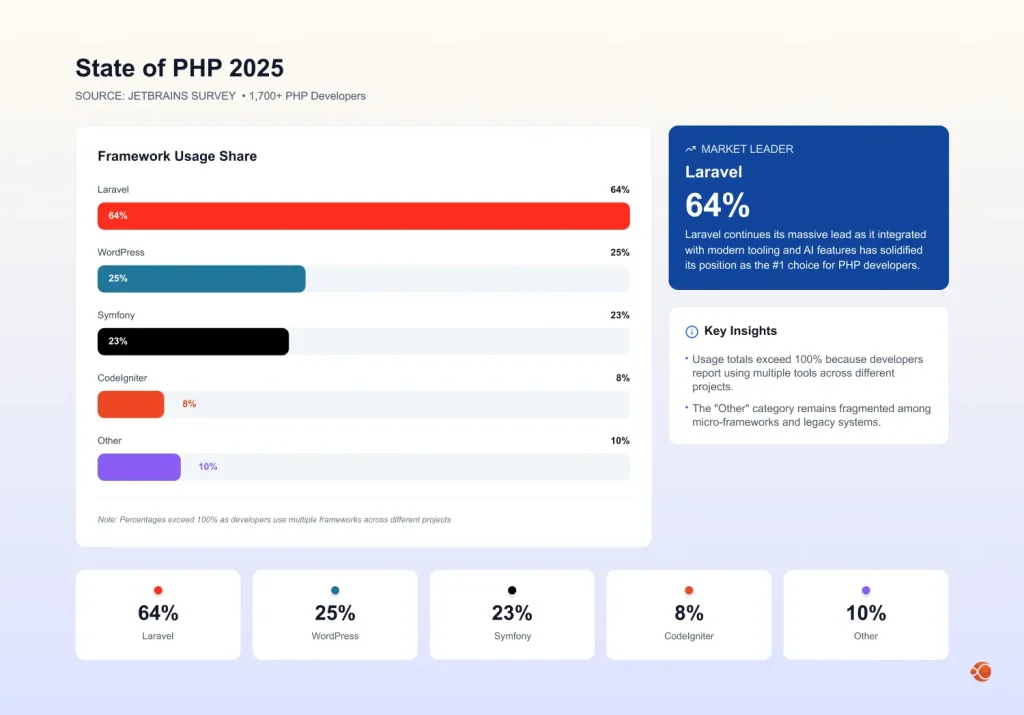
According to JetBrains’ State of the PHP 2025 survey:
- Laravel- 64% market share
- Symfony- 23% market share
- Other- is under 10%
Technical Comparison: Symfony vs Laravel vs CodeIgniter
This PHP frameworks comparison shows the main difference that matters most to developers. Laravel gives an intuitive syntax, expressive ORM, and built-in tools, making Laravel development services desirable for startups or SaaS platforms. Symfony offers enterprise-level flexibility with a modular design, while CodeIgniter focuses on simplicity and minimal setup for rapid development.
Differences between Laravel, Symfony, and CodeIgniter
| Feature | Laravel | Symfony | CodeIgniter |
| Architecture | MVC with Eloquent ORM | Modular, bundle-based MVC | Simple MVC, minimal setup |
| Learning Curve | Moderate, beginner-friendly | Steep, enterprise-focused | Very shallow, easy start |
| Performance | Good with caching & queues | Excellent for large apps | Fast for small apps |
| Testing & Tooling | PHPUnit, artisan CLI, debugging | PHPUnit, profiler, debug tools | Basic testing, limited tooling |
| Community & Ecosystem | Large, many packages | Strong enterprise support | Smaller, fewer packages |
| Scalability | Medium to large apps | Enterprise-grade | Small to medium apps |
| Best Use Case | Rapid development, SaaS | Enterprise apps, API-first projects | Lightweight apps, legacy modernization |
The debate of Laravel vs Symfony comes down to project complexity. Laravel emphasizes developer speed and intuitive APIs; on the other hand, Symfony focuses on architectural flexibility and long-term maintainability.
Let’s explore them in depth.
Architecture and Code Structure
Laravel is built keeping the convenience of developers in mind. It’s easy to get started with expressive syntax, and it includes pre-built features like routing, authentication, queues, and Eloquent ORM. Many developers like it because it’s intuitive and follows a “convention over configuration” method. This means things work the way you’d expect without spending hours configuring files.
On the other hand, Symfony is a framework for architects. It is highly modular, configurable, and adheres to strict coding standards. You can control almost every aspect of your application, making it right for large, complex projects. The downside? It has a steeper learning curve.
CodeIgniter is a simple and practical framework. It is easy to understand and learn. But as the projects grow, you’ll need to impose your own structure and patterns to keep things organized.
Routing, Controllers, and ORM
Routing and controllers are where frameworks really show their personality.
Laravel: Routing is clean and expressive, and controllers follow MVC strictly. Middleware is easy to add, and the request lifecycle is intuitive. Companies that hire Laravel developers benefit from Eloquent ORM, which just simplifies the database management while keeping the code maintainable and readable.
Symfony: Routing is annotation-driven, and controllers can be designed as services. Symfony offers events/hooks for deep control, making it excellent for enterprise projects.
CodeIgniter: Routing is straightforward. Controllers are simple classes, which makes it fast to start, but less flexible for difficult requirements.
When it comes to database handling, Laravel uses Eloquent ORM, which is expressive. Symfony uses Doctrine, which is powerful but heavier and requires more setup. CodeIgniter uses Active Record, which is easy for queries but lacks advanced ORM features like lazy loading or relationships.
Developer Experience and Productivity
Laravel often wins in developer experience. This benefit comes from its tight integration with modern PHP development tools such as artisan CLI, migration, PHPUnit, and debugging utilities that streamline day-to-day development tasks. Symfony gives a structured development environment, reusable components, and strong tooling. This helps teams hire Symfony developers maintain consistency across projects, reduce technical debt, and handle large-scale applications with confidence. CodeIgniter is the fastest to pick up, download it, unzip, and you can start coding in an hour, but it’s easier to get into trouble if you don’t enforce good coding practices.
Testing is another key factor. Laravel integrates with PHPUnit out of the box and has tinker for interactive experimentation. CodeIgniter’s testing capabilities are very basic and often require extra tools for modern workflows. Symfony has a detailed profiler for debugging and performance monitoring.
Performance and Security
Performance of the framework changes depending on the project:
- Laravel: Best for most apps, particularly with queues and caching.
- Symfony: It gives proper control, optimized for large-scale applications.
- CodeIgniter: Fast and lightweight for small projects, but may struggle with high concurrency or large datasets.
Security is important for modern web applications. Laravel includes CSRF protection, encryption, and password hashing. Symfony gives an enterprise-grade security with authentication, authorization, and guards. CodeIgniter has basic security features, but you’ll need additional libraries to meet standards.
We create scalable, high-performance PHP enterprise applications backed by secure architecture and future-ready UI experiences.
Contact UsScalability and Maintainability
With a clean architecture, Laravel scales better. Symfony is designed for enterprise-level scalability and modularity. CodeIgniter is perfect for small apps; scaling a large project can become challenging.
Laravel has regular updates, Symfony follows methodological upgrade cycles with strong backward compatibility. CodeIgniter upgrades can occasionally require rewriting parts of the application.
Ecosystem and Project Fit
The community support and ecosystem can affect how easily you build and maintain projects. Symfony has a smaller ecosystem but high-quality, reliable bundles. Laravel has a huge community, active tutorials and many packages. CodeIgniter has a modest ecosystem, which can limit options for specialized functionality.
Just like community support, project fit is equally important. Laravel is great for small to medium teams. Symfony works best for larger teams developing enterprise apps, API-first applications or modular systems. CodeIgniter is perfect for small apps or modernizing legacy PHP projects.

Laravel, Symfony, and CodeIgniter: Practical Use Cases and Project Fit
| Framework | Ideal Use Case | Key Strengths | Example Applications |
| Laravel | Rapid development and SaaS platforms | High developer productivity, built-in tools for routing, authentication, caching, and database management | Subscription-based SaaS apps, marketplaces, MVPs |
| Symfony | Enterprise applications and long-term projects | Highly configurable, modular architecture, reusable bundles and services, strong security | Banking systems, large CRMs, and enterprise e-commerce platforms |
| CodeIgniter | Lightweight projects and legacy modernization | Simple, minimal setup, fast to deploy, low learning curve | Small-scale web apps, blogs, CMS, internal tools, legacy system upgrades |
How to Choose the Right PHP Framework for Your Project
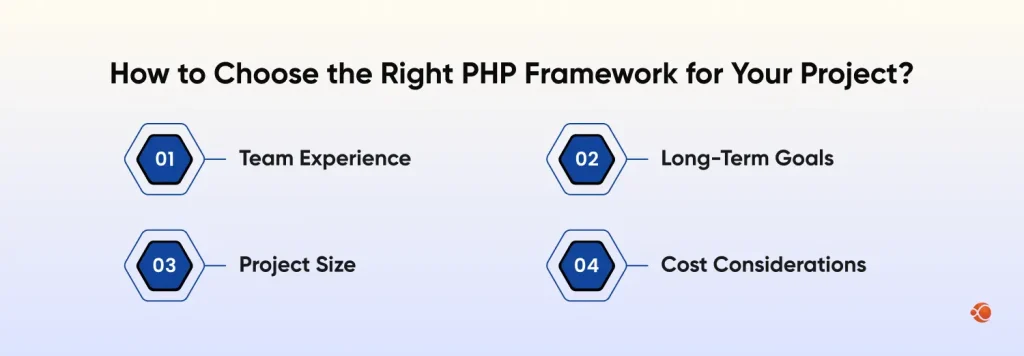
Choosing the best PHP framework for web development is about considering long-term goals, team experience, and project size. The PHP framework performance comparison should guide your decision as per real-world needs and not just the existing standards. Here’s how to think about it:
Team Experience:
- Laravel is beginner-friendly, making it ideal for teams relatively new to modern PHP development.
- Symfony requires experienced developers who are well-versed in modular design, enterprise-grade standards, and dependency injection.
- CodeIgniter is perfect if you need a quick learning curve and minimal overhead.
Long-Term Goals:
Symfony’s modularity and maintainability pay off when enterprise projects or applications are expected to last for years. If it is a SaaS platform or startup MVP, then Laravel’s speed and community support are valuable things. For legacy upgrades or quick deployment, CodeIgniter’s simplicity is ideal.
Project Size:
- Small projects: CodeIgniter allows you to deliver faster with minimal structure.
- Medium projects: Laravel provides the right balance of maintainability and productivity.
- Large or enterprise projects: Symfony’s modular architecture is right for large project scalability.
Cost Considerations:
- Laravel reduces the initial costs, due to faster development cycles, in-built features, and a large pool of developers.
- You need professional Symfony development services as it has a higher upfront cost, but it can be justified by lowering refactoring and maintenance in complex, long-lived systems.
- CodeIgniter is the most cost-effective option for small-scale projects, internal tools, and short-term applications where simplicity and speed matter more than long-term scalability.
By evaluating your team’s experience, expected complexity, and future growth plans of the project, you can choose a framework that reduces technical debt, improves development speed and make sure long-term success.
Why Choose CMARIX as Your Preferred PHP Development Company
Selecting a framework is only the first step of the process; having the right development partner makes sure your project succeeds in the long run. CMARIX has huge experience with Laravel, Symfony, and CodeIgniter, making them a reliable PHP development company and well-equipped to guide projects of different sizes or complexities.
Here’s what sets them apart:
- Expert Guidance on Framework Selection: CMARIX assesses your business goals, project size, requirements, and team capabilities to recommend the framework that fits best. In case you need a quick MVP development or a long-term enterprise solution, they advise accordingly.
- Support for Long-Term Scalability and Maintenance: Beyond just building the application, CMARIX focuses on architecture, code quality and future-proofing. This makes sure your application can grow and adapt without requiring a full rebuild in a few years.
- Best Practices in Security, Performance, and Development Workflows: With CMARIX, your project benefits from proven development workflows, security measures and performance optimization strategies.
Working with CMARIX means your PHP project is built to last, using the strengths of the chosen framework while avoiding common mistakes.
Conclusion
Choosing a PHP framework is not an easy job. It’s about picking the correct framework for your project’s goal, development team, and future growth. Laravel vs Symfony vs CodeIgniter each have their place. Whether you’re evaluating Symfony vs Laravel for enterprise needs or Laravel vs CodeIgniter for a prototype, having an understanding of these frameworks helps in forming the right foundation.
In enterprise-level projects, Symfony excels in scalability; Laravel excels in rapid development; and CodeIgniter is ideal for speed and simplicity, especially when using expert CodeIgniter development services. Understanding their strengths and trade-offs, making sure your PHP project is maintainable, scalable, and successful.
FAQs on Laravel vs Symfony vs CodeIgniter
Which PHP framework is best: Laravel, Symfony, or CodeIgniter?
It depends on the project needs, size and complexity. Laravel works best in case of faster development, CodeIgniter for smaller or simpler projects and Symfony for enterprise-level apps.
Which PHP framework is best for enterprise applications?
Due to modular architecture, long-term maintainability and flexibility, Symfony is best for enterprise applications. It’s built to handle complex, large-scale applications.
Is CodeIgniter better than Laravel?
Not quite, CodeIgniter is lighter and faster for small projects. But Laravel gives more modern scalability, tools and community support.
Is Symfony harder than Laravel?
Yes, the learning curve for Symfony is steeper because of its modular design and complexity. But it’s better suited for enterprise-level or long-term projects.
Is CodeIgniter good for modern web development?
It is best for modernizing legacy systems or small apps. For advanced features and larger projects, Laravel/Symfony is a better choice.
How is Laravel/Symfony better than CodeIgniter?
Both provide structured architecture, better scalability, and development tools. They also make maintaining and expanding projects much easier over time.