

Quick Summary: Machine learning governance helps businesses maintain ML model accuracy, fairness, security, and compliance from initial development through decommissioning. This guide explains the differences between machine learning governance, MLOps, and AI governance; the relevant regulations; and how to implement machine learning governance in seven steps.
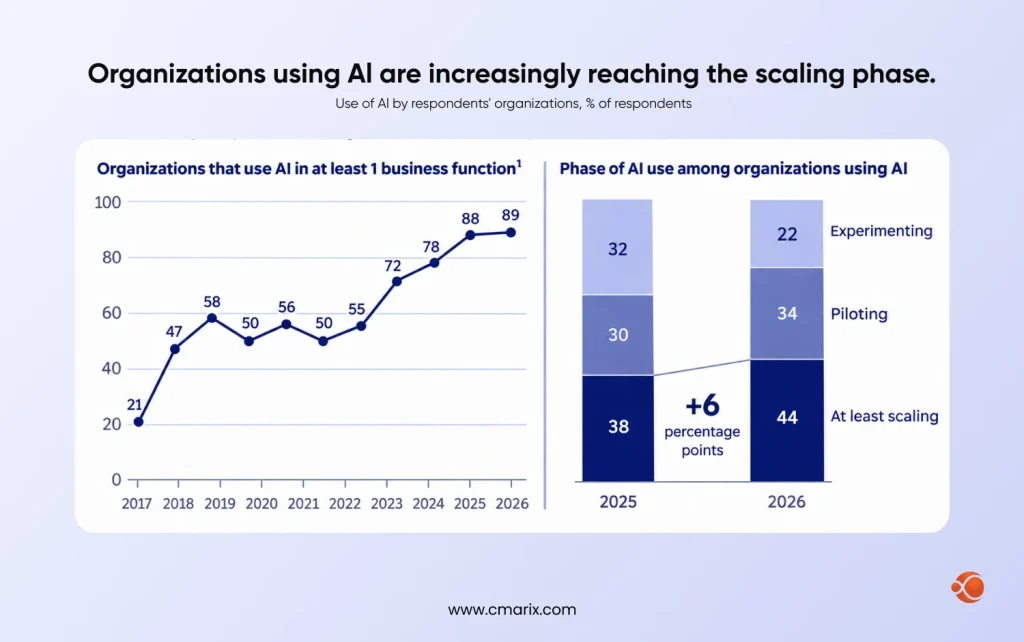
As machine learning (ML) moves from pilot projects to core business systems, the engineering around it has to mature too. Models now score credit risk, price products, flag fraud, and rank candidates, and each one depends on training data, feature pipelines, code, and a deployment that can all change independently. McKinsey’s State of AI 2026 survey, fielded in May and June 2026, found that nearly nine in ten organizations use AI in at least one business function, and 44% are now scaling it across the enterprise, up from 38% a year ago.
That growth exposes a gap. Developing and deploying a model is now normal for most data teams. Many teams struggle to link a prediction to the model version, dataset, and approval status, or to detect drift or fairness issues in production. This is where machine learning governance comes in.
What Is Machine Learning Governance?
Machine learning governance is the framework of processes, policies, roles, and technical controls an organization uses to manage ML models across their full life. It answers the questions a regulator, an auditor, or your own CEO will eventually also ask. Who owns this model? What data trained it? Who approved it for production? How do we know it still works? What happens when it doesn’t?
It covers more than the model itself. Good governance reaches back to the data that feeds the model and forward to the decisions it influences, which is why it sits inside the wider idea of enterprise AI governance. If you are still getting oriented on how models get built in the first place, our data science guide covers the groundwork.
ML Governance vs Model Governance vs AI Governance vs MLOps
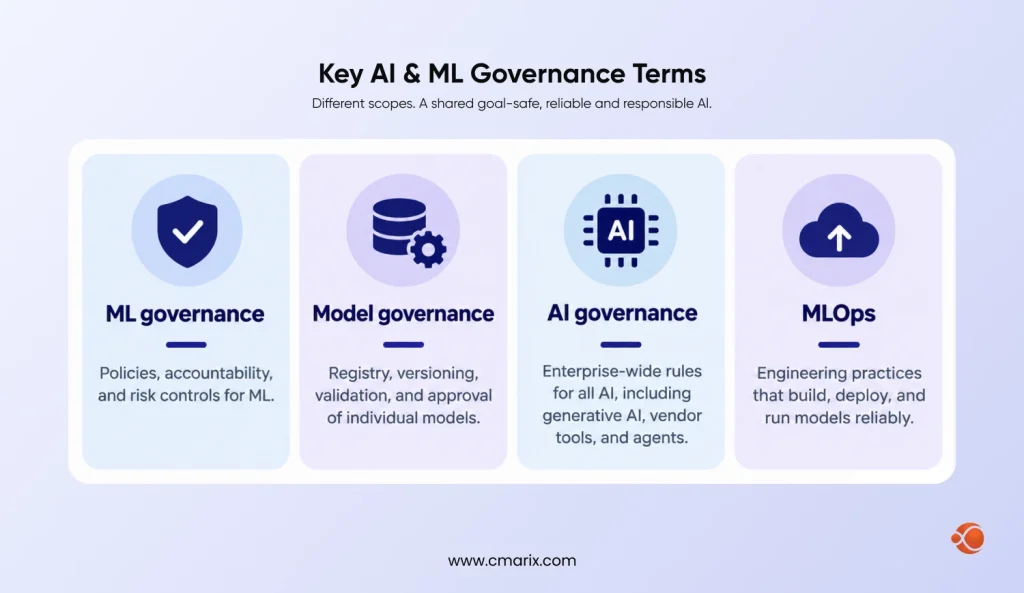
These terms get mixed up constantly, and the overlap is real. Here is how they differ in practice.
| Term | Main focus | Scope | Typical owner |
| ML governance | Policies, accountability, and risk controls for ML | Data, models, deployment, monitoring | Governance board, risk, ML leads |
| Model governance | Registry, versioning, validation, and approval of individual models | Model level | Model risk team |
| AI governance | Enterprise-wide rules for all AI, including generative AI, vendor tools, and agents | Whole AI portfolio | CIO, CDO, legal |
| MLOps | Engineering practices that build, deploy, and run models reliably | Pipelines and infrastructure | ML engineers, platform team |
The simplest way to think about it: MLOps is how you ship models, and governance is the set of rules you ship them under. The best programs do not run as two separate efforts. They use MLOps pipelines to enforce governance automatically, so a model cannot reach production without the right checks and sign-offs.
Why Enterprises Need Machine Learning Governance
The risks are not hypothetical. They show up as incidents, fines, and lost customer trust. These are the ones that come up most often.
- Model drift- Customer behavior, markets, and data sources change. A model that performed well at launch can quietly get worse, and nobody notices until a loss ratio or fraud rate moves.
- Bias and unfair outcomes- Models trained on skewed history repeat it. In lending, hiring, insurance, and healthcare, that turns into legal exposure fast.
- Shadow AI- Teams spin up models and connect third-party AI tools without telling anyone. If IT and risk do not know a model exists, nobody is governing it.
- Audit gaps- When an auditor asks for training data, validation results, and approval records, missing documentation becomes a finding on its own.
- Regulatory exposure- Laws like the EU AI Act and bank supervisory guidance reward documented controls, not good intentions.
There is also a good part to this: when teams have well-defined risk levels and approval processes, they deliver better, since low-risk projects don’t undergo extensive review and high-risk projects receive the scrutiny they require.
See your model risk gaps before an auditor finds them.
Core Pillars of an Enterprise AI Governance Framework
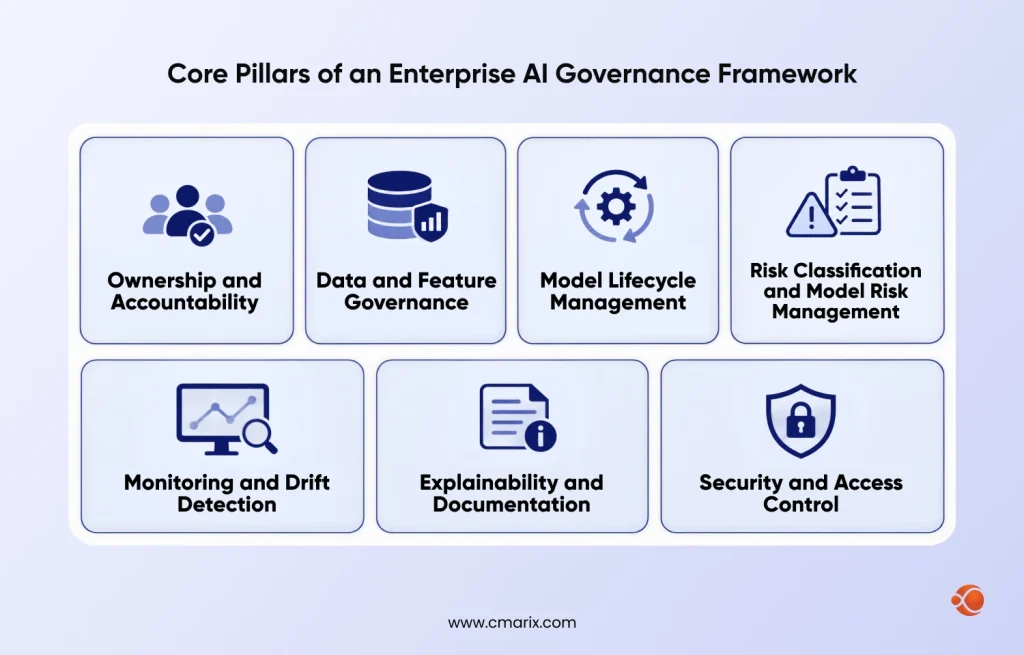
An effective AI governance framework rests on a handful of pillars. Together, they form a responsible AI framework for enterprises that works in daily operations, not just in a policy document.
Ownership and Accountability
Every model needs a named risk reviewer, a technical owner, and a business owner. Without names, nobody answers when a model misfires. Many enterprises also set up an AI governance board with the authority to approve, pause, or retire models.
Data and Feature Governance
Models inherit every flaw in their data. Keep track of your data sources, consent checks, and feature definitions so that you know what has gone into the decision-making process. The organizations that require assistance in this aspect usually begin with data governance consultation.
Model Lifecycle Management
Keep a central inventory of every version, model, training dataset, and deployment. This is the backbone of AI model lifecycle management, and it is the first thing an auditor asks to see.
Risk Classification and Model Risk Management
Not all models need the same level of scrutiny. A marketing propensity score and a credit decisioning model are worlds apart when it comes to the implications of failure. Tier your models according to their potential impact, and then ensure that the degree of validation and oversight is aligned with their tier.
Monitoring and Drift Detection
Models degrade when the world changes. Monitoring and drift detection monitor the changes to the input data, predictions, and fairness measures relative to certain thresholds.
Explainability and Documentation
The regulators, as well as consumers, are interested in getting explanations, not just scores. Keep model cards for all models that describe their purpose, data used to train models, their limitations, and results of testing. This matters most in finance, insurance, and healthcare, where regulators expect a reason behind each decision.
Security and Access Control
Restrict access to training data, model modifications, and production endpoint invocations, and log all changes. Account for security risks unique to ML, like data poisoning, model stealing, and prompt injection in the case of LLMs.
Regulations and Standards That Shape Machine Learning Governance
No single rule covers everything. Enterprises usually face several overlapping ones, depending on sector and geography.
| Framework | What it is | Who it applies to | What it asks of ML teams |
| NIST AI RMF | Voluntary US framework built on four functions: Govern, Map, Measure, Manage | Any organization, widely used by US enterprises | Map risks, measure them, assign governance roles, manage them over time |
| EU AI Act | Binding EU regulation with risk tiers (Regulation 2024/1689) | Providers and deployers serving the EU market | Risk management, data quality, documentation, human oversight, and logging for high-risk systems |
| ISO/IEC 42001 | International standard for an AI management system, published in 2023 | Any organization, certifiable | Documented policies, roles, risk assessment, continual improvement |
| GDPR | EU data protection law | Anyone processing EU personal data | Lawful basis, impact assessments, safeguards around automated decisions |
All enterprises usually select one such framework as their backbone, normally NIST AI RMF or ISO/IEC 42001, and apply sectoral requirements on top of that. This way, they avoid running five separate compliance processes at once. In the case of banks and payments firms, the ML applications in fintech analysis conducted above would help them identify how these requirements apply in practice.
One caution. In May 2026, EU lawmakers agreed to push back the high-risk rules. Standalone high-risk systems, which include credit scoring and hiring models, would now apply from December 2, 2027. High-risk AI built into regulated products, such as medical devices, follows on August 2, 2028. The bans on prohibited practices and the rules for general-purpose AI stay as they were. Plan around these dates, but confirm the final adopted text with legal counsel.
How to Implement Machine Learning Governance in 7 Steps
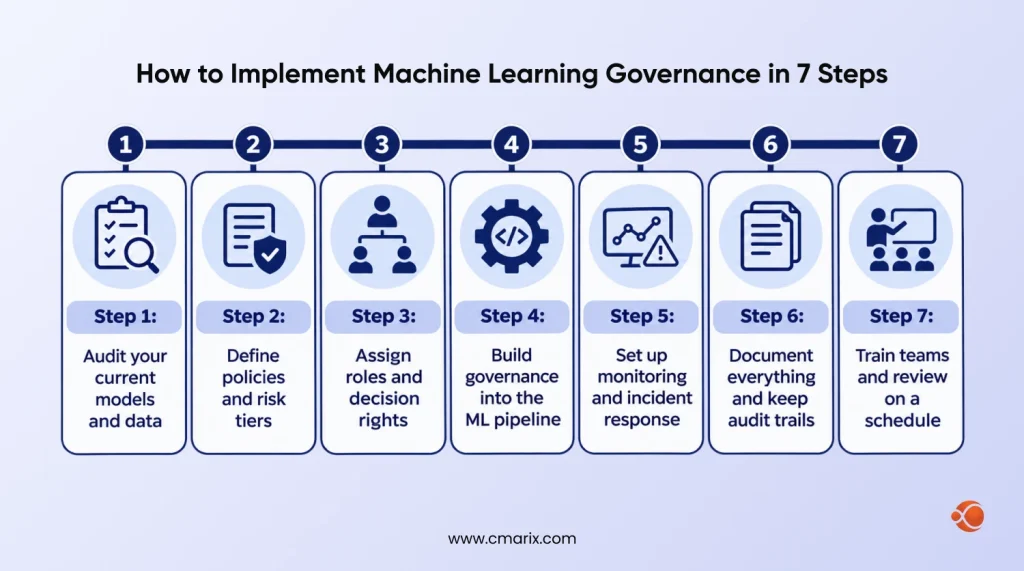
You do not need to boil the ocean. Start with what exists, put the highest-risk models under control first, then expand.
Step 1: Audit your current models and data
Develop a comprehensive list of all models in operation, whether they are part of spreadsheet applications, are used within vendor tools, or are utilized by a single analyst. Note who owns each one and its purpose.
Step 2: Define policies and risk tiers
Write clear rules for acceptable use, approval, documentation, and review. Set tiering criteria as per business impact, level of automation, regulatory exposure, and data sensitivity. Anchor the policies to the framework you picked, so they hold up under audit.
Step 3: Assign roles and decision rights
Decide who builds, reviews, signs off, and monitors. A simple RACI settles most disputes.
| Activity | Data science | ML engineering | Risk and compliance | Business owner | Governance board |
| Build and document model | R | C | I | A | I |
| Validate model | C | I | R | I | A |
| Approve for production | I | C | C | R | A |
| Monitor in production | C | R | C | A | I |
| Retire or retrain | R | R | C | A | I |
R is responsible, A is accountable, C is consulted, I is informed.
Step 4: Build governance into the ML pipeline
A policy that lives only on paper loses to the first tight deadline. Integrate governance procedures into the CI/CD pipelines by incorporating bias tests, data validation, approval gates, a model registry, and lineage management. In case the pipelines are not yet mature, you can seek out MLOps consulting services to bridge the gap.
Step 5: Implement monitoring and incident response
Identify drift, accuracy, and fairness metrics. Set up alerting and dashboards along with a kill switch or rollback mechanism. Create an incident playbook to help the team know who is responsible in case something goes wrong with the model at 2 a.m.
Step 6: Document everything and keep audit trails
Keep all documentation in one place where it’s easy to access. It works only if you can provide answers to your auditor within a few days rather than a month.
Step 7: Train teams and review on a schedule
Train the people who build models, the business owners who use them, and the approvers who sign off. Check on the framework every quarter during the first few months and thereafter annually. Conduct an internal review prior to the regulatory body’s.
Our engineers embed policy checks into training, release, and monitoring workflows.
AI Model Lifecycle Management: Governance Checks at Every Stage
Governance is not one gate at the end. Each lifecycle stage has its own checks, owners, and records.
| Stage | Governance checks | Owner | Artifacts |
| Problem framing | Purpose, risk tier, ethics screen | Business owner | Use case brief |
| Data preparation | Source approval, consent, quality and bias checks | Data steward | Data lineage record |
| Development | Reproducible experiments, feature review, explainability tests | Data scientist | Experiment log, draft model card |
| Validation | Stress tests, independent testing, fairness review | Risk team | Validation report |
| Deployment | Approval gate, access controls, rollout plan | ML engineer, governance board | Signed release record |
| Monitoring | Drift, accuracy, and fairness tracking | ML engineer | Alerts and dashboards |
| Retirement | Decommission plan, data retention check | Business owner | Retirement record |
Most teams build models in Python, so put the checks in the tools they already use: version control, notebooks, and test suites. Our overview of Python with machine learning covers the common stack.
Don’t limit this seriousness to AI project headlines alone. Predictive analytics supports decisions with monetary consequences, yet it is often poorly supervised. If you are going to use this process, it is a good idea to get help from predictive analytics consultants from the very beginning.
Governing Generative AI and LLMs vs Traditional ML
Generative AI breaks certain assumptions that traditional machine learning governance relies on because, while you can test the results of a churn model, an LLM generates text that doesn’t have a clear right answer. Adjustments are inevitable.
- Output risk- Hallucinations, toxic content, and made-up citations are hard to score automatically. Employ grounding using verified data sources, output filters, and manual evaluation for critical applications.
- Prompt and data leakage- Employees paste sensitive data into prompts, and models can echo it back. Set rules on what can be sent to which model, and log prompts and responses.
- Vendor model changes- A third-party model can change behavior after an update without your team touching anything. Pin versions where you can, and retest after every vendor release.
- Agents and autonomy- When an LLM can call tools or take actions, access control and approval limits matter as much as output quality. Give agents the narrowest permissions that work.
Fine-tuning adds another layer. It changes how a model behaves, so treat each tuned version as a new model that needs testing and sign-off. Our guide to LLM Fine-Tuning Techniques explains what changes under the hood. NIST also publishes a generative AI profile for its AI RMF, which is a useful checklist for these risks.
Machine Learning Governance Tools and Model Governance Platforms
The tooling market is young and growing fast. IMARC estimates the global AI governance market at USD 353.1 million in 2025, growing to USD 5,748.6 million by 2034 at a 35.25% CAGR. A small base with that kind of growth means buyers are still working out what a good platform looks like, so evaluate carefully.
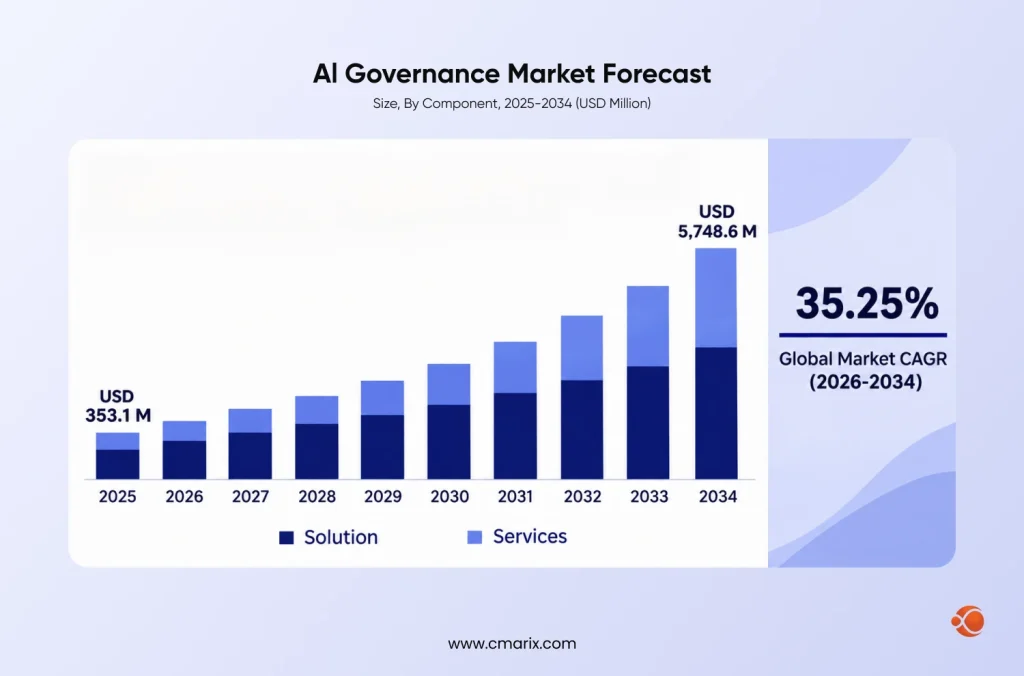
Whatever you choose, a solid model governance platform should cover these capabilities.
- Model registry and inventory- One source of truth for every model, version, owner, and status.
- Lineage- Traceability from prediction back to the training data and code.
- Bias and fairness testing – Tests you can repeat, not single-use notebooks.
- Drift and performance monitoring- Real-time monitoring with threshold-based notifications.
- Approval workflows- Sign-offs by risk tier, with an audit trail.
- Audit reporting- Evidence you can hand to a regulator without a scramble.
Here is how the main tool categories compare.
| Category | What it covers | Best fit when |
| Model registry and MLOps platforms | Versioning, lineage, deployment control | Engineering-heavy teams that want control inside the pipeline |
| Model governance platforms | Inventory, risk tiering, approvals, audit reports | Regulated firms running many models |
| Monitoring and observability tools | Drift, performance, and fairness in production | Models already live at scale |
| Data governance and catalog tools | Data lineage, quality, access | Weak data foundations |
| GRC and compliance suites | Policy mapping, evidence for frameworks | An existing enterprise GRC program |
A tool does not equal a program. Buy to fill specific gaps in your stack, and avoid paying for overlap with what your MLOps platform already does. Our rundown of AI governance tools compares options in more detail.
Common ML Governance Challenges and How to Fix Them
- Siloed teams- Data science, engineering, risk, and legal do not collaborate on a single process. Solve by using one governance committee and a single model inventory.
- Legacy models with no paper trail- Legacy models are often undocumented. Start with high-risk models, reconstruct their history, and retire any that are orphaned.
- Governance seen as a speed bump- If all models get a thorough review process, teams bypass the governance function. Solving this requires tiering and automated assessments to keep low-risk projects flowing.
- Unclear ownership- Models without clear ownership decay. Ensure models have owners before release.
- Scaling across business units- Processes that work well for one team fail when scaled up to ten teams. Standardization of templates, tools, and tiering, followed by appropriate variance, allows for exceptions where justified.
Build, Buy, or Partner: Choosing Your ML Governance Approach
There is no universal answer. The right path depends on your team size, regulatory load, and how mature your ML platform already is.
| Approach | Best for | Upside | Watch out for |
| Build in-house | Large teams with a strong ML platform | Full control, fits your stack | Slow start, scarce skills |
| Buy a platform | Regulated firms with many models | Faster rollout, built-in reporting | License costs, integration effort, a tool is not a process |
| Partner | Teams that need design and delivery help | Experience, speed, knowledge transfer | Needs a clear scope and handover |
Various enterprises land on a hybrid: buy the core platform, partner for integration and design, and keep ownership and policy in-house. A software development company that already builds and runs ML systems can design the framework and the integrations together, which keeps governance from drifting away from how models actually ship.
Why Choose CMARIX for Machine Learning Governance
Governance isn’t effective when it lives in a policy deck. Moreover, it never gets wired into the processes. CMARIX solves governance problems as engineering challenges. Our experts develop and operate ML solutions every day. That is why we integrate model inventories, approval gateways, drift detection, and audit logs into the data science pipelines you are working with right now.
We have been building software since 2009 and have worked across 40+ industries, which shows us how governance needs change from one regulated sector to the next. We are ISO 9001:2015 and ISO 27001 certified, so quality and security discipline are part of how we deliver, not an add-on. Whether you need an audit of your current models, a framework built from scratch, or a partner to run it alongside your team, we scope the work around your risk profile and your stack.
Conclusion
Machine learning governance is no longer an option for enterprises running models that touch money, health, or people’s opportunities. The way to do it is simple: understand all the models used, divide them according to their level of risk, give each one its designated owner, include controls in the pipeline, and preserve proof. Start with your most risky models, establish that the system works, and then scale it out. When done properly, governance won’t hinder AI development at all. It will help you grow it.
FAQs About Machine Learning Governance
What is machine learning governance?
ML Governance involves all those practices, rules, processes, and mechanisms that ensure the management of ML models through their entire lifecycle. ML Governance involves data quality, approvals, model validation, monitoring, documentation, and decommissioning. It aims at developing ML models that are reliable, secure, fair, and compliant.
How is ML governance different from MLOps?
MLOps deals with engineering aspects of development, deployment, and execution of models. Meanwhile, ML Governance defines the guidelines for models, which include approval, risk levels, and audit trails. The most advanced practices combine both areas, leveraging the pipelines of MLOps to perform governance checks.
What is the difference between ML governance, model governance and AI governance?
Model governance is the most specific and refers to the management of models (registry, validation, and approval). ML governance encompasses ML and includes more aspects like data, risks, and compliance. AI governance is the broadest and involves governance of all AI solutions across the organization, including generative AI, vendor offerings, and agents.
Why do enterprises need machine learning governance?
The models determine how credit, pricing, employment, and fraud cases should be managed, but uncontrolled models will exhibit biases, drift, and create risks of audits and legal problems. Through governance, one will have the authority, visibility, and warnings in case of any problem.
What are the core components of an enterprise ML governance framework?
The core components of an enterprise ML governance framework are ownership and accountability, data and feature governance, risk classification, model lifecycle management, monitoring, explainability and documentation, and security and access control. These elements collectively address the questions of who is responsible, what is deployed, how risky it is, and how it is monitored.
Which regulations and frameworks apply to enterprise ML models (NIST AI RMF, EU AI Act, ISO/IEC 42001)?
This will depend on the industry you belong to, where you live, and the level of risk. The NIST AI RMF is a voluntary framework for the United States; the EU AI Act regulates providers and users in the EU, and ISO/IEC 42001 is an AI management standard for certification.
How do you detect and govern model drift in production?
Monitor the distribution of input data, prediction quality, and the fairness metric against specified thresholds. When the value for any metric exceeds its corresponding threshold, then there is an alert to the owner and an action is taken by the owner.
How do you govern generative AI and LLMs differently from traditional ML?
Outputs are unbounded, which necessitates adding things like grounding, output filtering, human oversight for mission-critical use cases, and logging of prompts and responses. You need to manage vendor model updates, prompt-based data leakage, and agent privileges. Every fine-tuned version is a different model, requiring separate testing and approval.
Which ML governance tools or platforms should an enterprise evaluate?
Consider model registries, model governance platforms, monitoring tools, data catalog tools, and GRC suites. Evaluate them based on factors such as lineage, drift detection, approval process, auditing capabilities, and compatibility with existing technology stacks. Purchase solutions to address the gaps and not replicate the functions performed by your MLOps platform.
How long does enterprise ML governance take to implement, and what does it cost?
The first targeted phase of the process with inventory, risk tiers, and basic policies will normally take 8 to 12 weeks (approx.). The embedding of controls in pipelines and roll-out to all business units will normally take 6 to 12 months (approx.). Cost will depend on the number of models, regulations, tools, and maturity of MLOps, so the proper assessment will give a more realistic figure than any benchmark.