



Quick Summary: What if the already competitive US or UK healthcare markets don’t present the next big telemedicine opportunity? What if the true growth frontier lies in an area where patient expectations are changing rapidly, laws are evolving, and the use of digital health is accelerating? Discover this comprehensive guide on building a telemedicine app in Saudi Arabia, including its benefits, scope, regulations, and more.
With its Vision 2030 driving digitalisation in healthcare, growing government backing and investment, and increasing demand for remote care, Saudi Arabia is becoming a visionary and futuristic market. For telemedicine developers, the Kingdom of Saudi Arabia (KSA) is proving to be an attractive environment.
Whether you are a healthcare entrepreneur, a digital healthcare startup, or a pharmacy chain that wants to expand into remote care, or a global telemedicine provider that wants to explore new markets, Saudi Arabia presents a promising opportunity.
CMARIX is an ideal technology partner for your journey of building a telemedicine app in Saudi Arabia that is HIPAA-aligned and has a thorough understanding of Saudi healthcare workflows, compliance standards, and cultural factors.
This blog will cover everything you need to navigate and succeed in this ecosystem, from why invest in building a telemedicine app for the Saudi Arabian market to how, including cost estimates, information on required integrations, localization strategies, data privacy frameworks, and much more.
The Market Stats for Digital Pharmacy Solutions in Saudi Arabia
Numerous statistics and studies from renowned researchers, as well as market insights, highlight the growing popularity of building telemedicine apps for the Saudi Healthcare sector. Here are some of the popular stats:Saudi Arabia’s telemedicine market was valued at USD 842.1 million in 2024. Moving forward, the telemedicine industry in Saudi Arabia is expected to reach USD 4.554 billion by 2033.

- According to another study, the Saudi Arabian telemedicine market is projected to be valued at USD 825.6 million in 2024 and is forecasted to grow to USD 2,318.8 million by 2030.
- This study also highlights the telehealth services segment as growing even faster, from USD 361.4 million in 2023 to USD 3,125.4 million by 2030.
- A study conducted in Saudi Arabia from May 1, 2024, to June 30, 2024, among 2,234 participants who completed the survey, found that 95.7% expressed a positive attitude towards using telehealth services.
Why Saudi Arabia is Becoming the Next Telemedicine Powerhouse
Saudi Arabia is making considerable progress in various aspects, including technology, digital infrastructure, and innovation-driven industries. From smart cities like NEOM and AI-powered public services to rapid cloud adoption and nationwide 5G development, Saudi Arabia is positioning itself as a fast-growing market in digital transformation.
Similarly, digital pharmacy solutions in Saudi Arabia are undergoing one of the most ambitious digital evolutions in the world. Vision 2030 and the National Transformation Program are redefining how healthcare is accessed, delivered, and experienced.
What are the Key Drivers Fueling Telemedicine App Development Saudi Arabia
Vision 2030 Healthcare Digitalization:
The Saudi government views digital healthcare as an important pillar of its reform agenda. Vision 2030 in health focuses on:
- Increased delivery of virtual care: reduces hospital dependence
- Modernization of patient records and health data systems
Expansion of digitally integrated healthcare networks This makes telemedicine in the Saudi market not just about innovation, but a national mandate.
Government Support and National Investments
Saudi Arabia is heavily investing in the virtual healthcare infrastructure:
- SEHA Virtual Hospital (SVH): Connects 130 hospitals across Saudi Arabia and provides emergency and critical care consultation with over 8 clinics that specialize in heart, kidney, and other blood-related diseases, as well as diabetes and other medical rehabilitation services.
- Wasfaty e-Prescription System: It is a national e-prescribing platform in Saudi Arabia that enables government healthcare providers to send electronic prescriptions directly to community pharmacies for patients to collect.
HIPAA-Inspired Regulatory Alignment
Saudi Arabia is rapidly aligning its compliance frameworks with global standards:
- National Health Information Center for creating data privacy policies
- Regulations inspired by HIPAA, GDPR, and international best practices
- Heavy emphasis on patient data confidentiality, secure access, and digital consent
Robust Digital and Cloud Infrastructure
Saudi Arabia has the technical foundation to support next-gen healthcare apps:
- One of the highest smartphone adoption rates in the Middle East
- Country-wide 5G networks that enable real-time video consultations
- Mature cloud adoption by Oracle, Google Cloud, and other regional data centers
How CMARIX Builds HIPAA-Compliant Telemedicine Apps for the Saudi Healthcare Market
Building a telemedicine app in Saudi Arabia involves more than just writing code. The Saudi healthcare ecosystem requires compliance with local health authorities, secure data flows, seamless pharmacy integrations, and workflows that align with cultural expectations. CMARIX brings deep healthcare software development expertise into every stage of telemedicine software development for the region.
Step 1: Define the Telemedicine and Pharmacy Workflow
CMARIX begins by defining what kind of care model and pharmacy integration is needed. Saudi Arabia is rapidly adopting hybrid care, where telemedicine and pharmacy services operate in tandem, supported by digital infrastructure and remote consultation models.
Models CMARIX supports include:
- General telehealth platforms
- Chronic disease remote monitoring
- Specialist virtual care for diabetes, dermatology, and cardiology
- AI-driven pre-diagnosis and triage
- Digital pharmacist-first consultation systems
- Online pharmacy with direct medication fulfillment
This is essential for building a digital pharmacist app Saudi Arabia that supports real prescriptions and real patient journeys.
Step 2: Regulatory and HIPAA Compliance Foundation
Saudi Arabia requires strict governance of health data. CMARIX ensures platforms meet:
- HIPAA requirements
- NPHIES standards
- SFDA regulations
- Telehealth regulations KSA
This helps build HIPAA-compliant telemedicine apps that meet U.S. standards while aligning with Saudi data residency and MOH approval processes.
Step 3: Architecture and Platform Engineering
CMARIX creates modular healthcare platforms that scale without compromising security or performance.
Key implementation areas:
- Real-time video consultation
- Role-based user access
- API-driven clinical data exchange
- Encrypted patient data flows
- Web and mobile apps for doctors and patients
- Pharmacy integration for digital medication journeys
This is where CMARIX’s experience as a mobile app development company in Saudi Arabia creates real implementation value.
Step 4: Digital Pharmacy Integration
Pharmacy-led telemedicine is experiencing rapid growth in Saudi Arabia. CMARIX develops pharmacy workflows that are fully aligned with Saudi regulatory systems and the real-world needs of medication management.
- Smart e-prescription workflows
Doctors are allowed to issue digital prescriptions. These are instantly validated, stored, and shared through compliant channels. Integration with national prescription platforms is a reliable method for verifying the accuracy, traceability, and security of prescriptions.
- Local pharmacy network integration
The platform connects your app to pharmacies across Saudi Arabia, enabling patients to choose their preferred pharmacy for pickup or delivery. This also comes with support for Wasfaty and NPHIES pharmacy access.
- Medication therapy management (MTM)
Pharmacists gain access to clinical data. This enables them to monitor adherence, adjust dosages, flag drug interactions, and also provide virtual medication counseling. This is crucial for chronic care programs.
- Delivery and refill automation
The system automates medication refills based on prescription duration, chronic care scheduling, and patient reminders. Delivery logistics are built in, connecting pharmacies with local courier networks or in-house fulfillment.
- Pharmacy-led virtual care
CMARIX also enables a Digital Pharmacist workflow where patients can directly consult a licensed pharmacist for guidance, dosage clarity, side-effect management, or therapy optimization without needing a physician every time.

Step 5: AI Integration for Remote Care
AI is rapidly transforming digital health across Saudi Arabia, especially as healthcare providers shift toward remote monitoring, chronic disease management, and data-based decision-making. CMARIX integrates AI into telemedicine and pharmacy solutions to create intelligent, proactive care workflows built for scale.
CMARIX enables:
- AI-based symptom triage
Patients can describe their symptoms in Arabic or English and receive instant, AI-driven assessments before being escalated to a clinician. This reduces clinical workload, minimizes unnecessary consultations, and improves response times to care.
- Predictive patient health markers
AI models can identify patterns across various important indicators, behaviors, medical histories, and treatment progress. The platform is capable of recognizing and predicting risks related to heart issues, diabetes escalation, and other medical emergencies.
- Medication adherence intelligence
CMARIX implements AI systems that analyze refill timing, prescription duration, therapy type, and patient behavior. The platform can trigger automated reminders, flag adherence issues, and notify pharmacists or doctors when follow-up is required.
- Population health analytics
Across hospitals, virtual clinics, and pharmacy networks, AI aggregates anonymized health data to uncover large-scale trends. This supports Saudi Arabia’s national health goals, public health policy, and preventive care models.
This aligns with how AI in the Pharmaceutical Industry is influencing prescription safety, dosage precision, and automated pharmacist support.
Step 6: Data Security and HIPAA Implementation
Telemedicine platforms in Saudi Arabia must handle sensitive clinical data while adhering to international and local compliance frameworks. CMARIX builds systems where privacy, encryption, and regulatory compliance are embedded from the very first architectural decision, not added later as patches.
CMARIX implements:
- HIPAA-grade data encryption
All PHI data is encrypted at rest and in transit, ensuring that medical records, prescriptions, and patient history remain protected across all touchpoints. - Granular PHI access controls
Doctors, pharmacists, nurses, and even administrators all receive role-based access tailored to their specific roles, ensuring that everyone works according to the Principle of Least Privilege and thereby preventing unauthorized access. - End-to-end audit logging
Every medical action, like data access, modification, and transfer of health data, is logged. This allows keeping complete traceability for compliance reviews and system audits. - Zero-trust security frameworks
No user, device, or API is inherently trusted. Authentication, identity checks, and multi-layer security ensure continuous verification. - Saudi data residency and compliance
CMARIX deploys telemedicine systems in accordance with local hosting rules, ensuring that Saudi PDPL, MOH guidelines, and healthcare-specific cloud governance are fully adhered to.
Step 7: Deployment, Scaling, and Cost Planning
CMARIX takes a long-term approach to platform deployment, ensuring that telemedicine and digital pharmacy systems are not just launched but optimized for performance, compliance, and future growth. Every project begins with a clear scalability roadmap combined with a transparent cost framework specific to the Saudi market.
The cost to develop telemedicine apps in Saudi Arabia varies based on:
- AI-driven automation and clinical intelligence
The deeper the AI integration for triage, recommendations, or adherence, the higher the engineering complexity. - Third-party and government integrations
Integrations with NPHIES, Wasfaty, EHR systems, or pharmacy networks influence both cost and timelines. - Pharmacy workflow automation
Systems that manage refill cycles, delivery networks, or digital pharmacist workflows add operational layers to the platform. - Compliance and HIPAA implementation depth
Saudi PDPL and HIPAA compliance introduce encryption, audit logs, and access control layers that affect architecture and cost. - Multi-role telemedicine environments
Platforms that serve patients, doctors, pharmacists, hospitals, and admins require modular, role-based design and development.
Once deployed, CMARIX ensures:
- Cloud infrastructure aligned with Saudi data policies
- Performance testing for large-scale usage
- Load balancing and auto-scaling for peak usage
- Continuous optimization and feature expansion
For organizations growing fast or operating multiple care models, CMARIX also enables teams to hire dedicated developers, ensuring ongoing enhancements and long-term platform evolution without internal resource constraints.
The Importance of Localization and Cultural Alignment for Telemedicine in Saudi Arabia
Building a HIPAA-compliant telemedicine app for Saudi Arabia means more than translating screens into Arabic. Healthcare delivery in the Kingdom is deeply shaped by cultural expectations, gender-based care preferences, patient consent behavior, and trust in pharmacists.
CMARIX implements:
| Saudi-Focused UX Pillar | Why It Matters in Telemedicine Saudi Arabia |
| Bilingual Interfaces (Arabic + English) | Essential for HIPAA-compliant telemedicine apps serving both local and expat populations. Ensures digital pharmacist app users and patients interact seamlessly in their preferred language. |
| RTL-Native UI/UX Layouts | Enhances usability and trust by aligning telemedicine app development in Saudi Arabia with Arabic reading patterns and cultural browsing habits. |
| Gender-Sensitive Consultation Workflows | Critical in KSA, where cultural norms influence digital care adoption, especially in pharmacy automation and virtual doctor visits. |
| Culturally-Aligned Patient Onboarding | Smooth onboarding builds trust, reduces app abandonment, and supports compliance with Telehealth Regulations KSA including consent, identity checks, and data privacy. |
| Localized Medical & Pharmacy Terminology | Reduces diagnostic confusion while improving outcomes in healthcare software development, especially for AI-powered digital pharmacy solutions in Saudi Arabia. |
Key Regulatory Authorities Shaping Telehealth Regulations in Saudi Arabia
HIPAA is one of the most recognized compliance standards globally, and many of its regulations and best practices can be applied while building a telemedicine app in Saudi Arabia. However, KSA is governed by a more comprehensive and localized regulatory framework. Here are the key bodies that define how telemedicine software development operates in the Kingdom:
Saudi Food and Drug Authority (SFDA)
The SFDA plays an important role in regulating digital health applications, medical devices, and all forms of pharmacy-driven healthcare systems in Saudi Arabia. Any HIPAA-compliant telemedicine app, digital pharmacist platform, or AI-driven pharmaceutical solution must meet the standards set by the SFDA.
This includes verifying medications, ensuring dosage accuracy, ensuring e-prescription compliance, and ensuring that virtual pharmacy systems adhere to approved medication guidelines and regulations. For any digital pharmacy solutions in Saudi Arabia, compliance with the SFDA is needed.
Ministry of Health (MOH), Saudi Arabia
The MOH is the governing body for digital healthcare delivery across the Kingdom. It provides telehealth licensing, guidelines for doctor-patient interactions, and virtual consultation workflows. It publishes regulatory guidance for HIPAA-compliant telemedicine apps with a strong focus on patient safety, continuity of care, and remote healthcare access.
All telemedicine app development in Saudi Arabia must follow the MOH’s National E-Health Strategy, covering areas such as medical record handling, reimbursement models, and specialist consultation frameworks.
Saudi Data and Artificial Intelligence Authority (SDAIA)
SDAIA governs the responsible use of AI in healthcare software development, especially in areas involving sensitive patient and pharmaceutical data. It defines governance models for AI in pharmaceutical industry applications, clinical intelligence systems, and machine learning tools used in digital pharmacy applications.
Any application that takes the help of AI for treatment suggestions, pharmacy automation, or medical analysis must adhere to all SDAIA’s data ethics, privacy policies, and AI compliance standards.
National Cybersecurity Authority (NCA)
The NCA establishes cybersecurity guidelines for all digital health platforms operating in the Kingdom of Saudi Arabia. This includes taking steps such as implementing secure encryption standards, identity access controls, and protecting sensitive data on pharmacy apps.
CST: Communications, Space, and Technology Commission
CST in Saudi Arabia oversees digital infrastructure and data transmission rules that support telemedicine initiatives within the country. It ensures platform compliance when using cloud hosting, telecom networks, and 5G-enabled healthcare delivery models.
CST regulations are crucial for the development of telemedicine software utilizing Saudi Cloud, cross-border data handling, remote diagnostics, and digital pharmacy platforms that rely on real-time communication and secure medical data exchange.
Must-Have Features for a HIPAA-Compliant Telemedicine App in Saudi Arabia
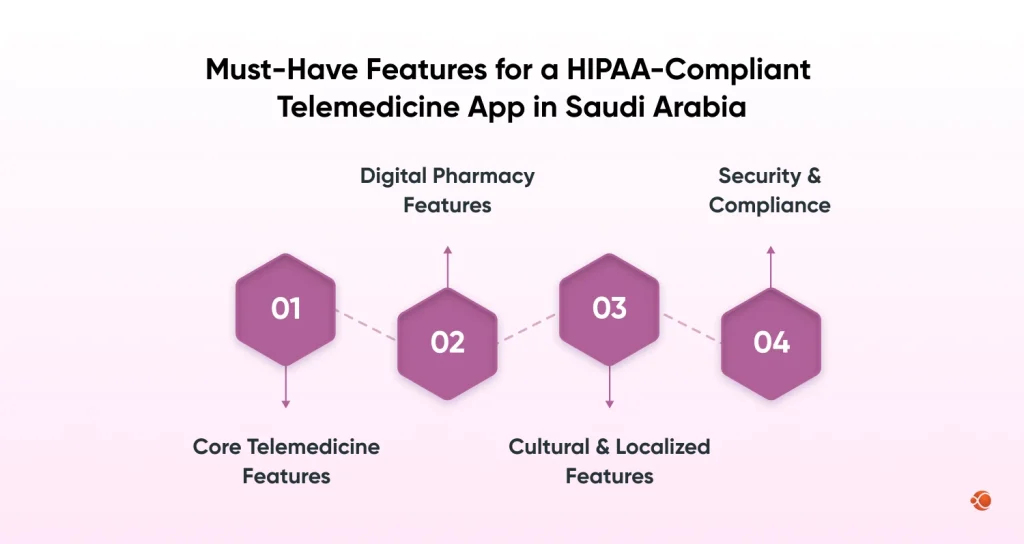
Telemedicine app development in Saudi Arabia must go beyond video calls and basic appointment booking. A feature set must align with compliance, cultural norms, pharmacy workflows, and digital care delivery expected in the Kingdom.
Core Telemedicine Features
Telemedicine platforms in Saudi Arabia must support fast, secure, and compliant care delivery while ensuring doctors, pharmacists, and patients operate within a unified system. CMARIX develops clinical-grade modules that align with the Saudi Ministry of Health’s workflows and HIPAA security standards. Any HIPAA compliant app builder must have these features:
Features include:
- Secure patient-doctor video consultations
- Digital-first patient onboarding with identity verification
- Patient medical history and EHR access (MOH-compliant)
- Symptom-based appointment routing
- AI-driven pre-consultation assessment
- Role-based dashboards (patient, doctor, pharmacist, admin)
Digital Pharmacy Features
Digital pharmacy workflows are at the core of modern healthcare delivery in Saudi Arabia, enabling accurate prescriptions, automated refills, and medication-led remote care. CMARIX builds pharmacy systems aligned with national platforms, such as Wasfaty and NPHIES.
Features include:
- Prescription management
- QR-based e-prescriptions
- NPHIES and Wasfaty connectivity
- Automated refill and medication reminders
- Integrated medication inventory and tracking
Cultural & Localized Features
HIPAA-compliant telemedicine apps for Saudi Arabia must reflect the artistic, linguistic, and behavioral expectations of the local end-users. The team at CMARIX integrates localization at the UX, clinical workflow, and consent levels, incorporating numerous local and cultural features.
Features include:
- Bilingual interface (Arabic + English)
- RTL UI/UX
- Gender preference for physician selection
- Consent-based access workflows
- Automated insurance eligibility checks
Security & Compliance
Saudi Arabia requires global-grade security aligned with HIPAA, PDPL, and national digital health regulations. CMARIX implements proactive security architecture and controlled access to protect all clinical data.
Features include:
- Data is encrypted from end to end, so it stays protected at every stage.
- Every access to PHI is recorded, giving you full visibility and accountability.
- Built to meet both Saudi PDPL and HIPAA standards, so compliance is covered.
- Multi-factor authentication keeps access secure.
- A zero-trust approach ensures that every interaction is verified, not assumed to be safe.
Types of Telemedicine Apps Emerging in Saudi Arabia
| Telemedicine App Type | Key Features | Use Cases / Applications |
| Doctor-On-Demand Telemedicine Apps |
|
|
| Pharmacy-Led Telemedicine Apps |
|
|
| Chronic Disease & Remote Monitoring Apps |
|
|
| Virtual Hospital Ecosystem Apps |
|
|
| AI-Based Symptom Checker & Triage Apps |
|
|
| Telepsychiatry & Mental Health Apps |
|
|
| Corporate / Workplace Health Telemedicine Apps |
|
|
| Telemedicine Platforms for Hajj & Umrah Healthcare |
|
|
| Virtual Care + Home Diagnostics Apps |
|
|
The Saudi Arabian healthcare ecosystem is undergoing a rapid transformation, driven by digital-first care delivery, pharmacy automation, remote diagnostics, and AI-driven workflows.
The increasing acceptance of AI-driven telemedicine apps is leading to more companies developing telemedicine apps in Saudi Arabia, which in turn offers a wider range of options to choose from. CMARIX brings expertise in developing telemedicine apps for Saudi Arabia.
1. Doctor-On-Demand Telemedicine Apps
These platforms connect patients to licensed physicians for real-time virtual consultations. They serve immediate care needs and reduce hospital dependency, which is an important priority for realizing Vision 2030 goals of KSA.
2. Pharmacy-Led Telemedicine Apps
Pharmacists in Saudi Arabia now play a larger role in remote care. These apps enable patients to receive medication guidance, digital prescriptions, and automated refill support directly from pharmacists.
3. Chronic Disease & Remote Monitoring Apps
With rising cases of diabetes, heart disease, obesity, and hypertension in KSA, remote monitoring platforms are becoming critical for long-term clinical management.
4. Virtual Hospital Ecosystem Apps
Inspired by Saudi Arabia’s SEHA Virtual Hospital model, these scalable care platforms interconnect doctors, laboratories, hospitals, and pharmacies within a fully digital clinical network.
5. AI-Based Symptom Checker & Triage Apps
These telemedicine healthcare apps utilize AI to classify symptoms and guide patients to the correct care pathway, providing a significant efficiency enhancer in a growing healthcare ecosystem.
6. Telepsychiatry & Mental Health Apps
Saudi Arabia is witnessing a growing acceptance of mental health care. These kinds of healthcare apps are generally delivered through private, secure, and HIPAA-compliant telemedicine platforms.
7. Corporate / Workplace Health Telemedicine Apps
Organizations in Saudi Arabia are now digitizing employee healthcare through custom telemedicine platforms aligned with insurance and occupational health standards.
8. Telemedicine Platforms for Hajj & Umrah Healthcare
During large pilgrimage seasons, on-demand telehealth becomes essential for managing fatigue, dehydration, injuries, and chronic conditions.
9. Virtual Care + Home Diagnostics Apps
Saudi Arabia is seeing a growing shift toward telemedicine apps that can connect with lab pickups, remote test kits, and at-home diagnostic services to provide more personalized, self-diagnosis, and health management services.
Cost to Develop Telemedicine Apps in Saudi Arabia
Here’s a rough cost estimate for building telemedicine apps in Saudi Arabia, broken down by complexity:
| App Complexity | Estimated Development Cost (SAR) | Approximate USD Equivalent |
| Basic Telemedicine MVP(video calls, appointment booking, simple EHR) | SAR 75,000 – 120,000 | ~$20,000 – $32,000 |
| Mid-Level Telemedicine App(video + e-prescriptions + payments + richer EHR) | SAR 120,000 – 250,000 | ~$32,000 – $67,000 |
| Advanced / Enterprise Telemedicine Platform(AI triage, real‑time monitoring, full compliance, multi-role) | SAR 250,000+ (potentially up to 500,000+ depending on scale & features) | ~$67,000 – $133,000+ |
| Ongoing Maintenance (Annual) | ~ 15–20% of Development Cost | Depends on initial build (e.g., $10K–$30K/year) |
Why These Costs Make Sense for Saudi Arabia
1. Feature Complexity Drives Cost
- A simple telemedicine MVP (comprising just video calls, scheduling, and user profiles) is fairly lightweight and therefore more cost-effective.
- As you add features like e-prescriptions, EHR integration, secure messaging, and payments, the development costs increase significantly.
- For advanced systems (e.g., AI symptom checking, wearable integration, continuous monitoring), you’re looking at a much higher engineering effort.
2. Compliance & Security Overhead
- Building a HIPAA-aligned system (even in Saudi Arabia) incurs non-trivial costs, including encryption, audit logging, access controls, and secure communication.
- If you’re also aligning with local Saudi health data regulations, the costs for security architecture, data residency, and legal compliance can go up further.
3. Team & Development Rates
- Where you build matters: development teams in different geographies charge very differently.
- Hiring local/regional experts may cost more per hour but brings domain knowledge (Saudi health regulations, language, cultural workflows), which can reduce risk and rework.
4. Third‑Party Integrations
- Integrating with APIs (video, payment, pharmacy, labs) adds to cost. For example, integrating video or EHR systems and e-prescribing platforms requires both engineering and licensing.
- Also, national Saudi integrations (like e-prescription platforms) may require custom work, which is costlier than off‑the‑shelf integrations.
5. Maintenance & Scaling
- After launch, a telemedicine app is not “done.” Ongoing costs include maintaining compliance, updating for new OS versions, security patches, and adding enhancements. This typically costs ~15–20% of the original development cost annually.
- Additionally, infrastructure costs for cloud hosting (especially when storing health data) can escalate as scale increases.
Implications for Telemedicine Investment in Saudi Arabia
- MVP First Strategy: For startups or pharmacy chains testing the waters, building a basic MVP (~SAR 75K–120K) is a smart way to launch quickly, check the feasibility, and iterate till optimized.
- Scaling to Full Platform: For long-term, scalable telemedicine and digital pharmacy systems with AI, multi-role users, and full compliance, the investment can vary. It’s best to reach out to a healthcare software development company that provides services for the KSA market.
- Budgeting for Growth: Companies should plan not only for development but also for ongoing maintenance, compliance updates, and infrastructure; otherwise, they risk underfunding critical post-launch operations.
- Partnership Advantage: Partnering with a healthcare app development team that truly understands how telemedicine works in Saudi Arabia helps you avoid compliance pitfalls. It also prevents costly rework, and ensures your app is built correctly from the start.
Note: Consult with a telemedicine app development company to determine the AI app development costs in Saudi Arabia, to build an AI-driven telemedicine app that is truly performative and ready to compete in today’s KSA market.
Integration Roadmap and Technology Stack Considerations for Building a Telemedicine App in Saudi Arabia
Telemedicine app development in the Saudi marketplace requires more than just a visually appealing front-end interface and video calls. Important third-party integrations, a scalable architecture, and the right technology stack are the primary considerations when developing a telemedicine app.
Key Integration Components
| Integration Area | Primary Capabilities | Compliance / Advanced Features |
| Electronic Health Records (EHR) & Hospital Systems |
|
|
| Pharmacy Networks & e-Prescription Platforms |
|
|
| Payment Gateways & Insurance Systems |
|
|
| Laboratory & Diagnostic Integrations |
|
|
| AI & Analytics Modules |
|
|
| Telecommunication & Video Solutions |
|
|
| Cloud & Security Infrastructure |
|
|
Final Words
Saudi Arabia’s telemedicine market is booming with Vision 2030 driving digital healthcare. Secure, AI-enabled, and culturally-aligned telemedicine apps are transforming patient care.
From digital pharmacies to chronic disease monitoring, the Kingdom offers immense opportunities to innovate, scale, and lead in next-generation healthcare delivery. Investing in telemedicine now positions healthcare providers and startups at the forefront of this fast-growing market.
FAQs for Building a Telemedicine App in Saudi Arabia
Is HIPAA compliance required in Saudi Arabia?
HIPAA is a US regulation, but Saudi Arabia enforces similar health data protection under the Saudi Health Information Exchange Policies and NDMO standards. Many companies still adopt HIPAA principles to align with global best practices.
What features should a HIPAA-compliant telemedicine app include?
Core features include secure video consultations, encrypted patient records, audit trails, role-based access controls, consent management, and secure electronic prescriptions. All data transmission and storage must be protected.
Can third-party APIs be integrated into a HIPAA-compliant app?
Yes, as long as they follow strict security controls, encryption, and comply with data handling regulations. Every integration must provide end-to-end protection and comply with regional privacy regulations.
How long does it take to build a HIPAA-compliant telemedicine app?
Timelines vary based on scope, integrations, and regulatory requirements. Compliance planning, security architecture, and testing typically extend the development cycle beyond standard applications.
Which cloud providers are HIPAA compliant for KSA healthcare?
AWS, Azure, and Google Cloud offer HIPAA-compliant services, including regions that meet Saudi data residency requirements. Providers must be configured properly with security, encryption, and access controls.
How much does it cost to develop a telemedicine or digital pharmacist app in Saudi Arabia?
Costs depend on the complexity, number of integrations, compliance requirements, and long-term scalability needs. Factors such as AI features, pharmacy networks, and secure infrastructure have a significant impact on the overall budget.