


Quick Summary: Microservices with Python allow teams to split one large application into small services that can be built, scaled, and released on their own. This blog walks through architecture, FastAPI project structure, Docker containerization, Kubernetes deployment, security, and observability. Also, it covers when microservices are the wrong call, so you can decide before you commit.
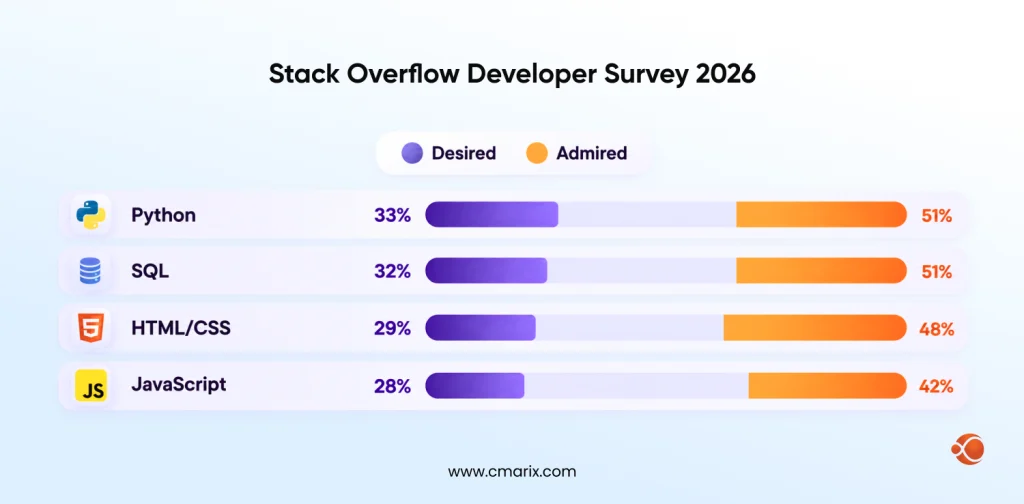
Every engineering team eventually faces the same problem. That which helped carry the product to market—the monolith—becomes the bottleneck for each new release. Microservices using Python have become a common escape from that problem, and statistics show that as well. According to the Stack Overflow Developer Survey 2026, Python remains popular: 33% want to use it, and 51% of developers admire it as a programming language.
Splitting an application is the easy part. Data ownership, service boundaries, data ownership, inter-service communication, and deployment all get harder the moment you have more than one moving piece. This guide shows how to build Python microservices step by step, from architecture and FastAPI project structure to Docker containerization and Kubernetes deployment, and it flags the spots where teams usually get stuck.
What Are Microservices?
Microservices are small, independently deployable services. Each one owns a single business function and its own data, and talks to the others through APIs or events.
Think of an application like a restaurant kitchen. In a traditional monolithic setup, the kitchen typically has only one professional chef, who is responsible for preparing every dish. If the chef becomes overwhelmed or makes a mistake, the entire operation would suffer and receive a bad reputation.
In a “kitchen” that follows microservices architecture, there would be multiple specialists working as chefs in the kitchen. The chef for appetizers could work independently of the chef for the main course, while the other chef could make dessert. In this way, all the chefs perform independently of each other, and what one does does not interfere with the results of others.
Put simply, a microservice is one small, independent service that owns a single business function. A microservices architecture is the larger application built from many of them, each run by its own team and deployed on its own, which makes the whole system far easier to manage.
Key Benefits of Implementing a Microservices-Based Architecture
- Scalability: Scale only those services that need more resources.
- Agility: Different teams can work simultaneously on different services.
- Resilience: A failure in one service/part doesn’t necessarily affect the entire system.
- Technology flexibility: Each service can be created using different languages or databases as needed.
- Independent deployment: Ship a fix to one service without redeploying the whole system.
When Microservices with Python Are the Wrong Choice
Microservices address the issues of scalability and organization. Microservices cannot solve the problem of bad code, and they are costly: more networking, more deployment, and more things to break at 2 a.m.
When one small team owns the product and can ship without hassle, it is better to use modular monoliths. You can maintain clear module boundaries, and later, when necessary, you can break off a service. One easy way to figure out where you are:
- Good signs you are ready: Various teams block each other on releases, one part of the system needs very different scaling from the rest, or a failure in one feature keeps taking down unrelated ones.
- Signs to wait: one team owns everything, the domain still changes weekly, or nobody has set up CI/CD and monitoring yet.
Our engineers design, build, and ship production-ready Python microservices.
Why Use Python for Microservices?
Correct question. Java, Go, and Node.js are all common picks for microservices, so why Python? Well, Python is rarely the fastest at raw execution, but for most services the bottleneck is the network or the database, not the interpreter. What you get is quick development, a mature library ecosystem, and first-class support for data and AI work. If you are new to the language, our explainer on “what Python is used for” covers the wider picture.
- Simplicity and Readability: Rapid development cycles and easy ramp-up for teams.
- Frameworks: Flask, FastAPI, and Django REST Framework cover everything from tiny services to full APIs.
- Rich Ecosystem: Mature libraries for data processing, AI, and ML mean a model or data pipeline can sit behind the same API as everything else.
- Container-Friendly: Python services package neatly into small Docker images and start quickly.
The honest trade-off is CPU-bound work. In standard builds, Python’s Global Interpreter Lock limits true parallel threads, so heavy computation is better handled by worker processes, native extensions, or a service written in another language.
Budgeting for a build? Our breakdown of the cost to hire a Python developer shows what to expect.
Understanding the Five Foundational Components of Microservices
| Component | Explanation |
| 1. Service Boundaries | Each microservice should have a clear, specific responsibility to prevent scope creep and complexity. This follows the Single Responsibility Principle (SRP) and supports maintainability. |
| 2. Communication | Services communicate through synchronous calls using REST APIs or gRPC, or asynchronous events through message brokers such as Kafka or RabbitMQ. |
| 3. Data Management | Each service should have its own private database to maintain independence. Databases such as PostgreSQL and MongoDB can be selected based on service requirements. |
| 4. API Gateway | The API Gateway manages external requests by handling security, rate limiting, and routing to the appropriate services. Kong and Envoy-based gateways are common options. On Kubernetes, the Gateway API provides a standard way to define routing. |
| 5. Service Discovery | Service discovery allows services to locate each other dynamically. Tools such as Consul and Kubernetes DNS automate this process and support communication between services. |
Architecture for Microservices with Python
Before any code, it helps to see the whole picture. The diagram below shows a typical layout: clients reach an API gateway, the gateway routes to independent FastAPI services, each service owns its database, services publish events through a message broker, and everything exports telemetry to one observability stack.
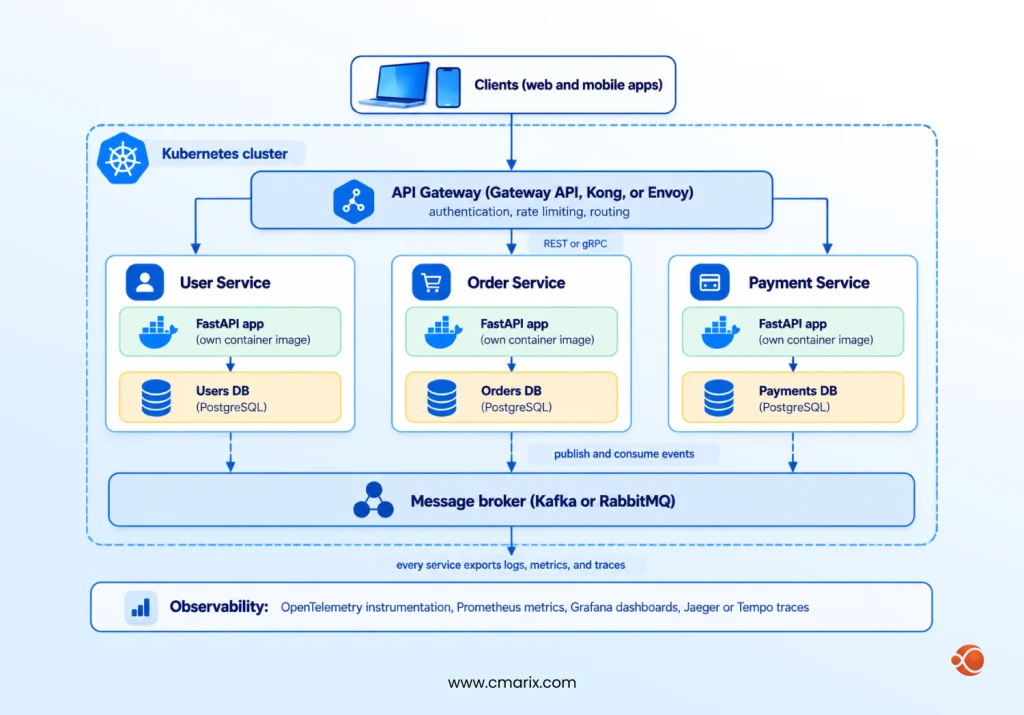
Notice what is missing: no shared database. Services never read each other’s tables, which is what keeps them independently deployable. Synchronous calls go through REST or gRPC, and anything that can happen later goes through the broker.
How Python Microservices Communicate
Once you have more than one service, how they talk matters more than which framework you picked. Python for microservices gives you solid options for all three common patterns.
| Pattern | Best For | Common Python Tooling |
| REST over HTTP | Public APIs and simple request-response calls | FastAPI, httpx |
| gRPC | Internal calls that require low latency and strict contracts | grpcio, protobuf |
| Events and messaging | Decoupled, asynchronous workflows | Kafka (confluent-kafka), RabbitMQ (aio-pika) |
These are often combined in an asynchronous microservices architecture design. One service communicates with the user using the REST protocol and publishes an event to allow billing, email, and analytics services to respond asynchronously. FastAPI async endpoints, along with an async HTTP client such as httpx, prevent one slow operation from blocking everything else.
The data side is the complex part. Each service has its own database, so one business operation may affect multiple databases, but this isn’t something that a regular database transaction can handle. Distributed data orchestration techniques come to the rescue here. The Saga pattern executes a sequence of local transactions with compensating actions in case any of them fail, and the outbox pattern stores the event and the data modification together to ensure no messages get lost. Get familiar with them at the early stages.
Handling Failures Between Services
Networks fail, and in a microservices system one slow service can drag down everything that calls it. Two tools cover most cases. Use tenacity for retries with exponential backoff, and retry only errors that are actually transient:
import httpx
from tenacity import retry, retry_if_exception_type, stop_after_attempt, wait_exponential
@retry(
retry=retry_if_exception_type(httpx.TransportError),
stop=stop_after_attempt(3),
wait=wait_exponential(multiplier=0.5, max=5),
)
async def fetch_user(user_id: int) -> dict:
async with httpx.AsyncClient(timeout=2.0) as client:
response = await client.get(f"http://user-service/users/{user_id}")
response.raise_for_status()
return response.json()
Pair retries with a circuit breaker so a dead service is not hammered with requests. The pybreaker library does this in Python code: after a set number of failures, it stops calling the service for a cooldown period and fails fast instead. If you run a service mesh, you can also configure timeouts, retries, and circuit breaking at the platform level, keeping that logic out of every codebase.
How To Set Up Microservices with Python
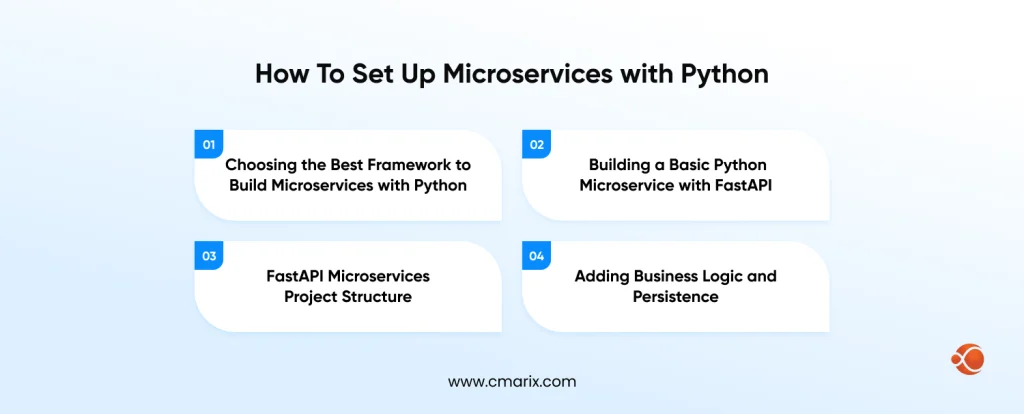
1. Choosing the Best Framework to Build Microservices with Python
These are the top Python frameworks for web development, well-suited for building microservice applications. You can go ahead with either:
- Flask offers a lightweight, minimal, and flexible architecture, usually ideal for small-scale projects.
- FastAPI is a modern and high-performance framework that supports asynchronous operations and automatic API documentation.
- Django REST Framework: Feature-rich and built on Django, DRF suits projects that need built-in authentication, serialization, and an admin panel.
| Framework | Best For | Async Support | API Docs |
| Flask | Small, simple services with full control | Limited (WSGI-based) | Requires an extension |
| FastAPI | API-first services, ML model serving, and high concurrency | Native (ASGI) | Automatic OpenAPI documentation |
| Django REST Framework | Services that need authentication, an ORM, and an admin panel | Growing, but still partial | Schema add-ons |
Picking a Python microservices framework mostly comes down to team skills and how much you want built in. Want a wider comparison that goes beyond Python? Our guide to the top microservices frameworks covers the field.
2. Building a Basic Python Microservice with FastAPI
Here is one of the Python app examples of how a simple User Service might look:
from fastapi import FastAPI, HTTPException
app = FastAPI(title="User Service")
USERS = {1: {"user_id": 1, "name": "Alice"}}
@app.get("/users/{user_id}")
async def get_user(user_id: int):
user = USERS.get(user_id)
if user is None:
raise HTTPException(status_code=404, detail="User not found")
return user
@app.get("/health")
async def health():
return {"status": "ok"}
That is a complete REST API backend in Python services form: typed path parameters, a proper 404, and automatic OpenAPI docs at /docs. The /health route looks minor, but Kubernetes will use it later to decide whether a pod is ready for traffic.
3. FastAPI Microservices Project Structure
A clean folder structure keeps each service easy to read and easy to hand over. This layout works well for most FastAPI microservices:
user_service/
├── app/
│ ├── main.py # app entry point and router setup
│ ├── config.py # settings read from environment variables
│ ├── database.py # engine and session setup
│ ├── models.py # database models
│ ├── schemas.py # Pydantic request and response models
│ ├── routes.py # API endpoints
│ └── services.py # business logic
├── tests/
├── requirements.txt
├── .dockerignore
└── Dockerfile
Keep routes thin and push business logic into services.py, so you can test it without spinning up a web server. Most teams then turn this layout into a shared FastAPI project boilerplate, a template repo that gives every new service the same logging, config handling, health checks, and Dockerfile from day one.
4. Adding Business Logic and Persistence
Connect to a database (e.g., PostgreSQL via SQLAlchemy):
from sqlalchemy import String
from sqlalchemy.orm import DeclarativeBase, Mapped, mapped_column
class Base(DeclarativeBase):
pass
class User(Base):
__tablename__ = "users"
id: Mapped[int] = mapped_column(primary_key=True)
name: Mapped[str] = mapped_column(String(100))
email: Mapped[str] = mapped_column(String(255), unique=True)
This ensures the service’s operation extends beyond that of a simple API. One such rule that comes to mind is that the database is only used by this specific service. If the order service requires any information about users, it will call the user service using the API rather than accessing the users table directly.
How to Test Python Microservices
Testing gets harder once logic is spread across services. A practical split keeps most tests fast and a few tests realistic:
- Unit tests with pytest: cover the logic in services.py. These need no web server or database and should make up most of your suite.
- API tests: FastAPI’s TestClient calls your endpoints in process, so you can check status codes, validation errors, and response shapes quickly.
- Integration tests: run the service against a real PostgreSQL instance, spun up in a throwaway container with Testcontainers, so migrations and queries are tested for real.
- Contract tests: use Pact to confirm that a consumer and a provider still agree on the API, without running both services together.
- End-to-end and load tests: keep these few. A small smoke test across services after deployment, and a Locust run before big launches, catch what the rest cannot.
Here is what an API test for the User Service looks like:
from fastapi.testclient import TestClient
from app.main import app
client = TestClient(app)
def test_get_existing_user():
response = client.get("/users/1")
assert response.status_code == 200
assert response.json()["name"] == "Alice"
def test_unknown_user_returns_404():
response = client.get("/users/999")
assert response.status_code == 404
Run these in CI before the image is built, so a failing test stops the pipeline long before anything reaches a cluster.
Containerization with Docker for Python Microservices
Microservices and containers go hand in hand. Containers ensure each service runs in isolation with its dependencies. Docker containerization also makes every environment behave the same, from a laptop to a production cluster.
FROM python:3.14-slim
ENV PYTHONDONTWRITEBYTECODE=1 \
PYTHONUNBUFFERED=1
WORKDIR /app
COPY requirements.txt .
RUN pip install --no-cache-dir -r requirements.txt
COPY app ./app
RUN useradd --create-home appuser
USER appuser
EXPOSE 8000
CMD ["uvicorn", "app.main:app", "--host", "0.0.0.0", "--port", "8000"]
1. Writing a Dockerfile
- Slim base image: start from a current release and pin the tag.
- Requirements first: copying requirements.txt before the code lets Docker cache the install layer and rebuild in seconds.
- Non-root user: a compromised container should not run as root.
- A .dockerignore file: keeps tests, virtual environments, and Git history out of the image.
2. Building and Running
docker build -t user-service .
docker run -d -p 8000:8000 user-service
The service is now containerized and can run anywhere Docker is available.
3. Using Docker Compose
For multiple services, Docker Compose helps manage them:
services:
user-service:
build: ./user_service
ports:
- "8000:8000"
environment:
DATABASE_URL: postgresql+asyncpg://app:change-me@user-db:5432/users
depends_on:
- user-db
order-service:
build: ./order_service
ports:
- "8001:8000"
user-db:
image: postgres:17
environment:
POSTGRES_USER: app
POSTGRES_PASSWORD: change-me
POSTGRES_DB: users
Two details worth noting. Current Compose ignores the old version line and warns if it is there, so it is gone from this file. And inside the Compose network, services find each other by name, so order-service can call http://user-service:8000 directly. That is microservices service discovery at its simplest. The passwords above are placeholders; real projects should pull them from a secrets store.
This allows you to spin up multiple services with one command:
docker compose up
Step-by-Step Guide on Deploying Microservices with Python
Once containerized, services need to be deployed and orchestrated in production. This is where Kubernetes deployment for microservices comes in, and where cloud-native Python applications start to pay off.

1. Container Orchestration
- Kubernetes (K8S): A popular one with scaling capabilities and resilience.
- Docker Swarm: Easier alternative for smaller setups.
- AWS ECS, EKS, Azure AKS, and Google GKE: Managed ones that don’t burden you with taking care of the control plane.
2. Deploying with Kubernetes
Basic deployment manifest for a User Service:
apiVersion: apps/v1
kind: Deployment
metadata:
name: user-service
spec:
replicas: 3
selector:
matchLabels:
app: user-service
template:
metadata:
labels:
app: user-service
spec:
containers:
- name: user-service
image: registry.example.com/user-service:1.0.0
ports:
- containerPort: 8000
readinessProbe:
httpGet:
path: /health
port: 8000
livenessProbe:
httpGet:
path: /health
port: 8000
initialDelaySeconds: 10
resources:
requests:
cpu: 100m
memory: 128Mi
limits:
cpu: 500m
memory: 256Mi
The readiness probe keeps traffic away from a pod until it can serve requests. And resource requests and limits stop one noisy service from starving the rest of the node.
Expose the service via a Kubernetes Service object:
apiVersion: v1
kind: Service
metadata:
name: user-service
spec:
type: ClusterIP
selector:
app: user-service
ports:
- protocol: TCP
port: 80
targetPort: 8000
ClusterIP keeps the service internal, and Kubernetes DNS lets other services reach it at http://user-service. Providing every service its own LoadBalancer gets expensive fast, so route outside traffic through a single gateway instead.
One current note on that gateway. The community ingress-nginx controller was retired in March 2026, and the Kubernetes project points new setups to Gateway API. If you are starting a cluster today, define routes with Gateway API and HTTPRoute objects. For production traffic spikes, add a HorizontalPodAutoscaler so replicas grow and shrink with load.
As the number of services grows, many companies hand cluster and pipeline ownership to a dedicated platform team. If you are weighing that move, our piece on the difference between platform and DevOps explains how the two roles split the work.
3. CI/CD Pipelines
When integrated with automation pipelines, deployment is greatly facilitated:
- CI/CD Tools: GitLab CI, GitHub Actions, Jenkins. For the deploy step, Helm and GitOps tools like Argo CD keep cluster state in Git.
- Pipeline Steps: Build → Test → Containerize → Push to Registry → Deploy to Kubernetes.
Teams are also adding AI assistants to this workflow for pipeline config, log triage, and release notes. Our guide to ChatGPT for DevOps automation shows where that helps and where it still needs a human reviewer.
Our DevOps and Python engineers handle containers and cluster rollout together.
Python Microservices: Observability and Monitoring
| Component | Description | Popular Tools |
| Logging | Centralizes logs from all Python microservices for easier debugging and monitoring. | ELK Stack (Elasticsearch, Logstash, Kibana), Fluentd |
| Metrics | Tracks performance indicators such as request rates, latency, and errors to monitor service health. | Prometheus, Grafana |
| Tracing | Follows requests across services to identify slow points and failures. | Jaeger, Grafana Tempo, Zipkin |
| Instrumentation | Provides a vendor-neutral standard for collecting logs, metrics, and traces from every service. | OpenTelemetry (Python SDK) |
Two habits make this table useful in practice. Write logs as structured JSON so they can be searched, and attach a request ID at the gateway that every service passes along. When something breaks, that single ID lets you follow one request across ten services in seconds.
How to Secure Python Microservices Applications
Every service is a new path into your system, so security has to be built in at each layer rather than added at the edge. The practical checklist:
- Authentication and authorization: apply authentication methods based on JWT and OAuth 2.0 with OpenID Connect. Verify tokens both at the gateway level and at the microservice level in case any microservices deal with sensitive information.
- Secure inter-service communication: encrypt inter-service traffic via mutual TLS, implemented through a service mesh such as Istio or Linkerd, and enforce Kubernetes NetworkPolicies.
- Secret management: keep API keys and database credentials in HashiCorp Vault or a cloud secrets manager. Kubernetes Secrets are only base64-encoded by default, so turn on encryption at rest if you use them. Never bake secrets into images or commit them to Git.
- Container hardening: run as a non-root user, use minimal base images, and scan images in CI with a tool like Trivy.
- Dependency hygiene: make sure that you pin down the versions, commit the lock file, and run pip-audit or Dependabot so that no vulnerabilities sneak through.
- Input validation and rate limiting: Pydantic models reject malformed requests inside the service, and the gateway throttles abusive clients before they arrive.

Best Practices to Implement Microservices in Python
- Services should be kept small and concise; avoid putting too much functionality into one service.
- Define contracts in the API using OpenAPI/Swagger.
- Automate testing and deployment in order to decrease human errors.
- Use asynchronous frameworks like FastAPI and aiohttp for I/O-heavy, high-performance services.
- Add circuit breakers and retries to handle service failures gracefully, using tenacity for backoff and pybreaker for circuit breaking.
- Versioning of APIs will allow avoiding any breaking changes.
- Documentation of services is important for collaboration.
- Retry calls should be safe; write endpoints should be idempotent, and backoff for retries should be added; otherwise, a retry would make an extra order.
- Test contracts, not just code: consumer-driven contract tests with Pact catch breaking API changes before they reach production.
- One database per service: shared tables quietly turn microservices back into a distributed monolith.
The Future of Python Microservices Development
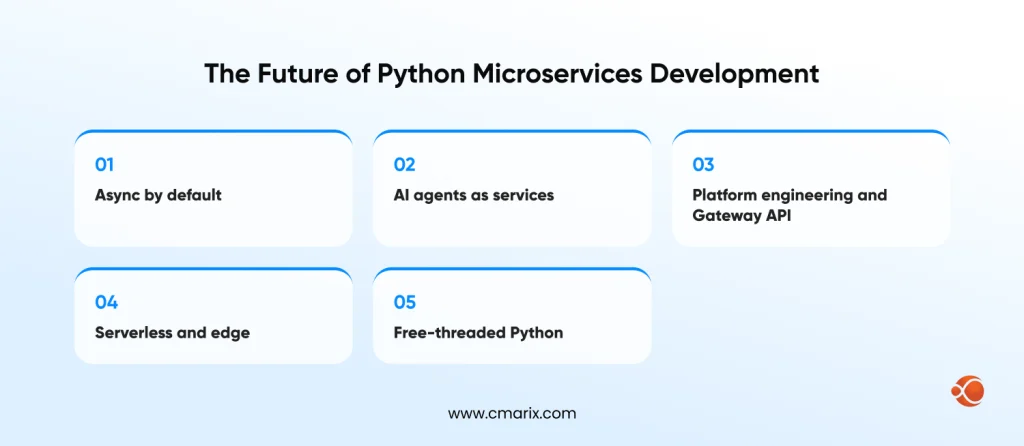
- Async by default: ASGI frameworks like FastAPI have made async the normal way to build I/O-heavy services.
- AI agents as services: Python teams increasingly wrap models, retrieval pipelines, and agent tools as their own services, and MCP servers are a growing pattern. Companies that keep sensitive data in-house run these internally, which we cover in enterprise private LLM deployment.
- Platform engineering and Gateway API: internal developer platforms abstract away the cluster infrastructure, and the Gateway API will be used as the routing standard, replacing Ingress.
- Serverless and edge: functions on platforms like AWS Lambda handle bursty workloads, and edge deployment moves services closer to users for lower latency.
- Free-threaded Python: optional builds without the GIL could widen where Python fits in CPU-heavy services as library support catches up.
Why Is CMARIX Your Ideal Python Web Development Company?
CMARIX has been building software since 2009, and as a Python web development company, our team works across FastAPI, Flask, and Django REST. Here is what you get:
- Microservices expertise: our Python programmers have defined the service boundaries, event processing, and ownership of data across various sectors.
- End-to-end delivery: from architecture and FastAPI development to Docker, CI/CD, and Kubernetes rollout, one team owns the path to production.
- Security-first approach to development: secret management, image scanning, and dependency checks are all incorporated in the process, not as an additional step.
- Integration of cloud and DevOps: practical experience in working with Azure, AWS, and GCP, including managed Kubernetes and pipeline automation.
Whether you are planning a migration or a new build, you can hire dedicated Python developers and have a team working with you from architecture through launch.
Conclusion
Microservices with Python are a strong fit for teams that need to scale, release faster, and keep systems maintainable. The way is clear once you see it: design a sound microservice architecture, build services with FastAPI, containerize them with Docker, and deploy on Kubernetes with limits, proper probes, and monitoring.
It requires planning, and it is not the right move for every team. But when the boundaries are drawn well, and the basics are automated, the payoff shows up in release speed, cost control, and resilience.
FAQs on Building Microservices with Python
What are the primary benefits of building Python microservices?
The main benefits are independent scaling, independent deployments, fault isolation, and team autonomy. You scale only the services under load and release one service without touching the rest. With Python, you also get fast development and easy containerization.
Why is Python for microservices heavily favored in data-driven backends?
Python already has the libraries data teams use, such as pandas, NumPy, scikit-learn, and PyTorch. A model or data pipeline can sit behind a FastAPI endpoint without a language switch. That keeps data scientists and backend engineers working in one language.
How does service orchestration work when configuring microservices in Python?
There are two layers. Kubernetes handles infrastructure orchestration by restarting failed ones, scheduling containers, scaling replicas, and allowing discovery through DNS. For business workflows, an orchestrator such as a Saga coordinator or a workflow engine like Temporal calls services in order and handles failures, while event-driven choreography lets services react to each other without a central controller.
What is the ideal FastAPI microservices project structure for microservices?
A good structure has an app folder with main.py, config.py, database.py, models.py, schemas.py, routes.py, and services.py, plus a tests folder, a Dockerfile, and a .dockerignore. Keep routes thin and business logic in services. Turning this into a template repo gives every new service the same starting point.
Which asynchronous options define a modern Python microservices framework?
FastAPI is usually the first solution to consider. It relies on Starlette and ASGI. There are other good alternatives: Litestar and aiohttp. In addition to the framework, there are async database drivers such as asyncpg, httpx to make outgoing requests, and aio-pika to interact with RabbitMQ.
How do you containerize a lightweight Python microservice using Docker?
Start by using a lightweight Python base image, copy requirements.txt, install packages without using the pip cache, then copy your application. Do not use the root user while running the container; also add a .dockerignore file.
What options exist for setting up secure inter-service communication?
Use mutual TLS authentication through a service mesh such as Istio or Linkerd, where the services authenticate one another, and their traffic is also encrypted. Add JWT/OAuth 2.0 tokens for authentication, along with Kubernetes NetworkPolicies to restrict what services are able to talk to each other.
How does a standard REST API layer handle request routing inside distributed structures?
The request goes to the API Gateway, where it gets validated and rate-limited and is then routed to the appropriate service based on the path or host. This is done in Kubernetes via HTTPRoute resources in the Gateway API. Within the service, the path and method are used to route the request to the handler with FastAPI, while requests to other services use DNS names.
What are the main steps to deploy microservices with Python to a Kubernetes cluster?
Create the Docker image and upload it to a registry.
Write the Deployment object with health checks and resource constraints, and create a Service object to make it accessible within the cluster.
Route outside traffic through Gateway API, store configuration in ConfigMaps and Secrets, and apply everything with kubectl, Helm, or Argo CD.
Finish by checking the rollout and adding autoscaling.
How do you troubleshoot complex database connection scaling bottlenecks at scale?
The common problem is too many connection failures and timeouts. Since each replica has its own connection pool, pool size times the number of replicas and services might exceed the maximum database connections. Scale down your connection pools, use PgBouncer for PostgreSQL, configure read replicas for read queries, use proper timeouts, and observe your pool usage through metrics.