


Quick Summary: AI medical transcription software is transforming healthcare documentation through speech recognition and NLP. This guide covers 2026 market trends, development costs, key features, implementation steps, benefits, leading AI transcription platforms, and how to build a secure, HIPAA-compliant custom solution.
With various advancements in technology, the healthcare industry has shown a significant rise in the market. The healthcare sector has advanced from keeping room after room of patient records and actual, paper-based medical paperwork to storing data digitally.
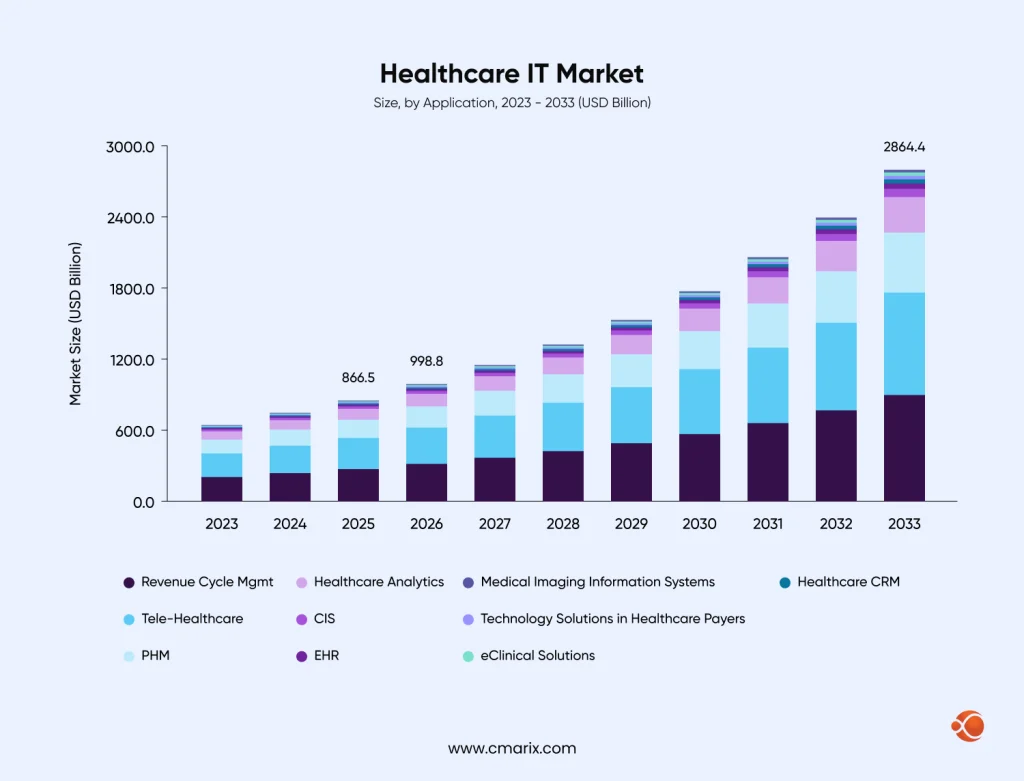
Hospitals can now use cutting-edge technologies to improve patient care and optimize their operations, thanks to next-generation AI software development services. According to Grand View Research, the overall market size for the healthcare IT industry is forecast to reach$2,864.4B in valuation by 2033.
Today, AI is a well-known and widely discussed technology in the healthcare industry, and AI solutions have helped resolve many challenges. AI for medical transcription can help hospitals and clinics detect and treat diseases more effectively and reduce management workload by automating repetitive processes.
Are you curious about AI medical transcription software development? This is the right blog to read. We will discuss this amazing AI medical transcription development and reveal AI’s enormous potential to transform medical transcription and change the way medical records are kept in the future. Let’s first look at where the market stands in 2026, then examine the costs associated with developing medical transcription AI software and the process involved.
AI Medical Transcription Market in 2026: Key Trends and Statistics
Before budgeting for a build, it helps to see where the market and the underlying pain point actually stand today. Both have moved noticeably since this guide was first published.
- Scale of the market: the total market size of medical transcription itself will be worth around $90.5 billion in 2026 and is expected to increase to $154.6 billion in 2035. Cloud deployment has become the major deployment mode. Demand comes mostly from hospitals.
- Growth of the AI segment specifically: the medical transcription AI market segment itself will be worth around $9.8 billion in 2025 and is expected to increase to $28.4 billion in 2034, with a 12.3% CAGR. The ambient AI medical scribing market segment is growing even faster, from $1.67 billion in 2026 to $8.93 billion in 2035.
- Burden of documentation: while the pandemic-era physician burnout rate has dropped, the rate remains quite high: around 42% of U.S. physicians report at least one sign of burnout in the latest AMA-based study data. A large percentage of physicians are working more than eight hours a week on EHRs after their shifts.
These numbers matter because they change the calculation for anyone weighing AI in healthcare administration against a custom build: the documentation problem is measurably worse for clinicians than it was a few years ago, and the tooling to fix it- from NLP in healthcare to ambient speech recognition- has matured enough to make ROI predictable rather than speculative.
Validate your idea, estimate development costs, and define the right AI architecture.
How Much Does AI Medical Transcription Software Development Cost?
The first thing that comes to mind when preparing to develop HIPAA-compliant transcription software is, “How much does it cost for AI medical transcription software development?” Let’s face it: there is no magic figure or set formula in this case, even though cost calculation is the most important factor. To understand in detail, let us read the factors influencing the cost.
Factors Influencing the Cost of Developing AI Medical Transcription Software
There may be a lot of variation in the cost to develop AI medical transcription software, depending on several important factors. Knowing these factors is important for accurate planning and budgeting for the development process. These are the factors that influence the cost of AI medical transcription software development:
| Factors | Description | Estimated Cost Range |
| Features & App Complexity | Advanced features like NLP and speech recognition. | $50,000 – $200,000+ |
| Platform Compatibility | Ensuring compatibility across platforms. | $20,000 – $50,000 |
| Developer Location | Cost based on the team’s location. | $25 – $150/hr |
| Third-Party APIs | Integrating external services (e.g., voice recognition). | $10,000 – $50,000 |
| Data Security | Ensuring HIPAA/GDPR compliance and encryption. | $15,000 – $50,000 |
| Maintenance & Updates | Ongoing updates and support. | $5,000 – $30,000/year |
List of Features and App Complexity
Development cost for medical software applications is directly affected by how complex or complicated the application becomes. Development of complex functions, like natural language processing for healthcare and speech recognition (ASR), takes more effort, time, and money.
Compatibility of Platforms
It takes more labor and testing to create the best voice recognition software for medical transcription that functions flawlessly on various platforms, like desktop, web, and mobile (iOS, Android, or cross-platform). Now, if you’re concerned that platform compatibility will add to the overall budget, scoping this early keeps the estimate honest.
Location of Developer
The total cost of custom app development services is significantly impacted by the development team’s geographic location. To save money, it is advised that you recruit developers from economically viable areas. Make sure they possess the necessary knowledge and development experience, though.
Integrating Third-Party APIs
The process of development could be made faster and more effective through the use of third-party APIs, for example, medical data storage APIs or speech-to-text applications (Google Speech-to-Text, Amazon Transcribe Medical, and OpenAI’s Whisper). At the same time, when integrating the Whisper API for clinical audio, one must be ready to pay license fees as well.
Data Security
Regulations like HIPAA and GDPR must be followed since healthcare data is sensitive. Because maintaining compliance is complex, strong security measures like data encryption can dramatically increase the cost of developing AI medical transcribing software. To provide you with a clear image of the situation, your AI development partner will guide you through each step.
Maintenance and Updates
To ensure the software remains up-to-date and effective post-development, maintenance, updates, and feature additions are required. To ensure your software runs effectively, it is imperative to allocate funds for updates. This is because these costs are important in fulfilling user needs, eliminating bugs, and ensuring that the software is in compliance with laws.
AI Medical Transcription Software Development – Steps to Follow
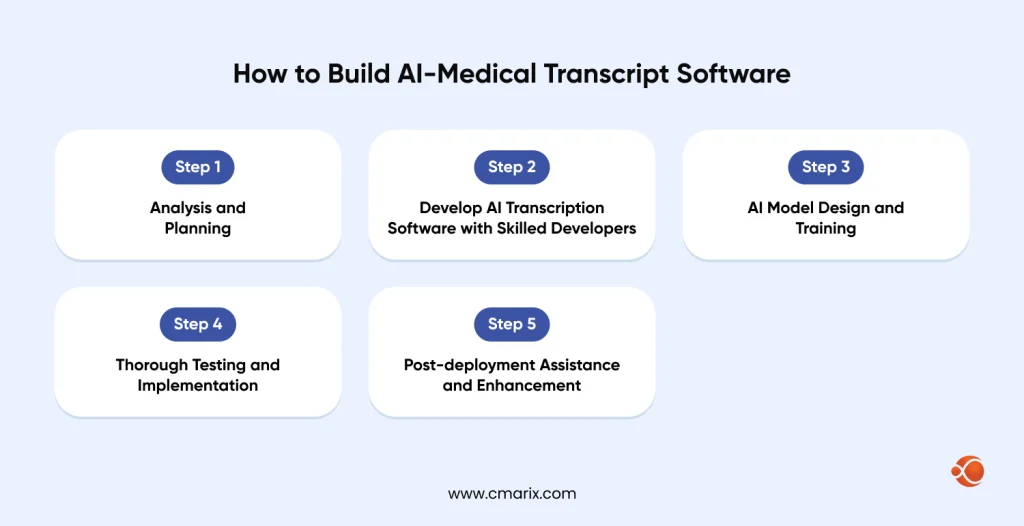
AI medical transcribing software system development can seem like a daunting undertaking, but it can be made much easier with the right strategy and professional guidance. Here’s a step-by-step guide to help you develop an accurate, efficient, and practical solution.
Let us check how an efficient healthcare software development company like CMARIX can help you with this.
Step 1: Analysis and Planning
Careful planning is the initial stage in creating AI-based medical transcribing software. It’s critical at this point to establish priorities and answer basic questions:
- What particular issues are you trying to resolve?
- What distinguishes your AI-powered transcription tool from competing products?
- What essential features would your program offer to better assist medical professionals?
We at CMARIX help you with market research, trend analysis, and turning your idea into a workable plan. This makes it easier to lay out a well-organized plan and go forward with assurance to the next stage of development.
Step 2: Develop AI Transcription Software with Skilled Developers
Creating AI-driven software takes experience. Hire AI Developers from CMARIX with expertise in software development, AI, and natural language processing. It can be challenging to find the proper people, but working with a reputed AI software development company gives you access to a group of skilled developers and artificial intelligence specialists who specialize in healthcare IT solutions. This saves a great deal of money.
Step 3: AI Model Design and Training
Your idea to build a medical tech startup starts to take shape. Creating medical documentation software with AI involves extensive training on large datasets. Here’s where to begin:
- Data Collection and Preparation: You must collect audio recordings from various medical situations while adhering to all applicable consent and compliance guidelines.
- Teach the AI Medical Language: After that, the model will be trained to identify medical terms, understand different accents, and detect minute variations in speech patterns.
- Minimum Viable Product: An MVP is the right starting point for teams worried about the cost of developing AI-powered medical transcription software.
Develop a secure, HIPAA-compliant solution with CMARIX.
Step 4: Thorough Testing and Implementation
Testing your software after development for healthcare transcription will ensure it works correctly and meets standards such as HL7, GDPR in the UK, and HIPAA in the US. These requirements need to be verified by QA specialists, as they should have been included right from the start.
Deploy the artificial intelligence transcription software solution once QA verifies functionality and compliance. Allow doctors to begin using the program for internal use right now. Launch it to your target market if it’s a commercial product.
Step 5: Post-deployment Assistance and Enhancement
Using AI in medical transcription software isn’t the end goal. It marks the beginning of a continuous process to maintain the relevance of your product in the constantly changing healthcare environment.
Benefits of AI in Medical Transcription
AI-powered healthcare startups are looking for efficacy and efficiency in healthcare documentation in several important ways. The following are the main benefits:
Accuracy in Documentation
Transcription errors can occur due to the complexity of medical language and the ambiguity of some audio files. Misinterpretations can affect treatment options. Luckily enough, AI transcription services can assist in the comprehension and transcription of medical language.
Expanding Accessibility
Different languages, accents, and background noise in audio recordings are difficult for traditional transcription techniques to handle. This results in inaccurate or incomplete paperwork. To be accessible in a variety of healthcare settings, AI transcription is now trained to identify different accents, dialects, and speech patterns. It adjusts to difficult audio sources by producing reliable results.
Cost-efficiency
It can be costly to hire qualified transcriptionists or outsource transcribing services, especially for major healthcare facilities. AI software reduces the need for manual effort. If you believe your organization cannot afford AI medical transcribing software, weigh it against the long-term advantages. AI transcription automates the process, lowering operating expenses without sacrificing quality.
Maintaining Compliance
It can be difficult to stay in compliance with healthcare laws like HIPAA and GDPR, particularly when managing private patient information by hand. Nonetheless, AI transcription solutions that adhere to industry requirements include data encryption, automated logging, and safe data storage. This lowers the risk of regulatory violations by ensuring secure data processing and storage on a HIPAA-compliant AI platform.
Improved Medical Treatment
Errors or delays in medical transcription could lead to delayed treatment or diagnosis, which affects patients’ health. The artificial intelligence system used in transcription provides an accurate and instantaneous transcription process that enhances the delivery of treatment to patients.
Top AI Medical Transcription Tools and Platforms to Watch in 2026
| AI Medical Transcription Tool | Key Features | Best For |
| Nuance DAX Copilot | Ambient AI documentation, real-time note generation, deep Epic/EHR integration, Microsoft cloud infrastructure | Large hospital networks and health systems using Epic or Microsoft ecosystem |
| Abridge | AI-generated clinical notes, specialty-aware documentation, continuous learning, enterprise deployments | Multi-specialty health systems requiring structured documentation |
| Suki AI | Voice-first assistant, voice commands for notes and orders, quick onboarding, multi-specialty support | Independent physicians, clinics, and small healthcare practices |
| Ambience Healthcare | Specialty-specific templates, structured clinical documentation, standardized workflows | Health systems managing multiple clinical specialties |
| Augmedix | AI-assisted transcription with human QA, remote medical scribing, accuracy verification | Organizations seeking AI efficiency with human-reviewed documentation |
Buying off the shelf is a reasonable first step for many organizations. Here are five platforms shaping the AI medical scribing and transcription space right now, alongside where each tends to fit best.
Nuance DAX Copilot
Microsoft-owned ambient documentation assistant built for large hospital systems already running on Epic or another major EHR.
- Ambient listening during the patient visit with real-time note drafting.
- Deep, native integration with Epic and other major EHR platforms
- Backed by Microsoft’s cloud and compliance infrastructure
- Best for: Large hospital networks and health systems standardized on Epic or Microsoft cloud services.
Abridge
Generative AI clinical documentation platform used by large health systems, including a recent Kaiser Permanente rollout aimed at cutting clinician administrative load.
- Converts patient-clinician conversations into structured, specialty-aware notes
- Built-in feedback loops so notes improve with continued use.
- Enterprise-grade deployments across multi-specialty health systems
- Best for: Multi-specialty health systems that want structured note generation at scale.
Suki AI
Voice-first AI assistant positioned as a lighter-weight option for practices that want fast time-to-value.
- Voice commands for orders, notes, and administrative tasks.
- Designed for quick onboarding without a heavy IT lift
- Works across a range of specialties and practice sizes
- Best for: Independent physicians, small practices, and clinics without dedicated IT teams.
Ambience Healthcare
Ambient documentation platform built around specialty-specific templates and structured data capture.
- Specialty-tuned templates across dozens of clinical areas
- Structured, codeable output rather than free-text notes alone
- Positioned for health systems running multiple specialties on one platform
- Best for: Health systems that need consistent documentation across many specialties.
Augmedix
Blends AI-assisted transcription with a human-in-the-loop review layer for quality assurance.
- Remote medical scribing combined with AI drafting
- Human QA pass before notes reach the chart.
- Useful where full automation isn’t yet trusted for every note type
- Best for: Organizations that want AI speed with a human accuracy check before notes are finalized.
Off-the-shelf platforms solve the general case well, but none of them is built around your specific EHR schema, speciality mix, or compliance stack. That’s usually the point where a custom AI software development partner becomes the more durable investment. Talk to CMARIX about a custom build if an off-the-shelf tool doesn’t fit your workflow.
Why Choose CMARIX as your Healthcare Software Development Company?
With years of experience developing AI-powered medical software, CMARIX has the know-how, resources, and portfolio to meet your needs. Hire dedicated developers from CMARIX to help you with AI medical transcription software development.
Our team creates the most effective solution based on your requirements, using AI/ML, IoT, and other technologies as needed. We aim to deliver quality services and robust software solutions within the project timeline. To know more about our medical device software development, contact us today.
A few reasons healthcare teams choose CMARIX specifically for AI-driven documentation projects:
- Established track record: operating since 2009, ISO 9001:2015 certified for quality and ISO 27001 certified for information security, both relevant when handling protected health information.
- Healthcare portfolio: delivered projects including Stryker Healthcare and Nutranext Healthcare & Wellness, alongside a dedicated healthcare software development practice covering EMR/EHR, telehealth, and clinical decision support.
- Full AI/ML stack: in-house experience with TensorFlow/PyTorch, LangChain, vector databases, and OpenAI integrations, including dedicated Whisper API integration work for speech-to-text builds.
- Cost-effective delivery: a hybrid engagement model with project managers based in the US, UK, Italy, Australia, Bahrain, and Nigeria, paired with development delivery out of India — typically up to 60% more cost-effective than a local vendor.
- Total ownership: clients receive complete source code and intellectual property rights on delivery, with no vendor lock-in.
Final Words
This is your ultimate guide to developing AI medical transcription software. If you want to build more smart healthcare IT solutions, you should look for a reliable Healthcare software development company with experience working with different healthcare specialists, meeting their compliance needs, meeting industry standards, and delivering tailored software solutions for the healthcare industry.
FAQs for Developing Medical Transcription Software
How much does AI medical transcription software cost?
Depending on feature complexity, developer location, and other factors covered above, AI medical transcription software development can typically range from $30,000 to $250,000. You can control expenses while providing a reliable and effective service by outsourcing healthcare software requirements to professionals like CMARIX.
Is AI medical transcription software HIPAA-compliant?
Yes. Many AI medical transcription software options are HIPAA-compliant. These regulations, combined with modern advancements, ensure complete compliance and patient data security.
What is the future of AI in medical transcription?
The future of AI in medical transcription is already here. As new technologies and tools have taken their place in the healthcare industry, automated medical transcription is widely used to ensure accuracy, efficiency, and real-time documentation, freeing healthcare professionals to focus more on patient care.
Can I use AI for medical transcription?
AI can be used for medical transcription. AI-powered solutions can automatically convert medical dictation into written text. This can enhance the precision and effectiveness of medical documentation.
What are the best AI medical transcription tools available in 2026?
Category leaders currently include Nuance DAX Copilot, Abridge, Suki AI, Ambiance Healthcare, and Augmedix, each suited to a different mix of health system size, EHR platform, and specialty coverage. Organizations with unique EHR, workflow, or compliance requirements often find a custom-built solution fits better long-term.
How is ambient AI scribing different from AI medical transcription?
Ambient AI scribing listens passively during the patient visit and drafts a structured clinical note in real time. Traditional AI medical transcription converts dictated audio or a recorded encounter into text after the fact. Many modern platforms now combine both approaches.