


At-a-glance view: Struggling with slow, hard-to-maintain enterprise applications? React.js for enterprise applications solves performance bottlenecks and scalability challenges through its Virtual DOM and component-based architecture. Leading companies like Netflix and Airbnb use React to build fast, maintainable solutions. Discover how React’s proven ecosystem addresses your development pain points and accelerates digital transformation.
Leading global enterprises, from financial platforms to streaming giants, are increasingly standardizing their front-end architecture on React.js for enterprise applications. This JavaScript library, maintained by Meta(formerly Facebook), has transcended its initial purpose to become the foundational layer for some of the world’s demanding and intricate digital experiences. Its architectural simplicity with its advanced features makes it the most favorite framework for organizations seeking high-performance, maintainable, and highly scalable front-end development with React.
What Is Driving the Rise of React.js in Enterprise Solutions?
The shift towards modern, highly interactive web applications necessitated a change from traditional monolithic frameworks. React.js for enterprise applications provides a compelling alternative by focusing purely on the view layer and introducing a revolutionary way to handle UI updates. Its pragmatic approach and quick learning curve have won over developers.
For large organizations, this meant improved user interfaces, faster development cycles, and the ability to develop sophisticated applications that could rival native desktop experiences, all within a standard web browser. The promise of building modular systems for React for digital transformation has solidified its place as a market leader.
React’s Main Use Cases in the Enterprise
| Use Case | Description | Examples |
| Large-Scale Web Applications | Works well for platforms that need stable performance, smooth UI interactions, and regular updates. | Dashboards, booking platforms, CRM tools, SaaS interfaces. |
| Single-Page Applications (SPAs) | Helps build apps where content updates without full page reloads, providing a seamless, desktop-like feel. | Project management tools, note-taking apps, learning platforms. |
| Complex User Interfaces With Many Components | Ideal when a product has reusable elements like buttons, forms, tables, cards, modals, and layouts. Teams can build and maintain UI components that stay consistent across the product. | Design systems, multi-step forms, complex data grids. |
| Real-Time Applications | Useful for features that require data to refresh live and efficiently. | Collaboration tools, live tracking dashboards (e.g., stock market or delivery), chat apps. |
| Media Streaming Interfaces | Fast rendering and smooth browsing make React an ideal choice for both video and audio streaming services. | Streaming UIs, playlist builders, watch-lists. |
| E-commerce & Product Catalogs | Great for dynamic and highly interactive features. | Dynamic filters, sorting, custom product pages, cart updates, and checkout flows. |
| Cross-Platform Apps | Using React Native (and React Native Web), teams can ship web, iOS, and Android apps from a shared foundation, maximizing code reuse. | Shared business logic and UI components across web and mobile. |
| Marketing Websites & Landing Pages | Helps build fast-loading, SEO-friendly marketing pages when used with frameworks like Next.js. | Corporate websites, high-conversion landing pages. |
| Interactive Data Visualizations | Integrates well with dedicated libraries for complex graphical representation of data. | Charts, graphs, and analytical dashboards using D3.js, Recharts, and Chart.js. |
| Design Systems & Component Libraries | Widely used by companies to build their own internal UI libraries that multiple teams can consume, ensuring brand consistency. | Centralized component repositories (e.g., Storybook). |
We build scalable, high-performance React.js enterprise applications with secure architecture and future-ready UI experiences.
Contact UsTop 9 Reasons for React.js Driving Enterprise Adoption
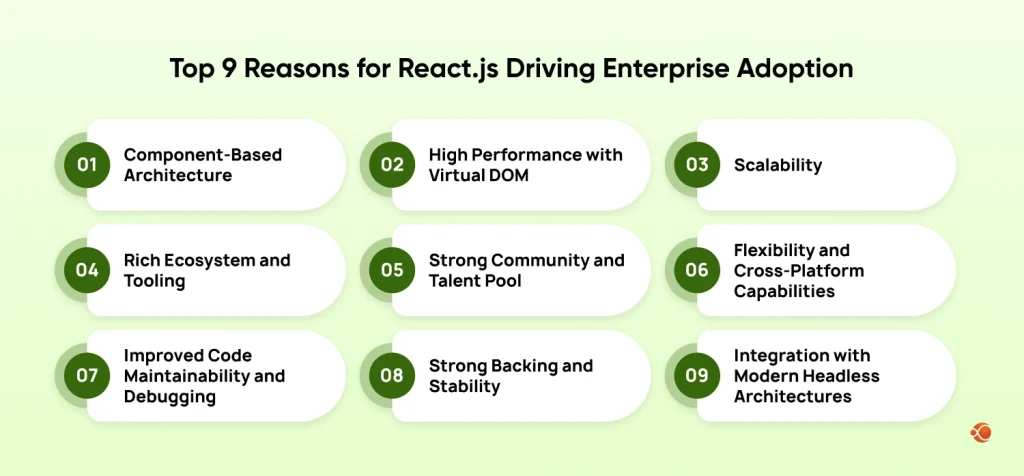
The popularity of React isn’t just about hype; it’s about the main technical advantage that directly addresses the pain points of building and maintaining complex web application framework solutions. Understanding why enterprise uses React.js comes down to these concrete benefits.
1. Component-Based Architecture
With React’s component-based architecture, developers are able to build UI from isolated, independent, reusable pieces. This structure is important for large teams working on huge applications.
- Modularity: Each component manages its own logic and state, preventing unintended effects on the application.
- Reusability: Components can be shared across different pages and projects, speeding up the development and making a consistent look and feel.
2. High Performance with Virtual DOM
React’s use of the virtual DOM for performance optimization is the major selling point for high-traffic enterprise applications where responsiveness is crucial.
- Efficiency: The virtual DOM is an in-memory representation of the real DOM. When data changes, React calculates the most efficient way to update the real DOM by comparing the current and previous virtual DOM trees.
- Speed: Only the necessary elements are updated, minimizing direct interactions with a slow browser DOM. This make sure fast rendering and a smooth user experience, even with frequent data updates common in real-time dashboards of trading platforms.
3. Scalability
The component model naturally leads to scalability. As the application grows, new components are simply added without breaking the existing ones. Furthermore, smooth integration with sophisticated architectural patterns like micro frontend development with React.
- Micro-Frontends: An Enterprise can break down a large, monolithic application into smaller, independently deployable units managed by different teams. This reduces friction, speeds up releases, and allows teams to scale development efforts independently.
4. Rich Ecosystem and Tooling
React benefits from an enormous and mature ecosystem. This abundance of pre-built solutions and tools reduces the need for building everything from scratch.
- Libraries: A stable supply of industry standards libraries exists for routing, form handling, and styling.
- Developer Experience and Tooling: React developers’ tools browser extensions allow developers to inspect component hierarchy and state, accelerating the debugging process.
5. Strong Community and Talent Pool
The widespread adoption of React means a robust community is ready to provide support, share knowledge, and continuously improve the library. This directly impacts talent acquisition.
- Recruitment: A large talent pool of skilled developers exists, making recruitment and onboarding for React enterprise-level projects less expensive and easier than frameworks with smaller followings.
6. Flexibility and Cross-Platform Capabilities
React is not just limited to web browsers. And its principles extend to other platforms through specialized tools.
- SEO-Friendliness: For applications that can rely on search engine visibility, SEO-friendliness is important. React can be rendered on the server or built as static pages using meta-frameworks like Next.js. This makes sure that search engine crawlers can easily index the content, resolving a common challenge of traditional single-page applications (SPAs).
7. Improved Code Maintainability and Debugging
The structure of React components, where logic and UI are closely related, improves code maintainability and debugging.
- Declarative View: Components describe what the UI should look for in a given state, rather than how to change it. This makes the code easier to read, understand, and predict.
- Strict Rules: The unidirectional data flow simplifies tracking down bugs, preventing the kind of “spaghetti code” that plagues large, stateful applications built with much older technologies.
8. Strong Backing and Stability
The library’s origin and consistent support from Meta provide reassurance to risk-averse enterprises.
- Stability: Meta uses React internally for products like Instagram and Facebook, making sure that the library stays stable, secure, and continuously receives updates and performance enhancements. This strong backing and stability are essential factors for long-term technology decisions.
9. Integration with Modern Headless Architectures
React is perfectly suited for modern architectures, where the front-end is decoupled from the back-end content source. This makes React integration with cloud and APIs a natural fit for enterprise systems.
- Decoupling: This separation allows the front-end to focus on presentation and interactivity while the back-end can be optimized for content delivery. React interacts with cloud and APIs, allowing faster content delivery and more flexible deployment strategies. This is a powerful combination for building React for SaaS application development.
We help enterprises create modern, scalable, and high-performance digital experiences using React.js.
Contact UsReact Ecosystem and Community Advantage
The surrounding ecosystem is often as important as the library itself, and React’s is arguably its most significant competitive advantage. For any web app development company, this ecosystem provides the foundation for rapid, reliable development.
Vast and Mature Ecosystem
The vast array of tools available makes sure that almost any enterprise requirement can be met with an established solution. This includes libraries for complex data visualization and established UI frameworks that provide pre-tested, accessible components, drastically reducing development time. The availability of stable, industry-standard libraries provides stability and minimizes risk.
Corporate Backing and Stability
The fact that Meta provides corporate backing and stability is a non-negotiable factor for large organizations making multi-year investments in technology. They are assured of:
- Long-term Support: The library won’t suddenly be abandoned.
- Continuous Innovation: Features like Concurrent Mode and Hooks demonstrate a commitment to pushing the boundaries of what is possible on the web.
Large Talent Pool
The number of skilled and experienced developers in the market who know React is unmatched by most competitors. This talent pool makes the project staffing easier and reduces the overhead expense of training new team members.
Developer Experience and Tooling
React prioritizes a pleasant and particular workflow for developers. Testing is the cornerstone of high-quality enterprise code, and the ecosystem delivers.
- Testing Libraries: Tools like Jest and React Testing Library encourage developers to write tests that resemble how users actually interact with the components, resulting in more robust, less fragile code.
- Hot Reloading: This particular feature allows developers to see the results of their code changes instantly without refreshing the page, which significantly boosts productivity.

Market Statistics Proving React’s Dominance in Enterprise Front-End Development
This section provides quantitative data demonstrating React’s dominance, developer preference, economic value, and technical superiority in the enterprise landscape.
Global Developer Survey Results (Usage, Satisfaction, Retention)
- Developer Usage: React remains the most widely used web framework, reported by 39.5% of developers in the Stack Overflow Developer Survey. This widespread adoption makes sure a large talent pool and strong community support.
- Popularity Ranking: React is also heavily represented across live websites, with millions of active sites using it. BuiltWith estimates over 11+ million websites built with React as of recent scans.
Market Share and Growth Trends Compared to Competitors (Angular, Vue)
- Market Share: Industry usage trackers such as W3Techs show React maintaining a notable lead among JavaScript UI libraries across the web. React also continues to outpace Angular and Vue in developer adoption across community surveys.
In addition, W3Techs’ JavaScript library breakdown shows that 7.7% of websites using a detected JS library rely on React. This reinforces React’s position as one of the most frequently implemented UI libraries on the internet.
Enterprise Job Market Demand and Salary Trends
A worldwide job listing snapshot on LinkedIn shows 133,000+ React.js job postings globally. In India alone, LinkedIn lists 16,000+ React.js developer jobs. Globally, full-time developers’ salaries range from $180,000 to $250,000 yearly.
Performance Benchmarks and Load Times
React’s performance advantages come from its selective rendering approach and Virtual DOM, allowing any UI updates to run more effectively without DOM operations. The benchmarks vary as per use case; React’s rendering model is recognized widely for supporting fast, interactive experiences across complex interfaces.
Challenges and Mitigation Strategies in Enterprise React Adoption
No technology is without difficulties. When you hire React developers and scale your team, you need strategies to manage the specific challenges that arise.
Addressing State Management Complexity
As applications grow, managing the data that flows through the component can become complicated.
- Mitigation: Enterprises standardize on solutions like Redux or, for simpler cases, using the built-in context APIs or modern libraries like Zustand. These tools give clear patterns for managing application-wide data, making it easier to debug and predict.
Strategy for Managing Component Library Consistency and Design Systems
Maintaining a uniform look and feel across hundreds of components and multiple teams is difficult. Following React security best practices during this process is equally important.
- Mitigation: Companies establish a centralized design system. Tools like Storybook are essential here, providing a sandbox environment for documenting, viewing, and testing components in isolation, making sure consistency and accelerating the work of both developers and designers.
Mitigating Tooling and Build Configuration Overhead
React itself is lightweight, but the tooling required to build a modern enterprise-ready application can be intricate to set up and maintain. This is where front-end development services become valuable.
- Mitigation: The overwhelming majority of enterprises now avoid configuring raw tooling like Webpack themselves. Instead, they rely on opinionated meta-frameworks like Gatsby and Next.js. These solutions handle complex routing, code splitting, server-side rendering, and build optimization out of the box, significantly reducing tooling and build configuration overhead.
Performance Optimization Techniques for Large Component Trees
Poorly structured React code can degrade performance, especially when many components are rendering simultaneously.
- Mitigation: Developers use specific performance optimization techniques. Key strategies include:
- Memoization: Using useMemo or React.memo to prevent unnecessary re-rendering of components when their props haven’t changed.
- Code Splitting: Using dynamic imports to break the application bundle into smaller chunks that are only loaded when needed, improving initial load times.
- Virtualization: Utilizing libraries for rendering only the visible items in long lists.
The Future of Enterprise React: Server Components, Concurrency, and Beyond
React continues to evolve, with core team features focusing on concurrency and server components. This powerful advancement promises even greater performance gains and a more integrated, smooth approach to data fetching and state management, directly benefiting React for enterprise-level projects. For providers of custom software development services, staying current with these innovations is critical. The React ecosystem benefits will only compound over time, making it easier to build high-quality web applications.
Deepening Server-Side Capabilities with React Server Components (RSC)
The introduction of React Server Components (RSC) represents a huge architectural shift with major implications for enterprises.
- Performance Advantages: RSC allows parts of UI to render entirely on the server before being sent to the client. This reduces the amount of JavaScript that needs to be downloaded and parsed on the user’s device, which improves initial load times and overall performance, a critical factor for delivering a superior user experience in complex applications.
- Simplified Data Fetching: It allows developers to directly fetch data within the components that need it on the server, simplifying data flow and smooth React interaction with the cloud and APIs. This paradigm is poised to become the new standard for modern web application architecture.
Concurrency and Enhanced User Experience
React’s move towards concurrency is a technical advancement that directly improves the interaction of users with the application.
- Responsive UI: Concurrency allows React to interrupt a lower-priority rendering task to handle a high-priority task, preventing the UI from freezing. This results in a smoother, more responsive interface, especially in data-intensive, complex web application framework environments.
- Improved Transition: It supports smooth transitions and loading states without jarring delays, important for maintaining user satisfaction in React for large-scale applications.
Unifying Web and Mobile Strategy with React Native
React Native is not just a secondary feature; it is an intrinsic part of the enterprise value proposition. Implementing React Native for a cross-platform strategy gives companies a competitive advantage.
- Code Reutilization: As enterprises prioritize integrated digital presence, the ability to share logic and even some UI components between their web applications and native mobile apps via React Native for a cross-platform strategy provides unmatched development velocity and consistency. This unified approach reduces maintenance overhead and speeds up time-to-market for new features across all the platforms.
Why Choose CMARIX for Your React.js Development Needs?
For enterprises standardizing on React.js for enterprise applications, selecting the right React.js development company is key to success. CMARIX offers focused, strategic expertise that accelerates React for digital transformation.
Enterprise-Grade React Expertise
CMARIX possesses a deep and proven track record in delivering high-quality, complex web applications.
- Scale and Experience: With 360+ ReactJS projects and over 1400+ custom web projects, we ensure the stability and robustness required for React for enterprise-level projects.
- Specialized Talent: Our team of 45+ ReactJS experts uses advanced tooling and modern languages like TypeScript and GraphQL to build high-performance solutions.
Modern Architecture Implementation
They ensure your application is built for the future by implementing advanced architectural strategies.
- Micro Frontends: Expertise in Micro frontend development with React for breaking down monoliths and achieving greater development agility.
- Performance Focus: Utilization of Server-Side Rendering (SSR), PWAs, and React Suspense to optimize load times and user experience.
Strategic Partnership and Quality Assurance
CMARIX provides a full development lifecycle with a commitment to quality and secure deployment.
- End-to-End Delivery: A comprehensive process covering planning, UX/UI design, development, multi-level testing, and continuous deployment using DevOps tools.
- Flexible Models: Providing scalable engagement models, including dedicated developer hiring, to smoothly integrate with your existing teams and deliver long-term support.
Concluding Lines
The decision to choose React.js for enterprise applications is a very strategic one, which is deeply rooted in its technical superiority for solving complex real-world problems. Its virtual DOM for performance optimization delivers speed; its component model make sure scalable front-end development with React and maintainability. And its enormous mature ecosystem gives stability and a talent pool required to staff multi-year initiatives. When considering React vs Angular for enterprise apps, React’s flexibility and ecosystem often tip the scales. By adopting React, enterprises are not just adopting the technology, but they are also adopting a proven methodology for developing the next generation of digital products.
Frequently Asked Questions About React.js for Enterprise Applications
Why are enterprises increasingly choosing React.js for large-scale applications?
Enterprises favor React for its component-based architecture and Virtual DOM, which together ensure superior performance and easy code maintenance at scale. Its massive, mature ecosystem and large talent pool also reduce development risks and costs associated with staffing and tooling.
How does React ensure high scalability for digital solutions?
React’s modular components allow development teams to easily add features without disrupting the current codebase. This structure naturally supports modern scaling patterns like Micro Frontends, allowing independent deployment of application segments.
Can React integrate with cloud platforms, APIs, and microservices?
Yes, React integrates seamlessly with all modern backend systems, using standard JavaScript libraries like Axios or Fetch for API communication. It serves as the ideal front-end for cloud-native microservices architectures, fetching data via REST or GraphQL endpoints.
How secure is a React.js application for enterprise use cases?
React is inherently secure against common risks like Cross-Site Scripting (XSS) through automatic data binding and escaping in JSX. High enterprise security relies on following best practices, such as using HTTPS, securing API tokens in HttpOnly cookies, and regular dependency audits.
Why do fast-growing SaaS companies prefer React for their front-end?
SaaS companies prioritize fast load times and a responsive user experience (UX), which React’s efficient Virtual DOM inherently delivers. Its flexibility and extensive library of UI components allow teams to quickly iterate on features and pivot product designs rapidly.
How much does it cost to build an enterprise app using React.js?
The cost changes based on complexity, features, and developer location, but a typical complex enterprise application can range from $50,000 to over $150,000 (approx). The final figure is a function of total development hours multiplied by the team’s hourly rate, plus ongoing maintenance fees.
For a large application, should we choose a full framework like Angular or a library like React?
While Angular provides a complete, opinionated structure suitable for teams needing standardization, React gives greater flexibility to select the best-in-class libraries needed for custom solutions. React’s lighter learning curve often translates to faster developer onboarding and a larger talent pool.
How does React’s component reusability impact the time-to-market for new features?
Component reusability dramatically improves development by allowing developers to build new pages and features using pre-tested, standardized UI blocks. This reduces the need to write new code for common elements, cutting development time and speeding up the time-to-market for product updates.