


Quick Summary: Curious how apps can scale automatically without managing servers? Wondering how top companies handle massive traffic efficiently? This blog dives into serverless architecture, exploring key platforms, real-world examples, best practices, and how serverless can make applications faster, flexible, and highly reliable.
Amazon launched AWS Lambda back in 2014, which first introduced the concept of “serverless architecture” and provided the first mainstream model, “Function-as-a-Service (FaaS). Since then, serverless computing has evolved from a niche idea into a mainstream approach for building modern applications. It removes the complexity of server management, enabling businesses and developers to focus entirely on writing code and delivering value, while trusting cloud providers to handle scaling, availability, and infrastructure maintenance.
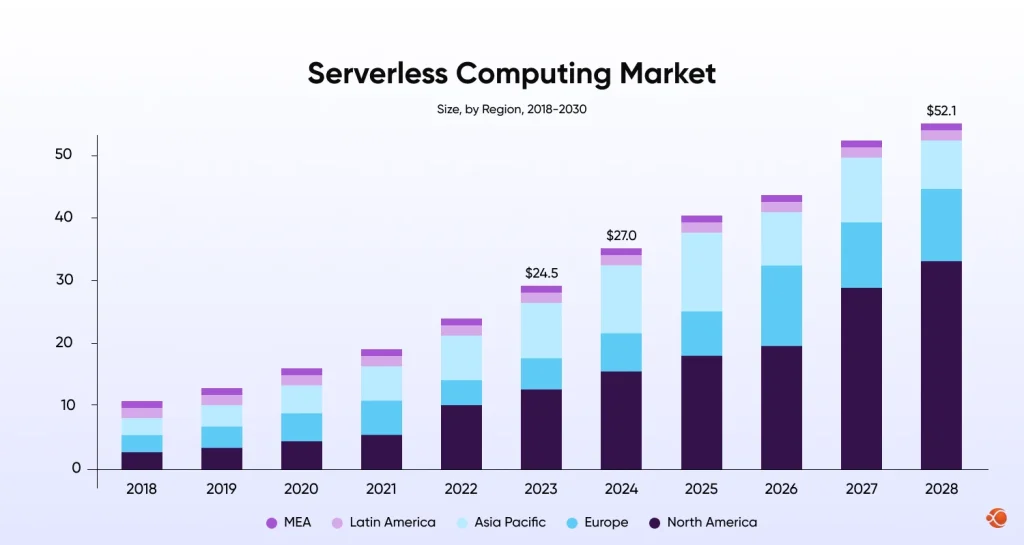
As we move towards 2026, the current landscape and future of serverless architecture are no longer a cost-saving strategy. It has become an architecture best practice for agile, event-driven development that powers everything from microservices and APIs to AI-powered applications. In fact, the global serverless computing market was valued at USD 27.00 billion in 2025 and is forecasted to reach over USD 52.13 billion by 2030.
CMARIX has worked with numerous enterprises to implement robust serverless architecture for improved deployments and scalability, and to build high-performance applications that respond dynamically to evolving business needs.
Today, with this ultimate guide on serverless architecture, we aim to provide business owners, developers, and decision-makers with a proper understanding, key considerations, technology choices, and real-world examples to shape their strategy and make optimal choices for their business.
What is Serverless Architecture with an Example?
Serverless architecture is an architecture approach that allows applications to run without needing developers to manually manage the servers. Instead of handling provisioning, maintaining infrastructure, and undertaking such tasks, developers can focus on writing functions or services that the cloud provider automatically executes in response to any event.
This abstraction approach lifts the complexities and efforts of managing servers, freeing teams to focus entirely on refining the code and business logic.
Practical Example for Integrating Serverless Ecommerce Platform
Imagine an eCommerce platform that sends order confirmation emails whenever a customer places an order. A software development company can fine-tune a serverless setup, where a cloud function triggers automatically when a new order is created in the database. The function sends the email and scales seamlessly, whether there’s one order or thousands at the same time, without needing the developer to manage any servers.
The Switch From Server to Serverless Architecture
Moving from a traditional server-based architecture to serverless is a monumental shift in how applications are built and operated. In a server-based setup, the developers set up virtual machines or containers, configure operating systems, and handle scaling and maintenance tasks. Such an architecture strategy provides complete control, but comes with high operational costs and slower deployment cycles.
How Serverless Computing Architecture Changes The Game:
- No manual server management: The cloud provider automatically handles provisioning, patching, and scaling.
- Event-driven execution: Function only runs when triggered, eliminating idle resource costs.
- Pay-as-you-go billing: Companies only pay for the compute and storage they use, rather than always-on servers.
Serverless Architecture Example: A content streamlining service on traditional servers may need to over-provision instances for managing peak traffic, which can lead to underused resources during off-peak hours. With serverless, the same service can automatically scale functions to match demand, and reduce costs when the demand is lower, improving cost-efficiency.
How Does Serverless Architecture Actually Work?
Serverless applications usually rely on the Function-as-a-Service model. Each function works as a discrete unit of code that gets triggered by events.
Key Components of Serverless Architecture
| Component | Description |
| Functions | Small, independent units of code that execute quickly and statelessly. |
| Event Sources | Triggers that automatically invoke functions, such as API Gateway, message queues, or IoT devices. |
| Managed Services | Databases, authentication systems, and storage fully integrated with serverless platforms. |
Event-driven execution and automatic scaling ensure that functions only run when and where needed. For instance, if you hire AWS Lambda developers, they will be able to instantly spin up thousands of instances for concurrent requests, without any manual supervision. Even other worthy cloud computing platforms like Google Cloud Functions and Azure Functions are capable of handling execution, scaling, and security automatically, behind the scenes.
What are the Benefits of Serverless Architecture?
Some of the primary reasons companies have started choosing serverless architecture over traditional approaches include the freedom and flexibility of scalability, faster deployment rates, the ability to free developers from writing code and optimizing business logic, and more. Here are the key advantages of serverless architecture for startups, SMEs, and enterprises:
Automated Scaling
Serverless functions automatically adjust to handle more or less traffic, so your app can smoothly manage spikes without you having to do anything. This way, you avoid wasting resources and ensure you have enough when you need them.
Faster Time-to-Market
Since developers don’t have to worry about scaling or managing the architecture, they can focus on improving the code and business features, allowing them to launch updates and new features faster.
Event-Driven Execution
Serverless functions only run when specific events happen, like someone making a request or uploading a file. This makes sure your resources are used efficiently and your app is responsive when needed.
Seamless Integration with Managed Services
Platforms running on serverless architecture integrate easily with databases, authentication systems, storage solutions, and messaging services. This simplifies application architecture and improves functionality.
High Reliability & Availability
Built-in redundancy and automatic scaling help applications remain more available and fault-tolerant during any unexpected occurrences, too.
Improved Agility
Serverless architecture supports microservices and modular development, allowing teams to experiment and iterate before deploying new features without being constrained by infrastructure limitations.

Comparing the Top Supporting Tools for Implementing Serverless Architecture
Now that the role of serverless architecture and how it makes the developers’ job easier are explained above, we should take a look at the leading companies that are providing serverless platforms for app developers worldwide.
AWS Lambda
AWS Lambda (for AWS serverless architecture) from Amazon Web Services has risen as one of the most widely adopted platforms for running code without the need for infrastructure management. Initially supporting only Node.js, it now supports several popular languages, including C#, Python, Java, Ruby, Go, and NET.
Using Lambda is highly efficient; developers only need to upload their application code, and AWS takes care of the execution. The platform allows both manual deployment and full automation through AWS services. From file processing and data streaming to validation and API request handling, AWS Lambda is effective for a broad range of AWS serverless app development scenarios.
Key Features:
- It easily connects with AWS services like S3, DynamoDB, API Gateway, and CloudWatch.
- The functions are stateless, which helps scale and handle events smoothly.
- The system is reliable and keeps running even if something goes wrong.
- It has built-in tools for monitoring and logging to keep track of performance issues.
Azure Functions
Azure Functions from Microsoft is an event-driven compute platform. It allows developers to execute code without provisioning or managing servers. It supports multiple programming languages, like JavaScript, C#, F#, Java, Python, PHP, and TypeScript.
Companies build serverless web apps in Azure Functions to benefit from its scalability and flexibility, adapting to workload demand and removing the need for capacity planning. Pricing is consumption-based, and developers benefit from one million free executions every month with no upfront cost.
Key Features:
- The system automatically manages resources based on demand and triggers actions when needed.
- It also supports various programming languages to fit different development needs.
- Easily integrates with Azure services like Blob Storage, Cosmos DB, and Event Hubs.
- Built-in tools for monitoring and analytics help track and improve performance.
- Pay-per-use pricing, so you only pay for what you actually use.
- Real-world uses include IoT data processing, real-time data pipelines, and automatic image handling.
Google Cloud Functions
Google Cloud Functions is an event-driven service that lets developers run code in response to cloud events or HTTP requests without managing servers. It supports Node.js, Python, and Go, making it ideal for API backends, data pipelines, IoT tasks, and chatbots.
Google Cloud is another leading platform for serverless computing solutions. There are several Google Cloud offerings. Let us have a look at the most important ones.
App Engine
This is a completely managed platform for building web and mobile applications. The platform allows you to deploy apps developed in PHP, Python, C#, Node.js, Ruby, Go, etc. The platform offers flexible payment options, allowing developers to pay only for the resources they consume. They can scale up the resources based on demand.
Cloud Function
This is an event-driven platform from Google to help run Node.js and Python apps in the cloud. The service can be used for developing API processing, IoT backends, chatbots, sentiment analysis, stream processing, and many others.
Google Cloud offers a whole array of additional services for different IT needs, including Storage, Firestore, BigQuery, Dataflow, Pub/Sub, ML Engine, and several others.
Leading Companies That Have Successfully Used Serverless Architecture
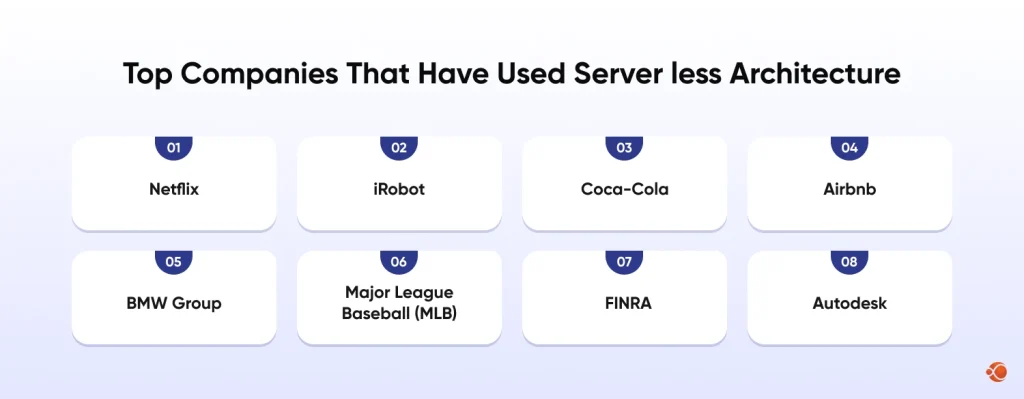
Netflix
They use AWS Lambda to handle key operational tasks such as video processing, encoding pipelines, system monitoring, and automating backend workflows. By adopting a serverless architecture, the platform efficiently manages its massive global scale, serving billions of hours of video while automatically adjusting to meet surges in demand.
iRobot
Built a fully serverless backend for its IoT platform that manages its internet-connected Roomba robotic vacuum cleaners. This architecture, using AWS Lambda and AWS IoT, handles connectivity, over-the-air software updates, and collection of telemetry data for millions of devices with minimal operational overhead.
Coca-Cola
Coca-Cola uses serverless (primarily AWS) to power its IoT-enabled Freestyle vending machines. The event-driven architecture allows the company to manage massive, unpredictable transaction spikes (up to 80 million transactions per month) and efficiently collect telemetry data from millions of devices, resulting in significant cost savings. You can also hire AWS developers to kickstart a similar project today.
Airbnb
Employs serverless functions for demanding, dynamic tasks like image processing (resizing and optimization) for millions of photos uploaded by hosts and guests. The architecture ensures cost-effective scaling to manage sudden and large traffic spikes that are common on its popular travel platform.
BMW Group
Uses a serverless-powered Cloud Data Hub to manage and analyze massive volumes of event-driven data over a billion daily requests, from its connected vehicles (ConnectedDrive). This allows them to create and refine machine learning models for proactive vehicle issue resolution and faster innovation.
Major League Baseball (MLB)
Utilizes serverless solutions (AWS Lambda) for its Statcast system. This system processes, transforms, and delivers accurate, real-time game-play data (pitch velocity, player movements) to fans and broadcasters. Serverless enables the platform to scale easily and cost-effectively to handle the varying frequencies of games throughout the season.
FINRA (Financial Industry Regulatory Authority)
Developed a serverless data processing solution to analyze vast amounts of market data—up to 75 billion market events daily. This allows the organization to rapidly perform complex data validations to detect potential fraud and insider trading, achieving high speed and reducing infrastructure costs by over 50%.
Autodesk
Implemented serverless architecture to automate internal IT processes, specifically for AWS account creation and management across its large engineering organization. By using a solution called ‘Tailor,’ they achieved a 98% reduction in the cost and labor hours associated with provisioning new accounts.
Key Characteristics of Serverless Architecture
Serverless architecture may seem like there are no servers involved. But in reality, what serverless architecture means is that servers are still running; developers just don’t have to manage them. Behind the scenes, the architecture relies on a combination of cloud-managed services, event-driven functions, and automatic scaling to handle workloads efficiently.
- Functions (FaaS – Function as a Service): These are small chunks of code that perform specific tasks. Each function runs when triggered by an event, like an HTTP request, file upload, or database change. Functions run independently, making scaling and failure handling easy.
- Event Sources: Events trigger functions to run. Common triggers include API calls, message queues, file uploads, IoT devices, or database updates. Functions only run when needed, saving resources.
- Managed Services: Serverless apps use fully managed services like databases, authentication, storage, and caching. The cloud provider handles the scaling, updates, and fault tolerance.
- Automatic Scaling: Functions scale themselves based on user demand. This means multiple instances can run in parallel when needed. You don’t even need to pay for idle functions because they don’t use resources.
- Monitoring and Logging: Cloud providers track performance, errors, and execution times automatically. Tools like AWS CloudWatch, Azure Monitor, and Google Cloud Logging give developers visibility to monitor and troubleshoot apps.
How to Build Better Apps with Serverless Best Practices
- Design Small, Single-Responsibility Functions: Functions should be focused on a single task to simplify scaling, testing, and maintenance.
- Use Managed Services: Use cloud-native managed services for storage, messaging, and authentication to reduce operational overhead.
- Implement Proper Monitoring and Logging: Even though the provider handles infrastructure, monitoring tools like AWS CloudWatch, Azure Monitor, or Google Cloud Logging should be used to get visibility into function performance and errors.
- Optimize Cold Start Performance: Cold start occurs when a function initializes after being idle. Choose lightweight dependencies and avoid long initialization routines for critical functions.
- Secure all Functions and Data: Make sure to provide proper access control, encryption, and API security to protect sensitive data and maintain compliance.
Is Serverless Architecture The Right Choice for Your Next Project?
Choosing serverless architecture makes perfect sense for:
- Projects that have unpredictable or variable traffic
- Rapid prototyping, MVPs, or startup projects where speed and faster deployments matter
- Microservices or event-driven parts of larger systems
- Backend tasks like processing jobs, scheduling tasks, and real-time data pipelines
- Web or mobile apps with backend services that don’t need constant, always-on servers
When you might want to avoid it (and why)
- If you have extremely latency-sensitive, always-on services where cold starts can be a dealbreaker
- If you need very long execution times
- Heavy stateful services or legacy applications that need persistent connections or sessions
- If the team lacks experience in serverless architecture, or regulatory compliances require more control over infrastructure.
How to Build Your Dream Serverless Team?
Building a high-performance serverless team is important to unlock the full potential of serverless architecture. Success in serverless projects depends on technology as well as expertise, structure, and collaboration of the team driving it. Here is how you can assemble an ideal serverless team:
| Role | Responsibilities |
| Cloud Architects |
|
| Backend & FaaS Developers |
|
| DevOps & Automation Experts |
|
| Security & Compliance Specialists |
|
| QA & Testing Engineers |
|
| Project Manager / Technical Lead |
|
What is the Future of Serverless Architecture?
1. Serverless for AI and Machine Learning
The use of serverless architecture in AI and ML workloads is increasing rapidly. From preprocessing data to deploying inference pipelines, functions can scale automatically for handling bursts in data processing. This makes serverless ideal for real-time AI applications like recommendation engines, predictive analytics, and smart automation.
2. Edge Computing Integration
The combination of serverless and edge computing will see rapid growth in the future. Developers will be able to deploy functions closer to the users, reducing the latency issue with serverless architecture. This trend will motivate companies with low-latency requirements like AR/VR apps, gaming apps, and others, to shift to serverless architecture.
3. Event-Driven Ecosystems
Serverless is no longer limited to isolated functions; they are building fully event-driven architectures. Future applications may rely on integrated event buses, managed queues, and streaming services for real-time coordination of microservices and seamless data flows across the distributed systems.
4. Multi-Cloud and Hybrid Approaches
To avoid vendor lock-in, businesses will look for multi-cloud serverless strategies. Future serverless deployments are likely to use multiple cloud providers, orchestrating functions across platforms, and improving availability.
5. Improved Development with Serverless Frameworks
The future frameworks and tooling support will make serverless deployment faster and easier to manage. They will come with integrated CI/CD, testing, observability, and monitoring tools to reduce operational complexity.
How a Software Development Company Like CMARIX Helps You Go Serverless
As a leading software development company, we can build serverless databases and apps using major cloud computing platforms such as AWS, Azure, and Google Cloud. While many companies try to “build your own serverless infrastructure,” our architects make the process easier. Our expert consultants start by looking at your current technology. Next, they figure out exactly what parts should go serverless, and finally, build you a perfectly tuned, auto-scaling solution. This results in improved efficiency and lower operational overhead compared to a DIY approach.
Key Benefits of Partnering with CMARIX for Serverless Adoption:
- Tailored Plan: We design a smart serverless blueprint that perfectly fits your business goals.
- Smooth Migration: We move your traditional systems to the new serverless platform with minimal fuss or disruption.
- Faster Applications: We build event-driven functions that make your app workflows quicker and more scalable.
- Full Automation: We set up systems to automatically deploy your code and connect smoothly with all your cloud services.
- Continuous Optimization: We constantly watch, fine-tune, and manage your resources to ensure the lowest costs and best performance.
Final Words
Serverless architecture has evolved from a niche concept to a mainstream strategy that can be implemented with the help of professional architects. You can hire dedicated developers experienced in using AWS, Azure, Google, and other serverless platforms.
Applications built on serverless architecture can scale up or down according to changes in traffic and evolving requirements. Adopting serverless architecture is not just a technological upgrade; it is a strategic approach to make software faster, more flexible, and highly reliable.
FAQs on Using Serverless Architecture
What is the difference between server and serverless architecture?
Traditional server-based architecture requires managing physical or virtual servers. At the same time, it requires conscious and physical attention towards aspects like scaling, updates, and maintenance. Serverless architecture can abstract server management, freeing developers to focus on code while the cloud provider takes on the infrastructure, scaling, and availability management responsibilities.
Why choose serverless architecture?
Serverless architecture reduces operational overhead, automatically scales with demand, improves cost efficiency by charging only for actual usage, and speeds up development by letting teams focus on functionality instead of server management.
How to build a serverless architecture?
Start by identifying functions or services that can run independently, choose a cloud provider (AWS Lambda, Azure Functions, GCP Cloud Functions), design event-driven workflows, and integrate serverless databases, storage, and APIs. Proper monitoring and security must also be included.
How to manage serverless architecture?
Use cloud-native monitoring, logging, and alerting tools, set up automated scaling and failover, enforce security policies, and optimize performance and costs by analyzing usage patterns regularly.
What is the use of serverless architecture?
Serverless architecture is most effective for event-driven applications, APIs, microservices, data processing, IoT systems, and applications with variable traffic. It provides better flexibility, faster deployment, and reduced infrastructure management.