



Quick Summary: The global software development industry is entering an unprecedented period of transformation. As we move through 2025 toward 2030, the convergence of Generative AI, cloud-native architectures, and critical talent shortages is rewriting the rulebook for IT strategy. The market is not just expanding; it is evolving into a more automated, intelligent, and security-critical ecosystem. Here are the top software development statistics as we approach 2026, with estimates and forecasts through 2030 and beyond.
Key Software Development Market Statistics and Strategic Insights:
- Market Valuation: The international software market is set to exceed $1 trillion in 2030, driven by the fundamental need for all industries, from Agriculture to Aerospace, to go digital.
- AI Saturation: The uptake of AI tools by developers has gone beyond 80%, which has completely transformed the development process from developing code, testing, and deployment. It can no longer be a source of competitive advantage.
- Talent Crisis: With a looming shortage of 4 million programmers worldwide, the industry has seen a dramatic increase in the use of low-code and strategic outsourcing, which is changing how the industry views retention.
- Cloud-Led Deployments: The cloud deployment market holds more than 70% market share and marks the end of traditional deployment as the norm.
Software development has moved from being a support function to becoming the core of global business innovation. Successful companies across industries, such as FinTech, healthcare, ecommerce, banking, and automotive, are not treating software development as a side project; they are basing their internal operations and client communications on smart systems.
Between 2025 and 2030, organizations will race to adopt the latest software market trends in artificial intelligence and cloud-native development. However, talent shortages, cybersecurity risks, and regulatory pressures are forcing companies to rethink their strategy moving forward. Today, we are going to discuss the most important software development statistics, trends, and forward-looking insights to get a clearer picture of how leaders should prepare for a software-first era.
1. Software Market and Global Economic Growth
The global software market is becoming the digital backbone of the global economy. As digital transformation mandates hit every sector, the financial scale of the industry is reaching unprecedented levels. Companies that were once purely physical, such as retailers, manufacturers, and logistics providers, are effectively becoming software companies.
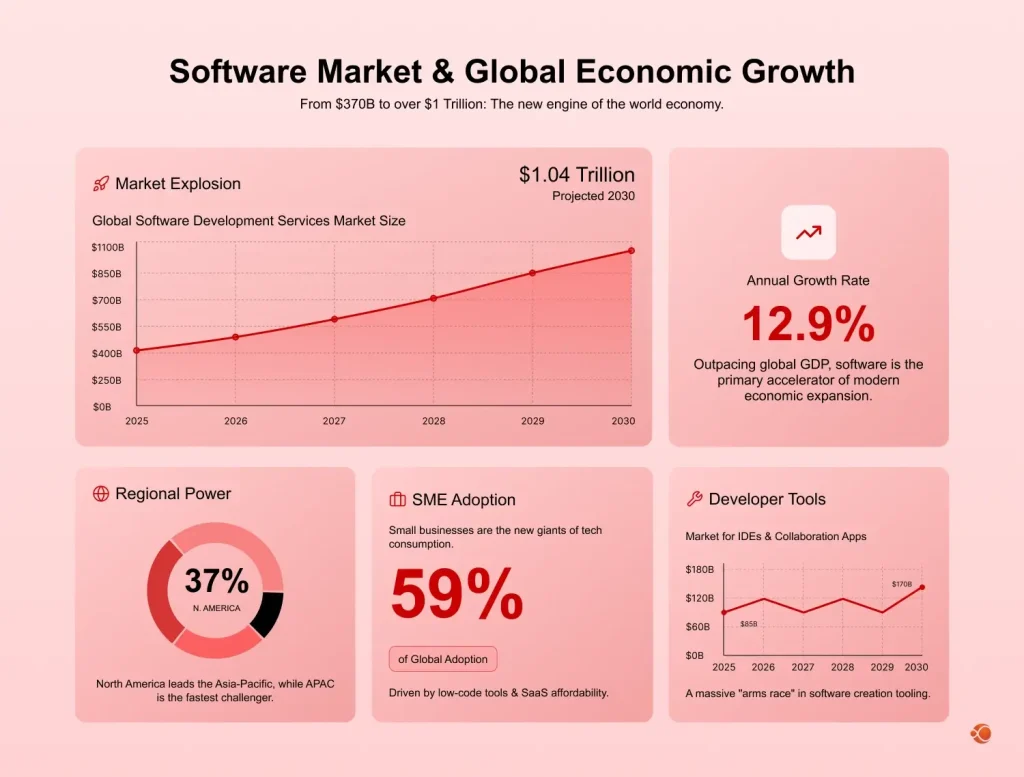
- Explosive Valuation: The global software development services market size is estimated at $570 billion in 2025 and is projected to surpass $1.04 trillion by 2030. This five-year doubling in value indicates a market that is accelerating rather than maturing.
- Sustained Growth: The industry is projected to grow at a CAGR of 12.9% between 2025 and 2030. This outpaces the global GDP growth. This shows how software is emerging as a primary engine of modern economic expansion.
- Regional Powerhouses: North America currently leads the market, holding approximately 37.2% of global revenues due to early investments in AI and hyperscale cloud infrastructure. However, the Asia-Pacific region is emerging as the fastest-growing challenger, driven by massive digitization drives in India and Southeast Asia.
- The Rise of SMEs in Software Adoption: Small and Medium Enterprises (SMEs) are becoming major drivers, accounting for 59% of software adoption in 2025. This shift is largely fueled by the affordability of SaaS models and low-code tools, which have lowered the barrier to entry for sophisticated tech.
- Tooling Revenue: By 2030, the application development software market specifically (the tools developers use to build apps) will reach $169.7 billion, nearly doubling from 2025. This suggests a massive “arms race” in developer tooling, from IDEs to collaboration platforms.
2. Cloud Computing Statistics For Software Development
Cloud computing has transitioned from an “option” to the “default” for modern development, enabling scalability that on-premise solutions simply cannot match. The conversation around cloud adoption has shifted from “Is it worth moving my software to the cloud?” to “How can we optimize our multi-cloud strategy?”
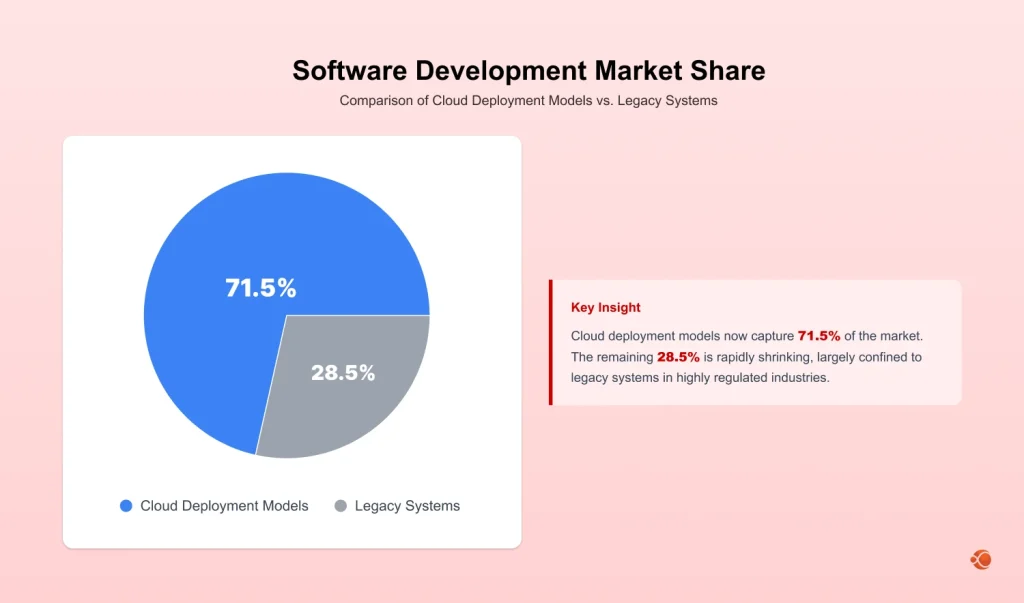
- Market Dominance: Cloud deployment models now capture 71.5% of the total software development market share. The remaining percentage is rapidly shrinking, largely confined to legacy systems in highly regulated industries.
- Spending Surge: Worldwide public cloud end-user spending is forecast to reach $723 billion in 2025. This capital is being poured into modernizing legacy stacks and building “cloud-native” applications from scratch.
- Native by Design: By the end of 2025, over 95% of new digital workloads will be deployed on cloud-native platforms, a massive jump from 30% in 2021. This means the next generation of software is being built specifically to leverage containers, microservices, and serverless functions.
- The Hybrid Compromise:63% of DevOps teams have adopted a hybrid cloud strategy. Companies are realizing that while the public cloud offers scale, private clouds offer control. Balancing these two through hybrid architectures allows for flexibility without compromising data sovereignty.
3. AI/ML and Automation Statistics For Software Development
Artificial Intelligence is the single biggest disruptor in the software lifecycle, acting as a “force multiplier” for developer productivity. It is fundamentally altering the “build vs. buy” decision-making process.
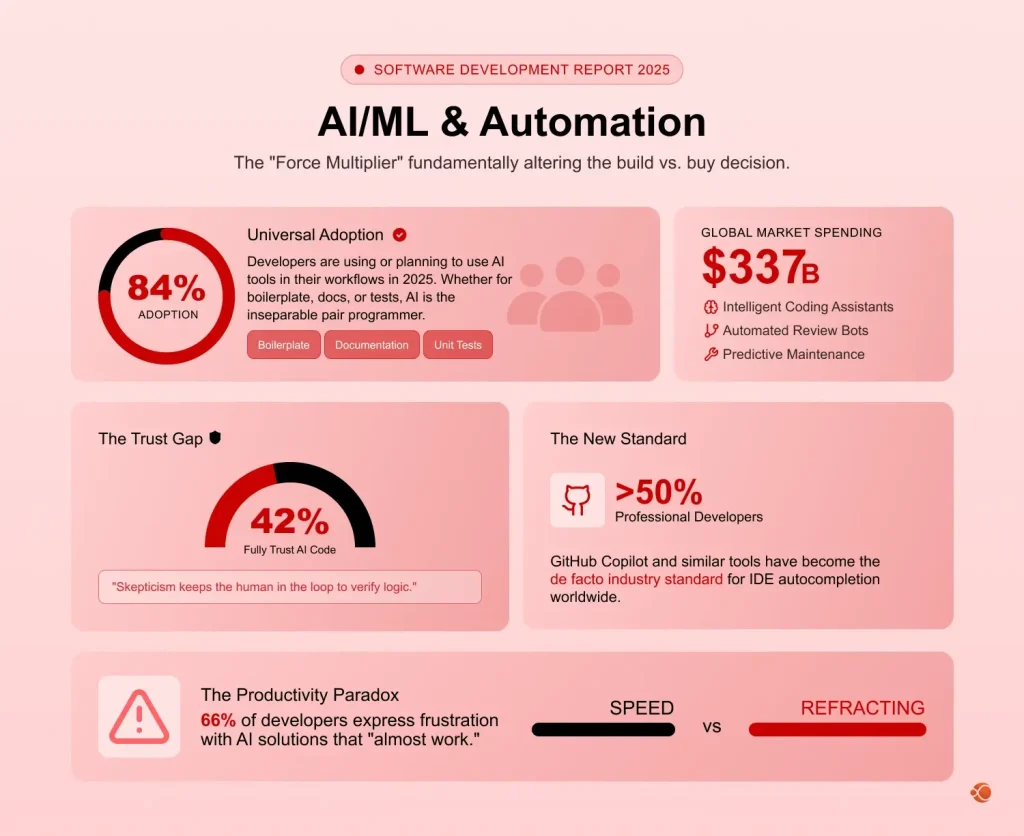
- Universal Adoption: 84% of developers are using or planning to use AI tools in their development workflows in 2025. Whether it’s for generating boilerplate code, documentation, or unit tests, AI is now an inseparable pair programmer.
- Economic Impact: The AI software development market is expected to reach $337 billion in global spending by 2025. This investment is going toward intelligent coding assistants, automated code review bots, and predictive maintenance algorithms.
- The Trust Gap: Despite high adoption, trust remains a significant hurdle; only 42% of developers fully trust the accuracy of AI-generated code. This skepticism is healthy and necessary, as it keeps the “human in the loop” to verify logic and ensure security.
- The Productivity Paradox: 66% of developers express their frustration regarding the use of AI ‘solutions’ that almost work.” Although the first stage of coding is aided by AI, refactoring complex code remains time-consuming.
- Key Tools: GitHub Copilot and other tools are now being embraced by over 50 percent of professional developers worldwide, becoming the de facto industry standard for IDE autocompletion.
We build scalable, high-performance software solutions with secure architecture and future-ready user experiences.
Contact Us4. Software Developer Statistics About Demographics and Workforce Trends
The most scarce resource in the industry is the human resource. The “talent crunch” is causing companies to spend more on salaries, designing compensation packages, and seeking talent in non-traditional markets. Here are some of the most important software developer facts:
- Global Shortfall: The global software developer population stands at approximately 26.3 million, yet the industry faced a shortfall of 4 million developers in 2025. This gap is most evident in key areas such as cybersecurity, AI engineering, and cloud architecture.
- The Remote Standard: 60% of developers worked fully remotely in 2024/2025. 87% prefer remote or hybrid options over full-time office work. Companies that demand full-time office return are having difficulty attracting senior-level talent in this remote-led era.
- Salary Inflation: The median annual salary for software developers in the US has reached USD 131,450, with specialized AI roles commanding considerably higher premiums, often exceeding USD 200,000.
- Emerging Talent Hubs: Software development companies in India are turning into a powerhouse. India has a developer population of over 17 million (including students and professionals). It is positioning itself not just as a back-office support hub, but as the center for high-end R&D and innovation.
5. Software Development Outsourcing, Nearshore, and Offshore Statistics
As talent shortages are rising rapidly and project complexity is increasing, outsourcing is becoming an essential component of modern software delivery. Between 2025 and 2030, they will not only outsource their software requirements to avail cost benefits. Instead, they are doing it to get access to global talent, skills, delivery speed, and operational efficiency through nearshore and offshore models.
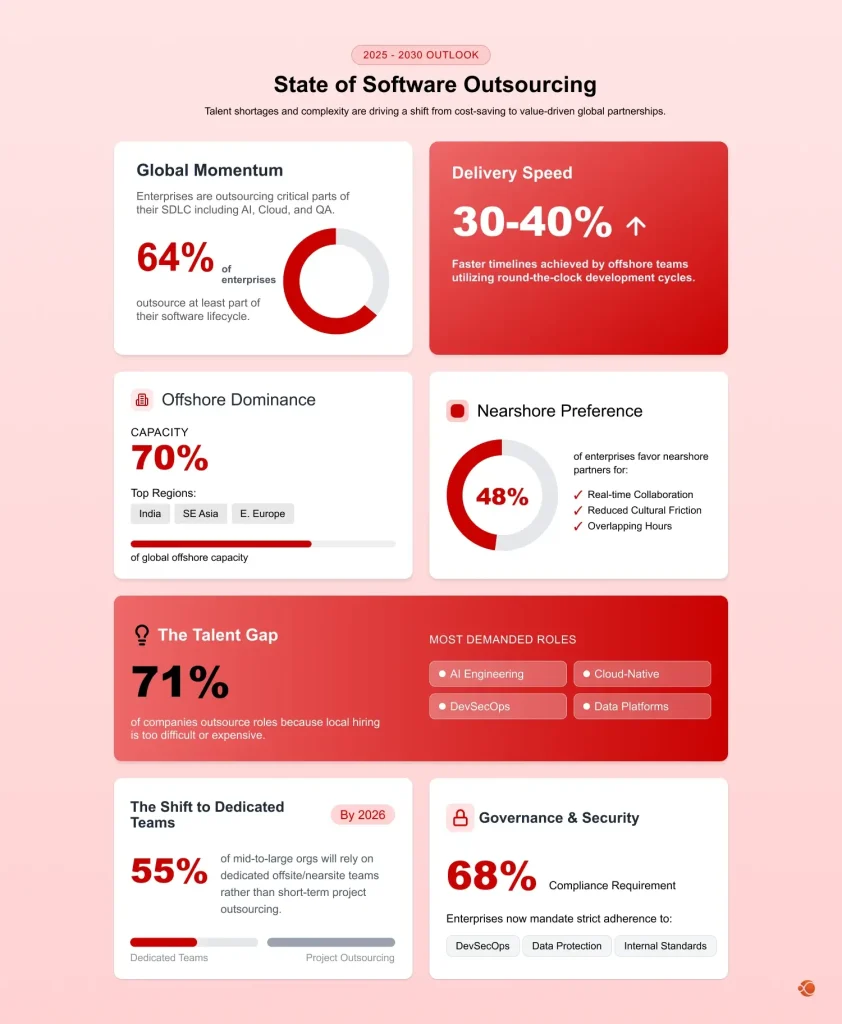
- Global Outsourcing Momentum: Over 64% of enterprises now outsource at least part of their software development lifecycle. This can apply to any aspect, such as application development, cloud migration, AI integration, quality assurance, and ongoing maintenance.
- Offshore Software Development Statistics: Offshore delivery continues to dominate large-scale engineering workloads. India, Southeast Asia, and Eastern Europe collectively account for more than 70% of global offshore software development capacity. Offshore software engineering statistics show that organizations using offshore teams achieve 30–40% faster delivery timelines thanks to round-the-clock development.
- Nearshore Software Development Statistics: Nearshore software development adoption is accelerating, particularly among North American and Western European companies. Nearshore software development statistics highlight 48% of enterprises favor nearshore partners to improve real-time collaboration, reduce cultural friction, and maintain overlapping work hours.
- Dedicated Team Models: By 2026, more than 55% of mid-to-large organizations will rely on dedicated offsite or nearsite development teams rather than project outsourcing for short-term needs.
- Skill-Driven Outsourcing: Some of the key software developer roles to look forward to include AI engineering, cloud-native development, DevSecOps, and data platforms. 71% of companies report outsourcing software development roles to reliable offshore vendors because it is difficult or expensive to hire locally.
- Governance and Security Maturity: Modern outsourcing is tightly regulated. Over 68% of enterprises require outsourced teams to follow internal DevSecOps practices, compliance standards, and data protection frameworks, signaling a shift away from loosely managed vendor relationships.

6. Statistics About Agile Software Development Methodologies
The way software is built has solidified around Agile software development methodologies. But hybrid models are emerging to better manage complex and custom enterprise requirements. The days of rigid, multi-year planning cycles are formally over.
- Agile Dominance: 73% of software projects in 2025 use Agile practices, making it the most widely used methodology worldwide. It lets teams pivot quickly in response to moving market demands.
- Performance Metrics: Agile projects boast a 64% success rate (delivered on time/budget). This is considerably higher than the 49% success rate of traditional Waterfall projects. The nature of Agile reduces the risk of running into total project failure.
- Waterfall’s Decline: The Waterfall methodology has seen an alarming 37% decline. This is especially prominent in highly regulated industries (such as aerospace or medical devices), where strict sequential phases and documentation are legally required.
- Framework Choices: 58% of Agile teams use Scrum as their primary framework, appreciating its sprint and stand-up structure. On the other hand 56% incorporate Kanban for visual workflow management to reduce bottlenecks.
7. DevOps and DevSecOps Statistics
Speed is nothing without security. The convergence of Development, Security, and Operations (DevSecOps) is a top priority for CTOs who need to release software fast without exposing the company to massive liability.
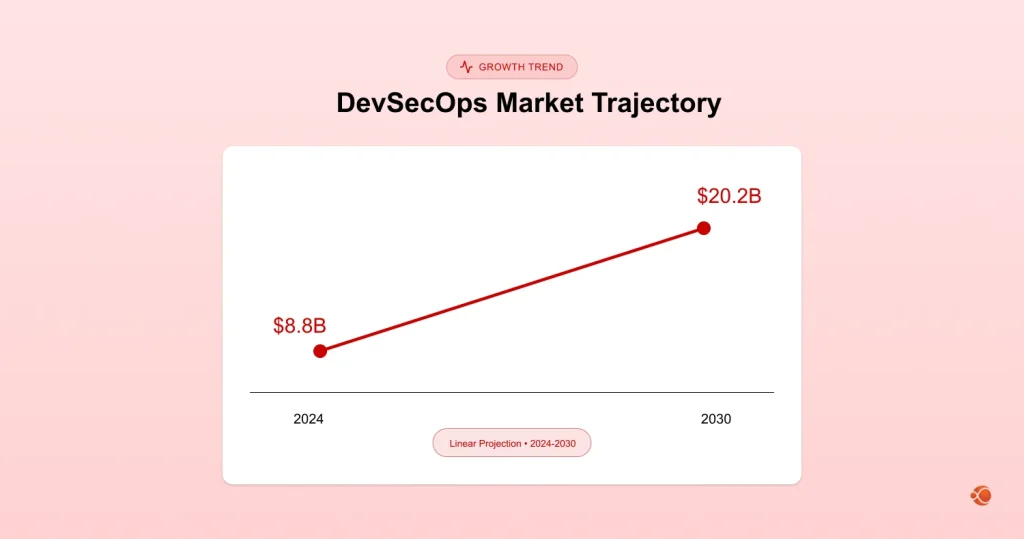
- Market Explosion: The global DevSecOps market is valued at $8.8 billion in 2024 and is projected to reach $20.2 billion by 2030. This growth is driven by the understanding that security cannot be treated as an afterthought; it must be baked into the code.
- Deployment Velocity: 80% of organizations have adopted DevOps practices to some extent, with high performers deploying code multiple times per day. This “continuous delivery” model is now the benchmark for competitive software companies.
- Shifting Left: Security is shifting left: 70% of development teams now integrate automated security testing directly into their CI/CD pipelines. This ensures that vulnerabilities are caught during the build process, not after deployment.
- Threat Response: The primary driver for DevSecOps growth is the 40% increase in cyberattacks targeting software supply chains. Hackers are no longer just attacking the app; they are also attacking the libraries and tools used to build it.
8. Software Development Statistics For Different Industries
Software is not one-size-fits-all. Different verticals are investing in technology at different rates to solve unique challenges, from regulatory compliance to supply chain visibility; hence, different types of software are needed for different use cases.
Healthcare Software Development
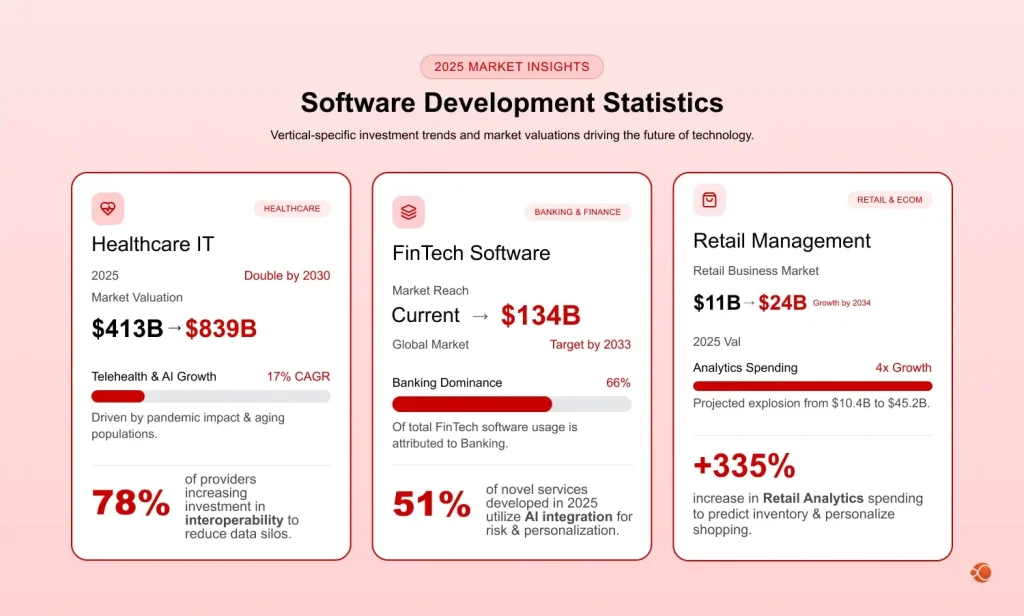
- Sector Valuation: The healthcare IT market is valued at $413 billion in 2025 and is projected to double to $839 billion by 2030.
- Telehealth Boom: Telehealth and AI-driven diagnostics are growing at a 17% CAGR, driven by the pandemic’s lasting impact and the need for remote patient care in aging populations.
- Interoperability: 78% of healthcare providers are increasing investment in interoperability software to ensure different hospital systems can “talk” to each other, reducing data silos that endanger patient health.
Banking & Finance (FinTech) Software
- Market Reach: Globally, FinTech software is expected to reach 134 billion by 2033.
- Usage Drivers: 66% of all FinTech software usage is attributed to the Banking Industry. Primarily, it focuses on developing mobile banking applications that deliver an optimized user experience.
- AI Integration: 51% of the novel FinTech services developed in 2025 have utilized AI for personalized financial services or risk analysis, going beyond mere transaction services.
Retail & Ecommerce Software
- Digital Retail: The retail business management software market is valued at $11 billion in 2025 and will reach $24 billion by 2034.
- Data Analytics: Retail analytics spending is exploding, projected to grow from $10.4 billion to $45.2 billion. Stores are using this data to predict inventory needs and personalize shopping experiences in real-time.
9. Low-Code/No-Code Development Statistics
To address the developer shortage, companies are turning to platforms that require little to no coding. This “democratization of development” is allowing business units to solve their own problems without waiting for IT.
- Rapid Expansion: The low-code development platform market is expected to reach $124 billion by 2032, growing at a massive 29.6% CAGR.
- Adoption Milestone: By 2026, 75% of new enterprise apps will be built with low-code or no-code platforms. This represents a fundamental shift in how internal tools and simple apps are created.
- Citizen Developers: 40% of low-code users are now termed as “citizen developers” (non-technical employees from business units like HR or Marketing). Non-technical teams can build their own products using such tools to improve their workflows without learning a line of code.
- Speed to Market: Using low-code platforms will boost development by up to 90% compared to traditional hand-coding. Companies can better prototype and validate ideas in days rather than months with MVP software development services.
10. Software Testing and Quality Assurance (QA)
Software testing ensures that applications work correctly and meet user expectations. It helps teams find bugs early, reduce costs, and improve overall product quality. In the age of AI-generated code, QA is the final line of defense.
- Cost of Defects: It can cost up to 25 times as much to resolve a bug in a finished program as in a program under development.
- Automation Gaps: Roughly 70% of development teams use test automation tools. But almost 45% are unable to achieve full test coverage, often neglecting edge testing by default.
- Functional Focus: Function testing is the primary approach to coding verification and validation for nearly 90% of programming teams, ensuring the software performs the intended functions.
- Market Value: The automation testing market is projected to grow to $68 billion in 2025 due to the need for continuous testing within DevOps pipelines, as manual testing is too slow.
- Budget Allocation: Spending on quality assurance and testing has increased to 26% of the total project budget of software projects, and is projected to rise as software applications become more intricate and vital to the running of businesses.
Challenges and Future Possibilities of the Software Development Industry
As we look toward 2030, the industry faces significant hurdles that will define the next generation of software. The path forward is not without its risks.
- Cybersecurity Threats: With software supply chain attacks on the rise, 68% of IT leaders cite security and data privacy as their top concerns over the next 3 years. The “secure by design” philosophy is becoming a mandate, not a suggestion.
- Technical Debt: The rush to release features has consequences; 45% of developer time is currently spent on “maintenance” and fixing old code rather than innovation. Breaking this cycle of debt is a major challenge for legacy enterprises.
- AI Regulation: By 2026, it is estimated that 50% of governments worldwide will enforce regulations on the use of AI in software. This will impact how developers build and deploy algorithms, adding a layer of compliance to the development lifecycle.
- Green Coding: Sustainability is emerging as a Key Performance Indicator (KPI); 30% of large enterprises are expected to require “green software” principles by 2028. This involves optimizing code to consume less processing power and energy. This reduces the carbon footprint of massive data centers.
Final Words
The picture for 2025-2030 is clear in the data: software development is speeding up, becoming more automated, and integrating ever more closely with business success than ever before. Nevertheless, the ever-widening chasm between the phenomenal demand for software and the shortage of skilled experts means “business as usual” is no longer an option.
The successful enterprises of the next decade will be those that learn to hybridize their paradigms. This involves exploiting artificial intelligence and low-code platforms to automate mundane work. However, at the same time, investing heavily in human knowledge to address the complex work of enterprise architecture and security will be the only factor for survival in the next decade.
FAQs on Software Development Statistics
How fast is the software development market growing in 2026?
The software development market is expected to keep on growing at a double-digit pace in 2026. In fact, this is a result of higher investments in AI, Cloud, and Custom Enterprise software applications. Software spend is likely to outpace overall IT spending, underscoring its significance for business growth and digital transformation.
Why are software development statistics important for businesses?
Statistics on software development help make sense of industry trends, technology adoption, and investment patterns. This data helps to make the best decisions on budget allocation, technology, and talent investment.
Are software developers still in demand?
Indeed, the demand for software developers has remained extremely high. The world faces a talent shortage that is worsening, with millions of vacant positions expected as digitization, AI advancements, and reliance on custom software applications continue.
Why do software development projects fail?
Most software projects fail due to unclear requirements, frequent scope changes, and poor planning. Lack of proper alignment between business goals and technical execution, combined with insufficient testing and security planning, also contributes to missed deadlines and budget overruns.
How is AI impacting software development?
AI is transforming software development by automating coding, testing, and debugging tasks. It improves development speed, enhances code quality, and enables teams to focus more on architecture, logic, and innovation rather than repetitive manual work.
What role does AI play in software development in 2026?
By 2026, AI will play a central role in software development workflows, from intelligent code generation to predictive maintenance and automated quality assurance. AI-driven tools support faster releases, improved reliability, and smarter applications across enterprise and consumer platforms.