



At-a-glance View: Struggling with slow time-to-market and rising development costs? React.js for enterprise development solves this through reusable components, Virtual DOM performance, and faster cycles. Its modular architecture and React Native integration allow scalable mobile and web solutions with significantly lower maintenance costs. Discover how leading enterprises dramatically reduce their development expenses.
As the world has become technology-driven, and with that, the needs of large organizations are constantly increasing, requiring dependable, fast, and highly maintainable software. Choosing the correct front-end technology is a fundamental decision that impacts everything from initial expenditure to long-term continuity.
For many Chief Technology Officers (CTOs) and product leaders, React.js for enterprise development has emerged as the clear front-runner, providing a compelling blend of speed, efficiency, and financial prudence. This financial viability is reflected in its broader ecosystem, where its mobile equivalent, React Native, is predominantly utilized by applications generating less than $10,000 USD in monthly revenue, demonstrating the technology’s widespread and commercially successful adoption
Why Enterprises Are Choosing React.js Over Other Frameworks
When selecting a framework for creating a complex, scalable application, enterprises prioritize three main factors: scalability, performance, and developer experience. While several JavaScript frameworks exist, React.js, an open-source JavaScript framework maintained by Meta and a large community, consistently excels in these areas.
Unlike monolithic frameworks that demand adherence to strict patterns, React.js provides flexibility by focusing only on the view layer. This targeted approach results in smoother user interfaces, quicker rendering, and a gentler learning curve for developers.
For organizations needing to build sophisticated user interfaces (UIs) quickly and efficiently, this advantage is monumental. The widespread developer familiarity and the strong toolset surrounding it. React.js’s widespread adoption means access to a broad global talent pool, making it easier to expand the team through offshore development services without sacrificing consistency.
What Makes React.js a Cost-Effective Choice for Large-Scale App Development?
The cost-effectiveness of React.js for enterprise development goes beyond just the hourly rate of developers. It’s built into the framework’s design, leading to lower Total Cost of Ownership (TCO) over the application’s lifespan.
- Faster Development Cycles: The modular nature of React.js allows teams to break down complex UIs into smaller, manageable pieces, accelerating parallel work and reducing integration conflicts. A full-stack development team can work efficiently across both front-end interfaces and API integrations, streamlining the entire development process.
- Reduced Bug Fixes: The use of a one-way data flow (unidirectional data binding) makes components predictable and easier to debug, directly reducing the time and expense spent on maintenance.
- Widespread Talent Pool: React.js has a massive and active developer community. This means hiring is easier, and labor costs are often more reasonable compared to frameworks with smaller, niche talent pools. This availability directly contributes to low development cost with React.
- Future-Proof Architecture: The principles of composition and modularity built into React.js mean applications built today can be more easily updated and extended for years to come without the need for a complete rewrite.
React.js Key Features That Reduce Development Cost & Time
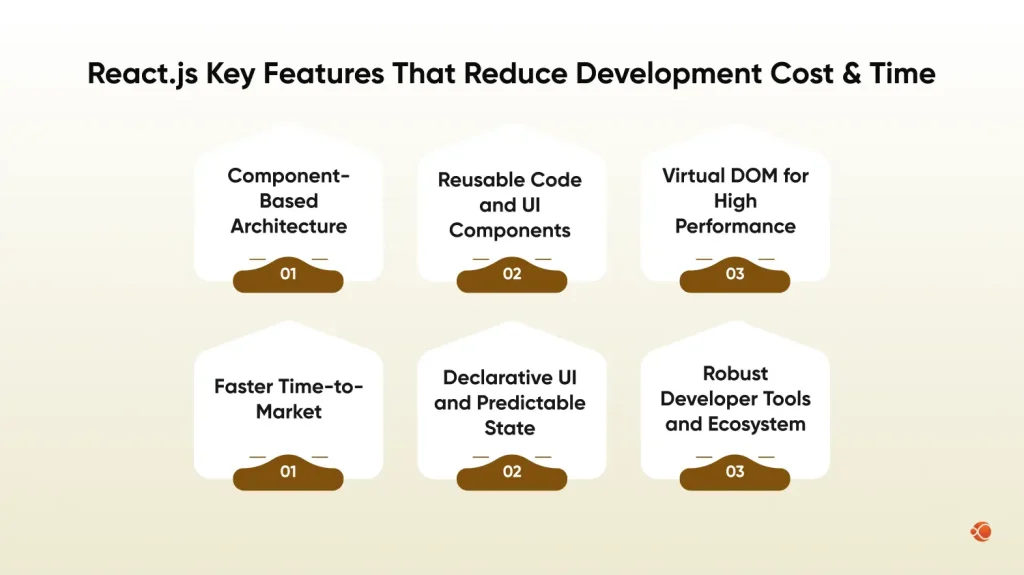
Several core features of the React.js framework directly contribute to lower expenses and a quicker timeline for enterprise projects.
Component-Based Architecture
The component-based architecture is the heart of React.js. It involves building UIs as isolated, self-contained components. Think of these components as customizable building blocks: a navigation bar, a button, or a user profile card.
- Isolation and Maintainability: Because each component is independent, that means changes in one area of the app are less likely to break another area. This isolation makes testing, debugging, and maintenance significantly simpler, saving resources and time. This approach is particularly valuable for custom web application development, where unique business requirements demand tailored solutions.
- Team Parallelism: Different development teams can work on different components simultaneously without causing delays for each other.
Reusable Code and UI Components
The components created for one part of an application can often be used again in another part, or even in an entirely different project within the enterprise. This reusable code and UI components feature eliminates the need to rewrite the same logic and interface elements repeatedly.
- Accelerated Development: Once a component library (or design system) is established, new features can be assembled rapidly, like building with LEGO bricks.
- Consistent UI/UX: Reusing components ensures visual and functional consistency across all enterprise applications, improving the user experience and reducing the effort required for design review.
Virtual DOM for High Performance
The Virtual DOM performance mechanism is perhaps the most significant reason for fast app performance using React. Instead of manipulating the actual browser Document Object Model (DOM) directly, a slow operation, React.js creates a lightweight, in-memory representation of the DOM.
When data changes, React.js first updates the Virtual DOM, compares it to the previous state, and then intelligently calculates the absolute minimum necessary changes to apply to the real DOM. This “diffing” process means fewer expensive updates to the browser, resulting in much quicker rendering and a smoother, more responsive user experience, even on data-heavy enterprise applications.
Faster Time-to-Market
The combination of the component model, code reusability, and efficient rendering means that the time required from concept to deployment is dramatically shortened. This reduced time-to-market with React provides a crucial competitive edge. Getting an application into the hands of users or internal stakeholders faster allows the enterprise to gather feedback, iterate sooner, and realize the return on investment more quickly.
Declarative UI and Predictable State (Reduced Debugging Time)
By using a declarative approach, developers describe what the UI should look like for a given state rather than writing step-by-step instructions for changing it. This one-way data flow makes the application’s state highly predictable, significantly reducing the time spent tracking down and fixing bugs, which is a major driver of development cost. This predictability is valuable when collaborating with UI/UX design and development services, as a developer and designer can work from a shared understanding of how state changes affect the interface.
Robust Developer Tools and Ecosystem
The availability of specialized React developer tools browser extension allows inspecting component hierarchies, monitoring performance in real-time, and viewing stat/props changes. This rich ecosystem, including strong community support and ready-made UI libraries (e.g., Material-UI), cuts down the time needed for custom coding and problem-solving.
We build scalable, high-performance React.js enterprise applications with secure architecture and future-ready UI experiences.
Contact UsHow React.js Supports Both Web and Mobile (React Native) Development
A major cost-saving differentiator for React is its companion framework, React Native. This synergy allows organizations to use their existing React expertise for both web and native mobile application development.
Single Codebase Advantage
React Native allows developers to develop for iOS and Android a truly native mobile app using the identical declarative, component-based programming style they use for the web. While some platform-specific code is necessary, a significant portion of the business logic and even UI components can be shared. This Single Codebase Advantage is key to lowering costs.
Lower Mobile App Development Cost
Instead of maintaining separate teams of Objective-C/Swift (iOS) and Java/Kotlin (Android) developers, a single team of JavaScript/React developers can handle all three platforms (web, iOS, and Android).
- Reduced Headcount: Less specialized staff are needed to achieve the same cross-platform reach.
- Unified Maintenance: Updates and bug fixes can often be applied across all platforms simultaneously, cutting down the total maintenance effort and lowering the mobile app development cost. This makes React Native for mobile apps a primary choice for cost-conscious enterprises seeking comprehensive mobile app development services.
Access to a Single, Large Talent Pool
Because both React (Web) and React Native (Mobile) rely on JavaScript and the core React principles, enterprises don’t need to hire separate teams of specialized native mobile developers (Swift/Kotlin). Existing web developers can often quickly transition to React Native, which keeps hiring costs down and makes staffing a unified project team much simpler.
Hot Reloading and Fast Refresh for Mobile (Rapid Iteration)
React Native includes features like Hot Reloading and Fast Refresh that apply code changes to the running mobile application instantly without a full restart. This dramatically speeds up the development and debugging loop for mobile apps, leading to considerably quicker feature iteration and validation, which saves developer hours.

Ideal Comparison: React.js vs Angular vs Vue for Enterprise Projects
When evaluating React.js cost comparison against its primary rivals, Angular and Vue.js, for Enterprise-grade UI development, the differences in architecture and community support become crucial.
| Feature | React.js | Angular | Vue.js |
| Architecture | Library (View Layer only) | Full-fledged Framework (Opinionated) | Framework (Progressive) |
| Learning Curve | Gentle/Moderate (Requires external tools) | Steep (Many concepts to learn) | Easiest |
| Performance | High (Virtual DOM) | Moderate/High (Real DOM) | High (Virtual DOM) |
| Scalability | Excellent (Modular, component-based) | Excellent (TypeScript, CLI support) | Very Good |
| Code Reusability | Excellent (Components) | Good (Modules) | Very Good (Components) |
| Enterprise Adoption | Very High (Meta, Netflix, Airbnb) | High (Google, Microsoft) | Growing (Alibaba, Xiaomi) |
For large, complex applications, React’s highly modular and flexible approach often simplifies the long-term management of massive codebases. Angular is a structured, heavy framework favored by enterprises that prefer a highly regulated, “out-of-the-box” structure. Vue.js is a strong contender, known for its simplicity, but it currently lacks the deep-seated enterprise ecosystem and massive resource pool that React.js for enterprise development offers.
Why React.js Is an Ideal Choice for Enterprise-Grade Applications
React.js for enterprise development is not just about saving money; it’s about establishing a resilient, maintainable, and scalable codebase that can handle the sheer volume and complexity of a large organization’s needs.
Scalability & Modular Architecture
The framework’s nature naturally encourages the creation of small, independent modules. This scalable front-end architecture is essential for applications that must grow over time. When a new feature is needed, it can be built and integrated without restructuring the entire application. When user traffic or data processing demands increase, the application’s architecture is already positioned to handle the load by design.
Long-Term Maintainability
Enterprise applications live for years, often a decade or more. Therefore, maintainability is a critical factor in TCO (Total Cost of Ownership). React’s clear component boundaries, one-way data flow, and strong typing support (via TypeScript, which integrates easily) reduce the probability of spaghetti code. The high level of code readability makes it easier for developers to understand the existing logic and join a project, minimizing the cost of developers’ onboarding and project handovers. These maintainability advantages make React particularly suitable for enterprise software development services where long-term support and evolution are priorities.
Large Ecosystem and Community Support
The size and health of the community surrounding a technology are an indispensable resource for any enterprise. React.js has one of the largest communities in the world.
- Extensive Libraries: Thousands of open-source libraries, UI kits, and state management solutions (like Redux and MobX) are available, meaning developers rarely have to build fundamental functionality from scratch.
- Immediate Problem-Solving: The vast online resources, tutorials, and forums mean that developers can quickly find solutions to almost any problem they encounter, minimizing costly research and downtime.
Technical Advantages That Matter to Enterprise CTOs & Product Leaders
CTOs and product leaders focus on technical capabilities that mitigate risk, ensure security, and optimize performance in mission-critical environments.
Strong Integration Capabilities (API, ERP, CRM)
React.js is simply a view library. This minimalist nature makes it exceptionally easy to integrate with any existing enterprise back-end system. Whether the organization uses a monolithic Customer Relationship Management (CRM), Enterprise Resource Planning(ERP), or microservices architecture, React.js can effortlessly consume data via standard APIs (REST or GraphQL). Its independence from any specific back-end language (e.g., Java, Python, .NET) ensures it fits into virtually any enterprise technology stack.
SEO Benefits with Server-Side Rendering (Next.js)
For public-facing enterprise applications (like e-commerce platforms or corporate websites), Search Engine Optimization (SEO) is a financial necessity. Traditionally, client-side rendering (CSR), where the browser renders the content, can hurt SEO because search engine crawlers struggle to see the fully rendered page.
Frameworks like Next.js (built on top of React.js) solve this with Server-Side Rendering (SSR). It renders the page on the server and sends the fully formed HTML to the browser. This ensures that search engine crawlers instantly see the complete content, providing significant SEO benefits and increasing organic traffic and revenue.
Enhanced Security Practices
While security is a function of development practice, React’s design aids in preventing common web vulnerabilities. Its approach to rendering discourages Cross-Site Scripting(XSS) attacks because it automatically escapes data before rendering it. Furthermore, the use of a Virtual DOM and standardized component inputs helps developers write code that is inherently safer when handling user input and rendering dynamic content. These security features make React a trusted choice for any front-end development company building applications that handle sensitive enterprise data.
Real Industry Use Cases: How Enterprises Save Costs Using React.js
React.js is proven by its widespread adoption across many of the world’s most demanding technology companies.
- Meta (Facebook): The original creator, which uses it extensively across all its platforms, proving its capability to handle massive, real-time data loads and billions of users.
- Netflix: Uses React for its entire front-end and applies React Native for its mobile experience, citing improved startup speed and modularity as key gains.
- Airbnb: Switched to React Native to manage a single development team for both iOS and Android, achieving significantly lower development costs with React while maintaining native performance.
- Microsoft and Uber: Both leverage React/React Native for various internal and external applications, reinforcing their reliability for mission-critical enterprise systems.
These cases demonstrate that React.js not only reduces initial development costs through efficiency but also saves long-term maintenance costs by providing a framework that is both performant and deeply maintainable.
We help enterprises create modern, scalable, and high-performance digital experiences using React.js.
Contact UsHow Much Does React.js Development Cost in the USA, UK & Europe?
Estimating the exact cost for a React.js project requires a detailed scope, but one can analyze the rates for hiring developers. The primary cost differences are typically geographical.
| Location | Estimated Average Hourly Rate (React Developer) | Cost Implication |
| USA | $70 – $150+ | Highest labor cost, but often access to specialized talent. |
| UK/Western Europe | $50 – $120 | High quality of development with a slightly lower rate than the USA. |
| Eastern Europe | $30 – $60 | High technical skill with a very attractive cost-to-quality ratio. |
| India/Asia | $20 – $45 | Most cost-effective rates globally for comparable quality. |
The advantage of React’s large talent pool means enterprises have the flexibility in where they source their development team, also allowing them to optimize their budget without compromising on technical skill. Organizations can hire React developers from various regions based on their project requirements and budget constraints.
How to Choose the Right React.js Development Company
Selecting a partner for a large-scale React.js enterprise development project is a strategic decision that needs rigorous evaluation.
- Portfolio of Enterprise Projects: The company should show experience with applications that have complex requirements, handle large user volumes, and integrate with existing back-end systems (e.g., ERP, legacy systems).
- Expertise in the Ecosystem: Look for proficiency not just in React, but also in related tools that are important for enterprise-grade apps: Next.js (for SSR/SEO), TypeScript (for large codebase reliability), and Redux/MobX (for state management). This depth of knowledge is essential when React development is part of digital transformation services.
- Process and Security Standards: The developers must demonstrate adherence to secure coding practices and follow methodologies like Scrum or Kanban, making sure predictable delivery and transparency.
Why CMARIX is the Right Partner for Enterprise React.js Development
Choosing the ideal partner is important to maximizing the benefits of React.js for enterprise development. CMARIX stands out as a leading React.js development company for enterprise-level firms due to its expertise and proven execution across key areas:
Enterprise-Proven Quality and Expertise
CMARIX’s developers have deep expertise and experience in the React ecosystem, evidenced by a history of successful React.js and React Native projects.
- Advanced React Stack: They go beyond basic development, utilizing essential enterprise tools like Next.js for features like SEO-friendly Server-Side Rendering and managing complex application state with solutions like Redux and Context API.
- Robust Architecture: Their methodology prioritizes an API-First Approach for strong integration with existing enterprise systems (ERP, CRM). This ensures a maintainable and scalable codebase.
- Quality Assurance: Commitment to quality is maintained through comprehensive testing using industry-standard tools like Jest and React Testing Library, considerably reducing post-deployment bugs and long-term costs.
Financial and Operational Advantages
Partnering with CMARIX delivers clear financial and operational benefits that support the goal of achieving low development costs with React.
- Full-Service Offering: They provide complete enterprise software development services, including strategic planning, UX/UI design, and cloud integration, beyond just coding.
- Cross-Platform Efficiency: Their React Native proficiency allows a single codebase advantage, minimizing the need for separate iOS/Android teams and securing lower mobile app development costs.
- Flexible Engagement: They offer various global delivery models, allowing enterprises to manage budgets effectively while accessing highly skilled React talent and balancing quality with competitive pricing.
By focusing on predictable delivery, deep knowledge, and high technical standards of the React ecosystem, CMARIX provides a dependable path for enterprises to transform their digital presence.
Concluding Lines
React.js for enterprise development is a strategic investment that pays dividends over the whole application lifecycle. The framework delivers initial savings through fast, low development cost with React development, and provides sustained cost reduction via unparalleled code reusability, high developer efficiency, and simple maintenance. Its modular architecture, coupled with the power of React Native, offers a unified and future-proof strategy for building both cutting-edge web and mobile experiences. By adopting React.js, enterprises secure a modern, scalable foundation for their most essential digital products.
Frequently Asked Questions About React.js for Enterprise
Is the cost of hiring a large React developer team in the USA, UK, and Europe higher or lower compared to Angular or Vue.js?
The cost of hiring an experienced React.js developer for an enterprise development team in the USA, UK, and Europe is generally higher than for Angular or Vue.js. This is driven by React’s immense market demand, leading senior developers to command a salary premium. However, this higher wage is often offset by a larger talent pool and faster development cycles.
If we need both a web application and a native mobile app (iOS/Android), how does React save money?
React saves money through React Native, its companion framework. This allows enterprises to build both native mobile apps and web applications using a single codebase and a unified development team. This single codebase advantage reduces development time, eliminates the need for separate specialized native mobile teams, and make sure a substantially lower mobile app development cost and simpler long-term maintenance.
Should enterprises hire in-house developers or outsource React development?
In-house hiring: This is best for long-term core products, maximizing control and security, but entails higher fixed costs and slower scaling.
Outsourcing: It suits short-term projects, budget constraints, rapid scaling, offering lower operational costs and quicker access to niche expertise. Many enterprises blend both approaches.
What security features does React offer for enterprise-grade applications?
React gives inherent security by automatically escaping data rendered via JSX, offering default protection against cross-site scripting (XSS) attacks. True enhanced security practices for enterprise-grade apps still rely on rigorous developer adherence to best practices, including securing APIs, sanitizing all user input, and implementing authentication protocols.