

Quick Summary: The purpose of developing an MVP is not about increasing the amount of code written. It’s about identifying the right idea as soon as possible with the right technology stack, without hindering your future journey. This document outlines the process for Node.js MVP development, drawing on data-driven insights and official documentation.
A lack of good ideas isn’t the reason most products fail. It could fail because the validation process is taking too long, engineering resources are not aligned correctly, or the tech stack being used hinders iteration.
That is why MVP implementation is significantly technical and strategic. The global MVP Development market was valued at USD 288 million in 2024. The overall valuation for 2025 sat around 315 million in 2025 and it is expected to cross USD 541 million by 2031.
Node.js development is a preferable alternative for startups and product owners seeking faster validation of app concepts and strategic groundwork for future growth. The Node.js development features of event-driven programming, the JavaScript ecosystem, and scalability make it an ideal platform for modern MVP software development services.
In this guide, you’ll learn:
- Why Node.js technical architecture is best suited to rapid MVP development.
- How to check whether Node.js is a good fit for the requirements of your product.
- A Node.js MVP roadmap to build, lock down, and scale your MVP.
- How to hire Node.js developers for MVP development.
What is Node js MVP Development?
Node.js MVP development refers to the development of the Minimum Viable Product with Node.js environment for the runtime of the application. In this case, the initial functionality will be developed.
A minimal viable product with Node.js is designed to:
- Provide the core essential features only
- Reach real users quickly
- Collect actionable feedback
- Scale incrementally without architectural rewrites
Node.js is the JavaScript runtime engine that runs on Google’s V8 engine. It allows JavaScript to run on the server-side.
Combining the MVP philosophy with the fundamentals of Node.js creates a proper MVP development framework where:
- MVP combines what to build and why
- Node.js defines how to build it efficiently
Build MVP with Node.js: Real World Examples
| MVP Node Js Example | Requirement | Impact |
| PayPal | Rebuilt account overview page | 35% faster response, 2x dev speed |
| Walmart | E-commerce platform backend and real-time handling | Efficient high-concurrency support and improved performance under load |
| Netflix | Startup time optimization | 70% faster app start |
Why MVP Development is Important for Startups
Faster Time-to-Market
The markets in 2026 are highly competitive. The MVPs facilitate start-ups launching within weeks rather than months, so their strategy can be validated and corrected before investing heavily in a sector. Node.js accelerates this process by minimizing boilerplate and simplifying backend workflows. Node.js reduces the effort in this regard thanks to its minimal boilerplate code and easy backend operations.
Cost Efficiency
One of the most notable Nodele incrementally without architectural rewrite.js MVP benefits is cost efficiency. The development costs are low, with only the implementation of the necessary components as the expense. This cost can be mitigated even further thanks to Node.js’s lean infrastructure and reduced back-end resources required during development.
Risk Mitigation
An MVP tests for problem-solution fit before scaling. Releases like the one above prevent features from being built that don’t return measurable value.
Market Validation
User data helps outline product development, pricing, and the product roadmap, and develop the MVP that bridges assumptions into data-driven decision-making, which is important for fundraising.
We build scalable, high-performance MVPs with robust architecture and future-ready product foundations.
Contact UsWhy is Node.js ideal for MVP development? Data-Backed Advantages
Finding the right tech-stack for MVP development usually calls for a trade-off between development speed and performance. Node.js is a rare runtime engine that offers you both.
1. Exceptional Development Velocity
- Single Language Advantage: Node.js allows for full-stack development in JavaScript, thereby not requiring the use of multiple stacks for frontend or backend development. Stack Overflow 2025 Developer Survey ranks Node.js as the number one web framework. 48.7% of the respondents use this framework.
- Enterprise Productivity: 85% of companies report increased developer productivity with Node.js, enabling them to deliver MVPs through iterations faster and at lower development costs.
- NPM Ecosystem: Having 3,100,000+ packages, Node.js provides the opportunity to reuse pre-built solutions and develop an MVP in half the time or even three times faster compared to ground-up development.
2. Performance That Scales with Your Growth
- Documented Concurrency Capabilities: In Node.js, there is a single-threaded model for handling multiple requests concurrently. As discussed in the documentation of the architectural features of Node.js, using a single-threaded mechanism is easier for processing input/output operations. It can be asserted that this is the most optimal strategy for SOP when rapid growth is required.
- Built-In Performance Monitoring: With the help of the Official APIs for Performance Measurement in Node.js, programmers can tap into the built-in capabilities of their programs to monitor their performance. With the usage of the perf_hooks API, one can gain access to PerformanceObserver objects, which are responsible for calling back when a PerformanceEntry object is created and added to the Performance Timeline.
3. Perfect for AI-Powered MVPs
Node.js lets you build and train machine learning models in JavaScript using TensorFlow.js, without needing Python.
- Real-Time AI Processing: Its event-driven model enables real-time AI/ML development pipelines. This is great for building a MVP for chatbots, recommendation systems, or prediction engines.
- AI Microservices: Node.js’s lightweight footprint makes it easy to containerize microservices for artificial intelligence and scale an MVP to optimize a single component.
4. Cost Efficiency for Startup Budgets
- Reduced Infrastructure Costs: The lightweight, single-threaded, asynchronous model in Node.js allows more connections to be handled concurrently per server.
- Faster Time-to-Market: With its unified JavaScript platform or ecosystem that emphasizes productivity, Google’s V8 engine can potentially speed up development processes by as much as 30% compared to a multi-language platform.
- Lower Development Costs: Full-stack JavaScript teams are typically 30–40% more cost-effective than separate frontend and backend teams, according to enterprise adoption data.
Key Considerations Before Starting Your Node.js MVP Project
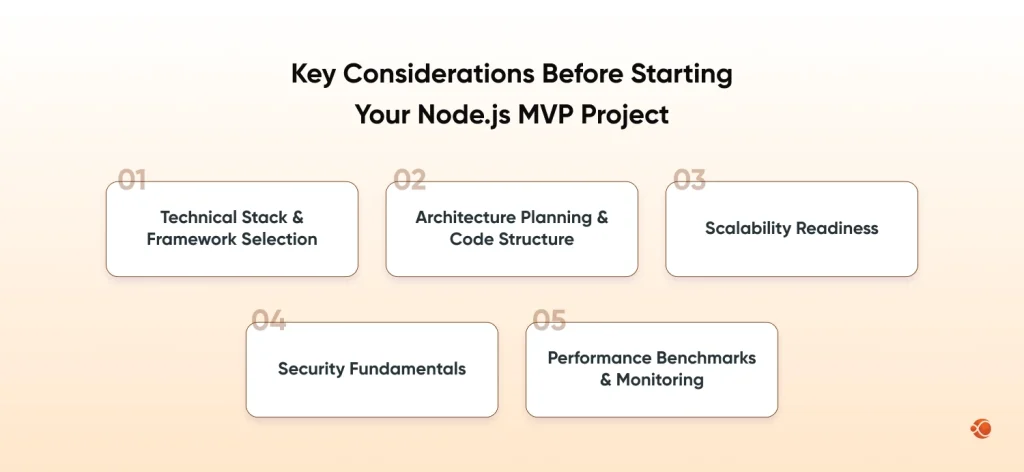
Technical Stack & Framework Selection
This will directly influence the development timeline by shaping the choice of Node.js frameworks and the tools that come with them. Light frameworks such as Express may be ideal for prototype development, and the organized frameworks such as NestJS may be ideal for ensuring architectural longevity. The choice of database, together with the API, may influence prototype development.
Architecture Planning & Code Structure
An architectural foundation helps prevent early technical debt. Architectural patterns such as modularity, separation of concerns, and asynchronous processing help keep the MVP flexible as features change. It is even possible to have a monolithic environment for the MVP architecture that can be scaled for future service separation.
Scalability Readiness
Handling concurrent connections is a strong suit of Node.js. However, scalability is not always straightforward when employing the MVP. Process management, horizontal scaling concepts, and load-handling mechanisms need to be factored in from the start. It is necessary to demonstrate market demand without scaling the system architecture.
Security Fundamentals
Security must be incorporated throughout, not layered on afterwards. This would include API security for OWASP, securing auth loops, protecting environment variables, and input validation. Node.js best practices help with rapid development.
Performance Benchmarks & Monitoring
This is important to ensure that the output meets the requirements for performance, and the output shall serve the needs of the target audience. It is also good to know response time, capacity, and resource usage by API.
How to Get Started with Node.js MVP Development
For a successful launch of MVP, there has to be a systematic process involving speed, quality, and scalability. By using node.js for product development, entrepreneurs can easily launch their business’s minimum viable product and benefit from the entire JavaScript stack.
Step 1: Understand Your Product’s Core Concept (1-2 Weeks)
First, it is very important to be clear on what problem you are trying to solve by your product. Then comes the step where you identify your product requirements and look for what Node.js has to offer you in order to solve your problem. On this basis, we can determine the technical issues.
What you do:
- Research Your Target Market: The first thing you have to identify is what problem you’re solving. You can use AI tools to examine trends in your feedback to get a better idea.
- Map the User Journey: Try to outline the major activities that users must pursue to engage your product. Since Node.js is really good at real-time data processing, think about adding advanced functionality to your MVP. It should include real-time updates or even just seamless user interactions.
What you get:
- A clear, validated problem statement.
- Defined user flows and core features.
- A strategic idea of how Node.js can support the functionality of your MVP.
Step 2: Plan Your Tech Stack (1 Week)
Tech Stack selection is very important for MVP development. You will need to choose libraries, frameworks, and databases for Node.js based on your product needs.
| Component | Options | When to Choose |
| Backend Framework | Express.js, NestJS | Express.js for lightweight MVPs. NestJS for structured, enterprise-style apps |
| Database | MongoDB, PostgreSQL | MongoDB for flexible or unstructured data. PostgreSQL for relational data |
| Cloud Hosting Provider | AWS, Google Cloud, Vercel | AWS or GCP for backend and scalability. Vercel mainly for frontend hosting |
| Scalability Option | Serverless (AWS Lambda) | Useful in early stages to reduce cost and scale automatically |
What you get:
- A clear tech stack ready for MVP development (Node.js, database, cloud hosting).
- A roadmap for your backend architecture and infrastructure.
Step 3: Design the Core Features (1-2 Weeks)
Resist the temptation to begin programming right away. Your full-time Node.js developers should be able to identify the scope for your MVP project. They should be able to do so properly and thus be able to set the proper order of the important parts and begin developing them first.
What you do:
- Feature Prioritization: An approach to prioritize requirements is MoSCoW prioritization (Must-Have, Should-Have, Could-Have, Won’t-Have). In Node.js implementation, backend functionalities include API support, real-time data support, and authentication services.
- Wireframing: Design wireframes of the major UIs in your app. These would be functionalities like registrations/login functionalities and so on. You may use Figma or Sketch to do so.
- Database Design: Design your database tables/collections structure, and their connections with respect to your features. This will include users’ ability to log in, manage their profiles, and retain data across different sessions.
- A prioritized feature list and wireframes.
- Basic database schema and data flow plans.
Step 4: Develop the MVP (5-12 Weeks)
Heavy lifting begins here. Integrating your tech stack, now start building the MVP using Node.js.
What you do:
- Frontend & Backend Development:
- You should use Express.js or NestJS to implement the backend APIs.
- In real-time applications, one has to implement Socket.io. This allows communication in both directions (for example, in messaging apps or in real time).
- Ensure proper error handling and logging using tools like Winston for Node.js.
- Authentication:
Add authentication for the logged-in user using JSON Web Tokens (JSON Tokens). - Database Setup:
You can then define the database models for storing user or transaction data. Based on the need for your MVP application, the database model will be designed. For the MongoDB database, Mongoose can be employed. Similarly, for the PostgreSQL database, Sequelize can be used. - Third-Party Integrations:
Add any APIs or services that require the use of third parties. This could include adding APIs for payment services like Stripe, or APIs for services like SendGrid for sending email.
What you get:
- MVP that can perform the required back-end operations.
- Secure user authentication, database models, and basic frontend UI.
Step 5: Test & Debug Your Node.js MVP (1-2 Weeks)
Testing your Node.js MVP app means your product will work as intended. This is very important, especially for Node.js apps, where asynchronous operations or database queries cause problems most of the time.
What you do:
- Unit Testing:
Implement unit tests for key methods by using testing tools such as Mocha or Jest. - Integration Testing:
Test the interaction of different components in your Node.js application. Utilize libraries such as Supertest for API endpoint testing. - User Testing:
Test your MVP with a small group of users to ensure it works well and is easy to use. - Bug Fixing:
Correct any bugs or errors that arise during testing. This can be particularly important if you are utilizing real-time functionality through Node.js.
What you get:
- A bug-free MVP ready for deployment.
- Insights into usability improvements before the public launch.
Step 6: Deploy and Monitor Your Node.js MVP (Ongoing)
Push to your favorite hosting platform once your MVP is ready. In most cases, with Node.js, this is quite straightforward; performance monitoring and user feedback collection are key to iteration.
What you do:
- Deploy the MVP:
You can host your app using Heroku, AWS, or Vercel. You need to ensure it can be accessed via https. All environment variables are properly set up. - Set Up Analytics:
Installing tracking software such as Google Analytics and Mixpanel will help track user behavior. - Monitor Performance:
To monitor Node.js app performance in real-time, you can use tools such as New Relic or Datadog. - Iterate Based on Feedback:
Gather user feedback and continue improving your MVP through regular updates and bug fixes.
What you get:
- A production-ready Node.js MVP app that is ready for users.
- Practical insights and findings about user engagement and performance for future improvements.
When to Hire Node.js MVP Development Experts
It is very important for a startup or any business to decide whether to hire Node.js MVP development experts for a fast, scalable, and maintainable MVP. These factors need to be kept in mind when designing your strategy of MVP development:
In-House vs. Outsourced Decision Factors
| Model | Best For | Pros | Cons |
| In-House Development | Long-term products | Full control, strong ownership | Hiring cost, slower setup |
| Outsourced Development | MVPs, fast delivery | Quick start, lower cost | Less control |
| Hybrid Approach | Growing or complex products | Balance of control and speed | Needs coordination |
Skill Gap Assessment
- Evaluation of your in-house capabilities against the requirements of your projects
- Identify the weaknesses in back-end development skills and design that need to be augmented by the use of asynchronous programming, APIs, and database optimization.
- This would translate to a situation whereby there is a need to hire Node.js developers or outsource to a team able to offer them.
Timeline and Budget Considerations
- MVP projects are time-sensitive; delayed development can impact market entry.
- Outsourcing or hiring experts can accelerate development, enabling the MVP to reach users sooner.
- Budget constraints can be the deciding factor when companies choose between hiring full-time software developers, freelancers, or a Node.js development services agency.
How to Choose the Right Node.js MVP Development Partner
Selecting the right partner is key to building a high-quality MVP on time and within budget.
Evaluation Criteria
| Evaluation Factor | What to Check | Why It Matters |
| Experience | Hands-on Node.js MVP experience | Reduces risk and rework |
| Portfolio | Relevant, complex past projects | Shows real delivery capability |
| Technical Expertise | Express.js, NestJS, Fastify, databases, testing, DevOps | Ensures scalable and maintainable MVP |
| Industry Knowledge | Familiarity with your domain | Faster onboarding, better feature decisions |
Questions to Ask Potential Partners
- Can you share your experience in Node.js MVP development for startups?
- What frameworks and tools you recommend to use in MVP, and why?
- Can you elaborate on Node.js MVP architecture, scalability, and security?
- Would client references or case studies be available?
- How do you handle agile software development and the management of sprints?
Red Flags When Hiring a Node.js Partner
- There is no methodology in the area of Project Management.
- A minimal portfolio or one that is very outdated.
- Overpromising on timelines or underestimating complexity.
- There are limited lines of communication or the response is not always good.
Why Choose CMARIX for Node.js AI MVP Development Services
CMARIX offers PoC and AI MVP development services of the highest standards, helping startups and businesses with PoC development and ensuring your product is scalable with high-performance Node.js right from day one. This is possible thanks to the Full-Stack JavaScript development services offered by CMARIX software company.
Whether it is building your project in terms of developing a scalable SaaS product, real-time collaboration tool, or any other AI-powered product, we will see to it that your tech stack is solid, secure, and investor-ready. We will go beyond code to provide key inputs in terms of product scalability to smoothly transition your MVP to a full-fledged product.
Core Features:
- Rapid MVP development with Node.js and full-stack JavaScript
- AI and machine learning model integration (TensorFlow.js, brain.js)
- Real-time processing and intelligent microservices
- Build AI apps with Node.js using real data to check what works and what doesn’t
- Launch on the cloud so the system can grow with demand
- Integrate smoothly with APIs and existing business systems
- Add monitoring, testing, and security from the start
Conclusion
A successful MVP will require strategic as well as technological rationale. The strength of the idea alone will never work. It will all come down to the time the idea takes to obtain real users, the effectiveness of the idea in terms of its development, and the malleability of the tech stack.
Node.js has proved to be a great option for MVP development due to its support for rapid prototyping, real-time processing, and full-stack JavaScript development. This enables startups to check their hypotheses quickly but creates the right foundation for a scalable application.
FAQs on Node.js MVP Development
What is Node.js MVP development?
Node.js MVP development means the creation of a Node.js MVP to swiftly test an idea using a scalable event-driven server powered by Node.js.
Why should startups choose Node.js for building an MVP?
Node.js offers fast development of applications, supports real-time functionality, and is furnished with an excellent ecosystem, thus definitely worth exploring for initial product validation.
How long does it take to develop an MVP with Node.js?
Development time will depend on the extent of features, integrations, and complexity. For defining a real roadmap, get in touch with experts at CMARIX to get a proper assessment.
What is the typical cost of a Node.js MVP?
The cost of MVP depends directly on functionality, architecture, and integrations with third-party services. The exact investment range shall be defined after discussing the requirements with CMARIX experts.
Can an MVP built with Node.js scale to a full-fledged product?
Node.js supports modular architectures, microservices, and cloud deployments, allowing MVPs to scale smoothly into enterprise-grade products.
Can machine learning features be integrated into a Node.js MVP?
Machine learning capabilities can be integrated using APIs, cloud AI services, or any external ML model, which enables intelligent features right from the MVP stage itself.