

Quick Summary: Starting a restaurant means getting customers, running a kitchen efficiently, and competing in the market. In this article, we’ll walk through 13 food app ideas, including AI food delivery apps, kitchen automation apps, deal apps, food rescue apps, and more. Each idea includes its target users, revenue models, and potential risks.
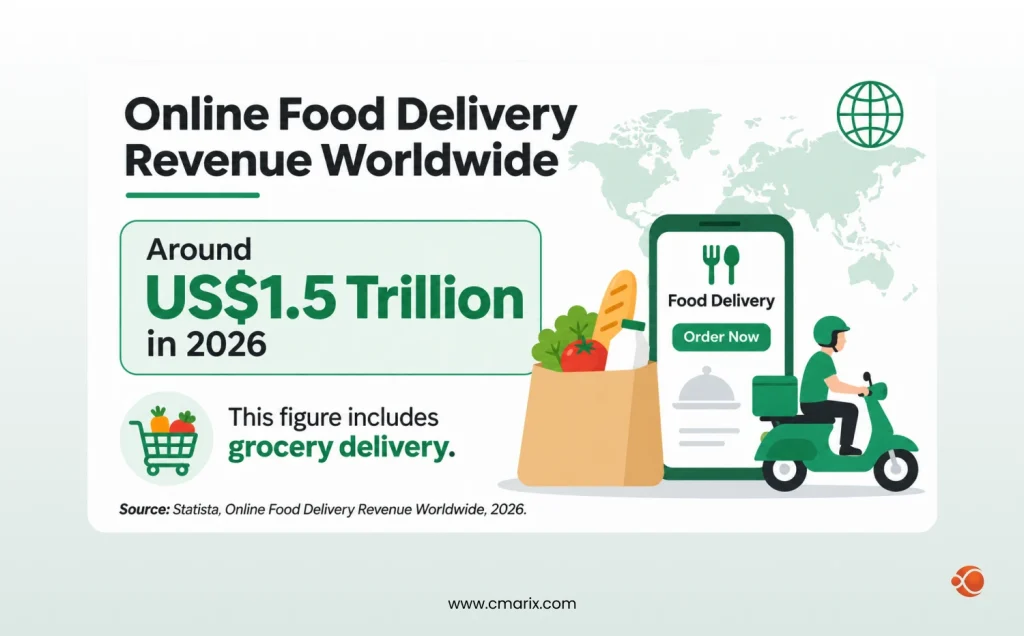
Statista projects online food delivery revenue of about US$1.5 trillion worldwide in 2026, including grocery delivery.
Most founders start by wanting to build an app like UberEats, and that is usually the wrong first move. Big marketplaces already own discovery in most cities, so a new entrant needs a sharper angle: one customer, one problem, or smarter use of data. The food delivery app ideas below are chosen with that in mind.
What Are Food App Ideas for Restaurant Startups?
Food app ideas for restaurant startups are product concepts that use a mobile or web app to solve one specific problem in how people find, order, pay for, or enjoy food, or in how a restaurant runs its day. They fall into two groups. Customer-facing apps help diners decide, order, save money, or eat better. Operator-facing apps help restaurants cut waste, speed up the kitchen, and keep guests coming back. The strongest concepts often connect the two.
AI Food App Ideas for Restaurant Startups in 2027
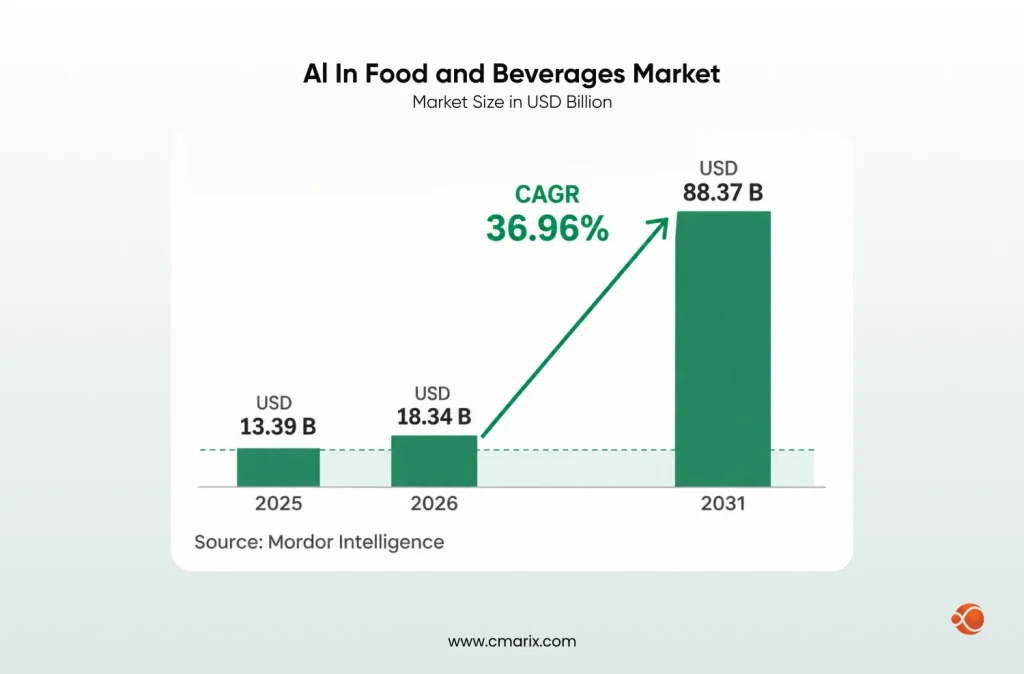
AI is where much of the momentum sits. Mordor Intelligence estimates the AI in food and beverages market will grow from USD 13.39 billion in 2025 to USD 88.37 billion by 2031, a 36.96% CAGR over 2026 to 2031. Much of that spend sits on the production side of the industry, but the same tools are now reaching ordering, kitchens, and marketing. That makes AI tools for food startups a smart place to look for an edge. These six are the most practical AI restaurant applications to build right now.
1. Predictive Ordering App for Offices and Catering
The predictive ordering concept is focused on the business aspect of food. The app, powered by AI technology, studies the eating habits of a company: when, how often, and what kind of food employees consume. Then, the app makes suggestions regarding lunches, manages invoices, and tracks event calendars in the area to account for fluctuations in the number of people.
The catch is data. Predictions only get good once you have enough order history per client, so start with a simple recurring-order engine and add the machine learning later.
2. Personalized Menu Recommendation Engine
Streaming platforms taught people to expect suggestions that fit their taste. An AI food recommendation engine brings that to menus. It learns from past orders, ratings, time of day, weather, and local trends, then surfaces dishes and restaurants a user is likely to want. For a startup, the payoff is a higher average order value and fewer abandoned carts.
Keep it honest, though. Recommendations that feel random or pushy hurt trust faster than having none at all.
3. Voice Ordering Assistant
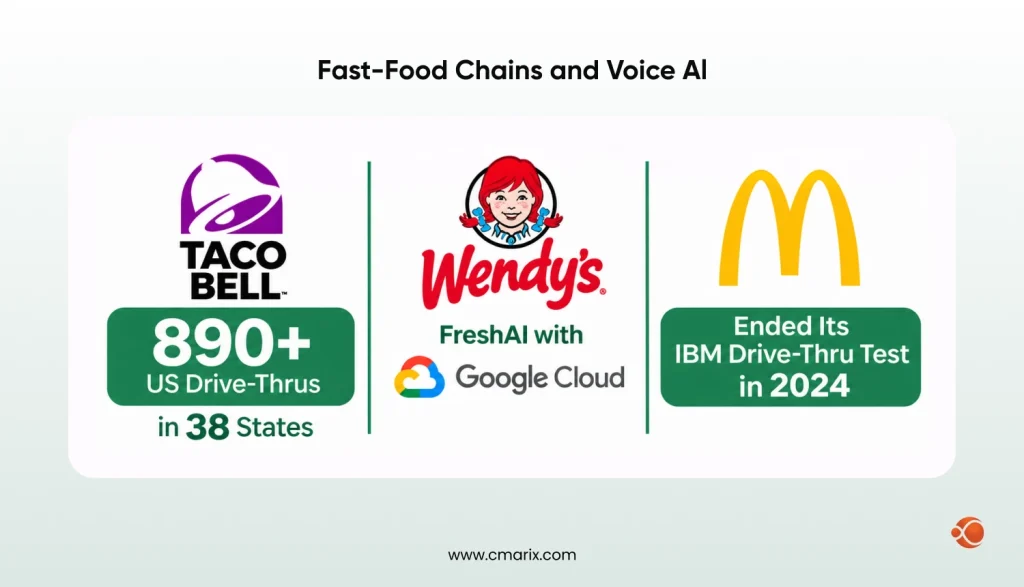
Voice ordering is already real. Taco Bell has rolled out Omilia voice AI across more than 890 drive-thru locations in 38 states in the US, while Wendy’s has developed its FreshAI solution using Google Cloud technology. The results have been inconsistent, though. McDonald’s has shut down its trial with IBM voice ordering.
For a startup, the better approach would be a more constrained environment – voice ordering via an app or by calling from a phone. In this case, you don’t deal with the extra noise of a drive-thru environment. The assistant accepts the order, makes customization changes, collects payments, and remembers regular orders. Add the ability to easily pass the task to a person.
4. Kitchen Operations Optimizer
This is a B2B idea aimed at restaurant owners. The application monitors live inventory and orders, as well as worker schedules, and organizes dish preparation so items are sent to the pass at the same time.
Automated kitchen operations like this pay off most for cloud kitchens and multi-brand operators, where one team cooks for several menus. Add cloud kitchen management software features such as order routing, per-brand menus, and a single dashboard, and the product grows with the customer.
5. Predictive Food Trend Tool
Menu choices are guesswork for most owners. Predictive food trends systems use information from web searches, conversations on social media, and trends in sales to identify emerging trends in dishes, foods, and diets in particular regions. A young company could offer such a service as a monthly subscription service for independent restaurants and cloud kitchens that cannot afford a research department.
The difficult part is accuracy. A trend spotted too late is useless, and one spotted too early can lose money. Start with a single city and a particular culinary category, confirm that the predictions work, and grow from there.
6. AI-Powered Meal Planning App
Food trackers and diet planners were not always merged into one solution. These days, it is more effective to combine calorie counting and meal planning into one service. The AI-powered meal planning application creates weekly plans based on users’ health objectives, allergens, budget constraints, and ingredients available at home. It tracks people’s nutrition in real time while they consume their meals. Additionally, such services assist nutritionists in creating diet plans for their clients.
The market is flooded with generic apps like MyFitnessPal and Cronometer, so our opening is niche-specific: diabetic-safe meal plans, athletes, or meals that use one restaurant’s menu. Since there is some health-related information involved, clarity is as important as the algorithm itself. Our guide to food app UI/UX covers the design details.
Our team scopes your concept and budget before you commit to development.
Everyday Food App Ideas for Restaurants and Diners
Not every good idea needs machine learning. These food app ideas solve everyday problems for restaurants and diners, and most can launch as a lean first version.
7. Direct Online Ordering System
Third-party platforms offer exposure; however, you pay a fee for every order. Fees usually range from 5 to 30 percent, depending on the pricing package. With a direct online ordering system, a restaurant can accept orders through its own mobile app and website, collect customer details, and even launch its own promotions.
Most restaurant groups end up with a hybrid approach: staying listed on marketplaces for visibility while attracting customers to create a restaurant app. For those considering direct online ordering, here is an article about how to build your restaurant app and what features to include.
8. Restaurant Customer Retention App
Acquiring the first order is costly; acquiring the second order has to be cheap. It’s what a restaurant customer retention app does with points, stamps, birthday promotions, and win-back communications based on guest activity, such as no order in three weeks. Integrate it with your point of sale so you can award points effortlessly.
Integrate it into omnichannel restaurant marketing, so that one promotion goes out across push notifications, emails, SMS, and social channels rather than five separate campaigns. The number that matters is the repeat order rate, so design your reporting system accordingly right from day one.
9. An App Like EatClub for Off-Peak Tables
Empty tables on a Tuesday afternoon are lost money. EatClub, an app active in Australia and the United Kingdom, solved this problem by letting venues offer time-specific discounts to customers who live nearby. It works because the discount offered can be controlled by the restaurant in terms of when and how many.
For an App like EatClub, two key features are a venue-side dashboard that lets staff create a deal in a minute and payment management that automatically applies the discount without awkward conversation.
10. Table Booking and Waitlist App
Table reservation seems like an easy problem to solve, but independent restaurants still have room to improve, even with systems like OpenTable and Resy. A dedicated table booking and waitlist app can add features like a text-based waitlist, a deposit for large groups, and a direct link to your ordering system so a reservation can include a pre-order.
The travelers’ segment is a good one to target from the beginning because they tend to plan reservations in advance in unknown cities.
11. Food Rescue App
Restaurants and bakeries throw away good food at every closing time. Too Good To Go turned that surplus into a business: venues sell unsold food at a discount in surprise bags, and users collect it at a set time. The company reports saving more than 600 million meals since launch, with over 120 million registered users and 200,000 active partners across twenty countries.
That scale makes a universal app for this issue a hard battle; focus on smaller aspects: university campuses, one city, or cooperation with food banks/charities to provide donations instead of sales. Profit may come from sponsorships or business partnerships aimed at minimizing waste.
12. Cooking and Recipe Experiment App
Home cooking apps are not new. Tasty, SideChef, and Mealime already claim this space, so there’s little room for a general cooking app. There is room only for the specifics – for example, an application that will suggest an alternative to the ingredient you don’t have or teach a certain cuisine with the help of cooking lessons.
However, if you are thinking of a restaurant start-up, consider a cooking application that sells meal kits or brings customers back to your menu.
13. AR Restaurant Preview
Augmented reality lets diners preview a venue’s atmosphere, or see dishes on the table in 3D before they order. It is the least proven idea on this list, so treat it as a pilot rather than a full product. Add it as a feature inside an existing booking or ordering app, such as a 360-degree venue tour or a 3D menu, and measure whether it lifts bookings before you invest further.
How the Big Food App Players Are Innovating in the US and UK
Studying the leaders shows where the market is heading and where smaller players can still find room. For more inspiration beyond food, see our list of mobile app ideas for startups.
| Player | Key Innovations and Features |
| DoorDash (US and UK) | AI-powered advertising tools (Symbiosys), robotic delivery with Coco Robotics, and UK entry through the Deliveroo acquisition completed in October 2025. |
| Uber Eats (UK and US) | Sponsored product placements (PepsiCo), grocery delivery expansion, and reusable packaging pilots in the UK. |
| Grubhub (US) | Now owned by Wonder, with multi-store ordering, loyalty features, and a free Grubhub+ benefit for Amazon Prime members. |
| Just Eat (UK) | Now part of Prosus, with the JET Go service that lets restaurants use its courier network under their own brand. |
| ChowNow (US) | Commission-free ordering for independent restaurants, plus Instagram ordering integration. |
The biggest shift is consolidation. DoorDash added AI advertising tools, then completed its acquisition of Deliveroo, which put it in direct competition with Just Eat and Uber Eats in the UK. Prosus completed its Just Eat Takeaway acquisition the same week, and Grubhub now sits under Wonder.
Uber Eats keeps pushing into advertising and into the grocery delivery app space, while ChowNow shows the other path: a restaurant-first model that protects margins. Just Eat is betting on JET Go for branded delivery.
The pattern is clear. The leaders are adding advertising, bundling subscriptions, and merging. Smaller players win by being narrower, which is why the ideas above each focus on one customer and one problem.
How Much Does It Cost to Build a Food App?
Cost depends on how many apps your idea needs. A marketplace needs four: customer, restaurant, courier, and admin. A direct ordering app for a single brand needs far fewer. Our cost breakdown goes module by module, and the table below shows the headline tiers.
| Build Tier | Cost Range | What You Get | Typical Timeline |
| MVP | $30,000 to $60,000 | Core ordering flow, basic restaurant dashboard, simple courier app, core admin controls | 3 to 5 months |
| Mid-Market | $60,000 to $120,000 | Real-time GPS tracking, in-app payments, ratings, push notifications, multi-restaurant support | 5 to 8 months |
| Enterprise-Grade | $120,000 to $200,000+ | AI recommendations, dynamic pricing, dispatch algorithms, multi-language and currency support, advanced analytics | 9 to 14 months |
Costs are approximate estimates and vary with scope, features, integrations, and business requirements. These tiers describe a full marketplace platform, so a single-restaurant app with one core flow can cost less.
Almost all the AI capabilities covered in this guide fall into the enterprise-level category. A realistic approach is to go live with the core ordering process first and implement prediction features once actual orders fund the effort. After launch, budget approximately 15–25% of the initial development cost annually for app maintenance. This covers bug fixes, security patches, iOS and Android compatibility updates, performance monitoring, and routine technical support. Hosting, payment gateway fees, SMS services, and new feature development are generally billed separately.
For example, maintaining a food delivery app that costs $60,000 to build may require an additional $9,000-$15,000 annually.
If you are budgeting beyond food, our general guide to the cost to develop an app shows how scope, platform, and team location move the number.
How to Choose the Right Food App Idea
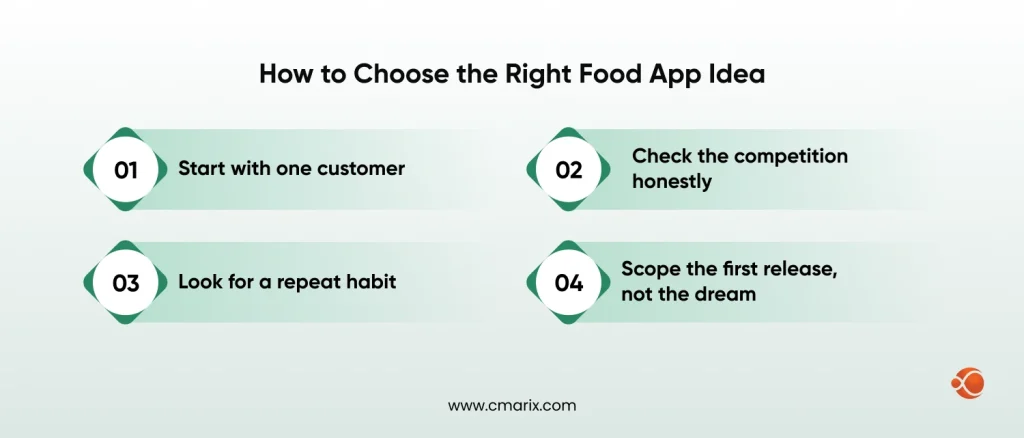
Long lists are meaningless unless you’re able to filter out some options. There are four criteria to do that.
- Start with one customer: Pick diners, restaurant owners, or corporate buyers. Ideas that try to serve all three tend to stall.
- Check the competition honestly: Search the app stores first. If five strong apps already exist, you need a narrower angle, not a slightly better copy.
- Look for a repeat habit: Applications that are related to something recurring, such as daily lunch orders and loyalty programs, will likely retain users better than novelty applications like augmented reality tours.
- Scope the first release, not the dream: Design an application based on one process, see how it’s used in real life, then implement artificial intelligence features.
Why Choose CMARIX for Your Food App Project
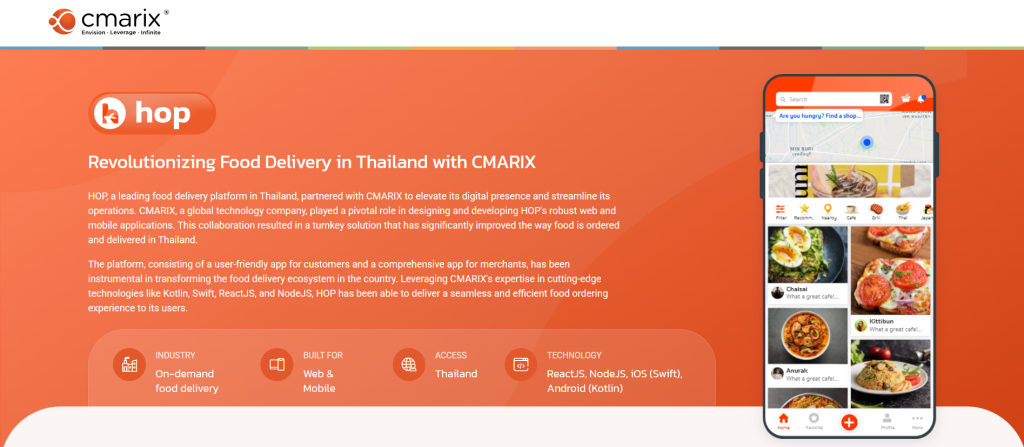
CMARIX develops food ordering, delivery, and restaurant platforms for real markets. HOP, a food delivery platform now operating in Thailand, pairs a customer ordering app with a merchant app, a NodeJS and ReactJS backend, real-time GPS order tracking, and a local payment gateway. The same structure adapts to a single-brand ordering app or a multi-vendor marketplace.
Our teams, including experienced iOS developers and Android developers, handle design, build, integrations, and continuous support under ISO 9001:2015 and ISO 27001-certified processes.
Conclusion
The best food app ideas are rarely the biggest ones. They target one customer, solve one problem, and grow from a lean launch. Start your venture with a direct-order solution, retention app, or kitchen AI solution, and run tests on a smaller scale in just one city. Once you are ready to plan your build process, get help from food delivery app development companies.
FAQs on Food App Ideas for Restaurant Startups
What are the best Food App Ideas for startups?
The strongest food app ideas pair a specific customer with a repeat habit. Direct online ordering systems, restaurant customer retention apps, AI-powered ordering apps, and off-peak deal apps all fit that rule. Pick one problem, build a lean first version, and test it in a single city.
Which Food Delivery App Ideas are missing in the market?
Few categories are truly empty, but some are underserved. Explore concepts like office catering services, hyperlocal apps covering one neighborhood or cuisine type, cloud kitchen apps covering multiple brands, voice ordering in restaurant-owned apps, and food-rescue apps in smaller towns. It would be prudent to keep in mind that only narrow niches should be considered.
How can startups use AI Tools for Food Businesses?
Start with the data you already have. AI tools in food startups could suggest dishes based on previous orders, predict demand to reduce waste, schedule kitchen prep, and answer customer queries via chat or voice. Start with one use case, gauge the impact on orders or wastage, then proceed further.
What are the best AI-powered restaurant apps?
At an enterprise level, clear examples include voice-activated ordering technology such as Taco Bell’s Omilia application and Wendy’s FreshAI technology. At the startup level, the most successful applications perform a specific task effectively, such as predictive ordering, kitchen preparation planning, or personalized menus.
How can AI improve Restaurant Customer Retention?
It helps identify customers who are about to churn and trigger an appropriate offer. It allows you to customize rewards based on past orders. It can also help you time messages through push notifications, SMS, and email to match the customer’s ordering schedule. You will also need to integrate it with your order system.
What features should an AI-Powered Food Ordering App include?
The most basic features are menu browsing, cart/checkout options, payment, order tracking, and push notifications. AI features can include recommendations, customization and filters based on user preferences, reorder options, and even voice ordering. Back-end options for admins are just as important.
How much does Food App Development cost?
The cost depends on the scope and may range from $30,000 for an MVP to more than $200,000 for an enterprise solution with AI. The pricing list above shows the prices and duration for each level, while annual maintenance usually ranges from 15 to 25 percent of the original development cost.
What are the most profitable Food Tech Business Ideas?
Profitability depends on implementation, but business ideas with recurring revenue or a clear cost-saving model are likely to succeed. Consider recurring tools such as restaurant management software, trend prediction software, direct ordering and loyalty software (to remove commissions), and deal apps that fill empty seats. Consumer apps also can scale, but may require more marketing effort. Perform due diligence through a pilot before scaling.
How can restaurants increase orders using Direct Online Ordering Systems?
With a direct ordering system, customers can place orders through your app or website without paying marketplace commission fees for each order. You will control the offers, collect customer data, and even send order reminders. Just promote it on your receipts, packaging, social media, and in-store QR codes.
How can AI predict trends using Food Trend Analysis Tools?
Food trend analysis tools use information about searches, social conversations, and local sales to determine which foods and ingredients are becoming more popular locally. AI recognizes the trends through machine learning and assesses the chances of the trend persisting for a long. It helps restaurants adjust their menus, develop promotional strategies, and buy supplies.