

Quick Summary: B2B mobile app development is not only a choice but the only way for businesses to remain fast, connected, and competitive in today’s world. By emphasizing integration, security, and workflow optimization, businesses can develop mobile applications that allow employees, partners, and customers to make smarter decisions.
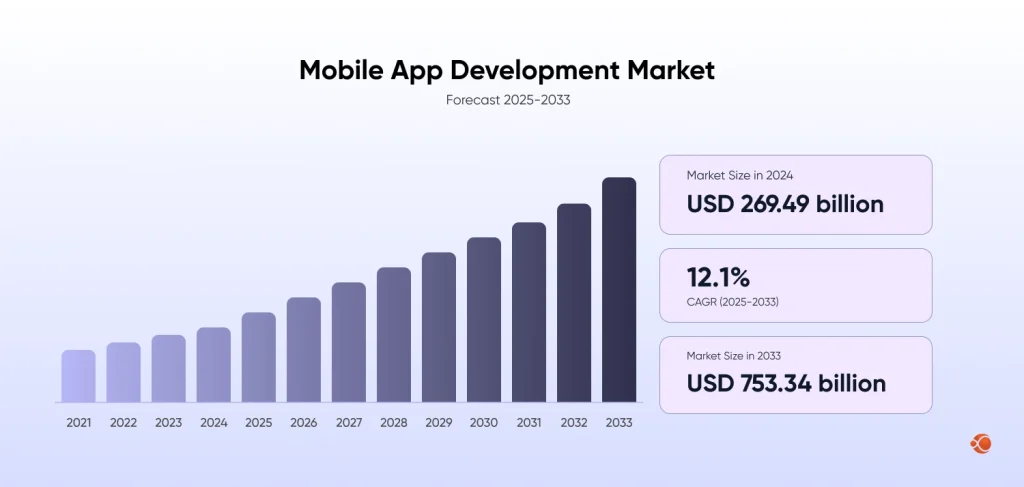
Computers are no longer the backbone of businesses. And executives want dashboards in their pockets, not in spreadsheets. That is why B2B mobile app development has become a serious business concern, and not a “nice to have” aspect. Even the global mobile app development market size is expected to grow at USD 753.34 billion by 2033, and it was valued at USD 269.49 billion in 2024, with a CAGR of 12.1% from 2025 to 2030.
If you’re building customer portals, internal tools or partner platforms, you already know that customer-style apps won’t cut it. B2B apps live in a different world, one shaped by security rules, workflows, integrations, and long buying cycles.
In this guide, we’ll walk through what B2B mobile apps really are, how they’re built, what they cost, and how to get them right the first time. No fluff. No buzzwords. Just practical insight you can use.
The Shift Toward Mobile-first Enterprise Operations
A few years ago, enterprise software used to live on desktops. Today, work happens everywhere, such as in warehouses, on shop floors, in client offices and sometimes in the back of a cab between meetings. Mobile apps aren’t replacing desktop systems; they’re extending them into real-world workflows. Working along with a mobile app development company can help businesses translate traditional systems into seamless mobile-first experiences.
You might notice that teams respond faster, close deals quicker, and solve issues sooner when they’re not tied to a desk. That’s the power of mobile-first enterprise thinking.
Growing Demand for Real-time Business Access
Data loses value when it’s late. Sales reps need pricing updates now. Warehouse managers need stock counts now. Executives want performance numbers now. Mobile apps make that possible without forcing people to log into bulky systems or wait for reports.
Role of Mobile Apps in Digital Transformation
Digital transformation is not just about moving everything to the cloud. It’s about making systems easier to use, faster to access, and smarter in how they support daily work. And mobile apps become the front door of such transformation.
What Is B2B Mobile App Development?
B2B mobile app development means building applications that are specially designed for business users, partners, employees, vendors, distributors or enterprise customers. These apps focus on workflows, productivity, data accuracy and system integration rather than entertainment or impulse purchases. Knowing the mobile app development process makes sure that apps provide measurable value and business objectives.
Types of B2B Mobile Applications
Some common types include:
- Internal workforce apps (HR, operations, field service)
- Sales enablement and CRM apps
- Partner and distributor portals
- Inventory, logistics, and warehouse apps
- Customer service and support platforms
Each type serves a different business role, but they all share one goal: making work easier and faster.
How B2B Apps Support Internal and External Stakeholders
Internally, apps help teams work smarter. Externally, they help partners and customers interact with your business more smoothly. In various cases, one app serves both sides, with different access levels and features depending on the user’s role. A strong mobile app business plan makes sure that stakeholder needs are mapped and business goals are achieved.
Key Differences Between B2B and B2C Mobile Apps
| Aspect | B2B Mobile Apps | B2C Mobile Apps |
| Target users | Employees, partners, vendors, enterprise clients | General consumers |
| Usage context | Work-focused, task-driven, role-based | Lifestyle, entertainment, shopping, social |
| Feature complexity | High, supports long workflows, approvals, and data validation | Lower, shorter user journeys and simple actions |
| Security needs | Enterprise-grade security, role access, and compliance | Basic user authentication and data protection |
| Integrations | Deep integration with ERP, CRM, HR, inventory, and finance systems | Limited or no enterprise system integration |
| Buying process | Long sales cycles with multiple decision-makers | Quick, individual download decisions |
| Updates and changes | Planned releases, regression testing, compliance checks | Frequent updates with lighter testing cycles |
Collaborate with trusted development teams to deliver secure, scalable, and performance-driven solutions.
Contact UsBusiness Benefits of B2B Mobile Apps
- Greater efficiency: Because the employee doesn’t have to switch between apps or write notes by hand or re-enter data later. This means work happens faster, with fewer steps and errors.
- Boosted employee productivity: Mobile apps remove friction. Employees can change work status on sites, sales reps can enter meeting results immediately, and managers can approve requests without needing to log into a desktop application. Small gains add up quickly for big teams.
- Increased engagement: Customers and partners appreciate tools that make their work simple.Whether it is ordering, delivery tracking, or support, having access through mobile devices will increase satisfaction and loyalty.
- Informed decision-making: Leaders can respond to issues quickly and spot trends early, with real-time data flooding dashboards. This is one of the crucial long-term benefits.
For companies looking to transform operations and drive measurable results, working with a B2B mobile app development company makes sure apps are designed and built to maximize productivity, efficiency and engagement.
Common Use Cases of B2B Mobile Apps
Sales Enablement and CRM Access
Sales teams depend on fast access to product catalogs, customer data, pricing and order history. A mobile CRM lets them prepare for meetings, update pipelines and follow up while they’re still in the process. Inventory management and supply chain, field services and partner portals also get benefits from app development statistics, which show how each use case improves efficiency and adoption.
Supply Chain and Inventory Management
Mobile applications are used by logistics professionals, procurement teams and warehouse managers to monitor inventory, point out shortages, manage deliveries and scan items before they become issues.
Field Service and Workforce Management
Technicians use mobile apps to receive job assignments, log repairs, view equipment history, capture photos and get customer signatures, all without paperwork.
Partner Portals and Distributor Platforms
Resellers and distributors use a mobile app to place orders, access marketing materials, manage accounts and track shipments. This strengthens relationships and reduces manual coordination.
Enterprise Communication and Collaboration
Some of the apps emphasize internal communication, task management, announcements and document sharing, especially for teams without regular desk access.
Essential Features of a Successful B2B Mobile App
Secure Authentication and Role-based Access
Not every user should see everything. Role-based access makes sure that employees, managers, partners, and customers only access what they’re allowed to. Strong authentication, often multi-factor, is non-negotiable.
Offline Access and Data Synchronization
Many B2B users work in places with weak or no internet: remote sites, warehouses, and factories. Offline functionality makes sure work continues, with data syncing once connectivity returns.
Real-time Notifications and Alerts
Alerts and push notifications help app users respond to approvals, issues, updates or urgent tasks. Used well, they improve speed without overwhelming users.
Advanced Analytics and Reporting
B2B apps include dashboards, performance metrics, and reporting tools. These give managers insights without needing to export data into separate tools.
Smooth Third-party Integrations
Applications won’t live in isolation. It needs to connect with ERPs, CRMs, payment gateways, HR systems and other platforms. Integration and APIs layers are key here. Role-based access, offline access, secure authentication, real-time notifications, and advanced analytics are all important.
These features are best implemented by teams with experience in mobile app design services, usability, making sure clarity and smooth workflows for all users.
Technologies and Platforms for B2B App Development
| Platform/Technology | Description |
| Native iOS | Built using Swift, offering high performance and deep integration with Apple devices and OS features. |
| Native Android | Built using Kotlin, ideal for businesses focused on B2B Android development, especially where hardware integrations like scanners and rugged devices are required. |
| Cross-platform | Built using frameworks like Flutter or React Native, allowing shared codebases and faster development across iOS and Android. |
| Web platforms | Used alongside mobile apps as part of larger B2B web application development ecosystems, sharing services and data. |
| Backend frameworks | Common choices include Node.js, .NET, and Java for building scalable, secure backend services. |
| Cloud infrastructure | Platforms like AWS, Azure, and Google Cloud provide hosting, scalability, data storage, and security. |
| API architecture | API-driven systems connect mobile apps to enterprise tools like ERP, CRM, and HR platforms. |
| Databases | Enterprise-grade SQL and NoSQL databases manage structured and unstructured business data. |
| Security technologies | Includes encryption, token-based authentication, role-based access control, and audit logging. |
| Integration tools | Middleware and integration platforms enable smooth data exchange between systems and services. |
Step-by-step B2B Mobile App Development Process
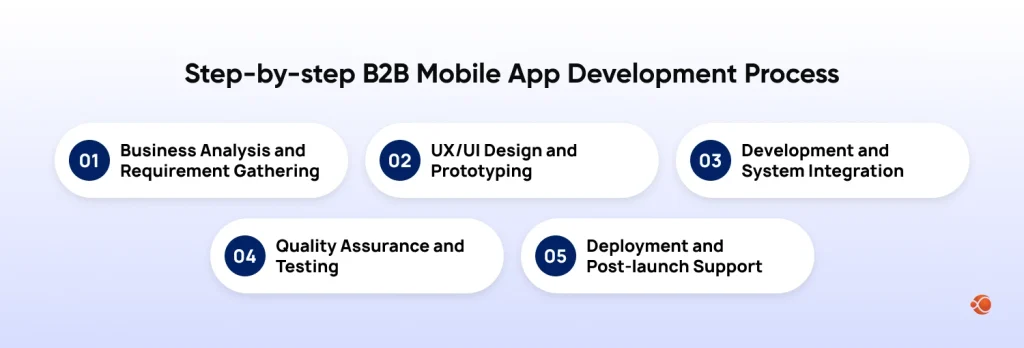
1. Business Analysis and Requirement Gathering
This is where most success starts. Teams work closely with stakeholders to user roles, understand workflows, system dependencies, business goals and compliance requirements and business goals. This stage includes technical audits, identifying pain points and process mapping. Skipping or rushing this step usually leads to scope creep, missed expectations and costly rework later.
2. UX/UI Design and Prototyping
Design in B2B apps isn’t just about beautiful visuals. It’s about speed, clarity and reducing user effort. Designers focus on information hierarchy, task flows and minimizing clicks. Interactive prototypes are created so users can test real scenarios early, that helps validate workflows and catch usability issues before development begins.
3. Development and System Integration
This phase involves creating frontend interfaces, backend systems, APIs, and integrations with enterprise systems such as ERP, CRM, and HR systems. App developers will work on implementing business logic, performance, security and data. This is where custom B2B mobile app development can play a very important role, as no off-the-shelf app can possibly handle complex business workflows.
4. Quality Assurance and Testing
This includes testing the app for performance under stress, offline support, security vulnerabilities and cross-device and cross-platform support. In some industries, compliance testing may also be necessary to ensure industry regulations are met. This stage makes sure that the app performs well in real-world business scenarios and not just in controlled ones.
5. Deployment and Post-launch Support
After the app is launched, the development team will monitor its performance, track users, resolve bugs, roll out updates, and optimize features based on actual usage. OS updates, security updates, and feature improvements are also part of the support process. A B2B app is never “done,” it grows along with the business and its needs.
Cost of Developing a B2B Mobile App
| Cost Factor | How It Affects the Budget | Estimated Cost (USD) |
| App complexity | More workflows, roles, and features increase development time and cost | $10,000 – $40,000 |
| Platforms | Building for iOS, Android, or both impacts total effort | $5,000 – $20,000 |
| Integrations | Connecting with ERP, CRM, and legacy systems adds technical work | $5,000 – $25,000 |
| Security & compliance | Advanced security layers and audits increase development and testing costs | $3,000 – $15,000 |
| UI/UX design | Custom enterprise UX design takes more time than standard layouts | $4,000 – $15,000 |
| Maintenance & support | Ongoing updates, fixes, and scaling require long-term investment | $2,000 – $10,000/year |
B2B Mobile App Cost Breakdown by Development Phase
| Phase | What’s Included | Estimated Cost (USD) |
| Discovery & planning | Requirements, workflows, system mapping, compliance analysis | $3,000 – $10,000 |
| Design & prototyping | UX research, wireframes, and clickable prototypes | $4,000 – $12,000 |
| Development | Frontend, backend, APIs, integrations, data handling | $15,000 – $60,000 |
| Testing & QA | Functional testing, performance, security, and device compatibility | $3,000 – $12,000 |
| Deployment & support | App store releases, monitoring, bug fixes, updates | $2,000 – $8,000 |
Choosing the Right B2B App Development Partner
Industry experience and technical expertise: Look for development teams with experience in enterprise systems, a regulated environment and security standards. Developing consumer apps isn’t the same as building enterprise tools. Working with an experienced custom software development services provider reduces risk, improves long-term outcomes and reduces timelines.
Development methodology and communication approach: Agile methods work perfectly well for B2B apps because requirements evolve. Clear communication, regular demos and transparent progress reporting make a huge difference.
Security, compliance, and quality standards: Ask about data protection practices, testing processes and compliance experience. These aren’t optional in enterprise environments.
Post-launch support and scalability: Your application will grow. Make sure your partner supports maintenance, performance tuning, upgrades and scaling as usage increases.
Future Trends in B2B Mobile App Development
AI-powered Business Applications
AI is reshaping how B2B apps work, from demand forecasting and predictive maintenance to support and intelligent recommendations. We’re seeing rapid growth in AI-powered B2B mobile apps that don’t just display data, but actively assist decision-making. These apps can flag risks, suggest next actions and even automate parts of workflows. Over time, AI will shift B2B apps from being tools people use to systems that proactively guide how work gets done.
Low-code and No-code Platforms
The platforms like low-code and no-code are making it easier for development teams to develop internal tools without waiting months for development cycles. Business users can make approval systems, simple workflows, and dashboards with minimal technical skills. While these platforms won’t replace fully custom development for complex enterprise systems. They will play a bigger role in rapid prototyping, process experimentation and internal automation.
Increased Focus on Cybersecurity
Due to an increase in cyber threats and tougher regulations, security will continue to be a high priority. Zero-trust architecture, biometric authentication, and continuous security monitoring are integrated directly into apps. B2B mobile apps will have device-level security controls, advanced identity management, and real-time threat detection to safeguard enterprise data.
IoT and Edge Computing Integration
B2B apps will connect to machines, sensors and equipment, specially in healthcare, logistics, utilities and manufacturing. Mobile apps will act as control panels for physical systems, allowing remote monitoring, maintenance alerts and performance optimization. Edge computing will allow faster processing closer to the data source, reducing latency and improving reliability in real-time operations.
Advanced Data Analytics and Automation
The application will not only display what has occurred, they will also recommend what to do next. Analytics will automatically highlight trends, anomalies, and opportunities. Automation will take care of the regular tasks such as approvals, scheduling, reporting, and notifications. Eventually, B2B applications will become decision partners rather than just data interfaces.
Why Choose CMARIX for B2B Mobile App Development
Choosing the right development partner can shape the success of your B2B mobile app for years to come. CMARIX combines technical depth, industry experience, and a business-first mindset to deliver solutions that work in real-world enterprise environments.
Proven expertise in enterprise and B2B solutions: Proven expertise in enterprise and B2B solutions: CMARIX brings hands-on experience in B2B app development across industries like healthcare, logistics, finance, manufacturing, and SaaS. When you hire dedicated mobile app developers, you get skilled professionals focused on delivering tailored solutions and long-term value.
Strong focus on security and compliance: Enterprise apps demand strong security practices. CMARIX builds with compliance, data protection, and enterprise governance in mind from day one.
Custom development tailored to business workflows: No two businesses work the same way. CMARIX specializes in b2b custom software development, designing apps that match real workflows rather than forcing teams to adapt to rigid tools.
Agile delivery and transparent communication: Projects move in clear stages, with regular updates and working demos. You’ll always know what’s being built and why.
Long-term support and continuous optimization: Beyond launch, CMARIX supports enhancements, performance tuning, and feature growth, ensuring your app keeps delivering value as your business evolves.
If you’re working with skilled b2b app developers, this level of partnership becomes a long-term asset, not just a one-time project.
Conclusion
B2B mobile apps when built right, they improve collaboration, speed, accuracy and decision-making. Working with the right development team makes sure that every aspect from design to deployment, is optimized, making it easier to scale efficiently and using AI-powered mobile app development where it matters most.
FAQs on B2B Mobile App Development
How to develop a b2b mobile app?
Begin with clear business objectives, user roles, and workflow mapping. Then, design, build, integrate with enterprise systems, test, and maintain the app after deployment. Collaboration with an experienced B2B development team can prevent costly rework.
Why do businesses need a B2B mobile app in 2026?
To support mobile teams and remote work with real-time access to data, improved operational efficiency across departments, and faster decision-making. It also helps businesses stay competitive in a mobile-first market.
How much does it cost to develop a B2B mobile app?
Costs vary based on the integrations, functionality, security needs, and platforms. Most business apps cost between mid to high five figures, and some complex systems may cost more. Maintenance and upgrades should also be considered.
What are the best technologies for B2B app development?
Android and Native iOS, cross-platform development using React Native or Flutter, secure cloud infrastructure, and API-based backend solutions are popular. The ideal tech stack will vary based on system integrations and performance requirements.
How can AI enhance B2B mobile app development?
Artificial intelligence(AI) allows the automation of workflows, predictive insights, improved customer service, and faster business decisions. It also enables intelligent personalization and proactive issue identification.
What is an example of a B2B app?
A mobile CRM for sales teams or a field service management app used by technicians to manage jobs, assets, and customer data. Partner portals and inventory management apps are also common examples.