

Quick Overview: Customer service is breaking away from slow replies, overloaded support teams, and repetitive ticket handling. Today’s users expect instant, accurate, and effortless resolution with no waiting and no back-and-forth. This blog explores how AI customer service and agentic AI workflows are redefining that experience by delivering 24/7 autonomous support that thinks, acts, and solves like a digital support team.
Customer expectations have never been higher. People want instant answers, effortless resolutions, and seamless support across every channel. That is why AI in customer service has become one of the fastest-scaling transformations worldwide. And companies like CMARIX, a global AI software development company, are right at the center of this shift. We build agentic, intelligent workflows that never sleep or slow down.
We are now moving into a world where support doesn’t come as a guidebook or predefined instruction manual; it is becoming autonomous, predictive, and deeply personalized, powered by agentic AI workflows that act, learn, and solve problems exactly how humans do, but faster, with better memory, and most importantly, without losing productivity.
Why AI Customer Service Matters: Market Growth & Momentum?
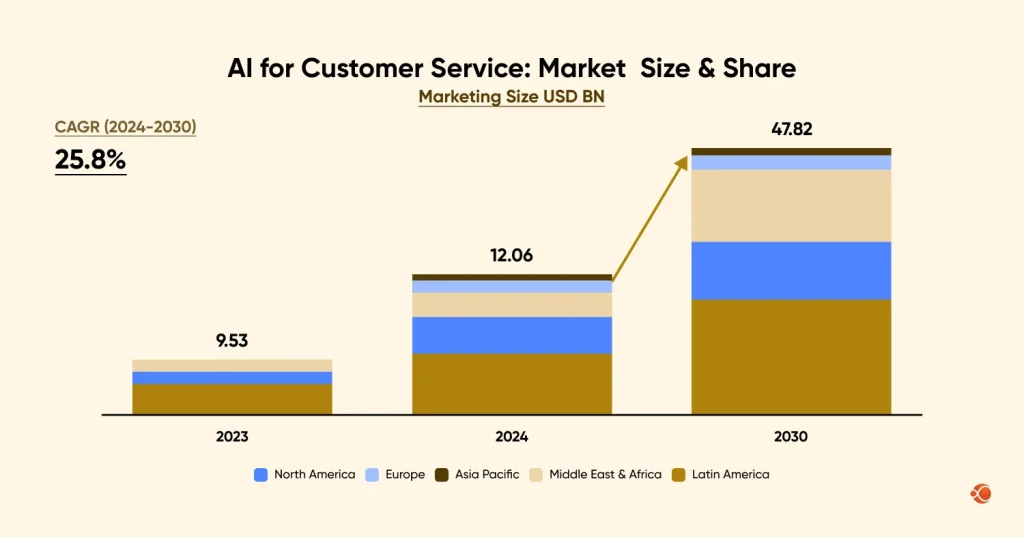
- The AI for customer service market size is estimated to reach USD 47.82 billion by 2030, at a CAGR of 25.8%.
- 80% of businesses say they’ll adopt AI customer service systems by 2026.
- According to one report, when customer support professionals were given access to AI agents, their productivity increased by 14%.
- 75% of customers expect faster, AI-powered resolution as part of modern support.
What Is Agentic AI?
Agentic AI is an intelligent system that can think, decide, and act with autonomy. Instead of simply answering questions, the agentic system executes workflows that check order status, reset passwords, issue refunds, update profile information, or even troubleshoot tech issues.
Think of it as having a digital support team that:
- Understands context
- Takes multi-step actions
- Connects to internal systems
- Learns from every conversation
This approach aligns with how CMARIX engineers enterprise systems using generative AI development practices that combine reasoning, autonomy, and structured task execution.
How AI Agents for Customer Service Work
To understand why this technology is revolutionary, we must look under the hood. Unlike a traditional chatbot that matches keywords to a pre-written script, an agentic workflow operates like a human support representative: it observes, reasons, acts, and learns.
At CMARIX, we engineer these workflows using a cognitive loop that ensures accuracy and autonomy.
1. Intent Recognition (Perception)
The workflow begins when a user submits a query like, “I need to change my shipping address, but my order is already processed”. A traditional chatbot would flag the keywords “shipping address” and find relevant results. But an agentic AI bot will identify its semantic intent (modification request) and the constraint (order status is “processing”, which means it needs an override).
2. Reasoning and Planning (The Chain of Thought)
Before sending a response to the user, the agent comes up with a plan. It doesn’t simply do guesswork; it creates a step-by-step logic chain like:
- Authenticate the user.
- Retrieve order ID #1234 from the database.
- Check the real-time status with the logistics API.AI for Customer Service Market
- If the package hasn’t left the warehouse, trigger an address update function.
- Confirm with the customer.
These AI-driven plans reflect real-world logic, similar to what CMARIX deploys through advanced machine learning app development services for enterprise CX systems.
3. Tool Use & Execution
This is the “agentic” difference. The system has permission to use tools like secure API connections to your CRM, ERP, or payment gateway. It doesn’t tell the customer to email support; it calls the function to update the address directly in the shipping software.
4. Learning (Memory)
Once the task is complete, the agent logs the interaction. If the customer returns a week later to ask “did that package go to the new place?”, the agent recalls previous context without needing a recap.
We create intelligent apps with robust AI integration, transparent costs, and scalable architecture to drive innovation for your business.
Contact UsKey Features of Agentic AI for CX
For an AI system to truly replace tier-1 support, it must possess specific capabilities that go beyond simple text generation.
- Autonomy: Agents can break down high-level goals into sub-tasks. You give it a goal (“process returns under $50 automatically) and the agent handles the verification, label generation, and refund issuance itself.
- Long-Term Context Retention: Advanced agents maintain “state”. They remember user preferences, past issues, and VIP status across different channels (for instance, knowing a user complained on Twitter before they emailed support).
- Multi-Agent Collaboration: Complex issues often need a “swarm” of specialized agents. A router agent can analyze a query and hand it off to a billing or technical support agent, as needed, to ensure domain expertise is applied at each stage.
- Action-Taking Ability (Function Calling): The defining feature of agentic AI is the ability to trigger code. It can reset a router, upgrade a data plan, or book a reservation directly within the chat interface.
These capabilities form the backbone of modern support automation, especially when combined with strategic generative AI integration services that allow agents to operate securely across multiple business systems.
Core Technologies Powering AI-First Customer Service
Building these workflows requires a sophisticated tech stack. At the enterprise level, this involves integrating several layers of technology:
- Large Language Model (LLMs): The cognitive engine (eg, GPT-4o, Claude 3.5, or Gemini) that provides reasoning and natural language fluency.
- RAG (Retrieval-Augmented Generation): To prevent hallucinations, agents are connected to your company’s internal knowledge base. Before answering, the AI retrieves the correct facts from PDFs, wikis, and product manuals, ensuring each answer is grounded in your business data.
- Orchestration Frameworks: Tools like LangChain or proprietary layers that manage the flow between the LLM, your tools, and your database.
- Vector Databases: These store your business data in a format the AI can search semantically (by meaning) rather than just by keyword matching, allowing for incredibly fast and accurate information retrieval.
How are Different Industries Embracing AI agents for Customer Service?
Agentic AI is not a theoretical concept; it is already rewriting the operational playbooks of major industries. While traditional chatbots deflect customers, agent workflows resolve their problems directly with backend infrastructure. Different industries are embracing AI agents for customer service in ways that align with their operational, customer behaviour, and regulatory needs.
Here are the major real-world applications across industries:
1. Ecommerce and Retail
Ecommerce rapidly adopts agentic AI to automate high-volume tasks such as tracking, returns, and inventory management. These systems can deliver instant resolutions, reduce support load, and improve overall shopping experiences.
How are AI agents used in the ecommerce industry?
- Order tracking & shipping updates
- Automated returns & refunds
- Personalized recommendations
- Inventory checks
- Address updates & replacements
Why does it work?
Automation of transactional and repeatable workflows makes retail an ideal industry for automation.
2. Banking and Financial Services
Using AI for customer service in the BFSI industry delivers faster, more secure, and more compliant customer support. These agents can handle authenticated tasks such as balance checks, dispute resolution, fraud alerts, and other such events with unmatched accuracy.
How are AI Agents used in the banking and finance industry?
- Account queries
- Fraud escalations
- Loan guidance
- KYC automation
- Dispute resolution
Why does it work?
AI agents maintain compliance while retrieving real-time financial data and executing secure, sensitive workflows.
3. Healthcare
Healthcare organizations adopt agentic AI to reduce administrative workload, streamline patient interactions, and provide accurate, regulation-compliant support across tasks such as scheduling, prescription management, insurance checks, and more. This aligns with ongoing investments in AI in digital transformation, especially as healthcare organizations modernize patient-facing systems.
How do AI agents help improve customer service in the healthcare industry?
- Appointments
- Prescription refills
- Insurance checks
- Symptom triage
- Follow-ups
Why does it work?
AI improves the patient experience with fast, accurate, secure guidance while reducing manual processes for staff.
4. SaaS & Enterprise Software
SaaS companies deploy AI agents for onboarding, troubleshooting, and account management. These agents understand the best practices for documentation and log analysis, and how to provide technical support within the application.
How is AI customer service being utilized in the SaaS and enterprise software?
- Tenant communication
- Lease renewals
- Maintenance scheduling
- Document workflow automation
- Property inquiries
Why does it work?
AI acts like a Tier-1 support engineer, automating technical assistance and reducing tickets.
5. Logistics & Supply Chain
Logistics companies make use of AI agents for shipment tracking, pickups, documentation, and inventory visibility. These AI customer service agents integrate seamlessly with fleet management systems, and provide accurate, real-time operational updates.
How are AI agents used for logistics and supply chain services?
- Shipment tracking
- Pickup scheduling
- POD verification
- Customs guidance
- Inventory queries
Why does it work?
AI improves transparency and automates coordination across warehouses, fleets, and customer channels.
6. Real Estate
Real estate adopts AI for lead qualification, tenant communication, document workflows, and property tours. These agents can streamline operations for both realtors and property managers.
How do AI agents help with real estate management?
- Troubleshooting
- User provisioning
- Onboarding
- In-app support
- RAG-based retrieval
Why does it work?
AI handles the mundane communication and scheduling tasks. This increases agent productivity and tenant satisfaction.
7. Travel, Tourism, and Hospitality
Travel brands use AI agents to manage time-sensitive customer needs such as itinerary changes, cancellations, refunds, and loyalty support. It helps deliver real-time assistance during critical travel moments.
How is AI used in travel customer service?
- Booking changes
- Itinerary updates
- Refunds
- Lost baggage
- Loyalty programs
Why does it work?
AI in the travel industry offers many benefits; it connects directly to booking systems, enabling immediate action, reservations, and other travel updates.
Quick Overview: Top AI Tools for Customer Service in 2026
| Tool / Platform | Key Features | Benefits |
| Zendesk AI |
| Provides context-aware suggestions and improves agent efficiency |
| Intercom Fin |
| Delivers instant responses and improves customer engagement across channels |
| Vertex Agents (Google Cloud) |
| Accesses real-time data and automates complex tasks efficiently |
| Bedrock Agents (AWS) |
| Rapid deployment of agentic workflows across multiple channels |
| Forethought |
| Reduces manual workload, ensures accurate routing, and integrates with CRM/helpdesk systems |
| Salesforce Einstein |
| Automates tier-1 support, improves resolution speed, and enhances customer experience |
If there’s still any confusion or a need for seamless AI integration tailored to enterprise projects, CMARIX can step in to implement fully functional, agentic AI customer service solutions.
We help enterprises build intelligent, agentic AI solutions with seamless integration, scalable architecture, and measurable impact.
Contact UsHow CMARIX Optimizes AI for Customer Experience: Best Practices and Considerations
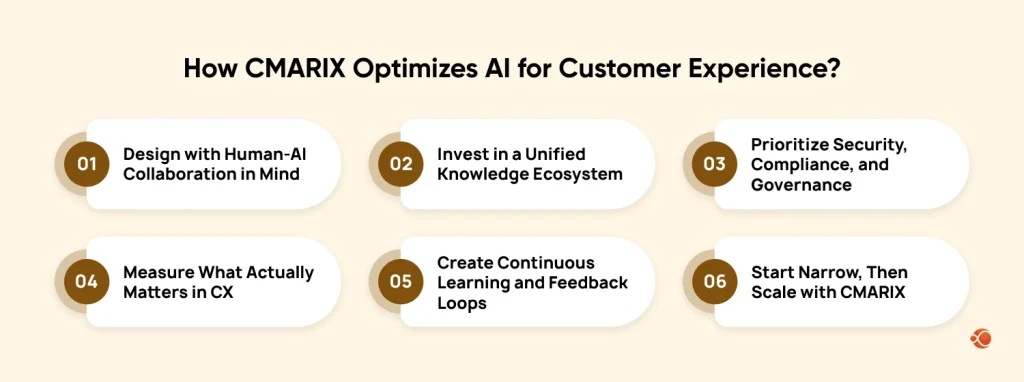
Building an AI-powered customer support system is not about deploying a smart AI chatbot customer service and getting done with it. True optimization lies in designing intelligent, human-centric workflows that continuously improve with data, context, and customer feedback.
Here are some best practices that ensure the AI systems enhance, and not replace, genuine customer experiences:
1. Design with Human-AI Collaboration in Mind
AI should empower support teams, and not isolate them. The most effective customer experience strategies make use of agentic AI to handle repetitive tasks so that human specialists can focus more on complex judgment-based inquiries.
2. Invest in a Unified Knowledge Ecosystem
Great customer experiences start with accurate, up-to-date information. By bringing together data from CRM entries, product FAQs, support logs, and documentation into a single, easily searchable knowledge graph or vector database, AI can provide faster, smarter, and more helpful responses.
3. Prioritize Security, Compliance, and Governance
When AI systems begin resetting passwords, processing refunds, or accessing medical/financial data, establishing strict guardrails becomes essential. Role-based access controls, encryption, PII redaction, detailed audit logs, and adherence to sector regulations such as GDPR or healthcare/financial standards.
4. Measure What Actually Matters in CX
Your teams should track metrics like automated resolution rate, first contact resolution improvement, customer effort score, and other such metrics to understand the true impact of your AI implementation on customer service. These insights show the quantifiable impact of AI customer service platforms and efforts and identify where they need fine-tuning.
5. Create Continuous Learning and Feedback Loops
AI agents should improve in terms of efficiency and speed with every interaction. To do so, it needs to be capable of recording every outcome, user feedback, and edge cases, and feeding it back to the model prompts, knowledge bases, and workflows. Keep up the habit of conducting A/B testing, retraining on real-world tickets, and following other best practices to keep your systems aligned with evolving products, policies, and customer language.
6. Start Narrow, Then Scale with CMARIX
The most effective AI CX programs start with a narrow, high-volume use case. After AI MVP development services, it expands into a multi-agent, cross-channel workflow as confidence and data maturity grow. CMARIX follows this roadmap end-to-end, designing, integrating, and scaling secure, production-grade AI agents to support each enterprise’s support stack.
CMARIX follows a structured delivery model powered by deep expertise in enterprise AI architecture, supported by a team that organizations often choose when they want to hire AI developers for long-term CX transformation.
Concluding Lines
AI in customer service can be as powerful as your strategy allows. It’s changing how companies handle customer questions. With smarter AI bots that can fully resolve issues, businesses can offer 24/7 support and still keep the experience personal and easy. CMARIX is a strong partner for leveraging the benefits of AI in customer service, which includes designing secure, scalable AI customer experience solutions.
FAQs for How to Use AI in Customer Service
How to use AI in customer service?
Use AI chatbots to provide instant 24/7 support for common queries, guide human agents with real-time insights, and automate routine tasks like ticket routing. Train AI on diverse data, integrate it with your systems, and ensure easy escalation to humans for complex issues.
What is the AI revolution in customer service?
The revolution is the shift from scripted bots to intelligent AI agents that understand context, detect sentiment, and perform tasks autonomously, improving efficiency while creating seamless, personalized customer experiences.
Can AI handle complex customer issues like returns or order changes?
Yes, AI can process structured workflows such as checking orders, initiating returns, and issuing refunds directly by integrating with backend systems, but it escalates unusual cases to human agents.
What are the risks of using AI agents in customer service?
Risks include providing inaccurate or biased responses, breaching compliance or privacy regulations, and customer frustration if AI cannot smoothly escalate to human support.
How do AI agents integrate with existing systems?
AI integrates via APIs and middleware with CRM, ticketing, order management, and payment systems, allowing real-time data access and action execution within existing workflows.
How can banks use AI to improve customer service?
Banks deploy AI for 24/7 support on queries, fraud detection, loan processing, and personalized financial advice while ensuring compliance and security. AI boosts speed, accuracy, and customer satisfaction in sensitive financial interactions.