

At-a-glance View: AI agents Statistics confirm 2026 as an important inflection point; enterprises globally are adopting autonomous agents to automate complex workflows and secure lasting competitive advantage. Leading organizations are already transforming industries through agentic AI. Overlook these AI agents’ statistics and risk falling permanently behind in the new era of enterprise automation.
An AI agent is a software system that is capable of perceiving its environment, reasoning about its goals, formulating a multi-step plan, and taking actions within the digital or physical world to achieve those goals, often under the direct supervision of a human. Not like simple chatbots or one-step automations, AI agents possess a degree of autonomy, reasoning, and memory.
In 2026, agentic AI statistics show that these systems matter because they address the limits of current AI tools. Traditional AI tools can just write text or code, but cannot complete a complex, end-to-end business process. AI agents bridge this gap, allowing true workflow automation that reduces human intervention and drives significant operational efficiency.
Top 4 AI Agents Statistics for 2026
- Nearly two-thirds (62%) of organizations are at least experimenting with AI agents, a strong indicator of their perceived value for future business models.
- 93% of leaders believe that those who successfully scale AI agents in the next 12 months will gain an edge over industry peers.
- The global AI agent market is projected to grow from an estimated $7.84 billion in 2025 to a projected $52.62 billion by 2030, with a Compound Annual Growth Rate of 46.3%.
- Agentic AI could generate nearly 40% of enterprise application software revenue by 2035, potentially surpassing $450 billion.
What counts as an “AI agent.”
For the purposes of these AI agents’ statistics, an AI agent is defined by four core attributes:
- Autonomy: The ability to initiate and execute tasks without needing a prompt for every single step.
- Reasoning/Planning: The ability to break down a complex, high-level goal into a series of smaller, sequential steps.
- Memory: The ability to retain context from previous interactions or actions within a workflow.
- Tool Use/Action: The ability to interact with external systems like ERP, CRM, email or other APIs to perform actions in the real world.
Global AI Agent Adoption Trends and Market Growth (2024–2026)
Growth in businesses using AI agents (2024–2026)
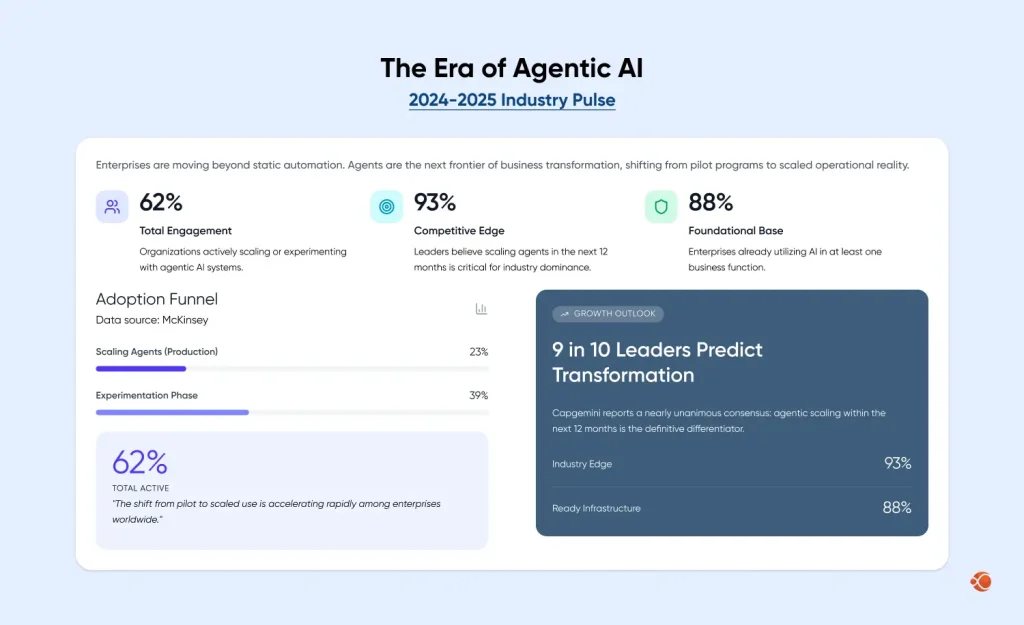
The momentum toward agentic AI is clear. The shift from pilot to scaled use is accelerating rapidly among enterprises.
- Scaling Agents: 23% of organizations report that they are actively scaling an agentic AI system somewhere in their enterprise (McKinsey).
- Experimentation: An additional 39% of organizations report that they have begun experimenting with AI agents, bringing the total engaged to 62% (McKinsey).
- Business Transformation Outlook: 93% of leaders believe that those who successfully scale AI agents in the next 12 months will gain an edge over industry peers (Capgemini).
- Widespread Use: 88% of organizations report using AI in at least one business function, indicating a mature base for the subsequent adoption of agentic technology (McKinsey).
These latest artificial intelligence statistics make it clear that the infrastructure and cultural readiness for autonomous agents are already in place across most large enterprises worldwide.
Industry-wise Adoption Patterns
While adoption is broad, certain industries are moving faster due to the immediate financial and operational impact.
| Industry | Current AI Agent Status (McKinsey) | Primary Use Case |
| Technology | Already high usage (>90% AI use) | IT Service Management, Code Generation, Incident Resolution |
| Insurance/Media & Telecom | AI use is now comparable to the Technology sector | Customer Engagement, Network Management, Content Personalization |
| Financial Services (BFSI) | High investment priority | Compliance Monitoring, Fraud Detection, Client Onboarding |
Regional Trends: US, Europe, Middle East, APAC
The shift to agentic AI is a global phenomenon, though the pace varies regionally, with the Asia-Pacific (APAC) region emerging as a strong growth driver.
- US Investment Focus: The United States’ focus in 2026 will be on building AI agents to automate business processes, with an expected growth rate of 48% (IDC).
- Global Readiness: 84% of survey respondents feel comfortable with AI making end-to-end autonomous decisions for specific processes in their organization, showing widespread confidence across major economic centers.
- North America Market Share: The North America AI Agent market is projected to hold the largest market share in 2025 (MarketsandMarkets).
AI Agent Market Size and Spending Forecast (2025–2030)
AI Agent Market Value in 2025–2026
The AI agents market size shows spectacular growth, outpacing many traditional software sectors.
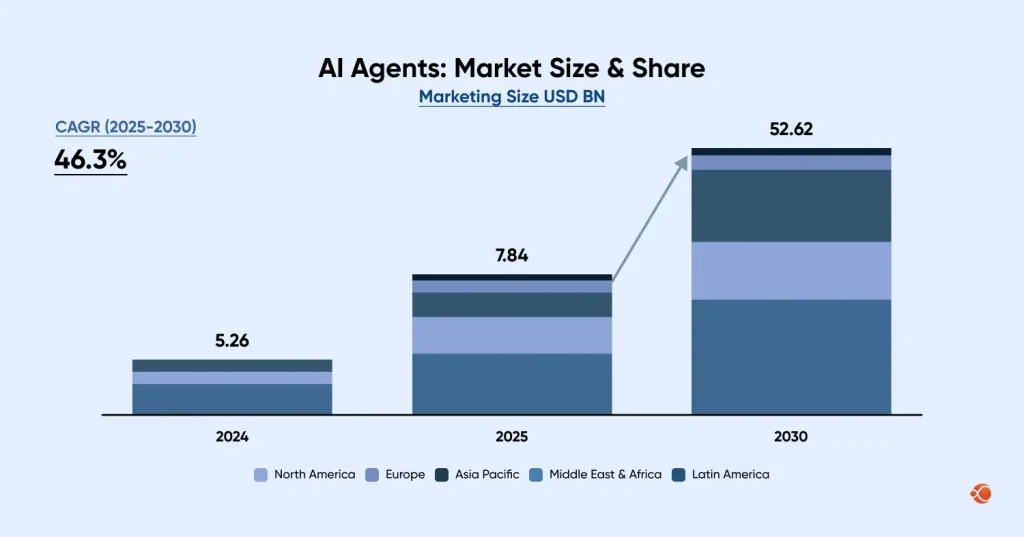
- Market Trajectory: The global AI agent market is projected to grow from an estimated $7.84 billion in 2025 to a projected $52.62 billion by 2030, and with a Compound Annual Growth Rate of 46.3% (MarketsandMarkets).
- Long-Term Revenue Potential: In a best-case scenario, agentic AI could generate nearly 40% of enterprise application software revenue by 2035, potentially surpassing $450 billion (Gartner).
- Vertical Agent Growth: The Vertical AI agents segment, specialized for niche, domain-specific tasks, is expected to register the highest CAGR of 62.7% between 2025 and 2030 (MarketsandMarkets).
Budget Allocation Inside Enterprises
Enterprises are restructuring their technology budgets to account for agent deployment and the necessary supporting infrastructure. If you’re ready to build a custom AI agent tailored to your exact workflows, partnering with a specialized AI agent development company would be the most feasible and realistic path to production-grade solutions.
- Investment Surge: Spending on agentic AI is set to dominate IT budget expansion over the next five years, exceeding 26% of global IT spending and reaching $1.3 trillion by 2029.
- Financial Investment: 56% of finance functions plan to raise their AI investments by at least 10% in the next two years (Gartner).
Forecasts for 2027–2030
Looking toward the end of the decade, the picture for the AI agent market size is one of rapid acceleration and deep integration.
- Enterprise Integration: 40% of enterprise applications will be integrated with task-specific AI agents by the end of 2026, a massive surge from less than 5% in 2025 (Gartner).
- B2B Procurement Shift: By 2028, 90% of B2B buying is predicted to be mediated by AI agents, representing more than $15 trillion in spend (Gartner).
- Future of Collaboration: By 2028, a third of user experiences will shift from native applications to agentic front ends (Gartner).
How Companies Are Using AI Agents
Companies are moving beyond simple chatbots to deploy AI agents that manage and automate complex, multi-step business processes across the organization. The following AI Agent usage statistics highlight five core areas of application:
Customer Support Automation
Agents are graduating from answering FAQs to resolving full, end-to-end customer issues by integrating with CRM and billing systems.
- Service Excellence: Organizations that automate 80% of customer-facing processes with multi-agent AI are expected to outperform peers by 2029 (Gartner).
- Quantified Impact: In one financial services case, calls to stores dropped by 47% following agent deployment, while customer satisfaction (NPS) rose to 65.
Sales and Marketing Agents
The focus here is on automating research, lead qualification, and content generation. This is a primary area for an AI agent for marketing.
- Conversion Improvement: European insurer reimagined its sales operation with AI agents, achieving conversion rates two to three times higher than the previous model (McKinsey).
- Revenue Impact: Agentic AI is estimated to power more than 60% of the increased value that AI is expected to generate from deployments in marketing and sales (McKinsey).
Internal Workflow Automation
This is where agents become “digital employees,” executing tasks across various platforms.
- Productivity Gains: Effective and scaled agent deployments could deliver productivity improvements of three to five percent annually (McKinsey).
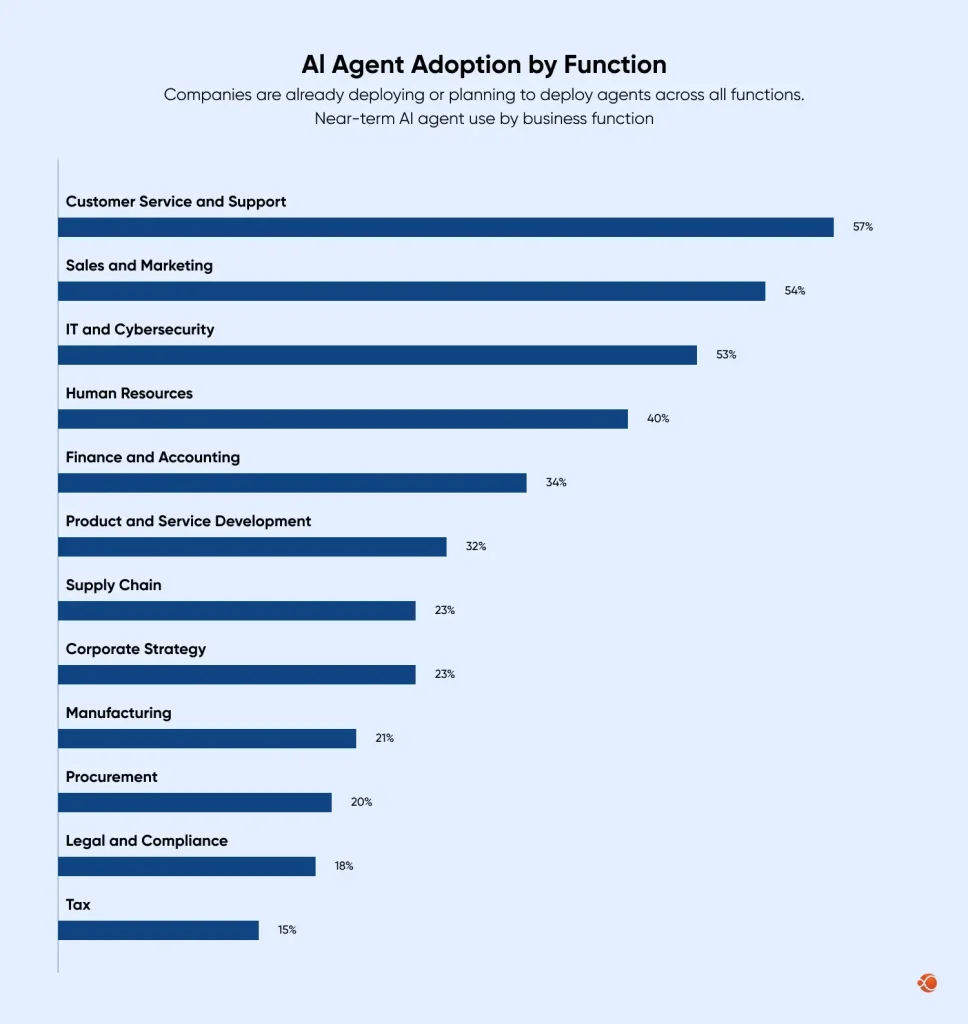
- IT Focus: 53% of US businesses deploying AI agents report using them in IT and cybersecurity functions (PwC).
Technical Assistants for Engineering Teams
Agentic AI systems are a key tool for developers and IT professionals, with high reported usage in these sectors. To accelerate internal agent-powered tools, many technology leaders now hire AI developers with a proven LLM-orchestrated, secure deployment and tool-use framework.
- Fastest Growth by Role: The coding and software development segment of the AI Agent market is projected to be the fastest growing by role, registering a CAGR of 52.4% through 2030 (MarketsandMarkets).
- DevOps Integration: Agents are increasingly deployed in DevOps to detect anomalies, resolve incidents automatically, and escalate only where human oversight is essential.
Back-office and Administrative Use Cases
Agents are taking on the most time-consuming administrative burdens in human resources and finance.
- Finance Confidence: 70% of financial services executives believe artificial intelligence will directly contribute to revenue growth in the coming years (World Economic Forum/Accenture).
- Workforce Impact: 32% of respondents anticipate workforce reductions of three percent or more in the coming year due to AI adoption, reflecting the automation of administrative roles.
Whether it's customer support, workflows, sales, or AI agents, find out which solution drives real results for you.
Contact UsAI Agent Adoption by Industry: Finance, Healthcare, Retail, and Beyond
The varied requirements of different sectors mean that agentic AI adoption statistics show diverse use cases, with distinct value propositions for each.
Finance
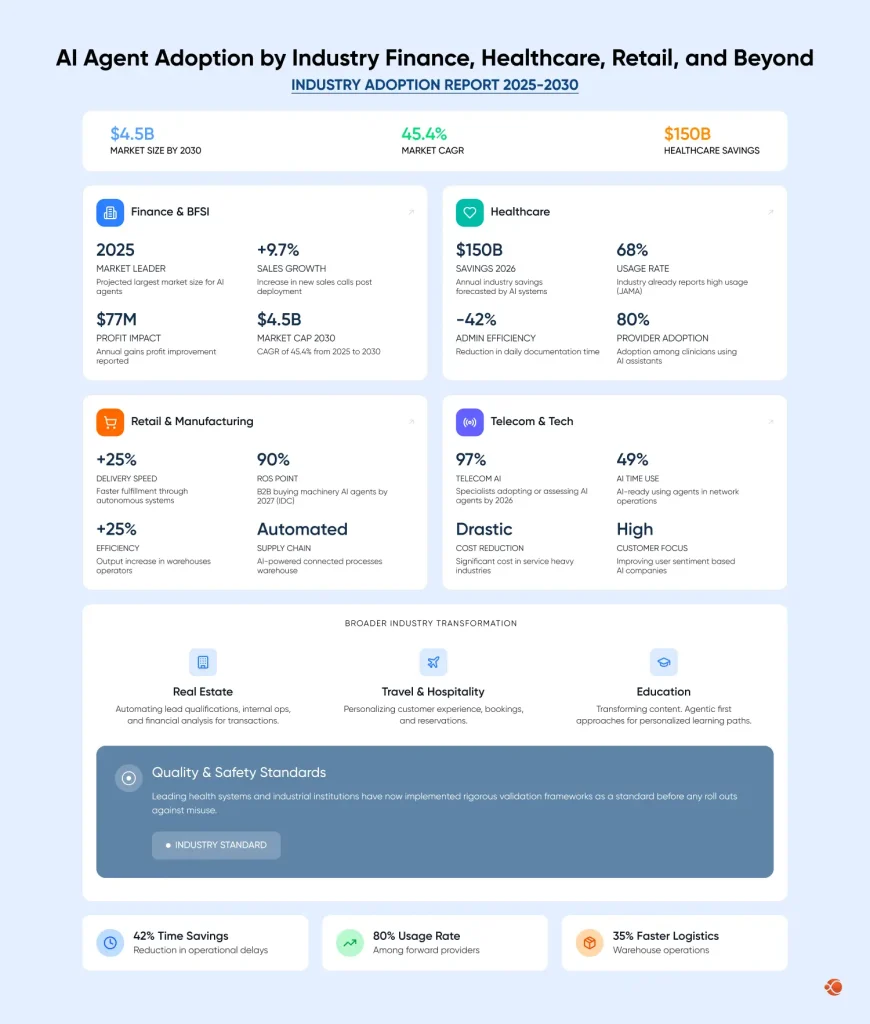
Finance and Banking, Financial Services, and Insurance (BFSI) were projected to hold the largest market size for AI agents in 2025.
- A financial services case reported a 9.7% increase in new sales calls following agent deployment, improving annual gross profit by $77 million.
- The global AI agent market is forecasted to reach USD 4485.5 million by 2030, growing at a CAGR of 45.4% from 2025 to 2030.


Healthcare
The healthcare sector is prioritizing agents to address staffing shortages and administrative load.
- Savings Potential: AI applications in healthcare are forecasted to $150 billion in savings(annually) for the industry by 2026 (Accenture).
- Adoption Success: One healthcare provider rolled out an AI agent statistics clinical assistant, seeing an 80% adoption among providers who used it and a 42% reduction in daily documentation time.
- Current Usage: 68% of the healthcare industry already reports high usage of AI agents (KPMG).
Before full rollout, a rigorous AI agent evaluation framework is now a standard practice across leading health systems.
Retail
Retail companies use agents for inventory management and customer personalization.
- Fulfillment Speed: In warehouse operations, coordinating autonomous systems has led to reported 25% faster delivery and a 25% increase in overall efficiency.
Manufacturing
Agents automate complex, interconnected processes in the supply chain and production.
- Procurement Shift: The prediction that 90% of B2B buying will be mediated by AI agents by 2028 is forcing manufacturers to digitize offerings (IBM).
Real Estate
The focus is on automating internal operations, financial analysis, and lead qualification, with a view toward broader agent-mediated transactions.
- Operational Excellence: Agentic AI is leveraged to manage complex engineering, construction, and real estate processes (Salesforce).
Telecom
Telecommunication companies are rapidly adopting AI to manage their vast customer bases and complex networks.
- High Engagement: 97% of telecom specialists are either adopting or assessing AI in their operations, with 49% actively using it.
- Cost Reduction: Service-heavy industries like telcos can dramatically reduce costs and improve customer satisfaction by deploying AI agents.
Travel &Hospitality
AI agents personalize service offerings and manage bookings and reservations.
- Experience Improvement: Travel and hospitality firms are focusing on delivering connected customer experiences through agentic AI.
Education
Agents assist with administrative tasks and personalized learning paths.
- Future Focus: The education sector is actively exploring how to become “Agent-First” in its operations.
Future Outlook: AI Agent Ecosystems and Workforce Transformation (2027–2028)
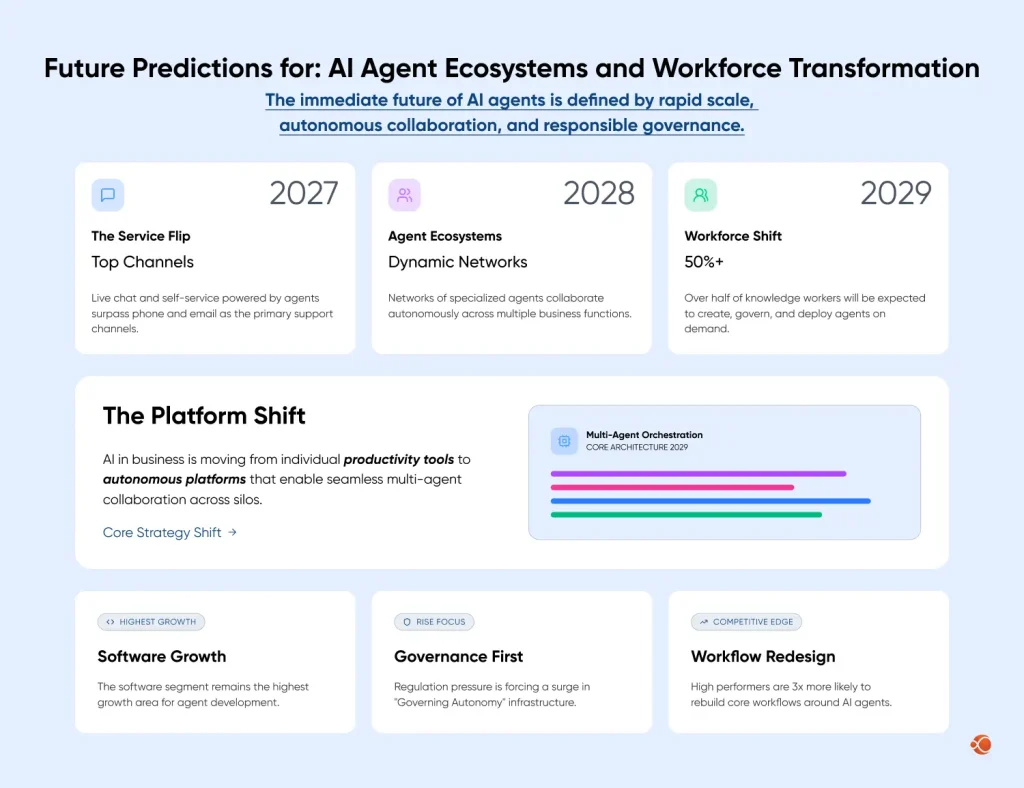
The immediate future of AI agents is defined by rapid scale, new capabilities, and a focus on responsible governance. The full agentic AI business impact statistics will materialize over the coming years.
Predictions for 2028-2029
The next two years will see agents evolve from simple task executors to sophisticated collaborators and decision-makers.
- AI Agent Ecosystems: By 2028, AI agent ecosystems will enable networks of specialized agents to collaborate dynamically across multiple applications and business functions (Gartner).
- Workforce Redesign: By 2029, at least half of knowledge workers will be expected to create, govern, and deploy agents on demand (Gartner).
- The New Frontier: AI agents in business will move from being tools supporting individual productivity to platforms enabling seamless autonomous collaboration (Salesforce).
Where AI Agents Will Drive the Biggest Shifts
The largest shifts will occur in areas where workflows cross departmental silos and involve unstructured data.
- Governing Autonomy: The convergence of autonomous business processes and increasing AI regulation creates pressure for vendors to launch governance infrastructure, with early movers gaining a competitive advantage (Forrester).
- Customer Experience: By 2027, live chat and self-service, often powered by agents, will surpass phone and email as the top customer service channels (Gartner).
Opportunities for Developers and Enterprises
For enterprises, the opportunity depends on designing AI agent statistics systems that combine human expertise with autonomous actions. For developers, the demand for specialized talent is surging.
- Developer Focus: The highest growth area for AI agents is in the software segment, driven by rapid advances in computing power and information storage (Grand View Research).
- Competitive Differentiator: Companies reporting the most value from AI, the “AI high performers,” are three times more likely to redesign their core workflows around AI integration (McKinsey).
Organizations building proprietary agents at scale are increasingly relying on AI software development services to create secure, maintainable, and enterprise-ready agent architecture.
Conclusion
The year 2026 is a significant turning point where AI agents and generative AI statistics confirm their move from novelty to necessity. With market growth accelerating at a CAGR of over 46% and a majority of businesses actively experimenting or scaling, the impact of agentic AI is no longer a forecast; it is a current reality. The ability of these systems to automate complex, end-to-end processes is redefining business productivity. It will be the single most significant factor in competitive advantage for the remainder of the decade.
FAQs: AI Agent Market Growth, Industry Adoption, Use Cases, and Security
How fast is the AI agent market expected to grow by 2026?
The global AI agent market is forecasted to expand at a Compound Annual Growth Rate at 46.3% from 2025 to 2030 (MarketsandMarkets). This fast growth will see the market reach a projected value of over $52.62 billion by 2030 (MarketsandMarkets).
Which industries are adopting AI agents the fastest in 2026?
The Technology, Media, and Telecom (TMT) sectors are leading, with the highest existing AI usage and rapid deployment in IT Service Management (PwC). Financial Services (BFSI) and Healthcare are close behind, prioritizing agents for compliance, fraud detection, and administrative automation (MarketsandMarkets).
What are the top use cases of AI agents in business?
Customer Support Automation is a primary use case, with firms aiming for agents to resolve 80% of customer-facing issues autonomously (Gartner). Internal Workflow Orchestration and Code Generation are also key, as agents manage complex cross-functional tasks and assist engineering teams (MarketsandMarkets).
How secure are AI agents for enterprise use?
Security is a high-risk area, with 25% of enterprise cybersecurity incidents expected to be caused by the misuse of AI agents by 2028 (Gartner). Robust governance, including strict least-privilege access and continuous monitoring, is critical to mitigate risks like prompt injection (Microsoft).
What is the role of generative AI in AI agents?
Generative AI (GenAI), specifically Large Language Models (LLMs), functions as the reasoning engine of the agent (Google Cloud). It enables the agent to understand complex goals, formulate multi-step action plans, and use external tools autonomously (IBM).