



Key Highlights
- 48.7% of software developers worldwide actively use Node.js, ranking it as the #1 runtime framework
- The JavaScript Web Framework software layer has scaled to $6.81 billion globally
- The global web development market has reached $87.75 billion, projected to scale to $134.17 billion by 2031
- The US accounts for 55.54% of all global Node.js customers
- W3Techs reports website-level adoption grew from 3.1% to 4.6% between 2023 and 2025
- TypeScript adoption in Node.js professional environments crossed 70% in 2025
- Monthly downloads across all active versions now exceed 350 million
Node.js has been running server-side JavaScript since 2009. In 2026, nearly half of all professional developers use it, millions of production applications depend on it, and the ecosystem around it, npm, Express, NestJS, Fastify, cloud-native toolchains, is deeper than ever.
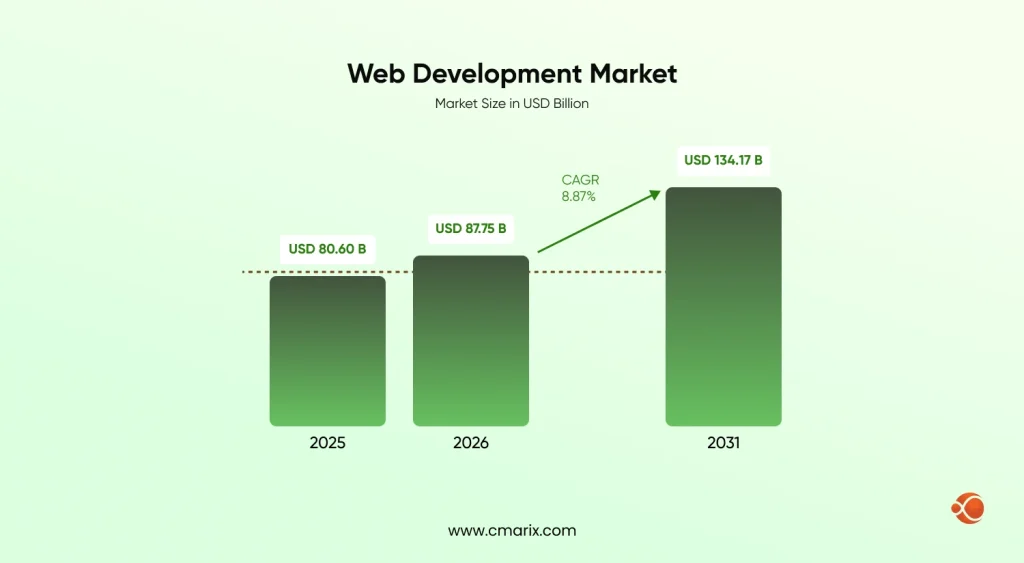
The JavaScript Web Framework market sits at $6.81 billion, and the global web development market at $87.75 billion. Node.js sits at the center of both. This article covers current Node.js statistics across usage, geography, enterprise deployment, download trends, and framework choices.
Overview of Node.js in 2026
Node.js is an open-source, cross-platform JavaScript runtime built on Google’s V8 engine. It uses an event-driven, non-blocking I/O model, which lets it handle thousands of simultaneous connections on a single thread — the core reason it works well for I/O-heavy workloads.
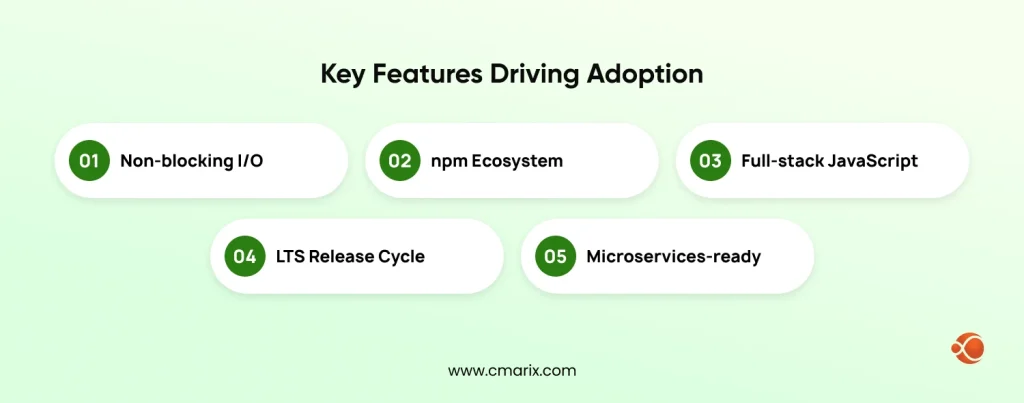
Key features driving adoption:
- Non-blocking I/O — handles concurrent connections without spawning a new thread per request
- npm ecosystem — 2.1 million packages as of 2026, the largest open-source registry in existence (npm registry data)
- Full-stack JavaScript — same language front and back, reducing context-switching for development teams
- LTS release cycle — 30-month Long-Term Support windows giving enterprises a predictable upgrade path
- Microservices-ready — its event-driven architecture aligns naturally with Node.js microservices architecture patterns used in modern cloud deployments
Node.js 24 LTS (codename Krypton), released in late 2025 and supported through April 2028. The State of JS 2025 survey puts Node.js backend runtime share at 90%, well ahead of Bun at 21% and Deno at 11%.
Tell us your project needs, and our team will get back to you shortly.
Historical Context and Growth Patterns
| Year | Key Milestone |
| 2009 | Ryan Dahl releases Node.js at JSConf EU |
| 2011 | npm launches; package ecosystem begins growing |
| 2013–15 | PayPal, LinkedIn, Netflix adopt Node.js in production |
| 2018 | Tops Stack Overflow developer survey for the first time |
| 2024 | Cumulative downloads pass 1 billion; monthly downloads hit 350M+ (nodejs.org) |
| 2025 | Node.js 24 LTS ships with native TypeScript support; 48.7% developer adoption |
Node.js Usage Statistics in the United States
The US is the largest Node.js market globally. Key numbers:
- 55.54% of global Node.js customers are based in the US
- Developer salaries for Node.js roles range from 60k to 210k+ in the US market
- 85% of enterprises using Node.js report improved developer productivity
Industry-Wise Adoption of Node.js Across Key Sectors
| Country | Share of Global Node.js Customers |
| United States | 55.54% |
| United Kingdom | 8.33% |
| India | 7.77% |
| Germany | ~4.5% |
| Canada | ~3.8% |
Note: Country share figures above are industry estimates from technology database aggregators, not official survey data.
India’s trajectory stands out. The country added 5.2 million new developers in 2025, surpassing the US at 3.2 million. With JavaScript-first bootcamps dominant in Bangalore, Hyderabad, and Pune, India’s Node.js share is set to climb meaningfully over the next few years.
Node.js Global Market Share: How It Compares to Other Backend Platforms
Among JavaScript-based backends, Node.js holds more than 90% market share. Measured against all server-side platforms, it accounts for over 35% of global backend runtime usage, placing it in the top three worldwide.
| Platform | Developer Adoption |
| Node.js | 48.7% — #1 web technology/runtime globally |
| React.js | 44.7% (front-end; included for scale reference) |
| Express.js | ~40% (built on Node.js) |
| PHP | Declining — down 19% in 2024 |
W3Techs data puts Node.js at 4.6% of all tracked websites, and around 9% among the top 1 million sites, reflecting its stronger concentration in larger, more complex applications.
Which Industries Are Adopting Node.js Fastest in 2026
Node.js adoption is strongest in software-native industries but extends well beyond them.
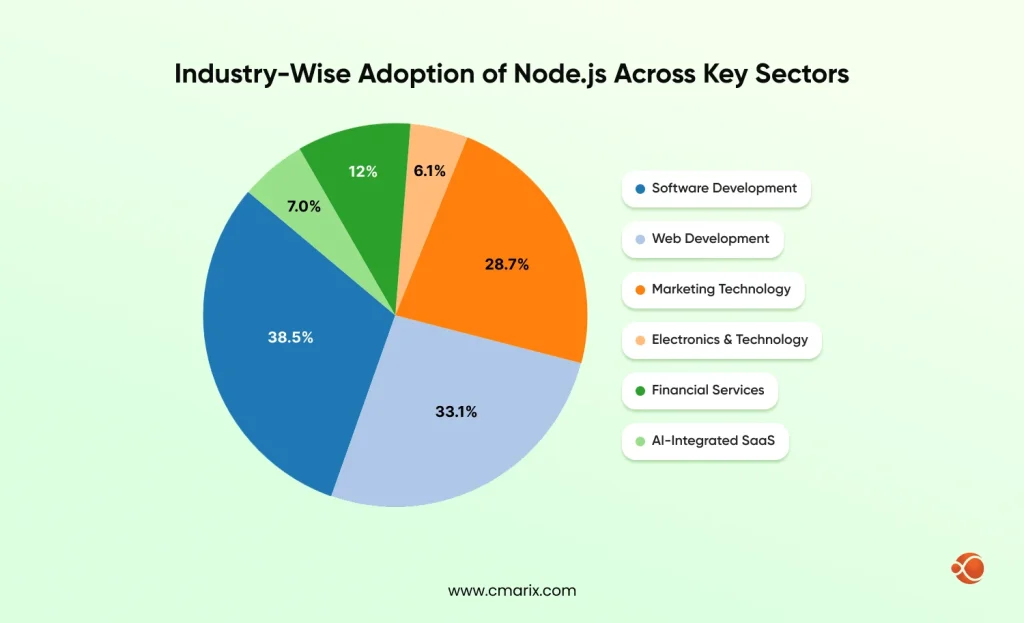
| Industry | Usage Signal |
| Software Development | 38.5% of Node.js users |
| Web Development | 33.1% |
| Marketing Technology | 28.7% |
| Electronics & Technology | 6.1% of vertical deployments |
| Financial Services | 12% |
| AI-Integrated SaaS | 7.0% |
In enterprise environments, Node.js appears in predictable patterns: API gateways aggregating microservice calls, real-time features like chat and notifications, serverless functions on AWS Lambda or Google Cloud Functions, and developer tooling like webpack and Vite. Most popular backend frameworks in enterprise settings — Express, NestJS, Fastify — all run on Node.js.
Teams building in fintech tend to reach for Node.js first. The combination of real-time transaction requirements and the large JavaScript developer pool makes it a natural fit for Node.js MVP development for startups in financial applications.
Top Companies Using Node.js in Production and the Results They Saw
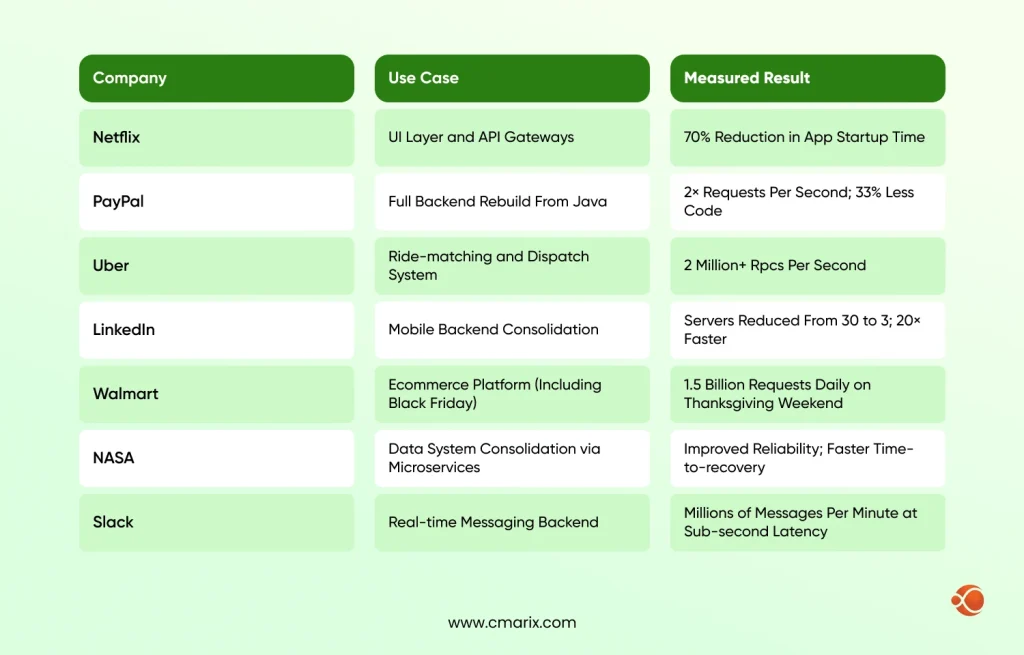
Company size breakdown for Node.js adoption shows it spans the full range:
- 116,000 companies with 0–9 employees
- 51,560 companies with 20–49 employees
- 26,246 companies with 100–249 employees
Node.js enables small teams to move fast with one language across the entire stack — the same reason the runtime powering startup MVPs also runs Netflix’s streaming infrastructure. The reasons to choose NodeJS for product development come down to development speed, ecosystem depth, and a hiring pool that beats almost every other backend option.

How Popular Is Node.js Among Developers in 2026
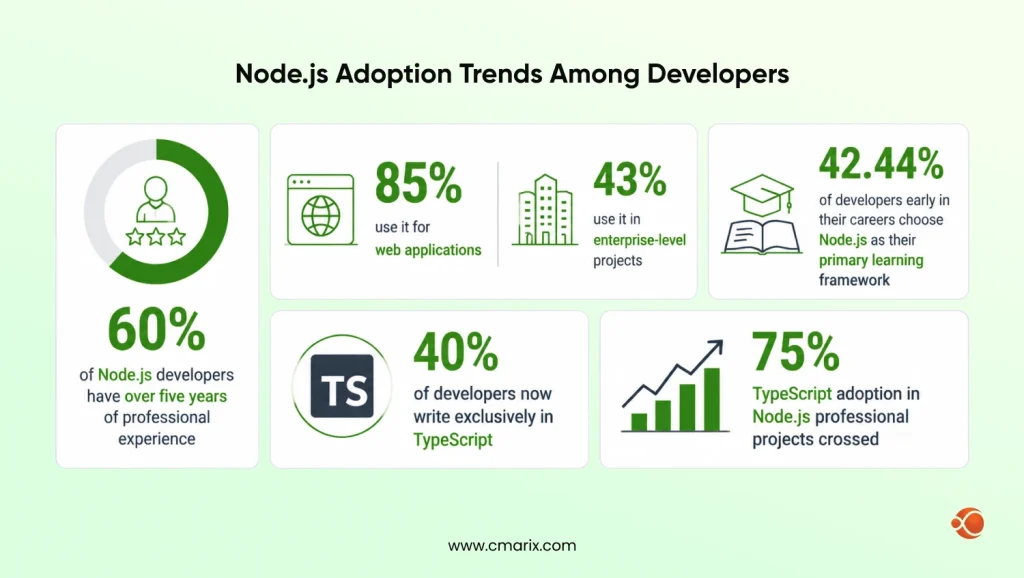
A few developer statistics that cut against common assumptions:
- 60% of Node.js developers have over five years of professional experience
- 85% use it for web applications; 43% use it in enterprise-level projects
- 42.44% of developers early in their careers choose Node.js as their primary learning framework
- 40% of developers now write exclusively in TypeScript
- TypeScript adoption in Node.js professional projects crossed 75%
The npm community health numbers reinforce this: 2.1 million packages, 15% year-over-year consumption growth, and the TypeScript compiler package alone crossing 60 million downloads per week in Q1 2025.
For teams building across the full JavaScript stack, dedicated MERN Stack developers consolidate all four layers under one language, removing the context-switching cost that slows down mixed-language teams.
Node.js Download Statistics and Version Adoption Trends in 2026
- 147.5 million total downloads from nodejs.org since 2014
- 350 million+ monthly downloads across all active versions
- 55%+ of users select LTS versions over current releases
Node.js version support status:nodejs.org official release schedule:
| Node.js Version | LTS Status | Support Until | Monthly Downloads |
| Node.js 24 (Krypton) | Active LTS | April 2028 | Growing — newest LTS |
| Node.js 22 (Jod) | Active LTS | April 2027 | ~120 million/month |
| Node.js 20 (Iron) | Maintenance LTS | April 2026 | Declining |
| Node.js 18 (Hydrogen) | End of Life (April 2025) | Expired | ~50 million/month (security risk) |
The v18 figure is worth flagging: 50 million monthly downloads on an EOL runtime means a large number of production applications are running without security patches. If your stack is on v18, that is the most pressing upgrade to prioritize.
For deployment environments, Node.js runs natively on AWS Lambda, Google Cloud Functions, Azure Functions, Cloudflare Workers, Vercel Edge, and all major container orchestration platforms. Node.js serverless and edge computing adoption is the fastest-growing deployment category heading into 2026.
Comparison of Node.js to Competing Technologies
| Runtime | HTTP Requests/sec | Cold Start Time | npm Compatibility |
| Bun | 52,000–125,400 | 8–38 ms | ~95% |
| Deno | 29,000–98,300 | 40–87 ms | Broad, growing |
| Node.js | 14,000–72,100 | 60–148 ms | 100% |
What Node.js has that neither competitor can replicate quickly:
- 100% npm compatibility — 2.1 million packages, fully tested in production
- Universal cloud support — natively supported across every major cloud provider, like AWS Lambda, GCP, Azure, Cloudflare
- 13+ years of production knowledge — failure modes are known, debugging patterns are documented, hiring is easier
The honest read: Node.js is not the fastest JavaScript runtime in 2026. It is the most supported and most hirable one. For teams prioritizing production reliability over benchmark performance, that tradeoff is straightforward.
Understanding Node.js security best practices remains important regardless of runtime choice — but especially for Node.js, where the permissive default security model means teams need to implement access controls explicitly.
Our team delivers scalable Node.js solutions tailored for growing businesses across industries.
Key Statistics for Node.js Application Monitoring 2026-2027
The metrics that matter most in production:
| Metric | What to Watch | Why It Matters |
| Event loop lag | Flag anything consistently above 10–20ms | A blocked event loop affects all concurrent connections simultaneously |
| Heap memory usage | Watch for steady growth over time | Sign of a memory leak; surfaces before OOM crashes |
| P95/P99 latency | 95th and 99th percentile response times | Outliers reveal blocking operations invisible in averages |
| Active handles/requests | Rising count without rising traffic | Signals a connection leak |
| GC pause times | V8 garbage collection pause duration | Long pauses affect latency; it shows in P99 first |
Node.js native test runner performance improved significantly in v22 and v24 — teams can now run node--test natively, cutting test suite dependencies and speeding up CI/CD pipelines.
Offloading CPU-intensive tasks to Worker Threads can reduce request processing time by up to 70%, the single highest-ROI performance improvement available for CPU-heavy Node.js applications.
Node.js's fs module and streaming API make it a strong fit for analytics and file processing. Rather than loading entire files into memory, streams process data chunk by chunk — keeping memory footprint low for log analyzers, ETL jobs, and large-file ingestion pipelines, and making it a practical high-performance API Integration layer for data-intensive backend development solutions.
Conclusion
The Node.js statistics in 2026 point clearly in one direction. The JavaScript Web Framework market sits at $6.81 billion, and the broader web development market at $87.75 billion. Node.js is embedded in both. For teams building APIs, real-time applications, or microservices at scale, Node.js remains the low-risk, high-productivity foundation in 2026.
If you are exploring Node.js development services for your next project, the data gives you a clear foundation. The market is mature, the ecosystem is deep, and the difference between Node.js and Next.js is clear — one is the runtime, the other is a framework built on top of it.
FAQs on Node.js Statistics
How popular is Node.js among startups and enterprises?
Widely used in both. Around 116,000 companies with fewer than 10 employees use Node.js because it lets small teams write JavaScript across the full stack. Enterprises like Netflix, Uber, PayPal, and Walmart run it in core production systems. 85% of enterprises using it report improved developer productivity.
What are the key trends driving Node.js development?
Native TypeScript support in Node.js 24, growing Node.js serverless and edge computing adoption on Cloudflare Workers and AWS Lambda, the maturing native test runner, and Node.js’s increasing role as the orchestration layer for LLM-powered applications.
Is TypeScript replacing JavaScript in Node.js?
Not replacing; it is the new default for professional Node.js projects. TypeScript adoption crossed 70% of Node.js production environments in 2025, and 40% of developers now write exclusively in TypeScript. JavaScript remains the runtime target; TypeScript is just how most teams write the code before it runs.
Which Node.js frameworks are leading in 2026?
Express is in the first position, then NestJS, which is best for enterprise and TypeScript-heavy projects. After NestJS, Fastify is a high-performance API integration. Hono leads on satisfaction scores and is the go-to choice for edge and serverless use cases. Over 70% of Node.js developers use one of these four in production.
How does Node.js handle concurrency and real-time data?
Through its event loop and non-blocking I/O model backed by libuv. Node.js processes all requests on a single thread using async callbacks, without spawning a new thread per connection. A well-optimized Node.js application can handle up to 100,000 concurrent requests with adequate resources. For real-time applications, WebSocket support enables maintaining persistent connections at scale. Slack handles millions of messages per minute at sub-second latency on Node.js. The main rule: avoid blocking the event loop with CPU-intensive synchronous work; use Worker Threads for that instead.