




Quick Summary: The edge can process data at its source – quickly, locally, and compliantly. Cloud computing is infinitely scalable using centralized data centers. By 2026, the question isn’t whether you should go edge or cloud, but which workloads are best suited to each. This guide explains the difference between Edge computing vs Cloud computing, gives real-life examples of each, and provides a practical decision framework for CTOs, architects, and product managers to build their optimal hybrid infrastructure.
Every business running on data faces the same uncomfortable truth in 2026: where your data is processed matters as much as how it is processed.
The dispute between edge computing and cloud computing is no longer just a conversation for enterprise architects in boardrooms. It now shapes product design, compliance strategy, customer experience, and operational cost for companies of every size.
Modern enterprises are also evaluating how the serverless architecture model fits into hybrid edge-cloud environments, especially for event-driven workloads, scalable APIs, and cost-efficient backend processing.
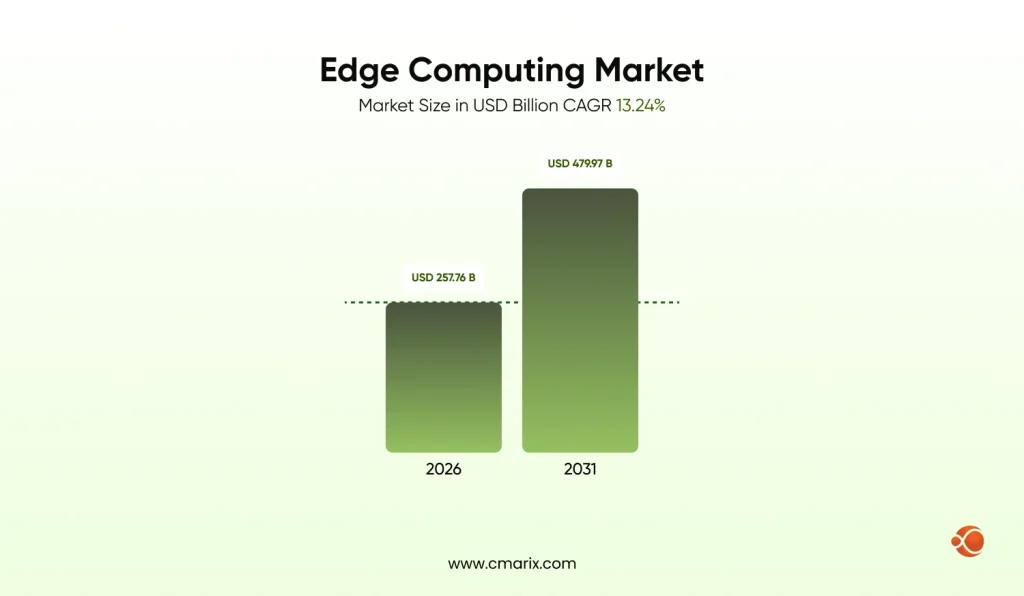
The edge computing market alone was worth $257.76 billion in 2026 and is expected to reach $479.97 billion in 2031. In contrast, the global cloud computing market size in 2026 is estimated at $1.04 trillion and is expected to grow to $2.65 trillion in 2031 at a 20.65% CAGR.
Two trillion-scale markets. One architectural decision.
This blog breaks down the differences between edge and cloud computing, explains when each approach wins, and helps you build a decision framework that actually fits your business — not just the prevailing hype cycle.
Design scalable edge, cloud, and hybrid systems built for modern enterprise workloads.
What Is Cloud Computing? (A Quick Refresher)
Cloud Computing is the offering of computer resources and services, such as servers, storage, databases, networking, software, and computing power, through the internet using the infrastructure supplied by firms like Amazon Web Services (AWS), Microsoft Azure, and Google Cloud.
AWS leads at 30% of global cloud infrastructure spend in Q1 2026, Microsoft Azure at 25%, and Google Cloud at 13%, together accounting for 68% of total enterprise cloud spending.
The cloud model is built on three core service types:
| Service Model | Description |
| IaaS (Infrastructure as a Service) | Rent computing resources, storage space, and network services |
| PaaS (Platform as a Service) | Build and deploy applications on managed infrastructure |
| SaaS (Software as a Service) | Use fully managed software delivered over the internet |
Centralization is the core element of cloud computing. It entails sending the data from the originating point to the distant data center, processing it, and returning the output. This process introduces minimal latency in business apps such as ERP, CRM, and business analytics dashboards. However, it is a business risk for apps that require sub-millisecond latency.
What Is Edge Computing?
Edge computing moves data processing closer to the source, such as the sensor, the device, or the end user, rather than routing everything to a centralized cloud. “The edge” refers to the physical location where data originates: a factory floor, a retail store, a connected vehicle, a hospital monitoring system.
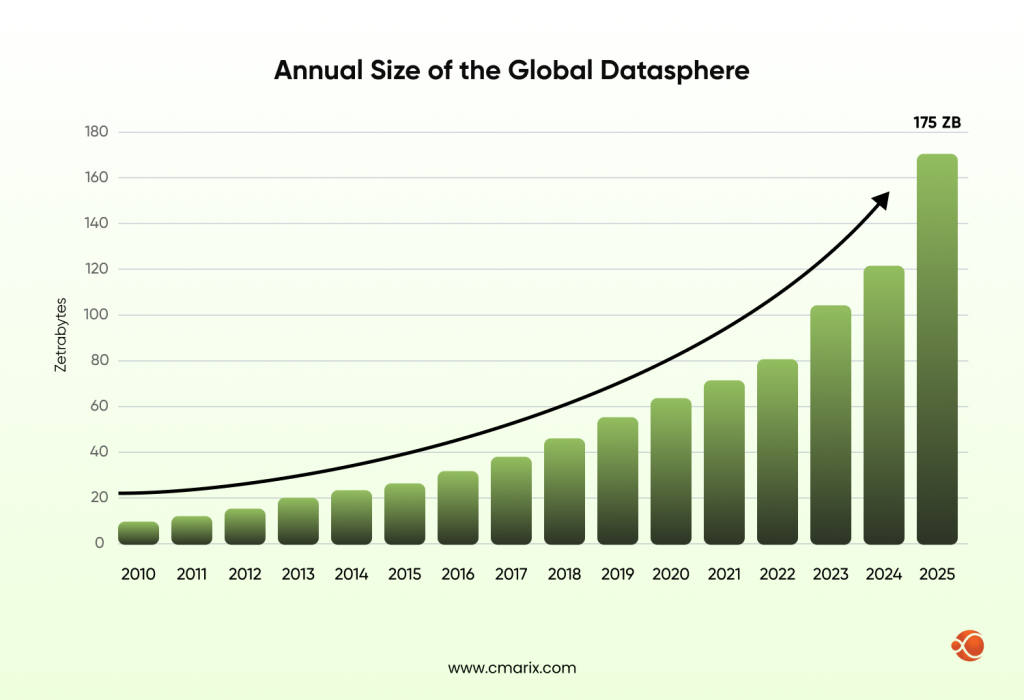
The International Data Corporation (IDC) estimates that globally, nearly 175 ZB of new data will be generated by 2025, increasing the need for edge computing to be completed at the device level rather than in data centers or cloud environments.
The number of global connections will increase to over 29 billion connected devices by 2030, generating data volumes that simply cannot all be routed to the cloud without serious latency, bandwidth, and cost consequences.
Edge computing addresses this by processing data locally, filtering, aggregating, and acting on it before (or instead of) sending it upstream to the cloud.
Edge Computing vs Cloud: The Core Differences
Comparing the structures of both systems will help choose the correct solution for each task.
| Aspect | Cloud Computing | Edge Computing |
| Data Processing | Done in central servers | Done near the device |
| Latency | Slower response | Faster response |
| Bandwidth Usage | Sends all data to cloud | Sends only important data |
| Scalability | Easy to scale | Limited by local hardware |
| Internet Dependency | Requires internet | Can work offline |
| Data Privacy | Data managed by cloud provider | Data stays local |
| Setup Complexity | Easy setup | More difficult setup |
| Cost | Pay-as-you-go | Higher setup cost |
Neither one nor another structure is always better. The right choice depends entirely on your specifics.
What’s the Key Difference Between Edge Computing vs Cloud Computing in 2026?
At its most fundamental level, the distinction is this: Cloud computing is designed for scalability and adaptability. Edge computing, on the other hand, is designed for speed and data proximity.
Cloud is your platform for processing, where the depth of analysis matters more than immediacy of action. Edge computing is your platform for processing, where the time from event to decision must be measured in milliseconds, not seconds.
As we move into 2026, the true picture is that enterprises no longer see cloud and edge computing as alternatives to each other, as much as they did even just five years ago. In fact, 56% of companies today deploy both technologies within their organizations.
When Should You Choose Edge Computing?
1. Real-Time, Low-Latency Data Processing
If your application cannot tolerate a delay of even 100ms, edge computing is non-negotiable. Autonomous vehicle collision detection, surgical robotics, real-time financial fraud detection, and industrial safety shutoffs all require response times that the cloud simply cannot guarantee over a standard internet connection.
2. IoT and Connected Device Environments
Industries that use industrial Internet of Things sensor networks will produce terabytes of data within minutes. It is neither practical nor necessary to send this amount of data into the cloud. The edge node filters out noise and sends up either outliers or summaries.
3. Data Sovereignty and Security Compliance-Heavy Industries
Healthcare establishments that follow HIPAA, banking institutions that follow PCI-DSS, and companies in Europe that follow GDPR must comply with rules governing the physical locations where their patients’/customers’ data can be stored. The nature of edge computing means it automatically places data in specified geographic locations.
The requirements regarding data sovereignty have only become stricter, not only in Europe but also across countries such as those in Southeast Asia, the Middle East, and Latin America.
4. Offline or Intermittent Connectivity Environments
Mining in remote locations, drilling platforms out at sea, monitoring agriculture in hard-to-reach areas, and logistics in difficult connectivity areas cannot rely on internet connectivity. Edge computing can keep the system going even without a cloud connection.
5. Bandwidth-Constrained Deployments
The transmission of raw video information, quality sensor information, and telemetry into the cloud comes at a high cost. However, through edge computing, the information can be compressed and filtered before its transmission into the cloud. You can benefit additionally from proper bandwidth optimization techniques provided by strategic AI consulting companies.
When Is Cloud Computing the Better Choice?
1. Variable or Unpredictable Workloads
Cloud computing’s elastic scaling is genuinely transformative for businesses with spiky demand patterns. A retail platform absorbing Black Friday traffic spikes, a media streaming service managing global content delivery, or a SaaS product onboarding thousands of new users simultaneously, these workloads belong in the cloud.
2. AI Model Training and Deep Analytics
It takes substantial computing resources to either train a big language model or execute machine learning pipelines. The cloud gives you access to GPU farms, TPUs, and distributed computing tools on the fly. Your model gets trained in the cloud; subsequently, your inference models are deployed at the edge.
3. Collaboration and Global Access
The types of applications that will have to support parallel use by widely dispersed groups of users worldwide are those that involve collaboration, file sharing, CRM systems ,and so on.
4. Rapid Development and Iteration
By leveraging cloud application development technology, one can use managed databases, serverless computing, machine learning, continuous integration, and DevOps to enable faster iterations.
5. Disaster Recovery and Business Continuity
Cloud services give you access to geographically dispersed backups, failovers, and other disaster recovery options at a fraction of the cost of setting up such facilities locally.
Can Edge Computing Work Without the Cloud?
Yes, but most deployments shouldn’t try.
Standalone edge computing works in specific scenarios: fully air-gapped military systems, isolated industrial environments with zero external connectivity, or embedded systems with fixed, pre-defined logic. In these cases, the edge node processes everything locally with no cloud dependency.
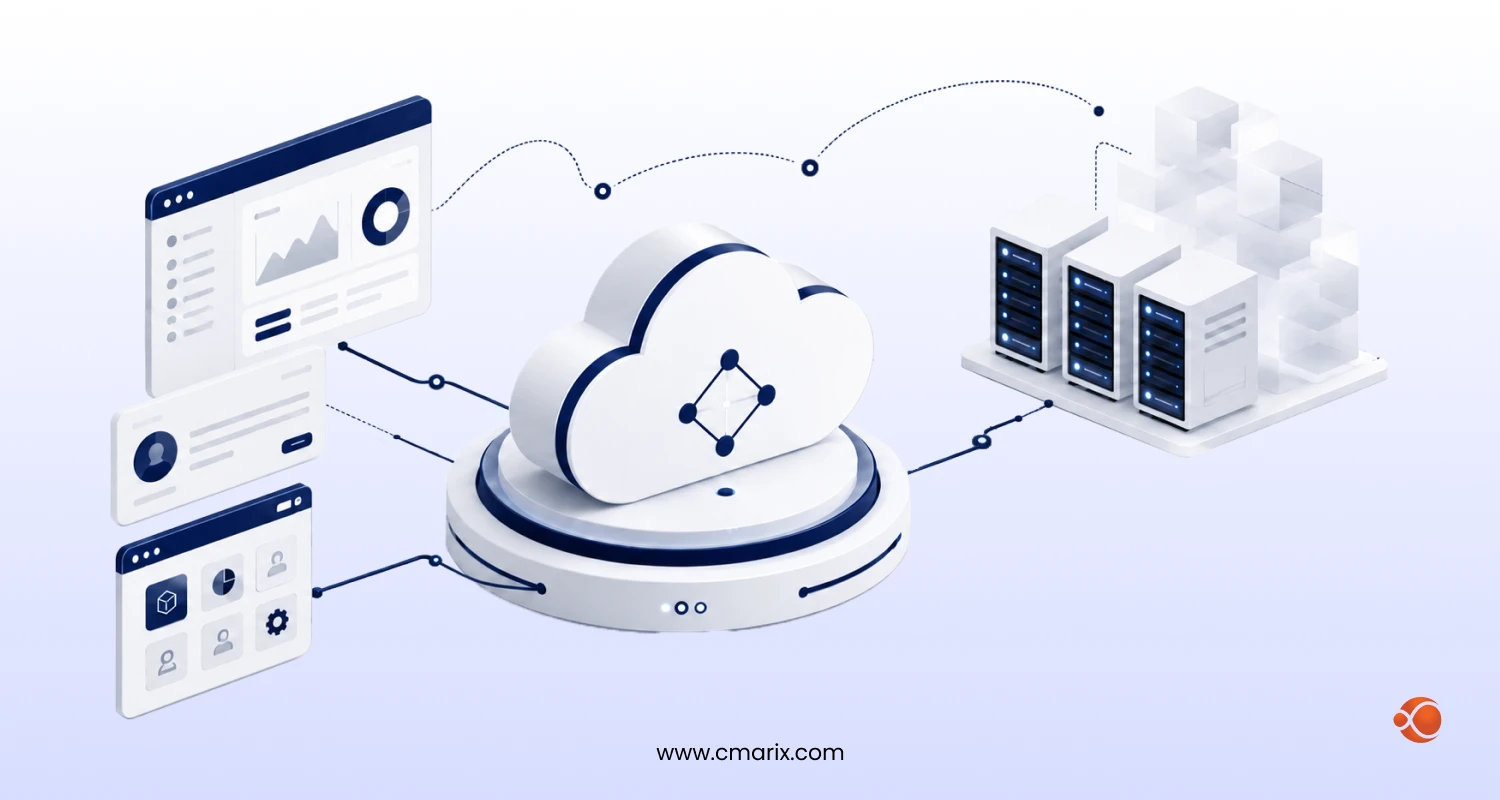
In most enterprise scenarios, however, edge computing and cloud computing support one another. Edge computing handles real-time processing, whereas cloud computing handles activities such as data aggregation, long-term data storage, training machine learning algorithms, and data analysis across multiple locations.
Is Edge Computing More Secure Than the Cloud?
Security comparisons between the edge and the cloud are more nuanced than the question suggests.
Edge computing advantages for security:
- Sensitive data stays local and never traverses public networks.
- Reduces the attack surface exposed to external threats
- Compliance with data residency regulations becomes structurally enforced.
Edge computing security challenges:
- Physical devices can be tampered with or stolen.
- Distributed nodes multiply the burden of updates and patch management.
- Individual edge devices typically lack the security monitoring sophistication of enterprise cloud environments.
Cloud computing advantages for security:
- Hyperscalers employ dedicated security teams and invest billions in protection.
- Centralized monitoring, threat detection, and response systems
- Automated security patching and compliance certification management
The most secure approach for most enterprises is a well-designed hybrid architecture: sensitive data processed and stored at the edge, with robust access controls and encryption on any data that does travel to the cloud. Neither model is categorically more secure — architecture quality and operational discipline determine the real-world outcome.
The Hybrid Edge-to-Cloud Architecture: The 2026 Standard
The enterprise consensus in 2026 has moved beyond the either/or framing. 29% of enterprises have already deployed edge computing infrastructure, and most of them are doing so alongside, not instead of, cloud platforms.
A well-architected hybrid model typically looks like this:
| Layer | Core Components | Primary Responsibilities |
| Layer 1: Device Layer | Sensors, cameras, actuators, connected equipment | Raw data generation, physical-world interaction, telemetry capture |
| Layer 2: Edge Layer | Edge servers, gateways, micro data centers | Real-time processing, filtering, compression, local storage, low-latency decision making |
| Layer 3: Cloud Layer | Centralized cloud platforms, data lakes, AI/ML infrastructure | Long-term storage, ML model training, cross-site analytics, orchestration, enterprise-wide insights |
The intelligence sits at each layer, with each layer handling what it does best.
At CMARIX, our artificial intelligence solutions, delivered by dedicated engineering teams, have built hybrid architectures across healthcare IoT platforms, industrial automation systems, and real-time logistics networks. The consistent finding: workload analysis before architecture selection always outperforms following a trend.
What Are the Main Limitations of Edge Computing?
Understanding edge computing’s constraints prevents over-engineering and over-investment:
1. Hardware Complexity & Maintenance: Edge infrastructure entails hardware components spread out among multiple sites. Unlike in the cloud, provisioning new capacity through API calls is not possible. Hardware maintenance and firmware upgrades are added burdens to operations.
2. Computational Constraints: Edge Nodes have constraints regarding the power used, space available, and heat generated. Applications that require a lot of computation, such as machine learning, are not feasible to run on edge servers.
3. Configuration and Orchestration Challenges: Handling the consistency of configuration on a hundred or more edge nodes is much harder than doing it from a centralized cloud service. While container orchestration can solve some problems by using Kubernetes and derivatives like K3S, operations become quite difficult.
4. More Initial Capital Outlay: Cloud computing provides a subscription-based payment structure, meaning there is zero capital expenditure upfront for hardware purchase. On the other hand, edge computing involves capital expenditure right from the beginning.
5. Security Governance at Scale: As the number of nodes increases in edge computing, it poses a great challenge to maintain proper security policy governance.
Key Decision Framework: Edge vs Cloud
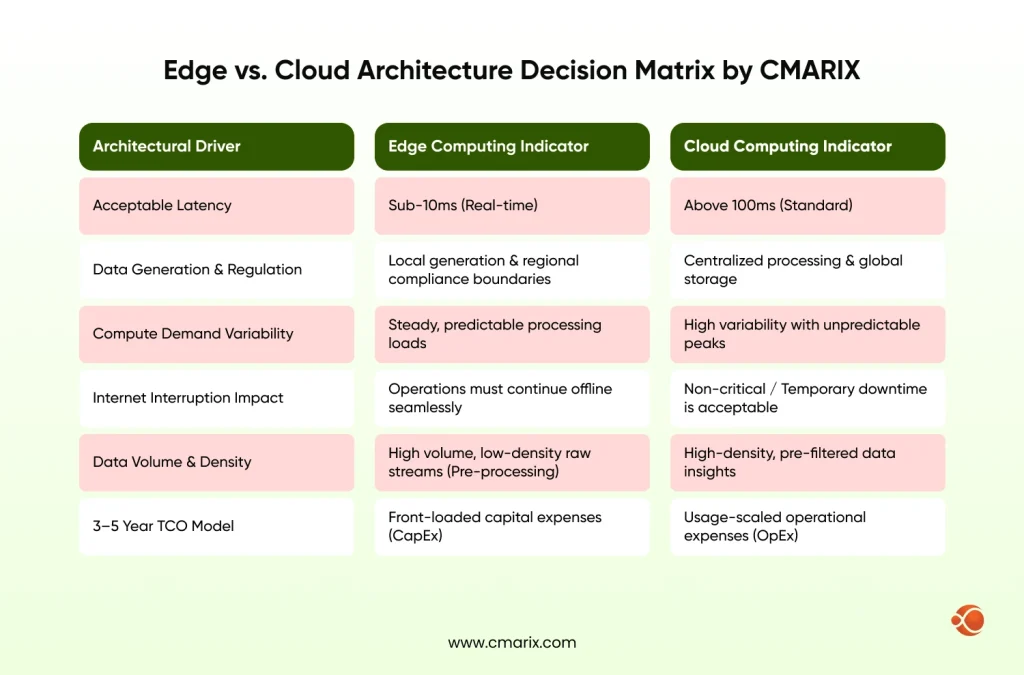
Before embarking on any architectural team or partner, including yourself, consider the following questions:
1. What is the allowable latency range for the study in question? Latency less than 10 milliseconds suggests we are dealing with the edge; latency greater than 100 milliseconds suggests we are dealing with the cloud.
2. At which location is the data produced, and at which one should it remain according to the regulation? Edge computing becomes necessary if there are coinciding conditions between the data generation and regulatory limitations.
3. To what extent does the calculated demand fluctuate with time? Fluctuating and irregular peaks in demand → cloud economics suffer. Regular and predictable demand → edge economics favor.
4. What would happen if the internet connection were to fail? The answer being “all operations must cease” means that edge computing is applicable.
5. How much data is there, and how much of it will actually need to be offloaded from the device? Large amounts of low-information-density data (e.g., unprocessed sensor outputs or video) greatly benefit from edge pre-processing.
6. What is the cost of ownership during a 3–5 year period? Cloud economics depend on consumption levels. The costs of edge are upfront costs. Estimate both models first.
Hybrid infrastructure balances edge and cloud for performance and cost.
AWS Architecture Optimization in Hybrid Deployments
The use of AWS by organizations as their main cloud computing platform provides them with the opportunity to leverage the benefits of AWS cloud computing infrastructure and platforms such as AWS Outposts, AWS Wavelength, and AWS Local Zones, all of which aim to bring AWS to the edge.
Why is that important? The most prevalent challenge when it comes to hybrid architectures is often the operational challenge of using two separate toolchains, one for the cloud layer and the other for the edge, along with some integration mechanism in between.
Certified AWS developers at CMARIX provide AWS architecture optimization services to help enterprises achieve their desired results.
Cloud Cost Optimization in Hybrid Architectures
A subtle but financially important dimension of the edge vs. cloud decision is the dynamics of cost optimization.
Studies show that nearly 30% of cloud spend is wasted on over-provisioned or idle assets. In hybrid architectures, a common pattern is that organizations initially over-provision cloud resources, assuming they’ll need centralized processing, only to discover that moving pre-processing to the edge significantly reduces cloud compute and egress costs.
Effective cloud cost optimization in hybrid environments requires:
- Metering actual data volumes flowing from edge to cloud (egress costs add up fast)
- Right-sizing cloud instances based on actual post-edge data volumes
- Using serverless or spot instances for workloads triggered by edge events
- Implementing FinOps disciplines to govern spend across both layers
The cloud migration risks that concern most enterprise architecture teams aren’t just technical — they’re financial. Hybrid architectures introduce new cost vectors that require deliberate governance from the start.
Real-World Scenarios: Making the Call
Scenario 1: Smart Manufacturing: Real-Time Intelligence at the Edge
A factory with 500 sensors generating 2TB of operational data daily cannot afford to route all of it to the cloud. Edge nodes process 95% of the data locally — running anomaly detection, quality control checks, and equipment health monitoring in real time. Only alerts and aggregated summaries reach the cloud for long-term trend analysis and predictive maintenance model training.
Verdict: Edge primary, cloud secondary.
Scenario 2: E-Commerce at Scale: Cloud-Driven Retail Operations
A retail e-commerce website needs to execute its algorithms for personalized product recommendations, monitor inventory across 12 distribution centers, handle payment transactions, and scale during periods of increased traffic. Requirements for latency are modest (sub-second, but not sub-millisecond), compute resources are extremely variable, and global availability is required.
Verdict: Cloud primary, edge optional for CDN and local caching.
Scenario 3: Telemedicine Infrastructure: Balancing Edge Speed with Cloud Compliance
The application requires that patient vitals need to be gathered from medical devices, emergency situations detected, and at the same time, HIPPA compliant regarding storing patient records. Real-time notifications need to be sent out within seconds. Patient records should not be kept in any other geography.
Verdict: Edge for real-time alerting and data residency; cloud for analytics, reporting, and non-sensitive workflows.
Final Words
The edge vs. cloud debate has a deceptively simple resolution: it is not a debate at all. For most enterprise workloads in 2026, the question is not which one, it is which workload goes where, and how well you architect the integration between the two.
56% of firms now implement edge computing alongside cloud platforms because the hybrid model delivers what neither architecture can achieve alone: real-time responsiveness at the source, combined with the analytical power and scalability of the cloud.
The people who are doing things correctly are not taking sides; on the contrary, they are analyzing their workloads, accounting for latency and compliance issues, and designing their architectures accordingly.
If you are evaluating your cloud architecture, planning a cloud migration, or assessing whether edge computing belongs on your infrastructure roadmap, the CMARIX technology consulting services team brings the technical depth and business context to help you make the right call, not the most fashionable one.
FAQs When Deciding Between Edge Computing and Cloud Computing
What is the main difference between edge computing and cloud computing in 2026?
In cloud computing, data processing occurs in remote data centers operated by hyperscalers. Edge computing, on the other hand, entails processing data on-site at the locations where it is generated by sensors. While cloud computing prefers scalability and extensive data analysis, edge computing focuses on fast processing and data proximity. By 2026, organizations will combine both methods in their architecture.
When should I choose edge computing over cloud?
Applications that require latency below 10ms, where crossing a certain geographical boundary is not acceptable due to regulatory constraints, where Internet connectivity is limited, and where the amount of data to transmit is too large to justify using the cloud are best suited for edge computing.
When is cloud computing better than edge computing?
When computing power is inconsistent, it is much more likely that cloud computing will outperform edge computing. Examples include machine learning training, international collaboration, performance from managed services, and geographic isolation for disaster recovery.
Can edge computing work without the cloud?
Certainly, in certain cases, where there are air-gapped industrial devices, offline embedded systems, or fixed-logic operational technologies. In general, though, the edge works together with the cloud; edge takes care of the on-the-spot processing, whereas the cloud takes care of deeper analysis and storage.
Is edge computing more secure than the cloud?
None can be considered superior when it comes to security. Edge computing stores sensitive data locally, protecting it from external network attacks but exposing it to physical vulnerabilities and complicating patching. Cloud computing offers enterprise-level security capabilities but involves entrusting sensitive data to another company. It is generally a hybrid architecture that yields optimal security results.
What are the main limitations of edge computing?
Some of the main disadvantages are the complex nature of hardware maintenance, limited computing capacity relative to cloud computing, difficulties in orchestrating a large-scale system, high initial costs, and security governance issues.