





Quick Summary: Insurance claims processing in 2026 is The claims process is undergoing a restructuring phase via AI automation throughout each step of the claims process. Carriers that use AI automation for FNOL intake, routing, documentation, reserving, and fraud detection are processing claims 75% faster (from 30 days to 7.5 days), saving 30 to 40% in costs per claim, and obtaining straight through processing of 70 to 90% for typical personal lines policies. On the other hand, the industry-wide average claim cycle time is 40.7 days, and only 34% of insurance companies have fully adopted AI.
The gap between leaders and others is widening fast. The J.D. Power 2025 U.S. Property Claims Satisfaction Study found that average claim cycle time has reached 44 days, the longest on record. Per the J.D. Power 2025 Claims Digital Experience Study, 52% of policyholders who rate their digital claims experience as poor are likely to leave. Only 4% of those with an excellent experience say the same.
In This Blog, You Will Get Answers To:
- What are the reasons that legacy claims systems will not be effective in 2026?
- How would you describe a fully integrated automated claim management system based on advances in Artificial Intelligence?
- What can an Insurer do to reduce claim processing time and costs per claim by 30-75%?
- What is the relationship between automating the First Notice of Loss and Straight Through Processing and Return on Investment for Insurers?
- In what ways can Artificial Intelligence improve the accuracy of reserves and the detection of fraud throughout the organization?
- What is needed for insurers to have real-time visibility into their claims processes?
- What type of phased implementation will provide the insurer with the fastest and most cost-effective path to achieve the implementation of their claims solution?
2025 Benchmark Snapshot
- AI-enabled carriers have cut claim resolution time by 75% (from 30 days to 7.5 days) and reduced cost per claim by 30-40%, from $40-60 to $25-36. Source: Datagrid / BCG Research, December 2025.
Companies using AI are pulling ahead, and the gap keeps widening.
BCG research shows that AI-enabled carriers have cut claim resolution time by 75%, from an average of 30 days to 7.5 days. Cost per claim drops 30 to 40%, from $40 to $60 down to $25 to $36. Bain estimates generative AI could create over $100 billion in benefits for property and casualty claims handling alone, with 20 to 25% reductions in loss adjustment expenses.
Nevertheless, two-thirds of American insurance companies are observing this revolution rather than driving it. McKinsey’s 2025 analysis puts full AI adoption at only 34%, compared to 8% last year. Just 7% of insurers have been able to scale up their AI efforts past the pilot phase. Insurers that act now will realize the benefits of faster claim payments, reduced cost structures, and better retention. Insurers that wait will find themselves in a more difficult competitive environment.
Insurance Claims Processing Benchmark Snapshot
| Metric | Industry Average / Legacy | AI Enabled Carriers | Source |
| Average claim cycle time (FNOL to final payment) | 40.7 days | 7.5 days (75% faster) | J.D. Power 2026 / BCG |
| Cost per standard claim | $40 to $60 | $25 to $36 (30 to 40% lower) | Datagrid / BCG 2025 |
| Straight through processing rate | 10 to 15% | 70 to 90% | IDC / Industry benchmarks |
| Full AI adoption rate | 34% of insurers | Up from 8% prior year | McKinsey 2025 |
| Scaled AI deployment | 7% of insurers | 93% still in pilots | Microsoft 2025 |
| Annual U.S. fraud losses | $308.6 billion | AI detection up 30%+ | CAIF 2025 / NICB |
| Policyholders at churn risk (poor digital experience) | 52% | 4% (excellent experience) | J.D. Power 2025 |
| Digital tool utilization (FNOL reporting) | 38% | Rising year over year | J.D. Power 2026 |
Why Legacy Insurance Claims Systems Are Failing
Legacy systems assert that failure does not happen in one fell swoop. Instead, failure happens gradually on several levels: rising costs, inaccurate reserve projections, processing delays, and loss of patience by policyholders due to communication delays. Three fundamental flaws characterize the problem.
Data Fragmentation Is Destroying Operational Capability
Most carriers still use 4 to 7 different systems for policy administration, claims management, billing, underwriting, fraud detection, and third-party vendor applications. According to McKinsey, about 74% of insurers are still on legacy core platforms by 2025. Manual document processing accounts for 80% of processing time in a non-automated claims process.
All these issues arise from inside the company. Differences between the policy and claims data result in miscalculated reserves, and loss recovery fails to happen; compliance rules demand additional work and present potential dangers. Upgrading old software would reduce IT services expenses by 41% and increase efficiency by 40%.
Policyholder Expectations Have Permanently Reset
According to the J.D. Power 2025 U.S. Insurance Digital Experience survey, Web-based purchases of auto insurance rose from 35% to 47%, thereby overtaking purchases via agents (35%) and call centers (17%). There is an important segment of insureds that will not interact with the totally analog claims process.
According to the J.D. Power 2026 Property Claims Study, the use of digital tools is on the rise at all touchpoints involved in the claims process: 38% of consumers initiate FNOL digitally, 49% provide photos of damage digitally, while 45% receive updates via digital means. Satisfaction with insurance claims processes is significantly higher among consumers who use digital tools at each touchpoint. However, only 22% of insurance companies provide adequate digital updates about the progress of the claims process.
According to a J.D. Power report, 2025, the effect on customer retention is immediate and measurable: 52% of customers who have a poor claims experience are expected to switch insurers. Conversely, only 4% of those who have an excellent claims experience indicate that they will.
Fraud Is Outpacing Manual Detection Methods
Insurance fraud in the U.S. costs an estimated $308.6 billion per year (Coalition Against Insurance Fraud). According to the National Insurance Crime Bureau, identity fraud is expected to rise by 49% between 2025 and 2026 because of synthetic identities and artificial intelligence (AI)-created documents, which cannot be detected using traditional rule-based systems.
Deloitte’s analysis shows that soft fraud identification rates currently sit between 20% and 40%, and hard fraud identification rates between 40% and 80%. Graph neural networks and machine learning-based anomaly detection are the only tools capable of keeping pace with organized fraud networks operating at scale.
The 5 Layer Insurance Claims Processing Automation Architecture
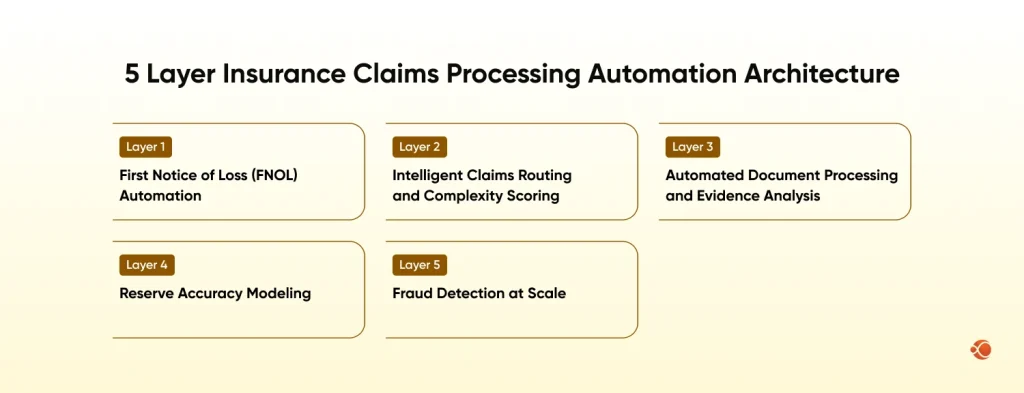
Insurance claims processing automation is not a single product purchase. It is a layered architecture where each capability multiplies the value of the next. The sequencing matters as much as the technology. The five layers below are ordered by speed of ROI delivery based on documented enterprise implementations.
Layer 1: First Notice of Loss (FNOL) Automation
FNOL is the most voluminous and automated way to capture information at the beginning of the claims-handling cycle for an insurance company. An artificial intelligence-powered intake engine collects claims information in all possible ways (phone transcription, online forms, mobile app submissions, emails, and other APIs).
The 2025 Roots State of AI Adoption in Insurance survey confirmed that FNOL is where carriers have made the most progress in their pilot initiatives. Most have achieved 60 to 80% automation within 6 months of deployment.
What changes operationally with automated FNOL:
- Processing decrease: Up to 80% reduction in manual intake processing for standard claims.
- Instant triage: Claims are processed shortly after being submitted, no matter what platform is used.
- Consistent data quality: Extraction precision is maintained consistently through shifts and changes in staffing.
- Downstream integration: The data is then supplied straight into the systems of routing, booking, and fraud scoring without any re-keying.
- Audit trail generation: Every intake decision is automatically logged with full audit trail capabilities for compliance.
Layer 2: Intelligent Claims Routing and Complexity Scoring
The AI routing engines process incoming claims on various scoring metrics and send them to the right processing path without any human intervention for most standard claims.
| Scoring Dimension | What It Measures |
| Severity | Estimated loss magnitude based on loss type and coverage limits |
| Complexity | Number of parties, jurisdictions, and coverage overlaps involved |
| Fraud Risk | Graph-based anomaly score versus known fraud patterns and networks |
| Litigation Probability | Injury type, attorney involvement signals, and jurisdiction history |
| STP Eligibility | Composite score determining automated settlement candidacy |
The claims process is automated by artificial intelligence for 70% to 90% of routine claims. This enables claims adjusters to focus on the more difficult claims that require human intervention.
Layer 3: Automated Document Processing and Evidence Analysis
The current document AI technology can process police reports, medical records, repair estimates, images, and videos with more than 95% accuracy. Once this system is scaled up, document processing will take only 20% of the total time needed to handle claims, compared to 80% at present.
- Cross-referencing of policies: Policy term verification occurs during intake rather than adjudication.
- Identification of gaps: Documentation gaps are identified before an adjuster is assigned.
- Automated audit trails: Audit trails are produced for every document review decision.
- Multi-format handling: AI processes standardized formats (ACORD, EDI), free-form text, handwritten notes, images, audio, and video.
Layer 4: AI Reserve Accuracy Modeling
Overestimation of reserves can be termed a silent contributor to poor profitability through over-retention of capital. On the other hand, underestimation causes unfavorable development that affects the combined ratio. The introduction of machine learning in fintech addresses both failure modes through regular refinement of settlement range estimates.
McKinsey projects a 25 to 30% reduction in loss adjustment expenses and a 3 to 5 percentage point decrease in indemnity spend for carriers deploying AI-driven reserve modeling.
💡 Capital Release Math
- An improvement of 5% in the accuracy of reserves for a $500M portfolio of claims will free up $25M in capital. Most AI reserve solutions will pay for themselves on this basis alone within 12-18 months of going live.
Layer 5: Fraud Detection at Enterprise Scale
The rule-based system for detecting fraudsters is simply incapable of keeping up with synthetic identity fraud and document forgery enabled by artificial intelligence. The graph neural network, a major component of contemporary fraud analytics in insurance claims, helps connect people involved in the insurance claims process to detect the ring-like structure of their relationships.
AI-based fraud detection systems have raised identification rates by more than 30% in companies with mature implementations of such technology. The NICB predicts a 49% increase in identity-related fraud.

Building Real-Time Claims Visibility: The Consolidation Architecture
AI works best when it can get and use data right away. Without solid integration, the whole automation process gets stuck.
API First Architecture: The End of Batch Processing
Modernized insurers who update their claims management processes use API-based ETL to replace batch ETL. All events related to changing status, approving payments, document submission, and fraud alerts are communicated in real-time to policy admin, claims, billing, and analytics systems.
Forrester’s 2025 insurance technology forecast projects spending on insurance technology will grow by 8% in 2025, with the highest growth in integration middleware and cloud native platforms. EDI integration for insurance claims automation is important within this layer, facilitating real-time standardized data exchange with medical providers, repair networks, and law firms.
What Real-Time Dashboards Deliver for Each Stakeholder
When the joining layer is properly constructed, all stakeholders receive what they require without waiting for batch reports or status calls.
| Stakeholder | Real-Time Visibility |
| Claims Adjusters | Live workload view, AI reserve guidance, fraud alerts, new document notifications |
| Operations Managers | SLA tracking, aging reports, cycle time trends, capacity heatmaps, bottleneck alerts |
| Finance / Actuarial | Reserve exposure by line, adverse development alerts, portfolio risk dashboards |
| Compliance | Regulatory deadline monitoring, full decision audit trails, exception notifications |
| Policyholders | Real-time claim status, document upload access, milestone notifications, payment confirmation |
According to the J.D. Power 2026 study, customer satisfaction scores are significantly higher for those using digital platforms for FNOL reporting, photo submission, and status updates than for those who are not. Just 36% of customers with auto insurance and 31% of those with home insurance use the claim status update feature on their insurers’ mobile apps.
CMARIX delivers AI-driven claims automation, real-time visibility, and measurable ROI across the entire claims lifecycle.
Contact UsWhat AI Insurance Claims Processing Automation Is Delivering: Benchmarks
| Metric | Legacy Baseline | With AI Automation | Improvement |
| Claim resolution time | 30 days | 7.5 days | 75% faster |
| Routine claim processing | 7 to 10 days | 24 to 48 hours | 70 to 80% faster |
| Standard cost per claim | $40 to $60 | $25 to $36 | 30 to 40% lower |
| Complex cost per claim | $200+ | $120 to $140 | 30 to 40% lower |
| Manual document handling | 80% of time | 20% of time | 75% reduction |
| STP rate (simple claims) | 10 to 15% | 70 to 90% | 5 to 6x improvement |
| Average repair cycle time (property) | 32.4 days (2025) | 29.6 days (2026) | 2.8 day improvement |
| FNOL to final payment (property) | 44.1 days (2025) | 40.7 days (2026) | 3.4 day improvement |
Enterprise Case Study: Aviva
The implementation at Aviva is the most well-documented enterprise use case in the industry. Following the implementation of over 80 machine learning models within motor claims (McKinsey 2025/2026):
- Claims routing accuracy: Improved by 30%
- Liability assessment time: Reduced by 23 days on complex cases
- Customer complaints reduced by 65%
- Total documented value: Over GBP 60 million ($82 million) in one year
Enterprise Case Study: Lemonade
Lemonade holds the record for fastest full claim settlement at 2 seconds using its AI bot. As of Q4 2025, 55% of all Lemonade claims are fully automated from start to finish. 96% of first notices of loss are processed without human involvement. The company posted a record Q4 loss ratio of 63% (a 12-point year-over-year improvement) and grew In Force Premium by 31% to $1.24 billion.
Enterprise Case Study: Zurich Insurance
Zurich Insurance used Expert AI’s advanced Natural Language Processing Development services to achieve a 58x reduction in claims review processing time, from 8 hours per claim to 8 minutes.
Enterprise Case Study: Ping An Insurance Group
Nearly 60% of accident and health claims at Ping An are now automated, with some settled in as little as 51 seconds. Ping An delivers instant decisions on 93% of its life insurance applications. This rapid turnaround highlights how advanced insurance app development improves operations and greatly improves the customer experience.
How CMARIX Delivers Insurance Claims Processing Transformation
The industry benchmarks above reflect what is achievable. What follows are production systems CMARIX has created for insurance carriers and digital services across three continents.
Wataniya Insurance (Saudi Arabia): Paper-Based to Enterprise Claims Platform
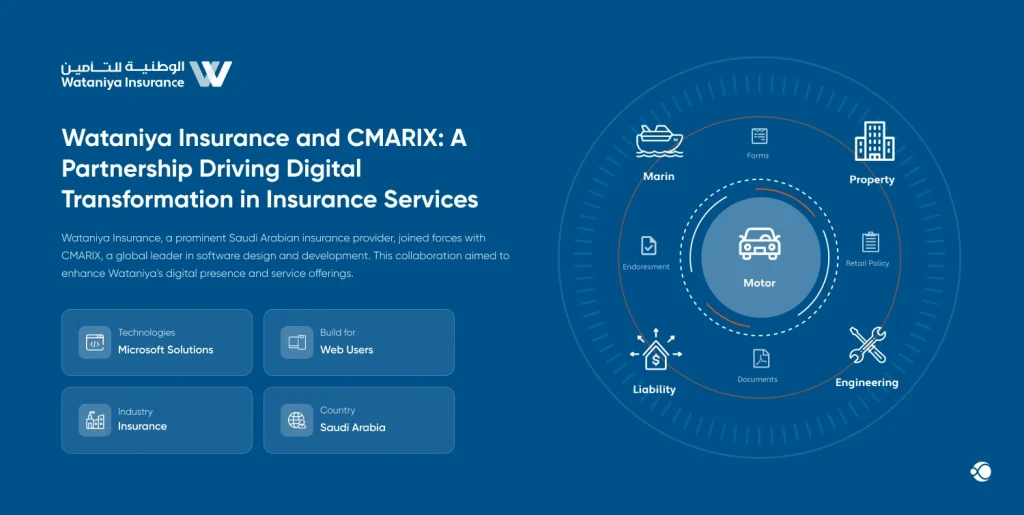
Challenge: Wataniya was entirely dependent on manual processing of claims and policies, which led to document search errors, no Internet access for policyholders, and increasing compliance problems.
Solution: CMARIX developed a fully customized insurance management system with multiple role logins, automatic commission calculations, and a policyholder portal for making claims online and tracking their status.
Result: Attaining full digital transformation from paper to platform requires specialized enterprise digital transformation consulting to produce zero manual document handling, real-time policy and claims tracking, and a compliant, scalable system serving both individual and corporate policyholders.
Beema1: Manual Workflows to Automated, Fraud-Aware Claims Engine

Challenge: Beema1 required an advanced platform that would support completely automated claims management with built-in fraud detection, live updates, and removal of vulnerabilities in the existing system.
Solution: CMARIX was designated for automated claims processing with entry-level fraud detection, a dynamic policy interpretation engine, and customer portals providing claim status.
Result: Claims processing time was drastically reduced. Fraud detection occurred pre-adjudication rather than post. The self-service portal increased customer satisfaction ratings.
Aspen Claims: Legacy Systems to End-to-End Claims Lifecycle Platform
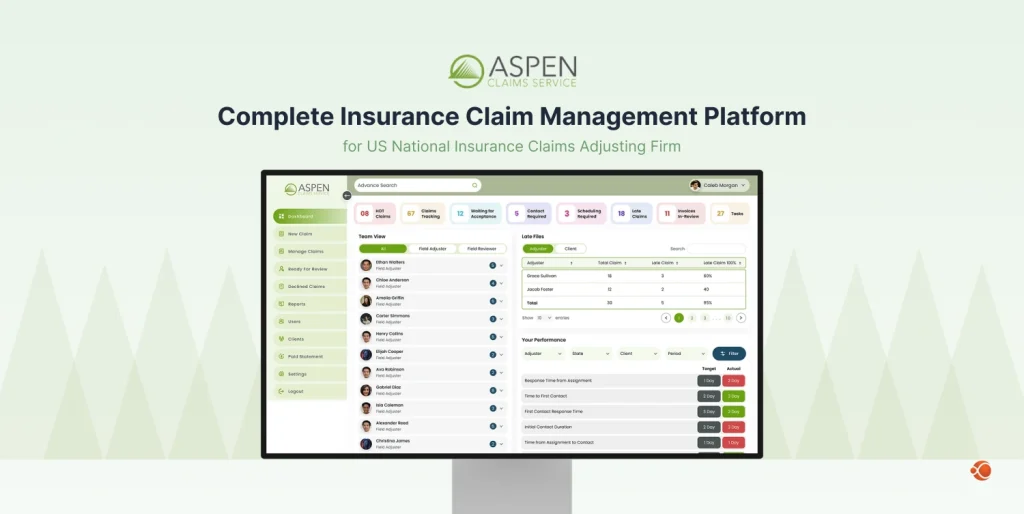
Challenge: A customized platform was required to handle all claim processing activity from FNOL to closure; this could not be achieved through the existing systems.
Solution: CMARIX created a web-based claims management platform with automated intake triage, document management with complete audit trails, and a real-time, data-driven dashboard for insurance companies designed for adjusters and operations managers
Result: Workflow management was greatly streamlined. Operations managers could see the claim process in real time. Audit trails were ready in document management.
Your Phased Insurance Claims Processing Implementation Roadmap
The fastest carriers to achieve ROI share a common approach: they do not attempt everything at once. A staged implementation regularly outperforms a big bang approach in terms of speed and cost.
| Phase | Capability Deployed | Expected Outcomes |
| Phase 1 (Months 1 to 4) | FNOL Automation + Integration Layer | 60 to 80% FNOL automation; STP baseline established; API architecture built |
| Phase 2 (Months 5 to 10) | Document AI + Reserve Modeling | Manual handling drops 60%; reserve accuracy improves 20 to 30%; adjuster capacity freed |
| Phase 3 (Months 11 to 18) | Fraud Analytics + Policyholder Portal | Fraud detection rate up 30%+; customer satisfaction gains; full scale STP reached |
Step 1: Conduct a Claims Process Maturity Assessment
Set your own performance benchmark before any vendor evaluation can be done. Evaluate your STP ratio per line of business, average cycle time from FNOL to disbursement; cost per claim for standard and complex claims; fraud leakage rate as a percentage of written premium; reserve ratio (initial/ultimate paid); and adjuster satisfaction and decay rates. This is where the ROI standard is set, and the implementation order is defined.
Step 2: Prioritize FNOL Automation First
FNOL has the shortest time to value compared to any other type of insurance claims process automation. It is the process that occurs at the forefront of each claim and which has the highest repetition of automations. It is also the process that creates structured data, which enhances every subsequent level of AI.
Step 3: Build the Integration Framework Foundation Before Adding More AI
An event-driven API architecture is required for everything on the layers above Layer 1. If carriers skip this layer and keep using their legacy batch processing, they will be limited in every layer going forward. Their fraud models will not be able to react to real-time triggers. Their reserve engines will not be updated when documentation arrives. Their policyholder portals will not have any current information. Build out the combining layer as your infrastructure.
Step 4: Pilot Fraud Analytics on One Line of Business
Training for fraud graphs is possible only with the help of training data that you have in your claim database. Begin with the line of business that carries the most fraud risk. Test whether your model has improved the detection results compared to your baseline.
Conclusion
Insurance claims modernization is no longer a choice. In 2026, insurers using AI-powered claims automation are seeing claims resolved 75% faster, with 30-40% lower costs, and significantly improved retention through real-time visibility and communication.
Legacy architectures simply can’t compete with a layered, API-first, automation-centric architecture. The key to success is a phased rollout approach: FNOL first, followed by document AI, reserve modeling, fraud analytics, and a real-time policyholder portal.
The performance divide is growing. Speed of execution is now the determinant of competitiveness.
FAQs about Insurance Claims Automation Software
What is insurance claims processing automation?
Insurance claim automation implies the use of AI, machine learning, and workflow tools to automate tasks such as intake, document review, fraud detection, reserving, and payments. These activities are mostly performed automatically, without involving many humans in the process.
How does AI improve insurance claims processing?
With the aid of AI, it is possible to have automated FNOL intake and triaging, intelligent triaging depending on severity and complexity scoring, data extraction from documents with greater than 95% accuracy, real-time fraud detection using graph neural networks, and dynamic reserve modeling that becomes more accurate with each new piece of data.
What is straight-through processing (STP) and what rate should carriers target?
Straight-through processing involves moving claims from assessment to reserve setting, approval, and payment without any human intervention. Some leading motor insurance companies have achieved an STP ratio of 70-90% on personal auto claims in 2025. IDC forecasts that the STP ratio for all categories of claims will be at least 65% by 2026.
How long does it take to implement AI claims processing software?
A focused FNOL automation solution takes 3 to 6 months to build. The total end-to-end solution for claims management, including document AI, fraud analytics, reserve models, and a customer portal, is 12 to 18 months of large-scale enterprise application development. Most documented enterprise deployments achieve positive ROI within 12 to 24 months.
Can you develop custom insurance claims automation software?
Yes. CMARIX build custom insurance software tailored to your lines of business, existing core systems, and regulatory environment. Every engagement starts with a maturity assessment to identify the highest-value automation opportunities before a single line of code is written.
How much does insurance claims processing software cost to develop?
Costs vary by scope, integrations, and line of business. When budgeting for digital insurance platforms, Modular systems (FNOL automation, document AI) tend to cost between $250,000 and $750,000. Enterprise-wide solutions incorporating custom AI models, integration with legacy systems, and multi-line coverage can cost anywhere from $1 million to $5 million and beyond. According to BCG, insurance companies spending between $25 million and $100 million each year on AI are beating their competitors in combined ratios and retention.
What should carriers look for when selecting AI insurance claims management software?
Some of the important considerations that have to be considered for assessment purposes include the ability of the system to integrate into current policy administration systems such as Guidewire, Duck Creek, and Majesco; the ability in record-keeping and compliance, pre-trained model versus carrier-specific information, real-time API access versus batch processing problems, STP rate benchmarks from live implementation, implementation flexibility, and audit trail creation per automation.
How does EDI integration work for insurance claims automation?
EDIFACT- and ANSI X12-compliant data interchange through Electronic Data Interchange (EDI) facilitates structured data transfer between insurance companies, healthcare providers, repair networks, lawyers, and government authorities. The requirements for claims automation through EDI include ANSI X12 and EDIFACT compliance for healthcare and property claims, real-time EDI transaction processing for straight-through processing, and a vendor portal for transaction execution with repair shops, healthcare providers, and lawyers.
Can insurance claims processing software scale during catastrophe events?
Yes. Modern cloud native claims platforms are built for elastic scaling. Volume spikes from catastrophe events, new product launches, or geographic expansion are handled automatically. The AI models also improve in accuracy as claim volume grows, making the system more efficient over time.