



Quick Summary: Low-code is no longer optional; it’s becoming the backbone of modern software development. With faster delivery, lower costs, and rising enterprise adoption, the latest low code statistics show a clear shift toward visual, AI-powered platforms that let businesses build and scale applications without traditional development bottlenecks.
Low code is no longer “the alternative way” to build software. In 2025, it’s the way many companies are building it: faster, cheaper, and with far fewer technical barriers.
The latest low code statistics show a clear shift. Enterprises are betting on low-code platforms for internal tools, customer apps, automation, and even mission-critical systems.
At the same time, business users are building more software than ever before, sometimes without touching a single line of traditional code.
If you’re wondering where low code really stands today, this guide walks you through real numbers, verified sources, and what they actually mean for your business.
Key Statistics on Low Code Development
- The low-code development platform market is valued between $26–50 billion in 2025, growing at 20–33% CAGR.
- 75% of large enterprises use at least four low-code tools.
- 78% of Fortune 500 companies deploy low-code in mission-critical systems.
- ROI ranges from 206% to 506%, with payback in under a year.
- Development time drops by up to 90%, and costs by up to 70%.
Why Low Code Is Redefining Software Development in 2026
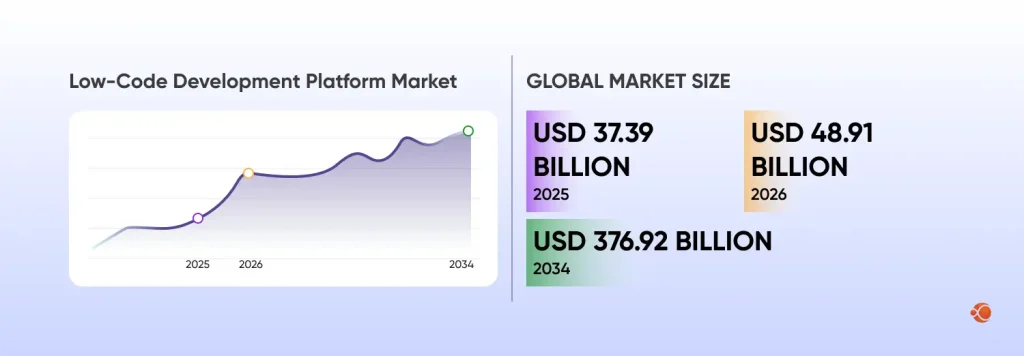
Not long ago, building software meant long development cycles, large engineering teams, and months of backlog. That model still exists, but it’s no longer the default.Global low-code development platform market share was USD 37.39 billion in 2025, and the projected growth for 2034 is USD 376.92 billion from USD 48.91 billion in 2026, exhibiting a CAGR of 29.10% during the forecast period.
The U.S. Bureau of Labor Statistics has predicted that there will be a strong demand for software developers up to 2030. That’s where low-code development platforms step in. And many companies choose to hire dedicated developers who are specifically skilled to work on low-code platforms.
These low code statistics offer a grounded view of how fast this change is happening and what’s driving it.
Low-Code Market Size, Growth Rate, and Industry Revenue Statistics
Low code development platforms market is growing at a pace that only a few enterprise software segments can match.
Here’s what major research firms report:
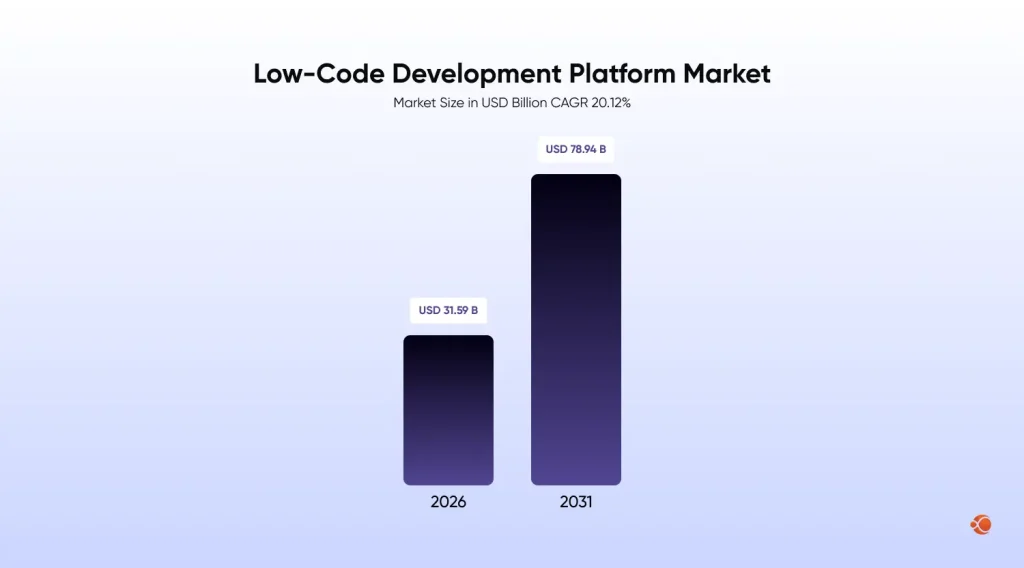
- Mordor Intelligence values the low-code development platform market at $31.59 billion in 2026, projecting $78.94 billion by 2030 at a 20.12% CAGR.
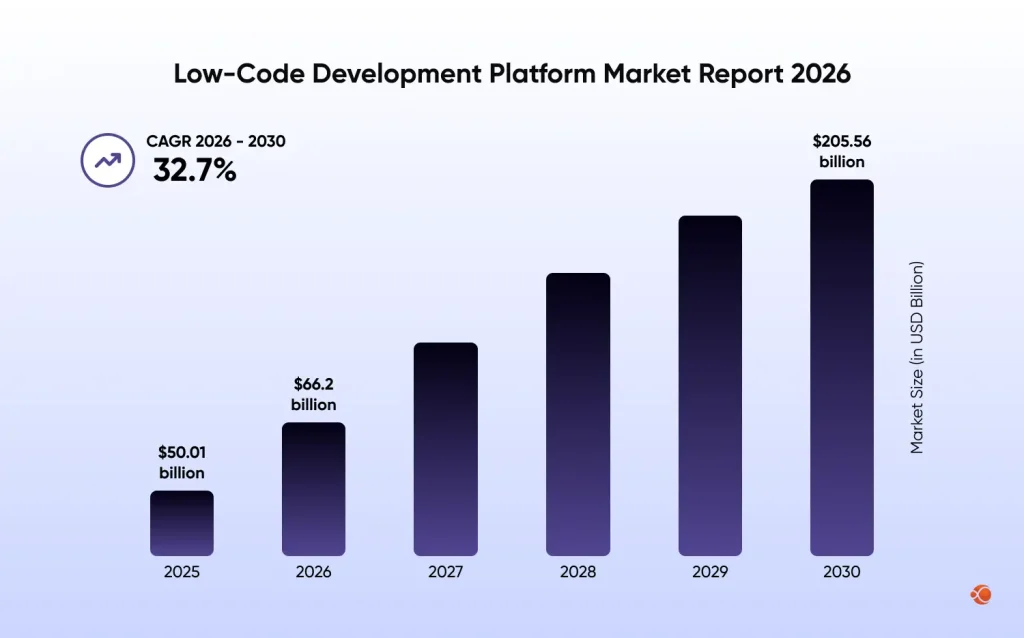
- As per Business Research Company, the low code development platform market grew from $50.31 billion in 2025 to $66.2 billion in 2026, expected to reach $205.56 billion by 2030 at 32.7% CAGR.
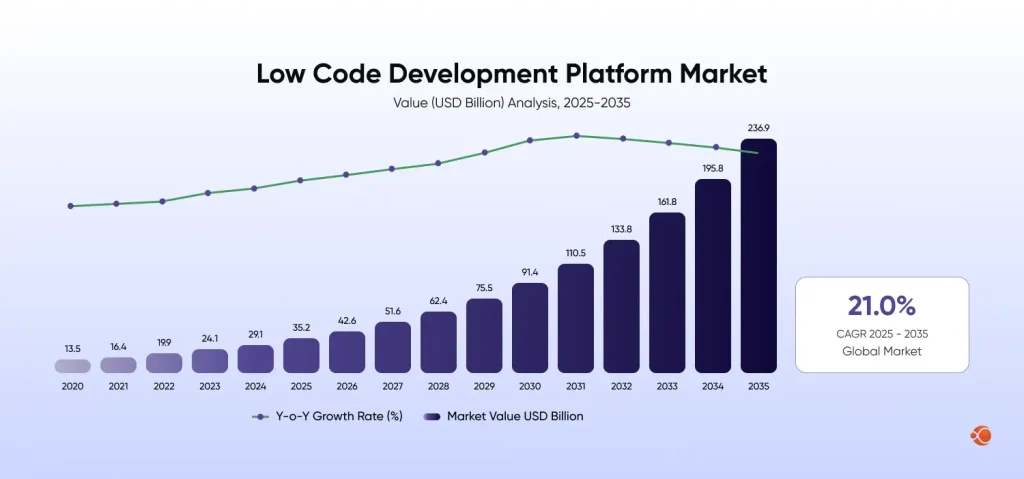
- Future Market Insights values low code platforms market at $35.2 billion in 2025, forecasting $236.9 billion by 2035.
Regionally:
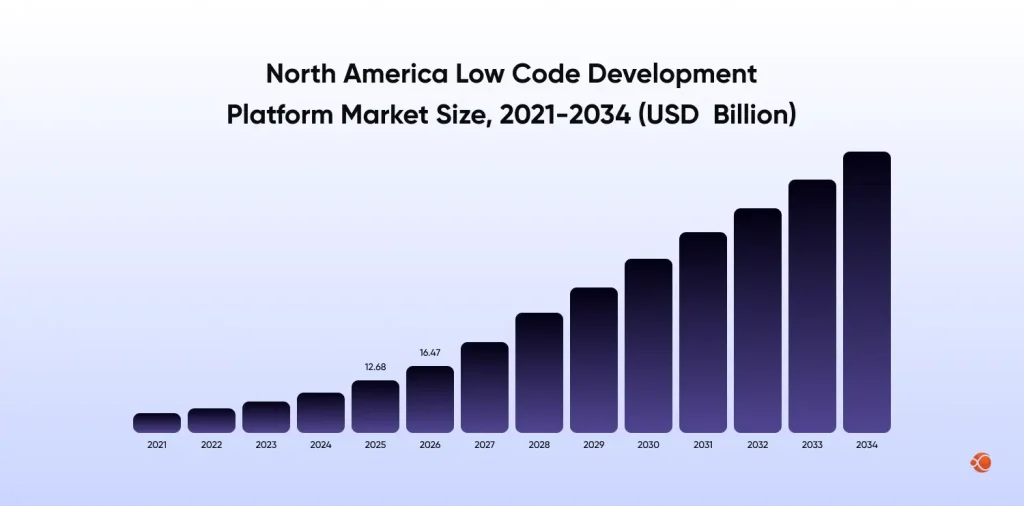
- North America holds the largest share at 33.90% in 2025, with a market value of $12.68 billion, and is forecast to increase to $16.47 billion in 2026.
Industrywise:
- BFSI leads adoption, followed by healthcare and the IT/ Telecom sector.
- The IT and telecom sector is projected to dominate the market, capturing 21.65% of global revenue.
- Healthcare is the fastest-growing vertical, with a 28.23% CAGR projected through 2035.
These numbers are increasingly cited in low-code software development statistics, showing how low code is becoming a measurable part of global spending in the IT sector.
Low-Code Adoption Rates by Industry and Use Case
Low-code adoption in 2026 isn’t limited to startups or tech-forward companies; it’ll happen across nearly every sector.
Here are the most telling adoption stats:
- Gartner research says that, typically,41% of employees outside of IT customize or build data or technology solutions. It is also predicted that most of the new low-code customers will come from business buyers who are outside the IT organization.
- 60% of custom enterprise apps are built by employees outside IT; 30% by users with limited or no coding skills.
- 84% of enterprises adopted low-code specifically to reduce IT backlogs and speed up delivery.
- 72% of IT leaders say development backlogs block strategic work.
Industry examples:
- Banking & Finance: Fraud monitoring dashboards, compliance automation, customer onboarding flows.
- Healthcare: 73% of healthcare enterprises are considering low-code software development to build applications and workflows. Patient intake systems, internal scheduling tools, and compliance reporting apps.
- Manufacturing: Quality tracking systems, supplier portals, and inventory dashboards.
- Retail: Order management tools, loyalty programs, and inventory forecasting apps.
- Enterprises: 63% of enterprises in the retail sector already have low-code development programs in place, helping retailers develop software solutions to address business process challenges, from supply chain management (SCM) to delivery tracking, at greatly reduced costs.
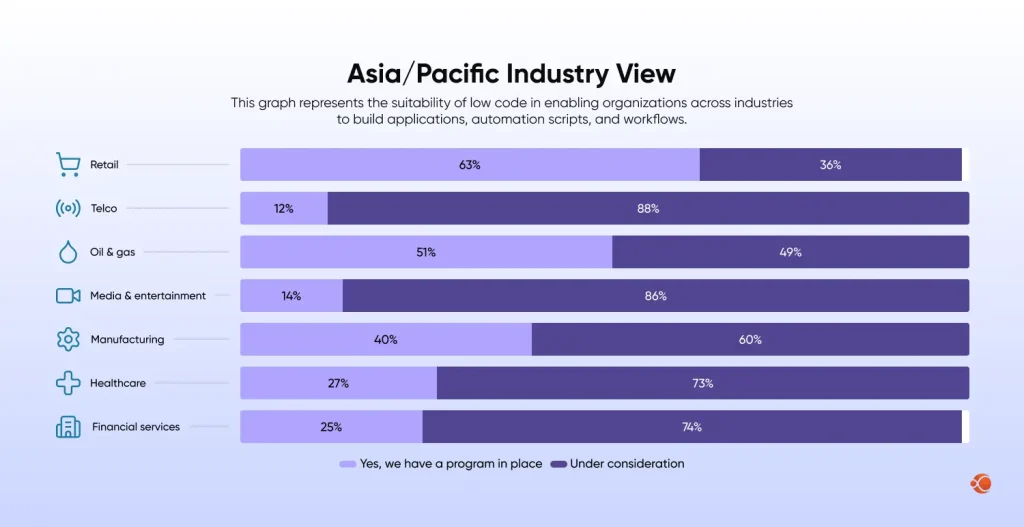
This is what modern low code business applications look like: practical, fast, and built close to the business need. Organisations investing in structured low code development services are seeing better scalability, stronger governance, and smoother integration than with traditional citizen development efforts.
Enterprise vs SMB Low-Code Adoption: Usage, Spend, and Scale
There’s still a perception that low-code is mainly for small businesses. The data says otherwise.
Enterprise low code platform statistics show that large organizations dominate market usage and revenue.
Enterprise Adoption Stats:
- 75% of large enterprises will be using at least four low-code development tools for both citizen development and IT application development initiatives. Also, the analysis found that users who had no such experience of using low code platforms learned to develop meaningful applications within a month.
- 78% of Fortune 500 companies deploy low-code in mission-critical systems that require deep customization and certified implementation partners.
- 85% of enterprises integrate their low-code apps with ERP and CRM systems, which is driving the demand for web-native platforms.
- Large enterprises are projected to generate 66.67% of global market revenue by 2035.
For large companies, low code doesn’t replace core systems. Instead, it improves enterprise web application development, specifically internal dashboards, workflow automation, and portals that previously required custom builds.
SMB Adoption Trends:
- SMBs are the fastest-growing adopter group as costs drop and platform maturity rises.
- Hiring pressure hits SMBs hardest, and with the U.S. facing a 1.2 million developer shortage by 2026, low-code becomes a survival tool.
- 82% of organizations struggle to hire engineers. This constraint drives SMB adoption more than any other factor.
Explore how low-code is transforming software delivery with faster deployment, improved ROI, and scalable enterprise solutions.
Contact UsLow-Code ROI, Cost Savings, and Business Impact Statistics
Low-code isn’t just faster, it’s financially compelling. The ROI numbers in 2025 are not easy to ignore.
Verified ROI stats:
- Ricoh achieved 253% ROI and full payback in 7 months using OutSystems.
- Microsoft Power Apps delivered 206% ROI in a Forrester TEI study. Having low-code/no-code available through Power Apps makes for a more pleasant work environment. It raises the HSE (health, safety, and environment) satisfaction and increases our reputation as a good workplace, said one of the energy product owners.
- The Microsoft Power Platform study showed 224% ROI and $82M NPV over three years.
- OutSystems delivered up to 66% efficiency gains, a three-year 506% ROI, and paid back its investment in less than six months.
Cost Reduction Stats:
- Organizations save $187,000 per year on average after implementing low-code, according to a report. Also, it has been found that due to an increase in productivity, it has a direct and proportional effect on cost savings.
- 60% of companies save between $100,000–$200,000 annually.
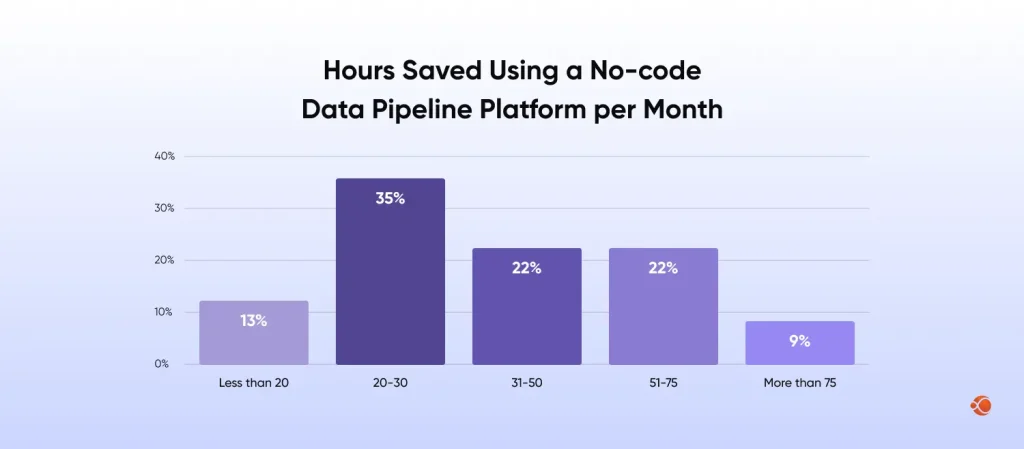
- Development costs drop by up to 70% in comparison to traditional development.
- Tools that require little or no code allow companies to avoid hiring two additional software developers, saving an estimated $4.4 million in business value over three years.
This is why many enterprises now evaluate the best low-code development platforms for enterprise solutions, not simply as tools, but as a financial plan. Some companies work with no code app development company to speed up MVP building and save early-stage financial risk.
Security, Compliance, and Governance in Low-Code Platforms
While adoption is at an all-time high, IT leaders continue vigilant about infrastructure durability.
- Over57% of employees use personal GenAI accounts for work purposes, and 33% admit to inputting sensitive information into unapproved tools.
- 41% of employees outside of IT, or business technologists, customize or build data or technology solutions on average.
Growing Confidence in Digital Agility
The consensus among IT leadership is clear: low-code is not optional anymore for retaining a competitive edge.
- 98% of enterprises now use low-code platforms, tools, or features within their development processes.
- 85% of IT leaders state that combining low-code with AI helps their organization innovate significantly faster.
Mission-Critical Forecasts
Gartner’s latest roadmap suggests low-code is moving from the “peripheral” to the “core” of global business operations.
- 80% of mission-critical applications are expected to be powered by low-code platforms globally by 2029.
- 75% of new enterprise applications will be developed using low-code or no-code tools by the end of 2026.
Security & Compliance Readiness
Modern platforms have matured into highly regulated environments, offering:
- Native Compliance: SOC 2, HIPAA, and GDPR frameworks are now standard in leading Enterprise Low-Code Application Platforms (LCAPs).
- Advanced Governance: Built-in role-based access control (RBAC), audit trails, and automated vulnerability scanning.
- Sector Leadership: The Healthcare and BFSI (Banking, Financial Services, and Insurance) sectors are currently the fastest-growing adopters, plus healthcare adoption is growing at a 32% CAGR through 2029 to meet remote service demands.
Low-Code vs Traditional Development: Speed, Cost, and Productivity
The contrast between low-code and traditional development becomes clearest when you look at delivery speed and output.
Speed and Development Time:
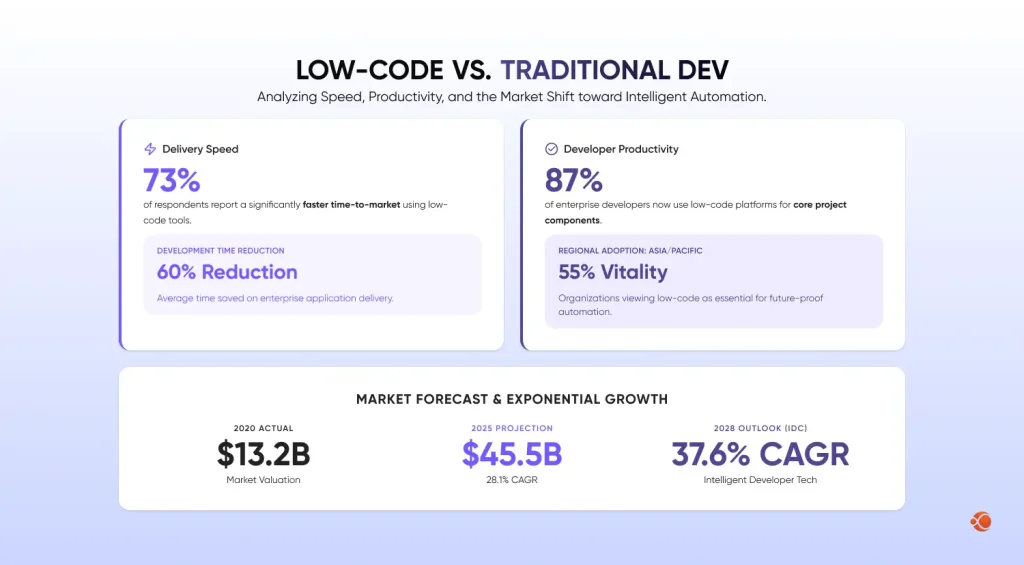
- 73% believe that low-code development speeds up the time-to-market. Nearly three-quarters of respondents say low-code tools help in launching applications faster.
- Low-code solutions can reduce enterprise application development time by 60%.
Developer Productivity:
- Research indicates low-code can be 5–10 times faster than traditional development methods. One study found that low-code took 11.93 hours compared to 38.38 hours for traditional coding.
- Over 55% of organizations in the Asia/Pacific region consider low-code/no-code as an essential development environment for creating future-proof enterprise automation solutions.
Market Growth and Adoption:
- The worldwide low-code development platform market was worth USD 13.2 billion in 2020. It is forecast to reach USD 45.5 billion by 2025, with a CAGR of 28.1%.
- IDC forecasts exceptional growth for the low-code, no-code, and intelligent developer technologies market for 2023–2028, with a CAGR of 37.6%.
Low code software development isn’t replacing traditional engineering; it’s complementing it. Most organizations now run hybrid stacks, using low-code for speed and traditional code where deep customization is required.

How Low-Code Is Powering Digital Transformation Initiatives
Digital transformation is the single biggest driver of low-code adoption in 2025.
Key Transformation Stats:
- 81% of companies now consider low-code development a primary strategic priority for their organization.
- 87% of enterprise developers use low-code platforms for at least some of their development work.
- 100% of enterprises report ROI from low-code adoption, according to Forrester’s commissioned study on large enterprises.
Integration and Business Adoption:
- Companies consider a 53% increase in process efficiency and a 51% increase in employees’ productivity to be the most important benefits of low-code adoption.
- Gartner has predicted that by 2026, developers that don’t work in formal information technology (IT) departments will account for at least 80% of the user base for low code development tools, up from 60% in 2021.
Examples:
- Retailers launching internal tools in weeks instead of quarters
- Hospitals automating intake and compliance reporting
- Manufacturers are digitizing quality control workflows free of custom builds
Explore 17 no-code apps helping businesses design, launch, and scale faster.
Explore MoreFuture of Low Code: Market Forecasts, AI Integration, and Trends
The future of low code is moving fast, and it’s being shaped heavily by AI.
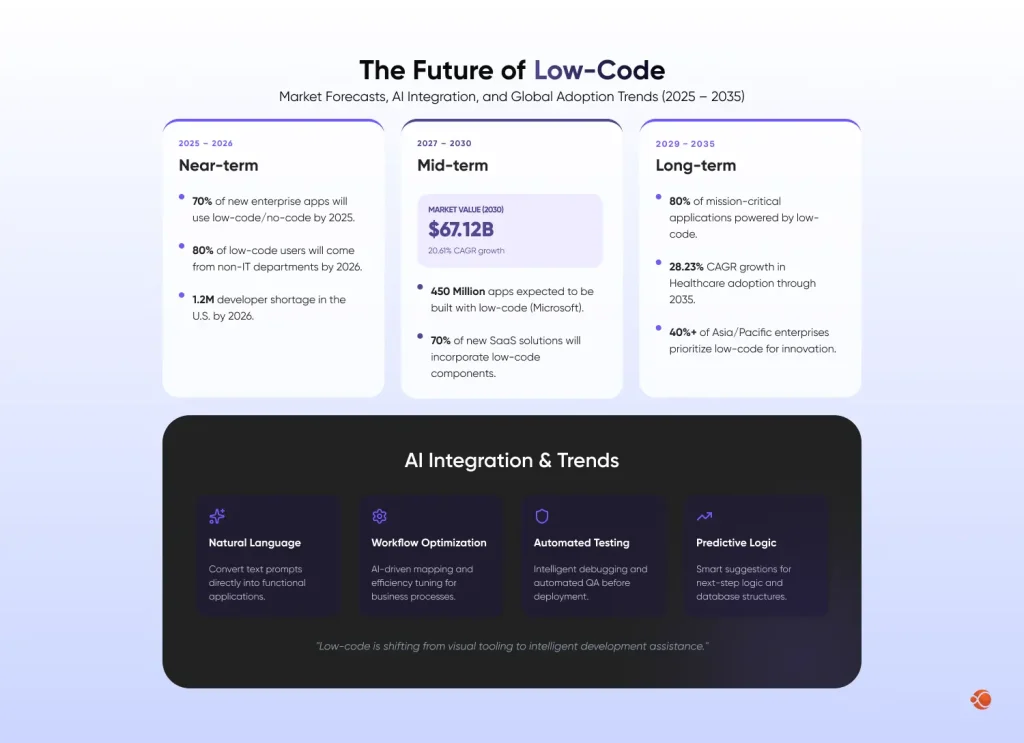
Near-term Forecasts (2025–2026)
- 70% of new enterprise apps will use low-code/no-code in 2025.
- 50% of new low-code buyers will be business users outside IT.
- By 2026, 80% of low-code users will come from non-IT departments.
- The U.S. faces a 1.2 million developer shortage by 2026.
Mid-term Forecasts (2027–2030)
- According to the latest analysis by Mordor Intelligence, the low code development platform market is valued at USD 26.30 billion in 2025 and is projected to reach USD 67.12 billion by 2030, growing at a CAGR of 20.61%.
- Microsoft expects 450 million of the next 500 million apps to be built using low-code or no-code.
- Over 70% of new SaaS solutions will incorporate low-code components.
Long-term outlook (2029+)
- 80% of mission-critical applications will be powered by low-code platforms.
- Healthcare adoption will grow at 28.23% CAGR through 2035.
- Over 40% of Asia/Pacific enterprises consider low-code application delivery methodologies among the most important technologies for promoting their innovation activity.
This is where low code development trends intersect directly with AI. Platforms now include:
- Natural language-to-app generation
- AI-powered workflow optimization
- Automated testing and debugging
- Predictive logic suggestions
Low-code is shifting from visual tooling to intelligent development assistance, and that changes what teams can make and how fast they can build it.
Conclusion
The low code statistics make one thing clear: this is no longer an experimental approach. It is a core development strategy across various industries, company sizes, and use cases. Low code isn’t replacing traditional development; it’s changing how software gets delivered. And for many organizations, the real question isn’t whether to adopt, but it’s how quickly and how deeply.
FAQs: Low-Code Market, Adoption, and Enterprise Use
How fast is the low-code market growing?
The market is valued between $26-$50 billion in 2025 and growing at a CAGR of 20-33%. Analysts projected it to reach $67-$376 billion by 2030-2034, depending on the scope. This makes low-code as one of the fastest-growing segments in enterprise software today.
Why are businesses adopting low-code platforms?
AI-powered app generation, citizen development growth, ERP/CRM integration, hyperautomation, and built-in compliance tooling are the biggest trends shaping low-code in 2025. These low code trends are pushing low-code beyond visual builders into intelligent development platforms.
Why is low-code adoption increasing across large enterprises?
Reason being 75% of large enterprises use multiple low-code tools, and 78% of Fortune 500 firms deploy them in mission-critical systems due to cost, speed, plus scalability benefits. Enterprises also value the security and governance controls modern platforms deliver.
What industries use low-code platforms the most?
BFSI leads adoption, followed by healthcare, IT/telecom, manufacturing, retail, and government. Healthcare is the fastest-growing vertical. These industries rely on low-code to modernize workflows while meeting strict compliance needs.
Is low-code suitable for enterprise applications?
Yes. 85% of enterprises integrate low-code apps with ERP and CRM systems, and Gartner forecasts 80% of mission-critical apps will run on low-code platforms by 2029. Modern enterprise low code apps now support complex logic, high scalability, and enterprise-grade security.
Is low-code the future of software development?
The data strongly suggests so. 70% of new enterprise apps already use low-code/no-code, and Microsoft expects 450 of the next 500 million apps to be built on these platforms. Low-code is becoming the default for business applications, not the exception.