



Quick Summary: The gen AI revolution is already here, reshaping entire industries faster than anyone predicted, and can even be seen through generative AI statistics. Businesses worldwide are racing to deploy this technology, moving from curiosity to competitive necessity as it transforms everything from customer services to healthcare.
The technology pace has always been quick, but the emergence of Generative AI has redefined what “rapid” means. Moving from experimental projects to crucial business tools, generative AI statistics show a clear picture of a technology that is reshaping industries globally.
This authoritative report gathers over 60+ data points and predictions to provide an in-depth look at the current state, future forecasts, and the profound impact of Generative AI across many sectors leading into 2026. This report is for leaders, investors, and technologists aiming to understand the direction and velocity of this monumental shift.
The Current State of Generative AI Adoption (2024-2025)
The current period shows experimentation transitioning into production-scale deployment. Companies have quickly recognized the productivity gains provided by large language models and other generative AI tools.
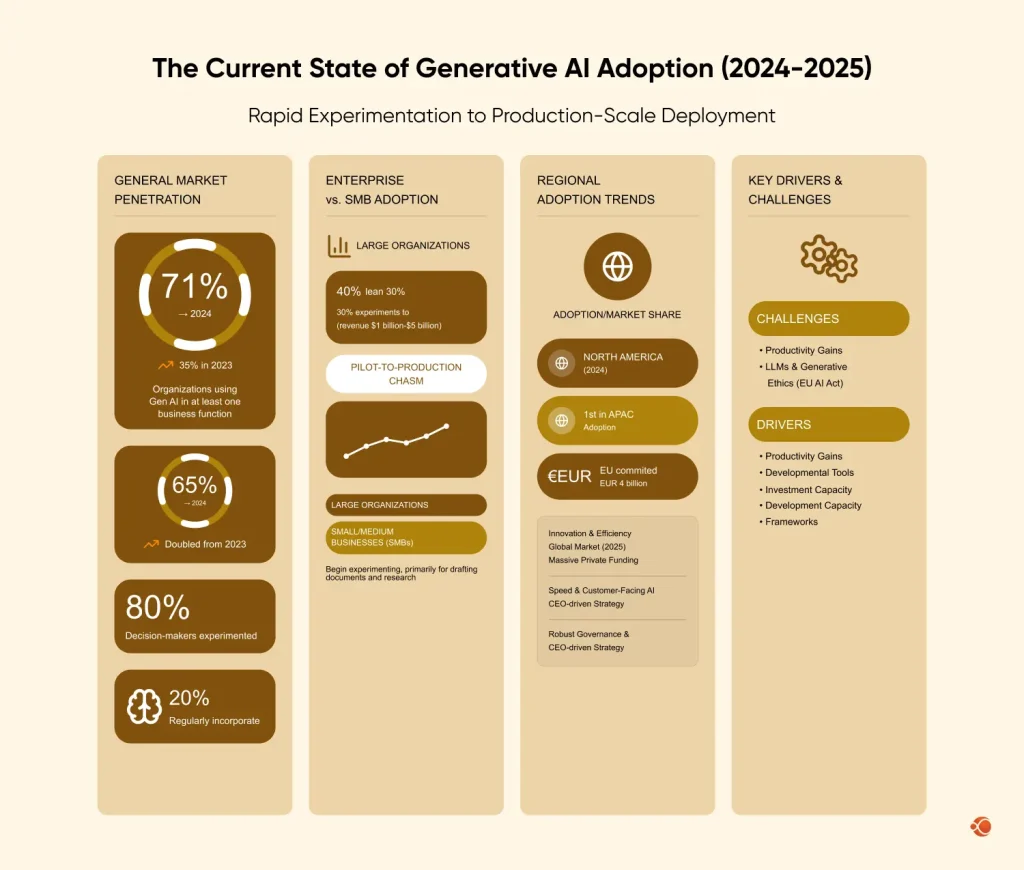
General Market Penetration Statistics
- In 2024, 71% of businesses reported using Gen AI in at least one business function, up from 33% in 2023. Generative AI development services fuel this via model training and vertical integration.
- 21% of respondents reported that their organization used Gen AI to redesign at least some workflows.
- Nearly 80% of decision-makers have already experimented with GenAI, with over 20% incorporating it regularly into their work.

Enterprise vs. SMB Adoption Rates
While large organizations are leading in the market, smaller businesses are not far behind; they are also utilizing readily available consumer and cloud tools.
- 40% of organizations report that less than 30% of their Gen AI experiments have moved into production, indicating a significant “pilot-to-production chasm” remains for most enterprises. This production gap has created massive demand for generative AI integration services that can bridge the divide between proof-of-concept and scalable deployment.
- Study shows that only 10% of businesses with annual revenue between $1 billion-$5 billion had fully implemented generative AI by 2024, suggesting that while experimentation is high, full production scaling is still a start for some of the large organizations.
- The widespread availability of user-friendly tools has allowed many small and medium businesses (SMBs) to begin experimenting, primarily for drafting documents and research.
Regional Adoption Trends (North America, APAC, Europe)
Regional differences reflect varied appetites for risk, regulatory environments, and investment capacity, creating different generative AI trends.
| Region | Adoption/Market Share | Key Trend/Focus |
| North America | Dominates the global market with a 49.78% share in 2023. Leads in Gen AI adoption rate at 40%. | Focuses on innovation investment and operational efficiency, benefiting from massive private funding and a mature tech ecosystem. |
| APAC (India) | India ranks first in Gen AI adoption across the Asia Pacific region. | Investing aggressively and moving fast, often driven by CEO ownership of AI strategy. Focus is on speed and extending AI into customer-facing functions. |
| Europe | The EU committed EUR 4 billion for generative AI development by 2027. | Faces tighter regulation (e.g., EU AI Act), leading to a focus on robust governance and ethical frameworks as a strategic asset. |
CMARIX connects you with pre-vetted Generative AI developers ready to accelerate innovation.
Contact UsGenerative AI Market Size and Growth Forecasts Through 2032
The next few years are expected to be the hypergrowth phase for the technology, with market size, user base, and investment all climbing at a pace the industry hasn’t seen before.
Overall Market Size Projections (Value/CAGR)
The overall market for Generative AI is expected to experience explosive growth, driven by enterprise uptake and new model developments.
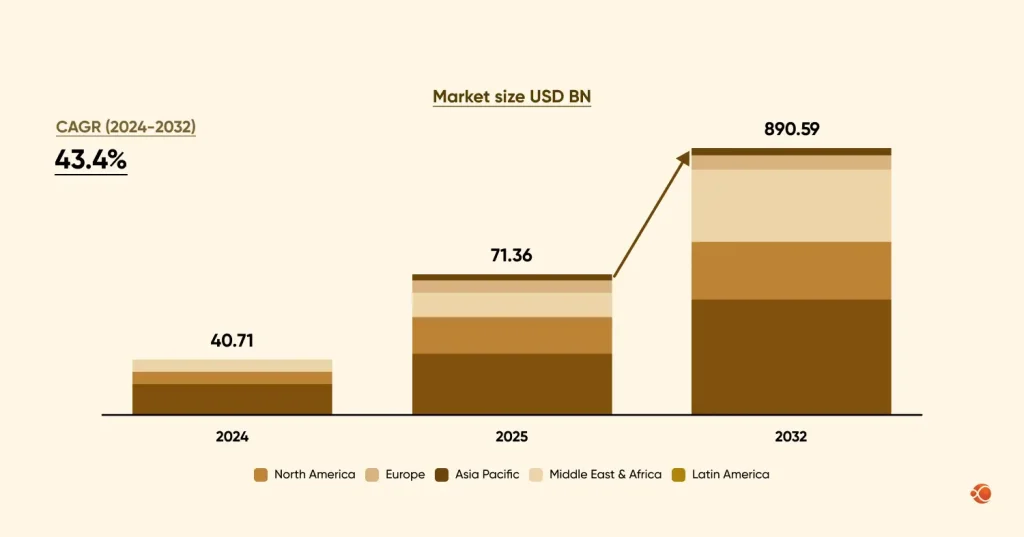
- The market is projected to grow from $71.36 billion in 2025 to $890.59 billion by 2032, reflecting a long-term CAGR of 43.4%.
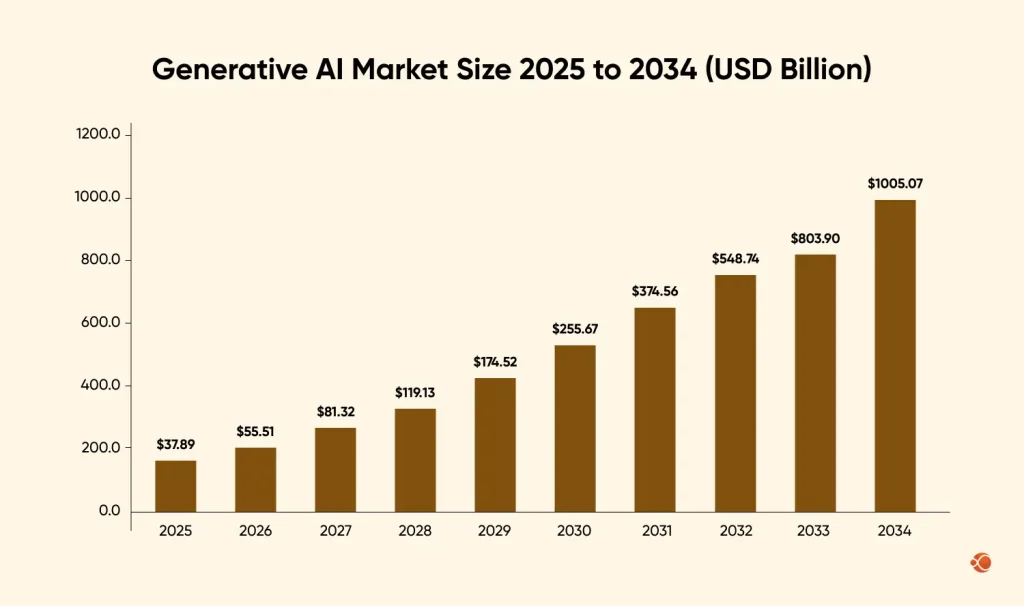
- The global generative AI market size is predicted to increase to USD 1005.07 billion by 2034, expanding at a 44.20% CAGR from 2025 to 2034.
Projected User Base and Consumer Adoption
The tools are quickly moving from early adopters to mainstream users across work and personal contexts.
- ChatGPT, the leading consumer tool, had reached 800 million weekly active users by late 2025.
- 70% of Gen Z have reported using generative AI tools, leading all generations in experimentation.
- Nearly 53% of adults have experimented with or regularly use generative AI.
Forecasted R&D Spending on Generative Models
Investment is pouring into the foundational technology required to push the boundaries of model performance.
- A McKinsey report from April estimated that a $5.2 trillion investment in data centers will be needed by 2030 to meet the worldwide demand for AI alone.
- Generative AI saw powerful momentum, attracting $33.9 billion globally in private investment, an 18.7% increase from 2023.
Predictions on AI Model Consolidation and Growth
While text-based models currently hold the largest share, multimodal approaches are poised for rapid growth, shifting the focus of generative AI stats.
- In 2024, the text generation segment accounted for the largest revenue share in the gen AI content creation market.
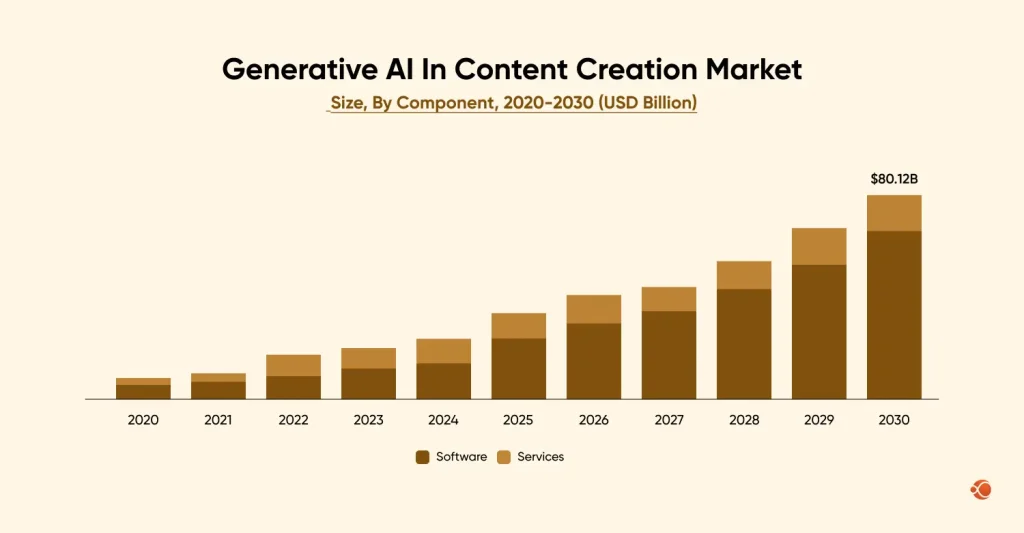
- The global generative AI in content creation market size was predicted at USD 14.8 billion in 2024, and is projected to reach USD 80.12 billion by 2030, at a CAGR of 32.5% from 2025 to 2030.
- The multimodal segment (combining text, image, audio, and video) is expected to be the fastest-growing modality in the long term, fueling use cases in autonomous systems and digital assistants.
Industry-Specific Generative AI Adoption Statistics and Use Cases
Generative AI’s impact on generative AI is highly specific to the vertical, with each sector finding unique ways to realize value. The data below shows the varying enterprise AI usage statistics by industry.
Healthcare: Drug Discovery, Diagnostics, and Administration
Generative AI in clinical healthcare is transforming patient care delivery with applications from automated clinical documentations to predictive diagnostics.
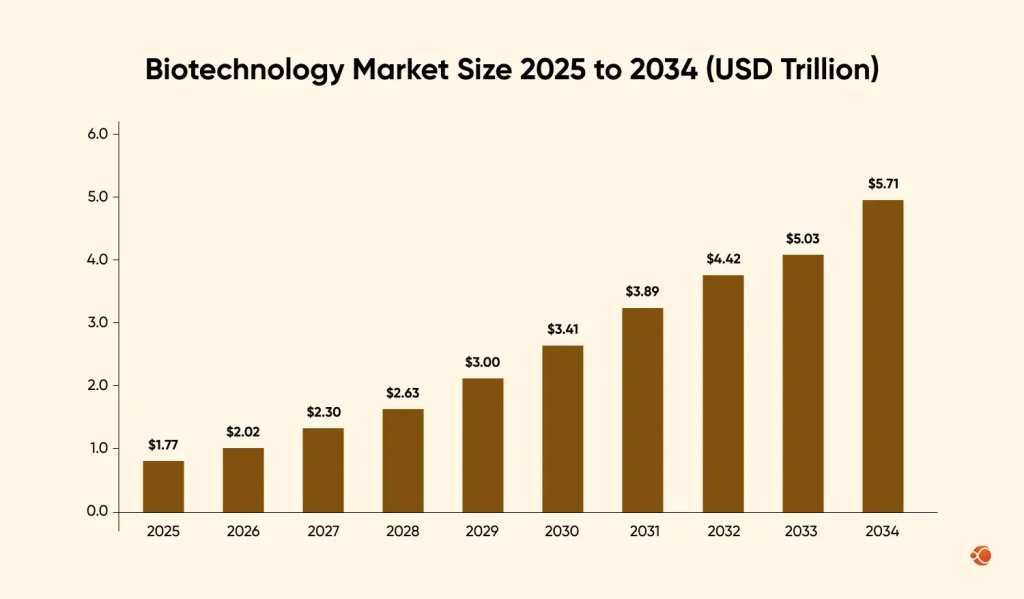
- The global biotechnology market size is accounted at USD 1.77 trillion in 2025 and predicted to increase from USD 2.02 trillion in 2026 to approximately USD 5.71 trillion by 2034.
- Approximately 80% of hospitals report using AI in at least one clinical or operational function as of 2024-2025, per American Hospital Association IT Supplement data.
- Over70% of the healthcare organizations have implemented or are pursuing gen AI capabilities.
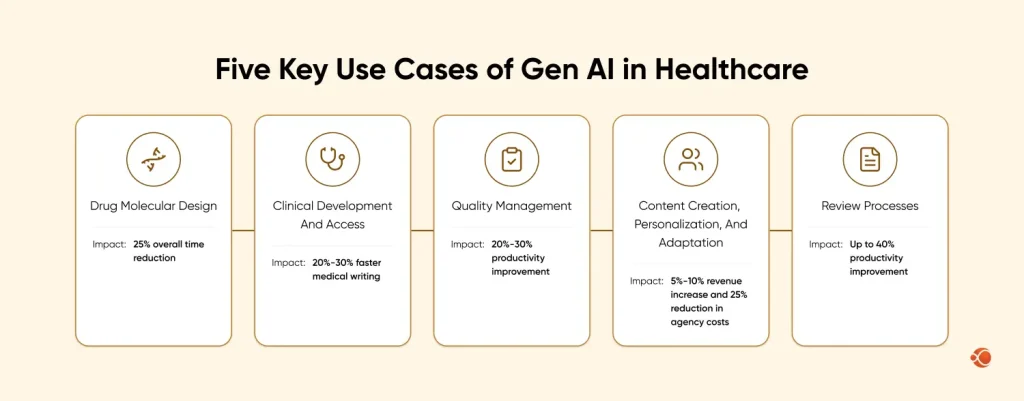
- A Boston consultancy group highlighted five key use cases of Gen AI in healthcare.
Finance: Fraud Detection, Risk Modeling, and Personalized Banking
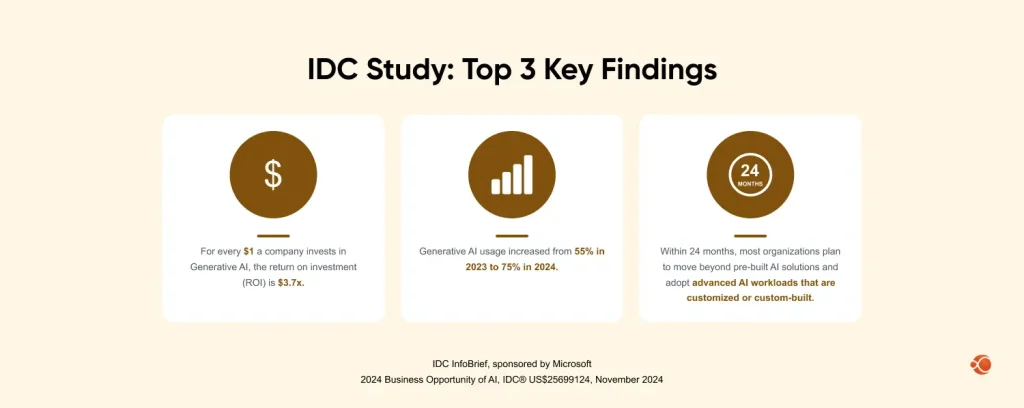
- Financial Services has the highest overall Generative AI ROI among all sectors. The average ROI is $3.7x for every $1 invested.
- Nearly 70% of financial services executives reported that AI increased revenue and that it will continue to do so in the coming years.
- 64% of banks cite fraud detection as a top process for deploying AI agents at scale.
- There is a potential productivity lift in the baking industry by Generative AI of 2.8 to 4.7% of the industry’s annual revenue, or an additional $200 billion to $340 billion.
Let's talk about custom AI solutions for your financial services firm
Contact UsTech & SaaS: Code Generation, Product Development, and IT Operations
- The Software and Technology end-user segment holds the largest market share in 2025, driven by AI-native product innovation.
- Mobile app development statistics reveal the majority of developers use generative AI for productivity, despite release delays costing firms $100K+ annually. Software holds the largest 2025 market share via AI-native innovation.
- There is a potential productivity lift in the banking industry by Generative AI of 2.8 to 4.7% of the industry’s annual revenue, or an additional $200 billion to $340 billion,with fraud detection and personalized service leading the way in real AI deployments in banking.
Manufacturing: Design Optimization, Quality Control, and Robotics
- 93% of businesses believe machine learning adoption in manufacturing will be crucial for innovation and growth.
- Gen AI is used to make 3D models (digital twins) of factory floors and supply chains.
Education: Personalized Learning and Administrative Automation
In the realm of AI in education, where personalization of learning paths and automation of administration tasks is now commonplace.
- Generative AI benefits from substantial human involvement for superior results, making it a promising domain for scholarly exploration.
- Research demonstrates that generative AI could also be used for tasks such as feedback and tailored support in schools.
Media & Entertainment: Content Creation, Gaming, and Personalization
- Media and Telecommunication have the second-highest Gen AI ROI at $3.90 for every $1 invested.
- The telecommunication industry is not only adopting Gen AI, but, as Google’s survey shows, more than two-thirds of industries have moved from AI experimentation to real-world applications.
Government and Public Sector: Policy Analysis and Citizen Services
- Government organizations already deploying gen AI and data analytics are experiencing widespread benefits across multiple areas, including improved citizen experiences through access and personalized services.
- Generative AI has tremendous potential to transform society; it boosts productivity and unlocks trillions in economic value in the coming years.
Retail: Customer Experience, E-commerce, and Supply Chain
Retail has become one of the clearest proving grounds for AI in customer services, from chatbot-driven support to real-time personalization at scale.
- Top-performing GenAI leaders across sectors see an average ROI of $10.3 for every $1 invested, according to the same Microsoft-sponsored IDC report.
- E-commerce companies use the technology to generate synthetic data for product visual assets and to personalize marketing copy at scale.
- According to Salesforce,17% of shoppers reported using generative AI for purchase inspiration.
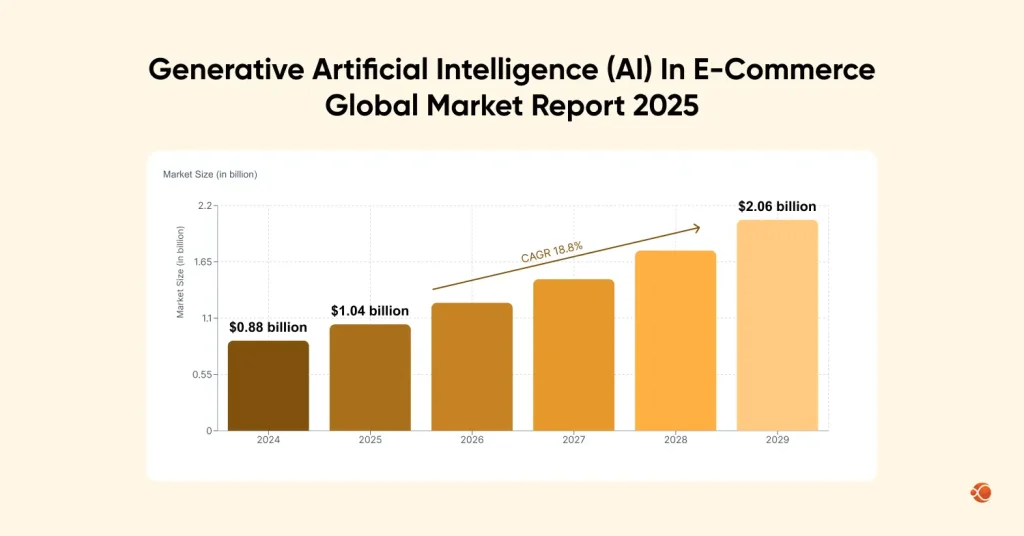
- The generative AI in ecommerce market size will grow to $1.04 billion in 2025 from $0.88 billion in 2024, at a 18.8% compound annual growth rate (CAGR).
Top Use Cases of Generative AI: Marketing, Support, Development, and R&D
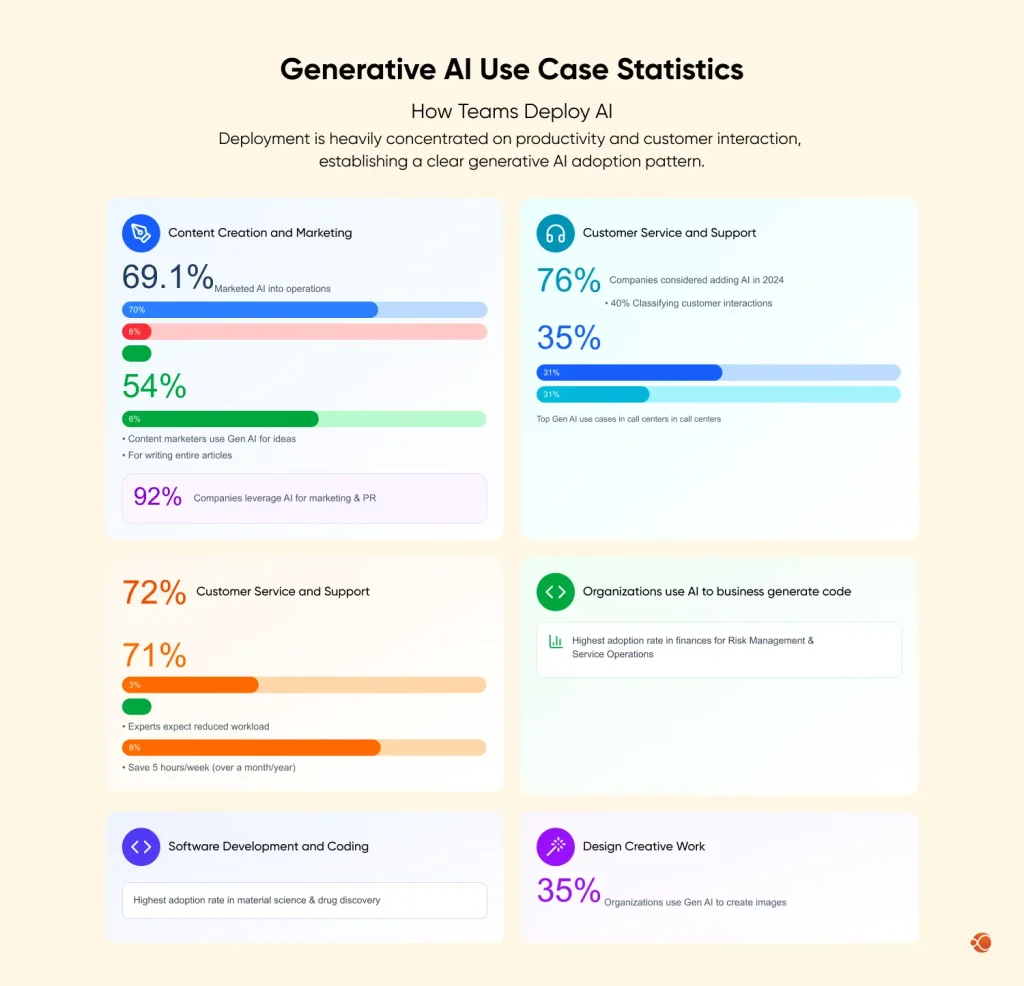
Deployment is heavily concentrated on productivity and customer interaction, establishing a clear generative AI adoption pattern.
Content Creation and Marketing (Copy, Imagery, Personalization)
- 69.1% of marketers have already integrated AI into their marketing operations.
- 54% of content marketers report using AI to generate ideas, but only 6% use it to write entire articles.
- 92% of companies leverage generative AI for marketing and PR use cases.
- 71% of experts expect this innovation to reduce workload, allowing more focus on strategic tasks, and they predict it will save them five hours of work per week, equating to over a month per year.
Customer Service and Support (Chatbots, Virtual Agents, Agent Assist)
- 76% of companies considered adding generative AI to their support in 2024.
- Content creation (40%) and classifying customer interactions (31%) are the top Gen AI use cases in call centers.
Software Development and Coding (Code Generation, Debugging, Testing)
- 35% of organizations using Gen AI utilize it to generate code, accelerating the pace of product development.
Talk to our experts about deploying production-ready solutions
Contact UsData Analysis and Business Intelligence (Insight Generation, Summarization)
- Generative AI in data science applications for Risk Management and Service Operations has the highest adoption rate among business functions in financial services.
Research and Development (Hypothesis Generation, Simulation)
- Gen AI is applied to accelerate R&D in areas like material science and drug discovery.
- AI-discovered molecules achieve an 80-90% success rate in Phase I clinical trials, significantly outperforming the traditional industry average of 40-65%.
Design and Creative Work (Prototyping, Visual Assets, 3D Modeling)
- 35% of organizations using Generative AI create images.
- The AI-Generated 3D Asset Market was valued at $1.63 billion in 2024 and is forecasted to reach $9.24 billion by 2032.
Partner with CMARIX to hire vetted Generative AI engineers who deliver real business impact.
Contact UsKey Drivers to the Adoption of Generative AI
Understanding the forces driving and restraining the generative AI growth forecast is critical for strategic planning.
Top Business Drivers for Generative AI Investment
- Productivity and Cost Reduction: 92% of AI users surveyed are using AI for productivity use cases.
- Customer Experience: 60% of financial services firms cite customer experience and engagement as their top Gen AI use case.
Statistics on Skill Gaps and Talent Shortages
- 42% of companies cite inadequate generative AI expertise as a major adoption challenge.
- Through 2027, generative AI will require 80% of the engineering workforce to upskill.
Concerns and Statistics on Ethical AI and Data Governance
- Concerns about data accuracy or bias (45%) and privacy or confidentiality of data (40%) are the top adoption challenges.
- 85% of people took at least one action on data security concerns in the past year, up from 79% in 2023.
ROI Statistics and Cost-Saving Metrics
- The average ROI for $1 invested in Gen AI is $3.70.
- 34% of companies that are using generative AI have reported a productivity increase.
- Companies adopting gen AI could achieve 15.2% cost savings.
The Future Landscape: Beyond 2026
The long-term outlook for this technology provides a fundamental shift in how all human and machine work is conducted.
Long-Term Projections (2027-2030)
- The global AI market is forecasted to grow $1.81 trillion by 2030.
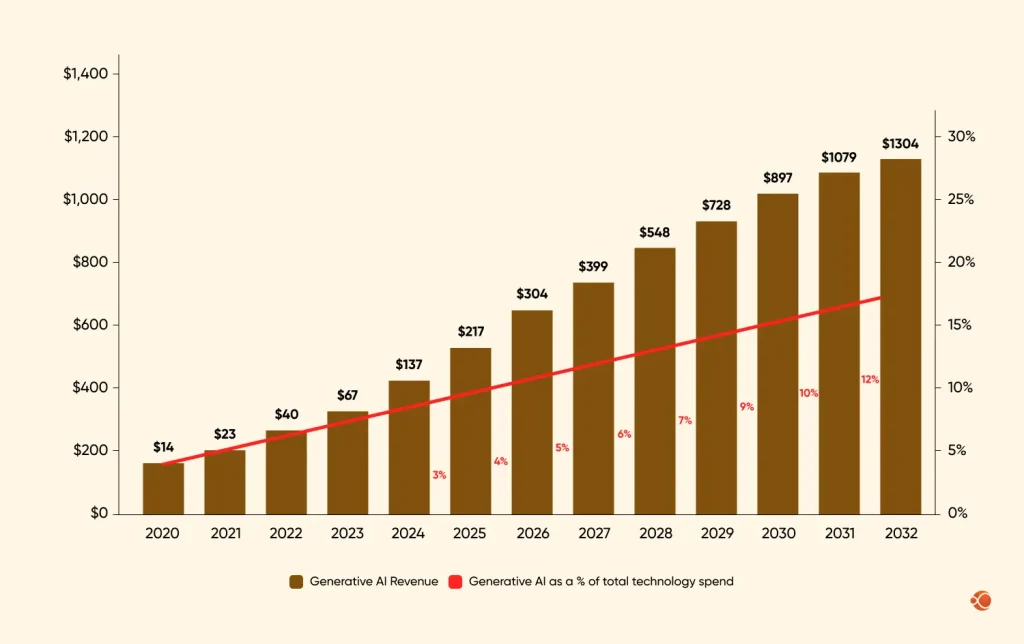
- Forecasts predict the global Generative AI market could reach $1.3 trillion by 2032, demonstrating its long-term potential as a critical segment of the global economy.
Emergence of New Generative AI Use Cases
- Agentic AI: Deloitte forecasts that 25% of GenAI-using companies will deploy intelligent agents in 2025, with that number expected to double to 50% by 2027.
- AI PCs: Gartner forecasts that 100% of enterprise PC purchases will be AI PCs by the end of 2026.
Agentic AI Adoption Statistics (2026)
It is true that agentic AI technology has evolved from conception into a corporate priority faster than any other previous wave of AI technology.
- According to Gartner, 40% of enterprise applications software will incorporate AI-based agents tailored for particular tasks by the year 2026, compared with less than 5% in 2025.
- 88% of organizations now report using AI in at least one business function, up from 78% a year earlier, according to McKinsey’s 2025 State of AI survey.
- 62% of organizations say they are at least experimenting with AI agents, but only 23% report scaling an agentic AI system anywhere in the enterprise, per the same McKinsey survey.
- In any given business function, no more than 10% of organizations are actually scaling agents, according to McKinsey’s follow-up research on agentic AI infrastructure, underscoring how much adoption is still confined to pilots.
Concluding Lines
The generative AI statistics confirms that this technology is in a hypergrowth phase, that is moving from novelty to necessity for organizations globally. The adoption of generative AI is driven by the tangible economic return and the demand for increased productivity and superior customer experiences.
While North America currently leads in market share and investment, the Asia-Pacific region is demonstrating the highest velocity of enterprise adoption, with Europe prioritizing regulatory compliance as a strategic differentiator. The next few years will see greater deployment of multimodal and Agentic AI, requiring businesses to address the critical barriers of skill gaps and ethical generative AI trends to realize the full potential of this transformative technology.
FAQs: Latest Generative AI Statistics and Market Insights
How fast is Generative AI adoption growing worldwide?
The generative AI adoption rate is growing at an unprecedented speed. Usage among businesses more than doubled from 33% in 2023 to 71% in 2024, and the global market grows at a CAGR of over 40% through 2032.
Which industries are adopting generative AI the fastest?
Financial Services has also demonstrated a very fast rate of scaling, reporting the highest ROI among all sectors at $3.70 for every $1 invested, per Microsoft-sponsored IDC research.
How are small and medium businesses adopting generative AI?
While large enterprises are investing in custom models, many SMBs are primarily using easily accessible consumer tools like LLMs for drafting documents, email campaigns, and data summarization. However, only 10% of mid-sized companies have reached full implementation, suggesting initial use is still heavily exploratory.
What benefits do companies achieve from generative AI by 2026?
Companies that adopt Gen AI can expect an average ROI of $3.70 for every dollar invested, along with an average cost saving of 15.2%. The primary benefits reported are increased worker productivity and improved customer service speed and quality.
What types of generative AI models are most widely used?
Text-based models (Large Language Models or LLMs) currently hold the largest market share in 2025. However, multimodal models (combining text, image, and video) and diffusion networks (for image generation) are projected to be the fastest-growing segments in the near future.
Why are some Generative AI pilots failing in enterprises?
The problem is generally related to the mismatch between experimentation and deployment. The 2025 State of AI Survey by McKinsey revealed that even though 62% of firms are testing out AI agents, only 23% of them have been able to scale an AI agent anywhere across their operations. Typical reasons are lack of clear business value proposition, poor data infrastructure, and lack of governance for actual action-taking AI systems.
What is the projected market size and CAGR of Generative AI by 2030?
The global generative AI market is projected to grow at a compound annual growth rate (CAGR) of over 40% through 2032, reflecting one of the fastest expansion rates of any enterprise technology category.
How is Generative AI affecting software engineering productivity?
Generative AI is measurably speeding up software development cycles, with engineering teams using AI coding assistants for tasks like code generation, debugging, and documentation. This is a core reason enterprises are turning to firms like CMARIX for AI-integrated development, since the productivity gains show up fastest in teams that pair the technology with experienced engineering oversight rather than deploying it on its own.
How are companies managing the risks of Generative AI adoption?
Governance is receiving more attention within organizations in the form of agentic systems that are carrying out actions instead of just creating content. The average responsible-AI maturity score increased to 2.3 in 2026 in comparison to 2.0 in 2025, according to the 2026 AI Trust survey by McKinsey. However, less than one-third of organizations have reached maturity scores of three or above in terms of strategy and governance.
How is Generative AI impacting the global job market?
As per the World Economic Forum’s Future of Jobs Report 2025, by 2030, there will be the creation of 170 million jobs and the destruction of 92 million jobs because of technological changes such as generative AI, leading to the net creation of 78 million jobs worldwide.