





Mobile Overview: The 2026 mobile application development statistics tell us an interesting story: the app economy is far from declining. The global mobile applications market, estimated at $252.89 billion in 2023, will grow to reach $626.39 billion by 2030. The total number of global mobile app installations has leveled off at billion per year, but consumer spending skyrocketed to $167 billion, implying users are s150pending more time within trusted apps.
On mobile platforms, 94% of time spent is on native apps, while 6% is on mobile browsing. AI penetration in app development is at 63%, with AI app downloads estimated at 7.5 billion in 2026. These figures represent the new baseline for any decisions made by anyone working in the mobile products industry in 2026.
The mobile application landscape is accelerating at unprecedented rates. As we move into 2027, analyzing the momentum built in 2026 and the projections shaping the future will be essential for anyone who plans to compete in the digital ecosystem. Mobile applications are not only increasing in number, but also transforming how people shop, bank, learn, receive healthcare, and entertain themselves. This is not a prediction but a reality playing out in every large economy.
For businesses, developers, founders, and marketers striving for growth in 2027, success depends on recognizing the statistical truths that reveal the scale, direction, and opportunities in the mobile industry. Here are 80+ powerful statistics gathered by CMARIX mobile app developers, covering market growth, user behavior, monetization, and emerging technology trends.
Let's build a high-performance app that drives measurable growth.
Contact UsPart I: The Massive Mobile App Market and Growth Projections for 2026
The mobile application economy continues to soar, driven by global smartphone growth and evolving digital consumption habits. These mobile app stats highlight the scale of the coming growth wave.
Market Size and Trajectory
The mobile application ecosystem continues to expand at a record pace, shaped by AI adoption, platform maturity, and the rising expectations of digital-native users. As a leading mobile app development company, CMARIX continues to see increased demand for enterprise-grade mobile applications powered by AI, automation, cloud technologies, and cross-platform frameworks.
- The global mobile application market was valued at USD 252.89 billion in 2023.
- The industry is projected to reach USD 626.39 billion by 2030.
- Global app revenue is expected to grow from 522.7 billion in 2024 to 673.7 billion by 2027.
- In 2024, mobile apps are expected to generate a total revenue of USD 935 billion.
- The AI in mobile app development market is estimated to reach USD 221.9 billion by 2034.
- Total global consumer spending on mobile apps and games reached approximately USD 223.1 billion in 2026.
Global and Regional Dominance Mobile App Growth

- The US mobile app market is projected to grow at a CAGR of 14.1 percent through 2030.
- The UK accounted for over 26 percent of the European mobile app market revenue in 2023.
- The Middle East and Africa market is expected to reach USD 26.04 billion by 2030.
- Asia Pacific led the mobile app market in 2023 with more than 32 percent revenue share.
- China’s market will grow even faster with a projected CAGR of 15.8 percent.
As you can see, you can find different mobile app users in different demographics, with more demand for a particular product in one, and others in another.

Mobile Apps vs Web Apps: Market Share Statistics 2026
One of the most searched questions in mobile app development statistics right now is how mobile apps compare to web apps in terms of market share, time spent, and revenue. The 2026 data leaves little room for debate.
- Mobile users spend roughly 94% of their smartphone time inside native apps. Less than 6% goes to mobile web browsers.
- Mobile devices account for 62 to 64% of worldwide web traffic as of early 2026.
- 75% of ecommerce site traffic comes from mobile devices.
- Native mobile apps convert at roughly 3x the rate of mobile websites.
- App users view 286% more products per session than mobile web users.
- Apps average 157% higher conversion rates than mobile websites overall.
- The SaaS web app market hit $408 billion in 2025, projected to reach $465 billion in 2026. Web apps still dominate enterprise B2B monetization.
- Commissions from the App Store (15-30%) have lower margins than web applications (around 2.9% + $0.30 per transaction). It makes web applications marginally more efficient for B2B SaaS solutions.
- By December 2025, mobile-only usage climbed to roughly 50% market share in the US, while web-only usage declined to approximately 27%.
Mobile apps dominate consumer interaction and conversion. Web apps dominate enterprise SaaS revenue and discovery. Most successful products in 2026 use a composite approach.
Mobile App Development Market Size by Region in 2026
Regional market data matters because growth rates, platform preferences, and consumer spending habits vary considerably across geographies.
| Region | Market Size / Projection | Growth Rate |
| Global | USD 305.18 Billion (Up from baseline projections, tracking to hit USD 618.65B by 2031) | 18.0% CAGR through 2031 |
| United States / North America | USD 58.48 Billion in 2026 (U.S. alone stands at USD 42.03B) | 14.1% CAGR through 2030 |
| Asia Pacific (APAC) | Largest revenue share (over 52.9%) in the global footprint. | Fastest regional growth (17.9% CAGR) |
| China | Remains the single largest APAC volume market, leading in super-app infrastructure. | Projected steady 15.8% CAGR |
| India | Massive digital surge, 4.9 to 5.3 hours daily app usage | Projected to reach USD 48.27 billion by 2033; growing at an 18.5% CAGR. |
| Middle East and Africa | Projected to scale aggressively, reaching USD 26.04 billion by 2030. | Driven heavily by the GCC sovereign digital transitions; high demand for B2B mobile frameworks. |
| GCC (Gulf) | Payment-as-a-Service (PaaS) models. | UAE leading growth at 17.15% CAGR; Saudi Arabia following at 15.8% CAGR. |
| Europe | Steady enterprise growth; the UK holds a dominant 26% share of the regional revenue. | Heavily influenced by strict GDPR and data sovereignty; strong corporate low-code framework adoption. |
Key Drivers Fueling the Surge in Mobile App Development
| Key Driver | Description |
| Rising Smartphone Adoption and Consumer Reliance on Apps |
|
| AI, Automation, and Advanced Technologies |
|
| Faster Development and 5G Connectivity |
|
| Monetization Potential and Competitive Pressure |
|
Part II: AI Mobile App Development Statistics
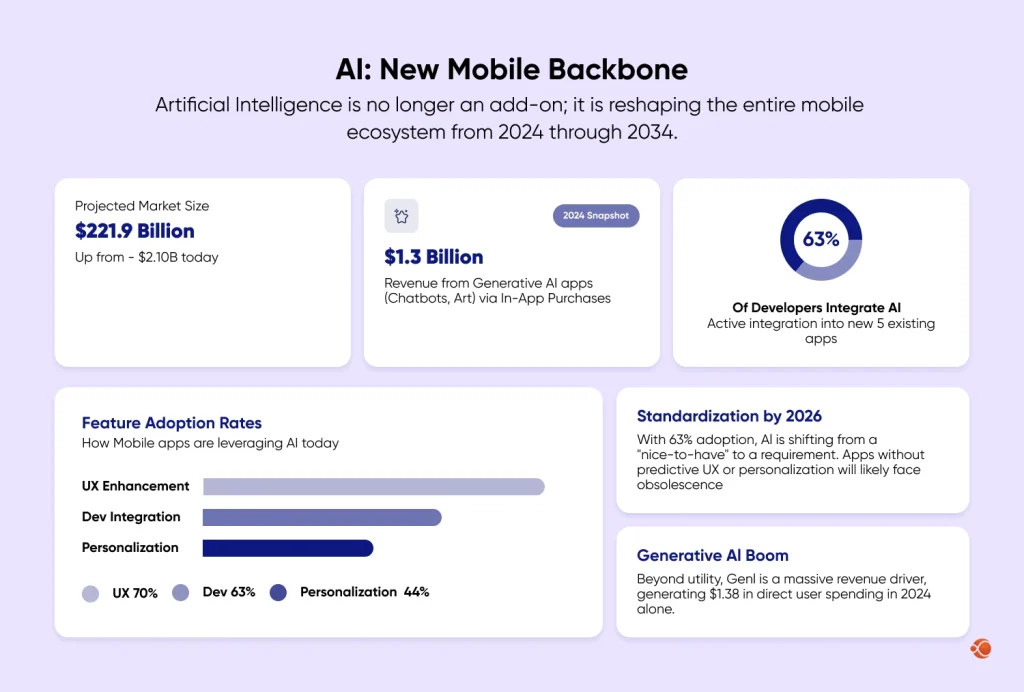
Before exploring downloads and app performance, it is important to understand the new force shaping the entire mobile ecosystem: AI. AI is no longer an add-on; it is the backbone of modern apps across personalization, recommendations, automation, search, and predictive UX.
Here are some of the defining stats that show the impact of AI on mobile app development in 2026:
- The global AI mobile app development market size is estimated to reach USD 221.9 billion by 2034.
- 63% of mobile app developers integrate AI features into their apps.
- 44% of mobile apps use AI personalization to deliver tailored content.
- 70% of mobile apps use AI features to improve user experience.
- The AI industry in the app space is valued at around $210 billion.
- Generative AI app downloads are projected to reach approximately 7.5 billion in 2026, representing roughly 108% year-over-year growth.
- ChatGPT held 45% market share in the US during Q3 2024, while Gemini had over 50% market share in India.
- By December 2025, mobile-only usage for generative AI climbed to 50% market share in the US, up from 25% in 2024.
- All of the top 10 generative AI apps by global downloads in 2025 were AI assistants.
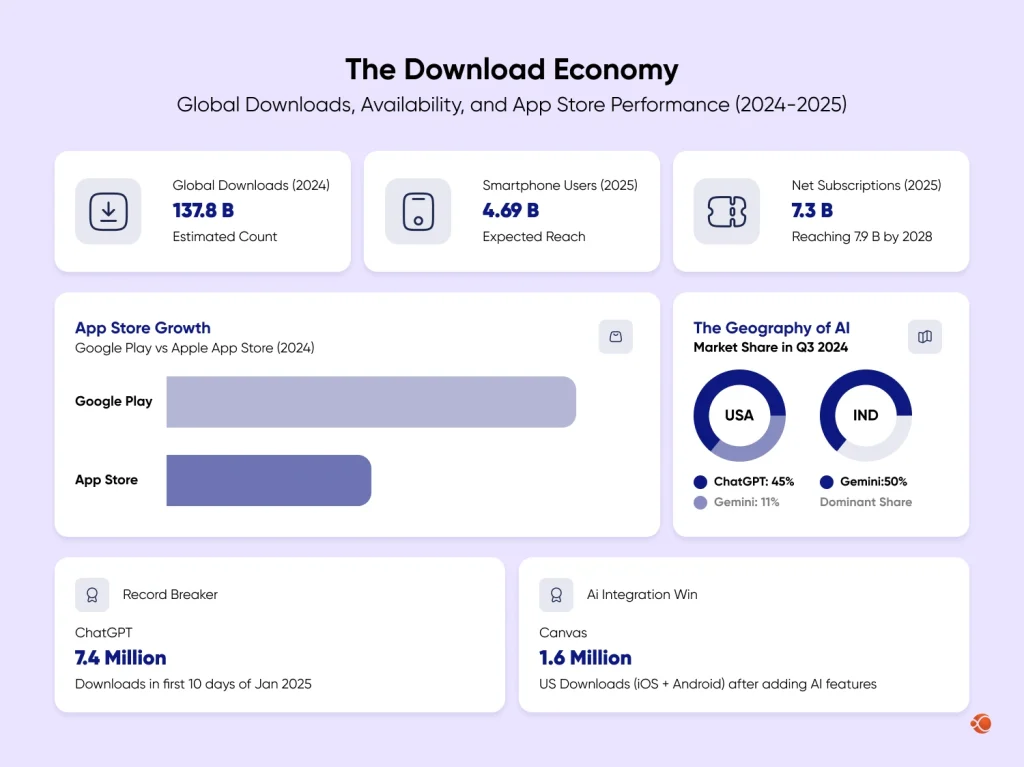
Global Downloads and User Base
- Global app downloads were estimated at 181 billion to 292 billion apps in 2024.
- Google Play Store saw a 31% increase in mobile app downloads, whereas Apple App Store recorded only a 2.5% growth rate.
- By 2025, the global smartphone user base is expected to reach 4.69 billion.
- Smartphone network subscriptions reached nearly 7.3 billion in 2025, and are expected to reach 7.9 billion by 2028.
- ChatGPT saw almost 7.4 million downloads during its first 10 days of initial release, as of January 2025, making it the leading gen AI app to gain so many downloads.
- During Q3 of 2024, ChatGPT had a market share of 45% in the US, compared to 11% for Gemini, whereas in India, Gemini had over 50% of the market share.
- Canva saw around 1.6 million downloads among US users across Android and iOS as it added AI features.
- Total global app downloads are projected to exceed 320 billion per year by 2026.
- Average daily app downloads in 2026 are expected to reach about 860 million. On Black Friday, downloads spike to around 1.6 billion.
“These mobile app insights reflect the shift toward intelligent app ecosystems,” notes CMARIX experts, who frequently optimize the mobile app development process for AI-centric products.
Get the best native and native mobile app development services.
Hire App Developers in IndiaPlatform Competition and App Store Availability
- Google Play Store downloads will hit an estimated 143 billion by 2026.
- The Apple App Store is expected to reach 38 billion downloads by 2026.
- The App Store currently earned around 1.3 trillion in billing and sales during 2024.
- The global mobile operating system market share currently has Android with 72.55% of market share, iOS with 27.04%, Samsung with 0.222%, and so on.
- Android holds approximately 75% of the global smartphone market.
- Gaming apps account for the highest app downloads in 2026 at about 30%. Social media apps contribute nearly 25%, ecommerce apps 20%, productivity apps 15%, and health and fitness apps 10%.
These Android and iOS app statistics underscore the competition between platforms and the scale developers must consider when planning releases.
Mobile App Size and Performance Statistics 2026
Another niche in mobile application development is enterprise mobile applications, which is rarely mentioned when talking about mobile application development statistics.
The market for enterprise mobile application development keeps growing at a fast pace, with a valuation of $189.22 billion in 2026 and a forecast of $338.42 billion by 2031. Growth in this segment comes largely from digital transformation in healthcare, logistics, finance, and manufacturing.
- The adoption of low-code and no-code platforms is driving the market size towards $52 billion to $65 billion in 2026, enabling citizen developers to outnumber professionals four times to create customized workflow solutions.
- Workflow automation through low-code solutions speeds up internal application development and significantly decreases process cycle time by an average of 65% to 70%.
- Artificial intelligence has increased its use in finance-related operations to 59% of companies worldwide by 2026, up from 37% in 2023, as banks implement agentic artificial intelligence and machine learning for fraud detection and underwriting risks.
- Mobile applications command 67.83% of modern financial tech user interfaces, as mobile payment applications alone process a massive portion of the projected $9.2 trillion global digital transaction volume.
- FinTech application engagement remains intensely sticky, with 51% of global smartphone users interacting with their primary financial and utility applications 11+ times every single day.
Enterprise spending on mobile app builder software and development platforms continues to grow across the US, Europe, GCC, and Asia Pacific regions, with North America holding a dominating 33.9% share of the infrastructure market.
Part III: User Engagement and Mobile Application Usage Statistics
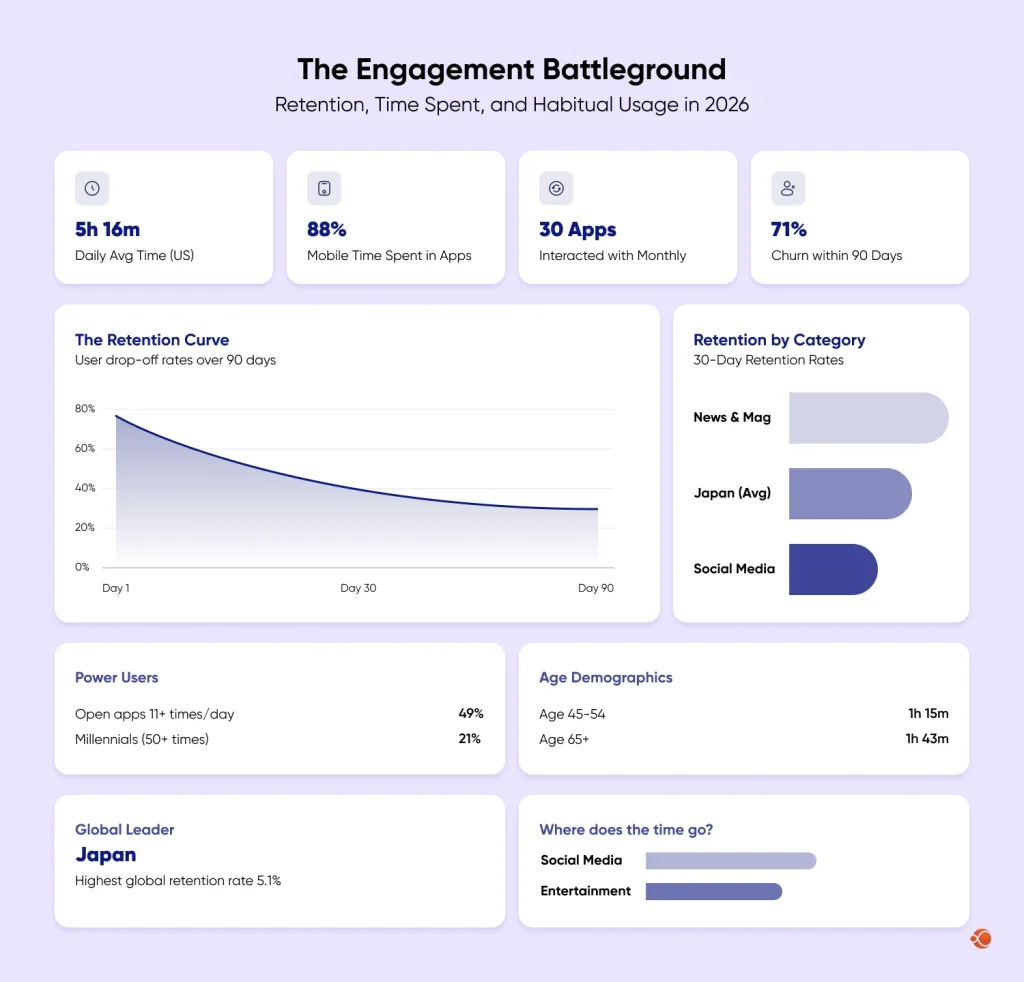
In 2026, engagement is the real battleground. The numbers below reveal how deeply mobile apps dominate modern digital habits. Here are some key mobile application usage statistics:
Time Spent and Usage Behavior
- Users spend roughly 94% of smartphone time in apps, with less than 6% in browsers
- An average American spends around 5 hours and 16 minutes on their phone.
- 70 percent of all digital media time in the US comes from mobile apps.
- Up to 90 percent of overall online time is spent within mobile apps.
- Users interact with around 30 different apps each month.
- Globally, users spend an average of 3.6 hours per day in mobile apps.
- Total hours spent in apps worldwide reached 5.3 trillion in 2025 and are expected to cross 5.5 trillion by the end of 2026.
- Indian users spend 4.9 to 5.3 hours daily on mobile apps, one of the highest rates globally.
- In 2024, more than 35% of mobile time went to social media apps, followed by entertainment apps at 32.7%.
Habitual Usage and Demographics
- 49% of users open an app more than 11 times per day.
- 21% of Millennials open an app 50 or more times daily.
- 51% of users check their apps one to ten times per day.
- Users aged 45 to 54 spend 1 hour and 15 minutes per day on mobile apps.
- Users over 65 spend nearly 52 hours per month on apps, about 1 hour and 43 minutes per day.
- In 2024, more than 35% of users’ time on mobile devices was spent on social media apps, followed by entertainment apps at 32.7%.
App Retention Rates and Churn
- 71 percent of users churn within 90 days of installing an app.
- 25% abandon an app on the very first day.
- 59.71% of social media apps were uninstalled within the first 30 days.
- Social media apps have the lowest 30-day retention rate at 1.37%.
- News and magazine apps have the highest retention at 9.1%.
- Japan leads globally with the highest retention rate at 5.1%.
- Apps with AI-powered personalization and onboarding achieve measurably higher retention.
- Educational apps with AI personalization see up to 50% higher retention than those without it.
For companies evaluating mobile app development costs, retention metrics help prioritize long-term optimization strategies over one-time build efforts.
Part IV: The Money Trail and App Monetization Trends
Monetization continues to evolve, but free apps still dominate global revenue. Here is what 2026 will look like.
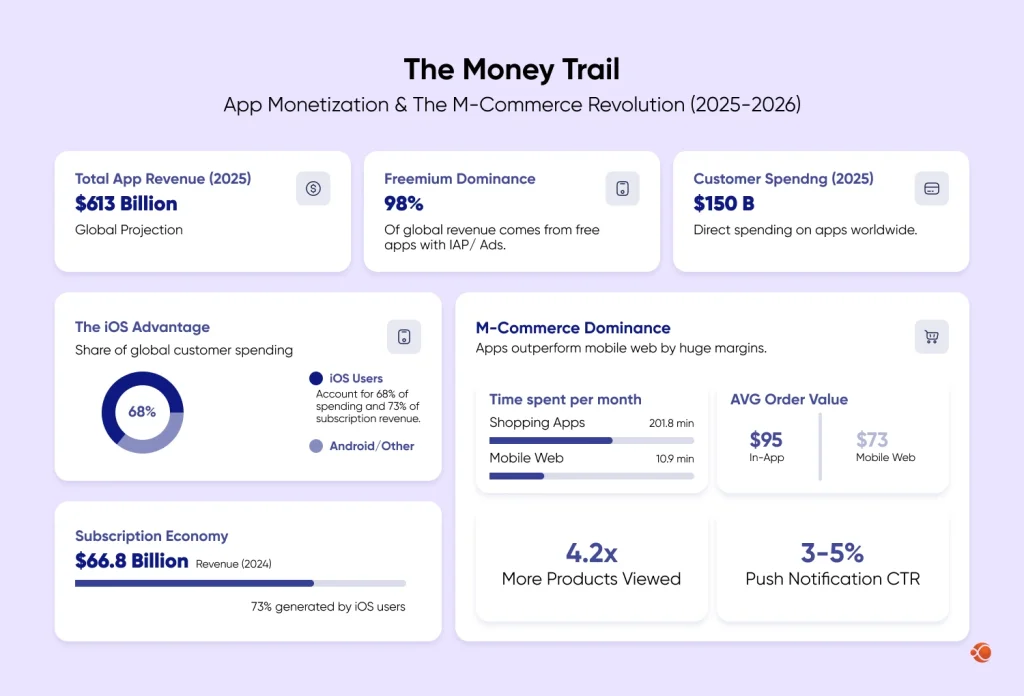
Revenue Streams and Consumer Spending
- Mobile app revenue is expected to reach USD 613 billion in 2025.
- Consumer spending on apps reached USD 167 billion in 2025, surging to approximately USD 223.1 billion in 2026, including games.
- 98 percent of global mobile app revenue comes from freemium apps.
- iOS accounts for 68% of global app consumer spending.
- iOS has contributed 75% of total app spending to date.
- In Q3 2021, the App Store generated USD 21.5 billion in revenue versus Google Play’s USD 12.1 billion.
- Subscription revenue reached USD 66.8 billion in 2024.
- About 73% of subscription revenue comes from iOS users.
- In Q2 of 2025, total combined Apple App Store and Google Play Store spending amounted to USD 40.9 billion.
- Most app revenue worldwide in 2025 comes from mobile advertising, accounting for roughly 75% of the total, with Google and Meta controlling nearly 90% of mobile ad spending.
These statistics guide brands in choosing the right mobile app monetization strategies, including subscriptions, ads, and hybrid models.
The M Commerce Revolution
- The global market share for mobile commerce is estimated to reach USD 14 billion by 2023.
- More than 60% of shoppers prefer mobile apps over mobile websites.
- 76.5% of US smartphone users regularly use shopping apps.
- 78% of global consumers shop through mobile apps.
- App users spend 201.8 minutes per month on shopping apps VS 10.9 minutes on mobile websites.
- App users browse 4.2 times more products per session compared to web users.
- Customer lifetime value is 2.8 to 5 times higher for app users.
- App’s average order value is 10 to 50% higher than mobile web.
- App users spend USD 95 per order VS USD 73 on mobile websites.
- Abandoned cart push notifications have CTRs of 3-5%.
- Push notification conversion rates typically range from 1.5 to 4%.
For brands working with a mobile app development company, these insights help align product roadmaps with the latest mobile app industry trends.
Enterprise Mobile App Statistics 2026
The market for enterprise mobile application development keeps growing at a fast pace, with a valuation of $189.22 billion in 2026 and a forecast of $338.42 billion by 2031. Growth in this segment comes largely from digital transformation in healthcare, logistics, finance, and manufacturing.
- The adoption of low-code and no-code platforms is driving the market size towards $52 billion to $65 billion in 2026, enabling citizen developers to outnumber professionals four times to create customized workflow solutions.
- Workflow automation through low-code solutions speeds up internal application development and significantly decreases process cycle time by an average of 65% to 70%.
- Artificial intelligence has increased its use in finance-related operations to 59% of companies worldwide by 2026, up from 37% in 2023, as banks implement agentic artificial intelligence and machine learning for fraud detection and underwriting risks.
- Mobile applications command 67.83% of modern financial tech user interfaces, as mobile payment applications alone process a massive portion of the projected $9.2 trillion global digital transaction volume.
- FinTech application engagement remains intensely sticky, with 51% of global smartphone users interacting with their primary financial and utility applications 11+ times every single day.
Enterprise spending on mobile app builder software and development platforms continues to grow across the US, Europe, GCC, and Asia Pacific regions, with North America holding a dominating 33.9% share of the infrastructure market.
Part V: What is the Current and Future State of Mobile App Development Across Different Industries
Mobile apps no longer offer one-size-fits-all. Different industries experience unique growth patterns, user engagement, and monetization trends. Understanding industry-specific mobile app statistics helps you build more efficient mobile app solutions that maximize ROI, enhance customer engagement, and leverage emerging AI-driven trends.
Retail and E-Commerce Mobile App Stats
- Over 73% of global consumers prefer shopping via mobile apps rather than mobile websites.
- App users spend an average of 201.8 minutes per month on shopping apps, compared to just 10.9 minutes on mobile web.
- Average order value via apps is 10–50% higher than on mobile websites, with app users spending USD 95 per order, compared with USD 73 on mobile websites.
Healthcare and Telemedicine Apps
- 55% of patients prefer booking appointments via mobile apps.
- Telemedicine app downloads are projected to grow by 28% annually through 2026.
- AI-driven symptom checkers and virtual care features improve patient engagement by over 40%.
Finance and FinTech Apps
- Mobile banking apps account for 65% of global financial transactions.
- FinTech app users open apps an average of 12 times per day, with Millennials leading frequent engagement.
- AI-powered features such as fraud detection and personalized budgeting are integrated in 58% of top FinTech apps.
Education and E-Learning Apps
- Over 70% of learners report using mobile apps for study or skill development.
- Educational apps with AI personalization achieve up to 50% higher retention than those without it.
- Monthly active users of e-learning apps are projected to surpass 1.2 billion by 2026.
Travel and Hospitality Apps
- 61% of travelers prefer using mobile apps to book flights, hotels, and experiences.
- Push notifications for travel updates achieve 4–6% higher engagement than email.
- AI-powered travel recommendations increase in-app bookings by 32%.
Entertainment and Media Apps
- Users, on average, spend around 2.5 hours per day on entertainment apps.
- Streaming apps with AI-driven content suggestions see 35% higher retention.
- Gaming apps accounted for over 50% of total app downloads in 2025.
Mobile App Developer and Technology Statistics 2026
For teams evaluating technology stacks, these mobile app development statistics on platform adoption and developer tooling are useful benchmarks.
- Kotlin is now the primary language for new Android projects, with over 95% of the top 1,000 Android applications natively using Kotlin code in their repositories since Google made it the preferred language.
- iOS continues to use Swift as its development tool of choice. However, developers are increasingly using SwiftUI when developing new applications. Research from a survey of developers shows that 57% of developers developing on iOS use SwiftUI, while 22% use a hybrid framework.
- Cross-platform frameworks like Flutter and React Native keep getting traction, especially in MVPs and products developed for both platforms.
- Flutter captures 46% of global cross-platform developers, driven by its production-ready rendering performance.
- React Native maintains strong community traction, with its core open-source package recording up to 10.3 million downloads per week in mid-2026.
- Kotlin Multiplatform (KMP) is the fastest-growing framework, experiencing an explosive 120% year-over-year increase in enterprise deployment.
Low-code and no-code platforms have been adopted for building enterprise software and rapid prototyping. The global low-code development platform market size is projected to be valued at US$66.2 billion by 2026. Even so, custom native development remains the baseline requirement for customer-facing solutions.
- 5G network availability is expanding the scope of mobile app capabilities, enabling lower latency for AR/VR, real-time gaming, IoT integration, and streaming applications.
- 5G networks process nearly 50% of all global mobile data traffic, drastically mitigating traditional network payload limits.
- Global 5G mobile subscriptions surpassed 3.1 billion in the first half of 2026.
- Differentiated 5G network slicing platforms surged from 65 to 84 configurations to power complex enterprise software constraints.
Key Trends That Are Shaping the Future of Mobile App Development in 2026 and Beyond
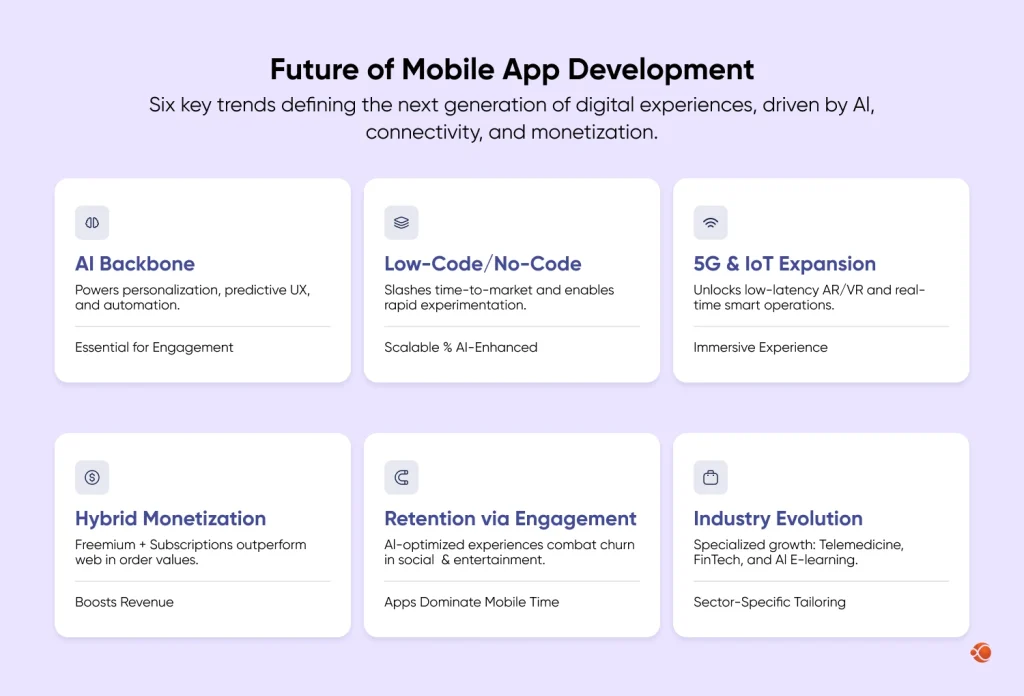
- AI Backbone for Apps: AI powers personalization, predictive UX, chatbots, and automation, becoming essential for engagement in e-commerce, telemedicine, and financial services.
- Low-Code/No-Code Shift: Enables rapid development and experimentation, slashing time-to-market while supporting scalable, AI-enhanced apps.
- 5G and IoT Expansion: Unlocks low-latency AR/VR, streaming, and connected devices for immersive, real-time experiences in gaming and smart operations.
- Monetization via Freemium and Subscriptions: Hybrid models boost revenue through in-app purchases and m-commerce, outperforming web in retention and order values.
- Retention Through Engagement: Apps dominate mobile time; AI-optimized experiences combat churn, especially in social media and entertainment.
- Industry-Tailored Evolution: Retail prioritizes shopping apps; healthcare telemedicine surges; FinTech handles transactions; e-learning personalizes via AI for higher retention.
What These Statistics Mean for Businesses in 2026
The mobile application landscape is now the core of digital strategy. A professional mobile app development company can help you get actionable, data-driven mobile apps, for which you’d get a detailed report that defines the success of your app against industry benchmarks, your milestones, and competitors’ apps.
- Track performance to boost business results: Measure how your app is performing to make smart adjustments that drive better outcomes.
- Plan your market entry to seize new opportunities: Strategically position your app to tap into fresh markets and grow your customer base.
- Target the right audience for greater impact: Identify key demographics and engage users most likely to convert and stay loyal.
- Refine monetization to boost revenue: Focus on smart strategies to increase your app’s earning potential without compromising user experience.
- Reduce churn by solving user pain points: Understand what’s driving customers away and address the issues that keep them from coming back.
- Enhance retention with personalized experiences: Create tailored experiences and loyalty programs that make users feel valued and encourage long-term engagement.
- Use AI to improve user satisfaction: Integrate AI-powered features that deliver smarter, more intuitive interactions, making your app more valuable to users.
- Maximize customer lifetime value: Build long-lasting relationships with users, ensuring they continue to engage with your app over time and drive sustainable growth.
Understanding these app statistics is important for improving your overall strategy. It will help teams decode their overall mobile app development costs, improve app performance, make their apps more future-ready, and produce more accurate estimates.
Get the Most out of Mobile App Development with CMARIX
It is important to build or modernize mobile apps for startups, SMEs, and enterprises that can benefit from the modern technological advancements and capabilities. If you are planning to build a new app for iOS and Android, or are having trouble keeping up with customer or internal business needs with your existing mobile app solution, reach out to the dedicated experts at CMARIX to get the most out of your mobile app investment.
So if you are looking to build a future-ready mobile app that scales and automates most tasks, we are more than happy to help.
We have a team of native app developers (Swift/Kotlin) as well as cross-platform development experts in Flutter, React Native, and other leading technologies. With 240+ professional iOS developers, 2000+ projects, and clients from 46+ countries, we assure you that your project is in the most capable hands.
Our dedicated iOS and Android app developers and testers have also worked with clients across different industries and domains, enabling us to provide subject matter expertise and help them meet compliance requirements. Unlock unmatched excellence with our innovation-driven mobile app solutions.
Get in touch with our mobile app consultants and redefine what’s possible!
FAQs on Mobile App Development Statistics 2026-27
What are the most important mobile app development statistics for 2026?
The global market for mobile applications will grow to $626.39 billion by 2030. Ninety-four percent of smartphone usage occurs within applications. Consumer app spending amounted to $167 billion in 2025 and increased to $223 billion in 2026. The AI adoption rate by developers was at 63%. Application downloads remained stable at 150 billion per year, but spending per user keeps rising.
How do mobile apps compare to web apps in market share in 2026?
Mobile apps account for up to 94% of all user interaction, while native applications convert 3 times better, and users browse through 286% more items per session compared to mobile websites. Web applications have the upper hand when it comes to enterprise software-as-a-service (B2B SaaS) revenue, with the SaaS market estimated to grow to $465 billion by 2026. The most successful companies rely on a hybrid model.
What is the global mobile app market size in 2026?
The global mobile application market was valued at USD 252.89 billion in 2023 and is projected to reach USD 626.39 billion by 2030. The US market is growing at a CAGR of 14.1%, while China’s market is projected at 15.8% CAGR. Asia Pacific holds over 32% of global revenue share.
What industries are investing the most in mobile apps in 2026?
Three industries spending the most on mobile applications in 2026 include FinTech and mobile banking, E-commerce and retail, and Healthcare and telemedicine. These three industries drive global mobile app growth, supported by an estimated global mobile application market value that will surpass $377 billion.
How much revenue does the mobile app industry generate in 2026?
Global mobile app revenue continues to climb. Total consumer spending on apps and games reached approximately $223.1 billion in 2026. Mobile advertising accounts for roughly 75% of total app revenue, with Google and Meta controlling nearly 90% of mobile ad spending. Subscription revenue alone reached $66.8 billion in 2024.
Is mobile app development still in demand in 2026?
Yes. Growth in the app development market is estimated to be growing at more than 14% CAGR worldwide. Over 63% of developers have started incorporating AI functionalities into their products. Adoption of enterprise mobile platforms is rising. Spending is on the rise. The need for simple apps has shifted towards AI-based and performance-driven solutions.
What are the latest app store download statistics for 2026?
Downloads on the Google Play Store will reach 143 billion by 2026. The downloads on the Apple App Store will be 38 billion. The total number of downloads globally will go beyond 320 billion. The average number of downloads in 2026 is expected to be 860 million. During holidays, the number of downloads may reach 1.4-1.6 billion per day.
What is the average user retention rate for mobile apps in 2026?
User retention is still a major challenge. 71% of users churn within 90 days. 25% abandon an app on the very first day. News and magazine apps have the highest 30-day retention at 9.1%, while social media apps have the lowest at 1.37%. Apps with AI personalization and strong onboarding see measurably better retention.
What mobile app growth statistics matter most for investors and founders?
The mobile app growth statistics that matter most for investors and founders are retention rates, unit economics, and user stickiness. Raw download numbers are often considered vanity metrics because they do not reflect true product value or ongoing usage.