




Quick Summary: Having trouble setting the budget for an iOS app development project? From the ideation of what your app will do to integrating every feature and functionality, all require a carefully planned iOS app development costs and budget that allocates resources, time, and capital to ensure your app remains profitable and scalable.
iOS app development has changed remarkably over the years since Apple introduced their first generation of mobile apps. Moving towards 2026, these apps have become a core part of how businesses build digital experiences, improve customer engagement, and compete with other apps in the Apple ecosystem. In this neck-to-neck competitive market, one question always continues to surface: “What does it cost to develop an iOS app?”.
If you are a C-level executive, a developer, a solo entrepreneur, looking to figure out your app development budget, this guide will help you understand various factors, tips, and considerations to keep in mind to get the most worth for each dollar you spend.
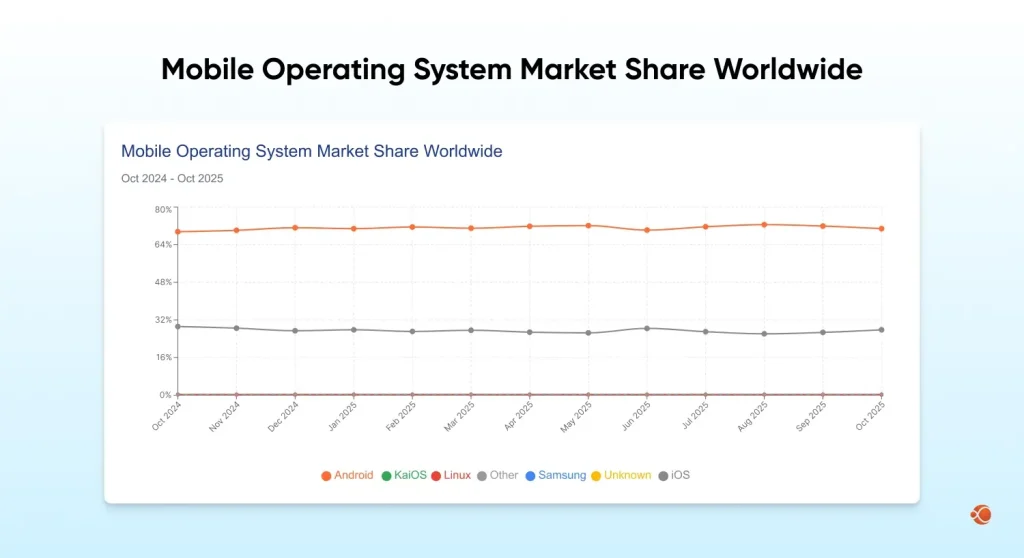
When comparing Android and iOS market share, iOS holds 27.04% and Android holds 72.55%. Yet iOS is a market worth investing in. Why is that? We will find out in today’s blog.
Today, we are going to provide the ultimate iOS app development cost breakdown guide, so you can plan your budget, understand the most optimal path for your app development, receive expert tips on reducing iOS app costs, decode the role of AI in iOS mobile application development, and also have a proper understanding of the hidden costs related to iOS app development.
Why is investing in iOS app development a strategic move in 2026
Before we discuss how to budget iOS application development costs, it is essential to address the most important question: why are companies investing in iOS app development? What are the benefits that the iOS platform brings that make it worth building an iOS app in the first place?
- Premium User Base: The Apple community is often said to have a higher spending power and engagement levels, allowing companies to target them and cultivate loyal customers.
- Robust Security: Apple follows Human Interface Guidelines and has many built-in security features, which add a sense of trust in your app if it’s on the Apple App Store.
- Consistent Performance: One of the most important benefits of iOS app development is the fact that the developers only need to optimize their app for a limited range of devices, which makes performance optimization easier.
- Early Adoption of Technology: Apple’s ecosystem is renowned for its innovations in AR, AI, and other emerging technologies.
10 Factors That Affect the Cost of Creating an iPhone Application
To obtain accurate estimates of the cost for iPhone app development, it is essential to evaluate the various factors that influence pricing throughout a project’s lifecycle. Each factor contributes well to the final budget.
Here is a proper breakdown of the major factors that determine how much it costs to develop an iOS app:
1. App Complexity and Features:
One of the first factors to consider when figuring out the cost of building an iOS app is the complexity of the app. A simple iOS app with basic functionalities, such as login profiles and standard static UI elements, and no need for creating algorithms, will cost less compared to apps that require real-time data syncing, AR/VR Modules, AI-driven recommendations, and complicated third-party integrations.
| App Complexity | Description | Typical Features | Estimated Cost Range (USD) | Development Duration |
| Simple App | Basic functionality with limited user interaction and minimal backend requirements. |
| $5000 – $25,000 | 1 – 3 months |
| Mid-Level App | Moderate complexity with dynamic content, multiple roles, and integrations. |
| $20,000 – $100,000 | 3 – 6 months |
| Complex / Enterprise App | Advanced architecture with AI, cloud connectivity, and large-scale user operations. |
| $100,000+ | 6 – 12+ months |
Pro Tip: Invest in an AI MVP development service first to prioritize the most important features, and expand the app later as the user base grows.
2. UI UX Design Complexity
Design is far more than aesthetics; it is a direct cost driver. When you think of design, you probably think of colors, typography, icons, and other such assets, but that just makes up one part of the entire UI/UX effort. You should also consider the cost of adding animations, intricate micro-interactions, and brand-specific UI kits that need more design and development hours than standard iOS Human Interface Guidelines (HIG) components.
Basic Design (Template-Based): $3,000 – $8,000
Uses standard iOS components, minimal custom graphics, and simple navigation
Custom Design: $8,000 – $25,000
Ideal for applications that require a customized look and feel, with custom illustrations, consistent brand color, smooth animation, and around 5–15 unique screens.
Pro Tip: Invest in a design system from the start. Having reusable components as an asset streamlines future updates and reduces the total feature development costs by nearly 25–35%.
3. Type of iOS App and Platform Compatibility
Native iOS Apps:
These are apps designed specifically for iPhones and iPads, utilizing Apple’s proprietary coding languages, such as Swift. These apps are the fastest, most performance-oriented, and secure. They can also utilize Apple’s native features, such as Face ID and Apple Pay, to provide a more premium and authentic Apple experience to the users. To get the best native iOS apps, it’s best to hire Swift developers from a reliable iOS app development company.
Estimated Cost to Build a Native iOS App: $10,000 – $150,000+
Hybrid Apps:
Platforms like Flutter and React Native provide developers the freedom to write a single codebase that functions on both iOS and Android devices. It’s cheaper upfront because you’re building one app instead of two. In some cases, the trade-off is slower performance or the inability to access all iPhone features fully.
Estimated Cost to Build Hybrid iOS App: $20,000 – $100,000
Progressive Web Apps (PWAs):
PWAs are browser-based applications that provide a native application-like look and feel. While they are not hosted on the App Store, they can still function across devices and save startups or MVP launches, decent costs.
Estimated Cost to Build a PWA App: $10,000 – $60,000
4. Backend Infrastructure and Database Architecture
| Backend Complexity | Key Features | Examples | Estimated iOS App Development Costs |
| Basic |
|
| $5,000 – $10,000 |
| Intermediate |
|
| $5,000 – $40,000 |
| Advanced |
|
| $40,000 – $60,000 |
| Enterprise/Scalable |
|
| $60,000+ |
Backend development is the invisible backbone of any iOS app. It is the powerhouse that manages data flow, authentication, APIs, and communication between the app and server. The complexity of this infrastructure has a direct correlation with cost.
Apps with simple backend setups, such as static content or minimal user interaction, require limited resources. However, apps that deal with real-time data exchange, payment processing, AI-based analytics, or multi-user collaboration require a scalable, secure backend with advanced logic and integration layers.
Setting up and maintaining a robust backend infrastructure can range from $10,000 to $60,000+ USD. This depends on whether cloud solutions like AWS or Firebase are used. Scalability, security compliance (such as GDPR or HIPAA), and data redundancy planning also impact the overall cost of iOS app development. When you invest wisely in backend architecture, it is important to make sure the app remains stable as it scales, preventing expensive rework later.
5. Third-Party Integrations and APIs
Most iOS apps available on the Apple App Store require some extent of third-party integration to run their app. Now, these integrations can be as simple as an option for users to Sign In or Create an Account using “Google”, “Facebook”, “Apple ID”, and many other service providers.
Another popular integration is that of payments and maps, which you may have already seen in the food delivery apps you use. Many apps are now utilizing OpenAI’s APIs to integrate AI features into their applications. Now, different integrations have different pricing structures that affect the overall cost of building an iOS app.
Here is a cost breakdown of the few popular integrations:
| Category | Provider | Pricing Details |
| Identity / Sign‑In | Google Identity Platform | No‑cost up to 50 000 MAUs; beyond that ~ US$0.0025 to US$0.0055 per MAU (Google Identity Platform) |
| Payments | Stripe | 2.7% + US$0.30 per successful domestic card transaction (US standard) (Stripe) |
| AI / Language Model APIs | OpenAI API | Text model: US$4.00 input / 1M tokens, US$16.00 output / 1M tokens (OpenAI) |
| Mapping / Navigation SDK | Mapbox Navigation SDK | After free tier, US$0.30 per MAU for unlimited trips option (mapbox.com) |
6. iOS Developer Profiles and Their Hourly Rates
There are multiple skill levels and specializations involved in developing an iOS app. Each carries a distinct market value worldwide. The iOS app developer cost comparison table below gives a quick reference to the average hourly rates for local iOS developers in the United States as per their profiles and responsibilities.
| Developer Profile | iOS Hourly Rates (USD) | Ideal For |
| Junior iOS Developer | $20 – $50/hr | Suitable for small projects, MVPs, bug fixes, and assisting senior devs on less complex modules. |
| Mid-Level iOS Developer | $50 – $90/hr | Ideal for mid-sized apps with API integrations, database operations, and moderate backend complexity. |
| Senior iOS Developer | $90 – $150/hr | Best for full-scale commercial apps, performance optimization, and implementing scalable architectures. |
| Lead iOS Developer / Architect | $120 – $200/hr | Perfect for enterprise-grade projects requiring architecture design, security, and team leadership. |
| iOS UI/UX Designer | $60 – $130/hr | For apps prioritizing high-quality design, animations, and compliance with Apple Human Interface Guidelines (HIG). |
| iOS AI/ML Engineer | $100 – $200/hr | Suited for apps using machine learning, predictive analytics, or Core ML-based AI features. |
| iOS Game Developer (ARKit / Unity) | $80 – $180/hr | Best for gaming, AR/VR apps, and interactive 3D user experiences. |
| Full Stack iOS Developer | $70 – $160/hr | Suitable for startups that need one developer to handle both frontend (Swift) and backend (Firebase, AWS). |
| Flutter / React Native Developer (for iOS) | $35 – $100/hr | Great for cross-platform apps targeting both iOS and Android while optimizing development costs. |
As you can see, hiring iOS talent individually for every role can be more costly and time-consuming. A more cost-effective alternative is to partner with an offshore iOS app development company that offers a full-stack development solution under one roof.
7. iOS App Developer Cost Breakdown As Per Location
You must have searched for phrases like “how much does it cost to hire iOS app developers in India” or “iOS app development cost in India” in countries such as the US, Ukraine, and others. Comparing costs across countries makes sense, as different countries have varying economic policies.
iOS developer hourly rate cost comparison as per region:
| Region | Average Hourly Rate (USD) |
| North America (USA & Canada) | $80 – 250/hr |
| Western Europe (UK, Germany, France) | $70 – 160/hr |
| Eastern Europe (Poland, Ukraine, Romania) | $30 – 90/hr |
| India / South Asia | $15 – 50/hr |
| Southeast Asia (Vietnam, Philippines) | $25 – 55/hr |
| Latin America (Brazil, Argentina, Mexico) | $30 – 70/hr |
As you can see, hiring iOS app developers from India and South East Asia provides significantly lower costs compared to Brazil, the UK, the USA, and other contemporaries. India has six cities that rank among the top tech talent hubs in the Asia-Pacific region.
8. App Testing Cost Breakdown Analysis
In 2023, the Apple App Store reviewed over 7.7 million apps and rejected nearly 1.93 million apps. To ensure your app doesn’t meet the same fate, it is essential to conduct thorough testing on it before submitting it to the Apple App Store for review. In such situations, it’s best to hire dedicated iOS developers who follow test-driven development best practices.
Types of iOS mobile app testing and their costs:
| Type of App Testing | Description | iOS Testing Tools | Average iOS App Cost |
| Functional Testing | Ensures all app features, workflows, and interactions work as intended across devices. |
| $3,000 – $10,000 |
| UI/UX Testing | Evaluates navigation flow, responsiveness, and adherence to Apple’s Human Interface Guidelines (HIG). |
| $2,000 – $8,000 |
| Performance Testing | Tests app speed, load handling, battery usage, and responsiveness under stress conditions. |
| $4,000 – $12,000 |
| Security Testing | Checks for vulnerabilities, data encryption, and compliance with Apple Store security policies. |
| $5,000 – $15,000 |
| Compatibility Testing | Ensures consistent performance across iPhones, iPads, and iOS versions. |
| $3,000 – $7,000 |
Testing is more of an investment than a cost factor in iOS app development. Apple follows the strictest policies for quality check, functionality, and UI/UX design best practices as well. Hence, you need a dedicated team of qualified testers to ensure your iOS app passes all quality checks and adheres to the best practices that users expect from modern apps.
9. iOS App Development Cost Breakdown as per App Categories
What most iOS app development cost breakdown guides often overlook is accounting for the type of app you want to build. Generally, the overall Apple app development budget expectations can be measured if you know the category you’re creating an iOS app for.
Social Networking Apps
iOS social apps focus on real-time interactions, messaging, media sharing, and other community-driven features. Such apps require a more capable backend infrastructure and high user engagement capabilities.
Key Components & Considerations:
- Real-time chat, video calling, and instant notifications
- Social feeds, profiles, and user-generated media
- Backend scalability and advanced content moderation
Cost Range: $50,000 – $150,000+
Development Timeline: 3-6 months
E-commerce / Retail Apps
Ecommerce apps are one of the most popular and competitive iOS app categories. From a basic Ecommerce storefront to a multi-platform marketplace, the cost of developing an Ecommerce app on iOS can vary significantly.
Key Components & Considerations:
- Product listings, filters, carts, and secure checkout
- Payment integrations: Apple Pay, Stripe, PayPal
- Order tracking, inventory sync, and recommendation engines
Cost Range: $20,000 – $100,000+
Development Timeline: 4- 8 months
On-demand/Service Apps
These kinds of apps are very popular in North America and the Asia-Pacific regions. With many popular app services in different industries, the demand for on-demand apps like Uber, Tinder, and other popular apps is on the rise. These apps are feature-rich, flexible, come with multiple modules (admin, rider, user) and are ready to deploy.
Key Components & Considerations:
- User/provider/admin modules with dashboards
- GPS tracking, scheduling, and real-time updates
- In-app payments, chat, and dynamic pricing logic
Cost Range: $30,000 – $150,000
Development Timeline: 4-7 months
Fintech / Banking Apps
Fintech and banking apps have the highest requirement for security and regulatory compliance. These apps should have features like payment management, investment, KYC, analytics, and much more, while keeping the data of customer secure at all times.
Key Components & Considerations:
- KYC verification, biometric login, and fraud detection
- Transactions, budgeting, investment tracking
- Bank-level encryption and regulatory compliance
Cost Range: $50,000 – $250,000+
Development Timeline: 5-9 months
Health & Fitness Apps
The health and fitness apps have transformed personal health, especially with integration for wearables like the Apple Watch, and personalized dashboards. These apps often work with Apple HealthKit for getting more accurate data.
Key Components & Considerations:
- HealthKit integration and wearable device sync
- Activity logs, workout plans, analytics dashboards
- Real-time metric tracking and personalized insights
Cost Range: $40,000 – $120,000+
Development Timeline: 3-6 months
Education / E-Learning Apps
If you are planning to build an educational app with interactive lessons, video modules, progress tracking, and gamification, the costs of adding such features will be more than basic educational apps. Education apps in 2026 also include support for offline content and multi-device accessibility.
Key Components & Considerations:
- Video lessons, live classes, and assessments
- Gamification, progress tracking, leaderboards
- Offline access and multi-device support
Cost Range: $30,000 – $100,000+
Development Timeline: 3-5 months
Travel & Booking Apps
Travelling and booking industry is one of the most frequently used apps, where travelers, corporate bookings, and family holidays all make use of such apps. The types of travel and booking apps include flight booking apps, hotel booking apps, travel planners, cab booking apps, restaurant finders, and more.
Key Components & Considerations:
- Search, compare, and booking features
- GPS, itinerary planning, and real-time updates
- Airline, hotel, and travel API integrations
Cost Range: $25,000 – $150,000+
Development Timeline: 3-6 months
Gaming / AR Apps
iOS apps range from casual games to advanced AR titles built with ARKit. Such projects demand heavy coding knowledge, animation budget, and performance optimization best practices.
Key Components & Considerations:
- 2D/3D graphics, animations, and effects
- ARKit-based augmented reality experiences
- Multiplayer mode, physics engines, and high performance
Cost Range: $80,000 – $300,000+
Development Timeline: 6-12+ months
Utility / Productivity Apps
These types of iOS apps are used daily by the users, and are mostly designed to be minimal, function-driven, and take up very less space in the user’s device. They are mostly used for tasks such as daily reminders, time tracking, workflow automation, or taking notes.
Key Components & Considerations:
- Notes, reminders, scanners, time-tracking tools
- Intuitive UI with fast responsiveness
- Cloud sync and cross-device accessibility
Cost Range: $25,000 – $80,000+
Development Timeline: 2-5 months
Entertainment / Streaming Apps
One of the largest and lucrative markets, the OTT and other streaming apps demand heavy backend support with the most intuitive UI/UX to build performance-oriented, seamless mobile apps that provide high-quality content delivery.
Key Components & Considerations:
- High-quality video/audio streaming
- Personalized categories, recommendations, and playlists
- CDN integration and DRM for secure content delivery
Cost Range: $30,000 – $100,000+
Development Timeline: 4-8 months
10. Deciding the Cost of iOS App Development as per Your Hiring Method
The cost of building an iOS app is not solely determined by features and complexity, but also by other factors. It heavily depends on the way you hire your development team. Every different model of hiring comes with its cost structure, timeline, and expertise.
Freelance iOS Developers($20 – $150/hr): Independent developers hired on an hourly or project basis.
- Ideal for: Small projects, MVPs, or individual modules where a full team isn’t necessary.
In-House Team($80k – $200k/year per developer): Full-time developers employed directly by your company.
- Ideal for: Large-scale or long-term projects where complete control, collaboration, and rapid iteration are critical.
Offshore Development Company($25 – $120/hr): Remote teams from other countries, typically managed by the client or a project manager.
- Ideal for Startups or mid-sized companies seeking cost-effective, full-stack development with end-to-end solutions.
Hybrid Model($40 – $150/hr): A combination of in-house oversight and offshore execution.
- Ideal for Companies that want both control and cost efficiency. This is ideal for benefitting from the expertise of offshore talent while maintaining an on-premise iOS development team for control and supervision.
We develop user-friendly iOS apps with clear cost, predictable delivery, and scalable architecture to support your startup growth.
Contact UsWhat are the 10 Hidden Costs of Creating App for iOS?
Most of the time, businesses don’t account for certain unsaid or non-negotiable expenses when planning their iOS app development budget. Here is an iOS app development hidden cost checklist you can refer to before creating an iOS app.
Quick Table Overview of Hidden iOS App Development Costs
| Hidden iOS App Costs Factor | Estimated Cost Range (USD) | Notes / Details |
| Apple Developer Account & App Store Fees | $99/year + 15–30% commission on in-app purchases | Needed for publishing on the App Store; commission affects revenue-generating apps |
| Maintenance & Updates | $5,000 – $50,000/year | Includes bug fixes, iOS version compatibility, performance optimization |
| Cloud Hosting & Storage | $50 – $10,000+/month | Backend hosting and database costs; scales with users and media usage |
| Third-Party SDKs & APIs | $100 – $5,000+/year | Examples: Mapbox, Stripe, Twilio, OpenAI APIs; cost increases with usage |
| Marketing & User Acquisition | $2,000 – $50,000+ | App Store Optimization (ASO), paid ads, campaigns to attract users |
| Analytics & Monitoring Tools | $0 – $1,000+/month | Tools like Firebase Analytics, Mixpanel, Crashlytics; free tiers often limited |
| Legal & Compliance | $500 – $20,000+ | GDPR, HIPAA, or other regulations; non-compliance risks fines or app rejection |
| App Localization | $500 – $10,000 | Translating app, UI adjustments, cultural adaptation for multiple languages |
| Technical Debt | 10–25% of initial development cost | Fixing rushed or suboptimal code later; affects maintenance and scalability |
| Customer Support | $500 – $5,000/month | Dedicated team or outsourced support to handle user queries and complaints |
How to Budget Your iOS App Costs for Startups, Enterprises, and AI-Driven Projects
Your requirements for an iOS app development project will be different if you are a startup, an enterprise, or a business that is newly experimenting with AI-driven software solutions.
To make sure you get the best iOS app development services, here is an iOS app budget overview you can refer to:
| Category | Startup MVP | Enterprise iOS App | AI-Driven iOS App |
| Total Budget | $30,000–$80,000 | $150,000–$500,000+ | $75,000–$200,000 (initial) |
| Timeline | 8–12 weeks | 6–12 months | 4–8 months |
| Development | $18,000–$48,000 | $40,000–$125,000 | $18,000–$50,000 |
| Backend & Integrations | Minimal (Firebase) | $60,000–$200,000 | $10,000–$30,000 |
| Design | $5,000–$12,000 | Included | $7,000–$20,000 |
| Testing & QA | Basic | $20,000–$75,000 | $10,000–$25,000 |
| AI Model & Data Setup | N/A | N/A | $35,000–$100,000 |
| Monthly Infrastructure | $50–$150 | $500–$5,000 | $2,000–$10,000 |
| Maintenance | 15% yearly | 20–25% yearly | 25 |
| Team Size | 2–3 members | 6–10 members | 4–6 members |
As we can see, startups can launch efficiently with lean teams and minimal infrastructure, while enterprises require larger budgets to support scalability and integrations. AI-driven apps, although mid-range in cost, require more focused investment in data and model development.
Whether you are a startup, an enterprise, or need to build an AI-driven mobile app, you should outsource iOS app development to an experienced team of iOS app developers like CMARIX that work on various projects across different industries.
Understanding the Differences: iOS vs Android App Development Cost Comparison
| App Type/Service | iOS Cost (USD) | Android Cost (USD) |
| Simple App | $10,000 – $50,000 | $8,000 – $40,000 |
| Mid-Level App | $50,000 – $120,000 | $45,000 – $100,000 |
| Complex / Enterprise App | $150,000+ | $130,000 – $250,000+ |
| UI/UX Design | $3,000 – $50,000+ | $2,500 – $45,000+ |
| Native App Development | $30,000 – $250,000+ | $25,000 – $200,000+ |
| Hybrid App Development | $20,000 – $100,000 | $20,000 – $100,000 |
| Backend Development | $10,000 – $60,000 | $10,000 – $60,000 |
| Testing & QA | $3,000 – $15,000+ | $3,000 – $15,000+ |
| Developer Hourly Rates | $20 – $200/hr | $15 – $150/hr |
| Maintenance & Updates (per year) | $5,000 – $50,000 | $5,000 – $45,000 |
| Total Enterprise App Budget | $150,000 – $500,000+ | $130,000 – $450,000+ |
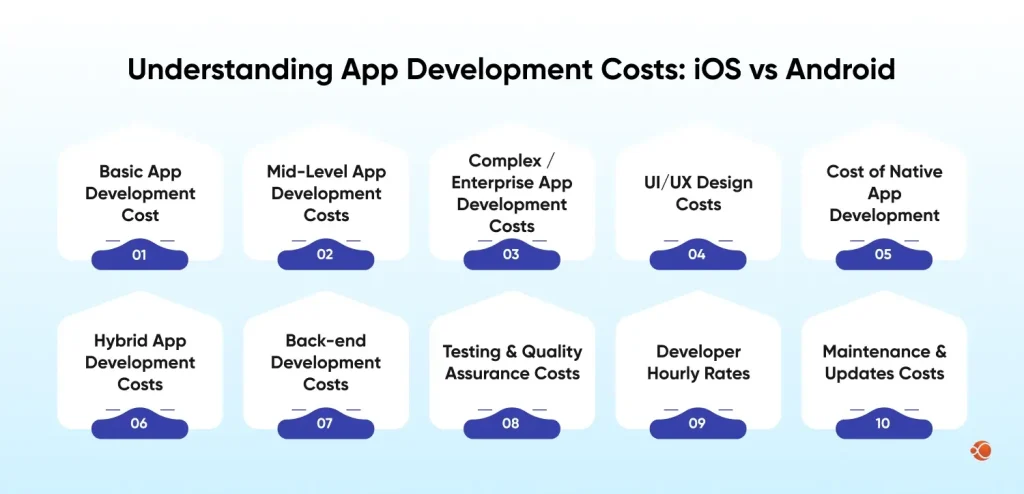
1. Basic App Development Cost
Simple applications typically have a basic UI, static content, and a limited number of backend features. Applications for Android are generally less expensive to develop because the ecosystem is open, allowing for free tools to be available.
2. Mid-Level App Development Costs
The mid-level applications include dynamic content, push notifications, APIs, and in-app payment integrations, among others. Android development may be less expensive if device testing requirements are lower.
3. Complex / Enterprise App Development Costs
The features that come with these apps often include AI/ML, AR/VR, real-time data, and enterprise-level security. For Android, mobile app testers need to conduct additional testing on multiple devices, which often results in increased QA costs and overall app development time. iOS has a clear benefit, as it has a limited number of devices on which to test the app.
4. UI/UX Design Costs
The total cost of UI/UX design depends on the customer’s brief and the level of detailing, branding, and other components required. However, iOS design tends to be a bit pricier because Apple’s Human Interface Guidelines are quite detailed and require extra design accuracy.
5. Cost of Native App Development
Native apps are designed and developed keeping in mind a single platform, either iOS or Android, which means they’re fine-tuned for speed, performance, and seamless user experience. However, this specialization comes at a higher price. iOS apps often lean toward the pricier side, not only because of stricter design rules but also because of the generally higher rates of iOS developers.
6. Hybrid App Development Costs
Hybrid apps, on the other hand, take a “Write Once, Run Anywhere” approach. They share one codebase across both iOS and Android, which can significantly cut costs. The trade-off? You may sacrifice some performance or miss out on certain native features that platform-specific apps handle more effectively.
7. Back-end Development Costs
From this perspective, back-end costs depend on the complexity of real-time data handling, AI/ML integration, and the scalability requirements of cloud hosting.
8. Testing & Quality Assurance Costs
QA encompasses functional, performance, security, and compatibility testing. Android testing can be more complicated due to its fragmented market and the variety of devices.
9. Developer Hourly Rates
On average, iOS developers have slightly higher rates worldwide due to the high demand for the platform and their experience.
10. Maintenance & Updates Costs
Post-launch costs also include bug fixes, OS updates, and feature enhancements.
Verdict: iOS vs Android App Development Costs
In summary, iOS apps typically cost 10–20% more than Android apps, but they offer higher monetization potential and premium market positioning, making the extra investment worthwhile for most enterprises.
How Our iOS App Developers at CMARIX Help Reduce iOS App Development Costs
| iOS App Development Cost Reduction TIp | Best Practices to Optimize iOS App Development Costs |
| 1. Define Clear App Requirements Early |
|
| 2. Start with an MVP (Minimum Viable Product) |
|
| 3. Opt for Cross-Platform or Hybrid Development (When Suitable) |
|
| 4. Use Pre-Built Templates and UI Components |
|
| 5. Outsource to Experienced Offshore Teams |
|
| 6. Automate Testing and Maintenance |
|
| 7. Leverage Cloud and Scalable Backend Solutions |
|
| 8. Integrate AI Intelligently |
|
| 9. Plan for Long-Term Maintenance Costs Early |
|
| 10. Regularly Audit and Optimize Features |
|
| 11. Great ROI – Attractive Cost |
|
Final Words
In conclusion, estimating iOS app development costs is not just about numbers; it’s about aligning vision, functionality, and business goals within a realistic budget. Whether it’s an MVP or an enterprise-grade solution, factoring in design, backend, integrations, testing, and maintenance is important to gain complete financial clarity. With a professional mobile app development company like CMARIX, you can rest assured to get the most transparent, honest, and optimal rates for your iOS app project.
FAQs for Cost of Building an iOS App
What is the average cost of building an iOS app in 2025-2026?
The cost of building an iOS app can differ depending on the complexity. Some apps with basic features start at lower price points, while mid-level apps require some integrations, and hence cost more. Complex enterprise applications often utilize next-generation technologies like AI, real-time data, and AR capabilities, which then increase the overall iOS app development budget. It is always ideal to validate the concept with professional AI MVP development services before committing to a full-scale app project.
How much does it cost to hire an iOS developer per hour?
The hourly rates for hiring an iOS developer depend on the skill, experience, and location of the iOS developer. A senior developer charges more than an entry-level developer. Generally, if you want to maximize the return on your investment, consider hiring iOS app developers or outsourcing your iOS app development project to India.
Are iOS apps more expensive than Android apps?
iOS apps tend to be more expensive than Android apps, despite being proprietary software, as opposed to the open-source nature of Android. Yes, Android mobile apps need to be tested on multiple devices, but Apple has stricter design guidelines and an app review process, which makes it even more challenging to get your app published on the Apple App Store. But for the slightly increased investment, Apple users are also more likely to indulge in in-app purchases for a better experience, making it a considerable investment.
How long does it take to develop an iOS app?
While each app has a different timeline based on requirements, team availability, client urgency, and other factors, basic iOS app development typically takes 2-3 months on average, medium projects 4-6 months, and larger projects can take more than a year.
What factors can make an iOS app project exceed its budget?
Hidden costs that companies often overlook when estimating their iOS app development budget are usually the reason their budget exceeds their expectations. These factors include app maintenance, cloud hosting, third-party APIs, and compliance, as well as additional features or services.
How do startups keep iOS app costs under control?
We always recommend that our startup clients validate their ideas with AI MVP development services or AI POC development services that we offer. Doing so provides them with a better structure, clarity, and confidence in the project’s scope and roadmap, which then enables us to plan their full-scale iOS app from the outset. This allows us to reduce many unnecessary costs that would have been incurred if we had directly developed an iOS app.
Is there any price difference in developing apps for iOS and Android?
Yes. iOS development can be more expensive due to higher design and testing standards. Android requires more testing due to the variety of device types. Despite higher costs, iOS often gives better profits and attracts users who spend more.
How does the choice of a development team affect costs?
Freelancers charge less but have limited capacity. In-house teams offer more control but come at a higher cost. Offshore companies provide comprehensive solutions at competitive rates. The best choice depends on your project size, budget, and support needs.