CO2MENA Pioneering Carbon Accounting In The Middle East
CO2MENA, the first carbon accounting tool developed for the Middle East (MENA) region, is revolutionizing how organizations manage their greenhouse gas emissions. Partnering with CMARIX for web application design and development, CO2MENA offers a comprehensive platform featuring spend and consumption data models, a CO2 emissions calculator, and AI-powered data categorization. This user-friendly solution enables businesses to accurately measure and report their carbon footprint emissions. By providing detailed insights and actionable data, CO2MENA empowers MENA businesses to make informed decisions, driving them towards their Net Zero targets while unlocking economic advantages in an increasingly environmentally conscious market.
TechnologyLaravel, MySQL, Node.js, React.js
IndustryEnvironmental Technology
Built ForWeb Users
AccessMiddle East (MENA) Region
Bridging the Gap Carbon Management Challenges in Middle Eastern Economies
Lack of Region-Specific Solutions Existing carbon accounting tools were not tailored to the unique economic and industrial landscape of the MENA region, leading to inaccurate emissions assessments. Data Fragmentation Companies struggled to consolidate emissions data from various sources and departments, resulting in incomplete and unreliable carbon footprint calculations. Limited Technological Infrastructure Many MENA businesses lacked the necessary digital tools to efficiently track and manage their carbon emissions, hindering their ability to meet sustainability goals. Regulatory Compliance Hurdles With evolving environmental regulations in the MENA region, companies faced difficulties in adhering to new standards and reporting requirements. Industry-Specific Emission Factors The absence of MENA-specific emission factors for various industries led to imprecise carbon accounting, particularly in sectors like oil and gas, construction, and manufacturing. Language and Cultural Barriers Existing global solutions often failed to account for Arabic language requirements and local business practices, limiting their adoption in the region. Scope 3 Emissions Complexity MENA businesses struggled to accurately measure and report Scope 3 emissions due to complex supply chains and limited supplier engagement in sustainability initiatives. Limited Expertise There was a shortage of local expertise in carbon accounting methodologies and best practices, making it challenging for companies to implement effective emissions management strategies. Data Security Concerns Companies in the region were hesitant to use cloud-based solutions due to data security and sovereignty concerns, particularly for sensitive emissions data. Integration with Existing Systems Many businesses faced difficulties in integrating carbon accounting processes with their existing ERP and financial systems, leading to inefficiencies and data discrepancies.
From Data to Insights The Technological Backbone of CO2MENA
CO2MENA's platform is built on a robust, scalable architecture designed to handle the complexities of carbon accounting in the MENA region. The system utilizes a microservices architecture, allowing for flexible deployment and easy scaling of individual components as user demand grows.
Key technical features include
Data Ingestion Engine A powerful ETL (Extract, Transform, Load) system capable of processing various data formats from multiple sources, including CSV, Excel, and direct API connections to popular ERP systems.AI-Powered Data Categorization Leveraging machine learning algorithms to automatically categorize and map input data to relevant emission factors, reducing manual effort and improving accuracy.Real-time Calculation Engine A high-performance computation module that processes emissions data in real-time, utilizing region-specific emission factors stored in a regularly updated database.Secure Multi-tenancy Implemented using a combination of database-level segregation and application-level access controls, ensuring data isolation between different organizations.RESTful API Layer A comprehensive API allowing for seamless integration with third-party systems and potential future mobile applications.Caching and Performance Optimization Utilizing Redis for caching frequently accessed data and optimizing query performance for large datasets.Containerized Deployment Docker containers orchestrated with Kubernetes, enabling easy scaling and management of the application across cloud environments.
Blueprint for Sustainability CO2MENA's Architectural Framework
Presentation Layer
React.js-based responsive web application
Server-side rendering for improved performance and SEO
Tailwind CSS for consistent and efficient styling
Application Layer
Laravel PHP framework for robust backend logic
Node.js microservices for specific high-performance tasks
Redis for caching and real-time data processing
Persistence Layer
MySQL for structured relational data storage
MongoDB for flexible document storage of unstructured data
Elasticsearch for efficient full-text search and analytics
Security Layer
JWT-based authentication and authorization
Data encryption at rest and in transit
Regular security audits and penetration testing
Integration Layer
RESTful APIs for external system integration
Apache Airflow for orchestrating data workflows and ETL processes
Data Processing Layer
Node.js-based data processing pipelines for complex calculations
Apache Kafka for event streaming and data pipeline management
Empowering Carbon Management CO2MENA's Feature Suite
User Management and Access Control
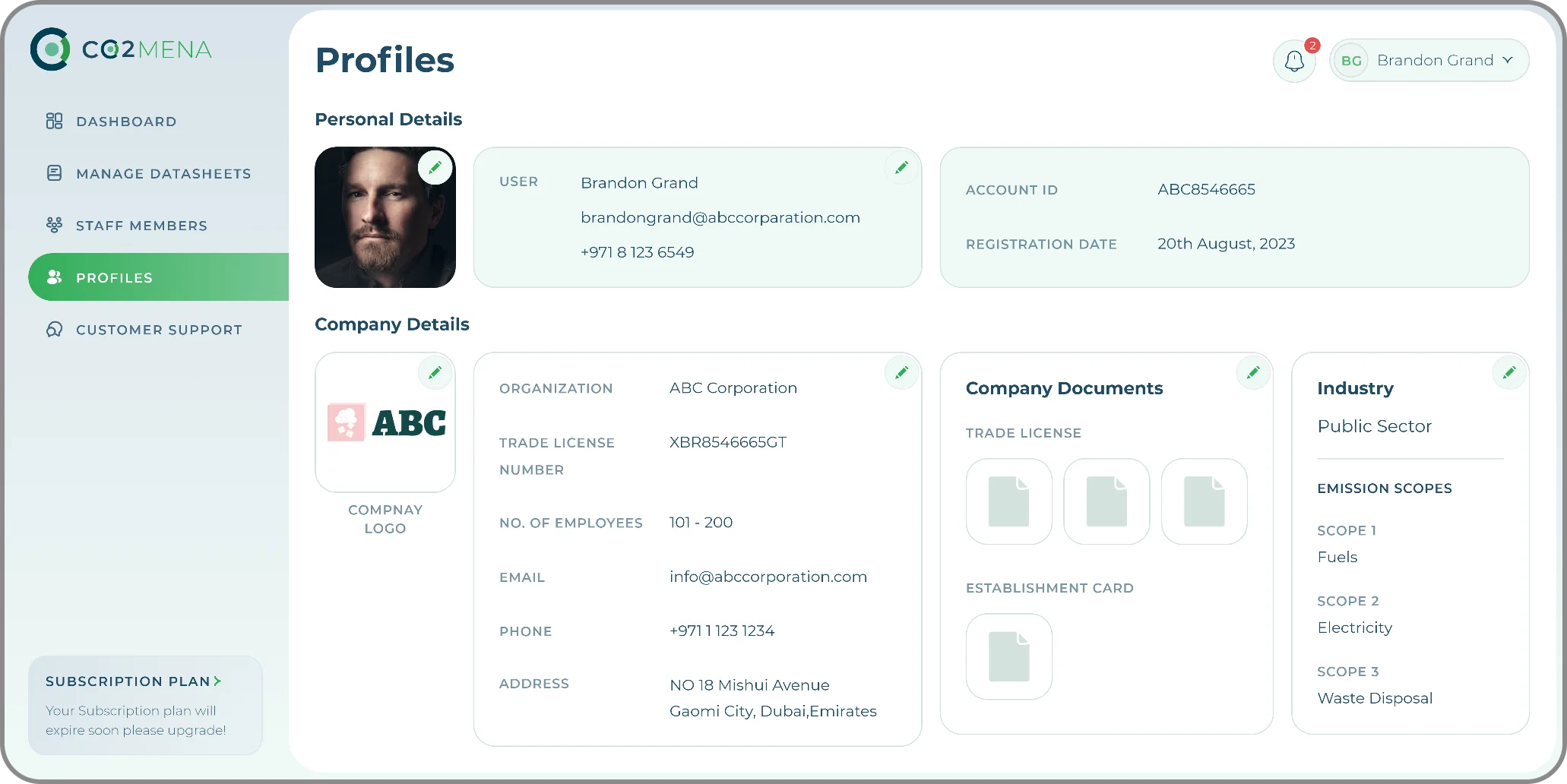
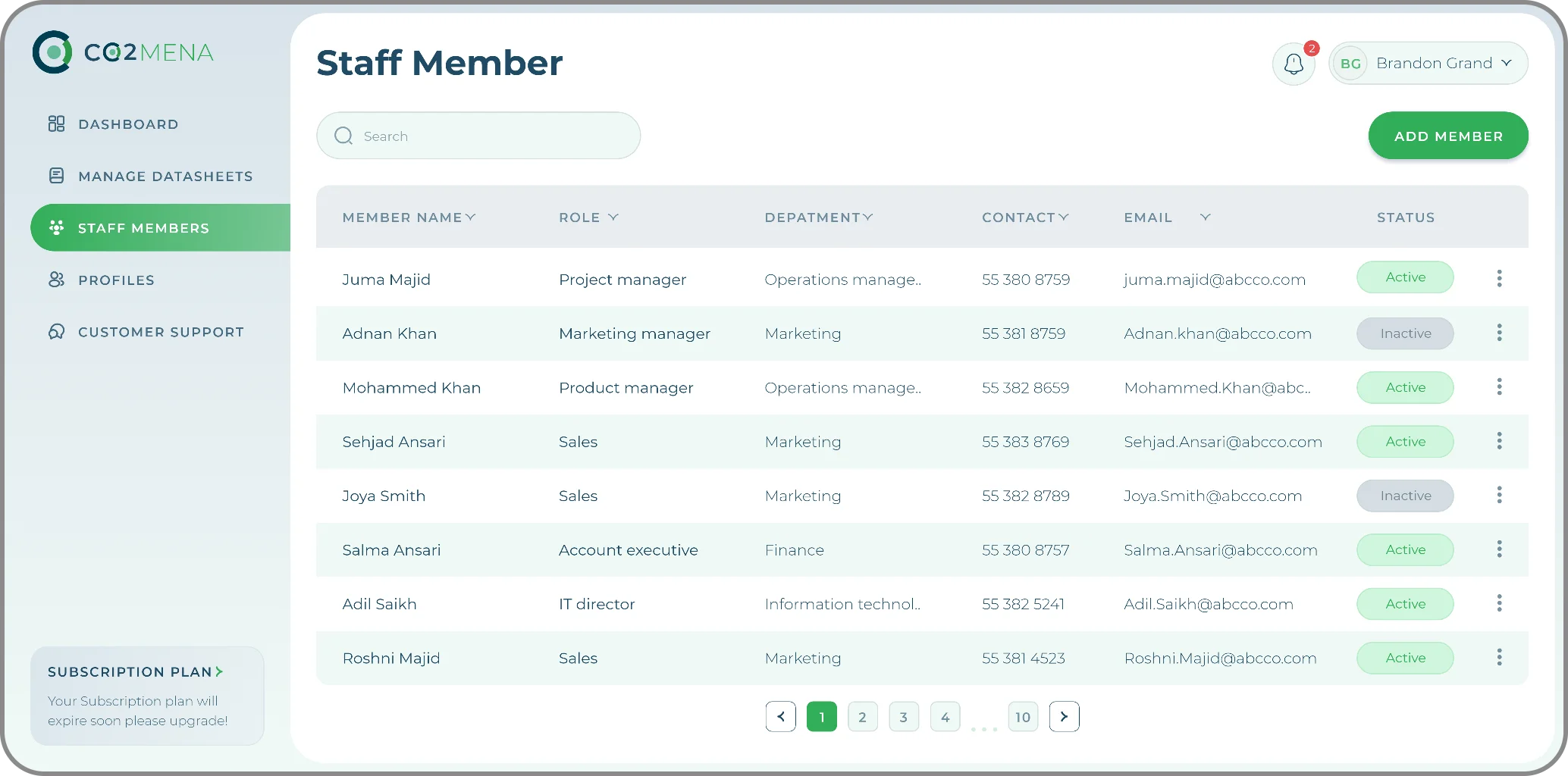
Role-based access control for Super Admins, Company Admins, and Staff Members
Secure authentication with multi-factor authentication support
Customizable user permissions for granular access control
Data Sheet Management
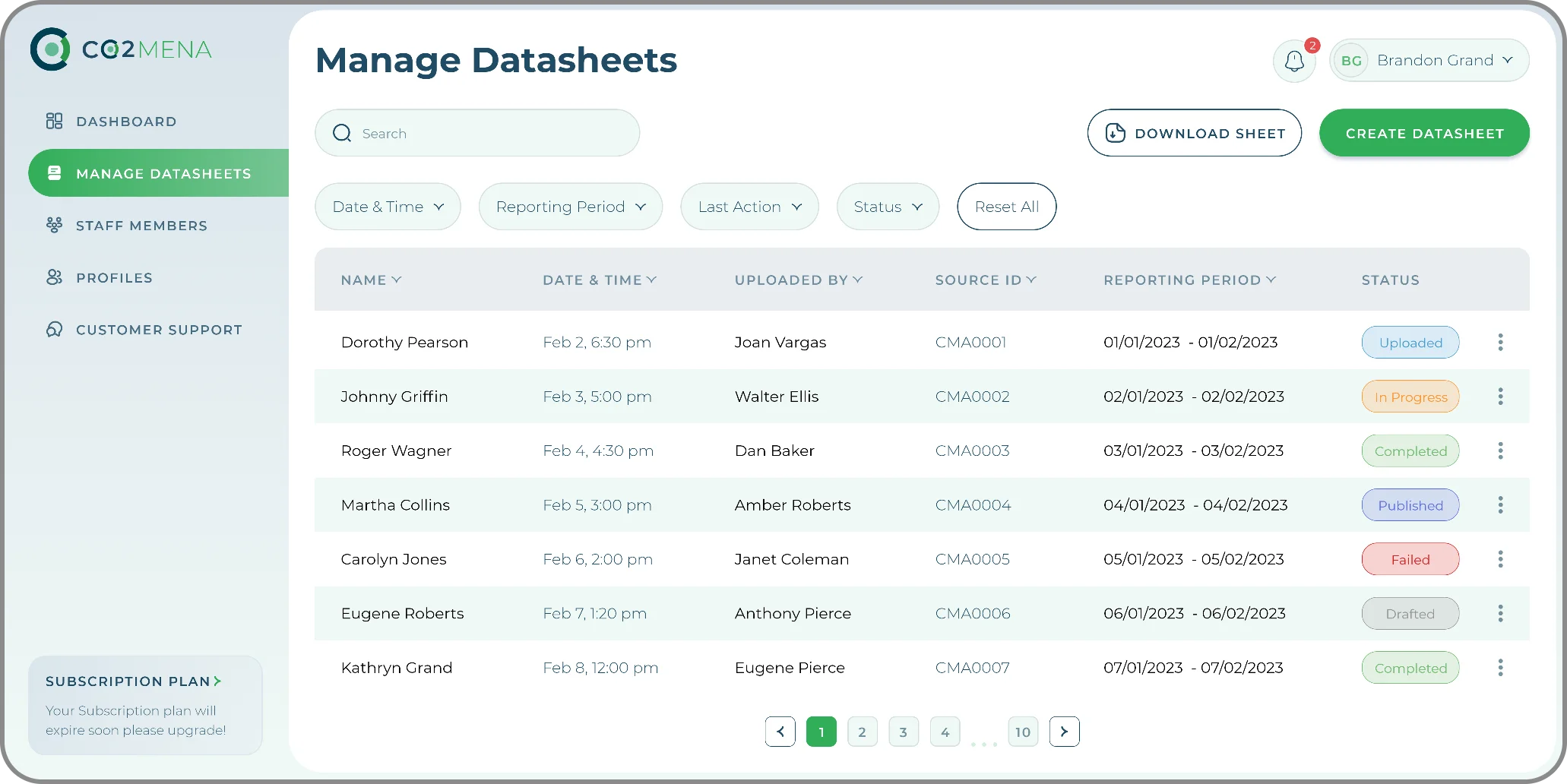
Intuitive interface for uploading and managing data sheets
Support for various file formats (CSV, Excel, etc.)
Automated data validation and error checking
AI-Powered Data Categorization
AI algorithms for automatic categorization of emission sources
Continuous learning from user inputs to improve categorization accuracy
Manual override options for fine-tuning categorizations
Emissions Calculation Engine
Real-time calculation of Scope 1, 2, and 3 emissions
Support for region-specific emission factors
Customizable calculation methodologies to align with different reporting standards
Interactive Dashboards
Customizable dashboards for different user roles
Real-time data visualization with charts and graphs
Drill-down capabilities for detailed analysis
Reporting and Analytics
Automated report generation for various stakeholders
Export functionality in multiple formats (PDF, Excel, etc.)
Trend analysis and forecasting tools
Goal Setting and Tracking
Ability to set emission reduction targets
Progress tracking against set goals
Scenario modeling for different reduction strategies
Supply Chain Emissions Management
Tools for engaging suppliers in emissions reporting
Scope 3 emissions calculation and allocation
Integration Capabilities
API-based integration with ERP and financial systems
Support for IoT device integration for real-time data collection
Compliance and Audit Support
Built-in compliance checks for regional regulations
Audit trail and data versioning for transparency
Multilingual Support
Full Arabic language support
Easily extendable to other languages
Mobile Responsiveness
Fully responsive design for access on various devices
Potential for future dedicated mobile applications
Behind the Scenes CO2MENA's Server-Side Mastery
Data Processing and Validation
Robust data validation algorithms to ensure data integrity
Automated error detection and reporting for uploaded data sheets
Batch processing capabilities for large datasets
Advanced User Management
Hierarchical user structure management
Granular permission controls for different user roles
Audit logging for user actions and system changes
Emission Factor Management
Dynamic emission factor database with regular updates
Region-specific factor management for MENA countries
Version control for emission factors to ensure calculation accuracy over time
Calculation Engine
Scalable architecture for handling complex emissions calculations
Support for multiple calculation methodologies
Real-time and batch calculation modes for flexibility
Reporting Engine
Customizable report templates for different standards and regulations
Scheduled report generation and distribution
Data aggregation and summarization for executive-level reporting
API Management
RESTful API design for external integrations
Rate limiting and throttling to manage API usage
Comprehensive API documentation and versioning
Security Features
Encryption of sensitive data at rest and in transit
Regular security scans and vulnerability assessments
Compliance with data protection regulations (MENA regulations)
Caching & Performance Optimization
Intelligent caching strategies for frequently accessed data
Query optimization for large-scale data retrieval
Background job processing for resource-intensive tasks
Backup and Disaster Recovery
Automated backup systems with encryption
Disaster recovery protocols and regular testing
Data retention policies in line with regulatory requirements
Used Color
Primary Color #32AE59
Secondary Color #204C65
Tertiary Color #000000
Typography
Montserrat
Light
Regular
Semibold
Bold
ABCDEFGHIJKLMNOPQRSTUVWXYZ
Abcdefghijklmnopqrstuvwxyz
123456789/[]@$#%^&*
Tech Stack and Third-Party APIs
Frontend
React.js
Redux for state management
Tailwind CSS for styling
Backend
Laravel (PHP framework)
Node.js for specific microservices
Databases
MySQL for relational data
MongoDB for document storage
Redis for caching
DevOps
Docker for containerization
Kubernetes for orchestration
Jenkins for CI/CD
Version Control
Git with GitHub for repository management
Potential Third-Party APIs and Services
Authentication
Auth0 for identity management
Maps and Geolocation
Google Maps API for location-based services
Email Services
SendGrid for transactional emails
File Storage
Amazon S3 for file storage
Documentation
Swagger for API documentationg
AI
TensorFlow for AI-powered data categorization
Monitoring and Logging
ELK Stack (Elasticsearch, Logstash, Kibana) for log management
New Relic for application performance monitoring
Analytics
Google Analytics for website traffic analysis
Mixpanel for user behavior tracking
Compliance and Security
Cloudflare for cloud security
Qualys for vulnerability management
Data Visualization
D3.js for custom charts
Chart.js for simpler visualizations
Are you planning for a digital transformation?
We can assist you with automating operations and creating end-to-end processes in a single software system.