


Quick Summary: WebRTC telecom platform development enables secure, browser-based real-time communication for modern enterprises. Using scalable SFU architecture, adaptive codecs, and global STUN/TURN infrastructure, organizations can build high-performance voice and video platforms with AI capabilities, enterprise security, and seamless integration with existing VoIP and SIP systems.
Enterprises are rapidly moving away from legacy VoIP and towards WebRTC in 2026. The rationale for this shift is obvious: native browser deployment, native encryption, adaptive codec support, and a mature open-source ecosystem.
Whether you are building a telehealth consultation platform, an AI voice agent, or a white-label communications product, WebRTC is the foundation. But technical architecture is only half the decision. The other half is who builds it with you. This guide gives CTOs a precise, technical, and partner-aware roadmap from architecture selection through post-launch observability.
This WebRTC guide covers:
- What is the best architecture for a scalable WebRTC telecom platform?
- How does WebRTC handle poor internet connections and network degradation?
- What does it cost to build a custom WebRTC platform in 2026?
- Is WebRTC secure enough for banking and healthcare telecom?
- Can WebRTC integrate with legacy VoIP and SIP systems?
- Do you need a media server for a WebRTC application?
- How do you evaluate and select a WebRTC development partner?
- What RFP questions should a CTO ask before engaging an engineering firm?
- How do you monitor and measure call quality post-launch?
WebRTC in 2026: The Shift to AI-Native Communication
The Shift to AI-Native Communication Ecosystems
Telecom software engineering services in 2026 are no longer defined by copper lines or PBX cabinets. It is defined by intelligence. Enterprises are rebuilding communication stacks around WebRTC.
The reason is architectural. WebRTC was designed for the browser, for real-time, and for peer-to-peer. That makes it uniquely compatible with AI-native enterprise communication ecosystems.
If a support representative wants to use real-time sentiment analysis during a call, WebRTC delivers the media stream. If a telehealth service provider wants to deliver an encrypted video consultation, WebRTC delivers the transport. And if a global team wants to use a collaboration tool that does not require a desktop install, WebRTC provides the base.
Freshness Insight: Why WebRTC Is Replacing Legacy VoIP in 2026
Legacy VoIP was built for static endpoints. Desk phones. Static offices. Static bandwidth. That world no longer exists.
The enterprise of 2026 lives in a world of 5G wireless networks, remote-first teams, IoT edge devices, and cloud-native microservices. Legacy VoIP cannot meet this reality.
WebRTC, as defined in the W3C WebRTC 1.0 Recommendation, is a royalty-free and open standard. It provides real-time communication using simple JavaScript APIs. No plugins. No proprietary clients. No royalties.
The IETF RTCWEB working group has optimized the underlying transport protocols for over a decade. This yields a battle-hardened standard used by hundreds of millions of users daily.
There are four factors that are contributing to the adoption of WebRTC over VoIP in the enterprise in 2026.
- Browser-native solutions offer the advantage of no client management.
- Adaptive codec support provides improved voice quality.
- DTLS/SRTP encryption provides the advantage of compliance without middleware.
- Open source provides the advantage of enterprise infrastructure at a fraction of the cost.
Market Opportunity: Enterprise Telehealth and VR-Based Remote Collaboration
Two verticals are driving the majority of enterprise WebRTC software development investment in 2026: telehealth and VR-based remote collaboration.
- The first is telehealth. CMARIX’s analysis of enterprise telehealth solutions shows that providers are deploying WebRTC-based video consultation platforms integrated with EHR systems, satisfying HIPAA requirements, and supporting tens of thousands of concurrent patients. Clinical workflow benefits include eliminating no-shows, expanded geographic reach, and real-time specialist consultation. ROI is measurable within 18 months of deployment.
- The second vertical is VR-based remote collaboration. As spatial computing hardware reaches enterprise price points, organizations are building immersive meeting environments. These require the low-latency, high-fidelity media transport that only WebRTC can provide.
For CTOs evaluating their communication infrastructure roadmap, the question is no longer whether to adopt WebRTC; it is how to architect it and who to trust to build a VoIP platform with WebRTC.
Selecting Your WebRTC Architecture: SFU vs. MCU vs. Mesh
What Is the Best Architecture for a Scalable WebRTC Telecom Platform?
Architecture selection is the single most important decision in a WebRTC platform build. Getting this wrong means rebuilding your media layer after your first traffic spike. There are three fundamental topologies to evaluate.
| Topology | How It Works | Best For | Scale Ceiling |
| Mesh | Every peer connects directly to every other peer | 1:1 calls, small groups (fewer than 4) | ~4 participants |
| MCU | Central server decodes, mixes, and re-encodes all streams | Legacy PSTN bridging, composite video | 50 to 200 (CPU-bound) |
| SFU | Server forwards individual streams; clients decode | Enterprise conferencing, webinars, telehealth | 10,000 to 100,000+ per cluster |
Key Takeaways:
Mesh:
- It has a limited number of users who can use the service (generally only works for groups of people).
- Good for one-on-one and small-group communication; not good for large groups due to system resource limitations (e.g., CPU and Bandwidth).
MCU:
- Centralized control but relies upon the CPU for processing.
- Decodes and re-encodes streams, which introduces CPU costs and delays.
- Best suited for using existing legacy PSTN gateways, and provides appropriate legacy PSTN and video-unified desktop capabilities; not well suited for hosting any type of large video conference.
SFU:
- The architecture is designed for enterprise-scale platforms.
- SFUs forward individual video streams without re-encoding, reducing CPU costs, quality loss, and delays. This architecture scales well and handles 10,000 to 100,000+ participants.
Why SFU is the Best Choice for Large-Scale WebRTC Platforms
- Scalability: SFUs scale horizontally. You can add more SFU nodes to a cluster as needed without CPU bottlenecks.
- No Single Point of Failure: SFUs avoid a central server that could become a single point of failure, unlike MCUs.
- Optimal for Large Numbers: SFUs can efficiently manage 100,000+ concurrent users, ideal for large-scale enterprise conferencing.
Work with engineers experienced in building large-scale real-time communication platforms.
Hire NowDeep Dive: Scaling to 100k+ Users with Selective Forwarding Units (SFU)
SFU is the architecture of choice for enterprise WebRTC in 2026. Unlike MCU, SFU does not mix streams server-side. It forwards individual participant streams. Each client handles its own decoding.
This approach scales horizontally. Add more SFU nodes to a cluster to increase capacity. No CPU bottleneck. No single point of failure.
The leading open-source SFU implementations are Mediasoup and Janus Gateway. The Mozilla MDN WebRTC API documentation provides the client-side API reference for managing peer connections at scale.
For a concurrent user model of over 100,000 concurrent users, we suggest using a stack of infrastructure technologies: a Kubernetes cluster of SFU servers distributed across multiple regions in AWS and/or GCP with a Redis layer managing room state. Also, use Socket.io with WebSocket signaling and sticky sessions. Each SFU Node/server can generally support 500-1000 concurrent streams, depending on the bitrate profile of those streams.
Supporting Hybrid Operations: Integrating WebRTC with Legacy Enterprise Systems
Most enterprise environments in 2026 are not greenfield. They depend on SIP trunks, PBX infrastructure, and PSTN gateways. A well-architected WebRTC platform must support hybrid operation.
The integration pattern is a WebRTC-to-SIP gateway. FreeSWITCH with mod_verto or Kamailio are the standard implementations. The gateway handles codec translation, DTLS-SRTP-to-SRTP conversion, and ICE candidate management for legacy SIP endpoints.
In Microsoft Teams, Direct Routing provides a certified WebRTC gateway. For Cisco Unified Communications, Expressway serves the same purpose. Route sessions to the appropriate gateway based on destination type.
The 2026 Tech Stack: Core Components for High-Performance VoIP
Signaling Mastery: Architecting WebSocket and Socket.io Servers for Zero Latency
WebRTC does not define a signaling protocol. This is by design, as documented in the WebRTC.org Architecture guide. The most widely adopted signaling stack in 2026 is WebSocket with Socket.io, running on Node.js or Go backends. Knowledge and understanding of these programming languages help improve the accuracy and efficiency of any mobile VoIP app development effort.
The concerns that a production signaling server (websocket/socket.io) should be addressed are:
- Connections that can be acted on even after they have been closed using WebSocket reconnection and expiring session IDs following a successful WebSocket reconnection (e.g., email).
- Ordering of messages sent via SDP by utilizing a value (sequence number) in each message to prevent race conditions when sending an SDP message.
- Horizontally scaled messaging system. We are utilizing Redis’ pub/sub capabilities to route messages.
- Structurally logged signaling events with correlation IDs for ease of observability.
For zero-latency signaling, deploy signaling nodes in the same availability zones as your SFU clusters. Use geographic DNS routing to direct clients to their nearest signaling endpoint. A well-optimized signaling path should add less than 50ms to total call setup time.
CMARIX’s engineering team has extensive experience building real-time chat architecture for enterprise clients. Signaling patterns developed for chat systems map directly to WebRTC signaling requirements. This allows our teams to significantly accelerate WebRTC platform builds.
CMARIX engineers design signaling, STUN/TURN, and scalable media server architecture.
Contact UsThe Backbone: Deploying Global STUN/TURN Server Clusters for 99.9% Connectivity
ICE (Interactive Connectivity Establishment) discovers the best path between two peers. STUN helps peers discover their public IP addresses. TURN provides relay fallback when direct peer-to-peer connectivity fails.
Direct connectivity fails in roughly 15-20% of enterprise network environments. Symmetric NAT, strict corporate firewalls, and CGNAT are the common causes.
For 99.9% connectivity, deploy STUN servers in every target region. Add TURN servers with TCP/443 fallback. Implement TURN server authentication with time-limited credentials. Monitor TURN relay usage percentage. A spike indicates network routing problems.
Coturn is the standard open-source TURN/STUN server. For global coverage, start with instances in AWS us-east-1, eu-west-1, ap-southeast-1, ap-northeast-1, and sa-east-1.
Next-Gen Codecs: Implementing AV1 and Opus for 4K Clarity on 5G Networks
Codec selection directly impacts call quality, bandwidth efficiency, and server costs. In 2026, the standard combination for enterprise WebRTC is AV1 for video and Opus for audio.
AV1 offers 30-50% better compression efficiency than VP8 and H.264 at equivalent quality levels. For a 4K video stream, this translates to roughly 8-12 Mbps, versus 15-25 Mbps for H.264. AV1 hardware acceleration is now available in all major browsers and in the latest Qualcomm and Apple silicon chipsets.
Opus for audio provides an adaptive bitrate from 6 kbps to 510 kbps. It includes built-in DTX to suppress silence and FEC in the codec itself. For enterprise voice, configure Opus at 32 kbps with DTX enabled and FEC enabled.
How Do You Maintain WebRTC Call Quality on Poor Internet Connections?
How Does WebRTC Maintain Quality on Low-Bandwidth Networks?
Network impairment is the primary quality challenge for enterprise WebRTC deployments. Corporate networks may de-prioritize UDP. Mobile networks have variable bandwidth. International calls traverse high-latency paths.
Congestion control in WebRTC provides raw data reporting, consisting of two main mechanisms for measuring network congestion: REMB (Receiver Estimated Maximum Bitrate) and TWCC (Transport-wide Congestion Control). However, it is up to the application layer to implement the appropriate behavior based upon these measurements.
Adaptive Bitrate Streaming (ABR) and Forward Error Correction (FEC)
- Adaptive Bitrate (ABR) streaming: Automatically adjusts encoding parameters based on real-time network conditions. The implementation can use either SVC (Scalable Video Coding) or simulcasting to encode video at varying quality levels. Feedback from RTCP is then used to measure the packet loss and jitter at the receiver’s end. Therefore, the encoder will select layers based on its estimate of available bandwidth.
- Forward Error Correction (FEC): The addition of redundant units/redundant information through FEC enables the lossless recovery of packets lost in transmission without retransmission. With an Opus-FEC scheme, it is possible to recover from packet losses as high as 20% while maintaining a low level of audibility/quality of the recovered audio stream. By default, FEC should be enabled for every audio stream.
2027 Readiness: AI-Driven Packet Loss Concealment (PLC) Strategies
A new area of research in WebRTC audio quality improvement is through AI-based Packet Loss Concealment (PLC). One example of this is Google’s WaveNetEQ, a PLC algorithm based on neural network technology developed by Google as part of the WebRTC audio processing pipeline. WaveNetEQ has shown a dramatic improvement in audio quality under 15-30% packet loss.
For 2027 readiness, evaluate integrating TensorFlow Lite inference at the media layer. Capture raw PCM audio before encoding. Run inference on a MobileNet-derived audio quality model. Apply the enhanced audio to the encoder input. This adds approximately 5-8ms of processing latency.

Is WebRTC Secure Enough for Enterprise Telecom? Zero-Trust Architecture Explained
Is WebRTC Secure for Banking and Healthcare Telecom?
WebRTC requires encryption to be built into the specification. All media streams must be encrypted using DTLS for key exchange and SRTP for media encryption. No configuration is required, and there is no option to disable it.
For banking and healthcare, the mandatory DTLS/SRTP baseline is necessary but not sufficient. A comprehensive enterprise security posture requires additional layers that your engineering team must implement explicitly.
Implementing End-to-End Encryption (E2EE) with SFrame and DTLS 1.3
The standard WebRTC encryption is limited to the SFU, meaning the media server (SFU, MCU, Kurento, Mediasoup) can access plaintext media streams. For companies within regulated industries, this can be an unacceptable risk.
Secure Frame (SFrame) solves this problem by encrypting media at the application layer before it reaches the WebRTC transport layer. The SFU will receive and forward encrypted frames, with no ability to access the plaintext data they contain. The application is responsible for managing the encryption keys through a Key Management System under enterprise control.
Since all major browser engines now implement DTLS 1.3, you’ll be able to have a better experience interacting with your users following an initial connection attempt. On top of that, you should ensure you’re also updating your STUN/TURN and signaling services accordingly; this includes raising the minimum requirement to DTLS 1.3, which adds an improved handshake mechanism and new encryption methods (ciphers used to encrypt data).
Compliance Roadmap: Navigating HIPAA, GDPR, and SOC2 in 2026
For enterprise deployments, security is inseparable from compliance. Three frameworks dominate:
| Standard | Scope | Key Requirement | Platform Impact |
| HIPAA | U.S. healthcare platforms handling PHI | BAA with all providers in call path SRTP encryption Audit logging | All signaling, SFU, TURN, and cloud vendors must sign BAAs. Secure metadata logging is mandatory. |
| GDPR | EU user data processing | Recording consent before processing Data residency controls | Clear consent flows required. May require EU-only SFU and TURN infrastructure. |
| SOC 2 Type II | Enterprise SaaS & telecom vendors | Incident response procedures Penetration testing Continuous monitoring | Requires structured security operations, infrastructure testing, and real-time observability. |
CMARIX builds compliance requirements into the architecture from day one rather than retrofitting controls after deployment. This is a critical distinction for enterprise CTOs with regulatory obligations, making us a responsible and reliable choice for building custom telecom software solutions.
AI Integration: Building the Future of Voice and Video Agents
Developing Sub-300ms AI Voice Agents for Automated Customer Support
The merger of web real-time communication (WebRTC) with large language models is ushering in a brand-new category of enterprise solutions: AI-powered Voice Assistants (VAs).
Unlike traditional IVR systems, AI voice agents engage in natural-language conversations. The target response latency is sub-300ms. Below that threshold, humans perceive a response as natural rather than delayed.
The architecture for a sub-300ms AI voice agent has five stages.
- The user’s voice is captured in the browser or mobile app and streamed through WebRTC to the server in real time.
- The incoming audio is passed through server-side Voice Activity Detection (VAD) to detect speech turns and determine when the user has finished speaking.
- A streaming ASR engine converts the audio into partial transcripts as the user speaks.
- The transcript is processed by the LLM, which generates a response in a streaming, token-by-token manner.
- The generated response is converted to speech using streaming TTS, enabling progressive playback to the user without waiting for the full response to complete.
Each stage must be optimized for streaming, not batch processing.
Real-Time Transcription and Sentiment Analysis Using TensorFlow.js
By converting WebRTC media streams into non-temporary audio or video streams, real-time transcription creates business data that is searchable and usable for analysis, in addition to providing real-time transcripts. To do this, it accesses the Raw Audio stream just before it is encoded into RTP.
Each 20ms of audio (audio chunk) is ingested into a streaming web socket transcription service. As transcription data from the web socket transcription service becomes available, both partial and fully complete transcript segments will be sent back to the web interface in JSON format and visualized in relation to the Video Stream in real time.
Sentiment analysis can be used together with transcription to provide a call quality score, an agent performance score, and escalation triggers. TensorFlow.js can be used to perform client-side sentiment inference for applications that require low-latency responses. A compressed version of the BERT model can perform inference in less than 30ms on a 50-word segment of text in a modern browser.
Extending Communication Platforms with Social Networking API Integrations
In modern WebRTC-based systems, real-time communication is supported by a social networking API . This creates a complete ecosystem of communication. The API integrations synchronize user identities, messaging activities, and engagements across other social networking sites.
A good way to understand this is by creating a support platform that can start a video consultation directly from a social interaction, while collaboration tools can connect community discussions with real-time meetings or live audio rooms.
Technically, this is done through OAuth-based identity synchronization, webhook events, and API-based messaging bridges. When combined with WebRTC’s low-latency media transport, social networking API integrations turn telecom platforms into scalable, community-based engagement tools rather than just individual communication tools.
The Role of WebRTC in VR-Based Immersive Collaboration Tools
VR-based collaboration is no longer a futurist exercise. Meta Horizon Workrooms, Microsoft Mesh, and enterprise custom builds are deploying immersive meeting environments in 2026. WebRTC is the media transport backbone for all of them.
Unique engineering challenges of VR-based WebRTC include spatial audio rendering via the WebAudio API PannerNode, 360-degree video encoding with equirectangular projection, sub-20ms frame delivery to prevent latency-induced nausea, and hand/controller tracking data transport over WebRTC DataChannels.
The CTO’s Partner Selection Framework for WebRTC Telecom Platform Development
It’s just as critical to have a strong engineering partner for your WebRTC Platform Development as it is to select the appropriate architecture. If you contract with an inappropriate Engineering partner, you will build technical debt, fall out of compliance with requirements, and slow your time to market. Conversely, with the correct Engineering partner, you will achieve more quickly, mitigate development risks, and augment your internal team wherever possible.
This section provides an organized, methodical way to rate WebRTC development contractors. We outline the vendor requirements, the scoring rubric, the list of RFP questions you should include as part of your process, and a simplified Financial Analysis model that you can use to establish a budget.
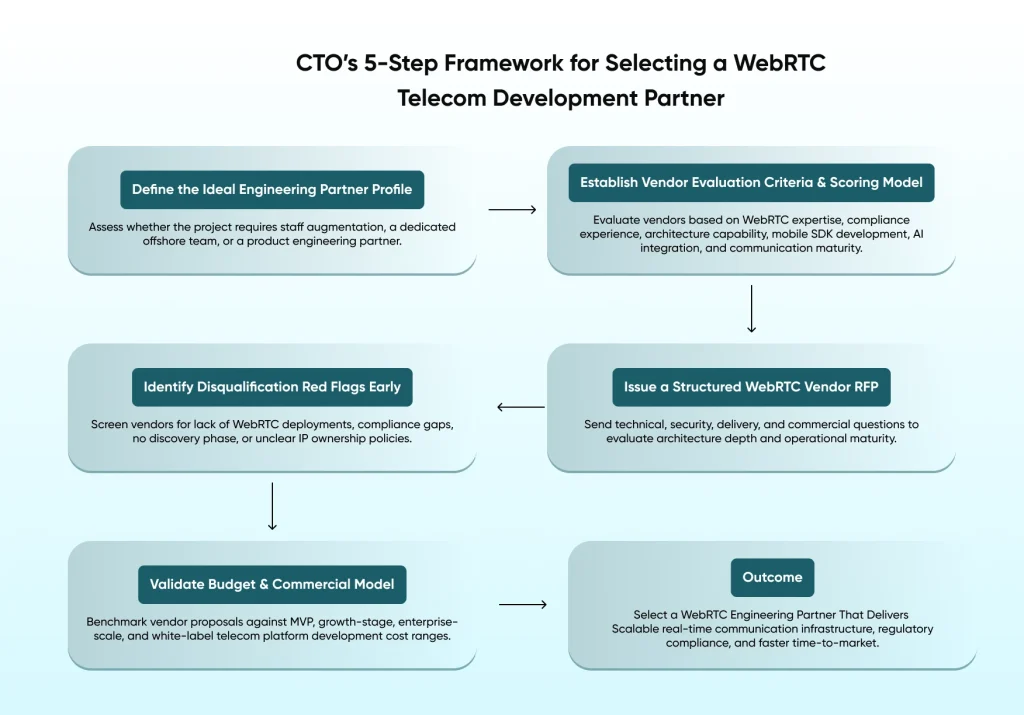
Step 1: Define Your Partner Profile Before You Evaluate Anyone
Before issuing an RFP or taking vendor calls, define what kind of partner you actually need. Looking to hire dedicated WebRTC engineers? Check out these three partner types that serve distinct needs:
| Partner Type | Best Fit | Trade-off |
| Staff Augmentation | You have a core team and need WebRTC specialists to fill gaps | Coordination overhead; you own the architecture |
| Dedicated Offshore Team | You need a full-stack team that owns a defined scope end-to-end | Requires strong async communication discipline |
| Product Engineering Partner | You need strategy, architecture, and delivery under one engagement | Higher day rate; longer onboarding |
When enterprise CTOs are creating the first WebRTC platform, the involvement of the relevant remote development team, with their senior architect on board, is welcome. CMARIX has already done this for all domains in medicine (telehealth), technology (SaaS), and finance.
Step 2: Vendor Evaluation Criteria and Scoring Rubric
Assign scores for the shortlisted vendor on the following six parameters. These parameters should be given appropriate weightage based on the platform’s priority. The rubric below shows the use of the 1-5 scale for the criteria.
| Evaluation Criterion | Weight | Score (1–5) | Weighted Score | Notes (From Evaluation Framework) |
| WebRTC-specific portfolio depth (SFU, signaling, TURN) | 20% | 4.5 | 0.90 | Ask for 2 to 3 live platform references |
| Compliance and security experience (HIPAA, GDPR, SOC2) | 20% | 4.0 | 0.80 | Request compliance case study or audit evidence |
| Architecture design capability (not just implementation) | 15% | 4.5 | 0.675 | Evaluate via technical discovery call |
| Mobile SDK experience (iOS and Android WebRTC) | 15% | 4.0 | 0.60 | Ask for App Store or Play Store live examples |
| AI and real-time processing integration experience | 15% | 4.5 | 0.675 | Transcription, PLC, sentiment analysis deployments |
| Communication quality and async workflow maturity | 15% | 4.0 | 0.60 | Trial sprint or paid discovery engagement recommended |
Scoring tip: A vendor scoring below 3 in compliance experience should be disqualified from any regulated industry deployment, regardless of the overall weighted score.
Step 3: RFP Framework for Selecting the Right WebRTC Vendor: Questions to Ask in 2026
You should issue a written RFP to all qualified vendors. The replies demonstrate both depth of technology and communication skills. The questions are grouped into four categories.
Category A: Technical Architecture
When evaluating a WebRTC development partner, the technical architecture discussion should focus on real-world scalability, interoperability, and media performance.
- What architecture would you recommend for supporting 50,000 concurrent sessions using an SFU-based infrastructure? Please describe the cluster topology, node sizing, and scaling strategy.
- What would be your design considerations for interoperability between WebRTC and SIP in a hybrid enterprise environment with Cisco UCM?
- Which codec profile would you recommend for a telehealth application used by patients with 4G and 5G connectivity in a mobile environment?
- What would be your design considerations for the infrastructure supporting STUN and TURN in a global environment?
Category B: Security and Compliance
- Can you share examples of WebRTC platforms that have been previously deployed?
- How do you implement SFrame-based end-to-end encryption in a WebRTC platform?
- What type of Key Management System (KMS) architecture do you typically recommend?
Category C: Delivery and Quality
- What type of automated testing frameworks do you utilize for WebRTC-based QA?
- How do you simulate network impairments in CI/CD pipelines?
- How do you handle Post-Launch Observability? What metrics do you instrument by default?
- How do you currently tackle observability after a release? What metrics do you instrument by default? What metrics do you recommend?
Category D: Commercial and Contractual
- Who owns all IP for code, architecture diagrams, and documentation created during the engagement?
- What are your SLA commitments for bug resolution severity levels (P0, P1, P2) during and after delivery?
- How do you handle changes to scope? Describe your process for handling a change request with an example.
- Do you offer a discovery or architecture sprint prior to committing to full delivery? What is created during that process?
Step 4: Red Flags to Disqualify Early
Not all criteria require a scoring rubric. The following criteria should raise a red flag and disqualify a vendor or require extreme caution:
- No live WebRTC platform references: When a vendor cannot provide two or more live references for their WebRTC implementation, they have not been vetted at the level of architecture that matters most.
- Generic portfolio without RTC experience: WebRTC is a highly specialized engineering discipline that requires expertise in media processing and optimization.
- Vague questions about compliance: When a vendor is unclear about HIPAA, GDPR, and SOC 2 in a regulated industry scenario, that is a red flag.
- No discovery phase offered: Vendors that skip a discovery phase and go straight to a fixed-price proposal are either underestimating the project’s complexity or padding their proposal to cover their own uncertainty.
- IP ownership ambiguity: When a standard contract leaves any ownership of IP for deliverables in the hands of a vendor, that issue needs to be clarified before a contract is signed. Client ownership of all IP is a requirement for a contract.
Step 5: Budget Reference Model
Use the following ranges to anchor internal budget conversations and evaluate vendor proposals for reasonableness. These reflect 2026 market rates.
| Platform Tier | Features | Timeline | Indicative Cost |
| MVP | 1:1 and group video, basic signaling, browser-only | 8 to 12 weeks | $40,000 to $80,000 |
| Growth Platform | SFU cluster, TURN infra, mobile SDKs, basic AI | 16 to 24 weeks | $120,000 to $250,000 |
| Enterprise Scale | 100k+ users, E2EE, compliance, AI agents, SIP gateway | 6 to 12 months | $300,000 to $800,000+ |
| White-Label Telecom App Development | Multi-tenant, custom branding, CPaaS-competitive features | 9 to 18 months | $500,000 to $1,500,000+ |
Additionally, infrastructure costs contribute 15 to 25 percent to every build cost. The self-build of the SFU cluster requires 500,000 minutes every month. However, the cost of self-build is between $3,000 and $5,000. This is in contrast to the CPaaS solution, which is between $7,500 and $10,000. The payback period for the custom build is between 18 and 24 months.
CMARIX’s outsourcing model for offshore engineering teams provides access to senior WebRTC engineers at 40-60% of North American market rates. Every engagement begins with a paid architecture sprint to deliver a system design document, a compliance-readiness assessment, and a delivery roadmap before writing a single line of production code.
In the context of white-label SaaS solutions, CMARIX offers scalable audio platform development across domains such as telehealth, legal, and financial services. It is possible to implement rapid MVPs if proper architecture and partners are chosen.
In terms of white-label SaaS solutions, CMARIX provides scalable audio platform development in various verticals such as telehealth, legal, and financial services. Rapid MVP implementation is possible when proper architecture and partner selection are made.
Post-Launch Excellence: Monitoring and Observability
WebRTC provides rich telemetry via the RTCStatsReport API, a structured data interface that provides dozens of metrics for each active peer connection. Four metrics are of primary importance to enterprise SLA management:
| Metric | What It Measures | Recommended Target | Quality Impact |
| Round-Trip Time (RTT) | Time taken for a packet to travel from sender to receiver and back | Below 150 ms for domestic calls; below 250 ms for international calls | When RTT exceeds 300 ms, noticeable delays appear and conversations begin to feel unnatural |
| Jitter | Variation in packet arrival timing during transmission | Below 30 ms | Above 50 ms, audio distortion and artifacts may occur even with jitter buffer compensation |
| Packet Loss | Percentage of RTP packets that fail to reach the destination | Below 1% | If packet loss rises above 5% (without FEC), voice quality deteriorates significantly |
| Mean Opinion Score (MOS) | Estimated score of perceived audio quality on a 1–5 scale, based on the ITU-T G.107 E-Model | Above 4.0 for enterprise-grade voice communication | Lower MOS scores indicate degraded clarity and overall call experience |
Implement a client-side stats collector that samples RTCStatsReport every 2 seconds. Ship the data to Prometheus, Grafana, or DataDog. Alert on MOS below 3.5, RTT above 200ms, or packet loss above 2% for more than 30 seconds.
Automated Testing Frameworks for Real-Time Communication Software
The difficulty in testing WebRTC platforms is that their interesting failure modes are emergent. They occur under specific network conditions, participant counts, or combinations of browsers and operating systems. Conventional unit and integration tests cover only a small percentage of possible failure modes.
To build a proper WebRTC testing strategy, a few key types of tests are required:
- Load testing: The application can be tested by simulating simultaneous user joins using testRTC or Nightwatch.
- Network condition testing: The application can be tested under poor network conditions, such as packet loss, delay, and jitter. The application can be tested using the tc command in Linux, which simulates network conditions.
- Cross-browser testing: Ensure the WebRTC application works correctly across Chrome, Safari, Firefox, and Edge. Platforms like BrowserStack or Sauce Labs can be used for this.
- Mobile SDK testing: Run mobile app testing on actual devices across both Wi-Fi and cellular networks.
Why CTOs Choose CMARIX for WebRTC Platform Builds
The first week of selecting your WebRTC partner should have a long-term impact on your codebase, given that WebRTC will serve as an integral part of your application for many years.
CMARIX has experience developing production-grade WebRTC solutions for use across industries where failure is not an option, including telehealth solutions designed to support tens of thousands of users concurrently, SOC2-compliant communication platforms for the fintech industry, and AI voice agent communication systems with sub-300 ms latency using enterprise LLMs. These are not prototypes; they are platforms in use today that generate revenue.
Below are the unique aspects of this engagement:
- Plan before coding: Every project starts with an architecture phase. This includes designing the system, verifying compliance with legal and regulatory requirements, and creating a clear development roadmap before writing any production code.
- We offer free resources to help you build the entire WebRTC stack. Apart from providing free tools/resources such as SFU Global Infrastructure, E2E Encryption SDKs for both iOS and Android, WebRTC-SIP integration tools, AI-enabled media processing tools, etc., we are also providing access to these resources in other ways.
- Clear and transparent pricing: Senior WebRTC engineers work at roughly 40–60% of typical North American rates, while clients retain full ownership of the intellectual property created during the project.
Your Next Step: From Architecture to Execution
WebRTC is not a feature. It is a foundational infrastructure decision. It will shape your platform’s scalability, security, user experience, and competitive positioning for the next 5 to 10 years.
The technology is mature. The open-source ecosystem is production-ready. The market window, as evidenced by the 45.7% CAGR trajectory, is open and expanding.
The differentiating factor between enterprises that capture this opportunity and those that do not is execution quality. That means the right architecture, the right security posture, and the right engineering partner.
CMARIX has delivered enterprise WebRTC platforms to clients across the telehealth, financial services, legal, and SaaS verticals. All custom real-time communication solutions begin with a paid architecture sprint before production code is written. If you are evaluating your WebRTC strategy or beginning a platform build, our engineering team is available for a technical assessment and architecture review.
FAQs for WebRTC Telecom Platform Development
What is the best architecture for a scalable WebRTC telecom platform?
For scalable WebRTC platforms, the SFU (Selective Forwarding Unit) architecture is widely preferred. It forwards media streams to participants without mixing them server-side, allowing efficient bandwidth usage, better performance, and horizontal scaling for large multi-participant calls.
How much does it cost to develop a custom WebRTC solution?
The cost varies based on feature, infrastructure, and scalability requirements. The basic WebRTC application can start at $30,000 to $50,000, while high-end enterprise-grade telecom solutions can cost more than $100,000.
Do I need a media server for a WebRTC application?
A media server is not required for simple peer-to-peer calls. However, for group calls, recording, streaming, or large-scale deployments, media servers such as SFU or MCU are essential for efficiently managing media routing.
Is WebRTC secure for enterprise telecom use?
WebRTC includes built-in encryption using DTLS and SRTP protocols, ensuring secure media and data transmission. When combined with proper authentication, access controls, and infrastructure security practices, it meets enterprise-grade communication security requirements.
Can WebRTC integrate with legacy VoIP/SIP systems?
WebRTC can be used in conjunction with existing VoIP and SIP infrastructures via gateways or SIP servers. The gateway or SIP server is responsible for translating the protocols and formats used in WebRTC, enabling the use of traditional telephony infrastructure in a browser-based communication solution.
How does WebRTC handle poor internet connections?
WebRTC uses adaptive bitrate control, congestion management, and packet loss recovery techniques to maintain call quality. It dynamically adjusts video resolution and bitrate based on network conditions to keep audio and video communication stable.