

At-a-glance View: AI and machine learning in ecommerce are transforming digital retail by allowing real-time personalization, predictive inventory, adaptive pricing and fraud prevention. Ecommerce platforms continuously learn from user behavior, customer experience and improve recommendations. From small shops to global marketplaces, artificial intelligence helps businesses respond faster, optimize operations and boost sales effectively.
Ecommerce used to be simple. List products, run ads, process orders, repeat. That setup doesn’t hold anymore. Customers expect stores to “get” them: what they want, when they want it, and how they like to shop. This is where AI and machine learning in ecommerce quietly changed the rules.
You might notice it when Amazon shows something oddly relevant or when prices shift without warning. Sometimes it’s a chatbot that actually answers your question. Other times it’s fraud being blocked before you even know it happened. None of that is accidental.
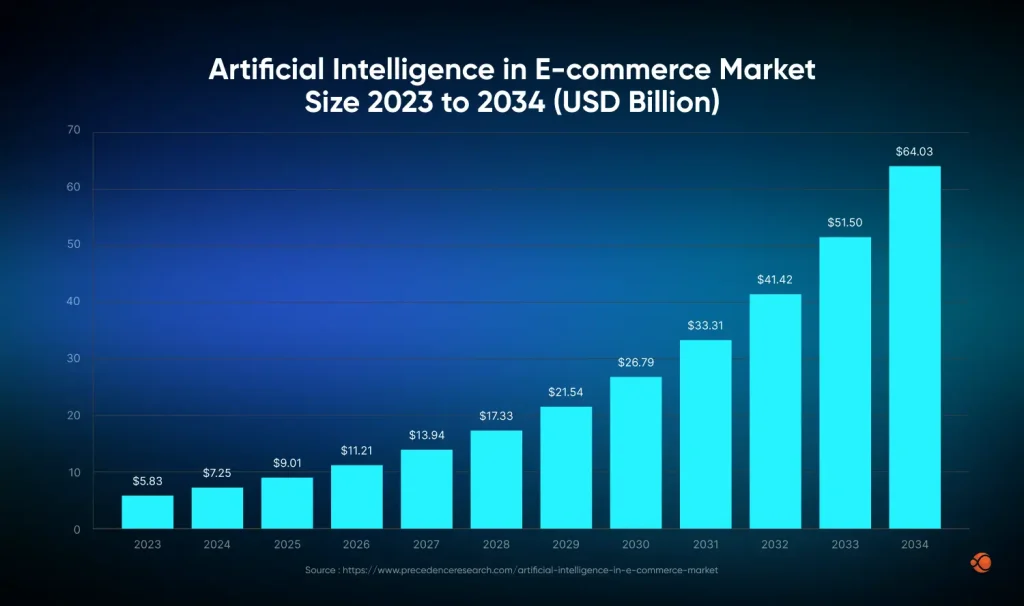
Modern ecommerce software now runs on data-driven decisions. And behind those decisions sit AI models that learn, adjust, and improve as more activity flows through the system. The global market size of artificial intelligence in ecommerce is estimated at USD 7.25 billion in 2024, and it is forecasted to reach around USD 64.03 billion by 2034, expanding at a CAGR of 24.34% from 2024 to 2034.
This guide breaks down how that works, where it’s applied, and why it matters if you’re building or running an ecommerce platform today.
Why AI and Machine Learning Matter in Ecommerce
Online retail runs at a speed humans can’t match alone. Thousands of clicks, searches, abandoned carts, returns, and payments happen every minute. Trying to manage that with static rules or manual logic just doesn’t scale.
AI ecommerce software in businesses helps spot patterns humans miss. Machine learning systems look at user behavior, sales data, inventory movement, and pricing signals, then respond in near real time. In many cases, they’re adjusting things before a human team even notices a problem.
That’s why AI in retail isn’t about “cool features.” It’s about staying competitive in crowded markets where customer patience is thin and alternatives are one click away.
Understanding AI and Machine Learning in Ecommerce Software
At a practical level, artificial intelligence in ecommerce software refers to systems that can make decisions or predictions based on data rather than fixed instructions. By learning from the outcomes, ML models improve.
When people talk about ML(Machine Learning) for ecommerce, they usually mean models trained on customer behavior, product performance, or operational data. These systems don’t just answer questions. They recommend actions that influence how products are built, sold, and supported across modern eCommerce software development projects.
For example:
- Forecasting which product a user is most likely to buy next
- Flagging suspicious transactions
- Forecasting demand before stock runs low
This approach replaces rigid automation with adaptive decision-making which is driven by real usage patterns.
How AI-driven Ecommerce Software Differs from Traditional Platforms
AI-powered ecommerce software changes the way platforms respond to shoppers. Decisions no longer rely on static configurations set months earlier. Instead, systems react based on current signals, trends, and outcomes.
This shift becomes clearer when teams move toward platforms built through machine learning app development services, where learning models adjust recommendations, search results, pricing logic, and risk checks continuously rather than waiting for manual updates.
| Aspect | Traditional Ecommerce Platforms | AI-Driven Ecommerce Software |
| Decision logic | Runs on fixed rules set by teams | Adjusts decisions based on live data |
| Product recommendations | Same suggestions for most users | Personalized for each shopper |
| Search experience | Keyword-based and literal | Understands intent, context, and typos |
| Pricing strategy | Manually set or scheduled | Changes based on demand, stock, and behavior |
| Customer experience | Mostly uniform for all users | Different for every visitor |
| Inventory planning | Based on past reports | Predicts demand before it happens |
| Fraud detection | Rule-based checks | Learns new fraud patterns over time |
| Marketing targeting | Broad customer segments | Behavior-driven micro-segments |
| Adaptability | Needs manual updates | Improves automatically with usage |
| Scalability | Struggles as data grows | Designed to handle large data volumes |
We create intelligent apps with robust AI integration, transparent costs, and scalable architecture to drive innovation for your business.
Contact UsImplementation of AI and ML in Ecommerce Software
Adding artificial intelligence to an ecommerce platform isn’t a single feature release. It is a gradual process that affects data flow, infrastructure, and daily operations. Teams generally start with one use case, prove its value, and expand from there.
Data Collection and Preparation
Everything depends on the quality of data. Ecommerce platforms already generate huge volumes of searches, clicks, cart events, transactions, returns and support interactions.
The challenge isn’t volume, it’s consistency. Data often lives across storefronts, payment systems, CRMs and marketing tools. Before models are trained this data needs cleanups and alignment so predictions reflect real behavior instead of noise. Feature engineering also happens here, turning raw activity into usable signals like repeat visit frequency or price sensitivity.
Model Selection and Training
Different problems need different approaches. Fraud detection systems, recommendation engines and demand forecasting tools each depend on distinct model types. This phase often determines whether teams should hire AI developers with ecommerce experience, since model selection and retraining schedules directly affect accuracy as customer behavior shifts over time. Training continues after launch, models must keep training as products, seasons and interfaces change.
Integration with Existing Ecommerce Systems
AI rarely replaces core ecommerce platforms. Most setups depend on APIs that connect AI services with search systems, catalogs, checkout flows and analytics tools. This is also how AI agents for online shopping operate, assisting with support, discovery and decision-making without disrupting existing workflows. Real-time features require fast responses, while segmentation and forecasting usually run in batch mode.
Monitoring, Testing, and Continuous Improvement
Once AI features are live, monitoring becomes routine. Teams track prediction accuracy, latency and its impact on metrics like conversion rate and fraud reduction. This is where mature AI software development services matter most, ensuring models stay reliable as traffic grows and data patterns change.
ML and AI ecommerce Examples and Use Cases
- Amazon uses ML to power recommendations that respond to live browsing behavior rather than relying only on past purchases. Fashion brands use similar logic to suggest full outfits instead of individual products, increasing order value. Many of these experiences now combine personalization with generative AI in eCommerce, adjusting visuals, descriptions and suggestions based on shopper context.
- Walmart applies machine learning to demand forecasting, restock faster, and reduce waste across locations.
- Payment platforms like PayPal and Stripe depend on adaptive fraud detection that evaluates transaction context rather than static rules.
These highlight the core benefit of AI in ecommerce for platforms worldwide.
Future Trends in AI and ML for Ecommerce
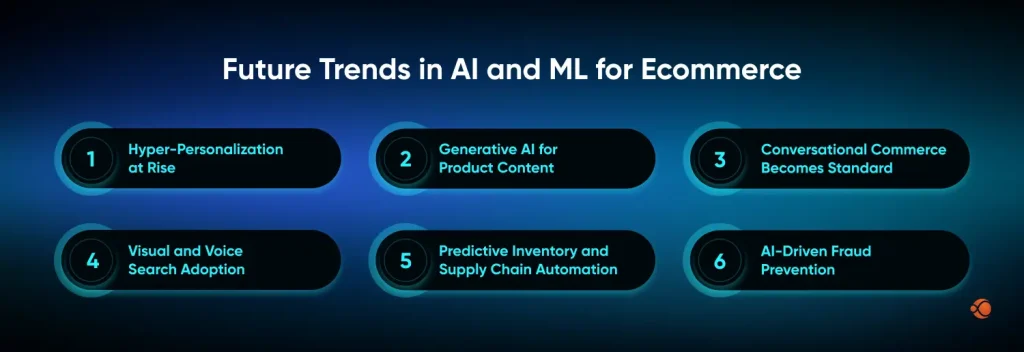
From small shops to global marketplaces, AI helps businesses respond faster, optimize operations, and boost sales effectively. The future of AI in ecommerce software is quieter, deeper and built straight into how platforms operate day by day. These trends aren’t just ideas for the future; they’re already taking shape in real products.
1. Hyper-Personalization at Rise
The benefits of AI and machine learning for ecommerce platform will increase hyperpersonalization. Predictive inventory systems, conversational shopping and visual search are improving quickly. Many of these rely on generative AI solutions that adapt content, responses and guidance dynamically across channels.
2. Generative AI for Product Content
Feature highlights, product descriptions and FAQs won’t be written once and reused forever. Generative systems will create content that adapts to different channels, audiences and regions. This helps teams keep catalogs fresh without constant manual updates.
3. Conversational Commerce Becomes Standard
Chat and voice interfaces will stop being support-only tools. Shoppers will browse, compare and complete purchases inside conversations. These systems will understand intent, remember context and guide users instead of pushing them through menus.
4. Visual and Voice Search Adoption
Typing won’t always be the main way people search. Users will upload photos or speak naturally to find what they want. AI models will connect those inputs to products more accurately, even when queries are incomplete or vague.
5. Predictive Inventory and Supply Chain Automation
Inventory systems will respond before problems show up. Models will predict demand shifts early and trigger restocking or redistribution automatically. This reduces storage costs, minimizes stockouts and keeps fulfillment running smoothly.
6. AI-Driven Fraud Prevention
Fraud detection will continue to move toward real-time prevention instead of post-transaction review. The system will assess risk based on transaction history, behavior patterns and device signals. As fraud tactics change, models will adjust without waiting for new rules.
Why Choose CMARIX for AI and Machine Learning in Ecommerce Software
When artificial intelligence becomes part of your ecommerce system, you need a partner who understands both technology and commerce. CMARIX focuses on making AI work where it matters.
- Ecommerce-focused AI expertise: CMARIX builds AI solutions around real ecommerce workflows like product discovery, checkout, inventory, and customer engagement.
- Reliable data and model foundations: Strong data pipelines and well-trained models make sure consistent performance as traffic and customer behavior change.
- Seamless system integration: AI features are integrated into existing ecommerce platforms without disrupting core operations or user experience.
- Scalable, production-ready solutions: Architectures are designed to handle growth, huge traffic and expanding product catalogs without rework.
Conclusion
Ecommerce today moves very fast for guesswork. Customer behavior changes mid-session, prices shift hourly and supply chains rarely stay predictable for long. Software that can’t act on changes in real time quickly falls behind.
That’s where AI and machine learning in ecommerce make a real difference. They help platforms notice patterns early, adjust without manual intervention and respond while opportunities are still open. What used to take weeks of analysis now happens in seconds.
The real advantage isn’t speed alone, it’s learning. Platforms that use AI well sharper with every search, every purchase and every interaction. Over the time, that quiet improvement adds up and it’s often the difference between stores that keep up and those that lead.
FAQs on AI and ML for Retail Ecommerce
How is AI used in eCommerce?
AI supports key areas like pricing decisions, product recommendations, inventory planning and fraud detection. Also, it powers customer support tools that respond faster and improve with every interaction.
What is the role of AI in modern ecommerce software development?
AI allows ecommerce software to react in real time instead of depending on fixed rules. It helps platforms personalize user journeys, analyze behavior continuously and adjust as data changes.
How AI and machine learning improve ecommerce platforms?
They make platforms more relevant and reliable by reducing manual errors and improving decision accuracy. Over the period, systems become better at predicting outcomes and responding to customer needs.
Can AI and machine learning boost eCommerce sales and conversion rates?
Yes, they often lead to higher conversions and increase in sales by showing the right products, adjusting prices or offers based on user behavior and improving search results.
What technologies (NLP, deep learning) are used in eCommerce AI?
Natural language processing helps systems understand search queries and power chatbots. Deep learning is used for recommendations, image recognition, fraud detection and pattern analysis at scale.
Is AI cost-effective for small or medium ecommerce businesses?
Yes, in many cases, cloud-based AI tools and targeted use cases allow smaller businesses to begin without major upfront investment and scale usage as results improve.